Jo-Ann Fabrics closed its last store in the spring of 2025, ending an 81-year run. At its peak, the company operated roughly 850 locations, employed nearly 19,000 people, and controlled about a third of the American sewing and fabric retail market. The end came quietly—not through fire or scandal, but through a slow accumulation of demographic change, economic pressure, and financial decisions that left the company with no room to adapt. The story began in 1943, in wartime Cleveland.
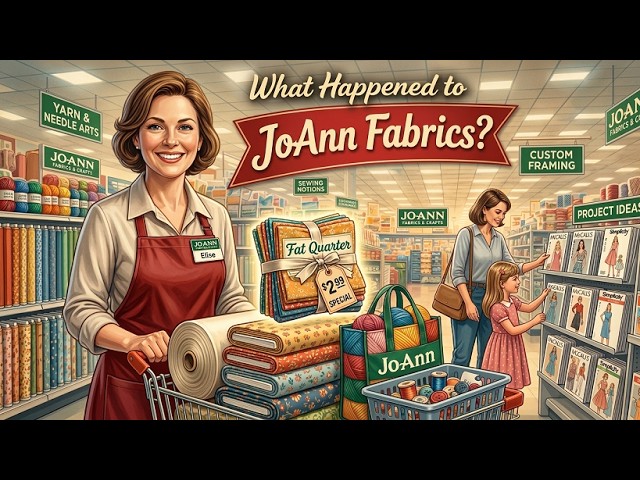
The country was deep in World War II, and rationing had redirected metal, rubber, nylon, and silk toward the war effort. Into that constrained economy, three German immigrant families—the Rohrbachs, the Zimmermans, and the Goldens—pooled their resources and opened a small fabric shop on the city’s East Side. They called it the Cleveland Fabric Shop. It was a plain name for a plain purpose, and in 1943, that purpose was essential.
Making clothing at home was not a hobby in mid-century America. It was an economic necessity. A ready-made dress could cost a woman the equivalent of a full week’s wages, and a man’s suit cost more. So women sewed, as their mothers and grandmothers had before them, typically producing four to six garments per year for their households.
The fabric shop existed to serve that need. After the war, America entered a long period of expansion. Soldiers returned, families formed, and suburbs grew outward from cities like Cleveland at an unprecedented rate. The Cleveland Fabric Shop grew with them.
New locations opened, and the model that worked in one neighborhood was repeated in others. By the mid-1960s, the founders renamed the business, combining the first names of wives from two of the founding families—Joe and Ann—into a single word: Jo-Ann Fabrics. The choice was telling. The company was not named after a founder’s surname but after women, the very customers it served.
Jo-Ann went public in 1969 and had more than 500 stores by 1980. The company moved deliberately toward the superstore format, opening larger locations in strip malls and shopping centers built around the automobile. It was the right business in the right country at the right cultural moment. Its core customers were women of the Silent and Greatest Generations, who had grown up during the Depression and internalized the lesson that things should be made to last.
Sewing was woven into their lives, passed from grandmother to mother to daughter. Home economics classes in public schools reinforced the skill, with a professional association of more than 50,000 members in the 1950s. But the foundation was already cracking. By the mid-1960s, the women who had built the company were aging, and their baby boomer daughters were coming of age with a different relationship to domestic labor.
Many entered the workforce. Many saw the sewing machine as a symbol of constraint rather than necessity. At the same time, globalization began to flood American retail with inexpensive imported clothing. The economic argument for sewing at home, which had always been the industry’s foundation, weakened.
By the early 1990s, the transmission of the skill from one generation to the next had broken down. The competitive landscape shifted dramatically in that decade. Roughly six major fabric chains had operated across the country, including Fabric World, House of Fabrics, and Cloth World. One by one, they collapsed.
House of Fabrics filed for bankruptcy, and Jo-Ann acquired its stores. Cloth World went under, and Jo-Ann absorbed those locations as well. By the late 1990s, Jo-Ann emerged as a near-monopoly, operating close to a thousand stores. The last serious national rival, Mississippi-based Hancock Fabrics, survived until 2016 before it too filed for bankruptcy.
Winning that race looked like strength, but dominance in a shrinking market is not the same as dominance in a growing one. Jo-Ann had won the race, but the track itself was getting shorter. The company responded as intelligently as it could, expanding beyond fabric into yarn, scrapbooking supplies, seasonal decoration, and other crafting materials. By the early 2010s, it operated 840 stores, had a diversified product mix, and its stock traded at an all-time high.
From the outside, it looked like a healthy business. Then the private equity firm arrived. In the early 2010s, Leonard Green and Partners acquired Jo-Ann for approximately $1. 6 billion, a premium of about 34 percent over the stock price.
The acquisition was financed substantially with debt, and that debt was placed on Jo-Ann’s own books. By most measures, the company was soon carrying roughly five times its annual earnings in obligations. Management’s room to invest in stores, staff, and new formats shrank as cash flow went toward servicing the debt. Leonard Green also charged the company annual management fees, consistent with standard private equity arrangements of the period.
The instability was visible in leadership. Between 2011 and 2023, nine different chief executives cycled through the company. Store conditions deteriorated, inventory management became inconsistent, and experienced employees—the staff who could advise on fabric weights and pattern adjustments—were replaced with lower-cost labor. By 2019, Jo-Ann had lost $546 million and carried approximately $900 million in outstanding debt.
Then the pandemic arrived. In March 2020, much of the country shut down. Jo-Ann stores, classified as essential retailers in many jurisdictions, remained open through parts of the shutdown. Commercial mask supplies were insufficient, and people began sewing their own masks from fabric.
Stuck at home with time on their hands, many younger people who had never sewed turned to crafting. For the first nine months of 2020, Jo-Ann’s revenue reached $1. 9 billion, a 25 percent increase over the prior year. After losing $188 million in the previous fiscal year, the company reported a net profit of $174 million.
Leonard Green saw the moment. In March 2021, they took Jo-Ann public again at $12 a share, retaining a majority stake while beginning to convert their investment into cash. But the pandemic enthusiasm for home crafting was situational. When restrictions lifted and offices reopened, many of the new customers returned to their old routines.
The younger customers who did stick around expected a different retail experience—instant price comparison, fast fulfillment, reviews, tutorials, and a social experience that a traditional fabric store was not designed to provide. Jo-Ann, burdened with debt and cycling through leadership, could not transform itself quickly enough. There were practical problems beyond the format. Cutting fabric, the fundamental service Jo-Ann had always provided, is labor-intensive and difficult to automate.
Waiting 30 or 45 minutes for two yards of fabric was acceptable in 1975 but not in an era when most retail transactions happen in seconds on a phone. Even Amazon, with its enormous capital and operational sophistication, had purchased an online fabric retailer in 2008 and shut it down a decade later, concluding that the economics of fabric retail in a digital environment did not work. In fiscal year 2023, Jo-Ann reported revenues of approximately $2. 3 billion, down nearly 9 percent from the prior year, and lost $200 million.
The chief executive resigned in May of that year, replaced by two interim executives. By October 2023, the stock had fallen below $1 per share, and the Nasdaq warned that the company was at risk of being delisted. The market valued the entire company at approximately $8 million—roughly what a single well-located commercial property might cost. The comparison with Hobby Lobby is instructive.
Founded in Oklahoma in 1972, privately held, closed on Sundays, and deliberately expanded, Hobby Lobby carried fabric and craft supplies with a clean balance sheet. It was never burdened by a leveraged acquisition or required to direct cash flow toward interest payments. It could invest in its stores, maintain its inventory, and keep its employees trained. As Jo-Ann’s operations visibly deteriorated, Hobby Lobby kept functioning as a competent retailer in the same category.
Retail businesses in declining categories can sometimes survive for long periods if they operate without excessive financial burden. What they cannot do is carry large debt loads in a shrinking market. The revenue base contracts while the interest payments remain fixed, and the gap eventually becomes unbridgeable. In March 2024, Jo-Ann filed for Chapter 11 bankruptcy protection with approximately $2.
4 billion in debt listed on its balance sheet. The court-approved plan shed roughly $500 million of that obligation, forfeited the private equity firm’s remaining equity stake, and allowed the company to emerge in April 2024 as a leaner business. Stores remained open, and employees kept their jobs. But the underlying conditions had not changed.
The generation of women who had learned to sew in the 1940s and 1950s was gone or nearly so. Fewer than a quarter of American high schools offered anything resembling home economics by the early 2020s. And the competition for leisure time had changed in kind, with digital entertainment and social media drawing attention away from activities that require sustained, embodied concentration. In January 2025, Jo-Ann filed for bankruptcy again, less than 12 months after the first filing.
The following month, the company announced it would liquidate. There would be no restructuring and no buyer willing to take on the stores as going concerns. By the end of May 2025, the last Jo-Ann Fabric store had closed. Nineteen thousand people lost their jobs.
The company’s website, brand, and customer data were acquired by Michael’s, another arts and crafts retailer. Searches for fabric on Michael’s platform increased substantially in the weeks after the acquisition, by some reports as much as 77 percent. The demand for fabric had not disappeared. It had simply relocated.
Hobby Lobby, having quietly expanded through Jo-Ann’s decline, now occupies a dominant position in physical fabric retail. People still sew, quilting guilds still meet, and costume designers and home sewists still need fabric, but the market is a fraction of what it was at Jo-Ann’s peak. The strip malls and long commercial structures that Jo-Ann helped populate are being repurposed for medical offices, fitness studios, and discount grocers. Some of the early stores from the 1940s and 1950s, built for walking-distance customers in urban neighborhoods, are still standing.
Jo-Ann Fabrics lasted 81 years. For most of that time, it served its customers well, employed people decently, and held a legitimate place in American commercial life. What ended it was not a single decision or mistake but the accumulation of demographic, economic, and cultural forces, combined with a financial structure that removed the flexibility that might have made adaptation possible. The economy that had supported the neighborhood fabric shop—one in which households produced as well as consumed, and the skills to make clothing were widely distributed—is gone.
The forces that ended it are not likely to be reversed. What remains are the buildings, the record of what was built and what was made, and the people who still sew, who still teach, and who still walk into a fabric store or place an online order to buy something to make.
