Babe Paley telephoned Slim Hayward in the first convulsive week after the magazine hit the stands, and her voice had lost its famous cool. Had she read Truman’s piece? Slim had barely turned the first pages when she heard her own voice coming out of a character’s mouth, the cadences, the wit, the wounds. “I feel absolutely as though I’ve been hit,” Slim told her.
“All the breath is out of me. ” Then Babe asked the only question that mattered to her: who was the businessman in the story sleeping with the governor’s wife? Slim knew the answer before the question was finished. It was Bill.
But Babe was sick, and Slim could not bear to hurt her friend. “No idea in the world who it is,” Slim said. “It could be anyone. ”
The November issue of Esquire had reached the newsstands of Manhattan in the third week of October 1975.
The story inside was called “La Côte Basque, 1965,” and it was set over a single lunch in the swans’ own temple of taste, the real restaurant named on the page. The narrator’s attention drifted from table to table, gathering up the secrets of everyone seated in the room, and holding court at the best banquette, swilling Cristal and unspooling scandal, sat a character named Lady Ina Coolbirth, brassy, western-born, lately discarded by a dear English lord. Every syllable of her was Slim. There were stories the real Slim would never have spoken above a whisper, and there was the story of a man called Sydney Dillon, a self-made media tycoon, a Jewish outsider hungry for the last room still closed to him, married to the most exquisite woman in New York.
Lady Ina told it over the champagne. How Dillon, years before, with his wife out of town, had finally gotten the governor’s wife into the marital bed of his Park Avenue apartment on the night of a great dinner. He wanted not her body, but, in Truman’s own words, revenge on that smug Wasp establishment that had barred him from its clubs and its sons from its schools. She insisted on the lights off.
It went badly, and she was dressed and leaving when he turned the lights on and looked down at a bed so bloodied it might have been a crime scene. She had been having her period and had not said a word. Dillon decided she had done it deliberately to get even. Then there was no time for grievance because the sheets had to be clean before his wife came home.
The tycoon scrubbed until eight in the morning and fell asleep on the soggy linen. Every reader who mattered decoded the story before the soup arrived. The governor was Averell Harriman. The hostess was his wife Marie.
The exquisite woman in whose bed it happened, the woman for whose sake a mogul scrubbed sheets until dawn, was Babe. Her husband’s appetite, her marriage’s transactional heart, her own humiliation, eleven thousand words, on sale at any newsstand in America, written by the person she had trusted above every living soul. None of it had to happen. Ten years earlier, Truman Capote stood at the summit of American letters, a small southern writer who had turned the murder of a Kansas farm family into a new kind of book and attended the execution of the man he had befriended on death row.
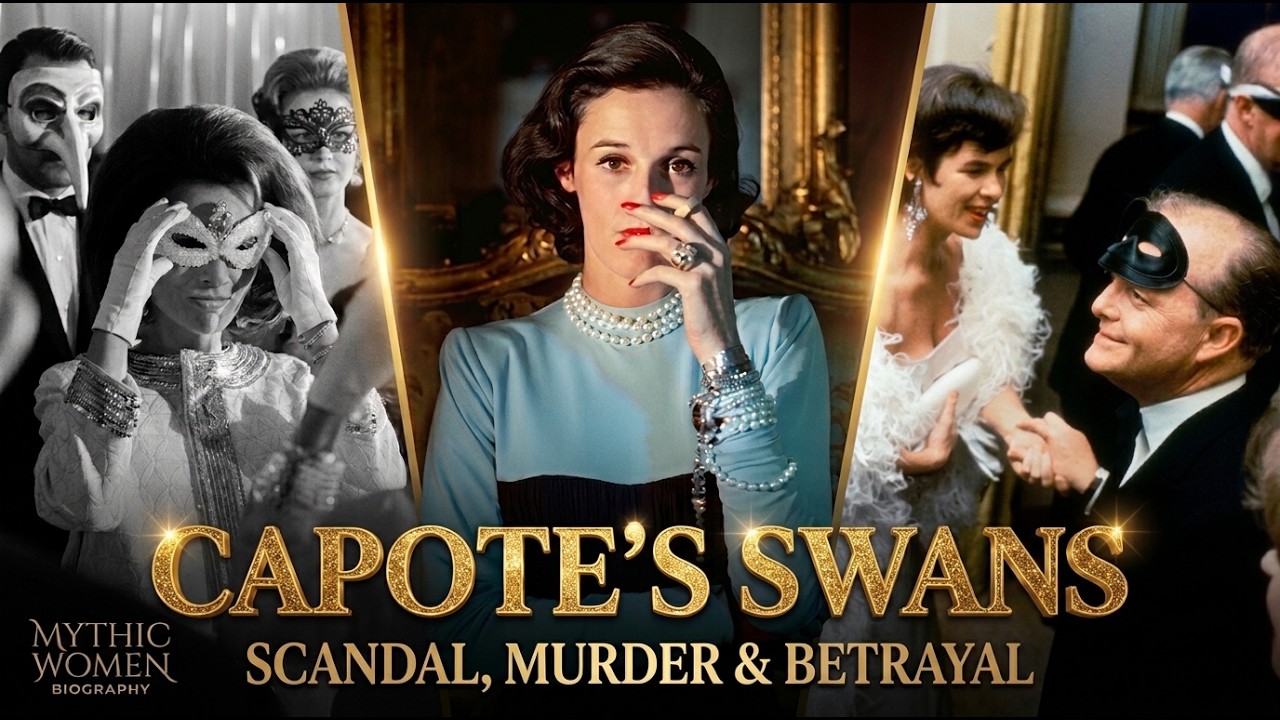
And at the Plaza Hotel he threw what the papers would call the party of the century. Five hundred and forty of the most famous people on earth, in black and white, every face masked until midnight. Scattered through the ballroom were the women he called his swans: Babe Paley, the most elegant woman of her age; Lee Radziwill, a princess by marriage and always in Jackie’s shadow; Pamela Churchill, the mistress of wartime London; Slim Keith, the California beauty; Mela Agnelli, the Neapolitan princess; Gloria Guinness, once suspected of spying for the Reich; C. Z.
Guest. Every secret these women possessed rested that night with the little man at the center of the party, the best listener New York had ever produced. Nine years later he published what he had heard, and a woman would end her own life. It began with the greatest of the swans in a doctor’s house in Boston.
Barbara Cushing was born on the 5th of July, 1915, and nobody in the family ever called her Barbara. From the cradle she was Babe, the fifth child, the last, the one her mother would finish. Her father was Harvey Cushing, the most famous surgeon alive, the first man on earth who could open a living skull and send the patient home to thank him. Fame of that kind is built in hospitals; it came home seldom and came home tired, so the yellow colonial house in Brookline became Kate Cushing’s theater, where nothing was ever merely itself.
Her daughters were the work of her life, and the training never paused. Three small girls learned to absorb the ambush of unannounced guests, smiling, stretching a dinner for four into a dinner for seven, sending the visitor home convinced he had been expected for a month. No suitors past ten, no tobacco, no drink. Beneath the rules ran the deeper curriculum, delivered daily in Kate’s unhurried voice: that her girls were wonderful, until each of the three stepped out of that house so certain of her own radiance that the certainty itself became a kind of beauty and the world simply agreed.
Babe was eight when she wrote to the father who was never home: “Dear Papa, stay at home with me and don’t go earning money. We’ll just do something funny. I’ll give you my pennies and I’ll give you my shiny buckle. I’ll arrange all for you.
” Papa did not stay home, and the promise outlived the pennies, for arranging all of it beautifully and without complaint for large, distant, world-conquering men was to become the whole shape of Babe’s life. On a June morning in 1926, word reached the hospital that Harvey’s eldest son, William, the Yale boy, the carrier of the name, had been killed in a car crash. The great surgeon absorbed the news at the operating table and finished his operation before he telephoned his wife. That same year brought Harvey the Pulitzer Prize, honors arriving in the very season the heir departed, and the house learned how quietly its master grieved.
Kate poured her own grief into the daughters who remained. No longer merely her occupation, they were the whole visible future of the family. Their mother, “Gogsy,” had ambitions for them that were exact, and they glittered. Coronets if possible, European nobles with castles and standing acres, and failing that, the richest men America could produce.
Love appeared nowhere on the list. Betsy moved first, marrying James Roosevelt in 1930. When his father won the White House two years later, a good match turned golden overnight. At seventeen, Babe walked into the inaugural ball of 1933 on the arm of the president’s own namesake, the youngest person in that enormous room and the most sophisticated.
New Year’s Eve found her back in Washington for a small family party beside the president of the United States. Weeks later, on the road home from a Long Island party, the car she was riding in left the road. Rescuers pulled her broken from the wreckage, her face torn open, her teeth gone. Plastic surgery stood in its infancy, but her father was Harvey Cushing, and under his eye the surgeons gave her back her beauty.
Finer, some swore, than before. But her teeth no surgeon could restore. From that year until the last morning of her life, the first thing Babe did on waking, before coffee, before daylight, before any man’s eyes were on her, was put in her teeth, an old woman’s ritual performed in secret by a girl of nineteen. For the next four decades the world would marvel that Babe was never once caught imperfect.
The world never saw the mornings. New York followed, a job at Vogue, where the well-dressed young women sashaying between offices made the newcomer the most stunning in the building. Designers pressed their clothes on her at a discount; before the camera she began timid, then learned it, mastered it, and made it hers. When a girl’s stock stands at its height and every season afterward begins quietly to mark it down, and Gogsy had built her for an altar, and the altar was waiting.
The curriculum could scarcely have improved on Stanley Grafton Mortimer Jr. His bloodline ran back to John Jay, the first chief justice of the United States; his mother’s father had helped found Standard Oil. He was a Harvard man, startlingly handsome, so handsome that when he and Babe walked down a Manhattan street together, strangers stopped to watch them pass. But the Mortimer fortune had been quietly bleeding for two generations, dissolved at card tables and in ruinous investments by pure inheritors who regarded losing money as no embarrassment at all.
And Stanley suffered from what a later age would call manic depression. Ascending, he was the most delightful man in any room. Descending, he vanished into rooms of his own, sometimes for weeks. Returning to his club after one long absence, he was greeted by a staff member remarking they had not seen him in some time.
“I’ve been depressed,” Stanley answered. “It’s very expensive. I wouldn’t try it if I were you. ”
Babe married him on the 21st of September, 1940, at St.
Luke’s Episcopal in East Hampton, and when she threw her bouquet it was her eldest sister, Minnie, who speared it out of the air over the heads of women fifteen years younger. One week later, Minnie married Vincent Astor. Nobody in that family believed the bouquet had traveled by chance. The morning after Pearl Harbor, Stanley enlisted in the Navy Air Corps, and his pregnant wife boarded the long train south to join him at cadet training in Pensacola, a journey stocked with ironies, because Babe had just been named the second best-dressed woman in the world, behind only the Duchess of Windsor, and she was riding toward a town of Quonset huts, bars, dust, and heat, where the only colors that counted were khaki and navy.
Wartime asked its wives to endure. Babe looked hard at how the other half lived in Pensacola, declined the assignment, and took the train home. A son, Tony, arrived in 1942, a daughter, Amanda, two years on, and Babe handed the rearing of both to hired hands with a smoothness her class considered perfectly ordinary. Evenings belonged to Café Society, where the war felt very far away, ringside tables at El Morocco, a Russian prince squiring her through it all.
When the best-dressed list, suspended in wartime as an indecency, resumed with victory in sight in January 1945, Babe stood at the head of it, and she would remain on that list for the rest of her life. One columnist inquired acidly whether her prize-winning outfits would have served her alongside the Russian women’s snipers who turned the tide at Stalingrad. Babe answered the sneer sweetly, insisting she had won with a Navy wife’s wardrobe, mostly three plain suits and lots of hats. Pressed to estimate the number of hats, she declined.
The man who came home from the Pacific at war’s end was heavier, grayer, and drinking, and the marriage that had never had much foundation now had none. In May of 1946 the divorce was done: a trust fund of forty thousand dollars, custody of two children Stanley barely knew, and Babe Cushing Mortimer, thirty years old, back on the market her mother had built her for. Though in truth she had never quite left it, for the next game had already begun while the last one was still being played. There was a man circling, and he had been circling for some time.
William S. Paley was the son of a Russian Jewish immigrant who had built the largest cigar business in America, and the son had improved spectacularly on the father. Still in his twenties, fresh out of the Wharton School, Bill took over a struggling chain of radio stations and conjured out of it the Columbia Broadcasting System, one of the great media empires of the century. He stood six foot one and radiated a take-charge magnetism women found difficult to survive.
By raw achievement he was as impressive a man as any her sisters had married. And yet there were doors in New York that all his millions could not move. The network chief whose sponsors ran the American living room was a Jew, and the clubs, the resorts, and the better dinner tables of his adopted city were closed to him, politely, absolutely, and as far as anyone could see, permanently. It was the one acquisition Bill Paley had never managed to make.
His first wife had given him everything money could not confer. Dorothy Hart Hearst, a beauty with a cultured eye, became Bill’s private finishing school. She sent the man who dressed like a funeral director to a Savile Row tailor, gutted the bachelor apartment with its sports prints, and taught him that taste was not a purchase but a practice present in every hour of the day. For years Bill sat at her feet like a schoolboy in the front row.
Then came the morning he decided the lessons were complete, and her guidance was reclassified as hectoring. There was something in Bill that would not stop either. His appetite for women ran past vanity into compulsion, and Dorothy understood it with a clinical coldness. This was his illness, she said later, absolutely pathological and never to be cured.
The illness left wreckage. A woman named Geraldine Kenyon Bourke, who had abandoned a factory worker and a baby daughter in Michigan to chase an acting career that never came, went home to Detroit at twenty-eight, took a suite on the seventeenth floor of the Book Cadillac Hotel, and painted a column of men’s names across the mirror in artist’s paint, William S. Paley’s among them, with two words at the bottom: “exit smiling. ” Then she went out the window.
Among her effects the police found a letter to Paley she had never sent. The war was in its way very good to Bill. Colonel Paley of the Office of War Information arrived in London while Edward R. Murrow was making CBS immortal from its rooftops, and the British elite, less fastidious about his origins than New York’s, took him up with enthusiasm.
Wartime London also suited the appetite, which by now had refined a specialty: married women. Among his conquests was a lush young Englishwoman named Pamela Churchill, the wife of the prime minister’s own son. By 1945 the pattern of the man was set: a builder of empires who collected beauty the way he ate, gluttonously, expertly, without ever feeling full, still locked out of the one room he wanted most. What Bill Paley needed was a key.
She was lying just then in a hospital bed on the east side of Manhattan. The divorce had left Babe living with her mother, still going into Vogue, run down and starting over, when a serious case of phlebitis put her in the hospital for a month. Bill Paley, technically still married, arrived on the first evening carrying a warming container packed with two dinners from one of Manhattan’s finest restaurants. Then he arrived the next evening and the next, night after night for the entire month, bearing the work of the city’s grandest chefs and discoursing on each course the way a curator discourses on a Manet.
The courtship was perfectly aimed at the wrong target: Babe kept her figure by eating like a sparrow, and food was never the way to her heart. It was the way to his, and she understood that, and let him feed her, and smiled. Across those weeks of quenelles and consommé Bill studied the woman in the bed and arrived at his verdict. Here was Dorothy without the mouth, every bit as beautiful, every bit as cultured, and trained from the nursery never ever to lecture a man on his failings.
Decades later he would publish a four-hundred-eighteen-page autobiography and spend seven of its pages on the woman who was his wife for thirty-one years, recounting those hospital dinners as a monument to his own thoughtfulness, without once pausing to wonder what she might have felt. It never seemed to occur to him that he was as much the hunted as the hunter. Marrying Bill meant marrying out of the clubs, the resorts, the gilded rooms that were the natural habitat of her sisters and their husbands would close to Mrs. William Paley forever, and no fortune on earth would reopen them.
Gogsy recoiled at first, her dream still trailing coronets. Then Minnie and Betsy walked their mother through the actual dimensions of the Paley fortune, and the recoil quietly subsided. There remained one final set in the match, and Bill served it: a prenuptial agreement. Married to him, Babe would live as a guest in her husband’s life, dismissible at a modest pre-negotiated cost.
She signed. On the 28th of July 1947, days after his divorce came final, Bill and Babe were married in a small ceremony, the bride one month pregnant with a son. There was affection in it, and respect, and real attraction, and beneath all three sat the actual instrument, which was a trade. Babe delivered entrée and elevation; Bill delivered the money that let her live as her mother had always insisted she was born to live.
And his open hand was not generosity but investment. Perform she did. When Babe walked into La Côte Basque in Chanel or Givenchy, the designer vanished somewhere between the door and the banquette; it was not a label arriving, but Babe, dressed in something that had become entirely her own. Caught in the heat one day outside a restaurant with a scarf in her hand and nowhere to put it, she knotted it to the strap of her handbag and walked in.
A photographer caught it, and within days women in New York, within weeks women across America, were wearing their scarves tied to their handbags. At Kiluna Farm, the eighty-five-acre estate in Manhasset Bill had bought in 1938 as his forceful statement of belonging, Babe set about erasing Dorothy from every room, deploying not one decorator but a competing contingent of the very best, Billy Baldwin and Sister Parish, Albert Hadley and Stéphane Boudin, until the house stood transformed. By her early thirties, Babe Paley had everything. By the only accounting her upbringing recognized, everything.
What the accounting left out would take a small southern stranger some years yet to itemize. At the far edge of the country, in the dry gold hills of California, another swan had been hammered out with no curriculum, no mother’s veto, no plan at all beyond escape. She was born in July of 1917 in Salinas, raised beside the sardine canneries of Monterey Bay, some of which belonged to her father, and her name was Nancy Gross, though nobody for the whole of her adult life would ever call her that. Edward Gross was a businessman of abrupt commands and carefully banked hatreds, of Jews, of Catholics, of Democrats, of anyone who crossed him, a man who ruled his household on the principle that fear was a stronger virtue than love.
Whatever warmth existed in that house lived in a small preserve his wife managed to keep, the way a gardener keeps one bed alive through a drought. Then came the winter night in 1928 that broke what remained. Her little brother, Buddy, eight years old, stood warming himself before the fireplace in his long nightshirt when the cloth touched flame, and in his terror he ran, carrying the fire with him, while his mother and sisters chased him through the house. By the time Mrs.
Gross caught her son and threw him to the ground, the burns had gone too deep, and Buddy soon died of them. Her father needed someone to blame and chose his wife, and never once relented. In the family plot he raised a marble mausoleum, and eleven-year-old Nancy, visiting her brother’s casket, slowly counted the remaining places, four of them reserved for her father, her sisters, and herself. For her mother, no place at all.
The man had carved his verdict in stone. Sent away to the Dominican Convent School in San Rafael, she found that her mother never once missed a visitor’s day. Her father came exactly once. He had left his wife, her older sister had already sided with him, and now he laid his offer before the girl in the visiting room like a contract on a desk.
Leave your mother’s house too, he explained, and the court will call her unfit, and I will owe her nothing. There would be a horse in it for her, a little boat, a car when she was ready, freedom drawn up like a bill of goods and priced to sell to a teenager. Nancy looked at the offer and at the man and answered in eight words. “I love my mother,” she said.
“I’m staying with her. ” Her father turned and walked out, and she scarcely saw him again until he lay near death. In early 1935, months short of her graduation, with her mother’s help and blessing, she bought a yellow Packard convertible and drove it south with the top down, brown-blonde hair streaming, into the hottest hole in America, the Furnace Creek Inn, a luxury oasis sunk in the floor of Death Valley. Guests came for a weekend; she stayed two months.
Why a seventeen-year-old needed two months alone in the desert was a question she never once answered. One of her editors years later speculated that the girl had gone to recover from an abortion, body and spirit both, and the speculation is all there has ever been. Into that lull walked a leggy, sun-browned girl who treated movie stars exactly as she treated everyone else. Warner Baxter and William Powell, two of the biggest names in pictures, adopted her like a mascot, and Powell gave her the title that replaced her name: his slim princess.
Slim. It fit the way the Packard fit the road. Nancy Gross had driven into the desert; Slim drove out of it. On an August evening in 1938, an actor took Slim to the fights at the Grand Olympic Auditorium and afterward to the Clover Club, a mob-run casino where Hollywood came in evening dress to lose its money.
Out of the gambling rooms walked Howard Hawks, forty-two years old, prematurely silver, immaculately tailored, the director of Scarface and Bringing Up Baby, a compulsive gambler in debt to his bookies, a married father of three who regarded women as a benefit of his position. Hollywood called him the silver fox. He saw a tall girl dancing to the band, arranged an introduction, and led with the line that had never yet failed him. Did she want to be in movies?
“No,” said Slim. He asked again, incredulous; the answer did not exist in his experience. He tried a different door: would she like to come to his house tomorrow for a swim? She had one instant to weigh a famous predator, and the judging of men was already her best-developed skill.
“Yes,” she said. The house in Benedict Canyon was Hollywood’s dream of an English manor, and when she came up dripping out of his pool, Hawks, to his own surprise, behaved like a perfect gentleman. The restraint lasted days. That he was twice her age troubled neither of them, and Slim was clear-eyed to the point of coldness about what the affair was for.
Hawks, she said later, was exactly the package she wanted: the career, the house, the four cars, the yacht, and that was the life for her. Love could be negotiated later or never. In December of 1939 Hawks drove them down from New York to Key West to buy the film rights to a novel called To Have and Have Not, and its author took the measure of the director’s young companion at once. Ernest Hemingway despised pretense in prose and in people, and here was a girl who owned none.
The friendship they struck that week was never dropped by either of them. Slim and Hawks married on December 10th, 1941, three days after Pearl Harbor, with Gary Cooper giving the bride away. At the door of the ceremony the bride’s nerve broke. “I really don’t want to do this,” she told Cooper.
“Well, you have to do it now,” Cooper rumbled back. “The music is playing, the people are waiting, and the train has left the station, so let’s go. ” In marriage Hawks delivered the package as promised. And the strangest tribute was still to come: his films had invented a new kind of American woman, quick, unimpressed, firing back at the hero line for line, and he had married the original.
Now he set about manufacturing her copy. It was Slim, leafing through Harper’s Bazaar, who spotted an unknown eighteen-year-old model and suggested her for the lead in To Have and Have Not. Hawks flew the girl west, tested her, signed her, and built the character out of his wife, naming her Slim on the screen, naming Bogart’s character Steve, which was his own nickname, and noting down his wife’s table talk to feed the script. When Lauren Bacall leaned into that doorway and told Bogart he knew how to whistle, just put your lips together and blow, America met its new dream girl.
The dream girl was standing off camera, married to the director, watching another woman deliver her own lines. The copy fell for Bogart. The original slowly took inventory of her husband. Hawks came home at three in the morning smelling of other women; that much she had priced in.
What corroded the marriage was the discovery that everything true about Howard Hawks was on the screen and nowhere else. The great captain of the yacht Sea Hawk turned green before the boat cleared the dock. The intrepid aviator could not fly a plane alone. The war stories belonged to a man who had never served in combat.
She had married the silver fox and found herself living with the silver ghost, a man who walked through life and left nothing. Against the despair she developed the remedy she would use forever after. Not bottles, not pills, but parties. Revenge made a house call, too.
One Sunday in 1944, Major Clark Gable came zooming up the driveway on a motorcycle, still in his Air Force uniform, home from bombing missions over Germany, a widower since Carole Lombard’s plane went down, to join Hawk’s Sunday Riding Club and stayed to be collected by Hawk’s wife. The number one star in the world proved as dim as he was dashing. But he treated her as though she genuinely mattered, and for a wife grown that angry and that competitive, no tonic was sweeter than Clark Gable. When Carmel Snow of Harper’s Bazaar came west, she took one look at the original California girl and asked her to pose.
Covers of four other magazines followed within the year. Then Snow offered her the West Coast editorship, payment for once for her eye rather than for being looked at, and Slim discovered she was pregnant, and the pregnancy decided it. When the daughter Kitty arrived in February of 1946, Hawks stayed for the photograph and went back to the set. Two months later Slim left the baby with her nanny and boarded the Super Chief East, danced her weeks away at El Morocco, and grew bored.
There had been a man at Sun Valley back before the wedding, cool and reserved where the other agents were brash, aristocratic in demeanor, the number one agent in Hollywood, there with his actress wife, and by his own proud description a one-woman man. Leland Hayward was a son of the Midwest who had dropped out of Princeton and kept the sheen. Unlike Hawks, he actually flew, a working pilot and founder of an airline. He owned three hundred pairs of shoes, kept his handkerchiefs sorted by size and color, and possessed the one quality no man had ever offered her: talking with him was as intimate as talking with one of her girlfriends.
He listened. One night Hawks left a party early, and Leland drove Slim home. In the long driveway he stopped the car and turned to a woman he barely knew. “Why don’t you quit?
Why don’t you leave? ” “Because he’s my husband,” Slim said. “He’s the father of my child. ” Then she got out of the car and hurried into the house.
The affair began anyway, in rented rooms and invented errands while Hawks was conveniently off in Arizona shooting Red River. And when Hawks found out, he did what he had always done with anything that troubled him: he walked past it and looked straight through his wife in her own house. The strain fell on the man built to feel it. One morning Leland’s secretary telephoned Slim: Mr.
Hayward had been taken to Cedars of Lebanon in the night, hemorrhaging badly, and the doctors did not seem to know what to do. Slim sent in her own surgeon, who operated and likely saved him. Tension, the doctor ruled, and the tension had a name, for a proud one-woman man was tearing himself open between the description and the discovery. From Leland’s bedside she telephoned her husband.
“Is he going to be all right? ” Hawks asked. “Yes, I think so. ” “Good.
I know how much you care for him. ” Slim heard the marriage end inside those flat courtesies, with what she would always call the most impeccable ease and grace. The silver ghost left the way ghosts leave. In June of 1949 they were married at a small wedding at Kiluna Farm, the Long Island estate of Leland’s friend Bill Paley and his new wife, Babe.
On that shared stretch of the North Shore the two hostesses divided the weekend: Saturdays belonging to Babe, formal and faultless; Sundays to Slim, loud and long, the wine emptying into the small hours. Slim had spent her youth judging the package, the career, the house, the four cars, the yacht. This time at last she had married the man. Across an ocean, the third swan was being made in England, and her making began with humiliation.
Pamela Digby came out of Dorset carrying one of the oldest names in the county and almost nothing else that London valued. Her parents kept the finest ponies but would not pay for a single good gown, and the débutante of 1938 arrived at the season’s balls plump, provincial, and cheaply dressed, radiating an aggressive eagerness that pushed people a step farther away. Teenage girls are the cruelest tribunal on earth, and their verdict was exile. The season had its own name for her, coined for the figure, and it was not meant kindly: the dairy maid.
Her true education began at Leeds Castle in Kent, where Lady Olive Baillie, an Anglo-American heiress with a politician husband and a fortune of her own, staged weekend gatherings of politicians, artists, and wits with herself at the glittering center. Watching her hostess, Pamela saw for the first time something she genuinely wanted to learn: that a woman with money, taste, and a little nerve could build an entire world and seat herself at the middle of it. Lady Baillie kept lovers, and the castle’s guests changed beds with the discretion of long practice, and the girl from Dorset absorbed the deeper lesson beneath the linen, that respectability was a rule book for people who lacked the nerve for the real game. Older married men, she discovered, were grateful in ways that boys were not, had conversation worth hearing, and had money they liked to spend.
And Pamela took their gifts and took their cash and saw no earthly reason to blush about either. Then the war came, and with it a telephone call. In the first autumn of the fighting she was living in a small London flat working as a French translator when a subaltern on leave rang up looking for an evening’s entertainment. His actress of choice being otherwise engaged, a mutual friend had recommended Pamela with the words “red-headed tart.
” The caller was Randolph Churchill, son of the First Lord of the Admiralty. “What do you look like? ” Randolph asked, subtlety never having been among his gifts. “Red-headed and rather fat,” Pamela answered.
“But Mummy says that puppy fat disappears. ” He proposed to her that same first evening and told a friend in her hearing that he was marrying because he expected to die in the war and wanted to leave a male heir. A broodmare with a good bloodline was what the position advertised, and Pamela read the advertisement clearly, understood that she was accepting a family rather than a man, and said yes. They were married on the 4th of October, 1939, and the wedding’s true event was a guest: the bride had just become Winston Churchill’s daughter-in-law.
Randolph proved every bit the bargain he had promised, drinking, gambling, and back among other women almost before the confetti settled. But the family exceeded the prospectus. Pregnant early in 1940, Pamela moved in with her in-laws, and the Churchills wrapped her in the intimate, attentive warmth her own parents had never supplied. Winston liked a pretty young woman about the place, but what he prized was rarer.
The girl listened, not the counterfeit listening of society, but total undivided attention that drew a speaker on and on. In the weeks she was settling into Admiralty House, the Germans took France, her father-in-law took Downing Street, and the world’s greatest talker found his favorite audience already living under his roof. That October she gave birth to a son at Chequers with the bombs falling on London and her husband away in another woman’s bed. The puppy fat went with the pregnancy, and the woman who emerged was for the first time in her life called beautiful.
She called these years the most exciting time in my entire life. Into that life walked Averell Harriman, and Britain’s survival ran through his signature. Son of the robber baron who built the Union Pacific, he had come to administer Lend-Lease, the armada of ships, weapons, and food without which the island could not stay in the war. Churchill needed the man flattered and kept close.
At a Dorchester dinner that April, the prime minister’s daughter-in-law took the assignment further than protocol strictly required. Pamela pronounced the forty-nine-year-old the most beautiful man she had ever seen. When the siren sounded over the hotel that night, she accepted his invitation down to his ground-floor suite, the safest floor in London, and the least safe room. By accepting she had made everything after it his choice.
Randolph came home on leave, discovered he had been cuckolded by a man he counted a friend, and aimed his rage not at his wife or her lover but at his own parents, who had gone on hosting the pair at Chequers every weekend. The family had chosen, and it had not chosen him. And men, it turned out, were the crueler gossips. Tommy Hitchcock Jr.
, the greatest polo player of his age, now in London with the Army Air Corps, heard the rumors and telephoned his nephew, a fellow pilot, to ask if the story was true. “I don’t really know, but I wouldn’t be surprised,” the nephew said. “Why not? If she had as many pricks sticking out of her as had been stuck into her, she’d be a porcupine.
” Under cover of wartime London, Pamela assembled a string of powerful men. And the same Bill Paley who six years on would marry Babe Cushing rendered his export’s verdict on Pamela with the bluntness of a man who had inspected the merchandise: she was, he pronounced, the greatest courtesan of the century. Remarkably, the prime minister went on consulting her throughout, because a woman who truly listened, remembered everything, and understood what mattered was an intelligence asset wearing an evening gown. When Harriman cooled and left for Moscow in the autumn of 1943, she called it a big, big blow.
But the wound was salved by an arrangement that outlasted the affair: Harriman gave her a lovely apartment and three thousand pounds a year. Two months later she found the one exception, Edward R. Murrow, the most admired reporter in London, the single man she seems to have loved rather than appraised. In the end he, too, went home to his wife.
Peace demobilized her. Divorced from Randolph, she crossed to Paris and then south, and the Riviera staged the handoff itself. She was camped at the villa of Prince Ali Khan, the playboy of the age, when Rita Hayworth arrived and Ali flew off with the film star, leaving Pamela parked among his guests. Pamela was out on the balcony above the Mediterranean when a motor launch pulled up to the dock and a man came up the stairs so handsome she took him for an actor or one of the gigolos who worked the Via Veneto.
“My name is Gianni Agnelli. ” The heir to Fiat was twenty-seven, a year younger than she was, and not a man who waited. Within days he had asked her to sail with him to Capri. What followed was the campaign of her life: five years laying siege to the most glamorous man in Europe.
She made herself indispensable in the only way she knew how, running the manageable parts of his life like a major-domo, assembling salons of worldly guests for a man whose own set ran to cocaine and speedboats. A man who had already retired the question of love: “You fall in love at 20. After that, only waitresses fall in love. ” He paid magnificently: a rented château on the Riviera, then La Leopolda, the most extraordinary estate on the entire coast, a Paris apartment, a new body of clothes, Balenciaga and Dior replacing the rain-ready tweeds of England until the dairy maid dressed like a duchess.
The costs were exacted differently: separate bedrooms, a friend of Gianni’s who brought prostitutes into hers and left traces so she would know, his brother Giorgio one night at Villar Perosa firing a spray of bullets through her bedroom door. She converted to Catholicism to position herself for marriage, accepting that the necessary annulment would render her own son illegitimate. And when she found herself pregnant in 1948, and Gianni demanded an abortion, she complied, wagering that his debt to her would convert where his faith had not. Gianni took her to Lausanne for the procedure, then drove on to a hotel on Lake Como.
When she joined him the next day, half sick and disoriented, he told her about the beautiful model he had bedded in the night. The debt never converted. The man she had besieged for five years would marry instead a young Italian princess. The fourth swan was made by a revolution.
Gloria Rubio y Alatorre was born in Guadalajara on the 27th of August, 1912, in the opening months of the Mexican cataclysm. Her father, a journalist loyal to the reformist president Madero, watched his cause triumph and then devour itself; the president was deposed and murdered, and the family fled north into an exile her father did not survive. A million Mexicans died in those years. Gloria’s childhood was spent among relatives on grand haciendas while the revolution reached into the countryside and carried the land away piece by piece.
What remained to her was a pious aristocratic mother, the nuns of her schooling, in her own summary strict, virtuous, and clear, and at times intolerably cruel, and a single lesson stitched into her daily: the hands and the mind must always be busy. Her mother sewed all of Gloria’s clothes herself, cutting and stitching each garment so finely that people said her dresses could be worn inside out. And over the needle came the admonition that shaped everything after: that Gloria was the most beautiful girl in Mexico, that she was clever, and that she must never in anything settle for second best. At twenty she married a Dutch sugar factory manager of forty-seven, the way out, or so it looked, and when the way out proved a dead end she shed him inside two years and arrived in Paris nearly penniless, carrying nothing but youth, beauty, and an idea.
Nobody in Europe knew anything about Mexico. An ignorance that total was not an obstacle but a costume shop. So she built a character: the accent went over the top, the French grammar was left charmingly, strategically broken. In 1935 she married a German count, Franz von Fürstenberg, who gave her one of the oldest names in Germany, a Gothic castle in Westphalia, two children, and a front-row seat at the abyss.
When the war came and her husband vanished onto the Russian front, she was left alone in the Reich’s capital with two small children while British bombs began block by block to flatten it. The worse the nights became, the wilder the parties grew, fueled by drink and amphetamines among the Nazi elite. And Gloria chose the parties. Her defense was the worry: a husband on the Russian front, letters that rarely came, the nights that took her mind off it.
And then the sentence that outlived every defense. “We danced and sang and flirted and wore the best we had. It was wild, wild. ” At one of those parties she met Walter Schellenberg, the young spy master of the SS.
The spy master took her into rooms she could not otherwise have entered. And when Gloria decided she wanted out, out of the marriage, out of Berlin, out of the collapsing Reich, and out with both children, it was Schellenberg who arranged it at real risk. In Madrid an OSS agent named Aline Griffith saw the countess sitting in the best seats in the shade, and sometime after that afternoon Gloria came to her, done with the Nazis, offering her usefulness to the Americans, selling the connection hard: “One night after the opera, I was at a party when Schellenberg walked in. In a month I was dining with Himmler and even Hitler himself.
” The agent discounted the inflation and kept a colder conclusion: Gloria was no great spy. She had become a messenger for the Gestapo in return for being allowed to leave Berlin with her children. Even Duff Cooper, the British ambassador in Paris, was warned to his face that she had been a Gestapo agent in Spain and that it was monstrous to go to her house anyway. “I never heard Nightingale singing so loudly,” he wrote in his diary, “as those under her window, and was never happier.
” The last rungs went quickly, failed marriages, and then in 1951, penniless again, twice exiled, nearly forty, the summit. Loel Guinness of the banking Guinnesses had just inherited two hundred million dollars. While Gloria had been dancing among the Nazi elite in Berlin, he had been flying fighters in the Battle of Britain with such distinction that the French made him an officer of the Legion of Honor. Gloria took the name, the houses, the yacht, and a clothing budget of a quarter of a million dollars a year.
Babe had been manufactured by a mother’s twenty-year plan. Gloria stitched herself out of revolution, war, four husbands, and nerve, so finely that the life could be worn inside out. And of all the swans, she was the one who made dependence look most like dominion, and the one who knew best what a secret could cost. By the early fifties they were assembled, the four of them and those still to come, sharing the same restaurants, the same lists, the same ten blocks of Manhattan, a constellation waiting for its astronomer.
On a winter morning in January of 1955, Bill Paley’s private plane stood fueled for Jamaica, where the Paleys kept a house at Round Hill and were flying down with their friends David Selznick, the producer of Gone with the Wind, and his wife, the actress Jennifer Jones. And the Selznicks had accepted the invitation with one small ask: might they bring Truman along? Bill was delighted. There was exactly one Truman he knew of, and though the two had never met, nothing about the request surprised him in the least.
Bill Paley was, after all, one of the richest and most influential men in America. And what former president wouldn’t want to spend a few days in his company? What came up the steps instead was five foot three of writer, trailing a scarf so long he nearly tripped on it, who introduced himself in a high, wispy child’s voice as Truman. Aloft and irritated, Bill leaned over to Selznick.
“You know, when you said Truman, I assumed you meant Harry Truman,” he complained. “Who is this? ” “This,” Selznick answered, “is Truman Capote, our great American writer. ” While the host was absorbing his disappointment, the writer was choosing a seat, and he did not choose the one beside Jennifer Jones.
Jennifer had been his closest friend since Ravello, where he wrote the screenplay for Beat the Devil under John Huston, and she had brought him aboard in the first place. He chose Babe. Across the narrow aisle Jennifer watched what happened then with the helpless fascination of a woman watching a courtship. The two dark heads inclining together, the whispering that sealed them into a private sphere, the laughter no one else was invited to understand.
It looked, she thought, like a mating dance. By the time the wheels touched Jamaica, she knew with a few jealous pangs that she had been supplanted. Truman’s verdict on Babe arrived with his usual drumbeat certainty: she was the most beautiful woman of the 20th century. Beauty to Truman did not exist without class, and Babe was class made flesh.
But underneath the hyperbole something rarer had happened on that flight, something that explains everything that follows. What no husband, no photographer, and no best-dressed committee had ever seen, Truman saw at once: that none of it was natural. He saw the work. He saw a woman who had built herself gesture by gesture, morning by morning, into a piece of living sculpture, and he recognized the artistry because manufacturing a self out of nothing was the one art he understood from the inside.
In a single flight, the manufactured man had identified the manufactured woman. Bill Paley spent that trip coming around; before long he would revel in the little man’s company, and the three of them would travel the world as a unit. The Swans had their astronomer, and the astronomer, from the very first morning, was taking notes. The small man in the long scarf was himself a made thing, and the maker here had also been a mother.
He came from Lilly Mae Faulk, orphaned at thirteen with a small inheritance and one consuming dream, a place among what she called the best people. Barely five feet tall and a genuine beauty, she married a hustler named Arch Persons, golden voice, fancy car, promises never kept, and bore him in New Orleans on the 30th of September, 1924, a son she had wanted to abort. She got Truman Streckfus Persons instead, and everything he became begins there. Wherever the dissolving marriage wandered, the boy was dragged along.
Somewhere around his fourth year, Lilly Mae developed the habit that marked him for life. Settling him in a hotel room at night, locking the door from the outside, and going out to meet men. “I pounded and pounded on the door to get out, pounding and yelling and screaming. ” And he named with clinical precision what the rooms left in him: a terror of being locked in, a great fear of being abandoned by some particular friend or lover.
In the summer of 1930 Lilly Mae deposited her son with her cousins in Monroeville, Alabama, and drove off toward her own ambitions. The house that received him held three unmarried sisters and a bachelor brother, and its two blessings saved him. Sook, the eldest sister, an uneducated, gentle soul who cooked enormous meals and hunted herbs in the woods with the boy, became the first person who loved him without requiring him to become anything else first. And the tomboy next door, a lawyer’s daughter named Nelle Harper Lee, who shared his treehouse and his outsiderhood.
The town itself was less kind. In the fancy linen shorts his absent mother mailed south, he was the white-faced little doll with the wispy voice. And his aunt watched the change come over him around his eighth year, when it finally dawned on the boy that both parents had simply declined him. From that point, she said, he was hell-bent never to be rejected again.
He was going to do the rejecting, and he did. Already he had the method: disarming whoever began by being put off until they weren’t. And the name he gave it later never changed. Seduction.
“That’s what I do. ” The mother, meanwhile, was conducting her own manufacture. In New York she shed Arch, married a courtly Cuban businessman named Joe Capote, and shed something else besides the name. Lilly Mae was small-town and giveaway; “Nina” sounded better on Park Avenue.
Mother and son had made the same discovery: a self could be edited. Brought north at last, renamed Truman Capote, the boy skipped college entirely and went straight to work on society. By his late teens he had assembled his first collection: Carol Marcus, Una O’Neill, Gloria Vanderbilt, three beautiful girls from money and fame he squired to the Stork Club, each one effectively fatherless and each so hungry for security that she rushed gleefully into marriage with a much older man. Una’s groom, Charlie Chaplin, had nearly thirty-six years on her.
They were his swans before he had the word, the laboratory in which he first mapped the species: the gorgeous abandoned girl who marries an older man and calls the bargain safety. The boy was working underneath the Stork Club act. And in 1948 Other Voices, Other Rooms made the strange child of Monroeville famous at twenty-three. The author photograph on its jacket, Truman reclining, staring up at the buyer, drew nearly as much attention as the sentences inside.
Into the flush of that fame walked Jack Dunphy, a dancer turned novelist, the long love of his life. The Capotes’ own Café Society perch turned out to be embezzled: Joe had been quietly bleeding his Wall Street firm of a hundred thousand dollars to fund the life Nina demanded. And when it surfaced, the manufactured woman looked at her disgraced name and vanished fortune and found nothing left to live for. In January of 1954 Joe telephoned Europe twice.
Nina had swallowed a bottle of Seconal. Then Nina was dead. Truman flew home to Frank Campbell’s on Madison Avenue, where the best people held their funerals. His mother had made it among them at last.
Out of that room he carried her true bequest: sorrow and anger, love and remorse, hate and bitterness braided so tightly they never afterward loosened. Years on that inheritance would find its subject: a novel about the rich women whose world he had entered, women who got their dreams of riches answered and ended with the taste of ashes in their mouths. He would call it Answered Prayers. But that lay ahead.
In January of 1955, almost exactly a year after Nina’s death, her son climbed the steps of Bill Paley’s airplane and took the seat beside Babe. The court, once it formed, ran on a daily liturgy. Mornings began with the telephone: Slim would ring, or Babe, or Gloria, and there would be no hello, just that unmistakable voice already in mid-story, spilling tales too sizzling for the gossip columns. Midday brought the lunches, and the lunches had their temples: La Côte Basque and later Lutèce, the twin kingdoms of Henri Soulé, where the seating chart was a public ranking of souls, the front room for the anointed, the back room, which regulars called Siberia, for everyone else.
When Babe came through that door the room performed its small, involuntary ceremony, and she crossed to her table without once glancing left or right, faultlessly polite, faintly imperial. At grand dinners, when the gentlemen withdrew for cigars and the tedious talk of politics and business, Truman stayed behind with the ladies, who egged him on, and he paid for his place in the currency he understood best, his own secrets first, anything, the more scandalous the better, offered up like a man opening his coat to show the merchandise. And secrets offered have a gravity that pulls out secrets in return. Slim, who had watched the method work on herself, named it exactly: “He was riveting, and he led with his vulnerabilities, and you could not help but like him at once.
” With Babe, the exchange deepened into a genuine tutorial in both directions. She taught the boy from Monroeville how the anointed actually lived, the houses, the pictures, the unwritten grammar of taste. And he brought her Proust, which she read to the last page, and Flaubert, and with particular point, Edith Wharton, the great anatomist of gilded cages, whose heroines Babe read with the uneasy recognition of a woman encountering her own life in another century. And Babe told Truman everything.
She told him what the mask cost: the separate bedrooms, the rising before her husband so that Bill would never once in three decades see his wife’s face unpainted, the dinner tables she composed to perfection and he rearranged on arrival without a word of concern, the allowance he doled out to her like a child’s. She told him about Bill’s women, holding little back. And the real talk, the talk that mattered, began only when the two of them were alone. What the listener did with it, one page survives to show.
“Mrs. P. had only one fault,” Truman wrote in his notebook. “She was perfect.
Otherwise, she was perfect. ” Turn it inside out the way his best epigrams asked to be, and there is what only he had been allowed to see: perfect was not a condition but a shift that never ended. Her secrets took two exits from those rooms. One went into the notebook.
The other went out the door the same evening, Truman hurrying to the next friend with tales he swore were only for her alone, and then to the friend after that, half-whispering, radiant with the goods. As dear as Babe was to him, her confidences were not as precious. Slim watched this from the closest possible range because Babe had become the closest woman friend of her life, and because Truman worked on Slim, too. But Slim had a wisdom the others lacked.
She understood that indiscretion is not the same thing as intimacy, no matter how hard Truman labored to blur them. “You never confide in me, Big Mama,” he complained, using his pet name for her. “That’s right, honey. I don’t,” Slim answered, “because I don’t trust you.
” She did not keep the insight to herself. Watching her best friend empty her life into that attentive little vessel, Slim delivered a warning with the flat clarity she was famous for. “It’s bad news,” she told Babe. “He’s going to rat you out.
” “Oh, he wouldn’t do that to me,” Babe insisted. “Our friendship is deep and binding. We love one another. We trust one another.
”
The court kept acquiring, and its next swans arrived from opposite ends of the world: one from the oldest money in Boston, one from the oldest blood in Italy. The Boston swan was Lucy Douglas Cochran, called C. Z. from a sibling’s lisp, and her progress to the lunch tables was on paper the most scandalous in the whole flock.
She and her sister had been the golden girls of Boston, and the whispers that C. Z. was dating hockey players attached to her name, the kind of shame old society did not say aloud. She went to Hollywood, where Darryl Zanuck signed her to Fox almost on sight; the contract produced one uncredited part and passed her evenings with Errol Flynn.
Then Mexico City and a devastatingly handsome bullfighter, and then Diego Rivera, who saw the rarest thing in Mexico, a blonde Boston beauty, and asked to paint her nude. The finished canvas went up over the bar at Ciro’s, where patrons sipped their margaritas beneath the unclothed body of a Brahmin’s daughter, and C. Z. left the city without a backward glance.
What retrieved her was a photograph. Winston Frederick Churchill Guest, Fifi’s stepson, cousin to the prime minister himself, six foot four, an international pigeon-shooting champion and one of the greatest polo players of his generation, saw her picture and resolved to meet the blonde in it. In March of 1947 the couple flew to Havana and were married by a notary at Hemingway’s country estate. His mother interviewed the bride and withdrew every objection, and the famous canvas came quietly into the family, for Winston bought the Rivera and stored it in a back room of the fifty-five-room Long Island house.
Her own explanation was, “You can have affairs. God knows I’ve had plenty, but you marry someone from your own environment. ” At the opening night of My Fair Lady in March of 1956, in the crowd was Cecil Beaton, who had designed the show’s costumes, savoring his triumph with C. Z.
beside him. Truman wrote the sighting down like a man describing a first love. “She stood shimmering in the blue smoky light, her hair parted in the middle, paler than Dom Pérignon and a shade darker than the column of white crêpe she wore. ” Beaton made the introduction, and it went nowhere; C.
Z. , who could wilt roses with her stare, met him with what Truman filed as Ice Queen reserve. He kept arriving anyway until he found what he swore was lurking there all along, a madcap, laughing tomboy under the vanilla. At the lunch tables C.
Z. became the cool one, fond of Truman, amused by Truman, and conspicuously unforthcoming. Her secrets stayed hers. The Italian swan’s entrance ran through a hospital door.
On an August night in 1952 Pamela came home to La Leopolda and found Gianni in her bed with a beautiful young woman. When the screaming was spent, Gianni drove the girl home along the Corniche, high on the cocaine that fueled what he liked to call his grand white nights. He knew every turn of that road, missed one, and put his car into a butcher’s truck: a cracked jaw, a leg broken in nine places, doctors recommending amputation. When he refused them, nine months flat on his back in a Florence hospital, Pamela hovered at the bedside.
His sisters, who considered the notorious Mrs. S. a stain that would never wash out, acted. One of them, Cristiana, invited a young Neapolitan princess to Turin: Marella Caracciolo, six years Gianni’s junior, carrying a crush on him since her teens and scarcely ever noticed.
Cristiana walked her into the hospital room. In time a pregnancy arrived, arranged or accidental; the record only shrugs. And Gianni, who could not ask this woman what he had asked Pamela, and who needed an heir for the dynasty in any case, proposed. They were married on the 19th of November, 1953, in a small castle chapel outside Strasbourg.
The siege Pamela had prosecuted for five years ended in another woman’s wedding photographs. Truman, who ranked his swans like a connoisseur grading porcelain, gave Marella the highest designation in his vocabulary: a princess out of an ancient realm, the aesthetic summit of the entire flock. He courted her in his fashion, the telephone ringing in Turin ahead of each visit, the Louis Vuitton trunks arriving packed like gym bags, magnificence outside and chaos heaped within. And Marella, who had read his books before she ever met him, watched him quite as closely as he watched her.
In the summer of 1965 the couple carried Truman for a month along the coasts of Turkey and the Greek islands aboard the Sylva, their lean white sailing yacht, past shorelines strewn with classical ruins that Marella begged him to come and see. “Oh, forget it,” said the guest of honor. “One old stone is just like another. ” Ruins bored Truman.
Living people did not. The other American aboard was Katharine Graham, the shy widow lately turned publisher of the Washington Post, and Truman, who knew an opportunity when it floated beside him, spent the anchorages reading his unfinished Kansas book aloud to the most powerful woman in American publishing. He then wrote the cruise up for Vogue, a diary of turquoise bays and beautiful people that polished the Agnelli legend exactly as Fiat’s publicists could have wished. And Marella came to count him among the closest friends of her life, perhaps the closest.
Six swans now sat at the tables, and the seventh was not recruited like the others. The seventh he chose the way a sculptor chooses stone. She was younger than the rest, and she came with the most famous sister on earth. Caroline Lee Bouvier was fourteen years old at the Newport Clambake Club in the summer of 1947 when she performed the act that contains her entire life.
She arrived at her older sister Jacqueline’s débutante party in a strapless pink gown of her own design, a dress no fourteen-year-old had any business carrying off, and upstaged the guest of honor at her own coming-out, which was clearly the point. The theft ran back the other way within the season: Jackie, who appropriated whatever she wanted, including her sister’s clothes, borrowed that same gown for the great New York ball and was crowned débutante of the year in her little sister’s dress. Lee’s own turn came three years on, and she took the same crown, a grander success by the accounts than Jackie’s. The early laps of the race were even, gown for gown, title for title.
The sisters would run that race in one form or another for the rest of their lives. The half-length came later, and it came all at once. She had been issued an heiress’s curse without an heiress’s money: the manor, the langour, the scattering of attention across abandoned enthusiasms. Sarah Lawrence quit.
Voice studies in Rome quit inside a few weeks. A promising perch under Diana Vreeland at Harper’s Bazaar quit. Underneath it a bank balance of exactly three thousand dollars, the whole of her father’s legacy, her rich stepfather having left her out of his will entirely. The first husband was Michael Canfield, adopted son of a great publisher, rumored natural son of Prince George, the Duke of Kent, a beautiful ex-Marine who cultivated the rumor with an acquired English accent and a strategically deployed stutter.
At the usher’s dinner before the wedding, Lee’s own stepfather mumbled the prophecy into his drink: “He will never be able to afford her. ” He never could. London followed, and lovers at the drop of an invitation. And then the trade up: Prince Stanislas Radziwill, almost twenty years her senior, a Polish title legally renounced with his British citizenship and worn anyway, so that “Princess Lee Radziwill,” the style even the New York Times printed, was strictly speaking a courtesy fiction.
After the two divorces, the pregnant Lee and the fallen prince were married in a civil ceremony in March of 1959. Then in November of 1960 the older sister stopped being merely a head and became the most famous woman on the face of the earth, and Lee’s every entrance, every photograph, every mention in print acquired the same three-word shadow: Jackie Kennedy’s sister. At the Buckingham Palace dinner the queen gave for the president and his wife, Prince Philip took the measure of his fellow guest in a sentence: “You’re just like me. You have to walk three steps behind.
” Into that precise wound came Truman, and Lee handed him the wound itself, the most painful secret of her life, that she was wildly, consumingly jealous of Jackie. And Truman did what she should have expected. He wrote Cecil Beaton about his new friend: “My God, how jealous she is of Jackie. I never knew,” adding that her marriage was all but finished.
The leak cost him nothing. The friendship deepened anyway. And this time he was not collecting a swan. He was commissioning one.
He adored Lee, the delicacy, the taste, the melancholy of the eternally second, and he resolved to do for her what Gogsy had done for Babe and Hawks had done for Slim: build her publicly into a star in her own right. In the summer of 1967 the project opened in Chicago as The Philadelphia Story, billed at her insistence as Lee Bouvier, the maiden name meant to shed both the title and the sister. The reviews were merciless. Any other thirty-four-year-old would have stopped there.
Instead came television. The producer David Susskind mounted Laura with a script credited to Truman, which Truman, it appears, never actually wrote, and a supporting cast of real actors chosen to carry her. Laura is the story of a woman everyone talks about for a third of the picture before she appears, who then need only stand there and look enigmatic. Lee floated into rehearsals as a princess among tradespeople, tried to have the director fired for correcting her, and could not master picking up a telephone on cue.
When the film aired in January of 1968, the Chicago Tribune settled the enterprise: “There was no question of who murdered Laura on the nation’s television screens that night. It was Lee, also known as the Princess. ” The manufacturer had failed. The one swan he tried to build with his own hands would not take the shape.
And that same autumn the family race produced its cruelest lap yet. For years the great prize circling Lee had been Aristotle Onassis, the richest ship owner alive, her admirer, her escort, by most accounts her lover. In the October after Jackie’s infant son died, it was Lee who asked Ari to invite the grieving first lady aboard the Christina, and she knew her mistake before Jackie was off the gangplank. When the sisters disembarked, Jackie carried away a necklace of diamonds and rubies; Lee, three bracelets so slight her sister’s five-year-old wouldn’t have worn them to a birthday party.
In October of 1968, on the island of Scorpios, Onassis finished what that cruise began. He took a bride: Jacqueline Kennedy. The call Truman received when the news broke was the sound of the wound itself. “How could she do this to me?
” Lee screamed down the line. “How could this happen? ” And then to the world she displayed nothing but sisterly devotion and delight. The hand that had taken her dress at fourteen had taken the man at thirty-five.
Of all the swans at Truman’s table, Lee held the least: the thinnest fortune, the borrowed title, the failed stage, the stolen suitor. What she had, and all she had, was his devotion. And she would be the one in the end who priced it lowest. By 1958, nine years past the Kiluna lawn, the Hayward marriage was running on habit and repartee, and the repartee had turned to acid.
Slim, at the watershed of forty and afraid the famous beauty was fading, had begun testing the marriage the way she tested everything. She took lovers, and then in a fit of pique she decided to tell her husband so herself. Her friend Leonora Hornblow begged her not to and diagnosed the motive in a stroke: “She was so vain she wanted him to know how irresistible she was. ” Leland, who had tolerated the sharp tongue for years as the price of the marriage, and who had by the accounts actually kept his proud description, the one-woman man, faithful through all of it, turned pale, stood up, and left the room without a word.
Slim had said her piece, and as far as she could see nothing had broken. That October she was preparing to join him in Munich when Lauren Bacall telephoned, widowed a year and adrift, and asked Slim to come early and meet her in Madrid. It was the kind of thing a friend did, and Slim went. Just before she left, the telephone rang again, and this call came from Babe.
A friend of hers would be in town for a few days staying with the Paleys: Pamela Churchill. Would Slim mind terribly if Leland escorted her to a Broadway play one evening? Slim ran the calculation everyone in that world ran about Pamela. Yes, the reputation was staggering, the affairs beyond counting.
But she was far shorter than Slim, not as beautiful as Slim or Babe, a woman who had been kept by half the powerful men of the century and married after Randolph by none of them. It was unthinkable that Leland would leave her for a little woman men passed among themselves like a favor. “Of course,” said Slim, and left for Europe. The evidence arrived by degrees, the way it always does, in objects.
In February, back from a week at an Arizona spa, Slim was taken by her husband to a dinner party at Pamela’s apartment at the Carlton House, and the first thing she saw, massed on every free surface, were sterling silver roses. His roses. Later in the evening Pamela asked Leland to fetch the ice bucket, and he jumped up at her command and went straight to it, as a man does in a room he has learned. Slim absorbed the roses and the ice bucket and declined for the moment to set them side by side.
That May Gypsy opened on Broadway and made the Haywards rich again overnight, and Slim laid her plan: a second honeymoon, Paris, Madrid, a month at the Gritti Palace in Venice, just the two of them. Days before departure Leland discovered urgent business and sent her ahead alone. It was Truman, of all people, who sounded the alarm as a joke. Lunching in Manhattan, he spotted Leland and Pamela at a table together and dashed off a note to Slim asking whether she knew her husband was running around with the notorious Mrs.
S. In Madrid a message waited at Slim’s hotel. Leland delayed most of another week. When he finally arrived, the man who talked machine-fast now unable to reach his sentence, he brought no roses and no pleasantries, only the words he had rehearsed into meaninglessness.
“I think we should have a talk. I think we should take a sabbatical from one another for a few weeks. ” Leland was no good at ending things, plays or pictures or marriages, and he could not say the true words. He did not need to.
The moment he left the room, Slim began to cry and could not stop. Months later, when she had exhausted a borrowed yacht and a brief Spaniard and flown home at last to the house in Manhasset, she found that Pamela had already been through it, moving from room to room, placing small red stickers on each piece of furniture she intended to keep. The queue Slim had run her whole life had moved up by one, and for the first time she stood outside the door. All society took up stations.
Babe and her sister Minnie vowed eternal war against that Pamela. Betsy declared for her out of what Truman diagnosed as pure relief. And Truman himself rendered the strangest verdict of all: he anointed the thief. Pamela was a swan now, a black swan, he allowed, but a swan.
On the yacht cruises that followed he collected her confidences by the nautical mile. “We spent a lot of time on yachts together,” he said. “I think I’ve lived through every screw she ever had in her life. ” In May of 1960 Pamela Digby Churchill became Mrs.
Leland Hayward and had at last the thing two continents had refused her: a rich husband in the American grain. In January of 1966 the promise Truman had been dining out on for years finally detonated, but it was the other book. In Cold Blood. His reconstruction of the murder of a Kansas farm family had taken five years of his life, and the doors of Kansas had never opened for the strange little man alone.
Beside him from the first day, vouching for him in parlors that would have shut on the wispy voice, filling one hundred and fifty pages of typed notes, was the tomboy from the treehouse, Nelle Harper Lee. The deepest cut of the five years was this: to write it, he had done to two condemned men exactly what he did at the lunch tables of New York. He had made himself indispensable to the killers on death row, bribing his way to access, receiving their hundreds of letters, sitting for hours in their cells. And to one of them, Perry Smith, a half-crippled dreamer with a childhood as abandoned as Truman’s own, he became the only person on earth who cared what he thought and felt.
Truman loved the tender, artistic soul in that cell and mocked him among his literary friends. The book had no ending as long as the killers were alive. When the Supreme Court refused the final appeal, he wrote to New York rejoicing: “Now, let’s keep everything crossed, knees, eyes, hands, fingers. ” Perry had already learned the book’s title and understood precisely what a title like that meant for an appeal built on the absence of premeditation.
When Perry asked if that was the title of the book, Truman looked the accusation in the eye and lied. There was, he told the condemned man, no such title. In the last days Perry telephoned Truman again and again, looking for proof that he had been loved and not merely used. And Truman, hiding in a Kansas City hotel, did not answer.
To Perry’s final cable he cabled back that he could not come because it was not permitted, which was not true. Then he came anyway. He said his goodbyes and watched from the warehouse as Dick Hickock dropped through the trap door at one in the morning on the 14th of April, 1965. And when they brought Perry in an hour later, Truman broke and ran from the building.
On the plane home, beside his editor, he cried as if he would never stop. Slim rendered the verdict the way only Slim could: “He came back from Kansas literally a basket case. Valium and vodka, just crazy. He was really in love with Perry.
” The book that this shattered man then published did not merely succeed. Readers finished it and began locking their doors and distrusting strangers. Critics called it the invention of a new form. And some part of Truman Capote never came back from that warehouse.
Before the year was out, Truman resolved to throw the party of parties, a masked ball at the Plaza, everyone in black and white like the ascot scene his friend Cecil Beaton had designed for My Fair Lady. And he sat down to the task he relished above all others: the list. Five hundred and forty names drawn from every kingdom he had ever infiltrated, the swans and their husbands, Hollywood, Washington, publishing, assembled with the care of a jeweler setting stones. A host cannot name himself guest of honor at his own coronation.
So Truman reached for the shy widow he had befriended on the Agnelli yacht. He telephoned Kay Graham, publisher of the Washington Post, and promised her “the nicest party, darling, you ever went to. ” Kay, genuinely baffled at being chosen over the famous beauties, supplied the honest verdict years later: she was, she said, a prop. On the night of November 28th, 1966, the grand ballroom of the Plaza filled with the world he had spent forty-two years climbing toward, every face masked until midnight, when, by the host’s decree, the disguises came off.
And the swans arrived dressed, each one as exactly what she was. Marella came in floor-length white Valentino, white gloves, a mask sweeping up into a plumage of white feathers. Gloria flew in from Paris in white Castillo and ruby and diamond necklaces, fifty-four years old and looking thirty. Babe, who owned one of the great jewel collections in America, wore a startling necklace of rubies and diamonds made entirely of paste, the queen so far beyond challenge that she could wear fake stones to the party of the century.
Lee came sheathed in white Maimon, the designer having flown from Milan for fitting after fitting, behind a white mask like designer goggles. C. Z. chose the least ostentatious gown in the ballroom.
Slim sauntered in on the arm of a third husband. And across the floor, dancing with the man Slim believed should still have been hers, was Pamela in black unbroken throat to floor. The black swan had dressed exactly as Truman had named her. For one night all of it, every marriage, every theft, every secret, stood on one floor.
Truman moved through his own creation, bestowing himself table by table, never alighting anywhere for long, among people whose houses he had slept in, whose marriages he knew from the inside, whose humiliations had reached him by telephone before breakfast. Lee called it his one brief moment of feeling power and recognition from the world that fascinated him. It was Marella who saw all the way to the bottom: she often thought his famous black-and-white ball was a way of gathering together all the characters who were going to be part of his novel. The columns would call it the party of the century, and for once the columns were under-selling.
But he had already given Slim, on a cold last evening in Copenhagen years before, the verdict on what a man like him was doing in rooms like this. “I’m an object. I’m a centerpiece, not a figure of love. ” And then quieter: “There’s not an awful lot to love.
” Nothing that follows can be understood without holding that night firmly in view: how high he stood, how completely they had admitted him, how much they loved him, and what the centerpiece believed about love. Almost nine years separate the midnight of the Plaza from the morning the magazine went on sale. He spent them promising. After the ball there was nothing left to climb, and what remained was the book, the great promised, permanently forthcoming book.
Random House signed him to a three-book contract worth three-quarters of a million, against a masterpiece he had already been describing for a decade. Twentieth Century Fox bought the film rights for another three hundred fifty thousand dollars, a fortune for a manuscript that did not exist. Deadlines were set, missed, and reset while Truman gave the performance that had replaced the writing. He talked about Answered Prayers so often and so brilliantly on late-night television and at every interview and every table that the novel seemed already to exist, as if the tedious business of setting it down were a formality.
The claims only grew grander: he was going to do to America what Proust did to France. Even the title was a warning lifted from St. Teresa of Ávila: “More tears are shed over answered prayers than over unanswered ones. ” He described the project in print as early as 1968: drawn from people he knew, in which “four or five characters get precisely what they always wanted.
And the result, I’m not telling, baby. ” The swans had watched this man befriend two killers into total confession and publish them to the world. Not one of them imagined the method now pointed at her. What they got instead of pages were performances, and the strangest was staged in December of 1970 at the Colony Restaurant on East 61st Street.
Truman convened the entire flock for lunch, all but Lee, without telling any of them who else was coming, and with a Women’s Wear Daily reporter and photographer invited in advance. Marella arrived to find herself seated with Pamela, her husband’s former mistress, the woman she had spent years declining to know. Slim found herself breaking bread with the thief of Leland Hayward and barely produced a word. The fashion daily ran the picture of the little man amid his beauties under the headline “Ladies’ Man.
” The impresario had assembled the collection purely to sit back and watch it react. Afterward Marella confronted him with the saddest line any swan ever spoke. “Strange,” she said. “I thought I was the only swan.
” “Oh, well, darling,” said Truman, and changed the subject. The terrible thing is that the intimacy had never been counterfeit, only mass-produced. In the moments he turned it on each of them, each of them was the only swan. Then he could turn his chair six inches and do it again.
The awakening completed itself on the water. Aboard the Agnelli yacht Truman produced chapters of the masterpiece at last, and Marella, a slow reader in English and conscious of the honor, asked him to read them to her aloud. Somewhere in the listening, Marella’s heart began to sink. What she was hearing was shallow, trivial, and nasty.
His dark, petty side, which everyone had glimpsed and everyone had indulged, no longer a flaw in the man but the whole engine of the prose. “Oh, Truman,” she said when he finished. “This is a gossip column. What are you getting yourself into?
” She began after that to see the operation entire: the way he worked at each husband’s faults when alone with each wife, gently prying every swan loose from her marriage so that he might stand as the most important man in every one of their lives. And she arrived at the coldest insight any of them ever reached about him: that after a decade of blue rooms and designer trunks, she had remained to Truman Mrs. Agnelli, the wife of a tycoon, a door he had gotten through in a world where he would always, always be the visitor. The end came in an antique shop in Turin on a foggy winter day amid dusty English lacquer, Truman bargaining with the aged proprietor and turning between bids to kick viciously at the reputation of one of Marella’s friends.
Something in her simply closed. She did not announce it. He was months noticing it. And when he finally understood, he had Lee engineer a small dinner of rapprochement at Lee’s apartment.
It was not until the drive home that Truman asked plaintively, “Why don’t you want to see me? ” “But Truman, it’s not true. I want to see you, but you know how things are. You live over here.
I live over there. ” She never saw him again. The first chair at the lunch table had emptied on the evidence of his character alone before a single page reached print. The other swans kept their seats, and in his apartment at the UN Plaza the pages kept accumulating.
By 1975 the masterpiece was six years past its first deadline, the advance long spent, and the performance of writing had to be fed with proof. Esquire offered money for a showcase. Truman selected a chapter, and the people who loved him read the pages and went pale. His biographer, Gerald Clarke, told him flatly: “You can’t publish this.
The characters are barely cloaked. Everyone you’re writing about will recognize themselves. ” Even Truman’s lover, John O’Shea, no literary man at all, saw the pages plain and said, “So that’s gossip. That’s bullshit.
” Every hand raised in warning got the same answer delivered with a little wave. “They won’t know who they are. They’re too dumb. ”
The chapter drew its first blood before a single one of the swans had read it.
Among the women in Lady Ina’s monologue was a character called Ann Hopkins, a scheming showgirl who had married into a great banking family, shot her husband dead, called it an accident, and been saved from prison by a mother-in-law who preferred a murderess in the family to a scandal in the newspapers. Café Society did not need a decoder ring for that one either, because everyone knew the original and half of them had dined with her. Her real name, to begin with, had been Angeline Crouch out of small-town Kansas. A girl who dreamed of being Joan Crawford came to New York and did what the age’s self-made women did: she manufactured a better self.
Angeline Crouch became Ann Eden, radio actress and showgirl. Her beauty caught the eye of William Woodward Sr. of the banking Woodwards, owners of racehorses and one of the oldest fortunes in New York, who kept her for years and then, deciding to end the affair without quite giving up her, found her a new assignment: his son and heir, Billy, whom the father suspected of being a virgin, possibly gay, and in need of exactly the education Ann could provide. The plan suited everyone except his wife Elsie, who watched her son marry the showgirl in 1943 and hated the bride on sight.
What followed suited no one. The marriage was jealous, alcoholic, and violent in public and in private alike. Two weeks before the end, Billy flew to Pittsburgh, Kansas, to collect a new airplane and in a bar near the factory met a man who remembered Ann Crouch. The mother, the life, and the fact that the conveniently dead father was alive and conducting streetcars in Detroit.
Billy telephoned his wife with what he had found. His lawyers, he told her, would be very pleased. After the divorce, she would never see the children again. And on an October night in 1955 the Woodwards came home to their Long Island house to find the garage broken into.
It was Billy who called the police, Billy who carried a pistol to the party that evening, where the couple fought on the drive over and where Ann spoke of the prowler all night and told the table she meant to sleep with a shotgun beside her bed. At home the couple whispered their goodnights, went to their separate bedrooms, and Ann took her usual sleeping pills. Sometime after midnight, she would say, a crash woke her. She rose through the haze of the pills, took up the shotgun, and fired at a shadow in the dark hall.
The shadow was her husband. He was dead before the police arrived. The prowler was real: a parole violator was arrested who admitted he had been inside the house that very night. The grand jury declined to indict, and Elsie, who had despised her from the first, closed ranks around the daughter-in-law, not for Ann’s sake but for the names, and at a price: the charges would go away if Ann gave up the children, who were sent to school in Switzerland and out of her life.
Society accepted the verdict and passed its own. In a Swiss café the year after the shooting, Truman spotted Ann drinking, flirting, insufficiently widowed, and crossed the room to make her feel it. The quarrel that followed ended with her spitting at him the ugliest word the age had for what he was, and Truman waving his finger and christening her “Mrs. Bang Bang.
” For twenty years she walked the great world under the name he coined, acquitted and convicted in the same breath. And for twenty years the writer remembered the word. Truman put the whole file in Lady Ina’s mouth: the showgirl climb, the shooting, the buying of silence, a case the grand jury had declined to call murder, published as murder, wearing a character’s name. In the weeks before publication an advanced copy found its way to the subject, sent to warn her or to wound her; she never knew which.
Ann Woodward read what he had made of her and told her friends she had to be far away when it landed. “It’s a bomb that will explode. ” She did not leave. On the 10th of October 1975, days before the magazine reached the stands, she put on her favorite dress, made up her face with care, swallowed a handful of pills, and got into bed.
And it fell to old Elsie to pronounce the epitaph on the whole affair: “Well, that’s that. She shot my son, and Truman just murdered her. ” Truman never publicly connected the death to his pages. Perhaps he could not afford to, because the rhyme once heard is deafening: a small-town girl who renamed herself, invented her past, married the gold, and swallowed poison when the bill arrived.
Truman had watched that life once before, from very close, close enough to be born into it. The first casualty of Answered Prayers was a woman whose story matched his mother’s note for note, down to the ending. Then the magazine went on sale, and the first thing Manhattan saw was the author: Truman on the cover in a black turtleneck, black fedora, and dark glasses, holding a stiletto in the hand that had written the obituary of the age. Babe called Slim first, and Slim heard her own voice coming out of Lady Ina’s mouth, and then Babe asked the only question that mattered.
That was the week the court broke apart. Babe and Bill Paley were at Kiluna Farm when she said it, the house where they had been married and where she had erased Dorothy from every room. She said it quietly, without accusation, the way she had said everything for thirty years, and then she walked out of the room. Bill stood alone by the window, looking out at the lawns she had arranged to the last stem, and understood that the trade was finished.
The divorce was begun within weeks, conducted through lawyers, because neither of them could bear to speak the words to the other. She took an apartment in New York, a small one, with rented furniture. “I have nothing,” she said to the friend who came to help her unpack, and meant it. He was found a year later in his rooms on the other side of the city, seated in a chair by the window, a glass of water on the table beside him, the manuscript of the memoir he had been writing for years open on his knee.
He had simply stopped eating, or so the doctors said, though the rumors were kinder and the truth was never established. The obituaries called him a man who had given everything to a love that could not be returned, which was, in its way, the truest thing they ever printed about him. She returned to Paris where they had been happiest and lived quietly in the apartment they had shared, surrounded by the objects he had collected for her, the lacquered boxes and the gray pearls. She saw the old friends who came to call, the ones who had known them both, and she wrote letters to the children and received them at the holidays, and she went on, as she had always gone on, with composure.
In the evenings she sat in the high drawing room with the curtains drawn against the long twilight and talked, when she talked at all, of the early years, of the house in the mountains and the journeys they had made, never of the end. She was found, at the last, in her bed, the gray pearls on the night table beside her, her face composed as if for a portrait. The death certificate gave the cause as heart failure, which was accurate enough. She had died, they said, of grief, which was what everyone who knew her had expected for a decade.
The others went on as the world goes on. Slim lived into her eighties in the house in California, writing her memoirs with a collaborator, the story of the farm in the desert and the silver fox and the roses. She spoke of Truman kindly in the book, as an old friend, and gave no sign that she remembered the warning she had once delivered to Babe, or the way the warning had been answered. She was photographed at her desk, silver-haired and upright, and died in her sleep at ninety-one.
The obituary mentioned the film, the parties, the marriages, and the friendship with a writer, in that order. Pamela married the ambassador and outlived him, and in the last decade of her life she went to Washington with him, where she had always said she would never live, and made a garden in the shade of the embassy and entertained the people who came with the same grace she had practiced in London and Paris and Rome. She died in her own bed, surrounded by the photographs in silver frames, the ones of the war years and the ones of the children, and the letter she had kept for fifty years from the man who had taught her that respectability was a rule book for people who lacked the nerve for the real game. She was buried in the family plot in Dorset, the first of the swans to go home.
Gloria was buried in Paris in the suit she had worn the night of the ball, the white Castillo, with the ruby and diamond necklace that was real, though the paper had said it was paste. Her daughter found the diary in the drawer of the night table, bound in leather, the pages filled in the careful hand of a woman who had learned to write in a convent in Mexico, and the last entry, dated three days before she died, read only: “He is still there. In the garden. In the evening, when the light goes.
” The diary was not shown to the press. Lee died in the spring, in New York, in the apartment where she had lived for forty years, surrounded by the lacquered furniture and the photographs of the sister who had gone before her. She had lived long enough to see the letters published, the ones she had written to Truman and the ones he had written to her, and she had refused to read the volume, telling the friend who brought it that she had lived through it once and had no need to live through it again. The obituaries called her the last of the swans, though she had never liked the name, and noted that she had been the sister of a president’s wife and the friend of a writer, in that order.
She was buried in the family plot beside the sister, and the stone bore only her name and the dates. C. Z. was buried in the garden she had made at the house in Boston, in the dress she had worn to the ball, the least ostentatious in the room, and the guests at the funeral were the same ones who had gathered for the party thirty years before, older now, fewer, and no one mentioned the writer.
The garden, as she had instructed, was not closed. Marella died last, in Turin, in the palazzo where she had lived with the prince, surrounded by the black-and-white photographs of the years on the yacht and the dinners in the high rooms. She had written her memoir in the last years, a book of remembrances, and in it she had mentioned the writer once, as a friend who had come into her life and gone out of it, and had written no more. The memoir was called The Last Swan, and the critics noted the title without knowing what it meant.
She was buried beside her husband in the family vault, and the crown was placed on the casket by the city, a tribute to the last of the great hostesses, and the only one of the swans who had never once been photographed in black. The writer was scattered in two places, as he had said he would be, half in the cemetery at New Orleans beside the mother he had never forgiven, half in the garden of a friend in California, where the roses were the ones he had admired the summer before he died. The marble bench in the garden bore no name, only the quotation from the saint, in the language he had loved: More tears are shed over answered prayers than over unanswered ones. No one who sat there knew what it meant, and no one asked.
The court that assembled on a January morning in 1955 had adjourned. The table was empty. The chair at its head, where the small writer had held court for two decades, was gone, carried off with the rest of the contents of the restaurant when it closed, and sold at auction to a collector who did not know its history. The plaques on the walls of La Côte Basque were taken down and boxed, and the murals of the Basque coast were rolled and stored in a warehouse in New Jersey, where they remained, awaiting a restoration that never came.
The great room where the seating chart had been a public ranking of souls was divided into two smaller rooms by a wall of glass, and the new restaurant that opened there served the same clientele, who did not sit where they had sat, and did not speak of it. The swans were dead, the writer was dead, and the secrets he had collected, the ones he had published and the ones he had not, the ones that had gone into the notebooks and the ones that had gone out the door with them, were scattered now, like the ashes, in four directions, and could not be gathered again. The manuscript of Answered Prayers, the book that cost him the swans, the book they died believing in, never appeared. The chapters he swore were finished, hidden, Joanne insisted, in a safety deposit box somewhere, were never found.
It exists only as the fragments that destroyed him and whatever else it was meant to be. He took the title from St. Teresa of Ávila: more tears are shed over answered prayers than over unanswered ones. Every woman in that room got her prayer answered.
The writer did too. The boy locked in the hotel room got the whole world to stay in the room with him for one night at the Plaza, in black and white, and then watched it file out door by door, until a borrowed guest room in Los Angeles held everyone who remained. On the morning of August 25th, 1984, a month short of his sixtieth birthday, in the guest bedroom of Joanne Carson’s house, he declined the ambulance and grew quiet. There, in the arms of the ex-wife of America’s king of late-night television, Truman Capote died.
His last word was “Mama. ”
Someone asked, much later, which of the swans had been the true one, the one he had loved above the others, and the friend who had known them all thought for a long time before answering. “The one who never knew she was a swan,” she said. “The one who never sat at the table.
The one who never read the book. ” She did not say the name. She did not need to.
