At the height of its fame, Fair Oaks Farms in Newton County, Indiana, drew six hundred thousand visitors a year. Families paid admission, boarded sealed buses painted like Holsteins, and rode past working dairy barns behind biosecure glass while a recorded voice compared the operation to Jurassic Park. They watched seventy-two cows rotate on a milking carousel, ate ice cream in the gift shop, and bought wheels of artisan cheese stamped with the farm’s logo. It was the most watched farm in America, a place engineered so that every stage of industrial milk production happened in front of an audience.
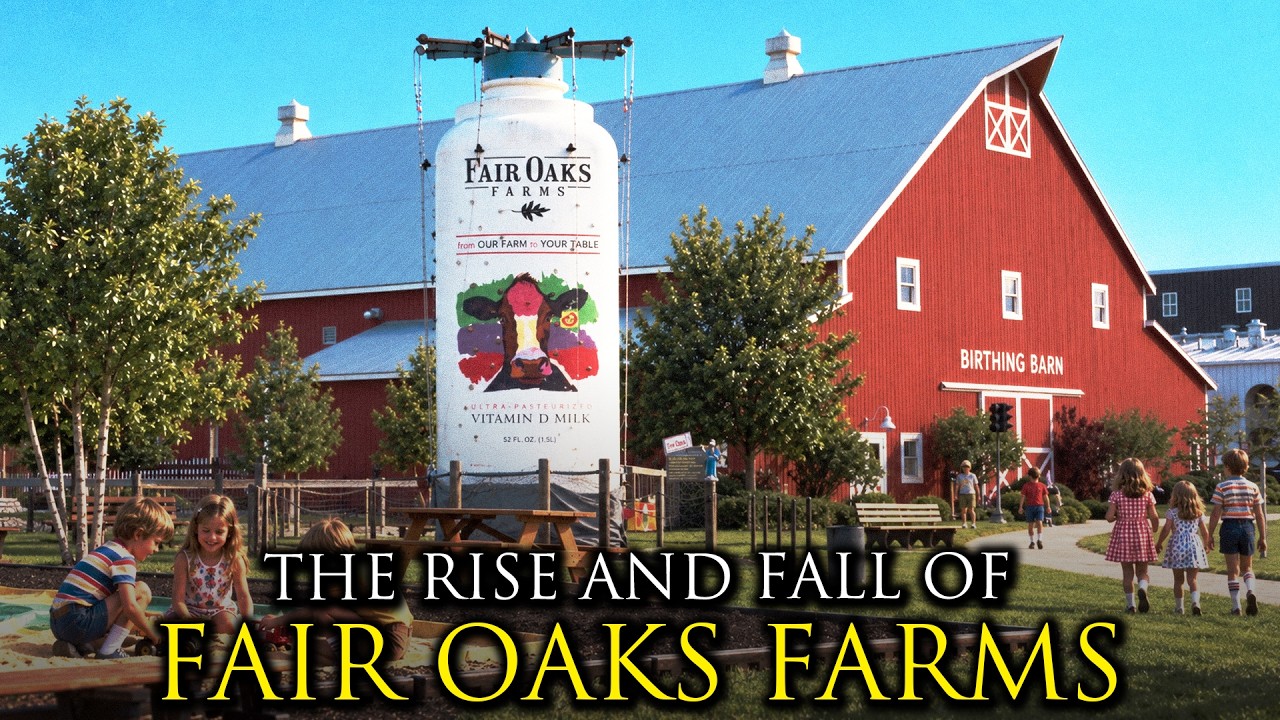
Then, in June 2019, an audience saw what was actually happening behind the glass. The footage showed newborn calves kicked in the head, slammed into the ground, beaten with steel rebar, and burned in the face with hot branding irons. It came from inside the same operation that had invited the world to come look. The man who built it all was a veterinarian.
Mike McCloskey was born in Pittsburgh around 1952. His father died when he was young, and his mother, one of ten siblings, moved her six children back to Puerto Rico. McCloskey later described arriving there as a seven-year-old as arriving in paradise, a sprawling, warm, chaotic family where loneliness wasn’t possible. One uncle changed everything.
He was a veterinarian who drove a battered truck from farm to farm across the Puerto Rican hills, and young Mike rode along day after day watching him work. He would later call those days adventures, a word he would eventually plaster across the entrance of the largest agritourism attraction in the Midwest. After his mother remarried a Mexican businessman, the family moved to Mexico, where McCloskey studied veterinary medicine at the University of Mexico, earning his doctorate in 1976. He crossed into the United States for a post-doctoral residency at the University of California, Davis, winning the resident of the year award two years in a row, the only person in the program’s history to do it.
He built a thriving veterinary practice in Southern California specializing in dairy cow health, but he was also studying the economics of milk. He noticed that bacteria levels in commercial milk were higher than necessary. If cows were kept healthier and milk was chilled immediately after milking, he believed bacteria counts could fall far below federal standards. He tried it.
He was right. The problem was that nobody cared. In the commodity milk market of the 1980s, excellent milk sold for the same price as acceptable milk. McCloskey also had an unusual advantage.
He was bilingual. The modern American dairy industry depended heavily on labor from Mexico, and McCloskey, who understood where his workers came from and could speak to them in their own language, ran operations that ran more smoothly than his competitors’ farms. In California, he met Sue, a New Jersey native who had grown up near a small dairy and loved the business. They married, bought a small herd, then expanded, eventually selling the veterinary practice and building a five-thousand-cow dairy from scratch in New Mexico.
In 1994, McCloskey made his first consequential business move, co-founding Select Milk Producers, a cooperative of dairy farms committed to producing higher quality fluid milk and getting paid for it. The concept worked. Select Milk grew to ninety-two member dairies and became the sixth largest milk cooperative in the United States, producing billions of pounds of milk per year. He also co-founded the Southwest Cheese Company, a joint venture that opened a two-hundred-thirty-million-dollar plant in Clovis, New Mexico, the largest cheddar facility on Earth, receiving ten million pounds of milk every day.
McCloskey was building an empire. But he had a problem. Per capita fluid milk consumption had been declining since the 1970s, and most dairy companies were responding by cutting costs and consolidating. He wanted to go the opposite direction, make milk worth more by making it better, and make people trust it by showing them everything.
He needed a place where premium quality and radical transparency could be demonstrated at scale. He found it in Newton County, Indiana, a flat, windswept prairie along Interstate 65, about seventy-five miles south of Chicago. The county had barely fifteen thousand people and no tourist attraction. But McCloskey saw the hundreds of thousands of drivers passing through every year and imagined an audience.
He didn’t want a petting zoo. He wanted to build a working industrial dairy, the real thing, operating at enormous scale, wrapped in the packaging of a family destination. Conventional wisdom said to keep the public far from farming operations. McCloskey believed the opposite: that if people saw how modern dairy farming worked at its best, they would trust the product more, not less.
Fair Oaks Farms opened to the public in January 2004. The Dairy Adventure was a fifteen-thousand-square-foot interactive museum full of exhibits and animatronic farm characters, a talking cow praising her scientifically formulated diet, a nerdy scientist explaining how manure became electricity, a grumpy rooster complaining about modern efficiency. The main event was the bus tour. Visitors boarded sealed biosecure buses painted to look like Holsteins and were driven to working barns, watching through sealed glass so they never touched the animals.
The first stop was the milking parlor, an immense building sheltering a seventy-two-cow rotating platform they called the dairy-go-round. Cows walked on at one end, workers attached suction cups in under nineteen seconds, and the platform completed its slow revolution while the cows walked off the other side, milked and done. The attraction that turned Fair Oaks into a phenomenon was the birthing barn. The herd was so enormous, thirty-six thousand cows across multiple farms eventually, that between eighty and one hundred calves were born every day.
McCloskey built a barn with stadium seating and a stoplight system. Red meant a cow was in early labor, yellow meant hooves were visible, green meant the calf’s head was emerging. Families watched newborns take their first breaths from padded seats in an air-conditioned room. By 2018, the farm was drawing six hundred thousand visitors a year.
Food and Wine magazine called it the Disneyland of agricultural tourism. The farm kept expanding, a pig adventure, a crop adventure, an apple orchard, a farmhouse restaurant, a cheese factory, a hotel, a gas station, an outdoor play area. McCloskey talked publicly about reaching a million visitors a year. For a county under fifteen thousand people, the impact was transformative.
The tourism operation generated revenue estimated at over thirty million dollars annually. Anaerobic digesters converted manure into electricity and compressed natural gas, and forty-two milk tanker trucks ran on that gas. The sustainability pitch was as polished as the tourism pitch. It all said the same thing: come look, we have nothing to hide.
But the real business was the milk. And the milk owed its existence to a broken well. In the late 1990s or early 2000s, the McCloskeys’ water well at their New Mexico dairy collapsed. After it was repaired, a repairman installed the wrong filter, and the water came through overloaded with minerals.
The cows drank less, and milk production plummeted. McCloskey called in engineers to install a proper filtration system. Watching them work, watching the filter strip minerals out of water, he had an idea. Why couldn’t you do the same thing with milk?
He began separating milk into its five core components, water, butterfat, protein, vitamins and minerals, and lactose, then recombining them in different proportions. The result tasted like milk but had fifty percent more protein, thirty percent more calcium, and half the sugar. In 2012, they launched Fairlife as a joint venture between Select Milk Producers and the Coca-Cola Company. Coca-Cola initially took a minority stake.
The product hit shelves in early 2014 in sleek bottles that looked nothing like a milk jug, priced at roughly double the cost of conventional milk. The premium depended on two things: a proprietary cold filtration process and a promise that Fairlife milk came from farms that treated their animals with extraordinary care. The entire tourism operation existed in significant part to prove it. Fairlife grew explosively in a market where conventional milk sales had been declining for decades.
By the late 2010s, it was one of the only genuinely growing brands in the entire fluid milk category. Then in August 2018, a man applied for a job at Fair Oaks Farms. He was an investigator for the Animal Recovery Mission, a Miami-based nonprofit dedicated to undercover investigations of large agricultural operations. He was placed as a calf care employee at the Prairies Edge North Barn, one of the many dairies in the complex that visitors never saw.
He worked there from August through November 2018, wearing a hidden camera, recording what happened in the parts of the operation the tour buses never reached. For seven months, ARM said nothing publicly. On June 4, 2019, they released the video. ARM called it the largest undercover dairy investigation in history.
The footage showed workers kicking newborn calves in the head, slamming them face first into concrete, hitting them with plastic bottles, beating them with steel rebar, burning their faces with hot branding irons, kneeing them in the spine, sitting on top of them, force-feeding them until they choked, dragging them by their ears. It also showed piles of dead calves and temperature readings above one hundred degrees inside some calf hutches. The video went viral, eventually seen over eighteen million times. Mike McCloskey released a video statement.
He said he was disgusted. He took full responsibility. He identified five individuals, four farm employees and one third-party truck driver, saying three had already been terminated after co-workers reported the behavior, the fourth was terminated that day, and the truck driver was banned. He denied drug cultivation claims.
It didn’t stop anything. The public reaction was a fury of feeling personally deceived. This wasn’t a faceless operation. This was the farm with the gift shop and the jumping pillow, the farm that charged families admission to watch calves being born while other calves were being beaten out of sight.
Jewel-Osco pulled every Fairlife product from its shelves. The Newton County Sheriff’s office launched a criminal investigation, and misdemeanor charges were filed against three former employees. Then a strange counter narrative emerged. The county prosecutor said a witness claimed an ARM operative had coerced workers into committing some of the abuse.
ARM called it absurd and accused the prosecutor of trying to divert attention. The allegations were never conclusively proven or disproven. Consumer lawsuits followed, seeking millions in damages, alleging buyers had paid premium prices based on promises of humane treatment. The suits named the farm, Coca-Cola, Fairlife, Select Milk Producers, and the McCloskeys personally.
School groups canceled field trips. Families pulled hotel reservations. Then COVID-19 arrived in March 2020, and the tourism operation shut down entirely. In April, a leaked internal letter revealed that three top executives had departed, with two positions eliminated outright.
And then the story took its strangest turn. In January 2020, seven months after the abuse footage went global, Coca-Cola completed its acquisition of the remaining fifty-seven and a half percent stake in Fairlife for approximately nine hundred eighty million dollars. Fairlife had immediately stopped sourcing from Fair Oaks. The filtration technology was proprietary and irreplaceable.
Consumer demand hadn’t collapsed. People wanted the milk. They just didn’t want to think about where it came from. The bet paid off beyond any analyst’s expectations.
Fairlife didn’t just survive the scandal, it accelerated through it. By 2022, annual retail sales surpassed one billion dollars, and Coca-Cola reported that a quarter of all American households had purchased a Fairlife product. The total cost of the acquisition was projected to reach roughly seven billion dollars. In 2022, Coca-Cola, Fairlife, Select Milk Producers, Fair Oaks Farms, and Mike McCloskey agreed to pay twenty-one million dollars to settle the class action lawsuits.
Fairlife confirmed it hadn’t sourced milk from Fair Oaks since 2019. The brand and the farm were officially severed. But the story kept echoing. In 2023 and again in early 2025, ARM released new investigations of other dairy farms supplying Fairlife, with the same kind of footage.
Fairlife cut ties each time. Mike McCloskey said the events at Fair Oaks had created a sadness he would carry for the rest of his life. He remained chairman of the farm. The farm remained open, the website still listed hours, the birthing barn still had its stoplight.
The hotel still stood beside the interstate. But the premise itself had broken. Fair Oaks Farms was built on a single radical idea: that a modern industrial dairy could survive total transparency, that showing the public everything would build trust, not destroy it. For fifteen years, the bet worked.
The video didn’t reveal that the farm was hiding something unusual. It revealed something worse, that the transparency had always been selective. The tour buses drove through the milking barns with glass walls. The calf care operations were in different buildings, staffed by different workers, in a part of the operation no visitor ever entered.
The transparency was real, but it was curated. And when the uncurated version appeared, it was devastating precisely because the curated version had been so convincing. Today the farm is still there, the parking lot smaller, the reviews mixed with comments from visitors who came because of the scandal and from people who found the video while searching for directions. The dairy operation itself never stopped.
The carousel still turns, seventy-two cows at a time, three times a day, while the milk is filtered and separated and recombined and poured into bottles that carry a different name now, sold in stores where nobody thinks about the farm in a country where forgetting has always been easier than remembering.
