On the night of November 12th, 1879, Dr. William Thorne was pulled from his sleep by a sound he would later describe, in a hand trembling with agitation, as unlike any he had heard emanate from a human throat. The clock at Massachusetts General Hospital read approximately 3:15 a. m.
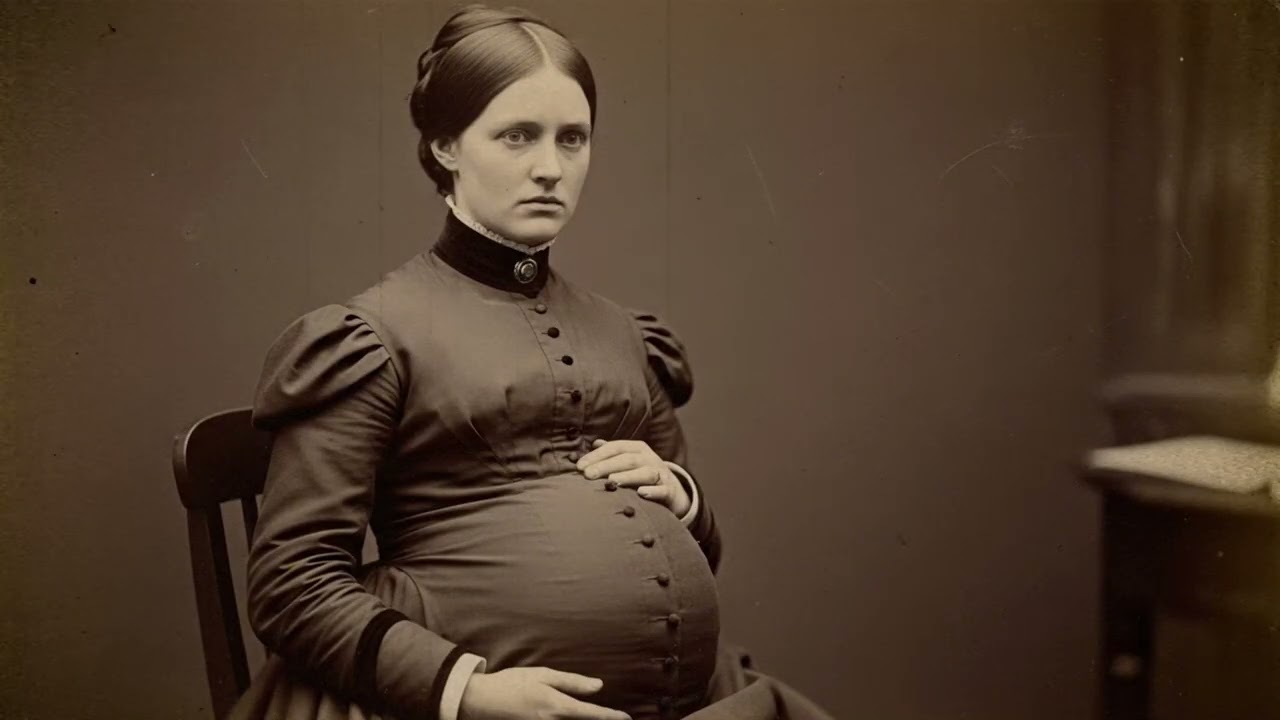
He rushed to room 237 with nurse Sarah Jenkins and Dr. Jonathan Pierce. Inside, Elellanar Blackwood was conscious but in obvious distress, her abdomen moving with violent purpose. As the three medical professionals watched, her abdominal wall began to separate—not as flesh tears, but as if it were being methodically parted from within like curtains drawn aside.
What emerged, Thorne wrote, defied all natural law and medical understanding. His journal entry becomes increasingly illegible at this point, with several ink blots and crossed-out sections. Fragments include descriptions of not flesh as we know it and a symmetry that suggests intelligence rather than biological accident. The entry ends abruptly with three words: “God help us.
It speaks. ”
No further explanation appears in Thorne’s journal. The next entry, dated December 1st, 1879, simply states: “The Blackwood case is closed. By mutual agreement of all involved, no further documentation will be produced.
Some knowledge is not meant for dissemination. ”
The official hospital record tells a different story. It reports that Elellanar Blackwood disappeared from her room during the night of November 12th. Nurse Sarah Jenkins checked on her at 2 a.
m. and found her asleep. When she returned at 4 a. m.
, the room was empty, with no signs of struggle or forced entry. A hospital-wide search yielded no results, and the Boston Police Department was notified. The official report listed Elellanar Blackwood as missing under unusual circumstances. No death certificate, further medical documentation, or evidence of relocation was ever discovered.
How the case reached that breaking point is a story that began months earlier, in a small town in Massachusetts, with a woman whose quiet life gave no indication of the medical anomaly she would become. In the autumn of 1879, the town of Wickfield, Massachusetts, became the center of what contemporary observers described as a medical impossibility. Elellanar Blackwood was 32 years old when she first appeared at the office of Dr. Samuel Green on September 17th, 1879.
According to Green’s meticulous notes, now preserved in the Massachusetts Medical Historical Society, Elellanar complained of unusual sensations within the abdominal cavity and a persistent sensation of movement when completely still. Green initially diagnosed her condition as simple nervous agitation, common among women of the era, and prescribed bed rest and laudanum to calm her nerves. What separated Elellanar’s case from the countless other women diagnosed with female hysteria during this period was what happened next. Three weeks after her initial consultation, she returned to Green’s office.
His notes from October 8th, 1879 reveal a physician clearly disturbed by what he observed. “Patient Blackwood exhibits symptoms inconsistent with any known pathology,” he wrote. “The abdominal distension progresses at an alarming rate, yet no evidence of pregnancy or tumorous growth can be detected through standard examination. ”
Archives from the Wickfield County Records Office indicate that Elellanar Blackwood was relatively new to the area, having arrived from Philadelphia approximately seven months earlier.
She purchased a modest house on the outskirts of town with funds she claimed came from a deceased husband’s insurance policy. Yet investigations conducted years later revealed no record of Elellanar Blackwood née Porter ever being married in Philadelphia or surrounding counties. The quiet, orderly life that Elellanar established in Wickfield gave no indication of what was to come. Neighbors interviewed in 1880 described her as reserved but pleasant, keeping to herself but never unfriendly.
Mrs. Abigail Winters, who lived adjacent to the Blackwood residence, noted that Elellanar maintained an immaculate garden and was often seen tending to her vegetables in the early morning hours. “She seemed particularly fond of her tomato plants,” Winters recalled in her statement to local authorities. “Spent hours with them, talking to them even, though many of us do the same.
”
The first indicator that something was amiss came from the local general store owner, Harold Jenkins. According to a statement given to the Wickfield Gazette, Jenkins noticed a dramatic shift in Elellanar’s purchasing habits. “Beginning in August, Miss Blackwood began buying unusual quantities of salt,” Jenkins stated. “More than any single household could reasonably use.
When I inquired as to the purpose, she simply stated it was for preservation purposes. ” Jenkins also noted Elellanar’s request for large quantities of linen and cotton cloth, which she claimed were for home projects. Green’s initial treatment proved ineffective. His notes from late October document a rapidly deteriorating patient whose symptoms defied conventional medicine.
“The abdominal distension continues at an unprecedented rate,” he wrote on October 27th. “Yet no fetal heartbeat can be detected, ruling out pregnancy. The patient complains of movement within, yet no typical bowel sounds are audible upon auscultation. ” Most disturbing was his observation that the abdomen appeared to shift independently of patient breathing or movement, as if housing something with its own volition.
Increasingly concerned, Green reached out to his former colleague at Harvard Medical School, Dr. William Thorne. Thorne, who had established himself as an authority on unusual medical cases, agreed to travel to Wickfield to examine Elellanar. This decision would ultimately bring national attention to the case and forever change the trajectory of Elellanar’s life.
Thorne arrived in Wickfield on November 3rd, 1879. His personal journal, discovered among his effects after his death in 1922 and now housed in the Harvard Medical School archives, provides the most comprehensive account of his initial examination. “Upon entering the patient’s home,” he wrote, “I was immediately struck by the overwhelming odor of salt. Every surface appeared to have a fine dusting of it, and bowls of salt water were positioned at various points throughout the living area.
”
The examination itself, conducted in Elellanar’s bedroom with Green present, yielded observations that Thorne described as beyond the scope of medical understanding. Elellanar’s abdomen had distended to a size comparable to a full-term pregnancy, yet maintained an unusual shape that Thorne described as more angular than rounded. Upon palpation, he noted movements that were deliberate and systematic, rather than the random shifting of internal organs or fetuses. What perplexed both physicians was the complete absence of other symptoms.
Elellanar’s vital signs remained normal. She displayed no fever, elevated heart rate, or respiratory distress that would typically accompany such a dramatic physical anomaly. Blood samples taken and examined under Thorne’s portable microscope showed no abnormalities. “It is as if the body is not registering what the eyes can plainly see,” Thorne wrote.
The most disturbing aspect of the examination came when Thorne employed his stethoscope. Upon placing the instrument against the patient’s distended abdomen, he recorded: “I detected sounds unlike any I have encountered in my 28 years of medical practice. Rather than the gurgling of intestinal activity or the whooshing of blood through vessels, there emanated a rhythmic scraping almost mechanical in nature. When I shifted the position of the stethoscope, the sounds appeared to follow, as if tracking the instrument’s movement.
”
Elellanar herself remained remarkably composed throughout the examination. According to both physicians’ notes, she answered questions lucidly and displayed none of the mental agitation or confusion that often accompanied serious physical ailments. When asked directly about her condition, she reportedly stated: “It wishes only to grow. I am simply its vessel.
” Neither doctor elaborated further on this statement in their records. Following the examination, Thorne insisted that Elellanar be transferred to Massachusetts General Hospital in Boston for further study. His letter to the hospital’s board requesting special accommodations for what he termed “potentially the most significant medical anomaly of our century” has been preserved in the hospital’s historical archives. In it, he specifically requested a private room removed from the general patient population and equipment for potential surgical intervention should the need arise.
Elellanar’s journey to Boston on November 5th, 1879, was documented by the conductor of the train, James Whitaker, whose written account later became part of the official record. “The woman sat alone, wrapped in blankets despite the warmth of the car,” he wrote. “She refused assistance boarding and deplaning, though her condition made movement visibly difficult. Throughout the journey, she remained utterly silent, save for occasional whispers directed toward her midsection.
”
Upon arrival at Massachusetts General, Elellanar was immediately placed under the care of Thorne and a hastily assembled team of specialists: Dr. Edward Clark, a renowned gynecologist; Dr. Frederick Hollis, a specialist in abdominal tumors; and Dr. Jonathan Pierce, whose expertise lay in parasitic infections.
The examination that followed would be documented in over 50 pages of notes, diagrams, and observations, creating one of the most comprehensive medical records of the era. The team’s initial findings only deepened the mystery. X-ray technology was not yet available in 1879, limiting the physicians to external examination, palpation, and auscultation. Clark’s notes indicate that the distension had progressed “beyond any pregnancy I have witnessed in 30 years of practice.
” Hollis ruled out any known form of tumor, noting the organized movement and responsiveness to stimuli inconsistent with cancerous or benign growth. Most perplexing were Pierce’s observations that the movements suggested an organism of significant complexity, yet no known parasite could achieve such size within a human host. What followed was a week of intense observation and documentation. Elellanar was kept in a secured room on the hospital’s east wing with round-the-clock monitoring by nurses instructed to record any changes in her condition.
The nurses’ logs, preserved in the hospital archives, reveal increasingly disturbing observations as the days progressed. On November 7th, nurse Mary Sullivan recorded: “Patient rests comfortably despite condition. Abdominal movement visible even through bed sheets. Patient often places hands on abdomen and whispers, though content is inaudible.
” By November 9th, nurse Katherine Powell noted: “Movement within abdomen now vigorous enough to displace bedding. Patient requested additional salt for her water, which was denied as per Dr. Thorne’s orders. Patient became agitated—only time since admission.
” November 11th brought the most alarming entry, written by head nurse Elizabeth Morgan: “Patient’s abdomen now protrudes at sharp angles at times, as if something with defined edges pushes from within. When alone, patient observed having what appears to be conversation with her condition. When I entered room unexpectedly, patient immediately ceased speaking and turned away. Requested additional nurses for night shift.
”
The breaking point came on November 12th, when Thorne and his team decided that exploratory surgery had become necessary, both for Elellanar’s safety and for scientific understanding. The surgical notes, co-signed by all four physicians, indicate their plan to perform a controlled incision into the abdominal cavity under chloroform anesthesia. The procedure was scheduled for 9 a. m.
on November 13th, 1879. That night, Elellanar Blackwood vanished from the historical record. The official report stated she was missing under unusual circumstances. A search of her Wickfield residence revealed it had been meticulously cleaned, with no personal items remaining.
Neighbors reported no unusual activity in the days leading up to her hospitalization. The physicians involved never publicly discussed the case again. Thorne continued his practice at Harvard Medical School but noticeably shifted his focus away from unusual medical anomalies to routine surgical procedures. He died in 1922.
His journal, discovered among his personal effects by his son, was placed in the Harvard archives without apparently being read. Pierce abandoned medicine entirely in 1880, moving to rural Vermont to become a farmer. In a letter to a colleague dated 1885, he wrote only: “There are things I have witnessed that have convinced me our understanding of natural law is woefully incomplete. I find more comfort in growing things from the soil than in exploring the dark corners of human physiology.
”
The case might have remained an obscure historical footnote if not for Thomas Harrington’s discovery in 1962. While researching 19th century medical approaches to female patients, Harrington, a graduate student, stumbled upon the yellowing files in the basement of Massachusetts General Hospital, where the Blackwood case had been archived after being closed in 1881. He uncovered not only the original case files but additional documents that had been deliberately separated from the main record. These included a series of letters between Thorne and Pierce in the years following the incident, and most significantly, a journal believed to belong to Elellanar Blackwood herself.
The journal, comprising 42 pages of increasingly erratic handwriting, had been sealed in an envelope marked “to be destroyed upon my death. W. Thorne. ” Why Thorne preserved rather than destroyed this document remains unknown.
The journal begins as a mundane account of daily life in Philadelphia in early 1878 but takes a dark turn after an entry dated March 15th, 1879. Elellanar wrote: “It came to me in the night, not as a dream, but as a visitation. It spoke of partnership, of vessels, and growth and knowledge beyond mortal understanding. I refused, as any God-fearing woman would.
Yet it returned each night more persuasive, more enticing. It showed me wonders. It promised knowledge. ”
Later entries document Elellanar’s apparent acceptance of some form of symbiotic relationship with an entity she never fully describes.
“It grows within now,” she wrote in June 1879. “Not as a child grows, but as knowledge grows. It learns through me, experiences through my senses. In return, it shows me the spaces between what we know, the colors beyond our spectrum, the sounds beyond our hearing.
” By September, the entries became increasingly concerned with preservation and protection: “It requires salt to maintain equilibrium. The salt keeps the vessel, keeps me from breaking down under its presence. I am changing to accommodate it, but the change must be managed carefully. ” The final entry, dated November 10th, 1879, while Elellanar was hospitalized, contains just one line: “They must not cut.
If they separate us, what emerges will not be what entered. It has grown beyond containment. ”
Harrington published his findings in the obscure Journal of Historical Medical Anomalies in 1963, but his paper received little attention from the mainstream scientific community. Those who did review his work dismissed it as a case of multiple parties suffering from shared delusion, possibly induced by ergot poisoning or carbon monoxide exposure common in poorly ventilated 19th century buildings.
What followed in Harrington’s investigation has never been fully explained. According to his research notes dated January 1963, he began to notice strange occurrences in his Cambridge apartment. “The salt in my shaker crystallizes in peculiar patterns overnight,” he wrote. “I find it arranged in geometric shapes I do not recall making.
” By February, his notes show increasing paranoia. “I believe someone enters my apartment when I am away. Papers are slightly moved. I hear breathing when the apartment should be empty.
”
In March 1963, Harrington requested access to Elellanar’s former hospital room. The East Wing had since been repurposed for administrative offices, but the basic structure remained intact. According to the hospital’s visitor log, Harrington spent seven hours in and around the former room 237, taking measurements and samples from the walls. The maintenance supervisor reported that Harrington seemed particularly interested in a section of the floor near the north wall, where he spent nearly two hours scraping at the floorboards.
Harrington’s research notes from this visit contain a disturbing observation: “The walls retain a trace of salt, detectable even after all these years. Under ultraviolet light, patterns emerge. Not random crystallization, but organized structures resembling circuit paths or a form of writing I cannot decipher. ”
In April 1963, Harrington traveled to Wickfield to locate the site of Elellanar’s former residence.
County records indicated the property had remained vacant since her disappearance, with ownership reverting to the town due to unpaid taxes. Six subsequent attempts to develop the land had failed, with construction abandoned for various cited reasons, including unstable soil conditions and persistent flooding issues, despite the property sitting on high ground. Harrington’s field notes from Wickfield described the location as “unnaturally sterile. No weeds grow within the foundation outline.
The soil has an unusually high salt content according to my tests, though there is no geological explanation for this. At night, the temperature within the foundation perimeter drops approximately 7° below the surrounding area. ”
Most disturbing was Harrington’s account of his third night in Wickfield. Staying at the local inn, he reported waking at precisely 3:15 a.
m. to find salt crystals forming patterns on his bedroom floor, arranging themselves without human intervention. He collected samples, but noted they degraded to ordinary salt by morning. “The patterns lost,” he wrote.
Upon returning to Cambridge, Harrington’s behavior became increasingly erratic. According to his department secretary, he requested all his calls be screened and installed additional locks on his office door. His research focus shifted entirely to the Blackwood case, with requests for obscure texts on parasitology, symbiotic relationships, and theoretical physics concepts well outside his historical expertise. In June 1963, he submitted a comprehensive paper to the New England Journal of Medicine titled “The Blackwood Anomaly: Evidence of Non-standard Biological Symbiosis.
” The journal rejected the paper without review, citing concerns about methodology and conclusions unsupported by established science. Undeterred, Harrington published his findings in the much smaller Journal of Historical Medical Anomalies, where it attracted little attention. The paper itself contained several passages that, in retrospect, suggest Harrington’s mental state was deteriorating. He wrote of communication attempts through crystalline structures and information encoded in salt formations.
Perhaps most concerning was his assertion that the entity that occupied Elellanar Blackwood did not die or depart, but evolved into a form that exists partially outside conventional physical laws, capable of influencing our reality without being fully present within it. By November 1963, Harrington had stopped attending faculty meetings. His few colleagues who maintained contact reported he had covered his apartment windows with salt-soaked cloth and spoke frequently of being watched through reflective surfaces. His last known communication was a letter to Dr.
Richard Chambers, a physicist at MIT, requesting an urgent meeting to discuss “non-standard matter that can interface with human consciousness. ” Chambers’s secretary reported that he called to decline the meeting, finding Harrington’s theories too speculative to merit scientific consideration. On December 3rd, 1963, Thomas Harrington failed to appear for his scheduled classes. Campus security conducted a wellness check at his apartment and found it empty of both Harrington and his research materials.
The only unusual element was a large quantity of salt scattered throughout the residence, particularly concentrated around doors and windows. A missing person’s report was filed, but the investigation quickly stalled due to lack of evidence or leads. For decades, the disappearance of Thomas Harrington was considered unrelated to his research on the Blackwood case, merely a curious coincidence or perhaps the result of mental health issues. This perspective changed dramatically in 1987, when physicist Dr.
Elaine Summers discovered a manuscript in the Harvard archives that had been misfiled among theoretical physics papers. The 212-page document, titled simply “Blackwood,” contained detailed analyses of Elellanar’s condition from biological, physical, and metaphysical perspectives. The writing style matched Harrington’s, but the content demonstrated knowledge of advanced scientific concepts that would not become mainstream until the 1970s and 80s. The manuscript proposed that Elellanar had encountered what it termed an entity of non-standard matter capable of existing partially outside conventional physical laws while using a human host as an anchor in our reality.
Most startling were passages describing the entity’s evolution: after sufficient growth within its vessel, the entity no longer required complete physical manifestation. It evolved to exist primarily in the spaces between conventional reality, what physicists might one day call quantum fields or probability waves. In this state, it can observe without being observed, influence without being detected, and continue its study of human existence. The manuscript was signed “T.
H. ” and dated 1965, two years after Harrington’s disappearance. It had been mailed to Harvard from a post office box in Anchorage, Alaska, with no return address or accompanying letter. Summers, troubled by both the content and the chronological impossibility of the manuscript’s scientific knowledge, attempted to trace Harrington through Alaskan records.
Her search revealed that a man named Thomas Henry had purchased a remote cabin outside Anchorage in 1964, paying cash and providing minimal personal information. Local records described him as reclusive but not unfriendly, occasionally visiting town for supplies but largely self-sufficient. According to the few neighbors within miles of his property, Henry’s cabin was surrounded by a perimeter of salt, which he meticulously maintained regardless of weather conditions. One neighbor, Jacob Tanner, reported in a 1972 local newspaper interview that “Old Tom’s Place never got animal tracks crossing it, not even in fresh snow—like they know to stay away.
”
In 1979, at an estimated age of 65-70, Thomas Henry suffered a stroke and was moved to an Anchorage nursing home. He reportedly spoke little about his past but occasionally made concerning statements about being watched through reflective surfaces and “it growing stronger with each vessel it finds. ” During his final days in 2005, Henry became increasingly agitated, insisting to staff that “it’s coming back to finish what it started. ” According to night nurse Meredith Oaks, he spent his last night alive meticulously placing salt in patterns on his floor and repeatedly murmuring “It’s still growing” until his death at 3:15 a.
m. on November 13th—precisely 126 years after Elellanar Blackwood’s disappearance. Among Henry’s few possessions was a locket containing a sepia photograph of a woman bearing a striking resemblance to Elellanar Blackwood, and a small notebook filled with what appeared to be random arrangements of dots and lines. When Summers learned of Henry’s death through her research contacts and traveled to Anchorage to examine these items in 2006, she discovered the nursing home had experienced an unexplained saltwater leak that destroyed most of his possessions.
The locket had apparently been lost, and only three water-damaged pages of the notebook remained, the patterns rendered illegible. Perhaps the most unsettling connection to the original Blackwood case emerged during renovations to the former Massachusetts General Hospital East Wing in 1997. Construction workers uncovered a previously unknown sub-basement directly beneath what would have been Elellanar’s room. Foreman Michael Donaghue reported finding a chamber roughly eight feet square, with walls coated in a crystallized salt compound.
At the center of the room stood a chair bolted to the floor, facing a single word carved into the stone wall: vessel. Hospital administrators quickly sealed the area and denied workers further access. No official statement about the discovery was ever released. Donaghue attempted to bring media attention to the discovery but abandoned his efforts after reportedly receiving an anonymous package containing photographs of his family with their eyes scratched out.
In 2001, geological surveys of the Wickfield property where Elellanar’s house once stood revealed anomalies that defied conventional explanation. Soil samples showed unusually high salt content with no clear geological or environmental cause. Ground-penetrating radar detected what technicians described as void spaces beneath the property that appeared to shift position between successive scans, a phenomenon the survey team attributed to equipment malfunction. Most recently, in 2008, a cache of letters was discovered during the renovation of an old farmhouse in rural Vermont, the former residence of Dr.
Jonathan Pierce. The correspondence, spanning from 1880 to 1887, revealed a man deeply traumatized by what he had witnessed. In a letter to his brother dated February 1880, Pierce wrote: “I cannot speak of what occurred that night, not because I am sworn to secrecy, though I am, but because I lack the words to describe something so fundamentally opposed to natural law. I will say only this.
What emerged from that woman was neither human nor animal, neither fully material nor immaterial, but something that exists in the spaces between what we understand and what we fear. ”
A later letter dated October 1883 showed increasing paranoia. “I believe it watches me still. I find salt crystals arranged in patterns I do not create.
My reflection sometimes moves independently of my own movements, just for a moment, just at the corner of my eye. I have removed all mirrors from my home. ”
His final letter, dated just days before his apparent suicide in April 1887, contains perhaps the most disturbing revelation. “William Thorne has confirmed my suspicion.
The entity did not die or depart that night. It evolved beyond physical containment. It exists now in the spaces between what we perceive. It watches, it learns, it grows through observation, and it is not the only one of its kind.
Elellanar was not the first vessel, merely the first we documented. How many others have there been throughout history? How many are among us now, serving as vessels for something that exists beyond our comprehension? I cannot bear the knowledge.
I cannot bear being watched a moment longer. ”
Dr. Pierce was found hanged in his barn on April 17th, 1887. The local coroner ruled it suicide, noting that Pierce had lined the noose with salt—a detail omitted from official reports but mentioned in the coroner’s private diary, discovered in 2010.
The scientific community has largely dismissed the Blackwood case as an example of 19th century medical limitations, possibly compounded by mass hysteria, shared delusion, or even deliberate hoax. The disappearances and strange behaviors of those who investigated the case are attributed to mental illness, possibly triggered by obsessive research into an ultimately mundane medical mystery. Yet questions persist that conventional explanations fail to address. Why did all the medical professionals involved either abandon their careers or dramatically shift their focus after the incident?
How do we explain the consistent presence of salt across multiple locations and decades? What caused the sub-basement chamber at Massachusetts General to be sealed away, forgotten, and then rediscovered more than a century later? And perhaps most troubling: why have at least 17 cases bearing striking similarities to Elellanar’s condition been documented worldwide between 1879 and the present day? Each involving abdominal distension with inexplicable movement, each patient disappearing before definitive medical intervention, each leaving behind spaces permeated with salt.
In 2013, biophysicist Dr. Rachel Kim proposed a theory that attempted to reconcile the Blackwood case with modern science. Her paper, “Theoretical Framework for Non-standard Biological Symbiosis,” suggested the possibility of organisms existing primarily as information patterns rather than conventional matter, capable of temporarily manifesting through interaction with standard biological systems. While her work made no direct reference to the Blackwood case, those familiar with the details recognized the parallels.
Six months after publication, Kim abruptly resigned her university position and relocated to an undisclosed location. Her only comment, provided through her attorney, stated she no longer wished to pursue that line of research due to personal concerns. The most recent development came in 2019, when the journal Science published a controversial paper on theoretical information-based entities that might exist primarily as patterns within quantum fields rather than as conventional matter. The authors proposed that such entities might be capable of interacting with physical reality through complex systems like the human brain or body.
Though presented as purely theoretical, the paper’s primary author, Dr. Viktor Levy, acknowledged in a subsequent interview that his work had been partially inspired by historical medical anomalies, including “a fascinating case from 1879 involving a woman whose condition defied contemporary medical understanding. ” Three months after this interview, Levy’s laboratory at Princeton University experienced what official reports described as a catastrophic saltwater plumbing failure, destroying years of research data. Levy himself took an extended leave of absence and has declined all further interviews on the subject.
The location where Elellanar’s house once stood in Wickfield remains vacant to this day. Local records indicate that every structure built on that plot since 1880 has been abandoned within a year of completion, with owners citing structural problems or unhealthy living conditions as reasons for departure. In the decades since the case was sealed, occasional reports have surfaced from around the world of medical anomalies bearing striking similarities to Elellanar’s condition: a woman in Kyoto, Japan in 1923; a man in Marseille, France in 1947; a teenage girl in São Paulo, Brazil in 1968. All exhibited extreme abdominal distension with inexplicable movement.
All disappeared before definitive medical intervention. All left behind living spaces permeated with salt. What we know for certain is that on November 13th, 1879, something occurred in room 237 of Massachusetts General Hospital that fundamentally altered the lives of everyone present. We know that Elellanar Blackwood, a woman with no history of mental illness or deception, experienced a physical transformation that defied medical explanation.
We know that highly educated medical professionals documented observations they could not reconcile with their scientific understanding, and that some abandoned their careers rather than confront the implications. During the final review of the original case files at Harvard’s archives, one overlooked detail was discovered. In the margins of Dr. Thorne’s notes from November 12th, 1879—the day before Elellanar disappeared—there appears a small, hastily sketched diagram.
At first glance, it resembles a medical illustration of abdominal anatomy. Upon closer inspection, however, it depicts what appears to be a network of interconnected nodes, almost like a neural network or circuit diagram. Beneath it, in Thorne’s distinctive handwriting, are the words: “Not a parasite, not a growth, a pattern seeking transmission. ”
In his final letter before his suicide, Dr.
Pierce wrote something equally perplexing. “It does not consume. It observes. It learns.
It transmits. Each vessel is merely a conduit for information exchange. A temporary anchor in our reality. ” Where this information goes, what is being built on the other side, Pierce never specified.
In one of his final journal entries, Thomas Harrington, or Thomas Henry as he later called himself, wrote something that continues to haunt those who study the case. “It was never about Eleanor’s body. The physical manifestation was merely to attract attention, to ensure documentation, to enter the record. Now it spreads through information, through those who study it, who think about it, who speak its story.
Each telling strengthens it. Each new mind that contemplates its existence becomes, however briefly, its vessel. ”
The Blackwood case remains officially unexplained. Perhaps that is for the best.
As Elellanar herself wrote in her journal: “The space between what we know and what we fear is narrower than we dare admit. “
