He had spent twenty-nine years learning the exact angle at which to bow, the precise tone of voice that would not provoke a strike, the art of appearing smaller than he was. Obadiah knew the texture of this world better than he knew the sound of his own surname, a name he had never truly been permitted to own. His back was a landscape of raised welts, a historical record of every time he had failed to bow low enough. Yet it was his eyes, dark and unnervingly sharp, that kept the overseer Harker Vance awake at night.
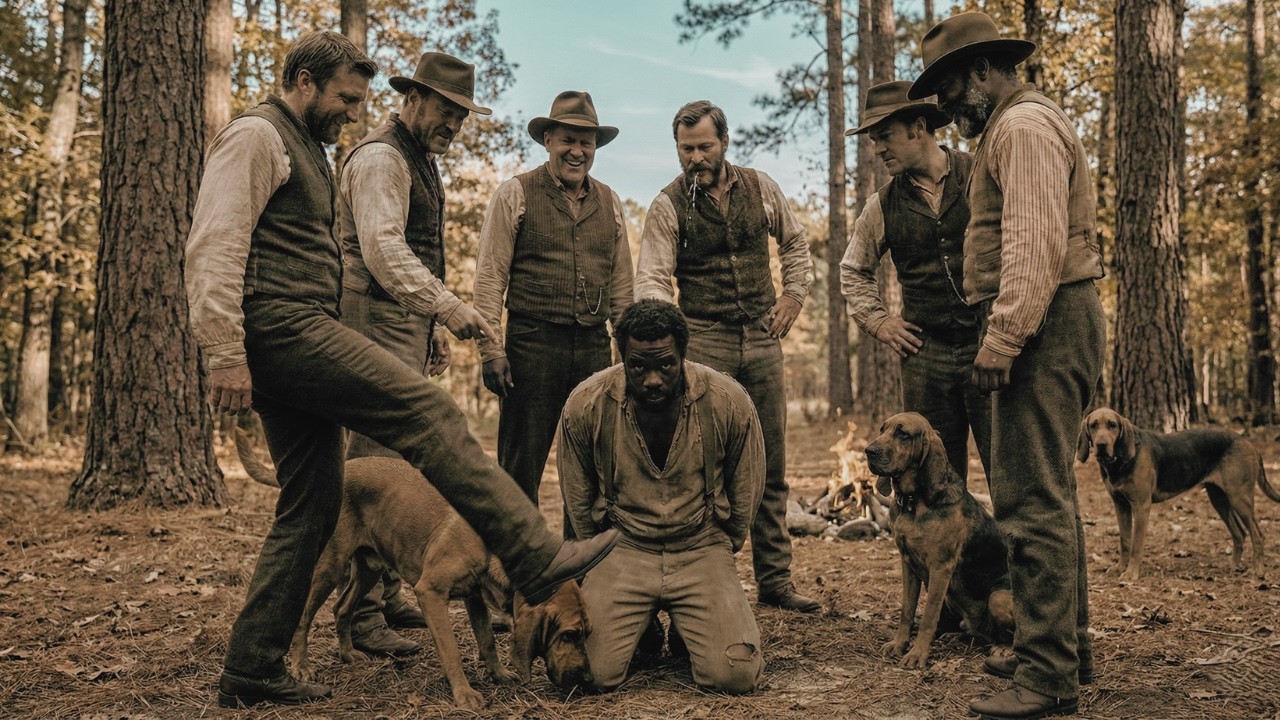
There was a flicker in those eyes, a silent, smoldering defiance that no amount of systematic violence had managed to extinguish. The Thorn Estate stretched across nine hundred acres of the most fertile silt in the Delta, a kingdom of white gold built entirely upon the broken spirits of the one hundred and fifty souls Cornelius Thorne claimed as his property. Thorne himself was a ghost in a white linen suit, a man who viewed his plantation from the shaded heights of a mansion supported by marble columns, rarely descending to taste the dust of the fields. He left the management of the stock to Harker Vance, a thirty-six-year-old man who had clawed his way out of poverty by weaponizing his own insecurities.
Vance understood that his authority was a fragile thing, a social fiction held together only by the constant application of terror. He didn’t just want obedience. He wanted the total psychological collapse of those beneath him. Obadiah had become Vance’s particular obsession three months earlier, in the cooling rains of April.
The transgression had been the most dangerous one imaginable in a system built on ignorance. Obadiah had been caught teaching the alphabet to a group of children. The evidence had been found etched into the damp earth behind the quarters, crude, shaky letters that represented the keys to a world the enslaved were never meant to enter. Under the pressure of Vance’s interrogation, a young boy had pointed the finger at Obadiah, revealing a torn, salt-stained page from a Bible hidden beneath a loose floorboard.
Knowledge in the hands of the oppressed was more volatile than gunpowder. A man who could read could forge a travel pass. He could consume abolitionist tracts. He could begin to understand the architectural flaws in the prison that held him.
When Vance discovered the hidden page, he didn’t just see a book. He saw a breach in the hull of his ship. He had Obadiah brought to the center of the quarters, a space of packed dirt where the whipping post stood as a permanent reminder of the cost of ambition. Obadiah remembered that day with a clarity that felt like a fresh wound.
He remembered the rough grain of the cedar post against his chest, the bite of the leather around his wrists, and the gathered crowd of his peers forced to bear witness to his destruction. Their faces were masks of controlled horror, a collective silence that hummed with unexpressed grief. Vance had made a performance of it, lecturing the crowd on the virtues of knowing one’s place before uncoiling the long braided leather of his whip. Twenty lashes.
Each one was counted aloud, the overseer’s voice steady and almost rhythmic, punctuated by the wet, tearing sound of the whip finding its mark. Obadiah had refused to give Vance the satisfaction of a single cry. He had bitten into his lower lip until he tasted the metallic tang of his own blood, his muscles seizing and vibrating with the shock of each blow, but he remained a statue of flesh and bone. This silence had been more insulting to Vance than any curse or scream could have been.
It was a refusal to participate in the ritual of humiliation. From that day forward, the overseer’s eyes never left Obadiah. He assigned him to the breaking gangs, put him in the most grueling rows under the peak of the midday sun, and slashed his weekly rations to the point of starvation. He threatened anyone who dared to share a scrap of cornmeal or a kind word with the literate slave.
Yet Obadiah endured. He had learned the art of the inner fortress, the ability to appear submissive and broken on the surface while nurturing a diamond-hard core of resistance deep within. To the other workers, Obadiah became a figure of quiet reverence. He carried himself with a terrifying dignity, a stillness that suggested he was merely a guest in his own captivity, waiting for the right moment to reclaim his life.
In the dead of night, when the quarters were filled with the heavy breathing of exhausted bodies, Obadiah would speak in low, gravelly tones to those he trusted. He didn’t talk about the mercy of the masters or the distant hope of legal manumission. He talked about a freedom that had to be seized with both hands. “They tell us to wait for the Lord,” he would whisper to his closest friend, Zebedee, a man who had been sold away from his family in Virginia and carried the hollow look of a man who had already died once.
“They tell us to wait for the law to change or the master’s heart to soften. But how long can a man wait to be a man? If you wait for a wolf to show you mercy, you’ll be nothing but bones before the moon turns. ”
Zebedee would watch him with a mixture of awe and terror.
He knew the plantation was riddled with informants, people so traumatized by the system that they would trade a brother’s life for an extra pound of pork or a day’s rest. Obadiah spoke only when the wind was high in the oaks. His words were dangerous seeds planted in the dark, fertile soil of his friends’ minds. Zebedee often asked him if he was planning a flight.
Escape in 1860 Louisiana was a fool’s errand. The state was a fortress of white supremacy. The Thorn Estate was miles from any town, and even in the towns, free Black people were watched with suspicious intensity. The roads were patrolled by patty rollers, armed men on horseback who hunted runaways for sport and profit.
To run was to invite the hounds, the branding iron, or the gallows. But Obadiah’s mind was turning towards something far more radical than simple flight. He was beginning to realize that survival was not enough if it meant the constant erosion of his soul. He was thinking about the exact moment a man decides that he will no longer be a thing, even if the price of that realization is his own life.
He wanted to make Harker Vance understand, truly, viscerally, that there were some spirits that could be killed, but never under any circumstance could they be owned. He was waiting for a catalyst, a moment where the pressure of his twenty-nine years of captivity would finally meet an equal and opposite force. That catalyst arrived on a blistering Wednesday in late June. The cotton was waist high, its leaves broad and green, drinking in the punishing radiation of the southern sun.
The workers moved in a rhythmic, mechanical trance, their hoes striking the earth in a synchronized pulse. Obadiah worked his row with a terrifying efficiency, his body a machine of sweat and sinew. Vance was patrolling the edge of the field on a tall chestnut mare. But today he wasn’t alone.
Riding beside him was Lucinda, his bride of less than a month. She was a woman of delicate features and expensive lace, a daughter of a Mississippi planter who viewed the field workers with a detached, clinical curiosity. She spoke to her husband in hushed tones, her eyes lingering on the workers as if they were exotic animals in a menagerie. Vance, eager to perform the role of the masterful husband, laughed loudly and dismounted.
He strode into the field, his polished boots crushing the very crop he was paid to protect. He walked straight toward Obadiah, his face tightening into a mask of performative rage. The air in the field seemed to turn to glass. Everyone knew that the performance was about to begin.
Harker Vance stopped at the end of Obadiah’s row. The dust from his heavy leather boots settled on the dark, tilled earth like a shroud. He looked at Obadiah, not with the gaze of a man looking at a worker, but with the predatory stare of a man looking for a reason to exert total dominance. “You,” Vance barked, his voice cutting through the heavy, humid air like a jagged blade of rusted iron.
“Drop that hoe and stand clear of the row. Now. ”
The rhythmic thack of wood against soil faltered. The other workers didn’t stop.
To stop was to invite a strike, but their movements became tentative, their ears straining against the oppressive silence of the heat. Obadiah straightened slowly, his joints popping with the sound of dry twigs in a fire. He did not look Vance in the eye. He knew the lethal rules of this psychological game.
He looked instead at the overseer’s chest, where the sweat had soaked through his linen shirt in a jagged map of salt and insecurity. “Look at this row, Lucinda,” Vance said, turning to his bride, who remained on the periphery of the field. “See how the weeds are still choking the plants? This one thinks he can slide by because he’s bigger than the rest.
He thinks his size buys him a pass on productivity. ”
It was a blatant lie. Obadiah’s row was the cleanest in the field, a testament to his grueling discipline. But in this kingdom, truth was whatever the man with the whip said it was.
Vance was performing a ritual of dominance, and Obadiah was the chosen sacrifice. The overseer’s hand went to the coiled leather at his belt, the braided whip that had tasted Obadiah’s blood more times than he cared to remember. “Strip off that shirt,” Vance commanded, his voice rising with a performative edge designed to impress his new wife. “Right here, in front of the sun and the lady.
I’m going to give you ten lashes to remind you that your hands belong to Mr. Thorne and your back belongs to me. ”
The slur that followed was like a splash of acid in the midday heat. Obadiah felt the pressure within him, the accumulation of twenty-nine years of forced silence and strategic submission, reaching a critical boiling point.
His mind raced through the cold, hard mathematics of his survival. If he stripped, he would be broken again, his dignity eroded further until there was nothing left but a hollow husk of a man. If he refused, he was courting immediate death. He looked at Lucinda Vance, who was watching with a mixture of terror and a dark, morbid fascination.
She represented the world that viewed him as a beast of burden, a creature without a soul or a voice. In that moment, the internal fortress Obadiah had built for decades finally cracked wide open. The voice of his ancestors, of the children he had taught to read in the dirt, and of the very earth beneath his feet seemed to scream for a single word of truth. He let the hoe fall.
It hit the ground with a dull, final thud that echoed across the silent field like a gavel. Obadiah did not move to unbutton his rough cotton shirt. Instead, he lifted his chin and did something he had never done in his adult life. He looked Harker Vance directly in the eye.
It was a gaze of such absolute clarity and recognition that the overseer actually took a half step back, his boots scuffing the dirt. “No,” Obadiah said. The word was not a shout. It was a quiet, resonant vibration that seemed to travel through the earth itself.
The field went tomb silent. The buzzing of the cicadas in the nearby oaks seemed to vanish into the humidity. Even the wind died down. Vance’s face went through a rapid, grotesque transformation, from shock to disbelief, and finally to a purple-veined, bulging rage that bordered on madness.
“What did you say to me? ” he whispered, his hand trembling as he gripped the handle of the whip. “I said no,” Obadiah repeated, his voice gaining a terrifying strength that filled the clearing. “I won’t strip.
I won’t be whipped. Not for your lies and not for her entertainment. I am a man, Harker Vance, and I am done being your dog. ”
The social fabric of the Thorn Estate, a tapestry woven from fear and blood, began to unravel in that singular moment of refusal.
The other workers were frozen, their eyes wide, witnessing a miracle or a massacre in the making, their hearts pounding in a collective rhythm of hope. Vance didn’t reach for his pistol. Not yet. To shoot Obadiah would be to admit he couldn’t control him through the traditional means of terror.
He needed the whip to restore the natural order. He drew the leather back, his arm muscles corded with a desperate, frantic energy. He swung with everything he had, the whip singing through the air with a high-pitched whistle. But Obadiah was no longer the man who stood still and accepted the strike.
As the leather descended, he stepped into the strike rather than away from it. His hand, hardened by decades of brutal labor, shot out and caught the overseer’s wrist with a grip like a closing iron trap. The whip cracked harmlessly against the dust. Vance let out a sharp yelp of pain as Obadiah twisted his wrist, the sound of grinding bone audible in the absolute silence.
With a sudden explosive burst of strength, Obadiah wrenched the whip from the overseer’s hand. For a heartbeat, they stood chest to chest, the oppressor and the oppressed. And the physical reality was undeniable. Obadiah was taller, stronger, and fueled by a lifetime of righteous fury.
He shoved Vance back with one arm, sending the overseer sprawling into the very weeds he had lied about. Lucinda screamed, her horse rearing in a panic at the scent of fear. But the field workers remained as still as statues, their spirits soaring even as their bodies trembled with the weight of the moment. Obadiah stood over the fallen man, the whip coiled in his hand like a dead snake.
Vance scrambled backward in the dirt, his face pale and glistening with cold sweat, his eyes darting toward the pistol holstered at his hip. “Don’t,” Obadiah warned, the tip of the whip twitching with a life of its own. “You want to talk about obedience. You want to talk about knowing one’s place.
Look at where you’re sitting, Vance. You’re in the dirt, just like you’ve kept us. ”
He didn’t strike the man. Not yet.
He wanted the psychological weight of the reversal to sink in fully. He wanted Vance to feel the cold, sharp edge of total powerlessness. “Take off your shirt,” Obadiah commanded, echoing the overseer’s own words from moments before. The irony was a heavy physical presence in the air.
Vance’s jaw worked, but no sound came out. He looked at his wife, then at the silent, watching line of men and women who had endured his cruelty for years. He saw in their faces not pity but a terrifying clinical observation. Slowly, his fingers fumbled with the buttons.
Vance began to strip. He was a small, soft man beneath the coat of authority, his skin pale and unmarked, a stark contrast to the scarred mahogany strength of the man standing over him. Obadiah raised the whip, not to kill, but to write a new history on the overseer’s back. He delivered five strikes, not the twenty Vance had given him in April, but five calculated blows that carried the weight of a thousand indignities.
Each crack of the leather was a testament, a scream for every child sold, every back broken, and every soul crushed by the Thorn Estate. When he was done, he tossed the whip into the mud at Vance’s feet. “I’m leaving,” Obadiah announced to the field, though his eyes never left the overseer. “I’m walking into those woods and I’m not coming back.
You can send your dogs. You can send your guns, but you’ll never own me again. ”
He turned his back on the man with the gun, a final, ultimate act of defiance, and began to walk with a steady, unhurried pace toward the dark, inviting line of the cypress swamp. Behind him, the field erupted into a low murmur that would soon grow into a roar of legend.
The treeline of the Louisiana swamp was less a boundary and more a portal into a pre-human world. As Obadiah’s boots transitioned from the dry, tilled soil of the Thorn Estate to the black, spongy loam of the wetlands, the air itself changed. The oppressive open radiation of the cotton fields was replaced by a humid emerald gloom that smelled of rot, ancient water, and the slow, inexorable birth of things. Cypress trees, their bases flared like the skirts of mourning widows, rose from the tea-colored water, draped in long, ghostly tresses of Spanish moss.
This was the indifferent land, a place that didn’t care for the social fictions of Baton Rouge or the legal codes of the state. To Obadiah, the sudden drop in temperature beneath the canopy felt like a baptism. He plunged deeper, his wet clothes clinging to his skin like a second, cold layer of identity. Behind him, he could still hear the distant, frantic shrieks of Lucinda Vance and the muffled, choked bellows of her husband, but those sounds were quickly absorbed by the swamp’s acoustics, which favored the low-frequency hum of insects and the splash of hidden predators over the tantrums of men.
It didn’t take long for the silence to be shattered by the sound he had feared since childhood: the baying of the hounds. It was a jagged, rhythmic sound that spoke of a singular, bloodthirsty purpose. Harker Vance wouldn’t wait for a doctor or a posse. He would unleash the dogs immediately to reclaim his shattered pride.
Obadiah felt his heart hammer against his ribs, a frantic bird in a bone cage. He knew the arithmetic of the hunt. Hounds could track a scent through the thickest brush, and men on horseback could skirt the edges of the swamp to cut off his escape. He had no food, no shoes designed for the muck, and no weapon other than the memory of the whip’s weight in his hand.
But as he waded into a slow-moving tributary, the water reaching his knees, a strange sense of calm began to descend upon him. In the fields, his value was determined by others. Here, in the labyrinth of the bayou, his value was determined by his own ability to read the water and the wind. He was no longer a runaway.
He was a participant in the oldest game in nature. He began to move upstream, his feet finding the slippery submerged roots of the cypress, making sure to leave no broken branches to mark his path. The Louisiana swamp of 1860 was a landscape of contradictions, a lethal trap for the uninitiated yet a sanctuary for those the world had rejected. To the white planters, it was a hellish wasteland of malaria and monsters.
But to the maroons, who had established secret communities within its depths, it was a fortress. Obadiah had heard the whispers for years about Mother Odette and her hidden colony, a place where the air was free, even if the belly was often empty. As he navigated the cypress knees, the strange woody protrusions that rose from the water like the fingers of a buried giant, he focused on the lessons Zebedee had shared in the dark of the quarters. The water is your only friend, the old man had said.
It washes away the scent of your sweat and the memory of your chains. Obadiah followed a meandering creek that twisted northwest, away from the plantation’s patrol roads. He moved with a mechanical, relentless grace, ignoring the leeches that attached themselves to his calves and the mosquitoes that swarmed his face in gray, biting clouds. He was moving toward a myth, hoping that the stories were more than just the desperate imaginings of the oppressed.
By the time the sun began to dip below the horizon, painting the sky in bruises of purple and gold, Obadiah was miles into the interior. The sounds of the hunt had faded into a dull, distant vibration, though he knew they were still there, casting about in frustration where his scent had vanished into the water. He found a small hammock of dry ground, an island of sorts created by the intertwining roots of a massive ancient oak. He collapsed onto the damp earth, his muscles seizing from the sudden cessation of movement.
His mind, finally catching up to his body, began to replay the image of Vance kneeling in the dirt. The psychological reversal had been so absolute that Obadiah felt a strange sense of mourning, not for the overseer, but for the world he had left behind. He knew that by striking Vance, he had condemned his friends like Zebedee to brutal interrogations. The plantation would be under a state of siege until he was found.
But then he remembered Mother Odette’s rumored philosophy: that one man standing upright does more to break the chain than a thousand men kneeling in prayer. His no was not just a personal act. It was a virus of dignity that would infect every soul on the Thorn Estate. Night in the swamp was not a lack of light, but a presence of darkness so thick it felt like velvet against the skin.
Without the moon’s guidance, the world became a symphony of sound. The guttural, bass-heavy bellows of bull gators echoed across the water like the sound of distant drums marking their territory. The screech of a barn owl cut through the humid air, a sharp reminder that the cycle of predator and prey never rested. Obadiah sat with his back against the oak, his eyes wide and unseeing in the gloom.
He was hungry, a deep, gnawing ache that felt like a living thing inside his stomach, and the water he had waded through had left his skin raw and chafed. Yet, for the first time in his twenty-nine years, he felt a profound sense of ownership over his own suffering. This hunger was his. This exhaustion was his.
He was no longer a gear in someone else’s machine. He was a man lost in a forest, and that, in its own terrifying way, was the purest form of liberty he had ever known. He closed his eyes, listening for a sound that didn’t belong to the animals, the sound of a human voice that didn’t hold a whip. As the first gray light of dawn began to filter through the canopy, Obadiah noticed something that wasn’t there before.
A few yards away, a cypress trunk bore three distinct vertical gashes in its bark. They were clean, deliberate, and placed at a height that no animal could naturally reach. His heart skipped. It was a marker.
He followed the direction the gashes seemed to point, and within fifty yards, he found another. The trail was invisible to the eye of a tracker looking for broken twigs, but to someone looking for intention, it was a map. He followed the signs deeper into the mire, where the water turned from tea-colored to a deep, obsidian black. Suddenly, the reeds parted, and a young man appeared as if he had been woven from the shadows themselves.
He was lean, carrying a long-bladed knife, and his eyes held a look of predatory intelligence. This was Finn. He didn’t speak. He simply raised a hand in a gesture that was half warning and half welcome.
Obadiah stood his ground, his body tensed for a struggle, but Finn only nodded. “You’re the one who made the overseer bleed,” the young man whispered. “The swamp told us you were coming. Follow the markers, or the mud will take you before the hounds do.
”
Finn moved with the unnerving fluidity of a shadow cast upon running water, leading Obadiah deeper into the heart of the Atchafalaya basin, where the very concept of a path became a treacherous myth. For over an hour they waded through sections of the swamp where the water reached Obadiah’s chest, the dark liquid feeling like cold silk ribbons against his skin. Finn navigated by a series of ghost bridges, submerged cypress logs and stable sandbars that were invisible to the naked eye but provided a solid foundation for those who knew where to step. They passed through curtains of Spanish moss so thick they felt like the tattered tapestries of a ruined cathedral, the sunlight only reaching the water in narrow, smoky shafts of gold.
The environment was a masterclass in natural camouflage. A man could be standing five feet away and remain completely invisible behind the flared base of a tupelo tree. Eventually, the watery labyrinth gave way to a hummock, a significant island of solid ground elevated just enough to escape the seasonal floods. Here, the vegetation had been subtly managed.
Vines were woven into living fences, and the canopy was pruned to allow small patches of garden to flourish while remaining invisible from the air. This was the sanctuary of the forgotten, a place built from the wreckage of the plantation system and held together by the collective willpower of those who refused to be ghosts. The settlement was an architectural marvel of necessity and defiance. Roughly a dozen cabins stood on high stilts made of rot-resistant cypress, their roofs thatched with palm fronds and sealed with river clay.
There was no iron here, no brick, and no straight lines that didn’t belong to the trees. Everything was organic, designed to melt back into the mud if the community ever had to vanish overnight. As Obadiah stepped onto the dry earth, the silence of the swamp was replaced by the low, industrious hum of a hidden society. He saw women in homespun clothes weaving nets from fibrous reeds, children with wide, curious eyes playing a game with polished river stones, and men cleaning a haul of catfish with practiced rhythmic efficiency.
The air smelled of wood smoke, wild herbs, and the sharp, clean scent of freedom. However, as Obadiah approached the center of the clearing, the activity ceased. The residents of the hummock didn’t look at him with the vacant stare of the oppressed. They looked at him with the sharp, calculating gaze of veterans.
They knew that a new face brought new stories, but it also brought the scent of the hounds. Obadiah felt the weight of their scrutiny, realizing that while he had escaped the physical chains of Cornelius Thorne, he was now standing before a different kind of tribunal, one that valued the safety of the hive over the survival of the individual. At the center of the hummock sat Mother Odette, a woman whose presence seemed to anchor the very island to the earth. She was in her early sixties, her hair a striking crown of silver-white coils that contrasted with her skin, which was as dark and lined as an old leather Bible.
She sat on a chair carved from a single oak stump, her left foot resting at a strange angle, a permanent testament to the iron brand that had once tried to anchor her to a Mississippi plantation. She didn’t rise as Obadiah approached. She didn’t need to. Her authority was not derived from a title or a whip, but from the fact that she had survived longer and fought harder than anyone else in the basin.
“Finn tells me you’ve made a name for yourself on the Thorn Estate,” she said, her voice a low, melodic rasp that carried the weight of history. “He tells me you turned the leather back on the man who owned it. That’s a heavy thing to carry into a quiet place like this, Obadiah. We’ve spent ten years building a world where the whip is a memory, not a threat.
By striking that man, you’ve turned yourself into a beacon, and beacons tend to bring fire. ”
She looked him in the eye, searching for the crack in his resolve, the moment where the adrenaline of the flight would give way to the terror of the consequences. Obadiah didn’t blink. He stood before Mother Odette with his shoulders squared, the same posture that had enraged Harker Vance.
“I didn’t come here to bring you fire,” he said, his voice steady. “I came because I’ve spent twenty-nine years being a shadow, and I wanted to see what it felt like to stand in the light of my own choosing. I have no papers, no money, and no family left to mourn me. All I have is the strength in these hands and the word no still ringing in my ears.
If my being here is a threat you can’t carry, then give me a knife and a day’s lead, and I’ll vanish back into the mire. But I’d rather die defending a place like this than live another hour pretending I’m a piece of Thorne’s furniture. ”
A murmur went through the crowd, a mixture of respect and apprehension. Mother Odette looked at the scarred foot that had been her prison, then back at Obadiah.
She called for a vote, a practice that was the foundation of their hidden republic. One by one, the men and women of the hummock stood. It wasn’t a unanimous choice. Seven people remained seated, their faces etched with the pragmatic fear of the hunted, but eighteen stood tall.
They chose the man over the risk. Mother Odette nodded slowly. “Then you are Obadiah of the hummock. You will work the gardens.
You will learn the water paths from Finn, and you will teach the children those letters you were whipped for. But know this: if the hounds come, we don’t run. We fight for every inch of this mud. Are you ready to kill for the peace you found?
”
The weeks that followed were a blur of sensory awakening and grueling labor. Obadiah discovered that freedom in the swamp was not an absence of work, but a transformation of it. Instead of picking cotton to line the pockets of Cornelius Thorne, he spent his days knee-deep in the muck, harvesting the swamp potatoes and wild rice that sustained the community. He learned from Finn how to move through the water without creating a single ripple, how to interpret the frantic chatter of the squirrels as a warning of approaching humans, and how to identify the medicinal mosses that Mother Odette used to treat everything from swamp fever to old scars.
In the evenings, under the flickering light of fatwood torches, Obadiah sat with the children. He used a piece of charred wood to draw letters on large dried lily pads, teaching them that A was for always and F was for freedom. He thought of the boy back at the Thorn Estate and hoped that the seed he had planted there was still growing, even in the shadow of Vance’s rage. But the peace of the hummock was a fragile glass dome.
Word eventually reached them through a network of free Black fishermen that Harker Vance had placed a five-hundred-dollar bounty on Obadiah’s head, dead or alive. The bounty changed the atmosphere of the settlement like a sudden drop in barometric pressure. Five hundred dollars was a king’s ransom in 1860 Louisiana, enough to buy a small farm or clear a lifetime of debt. It was a sum designed to turn even the most loyal ally into a traitor.
Tension began to simmer among the seven who had voted against Obadiah’s entry. Their glances became sharper, their conversations more hushed when he approached. Mother Odette noticed the shift and called a gathering by the central fire. “A man’s worth is not decided by the price a master puts on his head,” she told the community, her eyes reflecting the orange flames.
“Thorne thinks he can buy our souls with his gold. He thinks we are still the things he sold in the market. But a story like Obadiah’s, a man who refused the lash, is worth more than all the gold in New Orleans. That story is our armor.
If we give him up, we’re admitting that we’re still owned. We’re admitting that our freedom is just a temporary loan from the white man. We stay, we watch, and if they come, we show them that the swamp doesn’t just hide us, it arms us. ”
Obadiah felt a surge of loyalty that he had never known was possible.
But the scouts returned that very night with news that made his blood turn to ice. The hunters weren’t just coming. They had found a guide who knew the ghost bridges. The threat was no longer a distant baying of hounds echoing from the plantation lines.
It was a silent, creeping reality that tightened around the hummock like a garrotte. The scouts had confirmed the worst: the guide the hunters had secured was Silas, a man who had once broken bread with Mother Odette before the lure of Thorne’s silver, or the terror of the iron collar, had fractured his loyalty. This betrayal was a jagged piece of glass in the community’s collective heart. But Mother Odette had no time for grief.
She immediately triggered the vanishing protocol, a sophisticated system of obfuscation they had perfected over a decade of survival. The children and the elders were moved to the high sanctuary, platforms woven into the upper canopies of ancient cypress trees, camouflaged with hanging moss and vines so thoroughly they appeared as nothing more than natural storm debris from below. Obadiah, working alongside Finn and the others, transformed the hummock into a lethal, multi-layered trap. They didn’t have the rifles or the artillery of the Thorn Estate, but they had the gifts of the bayou weaponized with desperate ingenuity.
They sharpened cypress stakes until they were as keen as bayonets, hiding them beneath the surface of false mud pits. They rigged tension traps with vines that could sweep a rider from his horse and prepared fire bottles from rendered alligator fat and dried peat. Obadiah felt a cold, clinical focus settle over him. He was no longer the man who had picked cotton.
He was the architect of his own defense, a man who realized that his no had now become the physical foundation of this hidden world. He looked at Finn, who was checking the tension on a massive deadfall log rigged over the main ghost bridge. “They think they’re coming to a harvest,” Finn whispered, his teeth a white flash in the emerald gloom. “They don’t realize they’re walking into the belly of the beast.
”
The first sign of the enemy wasn’t a sound, but a smell: the sharp chemical bite of gun oil and the stale tobacco of men who didn’t understand the silence of the swamp. Harker Vance led the column, his back stiff with the fresh, itching scars Obadiah had gifted him, his face a pale mask of pathological obsession. He moved with a reckless speed, driven by the need to erase his humiliation in blood. Beside him was Silas, the guide, his head bowed in a shame that no amount of gold could ever wash away.
As they reached the narrowing of the Blackwater Channel, where the water turned the color of scorched earth, the swamp itself seemed to hold its breath. A sudden, piercing whistle from Finn, the cry of an osprey, signaled the start. The deadfall log crashed down with a sound like a thunderclap, obliterating the ghost bridge and plunging the lead horses into the waist-deep mire. Panic ignited instantly.
The slave catchers, blinded by the emerald gloom and the splashing water, fired their muskets into the shadows, the bullets splintering cypress bark but finding no flesh. From the reeds, the maroons struck like phantoms. They didn’t engage in a traditional line of battle. They were a collective force of nature, appearing to strike with spears and knives before vanishing back into the impenetrable green.
Obadiah watched from the cover of a massive flared root, his eyes locked on Vance. The overseer was screaming orders that were swallowed by the bellows of the disturbed gators, his horse thrashing frantically as a vine trap tightened around its hocks. The indifferent land had finally chosen a side, and it was not the side of the men who sought to own it. The skirmish moved like a fever dream, a blur of motion and sound where the traditional rules of engagement were irrelevant.
The slave catchers, terrified by the environment they had always loathed, began to break and run, leaving their wounded to the mercy of the dark water and the rising mosquitoes. But Harker Vance would not flee. He disentangled himself from his fallen horse, his pistol drawn, his eyes wide with a manic, singular need for closure. He waded toward the hummock, his expensive boots filling with the very silt he had once claimed to govern by divine right.
Obadiah stepped out from behind a curtain of moss, not as a target, but as a judge. He held no gun, only a heavy cypress staff and the absolute, unshakable certainty of a free man. “Vance,” he called out, his voice echoing through the vaulted chamber of the swamp like a funeral bell. The overseer turned, his hand shaking as he leveled the pistol at Obadiah’s chest.
“I’ll see you in hell for what you did to me,” Vance spat, his voice cracking with the strain of his shattered pride. Obadiah didn’t flinch. He walked forward with a steady, unhurried pace, each step a declaration of his own agency. “You’re already in hell, Harker,” Obadiah replied, his voice calm against the distant sounds of retreat.
“You’ve been in it since the day you decided you could own another man’s soul. That fire is of your own making, and it won’t be extinguished by a bullet. ”
Vance pulled the trigger. The hammer clicked dully on a damp cap.
The moisture of the bayou had sabotaged the weapon. Before he could cock it again, Obadiah closed the distance, his presence filling the overseer’s vision like a mountain of mahogany and resolve. The struggle was brief and decisive, a physical manifestation of a social order being dismantled in the mud. Obadiah didn’t kill Vance.
Instead, he disarmed him with a fluid efficiency and pinned him against the same marked tree that had once guided him to sanctuary. He looked into the eyes of the man who had symbolized his oppression and saw nothing but a hollow, shivering fear, the realization that without the whip and the law, Vance was nothing but a fragile man lost in a world he didn’t understand. “Go back,” Obadiah whispered, his face inches from the overseer’s. “Go back to Cornelius Thorne.
Tell him that the swamp is full of men who have forgotten how to fear you. Tell him that for every one of us you catch, ten more will hear the story of the man who said no. Your gold can’t buy the silence of the trees, and your whips can’t reach the soul. ”
He released the man, watching as Vance scrambled backward, his white shirt stained black by the swamp, eventually vanishing into the reeds as he fled toward the safety of the plantation lines.
The maroons gathered around Obadiah, their faces lit by the first rays of a triumphant dawn. They had lost two of their own in the fight, and several were wounded, but the hummock remained theirs. Mother Odette descended from the high sanctuary, her eyes moist as she looked at the wreckage of the hunt. “They’ll come back,” she said, her voice heavy with the realism of their existence.
“They always come back. ”
Obadiah nodded, looking at the children who were now descending from their hiding places. “Let them come,” he said. “We’ve taught the children how to read, and we’ve taught the men how to fight.
That’s a legacy they can’t burn out. ”
The summer of 1860 faded into a crisp, humid autumn, but the story of Obadiah and his refusal of the lash did not fade with the heat. It became a piece of the underground folklore that traveled from plantation to plantation, whispered in the quarters of the Thorn Estate and beyond. It was a story of a man who transformed a moment of certain destruction into a catalyst for a new existence.
Obadiah lived out his days in the hummock, becoming a leader in his own right, a guardian of the water paths and a teacher of the secret alphabet. The Thorn Estate eventually fell, as all things built on blood eventually must, consumed by the fires of the Civil War that loomed just a year on the horizon. But the freedom Obadiah found wasn’t granted by a proclamation. It was seized in the mud of a Louisiana cotton field and defended in the emerald shadows of the bayou.
It was a reminder that the human spirit possesses a depth that no ledger can quantify, an ability to endure the darkest strokes and still emerge as a masterpiece of resilience. The no that Obadiah spoke in 1860 was not the end of a life, but the beginning of a legend, a reminder that while power may hold the whip, dignity always holds the pen that writes the final chapter. To those who lived it and to those who tell it, the swamp remains a sanctuary of that unyielding truth.
