In September 1991, two hikers crossing a glacier in the Ötztal Alps, more than 10,000 feet above sea level, spotted something protruding from the melting ice: the back of a human head and a pair of bare shoulders. The skin was tanned, tight, and frozen. Believing they had found the victim of a recent mountaineering accident, they alerted the authorities. It took several days of harsh weather and heavy tools to free the body.
The extraction was brutal. A pneumatic jackhammer damaged the corpse’s hip, tore at its clothing, and cracked brittle bone. For decades, archaeologists would lament the damage done that day. But when radiocarbon dating came back from the laboratory, the physical harm suddenly became an afterthought.
The body was not a lost hiker from the twentieth century, nor a medieval traveler. It was over 5,300 years old — the oldest natural human mummy ever discovered in Europe. The find made headlines around the world. Newspapers, television networks, and scientific journals scrambled to cover the story of the man they called Ötzi, named after the valley where he had rested for five millennia.
By 1998, he was moved to a purpose-built museum in Bolzano, in northern Italy. There, inside a climate-controlled chamber held at minus six degrees Celsius, he became a global sensation. Millions of visitors peered through a frost-rimmed window at the dark, shrunken figure lying on his back. For three decades, scientists, historians, and artists built a portrait of the Iceman.
They produced lifelike reconstructions that were displayed in museums worldwide. Textbooks printed his image, and documentaries celebrated his story. The version presented to the public was that of a rugged Copper Age herder with pale skin, thick brown hair, and a majestic, untamed beard. He was depicted as a master of the wilderness, dressed in furs, caught in a sudden Alpine snowstorm and frozen solid within hours.
It was a romantic, easily digestible narrative of ancient survival and tragedy. Science, however, is an unforgiving adversary to myth. A breakthrough in high-coverage genomic sequencing and digital forensics has dismantled that narrative entirely. The true story of his life, his physical suffering, and his final hours is far darker and far more violent than anyone imagined.
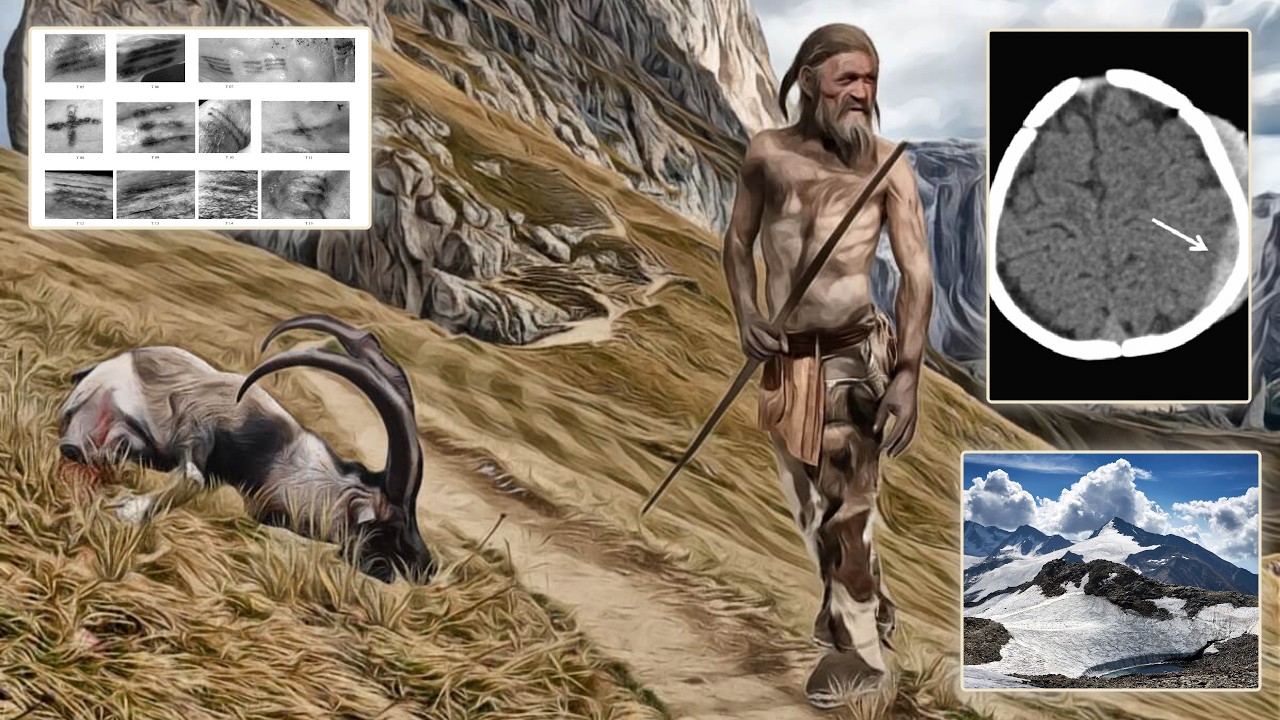
The ice had worked as a perfect biological time capsule. It dried his skin to a dark, leathery texture, but preserved his internal organs, bones, stomach contents, and even blood cells. What medical examiners found first was that this supposed survivalist was a walking collection of prehistoric disease. Across his body, scientists mapped 61 distinct tattoos.
They were not decorative. They were simple, dark lines clustered around his lower back, knees, and ankles — placements that correspond almost exactly to ancient acupuncture points used for treating joint pain. The Iceman had been living with severe arthritis and undergoing medical treatment to manage it. His suffering did not stop there.
Genomic mapping revealed that Ötzi is the oldest known human infected with Lyme disease, a tick-borne illness that causes fatigue, neurological issues, and joint inflammation. Analysis of his intestines showed a parasitic whipworm draining his nutrients. Inside his stomach lining, researchers found an ancient strain of Helicobacter pylori, the bacteria responsible for stomach ulcers. The genetic signature of that strain carried deep Asian origins, offering a microscopic map of ancient human migrations.
Ötzi was not a robust, invincible mountain man. He was a man in his mid-forties — elderly for his era — struggling with a failing, parasite-riddled body. Despite his health, his equipment showed he was a person of significance. DNA analysis of his clothing in 2016 revealed a man who bridged two worlds.
His hat was made from the pelt of a wild brown bear, his quiver from wild roe deer, connecting him to the untamed forest. But his heavy coat and shoes were patched together with the hides of domesticated sheep and goats. He was both hunter and herder. His tools elevated his status further.
Beside him lay an unfinished bow and a quiver with only two arrows ready to fire. His most prized possession, however, was a flawless copper axe. In the Copper Age, such an axe represented significant wealth and authority. This was not a random shepherd.
This was a man of consequence. In 2016, scientists used CT scans of his vocal tract to digitally reconstruct the sound of his throat. They synthesized the ancient dimensions of his airways and allowed the world to hear a simulated echo of his voice — a deep, raspy sound reaching across five millennia. For a long time, researchers tried to match that profile to his physical appearance.
The first major genetic reconstruction, published in 2012, gave him pale skin and a full head of hair. That genome suggested ancestry linked to the Pontic-Caspian Steppe, fitting neatly into established theories of ancient European migration. But the 2012 study had a catastrophic flaw: contamination. When Ötzi was pulled from the ice in 1991, he was handled without gloves.
Dozens of modern people touched him, their DNA seeping into the porous outer layers of his bones. The technology of the time could not separate the ancient signal from the modern noise. By 2023, that technology had been transformed. A team at one of the world’s leading ancient DNA laboratories set out to rebuild the Iceman’s genetic code completely.
To bypass the surface contamination, they drilled deep into his pelvis — the densest bone in the body — to extract pure, untouched ancient DNA. They achieved a 15. 3 times coverage genome, meaning every gene had been read more than fifteen times, eliminating statistical error. The results, published in Cell Genomics, annihilated thirty years of museum displays.
The DNA proved conclusively that Ötzi did not have pale skin. He possessed the darkest skin pigmentation of any European individual from his era ever sequenced. His dark, leathery appearance was not simply an effect of the freezing — it was close to his living skin tone. The second shock involved his hair.
The genetic markers for male pattern baldness were overwhelmingly dominant. By his mid-forties, he was almost completely bald. The glorious beard and thick locks were fictions. Most staggering of all was his heritage.
The new pure genome showed zero percent Steppe ancestry. Ötzi was not the product of migrating populations. His DNA was almost entirely that of Anatolian Neolithic farmers, who had migrated from modern-day Turkey thousands of years earlier. By the time he lived, that pure Anatolian lineage was rapidly vanishing, absorbed by new waves of migration.
He was a genetic outlier — the last pure descendant of a line the rest of Europe was in the process of forgetting. So how did this aging, ailing, genetically isolated man end up frozen on a desolate mountain pass? For decades, the story was peaceful: a man caught in a sudden storm who fell asleep and died. In truth, his final hours were a tale of murder, panic, and desperate flight.
Botanical evidence hidden in his stomach and clothing reveals a terrifying timeline. In 2019, scientists analyzing remnants of more than 75 species of mosses and liverworts found on the Iceman made an alarming discovery. Some of those mosses grow only in the low-lying valleys of the Schnalstal region, far below the mountain pass. Hours before his death, Ötzi had been down in the valley.
And down there, something went horribly wrong. A deep laceration between his right thumb and index finger tells the story of a close-quarters struggle. It is a classic defensive wound — a man grabbing the blade of an attacker’s knife to save his life. The wound had just barely begun to heal, meaning the confrontation occurred a day or two before he died.
After that bloody encounter in the valley, he fled. He turned around and began a grueling climb back up into the freezing, thin air of the high Alps. Microscopic wear analysis on his flint tools adds a layer of psychological terror. The deep scratches show he was right-handed, but more importantly, that he had frantically re-sharpened his flint knife and arrowheads just before he died.
This was not the methodical work of a craftsman at peace. It was the panic sharpening of a man who knew he was being hunted. He climbed higher and higher — exhausted, bleeding, riddled with parasites, his joints screaming. Finally, he stopped to rest and ate a final meal of ibex meat and einkorn wheat.
He thought he was safe. He was wrong. The killer tracked him through the snow and rock. The forensics of the murder are undeniable.
The killer stood below him, aiming up the slope. A flint arrowhead tore into the Iceman’s left shoulder blade, puncturing his subclavian artery. For years, scientists believed that wound killed him within minutes. But in 2025, a reanalysis using state-of-the-art 3D CT scans proved otherwise.
The scans revealed a massive hematoma — a pool of clotted blood — around the wound. Such a hematoma does not form in a body that dies instantly. It forms only if the heart keeps beating. Ötzi survived the ambush.
He lived long enough, in agonizing pain, to reach around to his own back and violently snap the wooden shaft of the arrow, pulling it out while leaving the flint head buried deep in his flesh. He may have crawled. He may have tried to stand. The damage was terminal.
Perhaps the most chilling detail is what the killer left behind. Beside the dying Iceman lay his flawless, priceless copper axe. In an era when such an object could change a life, the assassin refused to take it. This was not a robbery.
It was an assassination. The killer likely left the axe behind because carrying such a recognizable weapon back to the villages below would have identified him as the murderer. The mountains swallowed the evidence, but not immediately. Botanical pollen analysis proved that Ötzi died in the late spring, as hop hornbeam trees were blooming in the valleys.
He lay dead on open, sun-baked rock for weeks. Insects found him — the presence of fly pupae proves his body began to decompose in the open air. Only months later, when the harsh winter returned, did the glacial ice creep over him and seal him in a frozen tomb for 5,300 years. The story of the Iceman is no longer a quaint museum diorama of a furry caveman caught in a storm.
It is a profound human tragedy. It is the story of a bald, dark-skinned, aging man suffering from Lyme disease and chronic pain, the last surviving thread of an ancient bloodline. A man who fought for his life in a valley, fled in terror up a mountain, frantically sharpened his tools to defend himself, and was shot in the back by an assassin who left him to rot in the sun. The name of the killer is unknown, as is the exact reason Ötzi had to die.
But modern science has ensured that the victim’s true face, his true suffering, and his true story will no longer remain buried in the ice.
