In the autumn of 1900, in a farmhouse parlor in southern Ohio, an old woman named Mercy Callender looked at the young man standing before her and refused to sell. He had come to buy the thing on her wall—a wreath of flowers framed under glass, made entirely from human hair—and he carried more cash in his coat than her whole farm made in a year. She turned him down flat. Then she asked him a question he couldn’t answer.
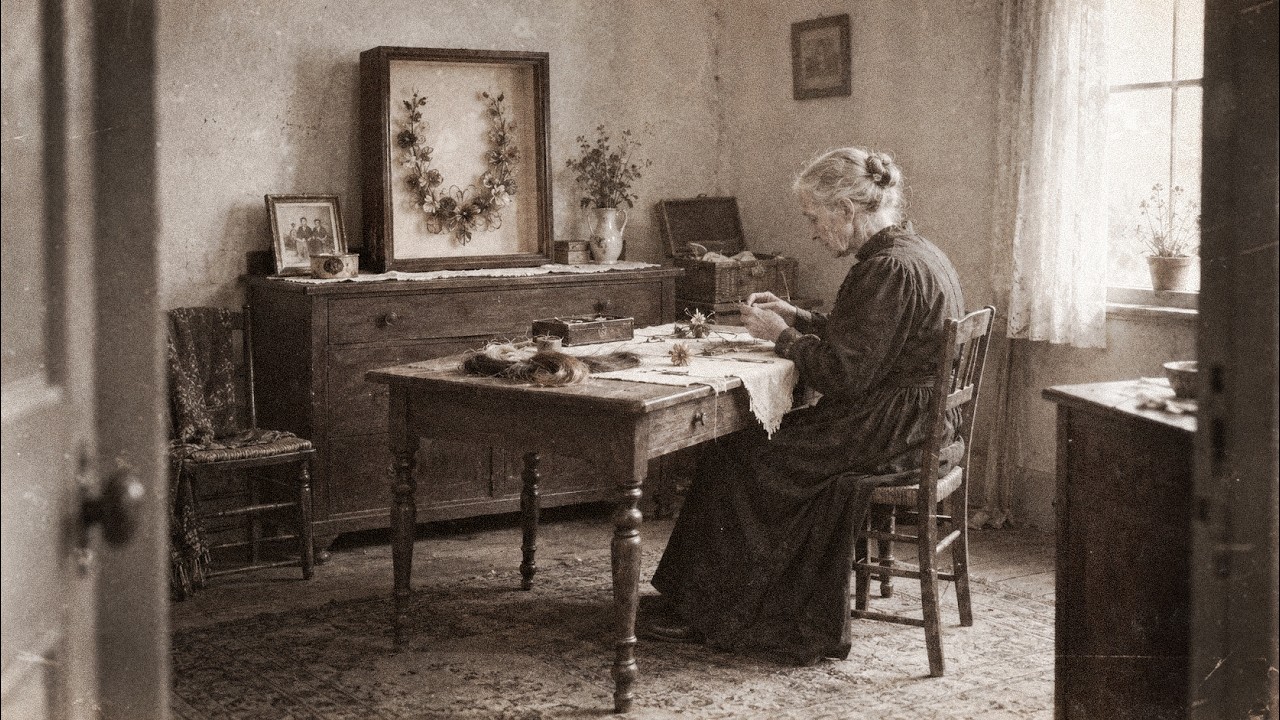
“Who’s buying them? ” she said. “And what do they want with our dead? ”
The young man was Walter Haynes, twenty-two years old, a traveling buyer working for a firm in Chicago.
He was the great-grandfather of the viewer who later sent this story in. After Walter died, his belongings went into a trunk, and in that trunk was a small leather ledger, the kind a salesman keeps in his breast pocket. The front half was filled with columns of figures—his purchases, his expenses, his routes. The back half he used as a diary.
Two things in that ledger never made sense to anyone in the family. The first was a missing page. Walter kept careful records, and for every purchase he noted where the goods were to be shipped afterward. But the page listing those shipping addresses had been torn out, close to the binding.
The second was an envelope tucked into the inside back cover. Inside was a single flower, no bigger than a thumbnail, made of fine brown hair twisted around wire. Nobody knew whose hair it was. By the end of this story, you will know—and you will understand why Walter kept it for the rest of his life.
First, you need to understand what a hair wreath was, because unless you’ve seen one, it’s very hard to believe. In the 1800s, across Britain and America, people kept the hair of the people they loved. Locks were cut from babies, from brides, from soldiers leaving for war, and from the dead. Some went into jewelry—rings, brooches, lockets with a curl behind glass.
When Queen Victoria lost her husband Albert in 1861 and went into mourning for the rest of her life, mourning jewelry made from hair became a fashion across the entire English-speaking world. Hair work was exhibited at the Great Exhibition in London in 1851. Instruction books taught the craft, like Mark Campbell’s *Self-Instructor in the Art of Hair Work*, published in 1867. And there were wreaths.
A hair wreath was made by the women of a family, usually at the kitchen table, over months or years. Strands of hair were wound around fine wire and looped and twisted into petals, leaves, buds, and whole flowers. Each flower might be made from the hair of a different person. The flowers were wired together into a horseshoe shape, usually with the open end at the top, and the finished wreath was mounted in a deep wooden frame called a shadow box and hung in the parlor—the best room of the house.
A large one could hold the hair of dozens of people: brown and black and auburn and blonde, the white of the very old, and the pale, almost colorless hair of babies. That’s what we’re told they were—sentimental keepsakes, a mourning fashion, something to remember the dead by. Mercy Callender told Walter Haynes that was only half of it. Walter described her in the back of the ledger.
Ninety-four years old, small, very straight, sitting in a rocking chair she didn’t rock. Her parlor wall held a wreath bigger than any he’d seen, more than two feet across in a frame of dark walnut. He’d been told to look out for wreaths exactly like it—the bigger, the better, and above all, the more colors, the better. Here’s the strangest part.
Walter’s ledger has a column for that. Town, family name, price paid—and then a column headed “heads. ” Walter wasn’t paid by the size of the wreath or the quality of the frame or the condition of the glass. He was paid by how many different people’s hair it contained.
He’d count the colors and textures as best he could, write the number in the column, and pay accordingly. A wreath with ten heads was worth a few dollars. A wreath with forty was worth a great deal more. Mercy’s had sixty-one.
Sixty-one people. One family. She knew the number exactly because she could read it. That’s the part Walter couldn’t get over.
She had him bring the frame down from the wall and set it on the table. Then she went around the wreath with one bent finger, flower by flower, and named every single person in it. “This one at the very bottom,” she said, “the dark one. That’s my grandmother’s mother.
She came from Wales. These two beside her are her sons. This one with the gray in it is my grandfather. ”
And then up the left side of the horseshoe and up the right, generation after generation, the wreath climbed.
Husbands and wives were twisted together into a single flower, their two colors wound into one. Their children branched out above them. The tiny white buds tucked among the leaves were babies who hadn’t lived. The newest flowers, nearest the open top, were her own grandchildren and great-grandchildren—still alive, still growing.
It wasn’t a decoration. It was a family tree. Every flower was a person, and its place in the wreath told you who they were, who they married, and whose child they were. Walter wrote down what she said next, word for word.
“It’s the family book,” she said, “the only one nobody can rewrite. ”
Then she explained what she meant, and Walter recorded that too. A parish register can be burned, she said. The courthouse can burn.
Somebody can cut a page out of the Bible and write a new one—but you can’t forge a person’s hair. You can’t make a dead woman’s hair grow on someone else’s head. “Bones go to dust,” she said. “Paper burns.
Hair remembers. ”
Mercy wasn’t the only one who could read a wreath. Decades later, a folklorist collecting old memories in the hill country of Kentucky wrote down a line from an old man who’d grown up with the wreath on the parlor wall. “My grandmother could read a wreath like a book,” he said.
Years after that, in Indiana, an elderly woman told a local historian almost the same thing in almost the same words. Different states, different decades, the same sentence—as if, once upon a time, every family had someone who could read one, and then, quite suddenly, nobody did. She showed him one more thing. Down inside the wreath, wrapped tight around the wire stems where you’d never see them unless you knew to look, were tiny twists of paper.
On each was a name and two dates, written in a hand so small it was almost a thread itself. The key, she called it—so that when she was gone, anyone could read it. Walter didn’t know who was buying the wreaths. He’d been hired by a firm in Chicago through a newspaper advertisement.
He was given cash, a list of counties, and his instructions. Buy old hair work—wreaths especially—and family Bibles if they were offered. Pay generously. Don’t haggle.
Ship everything to the address on the list. He’d never asked what happened to them after that. He wrote that night in the back of the ledger that he’d assumed they were being sold on to collectors. And then, underneath, he added a line.
*Why would collectors want the Bibles? *
Here’s what we’re told. Hair wreaths were a Victorian fashion, and like every fashion, they faded. By the early 1900s, they looked old-fashioned.
After the First World War, with millions dead, people turned away from the elaborate rituals of Victorian mourning, and hair in particular began to seem morbid, even a little disgusting. Grandchildren cleared out their grandparents’ parlors and threw the old wreaths away. Thousands simply rotted in attics and barns. That’s the line every history of the craft draws.
Nobody destroyed them. People just stopped caring. The official explanation collapses on Walter’s ledger, because people didn’t just stop caring. Somebody was paying them to let go.
The trade Walter was part of is real, and it’s stranger than you’d think. In the 1800s, human hair was a valuable commodity. The fashions of the time called for hairpieces, switches, braids, and false curls, and there wasn’t nearly enough hair to supply them. So buyers went out and harvested it.
In parts of rural Europe—especially in Brittany, in the west of France—hair merchants traveled from fair to fair, and young women sold their hair, cut off on the spot, for money or for cloth and ribbons. Contemporary writers described piles of it, sorted by color. The trade ran across the Atlantic. Hair was bought by the pound.
So there really were men going door-to-door paying cash for human hair in exactly those years. But a wreath is a strange thing to buy if all you want is hair. The strands in a wreath are short, wound around wire, stiffened with age. You couldn’t make a fashionable braid from them.
And the hair trade bought hair by weight, by length, by color. It didn’t pay by the head. It didn’t care whose it was. Walter’s buyers did.
They cared about exactly one thing: how many different people were in it. There’s something else. The Victorians themselves knew that hair could be swapped. One of the great worries of the period was that if you sent a dead relative’s hair away to a professional jeweler, you might get back a brooch made from some stranger’s hair—bought cheap by the pound—and you’d never know.
That’s one reason the instruction books existed. Women were told to do the work themselves at home, so they could be sure every strand in the finished piece was the one they’d been given. The whole point of a wreath was that it was certain. Every flower was who the family said it was.
The official explanation collapses right there. If wreaths were worthless sentimental clutter, nobody would pay cash for them by the head. If all anyone wanted was hair, any hair would do. Somebody wanted these wreaths precisely because they were certain—because each one was a whole family, proven in its own bodies.
Walter didn’t think about any of that at first. His ledger shows he’d been working for seven weeks before he reached Mercy’s door, and in those seven weeks he’d bought thirty-eight wreaths. He wrote about some of them. A widow in Portsmouth who cried the whole time and took the money anyway because her roof leaked.
A farmer who sold his grandmother’s wreath for nine dollars and then followed Walter down the lane asking to buy it back—and Walter, following his instructions, said no. A young couple who laughed at the old thing and were glad to see it go. Thirty-eight families, and not one of them, Walter wrote, could tell him who was in it. Once you see it, you can’t unsee it.
Because the wreaths weren’t the only family records disappearing. In 1890, the United States carried out its eleventh national census—a record of every person living in the country at the time, more than sixty-two million people, household by household, name by name. In January 1921, a fire broke out in the basement of the Commerce Building in Washington, where the records were stored. The 1890 census was badly damaged by flames and by the water used to fight them.
Over the following years, almost all of what survived was destroyed anyway, with official approval, in the 1930s. Today, only a few fragments remain. For genealogists, the 1890 census is the great hole in American family history. A whole generation from the end of the Civil War to the turn of the century simply isn’t there.
Then, a year later, on the other side of the Atlantic, it happened again. In June 1922, during the opening of the Irish Civil War, the Four Courts in Dublin were bombarded, and an explosion and fire destroyed the Public Record Office of Ireland. Centuries of records went up in a single afternoon. Among them were more than a thousand Church of Ireland parish registers that had been gathered there for safekeeping—births, marriages, burials for generations of families.
Burned paper fell like snow across Dublin. Paper burns. That’s what Mercy said. The pattern repeats with unsettling precision.
Across America, wreaths that recorded whole families bought up for cash, counted by the head. The record of every American alive in 1890 burned, then thrown away. The parish books of Ireland gone in an afternoon. All of it within a single generation, on both sides of an ocean.
It’s the same three steps every time. Buy it up, break it apart, burn the key. Look at what else was happening in exactly those years. The early 1900s were the age of an obsession with heredity.
In America, an entire movement arose that wanted to study—and to control—which families were fit to have children. It collected family pedigrees by the thousand and ended in laws that sterilized tens of thousands of people against their will. A history that is real, documented, and shameful. Nothing in Walter’s ledger connects that movement to his firm, and nothing here invents such a connection.
But it tells you something about the age. In the same decades the wreaths were vanishing, the question of who descended from whom had suddenly become something powerful people wanted to own. Think about what this would take. A firm in Chicago paying top dollar for family wreaths.
Fires in Washington and Dublin. Governments approving the destruction of what the flames left. A culture that decided almost overnight that keeping the hair of your dead was morbid and shameful. Different places, different reasons, and the same result.
In one generation, the ordinary families of the English-speaking world lost a great deal of the record of who they were. So ask the question nobody wanted asked. Who benefits when a family loses its own book? A family with a wreath on the wall knows exactly who it is.
It doesn’t need anyone’s permission to say who its great-grandmother was, or where she came from, or whose child is whose. Its record is in the hair of its own people, in its own parlor, under glass, and it can’t be forged or rewritten. Take that away, and the only record left of who you are is the one somebody else keeps—a register in an office, a file in a basement, a census on a shelf. Records that can burn, records that can be corrected, records that someone else gets to read.
To any new order that wants to decide who belongs and who doesn’t, a family that keeps its own unforgeable record is a problem. A wall full of them is a problem. Unless the forgetting was the point. No one sat in a room and planned it, but think about what it did.
And then remember what the firm asked Walter to buy along with the wreaths—the family Bibles. Try to picture what it looked like to make one of those wreaths. A winter evening in the 1850s, Mercy in her forties, the kitchen table cleared after supper, the lamp turned up. A lock of hair on a sheet of paper, cut that morning from a baby born three days before.
The fine wire, the little steel tools, the pot of gum. Her fingers winding the hair around the wire, loop after loop, forming a bud no bigger than a grain of wheat. Her daughters watching, learning, the baby asleep upstairs. And then, before the bud went into the wreath, a scrap of paper—a name and a date in tiny writing—twisted around the stem where no one would see it, so that in a hundred years anyone could know.
And picture the wreath being read. Christmas, the whole family crowded into the parlor, the frame taken down and set on the table. Children leaning in. An old woman with a bent finger going from flower to flower.
“This is your great-great-grandmother. This one is your uncle who died at Shiloh. This little white one is your sister you never met. ” And the children finding their own flower near the top and touching the glass over it—understanding, for the first time, that they were part of something that had been growing for a hundred years before them.
And yet, the wreaths were never all destroyed. This is where Mercy’s question finally gets its answer. Plenty survived. They turn up in antique shops, in estate sales, in attics.
Museums hold them. In Independence, Missouri, there’s an entire museum devoted to hair art with hundreds of wreaths on its walls. Most of the people who own them have no idea whose hair was in them, because the key is long gone, or was never found, or the paper twists crumbled to dust. But the hair is still there.
And that’s what Mercy understood, and what nobody else in 1900 could have. Hair remembers. Here’s the strangest part of all. In 2010, scientists sequenced the first complete genome of an ancient human being.
It belonged to a man who lived in Greenland around four thousand years ago. They didn’t get it from his bones. They got it from a tuft of his hair preserved in the frozen ground. Once you see it, you can’t unsee it.
Today, researchers can recover DNA from hair kept in lockets and envelopes and old frames—hair that’s been sitting in parlors for well over a century. The shaft of a hair alone carries some of it. A hair with its root carries much more. The family records that burned in Washington and Dublin are gone forever, but a wreath, in principle, still carries the record of every person in it, in their own bodies, written in a language nobody in 1900 could read.
The paper burned. The hair didn’t. What did they want with our dead? No one can say who was behind Walter’s firm, and no honest account pretends otherwise.
But it’s possible to say what they were buying. Not hair. Not frames. Records.
The one family record that couldn’t be burned, forged, or corrected, because it was made out of the family itself. And some of those records are still out there—still waiting in attics and barns and antique shops for somebody to read them. Now go back to Walter’s ledger and the little flower in the envelope. Walter didn’t buy Mercy’s wreath.
She wouldn’t sell it at any price. But before he left, she did something he didn’t understand until later. “She’d been looking at him the whole afternoon,” he wrote, “more than at the money. ” At the end, she asked him to take off his hat.
She looked at the top of his head for a long time—at the place where the hair grows in a spiral. Then she asked him his mother’s name. He told her he didn’t know it. He’d been raised in an orphan’s home in Cincinnati from the time he was a baby.
He knew his surname and nothing else. Mercy turned the wreath over, opened the back of the frame, and with a pair of small scissors, she cut out one flower—a little brown one from the right-hand side near the top. She unwound the paper twist from its stem, read it, and gave both to him. And she said the last thing Walter ever wrote down from that afternoon.
“You’ve got her crown. I’d know it anywhere. ”
The paper twist is still in the envelope with the flower. The viewer unrolled it very carefully with tweezers.
In tiny, thread-like writing, it reads: “Hannah Haynes, born 1856, died 1879. ”
Walter was born in 1878. Mercy Callender’s niece. Walter’s mother.
In a wreath he’d come to buy. The last entry in the ledger is two days later. “Return the money. Will not buy another.
”
Walter never worked for the firm again. At some point after that, the page with the shipping addresses was torn out. The viewer thinks Walter did it himself, so that no one could ever follow the trail. Or maybe somebody else did, so that no one could ever follow it back.
There is no neat conclusion here—only a question much bigger than one family in Ohio. Who was behind the firm in Chicago, and why did they pay by the head? Where did the thousands of wreaths go, and what happened to them there? Why did the family Bibles matter?
Why did the record of an entire generation of Americans and centuries of Irish parish books disappear in the very same years? And how many of the wreaths still hanging in antique shops today are someone’s whole family, waiting to be read? The story keeps returning to that parlor in the autumn of 1900. The walnut frame on the table, an old woman with a pair of small scissors, and a young man who came to buy his own family and didn’t know it until she told him.
He kept that little flower for the rest of his life. It’s still in the envelope—still brown, still as soft as the day it was cut from a girl who died when he was one year old. Everything else about her is gone. Her face, her voice, her grave, if there was one.
But the flower is still there, in the back of the ledger, waiting. Bones go to dust. Paper burns.
Hair remembers.
