The U-boat captain was confident. He had surfaced for a surface attack, his low profile and German engineering making him invisible, and ahead of him lay a massive Allied convoy, a wall of steel and supplies. He moved in for the kill. He did not realize he had just stepped into a trap set by the most relentless U-boat killer in history.
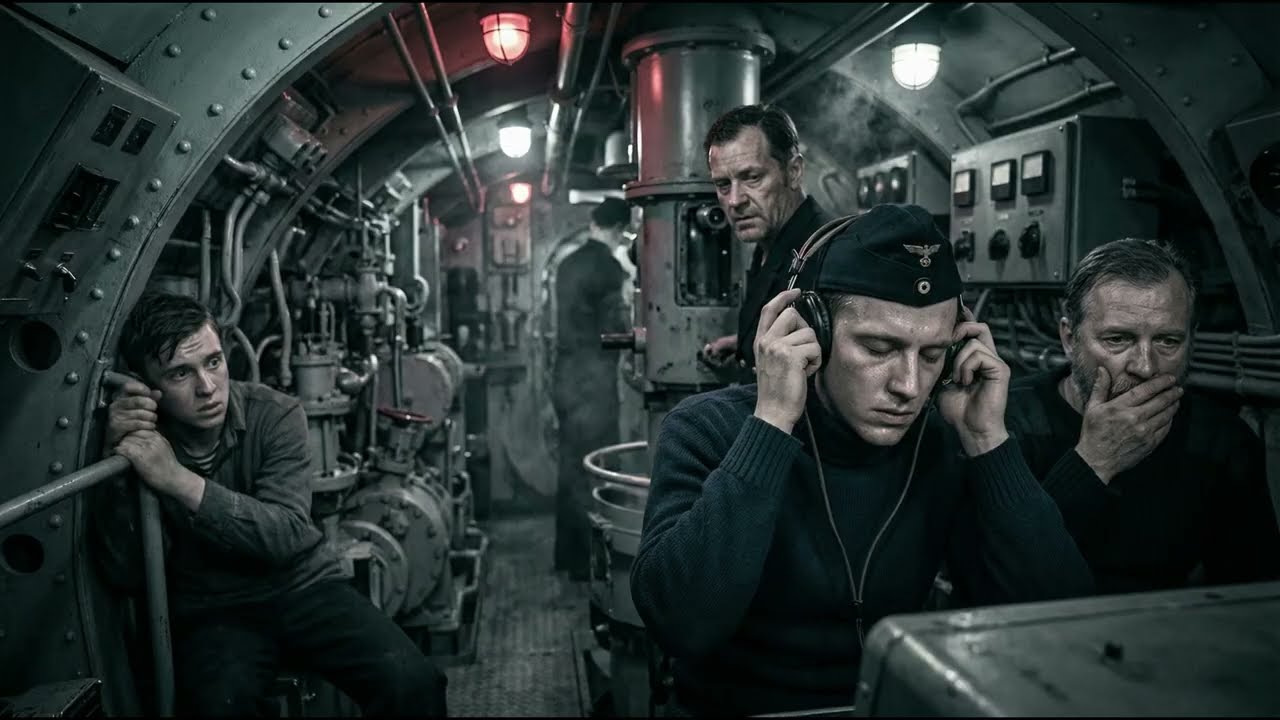
When the U-boat finally surfaced, expecting a slaughter, it found itself staring directly into the barrels of an entire British hunter-killer group. What happened next was not a battle. It was a demolition, both psychological and physical, that left the German naval elite speechless. The German U-boat crews of World War II considered themselves the elite of the master race.
They called themselves the gray wolves. They believed the Atlantic was their private hunting ground, and that Allied merchant ships were merely helpless prey waiting to be slaughtered. Their strategy was built on arrogance. They would strike from the dark, vanish beneath the waves, and laugh as the clumsy Allied escorts searched aimlessly for them.
For the first few years of the war, they were right. They were winning. But by 1943, the status was about to shift. Captain Frederick Johnny Walker was the ultimate unbothered master.
While the Germans obsessed over the heroic image of the U-boat commander, Walker viewed them as pests that needed to be exterminated. He did not just want to sink them. He wanted to break their spirit. Walker pioneered a tactic called the creeping attack.
Most Allied ships would rush in, drop their depth charges, and hope for the best. Walker was different. He would sit on top of a submerged U-boat for hours. He would play music over the ship’s loudspeakers.
He would let the Germans hear the sound of his propellers circling them over and over, like a shark playing with its food. The psychological pressure inside a German U-boat during a Walker attack was unbearable. The temperature would rise. The oxygen would run low.
The gray wolves would be reduced to terrified men huddled in a steel tube listening to a British captain who seemed entirely bored by their existence. In this particular encounter, the U-boat captain was desperate and running out of air. He made the fatal decision to blow the ballast tanks and surface. He hoped that by surfacing close to the convoy, the Allied ships would be too crowded to fire on him without hitting each other.
It was a gamble born of pure arrogance. As the U-boat breached the surface, foam and spray flying, the German crew scrambled onto the bridge, ready to man their deck gun. They expected chaos. They expected the British to panic.
Instead, they were met with a chilling sight. The HMS Starling, Walker’s flagship, was already there. It was not maneuvering to avoid them. It was accelerating.
Walker had not even bothered to use his main guns yet. He was heading straight for them. The impact was immediate. The Germans realized they were not being treated as a dangerous warship.
They were being treated as an obstacle. Walker’s orders were legendary. As the Starling bore down on the U-boat, he signaled the rest of his fleet to stay back. He wanted this one for himself.
As the British sloop slammed into the side of the U-boat, the sound of grinding steel filled the air. The German sailors were thrown across the deck. The invincible U-boat was being crushed by a British escort ship that had been built in a fraction of the time and cost. But Walker was not done.
As the U-boat began to sink, the German survivors jumped into the water. In a traditional naval encounter, there is a moment of somber respect for a fallen enemy. Not for Johnny Walker. He looked down from the bridge of the Starling at the bobbing heads of the master race in the oily water.
He did not offer a salute. He did not offer a speech about brave foes. He reportedly looked at his watch, turned to his officer, and complained that the engagement had taken ten minutes longer than it should have. The news of Walker’s hunter-killer groups sent shockwaves through the Kriegsmarine.
Admiral Dönitz, the head of the German Navy, was forced to admit that the U-boat was no longer the predator. Walker’s group once sank six U-boats in a single patrol. When they returned to Liverpool, the docks were lined with thousands of people. They played the tune “A-Hunting We Will Go” over the ship’s speakers.
The German U-boat arm suffered the highest casualty rate of any branch of any military in history. Nearly 75 percent of all U-boat men never returned home. The gray wolves who thought they would rule the world ended the war as terrified boys hiding in the dark, waiting for a British captain who was not even afraid of them.
