On June 24th, 1944, a messenger walked through artillery fire into Major General Ralph Smith’s command post on Saipan. The Army general was hunched over a map, directing an assault against Japanese positions dug into cliffs that dominated the battlefield. The messenger handed him a folded paper. Ralph Smith read it, pocketed it, and continued giving orders as if nothing had happened.
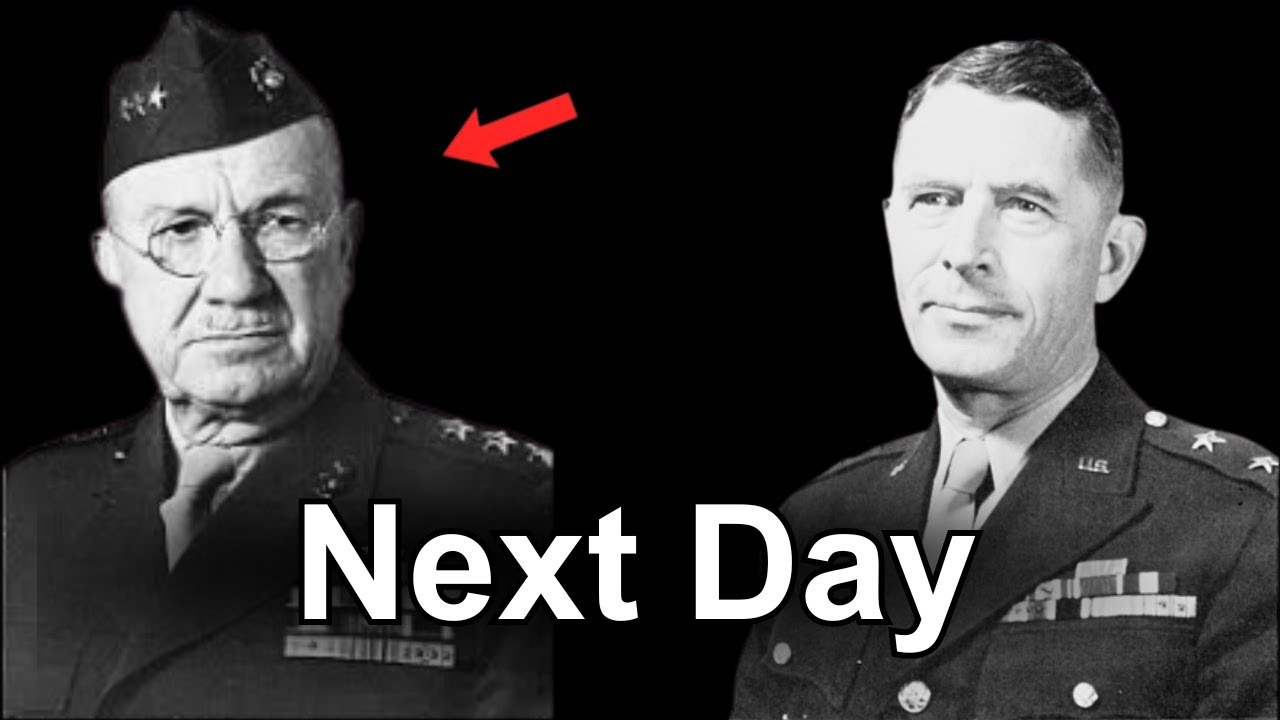
The message contained two sentences. He had been relieved of command, effective immediately. Marine Lieutenant General Holland Howlin’ Mad Smith had just done something that had never happened in American military history. He fired an Army general in the middle of combat.
Not for losing, not for cowardice, not for disobeying orders—for moving too slowly. The most aggressive Marine general in the Pacific had just destroyed the career of an Army commander whose division was fighting through the worst terrain on the island while sustaining fewer casualties than the Marines on either flank. But Holland Smith had been building his case against Ralph Smith for months. The two generals shared the same last name.
They shared nothing else. Holland Smith kept a mental list of every time the Army disappointed him: every delay, every excuse, every moment when Army troops didn’t attack with the suicidal aggression he demanded from his Marines. At Makin seven months earlier, he had driven behind Army lines, found supply troops unloading equipment, and screamed at them for not being at the front. He never bothered to check where the actual front line was.
It was three miles away. Ralph Smith knew Holland Smith hated him. What he didn’t know was that Holland Smith had already decided the Army general was incompetent before the first shot was fired on Saipan. That decision was about to trigger an interservice war that would reach all the way to President Roosevelt’s desk.
Because Holland Smith wasn’t just firing an Army general—he was declaring that Marines were superior to soldiers. The United States Army was about to fight back. Ralph Corbett Smith graduated from the Colorado Agricultural College in 1910 and entered the Army as a second lieutenant. He wasn’t West Point.
He wasn’t from a military family. He was a college graduate who wanted to serve, and the regular Army officers looked down on him for it. During World War I, Smith commanded infantry companies in France. He didn’t lead reckless charges.
He studied German tactics. He learned how artillery and infantry worked together. He kept his men alive while achieving objectives. His superiors called him cautious.
His soldiers called him competent. After the armistice, Smith spent twenty years in the peacetime Army. He taught at the Infantry School. He studied tactics at the Command and Staff College.
He rose slowly through the ranks by being methodical and thorough. By 1942, he commanded the 27th Infantry Division, a New York National Guard unit that had been federalized in 1940. The division was filled with truck drivers, dock workers, and factory laborers from Brooklyn and the Bronx. They weren’t professional soldiers.
They were civilians in uniform. Smith trained them the only way he knew how: slowly, methodically, with an emphasis on combined arms and mutual support. The Marine Corps trained differently. Marines rehearsed amphibious assaults against fortified positions.
They practiced speed and aggression. They expected casualties. Their doctrine assumed that hesitation got more men killed than aggressive action. Both approaches worked.
They just didn’t work the same way. Ralph Smith’s Army division was designed to advance across a broad front with artillery support and careful coordination. Holland Smith’s Marine divisions were designed to hit a beach, overwhelm the defenses, and accept whatever casualties came with that approach. Neither general understood the other’s methods.
Holland McTyeire Smith was everything Ralph Smith wasn’t. He graduated from Alabama Polytechnic Institute in 1901 and law school in 1903, but he hated being a lawyer. He joined the Marine Corps in 1905 as a second lieutenant. He was loud, he was profane, and he had a volcanic temper that terrified junior officers.
During World War I, he commanded a weapons battalion in France. After the war, he became the Marine Corps’s leading expert on amphibious warfare. He wrote the manuals. He designed the training.
By 1944, he was the most feared general in the Pacific. Marines loved him because he fought for them. He demanded the best equipment, the best naval gunfire support, the best air cover. He screamed at admirals.
He threatened to resign if he didn’t get what his Marines needed. But he also demanded absolute obedience. When Marines froze under fire, he had them court-martialed for cowardice. When officers hesitated, he relieved them on the spot.
He believed that aggressive leadership and aggressive tactics won battles. Half of that belief was correct. The other half got men killed. Holland Smith’s reputation was built on success.
Tarawa, Kwajalein, Roi-Namur. His Marines took fortified islands that military experts said were impregnable. But those victories came with horrific casualties. At Tarawa in November 1943, nearly a thousand Marines died taking an island two miles long.
Holland Smith called it acceptable. The Navy called it a massacre. Holland Smith didn’t care about the Navy’s opinion. His Marines had won.
That was all that mattered. In November 1943, Holland Smith commanded the invasion of Makin. The Marines would take Tarawa while Ralph Smith’s Army division took Makin. Intelligence estimated eight hundred Japanese defenders on Makin.
Ralph Smith had 6,500 soldiers. Holland Smith expected the Army to finish in one day. It took four. Holland Smith was livid.
He drove to what he thought was the front line to see why the Army was so slow. He found soldiers standing around in what looked like a rest area. He exited his jeep and unleashed a tirade about Marine Corps superiority and Army incompetence. What Holland Smith didn’t know was that he never made it to the front line.
He was three miles behind it. The soldiers he was screaming at were supply troops doing exactly what they were supposed to do—unloading ammunition and rations. The actual infantry was fighting through dense jungle against Japanese positions that had been reinforced far beyond what intelligence predicted. When Army investigators examined Holland Smith’s accusations, they found them baseless.
But the damage was done. Holland Smith had decided the 27th Infantry Division wouldn’t fight, and Ralph Smith couldn’t make them fight. Meanwhile, Admiral Chester Nimitz and General Douglas MacArthur were both watching the growing tension between the services. Nimitz commanded the Navy’s island-hopping campaign through the Central Pacific.
MacArthur commanded Army operations in the Southwest Pacific. Both men needed the Marines and the Army to work together, but interservice rivalry was poisoning operational planning. Marines accused Army troops of being timid. Army officers accused Marines of being reckless with their men’s lives.
Casualties on both sides were staggering, but Marine casualties were consistently higher. The Army pointed to that as proof that their methodical tactics worked. The Marines pointed to faster advances and said speed saved lives. In June 1944, the Americans invaded Saipan.
The island was 1,250 miles from Tokyo. Capturing it would put B-29 Superfortress bombers within range of the Japanese home islands. Thirty thousand Japanese troops defended Saipan. The invasion force included two Marine divisions and Ralph Smith’s 27th Infantry Division.
Holland Smith commanded all ground forces as commander of V Amphibious Corps. He assigned the Marines to the island’s flanks, where the terrain was relatively open. He assigned the Army to the center, where a valley ran between two heavily fortified ridges. The valley had no official name.
The soldiers called it Death Valley. Japanese defenders occupied caves and reinforced positions on both ridges. They had interlocking fields of fire. They had mortars pre-sighted on every approach.
They had orders to fight to the death. On June 23rd, Ralph Smith ordered his division to attack through Death Valley. The 106th Infantry Regiment would advance up the left slope toward Mount Tapotchau. The 165th Infantry would attack Purple Heart Ridge on the right.
It was a frontal assault against prepared positions. Everyone knew it would be costly. Holland Smith had ordered the attack to jump off at 0600. The 106th Infantry was late.
Different units reported different start times. Some battalions began at 0617. Others didn’t move until 0659. Holland Smith’s staff recorded the delay as anywhere from fifty-five minutes to two hours.
The truth was probably somewhere in the middle. What wasn’t in dispute was that the 106th Infantry advanced slowly once the attack began—very slowly. By nightfall, they had gained less than three hundred yards. The 165th Infantry on the right did better, but not much.
They fought all day for Purple Heart Ridge and barely dented the Japanese defenses. On the flanks, the Marine divisions advanced rapidly. The 4th Marine Division on the right pushed forward over a thousand yards. The 2nd Marine Division on the left gained similar ground.
But as they moved forward, their flanks became exposed. The Army division in the center wasn’t keeping up. Japanese troops on the ridges could fire into the Marines from behind. Holland Smith ordered the Marines to halt.
He was furious. He drove to the front to see what was wrong with the Army. This time he actually made it to the front line. What he saw convinced him that Ralph Smith had to go.
Here’s what Holland Smith didn’t see. He didn’t inspect the Japanese positions on the ridges. He didn’t talk to battalion commanders about why the advance was slow. He didn’t ask artillery officers why they couldn’t suppress the enemy fire.
He looked at the map. He saw the Marines advancing. He saw the Army stalled. And he made a decision based on prejudice, not facts.
Ralph Smith’s soldiers were fighting on terrain that made maneuver impossible. Every approach was covered by machine guns. Every ridge was honeycombed with caves. Flanking was impossible on the left because of Mount Tapotchau’s cliffs.
Flanking was difficult on the right because of Japanese positions that dominated the valley floor. The Army’s doctrine in this situation was clear: fix the enemy with frontal pressure, bring up artillery, reduce the fortification systematically, accept slower progress in exchange for fewer casualties. Ralph Smith was following that doctrine. His soldiers were taking losses, but not as many as they would have taken with reckless frontal assaults.
Holland Smith’s doctrine was different. Attack. Keep attacking. Accept casualties if necessary.
Speed saves lives by keeping the enemy off balance. Both doctrines had merit, but Holland Smith only believed in one of them. On June 24th, the 27th Infantry Division attacked again. Progress was marginally better than the previous day.
The 106th Infantry gained about five hundred yards. The 165th Infantry fought all day for Purple Heart Ridge and captured parts of it. Casualties were heavy, but the Marines on the flanks had to halt again because the Army hadn’t caught up. Holland Smith had seen enough.
He drove to the command ship USS Indianapolis and requested a meeting with Admiral Richmond Kelly Turner and Major General Sanderford Jarman. Holland Smith told them that Ralph Smith was incompetent, that the 27th Division wouldn’t fight, and that the entire corps operation was being jeopardized by Army timidity. Turner agreed immediately. Jarman, who would become Saipan’s garrison commander after the battle, was more hesitant.
But Holland Smith insisted. Admiral Raymond Spruance, the overall fleet commander, authorized the relief. At 1430 on June 24th, a messenger delivered the order to Ralph Smith’s command post. Major General Ralph Corbett Smith was relieved of command of the 27th Infantry Division.
Major General Sanderford Jarman would assume command immediately. The official reason was defective performance. The real reason was that Holland Smith had decided months earlier that the Army couldn’t fight as well as the Marines. Ralph Smith read the message.
He didn’t argue. He didn’t protest. He handed command to Jarman and walked to a transport ship that would take him off the island. His division was still in contact with the enemy.
His soldiers were still dying on Purple Heart Ridge and in Death Valley. But he was no longer their commander. As he left, Ralph Smith told one of his staff officers to send a message to Lieutenant General Robert Richardson, the commander of all Army forces in the Pacific. No Army combat troops should ever again be permitted to serve under the command of Marine Lieutenant General Holland M.
Smith. That message would start a war. Jarman, who initially agreed with Holland Smith’s assessment, changed his mind after commanding the division. He wrote a report stating that the Japanese positions in Death Valley were formidable and that tactical difficulties were greater than estimated.
He concluded that Holland Smith did not familiarize himself with the particular difficulties the 27th Division faced. General George Griner was even more blunt. After quarreling with Holland Smith for a week, Griner wrote that he had a firm conviction that Holland Smith was so prejudiced against the Army that no Army division serving under his command alongside Marine divisions could expect their deeds to receive fair and honest evaluation. On July 4th, while fighting was still ongoing on Saipan, Lieutenant General Robert Richardson convened a board of inquiry.
Richardson was the Army’s senior commander in the Pacific. He despised Holland Smith. He believed Marines were given too much credit for victories that Army troops made possible. The board was headed by Lieutenant General Simon Bolivar Buckner and consisted entirely of Army officers.
It heard testimony only from Army personnel. The board examined Holland Smith’s charges against Ralph Smith and reached four conclusions. First, Holland Smith had the authority to relieve Ralph Smith. Second, the orders were properly issued.
Third, Holland Smith was not fully informed regarding conditions in the zone of the 27th Infantry Division. Fourth, the relief was not justified by the facts. The Buckner board’s report was devastating. It concluded that Holland Smith had fired Ralph Smith based on prejudice, not performance.
The 27th Division had been assigned the worst terrain on the island. The Japanese had concentrated their strongest defenses in Death Valley. The Army’s slower advance was the result of tactical realities, not lack of aggression. The board found that the 27th Division’s casualties were substantial and that the soldiers fought with reasonable tactical direction.
Holland Smith’s decision to fire Ralph Smith was based on ignorance of the battlefield and deep-seated bias against the Army. Admiral Spruance and Admiral Turner both protested the board’s findings. They argued that Holland Smith had acted correctly and that Army troops had failed to match Marine aggressiveness. Holland Smith himself wrote to Admiral Nimitz stating that the board’s conclusions were unwarranted and that he remained convinced the 27th Division was not accomplishing even the combat results to be expected from a properly trained unit.
But Holland Smith’s protests couldn’t change the facts. His own replacement commanders had confirmed that Ralph Smith had faced impossible terrain and had performed as well as could be expected. A week after Saipan was secured, Richardson landed on the island without permission from Holland Smith or any naval commander. He reviewed the Army troops.
He presented decorations. He gave speeches praising the 27th Division’s valor—all without consulting the Marine general who still commanded the island. When Holland Smith confronted him, Richardson unleashed a tirade. “I want you to know that you cannot push the Army around the way you have been doing.
You and your corps commanders aren’t as well qualified to lead large bodies of troops as general officers in the Army. You Marines are nothing but a bunch of beach runners anyway. What do you know about land warfare? ”
Holland Smith, who normally exploded at the slightest provocation, said nothing.
He turned and walked out. Then he drove to Admiral Turner’s flagship and demanded that Richardson be court-martialed for insubordination. Turner and Spruance agreed. They sent formal complaints to Admiral Chester Nimitz, stating that Richardson had committed unwarranted assumption of command authority.
The dispute climbed to Washington. General George Marshall and Admiral Ernest King were both alarmed. On November 22nd, 1944, Marshall wrote to King that relationships between the Marines and the Army forces on Saipan had deteriorated beyond mere healthy rivalry. Marshall’s deputy chief of staff, Lieutenant General Joseph McNarney, reviewed all the evidence from both sides.
He concluded that Holland Smith’s V Amphibious Corps staff work was below acceptable standards. Ralph Smith had shown reasonably good tactical direction, but the division suffered from poor leadership among regimental and battalion commanders. Major General Thomas Handy, Marshall’s assistant chief of staff, was more direct. He wrote that Holland Smith had some cause to complain about the 27th’s aggressiveness, but that Holland Smith’s fitness for this command was open to question because of his deep-seated prejudice against the Army.
Handy recommended that both Smiths be removed from the Pacific theater. Marshall and King decided against official action. They hoped the controversy would die quietly. It didn’t.
On July 8th, 1944, the San Francisco Examiner ran a front-page story accusing Holland Smith of firing Ralph Smith because the Army general had protested reckless and needless waste of American lives. William Randolph Hearst editorialized that Marine commanders were one-dimensional and measured fighting spirit by casualty counts. He accused Holland Smith of being a butcher. Time magazine’s correspondent, Robert Sherrod, fired back.
Sherrod had landed with the Marines and embedded with them through the battle. He wrote that the 27th’s soldiers froze in their foxholes and had to be rescued by Marines. Sherrod’s article devastated the men of the 27th Infantry Division. They had fought for weeks against impossible odds.
They had taken horrific casualties, capturing positions that Marine commanders later admitted were the strongest defenses on the island. Now they were being accused of cowardice by a journalist who had never once visited their sector. Historian Jeff Lee Perret later wrote that the 27th Division’s morale never recovered from Sherrod’s article. The soldiers felt betrayed by their own country’s media.
These men fought through Death Valley and Purple Heart Ridge. They watched their friends die taking fortified caves. Their reward was a national magazine article calling them cowards. The controversy destroyed both generals’ combat careers.
Ralph Smith was given command of the 98th Infantry Division in Hawaii. It was technically a division command, but everyone knew it was exile. The 98th never saw combat. Ralph Smith spent the rest of the war training troops who would fight under other commanders.
He retired in 1946 without ever receiving another combat assignment. Holland Smith’s career ended differently but just as decisively. When Admiral Nimitz planned the invasion of Okinawa in 1945, Admiral Spruance and Turner wanted Holland Smith to command the assault forces. Nimitz overruled them.
Nimitz wrote that the Saipan controversy had created justifiable animosity between senior Army officers and Holland Smith. Placing him in command of another joint Army-Marine operation would be unwise. Holland Smith was promoted to commanding general of Fleet Marine Force Pacific. It was officially a promotion.
In reality, it was a way to remove him from combat command. His role at Iwo Jima in February 1945 was purely supervisory. He watched the battle from a command ship. The general who had spent his entire career preparing for amphibious warfare was sidelined for the last year of the war.
Lieutenant General Robert Richardson wrote to General Marshall recommending that no Army troops ever serve under Holland Smith again. He called Holland Smith prejudiced, petty, and unstable, with an apparent lack of understanding of how to employ larger units tactically. Marshall agreed. In a memo to his staff, Marshall wrote that Holland Smith had demonstrated unfitness for corps-level command and that Marines should command Marine divisions, not Army Corps.
That assessment ended Holland Smith’s combat career. It also ended any possibility that the Marine Corps would command large multi-service operations in the future. Ralph Smith never wrote a memoir. He never gave interviews about the relief.
When historians contacted him in the 1950s, he declined to discuss Saipan. He told one researcher, “I commanded my division to the best of my ability under the most difficult circumstances imaginable. Whether that was good enough is for others to judge. ” That was the closest he ever came to defending himself publicly.
Holland Smith wrote multiple memoirs. In his 1949 book Coral and Brass, he defended the relief as necessary to save the corps operation. He claimed Ralph Smith had failed to instill aggressiveness in his troops and that the 27th Division wouldn’t fight. But Holland Smith’s own words undermined his case.
In the same memoir, he admitted he never inspected Death Valley before firing Ralph Smith. He acknowledged that the terrain was difficult. He conceded that Japanese defenses were stronger than expected. And he admitted that his replacement commanders took six more days to capture positions he expected Ralph Smith to take in hours.
That admission cuts deep. Holland Smith fired a general for being too slow, then watched two other generals take six more days to finish the job. If Ralph Smith was incompetent, what did that make the generals who replaced him? In 1960, the Army published its official history of the Marianas campaign.
Historian Philip Crowl examined all available records from both services. He concluded that Holland Smith had good reason to be disappointed with the performance of the 27th Infantry Division on June 23rd and 24th. The division was late jumping off. Progress was slow.
Coordination was poor. But Crowl also concluded that whether the action he took to remedy the situation was wise remains doubtful. Firing Ralph Smith appears to have done nothing to speed the capture of Death Valley. The official history sided with neither general.
It stated that both had legitimate grievances and both made mistakes. George Marshall never publicly commented on the Saipan controversy. But in private letters uncovered decades later, Marshall wrote that Holland Smith’s relief of Ralph Smith was an error of judgment made by a combat commander who placed interservice pride above mission accomplishment. Marshall believed Holland Smith fired Ralph Smith to prove Marine superiority, not to improve combat effectiveness.
Admiral King disagreed. He wrote to Marshall that Holland Smith acted within his authority and in accordance with his best judgment. The two men agreed to disagree. They never resolved their differences over Saipan.
The Smith versus Smith controversy permanently changed how the American military conducted joint operations. After Saipan, the Joint Chiefs of Staff issued new guidelines for interservice command relationships. Marine generals would no longer command corps-level operations that included Army divisions. Army generals would command ground forces when multiple services were involved.
Marines would command purely Marine operations. The guidelines were designed to prevent another Saipan. They worked for the rest of the war. Army and Marine forces operated separately or under Army command.
No Marine general ever again relieved an Army division commander. The soldiers of the 27th Infantry Division fought in three more campaigns after Saipan. They took Tinian in July 1944. They returned to recapture the Philippines in 1945.
They fought on Okinawa, where they sustained some of the highest casualty rates of any American division in the Pacific. In every battle, they proved their combat effectiveness. At Okinawa, Marine and Army commanders praised the 27th for its performance. No one questioned their aggressiveness.
No one accused them of hesitancy. The division that Holland Smith called cowards earned battle honors that rivaled any Marine division in the theater. Ralph Smith died in 1998 at 105. He was the longest-lived American general officer of World War II.
He never publicly discussed the relief at Saipan. When he was buried at Arlington National Cemetery, the eulogy mentioned his distinguished service in two world wars and his dedication to the soldiers under his command. It did not mention Saipan. Holland Smith died in 1967 at 84.
His funeral was attended by hundreds of Marines who credited him with creating the modern doctrine of amphibious warfare. His eulogy praised him as the architect of victory in the Pacific. It mentioned Saipan only as one of many successful campaigns he commanded. The officers who investigated the controversy reached a conclusion that neither general wanted to hear.
Army historian Philip Crowl wrote that the relief of Ralph Smith was neither fully justified nor entirely without merit. Holland Smith had legitimate concerns about the 27th Division’s performance, but he acted on prejudice rather than facts. He fired Ralph Smith without understanding the tactical situation. He blamed Army doctrine for problems that were actually caused by terrain and enemy strength.
Ralph Smith, for his part, failed to communicate clearly with corps headquarters. He didn’t inform Holland Smith about the severity of Japanese defenses. He didn’t request additional artillery support. He didn’t push his regimental commanders hard enough to fix obvious problems with coordination and timing.
Both generals made mistakes. Both were victims of interservice rivalry that put pride above mission. And both paid the price. Ralph Smith lost his division.
Holland Smith lost his combat command. The real losers were the soldiers and Marines who died on Saipan while their generals fought each other instead of the Japanese. American forces suffered sixteen thousand casualties taking Saipan. Three thousand died.
Many of those deaths happened because Marine and Army units stopped coordinating effectively after the relief. Liaison broke down. Supporting fires became confused. Units advanced without flank protection because they didn’t trust each other anymore.
Holland Smith said Ralph Smith wouldn’t fight. He was wrong. Ralph Smith said Holland Smith was prejudiced and unstable. He was right.
But neither judgment matters compared to what actually happened. The 27th Infantry Division captured Death Valley and Purple Heart Ridge. They did it slowly. They did it methodically.
They did it with fewer casualties than reckless frontal assaults would have cost. Holland Smith fired Ralph Smith for refusing to throw his soldiers away. And in doing so, he proved that the most dangerous command decisions are the ones made from prejudice instead of facts. Holland Smith couldn’t control his contempt for the Army.
But in the end, he didn’t need to control it. He just needed to admit it. And that’s the one thing he never did.
