The spring of 1945 had turned the thousand-year Reich into a smoldering graveyard, and the world outside Germany saw only a defeated nation. But inside the ornate castles of Bavaria, a handful of men refused to accept what the rest of the world already knew. They were the men of the Prussian Officer Corps, the self-proclaimed elite of the German military. They did not think of themselves as ordinary soldiers.
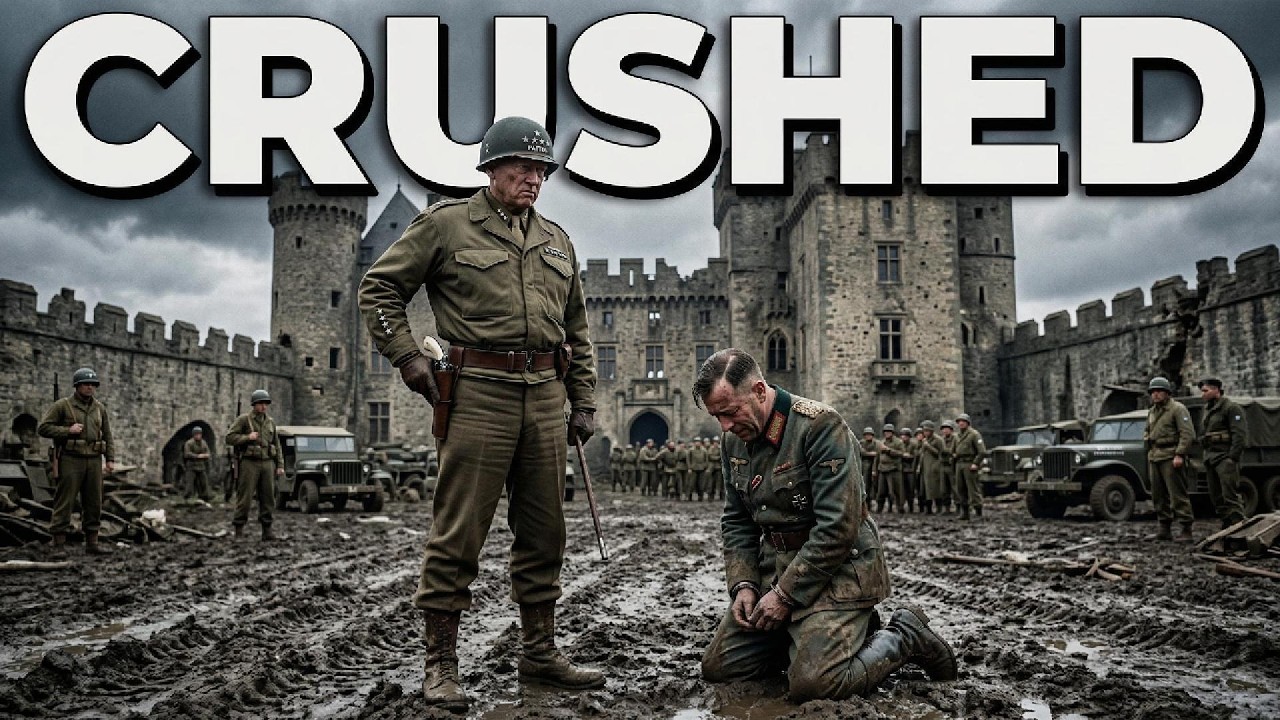
They considered themselves a separate, superior caste of human beings, men who believed that even in total defeat they still possessed a military honor that no one could touch. For years they had looked down on the rest of the world. To them, the Americans were nothing more than a mob of gangsters and farmers who had gotten lucky with logistics. They were convinced that when the end finally came, they would sit across a table from American generals and negotiate a peace between gentlemen.
They were waiting for a partner in their delusion. Instead, they got George S. Patton. Patton did not believe in gentlemen’s agreements with men who had built concentration camps.
He did not care about their centuries of Prussian lineage or their polished monocles. To him, these men were not worthy adversaries. They were criminals hiding in fancy suits. One high-ranking German general, a man who traced his military ancestry back to the time of Frederick the Great, decided that he would allow himself to be captured.
But he would only do it on his own terms. He sent a messenger to the headquarters of the US Third Army with a challenge so arrogant, so utterly disconnected from the reality around him, that it would trigger one of the most humiliating status collapses in the history of modern warfare. To understand why this moment mattered so much, you have to understand where that challenge came from. The German general had retreated to a massive medieval fortress.
This was not a bunker. It was a palace filled with stolen art, priceless wine, and servants in white gloves. He was surrounded by his personal staff, who still wore their dress uniforms, their leather jackboots polished to a mirror shine. They were drinking fine French cognac and discussing the unfortunate turn of the war as if it were a minor social setback.
From this retreat, the general sent his message to Patton’s headquarters. The demand was precise. He would surrender his command, but only under formal conditions. He demanded a ceremony.
He would hand his sword only to a general of equal rank. He insisted that his officers be allowed to keep their sidearms for self-defense. And he required a motorcade of luxury vehicles to transport his staff to a secure, honorable location. In his mind, he was still the master of the situation.
He was granting Patton the honor of capturing him. He expected the American general, a man known for his love of military pageantry, to be impressed by the castle, by the rank, by the sheer theater of it all. He expected Patton to play along. He was about to learn that while Patton loved pageantry, he hated arrogance.
While the German general waited for a polite reply, Patton was not waiting for anything. The Third Army was not moving like a standard military force. It was moving like a force of nature. Patton had ordered his tank commanders to bypass villages and surround strongpoints.
He did not want to fight for every piece of ground. He wanted to cut the head off the snake. Patton received the German general’s letter while standing in the mud of a roadside ditch, watching his armored columns roar past. He did not read it twice.
He did not consult his advisers. He reportedly laughed so hard he nearly dropped his cigar. “The Baron wants a ceremony? ” Patton asked his aide.
“Well, I’ll give him one he’ll never forget. ”
Patton did not send a diplomatic convoy. He did not even send a radio message. He climbed into his M15 command car, an open-topped jeep modified with armor plating and massive air horns.
On his hips hung the famous ivory-handled Colt . 45 revolvers. On his head was a gleaming, polished helmet that reflected the sun like a mirror. He drove toward the castle at a speed that terrified his own drivers.
Behind him came a single platoon of cavalry and a few M4 Sherman tanks. He did not come to talk. He came to deliver a reality check that would shatter the German general’s world. The command car screeched into the castle courtyard, kicking up a cloud of dust that coated the pristine uniforms of the German honor guard.
The general stood at the top of the grand marble staircase, his hands behind his back, waiting for Patton to walk up and salute him. Patton did not get out of the car. He sat there, staring up at the general, slowly exhaling a cloud of cigar smoke. The silence lasted for an agonizing two minutes.
Every second that passed was a blow to the German general’s ego. He was forced to stand there waiting while an American gangster looked at him with bored contempt. Finally, the German general broke the silence. “General Patton, I am ready to begin the negotiations for our honorable transfer.
”
Patton leaned forward. He did not use a microphone, but his voice carried through the entire courtyard like a whip. “Negotiations? ” Patton barked.
“Who told you we were negotiating? I didn’t come here to talk to a Baron. I came here to collect a prisoner. ”
The German general’s face turned a deep, angry red.
He began to sputter about the Hague Convention and European military traditions. He mentioned that he was a descendant of Prussian nobility and that his sword had been in his family for two hundred years. Patton stood up in the jeep. He looked at the general’s sword, then looked back at his own tanks, which were now turning their turrets toward the castle windows.
“I don’t care if your sword belonged to Julius Caesar,” Patton growled. “If you aren’t down here in sixty seconds with your hands in the air, I’m going to turn this castle into a pile of gravel with you and your nobility inside it. ”
That was the moment reality hit home. The German general looked into Patton’s eyes and realized something terrifying.
Patton was not joking. He did not value the castle. He did not value the general’s life. He did not value the tradition of the Prussian army.
To Patton, the Baron was just another obstacle in his way to Berlin. The invincible general, the man who had spent the morning drinking cognac and demanding luxury transport, slowly walked down the marble stairs. His hand was shaking. He reached for his sword to hand it over in a formal gesture.
Patton did not take the sword. He did not even look at it. He signaled to a nineteen-year-old sergeant from Brooklyn. “Sergeant, take this man’s toy,” Patton ordered.
“And make sure he gets a good seat in the back of a two-and-a-half-ton truck. No cushions. ”
The sergeant walked up, snatched the priceless sword from the general’s hand, and shoved the Baron of Bavaria toward a muddy transport truck filled with common infantrymen. The German officers, who had expected a gentlemanly retreat, were stripped of their sidearms.
Their medals were ripped from their tunics. They were forced to kneel in the mud of their own courtyard. Patton watched the entire process without a shred of pity. He had seen what Prussian honor had done at the edges of the death camps.
He had seen what their tradition had done to Europe. As the truck pulled away, carrying the humiliated general into the dust of history, Patton turned to his driver. “Drive on,” he said. “We’ve wasted enough time on these clowns.
”
The German general who had challenged Patton spent the rest of his life in a daze. In his memoirs, he complained about the vulgarity and rudeness of the American commander. He could never grasp the fact that his status had been a lie, protected only by the walls of his castle and the fear of his subordinates. Patton did not just win a tactical encounter that day.
He won a psychological war. He proved that the master race only existed as long as people were willing to believe in the theater of their arrogance. By treating the Prussian elite like common thugs, he stripped them of their dignity and their power. He had been challenged by a man who thought he was a king, and he left that man kneeling in the dirt.
In the face of true audacity, status is nothing but a shadow.
