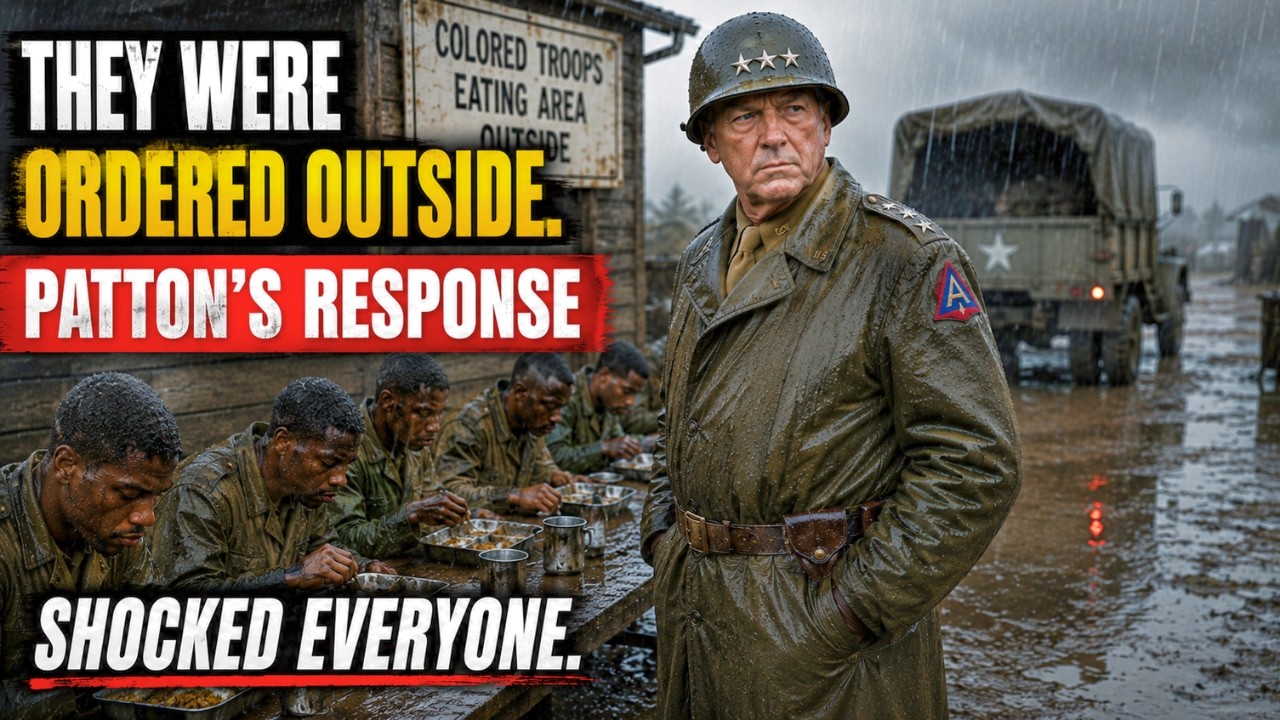
In November 1944, a hundred miles behind the front lines in eastern France, the men of the 761st Tank Battalion sat in the rain. They wore the black patch of the first all-Black armored unit in United States Army history, and they had just been ordered out of the mess hall by a quartermaster captain who pointed to the door. The white soldiers inside ate warm food at wooden tables. The Black tankers sat on wet ground with metal trays in their laps, the rain falling at thirty-six degrees.
Thirteen days earlier, they had fought their first battle. Since then, they had buried men in three villages. One of them, a tank commander named Ruben Rivers, had refused evacuation for twelve days with a festering wound in his leg because he said the tanks needed him. He was killed days ago.
The men who buried him now sat in the cold, waiting. At 12:15 a. m. , an unmarked jeep stopped at the gate.
The passenger wore a helmet with three stars. What he did in the next forty minutes was recorded in no regulation, no military file, and no training manual. But every man in that yard remembered it for the rest of his life. The 761st was activated on April 1, 1942, at Camp Claiborne, Louisiana.
Most of its men came from the deep South, sons of railroad workers, steelworkers, and preachers. They had grown up sitting in the back of every bus they ever rode. Now the Army gave them M4 Sherman tanks, thirty-three tons of steel, five men inside, one main gun, and three machine guns. They trained for two years.
White tank battalions activated in 1943 shipped to Europe in six months. Those activated in 1944 shipped in four. The 761st trained, and trained, and waited. They trained at Camp Claiborne under officers who left rooms when they entered.
They trained at Camp Hood, Texas, under a sun that peeled the paint from their tanks. Their gunnery scores were excellent. Their maintenance records were excellent. The Army sent them back to their barracks.
Excellence was not enough. Sergeant Calvin Reeves stepped off a landing craft onto Omaha Beach on the morning of October 10, 1944. He was thirty-one. He carried a rifle and a small notebook in his chest pocket.
In it, he began writing names. The battalion commander was Lieutenant Colonel Paul L. Bates, thirty-six, white. When the assignment first came through in 1942, the Army offered him a way out.
Officers spoke to him three times in hallways. The message was always the same: no man could advance in the United States Army with this assignment on his record. Bates refused. When asked years later why he stayed, his answer was one sentence: I trained these men.
I know their names. The battalion was accompanied by Trezzvant W. Anderson, a thirty-eight-year-old war correspondent for the Pittsburgh Courier, the largest Black newspaper in the United States. He crossed the Atlantic because his editors decided that what these men were about to do deserved a witness who could not look away.
He sent reports. Army censors held them. He kept writing. By late October 1944, the 761st was attached to the Third Army, commanded by Lieutenant General George S.
Patton. Earlier that year, Patton had written a private letter to his wife Beatrice, in his own hand, stating what he actually believed about the men he was about to receive: the Negro soldier cannot think fast enough to fight in armor. When the War Department indicated which tank formations his army needed in the fall of 1944, other generals refused the 761st. Patton did not.
He asked for their names, unit numbers, and training records. When someone tried to warn him over the phone about the unit’s color, he cut them off: Who the hell asked about color? I asked for tanks. The 761st sailed without Lieutenant Jack Roosevelt Robinson.
In July 1944, at Camp Hood, Texas, Robinson refused to move to the back of a military bus. He was arrested for insubordination. Bates refused to sign the court-martial charges. The Army bypassed him, transferred Robinson to another unit, and he was eventually acquitted, too late to sail with the 761st.
Historians differ on the exact date of what happened next, either October 28 or November 2, 1944, but they agree on what occurred. Patton arrived in a half-track. He climbed onto the vehicle’s hood so the men could see him. He spoke words documented by the soldiers present: You are the first Negro tankers to fight in the American Army.
I would never have asked for you if you weren’t good. I don’t care what color you are, as long as you go up there and kill those Kraut sons of bitches. The men listened. Two years of being treated as an administrative burden, two years of the Army training them and refusing to use them, and here was a three-star general saying he had asked for them by name.
Fighting began on November 7, 1944, at Morville-lès-Vic, a farming village east of France that the Germans had turned into a battleground. The 761st moved in at dawn. Tanks advanced through a valley of frozen mud. The first mine blew a track off a Sherman before its crew fired a shot.
German 88s fired from the tree line. Then a Sherman took a direct hit. The turret shattered. Two men got out.
Three did not. Sergeant Reeves watched from a tank forty meters away and opened his notebook. He wrote two names. By November 10, Reeves had four names.
That was the day Sergeant Warren G. H. Crecy’s tank was hit. Crecy, twenty-three, quiet, from Corpus Christi, Texas, climbed onto a wrecked vehicle in the middle of the field, seized a working .
50-caliber machine gun, and used it to silence German positions that were inflicting heavy losses on his battalion. He kept firing until the ammunition ran out, found another gun, and fired until that was empty too. The men called him the baddest man in the 761st for the rest of his life. He was recommended for the Medal of Honor.
The paperwork disappeared. Two days earlier, on November 8, near Vic-sur-Seille, Sergeant Ruben Rivers, twenty-six, of Tecumseh, Oklahoma, was leading tanks that hit a roadblock of felled trees planted with mines. He dismounted his Sherman under direct enemy fire, knelt on the road to attach a steel cable to the trees, and a mine exploded, tearing his right leg from the knee down. He finished securing the cable, returned to his tank, and pulled the roadblock clear.
Medics told him he was being evacuated. He refused, saying he had his orders. Twelve days he fought with that wound. Medics came back for him twice.
He refused both times. On November 19, near Gébling, Rivers placed his tank between his advancing men and a group of German anti-tank guns. He drew their fire deliberately. A shell hit his turret.
A second killed him instantly. His company commander wrote a recommendation for the Medal of Honor. It vanished into the Army archives. Rivers received the medal in January 1997, fifty-three years late, accepted by his sister Grace at the White House.
By mid-November, the 761st was pulled back to a rest area a hundred miles behind the front, 48 hours of warmth and dry clothes. The rest area was a former French army barracks. A mess hall stood on the east side, with a wall where iron posts marked a former roof, long since taken for firewood. The 761st arrived at 1:00 p.
m. They lined up at the mess hall at 4:00. Inside, white soldiers from a quartermaster company sat at long tables, eating hot food and laughing. The quartermaster officer, a 35-year-old captain who had never seen combat, raised his hand, walked to the front of the line, and told the tankers there was space outside under the awning.
They could take their trays there. He returned behind the counter and did not look at them again. There was no awning. The iron posts remained, but the wood was gone.
The men of the 761st sat on the wet ground, trays in their laps. They ate. Rain fell on the food. It went cold in four minutes.
Reeves leaned against the wall, looked at the door ten feet away, where warm light and laughter leaked out, and did not finish his meal. He set the tray on the ground. Trezzvant Anderson stood inside at a window, watching. He opened his notebook.
He recorded the time, 4:40 p. m. , the date, the location, the captain’s rank and unit, the temperature, thirty-six degrees, the rain, and every name he could make out through the glass. He wrote a report that night and sent it through Army channels.
It was never published. Censors held it. Anderson kept the carbon copy in a file for the rest of his life. It was found in a box at a southern university archive forty-seven years later.
The men of the 761st sat in the rain for an hour. Then they scraped their trays, stacked them at the mess hall door, and returned to their quarters in wet uniforms. Reeves sat on his bunk, took out paper and a pencil, and wrote a report. No complaint, no protest.
A military report: heading, date, location, facts, names, ranks, times, the regulations cited, the circumstances. It took him two hours. He read it twice, placed it on his footlocker, and went to sleep. At 7:00 a.
m. , Reeves handed the report to the battalion executive officer, a major he had trained with since Camp Claiborne. The major read the first paragraph, then the second. He asked, Calvin, do you understand where this will go?
Reeves said yes. The major took it, saved it, and passed it up. The report sat for a day, then moved through a network of acquaintances and favors until it reached Third Army headquarters. Patton’s aide brought it with the evening correspondence.
The aide later described how Patton read the report once, read it again, and set it down. He asked if the location was in his area of operations. The aide confirmed it. Patton said, Prepare my vehicle.
The aide asked if he meant in the morning. Patton said, I mean now. It was 10:30 at night. The jeep drove a hundred miles through rain and darkness.
They arrived at 12:15 a. m. The officer on duty, a 25-year-old lieutenant, came out and saw three stars on the helmet of the man in the passenger seat. Patton asked to see the installation commander.
The lieutenant colonel in charge came out, coat unbuttoned, and led Patton on a tour of the facility. They walked through the mess hall, the kitchen, the sleeping quarters, the storeroom. Then Patton stopped at the east wall, where the iron posts stood and the men had sat in the rain. He looked at the ground, at the mess hall door ten feet away, at the distance between them.
He turned to the lieutenant colonel and said quietly, Explain this to me. The lieutenant colonel explained, citing regulations, capacity, practicalities. Patton listened. When the officer finished, Patton waited.
Then he told the lieutenant colonel that the wrong regulations in his area of operations do not stop working because they are wrong. They stop working because he said they stopped. These are not the literal words. No page exists.
But two men who were there, interviewed separately decades apart, told the same story. The next meal was breakfast at 6:00 a. m. Six additional tables had been brought in during the night.
A work detail was woken at 2:00 a. m. and told the mess hall would be reconfigured by dawn. The men of the 761st entered through the front door, took their trays, and sat at the new tables.
The two groups did not speak, but they were together, inside, dry. The lieutenant colonel was not relieved of command. No disciplinary action was recorded. The captain kept his rank and his assignment.
The regulation was not rewritten. The mess hall returned to its normal function within forty-eight hours. The visit was an act of personal authority, not institutional reform. The Army remained segregated until July 26, 1948, when President Harry Truman signed Executive Order 9981.
Reeves’ report, the paper he filled out by pencil on a footlocker lid, exists in no public archive. It was lost in the natural attrition of wartime documents, or destroyed in postwar disposal, or filed where no one with reason to know its contents ever opened it. The story survives in three sources: an oral account given to a researcher, the officer-on-duty’s letter to his wife, and the documented pattern of Patton’s behavior in late 1944. The 761st returned to combat the day after breakfast.
They fought for 183 consecutive days, longer than any American armored unit in the European theater without relief. They liberated more than thirty towns and villages. They inflicted more than 130,000 casualties on the Germans. They earned 391 decorations for valor.
On May 6, 1945, they met the Red Army at the Enns River in Steyr, Austria. The war in Europe ended two days later. Patton was relieved of command of the Third Army in October 1945 after public statements about denazification policy. He died on December 21, 1945, from injuries in a car accident near Mannheim, Germany.
He was buried at Hamm, Luxembourg, the only American general buried there among his men. Sergeant Calvin Reeves returned home in 1946. He used the GI Bill to attend a state college that admitted Black veterans, earned a teaching degree, and taught high school history for twenty-seven years. His students remembered two things about him: he didn’t romanticize war, and he told the story of the mess hall.
He always ended it the same way. I wrote the report because the report needed to exist. Because what is not recorded in the records is as if it never happened. Ruben Rivers received the Medal of Honor on January 13, 1997, fifty-three years after his death, one of seven Black Americans from World War II to receive the award.
His sister Grace accepted it from President Clinton. She did not say the wait was worth it. It was not. The 761st was finally awarded the Presidential Unit Citation on January 24, 1978, after being denied in 1945, the 1950s, and the 1960s.
The Army’s final language acknowledged racial discrimination and inadvertent neglect. The barracks in eastern France were demolished in the 1960s. The ground where the men sat in the rain is now unmarked farmland. The paper Calvin Reeves wrote is gone.
The men were real, every name, every age, every rank. It rained that night. They sat in the rain.
He wrote down what happened.
