On the 8th of September 2001, a Saturday, Windows Millennium Edition hit a wall its own engineers had seen coming for months. Any System Restore checkpoint saved after that date would not bring a machine back. Users could open the wizard, choose a restore point, watch the screen go dark for the restart, and the system would simply abort. Microsoft had quietly published a fix that summer, but the patch carried a cost of its own: once installed, every checkpoint made before that Saturday became unusable too.
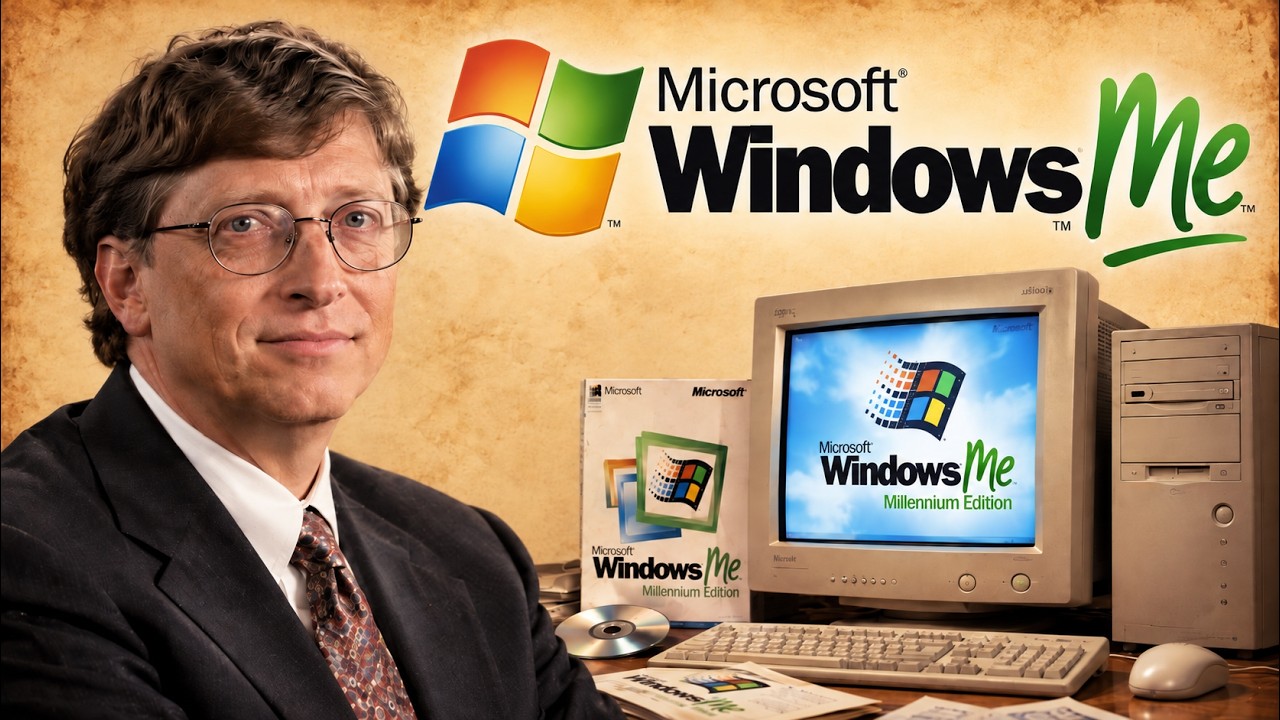
System Restore was the feature early reviewers had singled out for praise. It was, in many ways, the reason to buy the machine. And 15 days before that date, on the 24th of August 2001, Microsoft had already signed off on the finished code for the operating system that would replace it. Forty-seven days later, Windows XP went on sale.
Windows ME had reached store shelves on the 14th of September 2000. Thirteen months later, it was replaced. Five years after that, PC World ranked it the fourth worst tech product of all time, called it the “Mistake Edition,” and summed up the user experience bluntly: trouble installing it, trouble running it, trouble making it work with existing hardware, and trouble making it stop running. The deeper question is not whether Windows ME was bad.
The question is how Microsoft, having sold more than 45 million copies of Windows 98, came to ship an operating system with its own successor already on the calendar — and who inside the company made that call. By the late 1990s, Microsoft was really selling two operating systems under one name. The first was Windows NT, the business line built in the early 1990s as a modern 32-bit system with protected memory. It was stable, secure for its time, and heavy — it demanded more memory, disk space, and processing power than the average family computer had.
The second line was the one people actually had at home. Windows 95 and Windows 98 still booted on top of DOS, the old command-line system that had shipped with the original IBM PC in 1981. That old core carried 17 years of history: 16-bit code, segmented memory, and compatibility tricks for hardware nobody remembered buying. It was also the reason almost every game, scanner, and sound card on the market just worked.
That home line had made Microsoft enormous. Windows 95 launched behind a promotion costing around $300 million, with the Empire State Building lit up in the Windows logo colors and the Rolling Stones licensing “Start Me Up” for television spots — the first time the band had ever sold a song to a commercial. Windows 98 sold 530,000 licenses in its first four days, beating Windows 95’s 510,000. By mid-1999, it had passed 45 million copies.
Inside Microsoft, everyone understood the DOS core could not carry the company forever. In February 1998, at a conference for DirectX game developers called Meltdown, senior vice president Jim Allchin laid out the plan: Windows 98 was the end of the road for the old DOS core. The next consumer Windows would be built on the Windows NT kernel, and game developers would be steered there by bringing DirectX to NT first. The two lines would finally become one.
That plan lasted 14 months. In March 1999, Microsoft created the Consumer Windows division under vice president David Cole, focused on the home user. Then, on the 7th of April 1999, at the Windows Hardware Engineering Conference, Microsoft president Steve Ballmer stood up and reversed the plan. The next consumer version of Windows would not be built from Windows 2000, the new name for the next NT.
It would be built from the Windows 98 code. The reasons were hard ones: Windows 2000 needed substantially more memory, disk space, and processing speed — a penalty estimated at roughly $100 of extra hardware per machine. It was still incompatible with a wide range of programs written for Windows 3. 1, 95, and 98.
Put a consumer version on store shelves at Christmas, and millions of families would bring home a computer that could not run the games their kids already owned or the printer already sitting on the desk. So the Consumer Windows team went back into the Windows 98 code. By late July 1999, the project had a code name, Millennium, and goals built around digital photos, home video, music, and home networking. The first alpha build went out on the 23rd of July.
An early developer preview was already in the hands of those testing Windows 98 Second Edition, which told you exactly who Millennium was for: the same audience, on the same machines, asked to take one more step down the same road. The Register later reported that Microsoft had considered calling it Windows 98 Third Edition. Somebody decided that a product shipping in the year 2000 deserved a bigger name. But Microsoft had not given up on the plan Ballmer had just set aside.
Three weeks after that first Millennium alpha, a second team began building the consumer Windows that Millennium was meant to stand in for. Its code name was Neptune, it was based directly on Windows 2000, and it was meant to be the first consumer version of Windows NT. Its designers sketched “activity centers” — task pages for browsing, communicating, managing documents, and entertainment — and it had a planned follow-up, a smaller update codenamed Triton. The roadmap ran years ahead.
Millennium, meanwhile, ground through testing. A first beta went out on the 24th of September 1999, though Microsoft kept it from the press over quality concerns. A second beta followed on the 24th of November. Somewhere between them, the activity centers idea was pulled out of Millennium entirely, left for Neptune to carry.
Then the ground moved. On the 3rd of December 1999, Microsoft announced a sweeping reorganization. The separate consumer and business Windows divisions were merged into one Windows division under Brian Valentine. Jim Allchin was promoted to group vice president over the entire Windows family.
David Cole was moved out of Windows altogether. The Register reported that Millennium had been downscaled from a major release to something closer to a service pack. In late December, Neptune’s first and only developer build went out to a small group of testers. On the 25th of January 2000, Microsoft confirmed that Neptune was over, and so was Odyssey, the planned successor to Windows 2000 for business.
Both teams were combined into a single project: Whistler, which would serve both business and home users. The first known Whistler build was compiled on the 2nd of February 2000, barely a week after the announcement. The Millennium team was left finishing a product their own company had already announced a successor to. The single most important engineering decision in Windows ME was removing real-mode DOS — the ability to boot the machine straight into the old command line.
In Windows 98, holding the Control key during startup offered a menu that dropped you into pure DOS. In Windows ME, that menu was gone. Chief product manager Nicholas Cudier explained that it had become impossible to maintain compatibility with real-mode DOS. The other half of the reason was speed and support: Microsoft wanted faster startup and wanted to be rid of endless support calls caused by real-mode device drivers.
The strange part is that DOS never actually left — it was still there underneath Windows ME, loading at every boot. Microsoft had not torn out the old foundation; it had locked the door to the basement. For anyone who still ran old DOS games or business programs, that changed a great deal. Around that decision, the team built a set of features aimed at one idea: that a home computer should be able to repair itself.
System File Protection watched more than 800 core Windows files and quietly replaced any that were deleted or overwritten. More than 13,000 signed drivers shipped in the box. And there was System Restore, the ability to roll the whole machine back to an earlier checkpoint in a few clicks. The rest of the list was pure home focus: Windows Image Acquisition for scanners and cameras, a home networking wizard, universal plug-and-play support, voice chat for multiplayer games, an automatic update tool, and Internet Explorer 5.
5. The code for Windows ME was finished in June 2000. That same month, a federal judge in Washington ordered Microsoft broken in two. Judge Thomas Penfield Jackson ruled that the company should be split into two companies — one for operating systems, one for applications — and called Microsoft untrustworthy.
Bill Gates promised an appeal. Twelve days later, on the 19th of June, Microsoft announced that Windows Millennium Edition had been released to manufacturing. It would not reach store shelves until the 14th of September. On the 13th of July, two months before Windows ME went on sale, Microsoft stood in front of developers and released the first official preview of Whistler, telling them to expect it in the second half of 2001.
The successor had a public ship window before the product it replaced had reached a single store. Microsoft’s stock, meanwhile, had peaked at $119. 94 in December 1999 and closed at $50. 25 on the 16th of October 2000, down roughly 58%, its lowest level in nearly two years.
On the 14th of September 2000, Windows ME went on sale across the United States. Five years earlier, Windows 95 had lit up the Empire State Building. This time, Microsoft built the Meet Me Tour, three traveling displays set up like model homes where visitors could cut video, organize photos, and play music. The shoppers were less excited than the press release.
Reporters who checked CompUSA, Best Buy, and Fry Electronics found no real lines. At a Fry’s in Palo Alto, a salesman described launch day as a normal shopping day. Research firm PC Data counted about 75,000 copies sold on the first day and 250,000 in the first four days. Windows 98 had sold 530,000 in the same stretch.
Windows ME opened at less than half the pace of its predecessor. What followed was not kind. Five weeks after launch, The Register published a list of problems. Drivers were the biggest issue; Creative had to release new software for its Sound Blaster cards.
Fast new systems with ATA-100 hard drives could switch themselves off before the cache had been written to disk, meaning data vanished at shutdown. Windows ME, like Windows 98 before it, could not handle more than 512 megabytes of memory; above that, a cache driver swallowed the address space the rest of the system needed, and simple tasks failed with an error claiming there wasn’t enough memory. Microsoft’s first suggested workaround was to physically remove the extra memory. Even System Restore had a flaw built into its design: because it carefully preserved system files, it could carefully preserve infected ones.
Antivirus software often could not clean files stored in a restore point. PC World later joked that System Restore could bring back viruses you had just deleted. But some of what shipped inside Windows ME was very good, and one piece still ships in Windows today. System Restore was first developed for Windows ME, and a Microsoft patent filed on the 30th of June 2000 describes the machinery: a file change monitor hooked into the file system, deciding which files to watch by their extension, copying the most critical files outright while logging changes to everything else.
The snapshot was called a restore point. Windows Movie Maker also debuted with Windows ME on the 14th of September 2000. It was basic — you dropped clips onto a timeline, trimmed them, added a title and music, and saved a home movie — and it became the first video editor millions of people ever opened. Later versions could send video straight to YouTube.
Microsoft did not officially discontinue it until the 10th of January 2017. Windows Media Player 7 shipped with swappable skins. Spider Solitaire came in the box for the first time without an add-on pack. Built-in USB mass storage support was a first for the Windows 98 family.
Six weeks after Windows ME went on sale, on the 31st of October 2000, Whistler Beta 1 went out to testers, running on the NT foundation that Windows ME had been built to postpone. On the 6th of January 2001, Bill Gates stood at CES in Las Vegas and told home users the next Windows would bring the dependability of the highest-end corporate desktop into the home. On the 5th of February, Whistler got its name: Windows XP. In June, Microsoft announced a marketing campaign worth about a billion dollars.
That same month, on the 28th of June, a federal appeals court unanimously threw out Judge Jackson’s breakup order. Microsoft would stay one company. On the 24th of August 2001, Windows XP was released to manufacturing as Build 2600. Fifteen days later came the Saturday at the heart of this story.
Microsoft’s support note said only that checkpoints made after September the 8th received incorrect date stamps and could not be found. It never published a cause. On the 25th of October 2001, Windows XP went on sale in two editions: Professional replaced Windows 2000 in the office; Home Edition replaced Windows ME in the living room. For the first time, the computer a family bought and the computer an accountant used at work ran on the same NT foundation.
It was exactly the plan Jim Allchin had laid out in February 1998, delivered three and a half years late, with Windows ME standing in the gap. In January 2002, Microsoft announced XP had sold more than 17 million licenses in just over two months. Gates called it the company’s best-selling release of Windows ever. Windows ME came off retail sale on the 31st of December 2003.
In June 2006, PC World put it fourth on its list of the worst tech products ever made. Three weeks later, on the 11th of July, Microsoft ended support for it entirely, on the same day it ended support for Windows 98. It was the last Windows built on DOS, and for most people, that is all it is remembered for. But software does not die when its maker stops supporting it.
On the 31st of March 2001, a programmer who signed his work “Walter” released version 1. 3 of a Real DOS-Mode Patch. It modified three of Windows ME’s core startup files and unlocked everything Microsoft had hidden: holding Shift+F8 at boot would drop you into pure DOS again. Microsoft had locked the basement, and within a year of release, its own customers had cut a new key.
Windows ME itself found a strange second life. Retro collectors building period machines went back to it with a generation’s distance, installed it on hardware from its own era, and found it snappy, responsive, and perfectly capable of running DOS games. There is even a practical reason collectors like it: Windows ME was the last version of Windows released without product activation. Its old update service was retired by Microsoft in 2011, but the operating system itself still boots on the machines it was made for.
And the part those five inventors described in that 2000 patent is still on modern machines. If you open a Windows 11 computer today and follow Microsoft’s own support instructions to undo a bad update, it will tell you to type rstrui. exe. It is the same program name that sat in the Windows ME system folder in 2000.
The operating system lasted 13 months. That piece of it is still on your machine.
