At the corner of 45th Avenue and Sloat Boulevard in San Francisco, across from the zoo, a seven-foot-tall fiberglass dachshund head sits atop a pole. It wears a white chef’s hat and a blue polka-dotted bow tie, its wide eyes fixed in a grin that is neither quite cheerful nor quite threatening. For decades, it was a familiar sight to anyone who grew up in the Bay Area. For everyone else, it was simply puzzling.
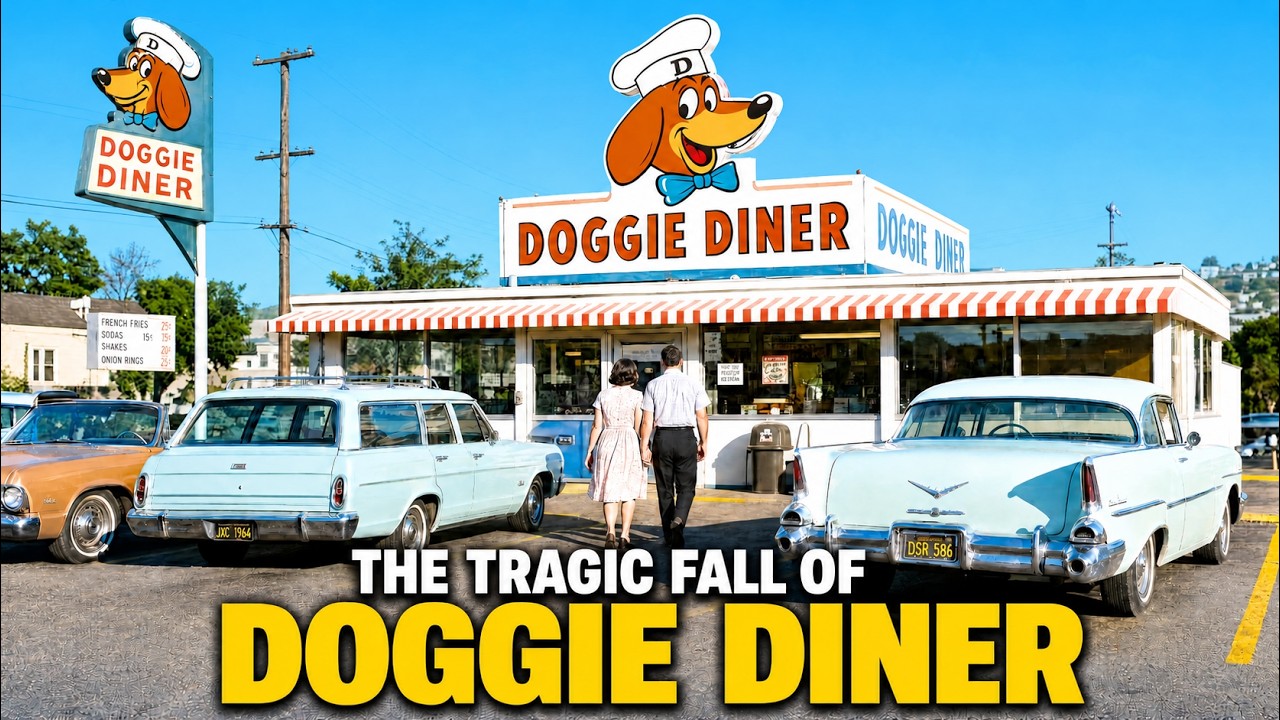
That head is the last physical remnant of Doggy Diner, a fast food chain that once anchored daily life across San Francisco. For a long time, the city nearly tore it down. A garden center next door wanted the land, and a public battle followed. Gavin Newsom, then a city supervisor, helped broker a compromise.
On a cold June morning in 2001, roughly 400 people gathered as a Department of Public Works crane lifted a tarp to reveal the newly repaired mascot, chanting “Let the dog out! ” as the crowd counted down from ten. There were jugglers, free hot dogs, and Mayor Willie Brown in attendance. All of that for a sign from a fast food chain that had been closed for fifteen years.
At its peak, Doggy Diner operated roughly thirty locations across the Bay Area, most of them in San Francisco itself. The Richmond District alone had three. There were locations in the Mission, the Marina, the Sunset, and Civic Center, with others across the bay in Oakland, Emeryville, and Hayward, and one as far out as Stockton. Most were open twenty-four hours a day, seven days a week.
According to a 1974 Oakland Tribune article, the chain was moving nearly 6,000 pounds of food per week, hot dogs, hamburgers, and French fries, along with roughly 35,000 gallons of soda. By 1986, every single location was closed. The story begins with Al Ross, a New York transplant and amateur boxer who moved to Oakland as a young man. Before he got into hot dogs, he ran an ice cream business with his mother out of a push cart near the port, calling it White Castle, no relation to the burger chain.
He noticed that the corner of 19th Street and San Pablo Avenue was constantly busy, filled with workers, sailors, and people in motion all day. In 1948, he opened the first Doggy Diner at that exact intersection. The name came from the wiener dog, and the original sign was simple: a cartoon hot dog with four short legs, a tail, and a head. It was modest and functional, but the food sold faster than the sign alone could explain.
Ross was committed to quality ingredients at a time when the easiest move for a roadside stand was to source the cheapest possible meat. The hot dogs were grilled until they had a charred exterior that crackled when bitten into while staying juicy inside. The chili, which became the chain’s most important preparation, was made fresh daily from ground beef and a spice blend simmered into something dense and savory, thick enough to stay on a hot dog rather than sliding off onto the wrapper. The chili cheese dog was the signature item: a grilled dog in a soft bun, covered with that fresh chili and topped with melted cheese.
People came back for it specifically. But the menu didn’t stop there. The Western Hamburger was a strong seller, as were the hot pastrami sandwiches, thinly sliced and piled on rye with mustard. The apple turnovers became a dessert item people remembered with a specific kind of nostalgia.
The French fries were hand cut, and the milkshakes were thick enough that you had to work the straw. For most of the chain’s history, main items cost between 25 and 50 cents, so you could feed yourself for less than a dollar. That mattered in the late 1940s and through the 1950s, and it kept mattering into the 1970s. The physical experience of a Doggy Diner was simple and consistent.
The interiors were built around Formica counters with swiveling stools, brown and white speckled tile floors, bright lighting, and a menu board large enough to read from the doorway. You ordered at the counter, got your food fast, and ate there or took it with you. There was no table service and no occasion required. The 24-hour operation was not incidental; it was a core part of what Doggy Diner was.
Shift workers got off at midnight and found an open counter. Bars closed at 2:00 in the morning, and the post-bar crowd formed a reliable rush. Cab drivers, nurses, dock workers, and people catching early buses all came through. Former employees remember the late-night chili dog rush as its own specific event, with the kitchen cranking through dogs at a pace that left the chili pot running low and the grill smoking.
The visual signature that made Doggy Diner impossible to miss came in the early 1960s, designed by Harold Bachmann, a billboard and ad layout designer from Pittsburg, California. He chose a dachshund because the menu was built around wiener dogs and sketched out just the head, wearing a chef’s hat and a polka-dotted bow tie with an expression somewhere between a grin and a smirk. His original concept was in neon, but after Ross saw what molded fiberglass could do at a trade show, a plastics firm in Los Angeles built the heads seven to ten feet tall, weighing roughly 700 pounds and designed to rotate. In a city that was still relatively low-rise in the early 1960s, these heads were visible from blocks away.
The Richmond District had three within reasonable walking distance of each other. The eyes seemed to follow you wherever you went, and at night, under the street lights, the grin took on a different quality. Kids either loved them or found them mildly terrifying, sometimes both. The radio jingle matched the energy perfectly: “Doggy Diner, nothing finer.
Doggy Diner, it’s doggone good. ”
The first ownership change came in 1969, when Ross sold the chain to Ogden Corporation, a diversified conglomerate that ran food service at airports, stadiums, and racetracks, along with parking lots, transportation, and real estate. Doggy Diner was a small regional chain, not the kind of asset that typically gets sustained strategic attention inside a company of that type. Under Ogden, the chain didn’t expand, didn’t meaningfully modernize, and locations started closing rather than opening.
The commitment to quality ingredients that had defined Ross’s operation wasn’t written corporate policy; it was a founder’s priority, and those don’t always survive the transition. The ownership problems unfolded alongside external pressures that would have stressed the chain even under better management. The first was competitive, and it was specifically McDonald’s. McDonald’s opened its first San Francisco locations in the early 1970s.
Before that, Doggy Diner had been competing mostly with other local and regional chains like Whisburger and Jack in the Box. When McDonald’s arrived at scale in Northern California, the rules changed. McDonald’s ran a non-union operation; Doggy Diner was famously unionized. That distinction translated directly into labor costs.
A non-union chain paying entry-level wages could undercut a unionized competitor’s pricing while still generating margin. Doggy Diner’s workers were paid fairly and the food reflected it, but in a fast food market, when competitors don’t have to make that investment, the cost structure becomes a disadvantage. Burger King followed McDonald’s into the Bay Area market, and by the mid-1970s, the fast food segment that Doggy Diner had largely invented for San Francisco was crowded with better-capitalized competitors spending heavily on advertising and opening aggressively. The second pressure was cultural, and it was more specific to San Francisco than anywhere else in the country.
The rotating heads ran into trouble first, when San Francisco passed zoning ordinances in the mid-1960s prohibiting rotating signs, with Alameda and Hayward following. A static head still worked, but less dramatically. The bigger shift arrived by the late 1960s and into the 1970s, when San Francisco became the center of a countercultural movement that developed a strong aversion to anything that seemed synthetic, plastic, artificial, or corporate. Doggy Diner’s aesthetic, fiberglass mascots, neon, Formica, the whole mid-century roadside vernacular, was precisely the kind of thing the city’s changing cultural identity was rejecting.
Marvin Mann, the chain’s president at the time, acknowledged this directly to the Oakland Tribune in 1985, saying the chain was upgrading image-wise because mainstream culture had absorbed what he called the hippie rejection of anything plastic or fake. Arthur Asa Berger, a professor of semiotics at San Francisco State University, put an academic frame on the same observation: “We’re in a more streamlined and blander society. ” The fiberglass dachshund heads that had been magnetic and charismatic in 1963 read differently to a certain San Francisco demographic by 1975. The third pressure was the chain’s inability to expand beyond a regional footprint.
There had been plans to expand nationally, but it never happened. The unionization issue was cited as one reason; a union shop trying to open in markets where non-union fast food operations were already entrenched would start at a cost disadvantage in every new city. That lack of national scale meant no leverage against suppliers, no national advertising budget, and no ability to spread management costs across enough locations to justify meaningful reinvestment. The structural disadvantage compounded every year.
By the early 1980s, Ogden was selling off properties, and locations were closing steadily. In 1985, Oakland’s last Doggy Diner head was removed when the restaurant on Fruitvale Avenue closed and the building was sold. There were three heads left in San Francisco, Emeryville, and Alameda. Then there was one.
The last Doggy Diner closed in 1986 in the Sunset District on Sloat Boulevard near the San Francisco Zoo. The building became the Carousel Restaurant, and the new owner kept the interior as close to the original as he could manage, keeping the brown and white speckled floors, the Formica counters, the swiveling Naugahyde stools, and the original menu board. The dachshund head stayed up on the pole outside. There is a footnote to the chain’s history that only lands if you already understand what the restaurants were.
In 1983, Clint Eastwood was filming Sudden Impact, the fourth Dirty Harry movie, which he also directed. A key scene early in the film takes place in a diner where Inspector Harry Callahan stops a robbery and delivers the line that became one of the most quoted in American film history: “Go ahead, make my day. ” According to accounts, that scene was filmed at a Doggy Diner location on Third Street in the Townsend neighborhood of San Francisco, though some other sources identify the restaurant differently. The building later became a McDonald’s.
The irony of that particular real estate transition is hard to ignore. After the Carousel Restaurant eventually closed, the dachshund head sat on a pole owned by the adjacent Sloat Garden Center. In the late 1990s, the garden center announced plans to tear the building down, expand its nursery and parking lot, and donate the head to a local museum. What followed was a preservation fight that went characteristically San Francisco.
People collected signatures and showed up for rallies. The cartoonist Bill Griffith, who had been including the Doggy Diner head in his nationally syndicated Zippy the Pinhead comic strip since the early 1980s, began illustrating the battle in real time. The San Francisco Planning Commission initially rejected the Historic Preservation Commission’s recommendation to protect the site. More petitions and more pressure followed, and Supervisor Gavin Newsom helped broker a compromise: the city took ownership of the head and committed to relocating it within two blocks of its original home.
Then, on April 1, 2001, April Fool’s Day, a windstorm knocked the head off its rusted pole, and it fell nose-first into the street, smashing its face on the pavement. Reporters called people to confirm it; some assumed it was an April Fool’s joke and hung up. Ed Lee, later mayor of San Francisco but at that point head of the Department of Public Works, showed up at the scene on a cold, foggy morning. The city agreed to spend $25,000 on restoration.
John Law, an artist and collector who had accumulated three Doggy Diner heads over the years and named them Manny, Mo, and Jack after the Pep Boys, lent his first dog to the Department of Public Works so they could use it as a reference for recasting the smashed nose. The painters’ union helped with the refinishing, and the result was described as museum quality. On June 30, 2001, approximately 400 people gathered at Sloat Boulevard. A crane lifted a white tarp off the restored head, and the crowd cheered.
Mayor Willie Brown gave a speech. John Law brought his three heads. Free hot dogs were handed out, and real dogs were in the crowd, apparently unimpressed by their fiberglass counterparts. In 2006, the head was officially designated San Francisco Historical Landmark Number 254.
The food is the part of this story that is hardest to convey. Doggy Diner was not a gourmet restaurant; it was a fast food counter that sold hot dogs and hamburgers. But within that category, it was doing something meaningfully different from what the national chains were offering. The hot dogs were grilled, not steamed.
The chili was made from scratch at a central commissary and seasoned with a distinctive spice blend that had body and coated the hot dog rather than running off it. People who grew up eating Doggy Diner chili and later tried to find something comparable described a recurring disappointment; the specific flavor they were looking for didn’t quite appear anywhere else. The Western Hamburger was consistent in its quality, with beef ground fresh and formed into patties thick enough to stay juicy on the grill. The hot pastrami sandwiches reportedly matched what you’d find at a dedicated deli counter, an unusual thing to say about a drive-in.
The apple turnovers came out warm with a light, flaky pastry shell. The French fries were hand cut, substantial, and golden brown, and people remember eating them in the car out of the paper bag, burning their fingers slightly because they hadn’t waited quite long enough. Al Ross died in Palm Springs in March 2010 at the age of 93, having retired there after selling the chain. Harold Bachmann, the designer who sketched the dachshund head, died in Santa Rosa in October 2005 at the age of 84.
He said in 2000 that he was surprised by the ongoing affection for the head; he just thought the thing would help sell hamburgers. What Doggy Diner’s story illustrates is how a regional food business can be economically sound for decades and then become structurally vulnerable to forces it isn’t equipped to counter. Al Ross built something that worked: quality food at low prices, open around the clock in enough locations to become part of the texture of daily life in a major American city. For the first twenty years, there was almost no meaningful competition.
The chain grew to thirty locations and became a Bay Area institution. But the vulnerabilities were there from the beginning: regional scale meant limited buying power and no national advertising; union wages kept the workforce stable and the food consistent but meant higher costs than the national chains that were coming; and the chain’s visual identity, built around the aesthetic of 1950s roadside Americana, was perfectly calibrated for the moment it was created and progressively less aligned with where San Francisco was culturally moving. When the national chains arrived with lower prices, more locations, and massive marketing budgets, Doggy Diner had no clean defensive response. It couldn’t cut costs without cutting quality, and cutting quality eliminated the only real advantage it had over McDonald’s.
Under Ogden, the chain contracted steadily rather than adapting. By the time the last location closed in 1986, it wasn’t a surprise. The surprise, if anything, is that it lasted as long as it did. What lasted longer than the restaurants were the heads.
Those seven-foot fiberglass dachshunds designed by a billboard artist who just wanted to help sell hamburgers outlasted the company, outlasted the owner, and outlasted the competitor that drove them out of business. The one at 45th and Sloat got a $25,000 restoration, a Gavin Newsom compromise, a crowd of 400 people counting down from ten, and eventually a bronze plaque in the dirt at its base. Doggy Diner is officially San Francisco Historical Landmark Number 254. The restaurants are gone, the chili dogs are gone, the Formica counters and the vinyl stools and the 24-hour counters are gone.
The head grins on.
