By Christmas of 1871, the Danish royal family had every reason to be terrified. Two of the king’s eldest daughters had just made extraordinary marriages, destined to become the future empresses of Britain and Russia. But their seventeen-year-old sister, Princess Thyra, had made the kind of mistake that princesses of the past were rarely forgiven for. She had fallen in love with an ordinary officer and secretly given birth to his child.
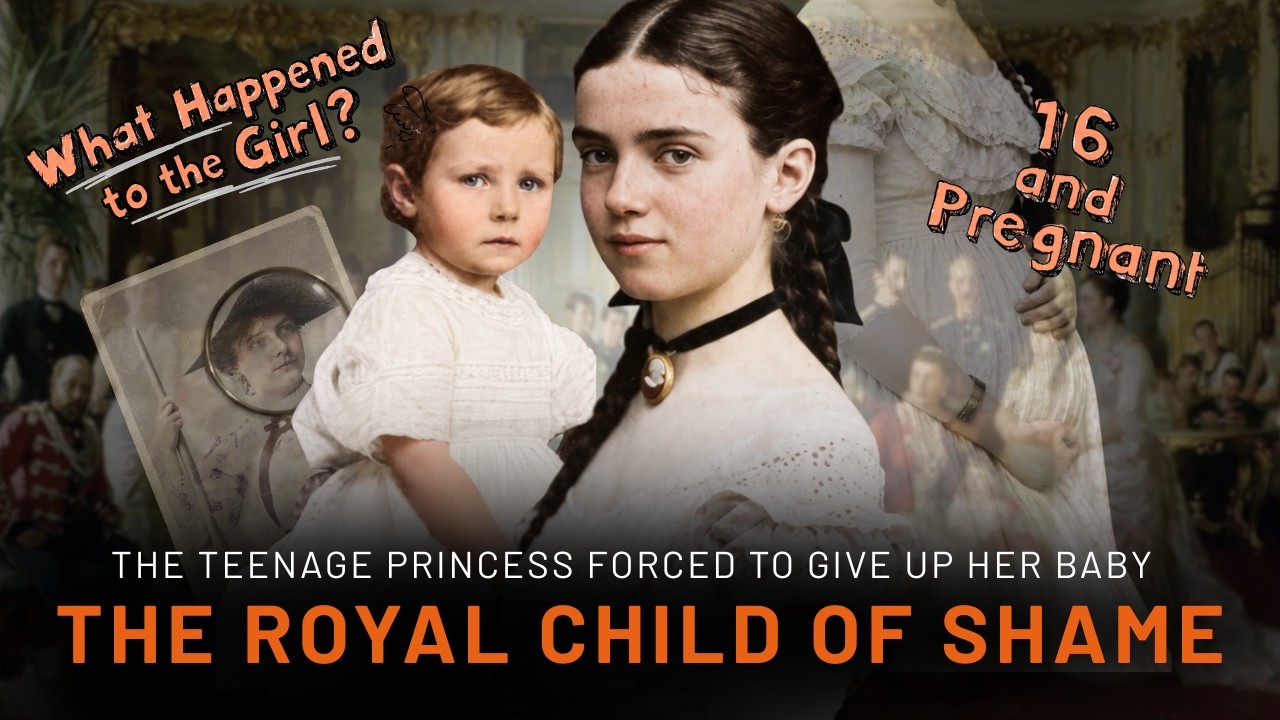
The royal family knew one thing for certain: no one could ever find out that this baby existed. So the young mother and her newborn child were torn from each other, never to meet again. Princess Thyra was born in 1853, just as a completely new chapter was beginning for her family. Only about two months before her birth, her father, who had been a distant relative of the Danish king and had lived a rather modest life until then, suddenly became a potential heir to the throne because of a dynastic crisis.
Despite the promise of enormous wealth and honors, the family continued to live modestly in rooms at the Yellow Palace in Copenhagen, where little Thyra shared a bedroom with her older sisters, Alexandra and Dagmar, and sometimes performed duties that in wealthier royal families would have been left entirely to servants. The princesses may not have been surrounded by gold, but they grew up in a genuinely loving family, and in the evenings, Hans Christian Andersen himself would sometimes come to visit and read them his fairy tales. When Thyra was ten, her father finally ascended the throne. The family’s life truly began to change.
Alexandra, Dagmar, and Thyra were no longer poor and relatively obscure princesses; they were now the daughters of the King of Denmark. Their mother, Queen Louise, was determined to secure the most brilliant possible future for her daughters, which meant finding them the best possible marriages. She succeeded spectacularly. Alexandra married the Prince of Wales, the future King Edward VII, and moved to Britain.
Dagmar married the Grand Duke who would later become Emperor Alexander III of Russia and left for Russia. Now it was the turn of their younger sister, seventeen-year-old Thyra. She received several marriage proposals, including from the elderly King William III of the Netherlands, who was almost forty years her senior, and Queen Victoria considered her as a possible bride for yet another one of her sons. But Thyra had very different plans for her future and for her love.
At the beginning of 1870, the young princess developed feelings for her brother’s royal aide, Wilhelm Frimann Marcher, a handsome cavalry lieutenant who was twelve years older than she was. At first, no one in the family seems to have paid much attention. Things like this happened often behind palace walls, where young women with very limited social lives could easily become attached to one of the men around them. Queen Louise apparently looked the other way, believing that sooner or later they would find Thyra a husband and the whole thing would pass.
Besides, it was assumed that the young officer knew his place and would never dare cross the line with a king’s daughter. But the young couple went far beyond long looks and innocent touches. One terrible summer day in 1871, Queen Louise was forced to face the horrifying truth: Princess Thyra was pregnant. A scandal now hung over the House of Glücksburg.
By this point, Christian was already becoming known as the father-in-law of Europe, and the birth of an illegitimate child to one of his unmarried daughters would have been an enormous disgrace. The family came up with a plan as old as time itself: a secret birth. Princess Thyra was urgently sent to stay with her brother George, who had already become King of Greece. The public was told that the princess was suffering from jaundice and would remain in sunny Athens for some time to recover her health.
Around Christmas of 1871, Princess Thyra gave birth to a baby girl. The exact date is unknown, and so is whether the young mother was allowed to spend even a little time with her newborn daughter or whether the baby was taken from her immediately. According to the family’s plan, the girl was supposed to be secretly placed with a Greek foster family, but Thyra most likely begged her parents to allow the child to grow up in her homeland, Denmark. In the end, her wish appears to have been granted.
After everything she had been through, the young princess was devastated, and her return home had to be postponed. On the way back, she also fell ill with typhoid fever, so her long and painful journey home did not end until June of 1872. Returning to Copenhagen turned out to be an even greater blow, because the man for whom she had endured all of this had already left this world. After the scandal, the young officer could not remain at court as if nothing had happened.
He was quickly appointed as an adjutant at the Ministry of War, effectively closing the doors of the royal palace to him. But before that happened, he had one private conversation with the girl’s father, King Christian. What exactly was said behind those closed doors remained a secret, but it is very unlikely that the father was pleased. Wilhelm had now lost both the woman he loved and his place in the world he had known.
He fell into a deep depression. Fellow officers who had once described him as a cheerful, open, and lively young man now saw someone completely different: withdrawn, gloomy, and constantly lost in his own thoughts. On the night of January 4th to 5th, 1872, the young man made the decision to take his own life in the regimental barracks. There was no happy ending for this couple.
What actually happened to the baby remains the biggest mystery of the entire story. The story of this forbidden love became known only thanks to Danish historian and biographer Bo Bramsen, who published it in his book in 1975. In that book, he mentioned the name of the supposed daughter, Maria Kathina Jørgensen. But at the same time, Bramsen wrote that there were other women in Denmark, also born in 1871, who believed they too might have been the princess’s daughter.
A modern researcher, Kurt Viskov, tried to investigate the biography of this particular woman. He studied church records and found the names of both her biological parents and her adoptive parents, but in the end he concluded that she most likely had no connection to Princess Thyra at all. A photograph that has circulated online claiming to show the illegitimate daughter appears to have surfaced only in 2021, and its origin remains unknown. Most likely, someone simply uploaded a random old photograph, and over time it became surrounded by myths.
The truth about this child may only come to light if the Danish royal family ever opens the private letters exchanged during that period between King Christian, Queen Louise, and Thyra. Normally, correspondence like this becomes available after one hundred years, and almost anyone can request access to historical letters in an archive. But the correspondence of the Danish royal family is still part of their private collection. Although almost nothing is known for certain about the fate of Thyra’s possible child, much more is known about how the princess’s own life unfolded afterward.
While returning from Athens, she met Prince Ernst August, heir to the Kingdom of Hanover, which by that point no longer really existed, having been annexed by Prussia. In a way, he was an heir without a kingdom, which did not make him the most desirable match in Europe. His appearance was not particularly impressive either, and Thyra’s own sisters openly wrote that Ernst was not handsome. But in the end, he won her over with his calm nature, his gallantry, and his persistence, continuing to court her for almost two years.
They were married on December 21st, 1878, and went on to spend almost forty-five years together in what seems to have been a genuinely happy marriage. Fate seems to have a particular sense of humor, because just when the royal family must have thought everything was finally under control, another scandal came knocking at their door. Thyra’s own niece, also named Thyra, the daughter of her brother, the future King Frederick VIII, fell in love with the court physician at the age of twenty-one. Once again, the same palace, another Thyra, and again a man considered completely unsuitable in terms of social status.
This time, however, it did not end in pregnancy, because the doctor was immediately sent far away from court. But the consequences of that love were no less painful. Princess Thyra never married, and neither did her beloved doctor, who kept her photograph on his desk until the end of his life. And then there remains the fate of that little girl who may have lived her entire life without ever knowing that she was related to some of the most famous royal families of the twentieth century.
Whether Princess Thyra really had an illegitimate daughter, and whether the Danish royal family will ever reveal the truth, remains unanswered.
