On February 8, 1942, a plane crashed shortly after taking off from a facility near Rastenburg, killing Fritz Todt, the Reich Minister for Armaments and Munitions. Within hours, Adolf Hitler summoned Albert Speer, the regime’s favored architect, and appointed him to replace Todt. In a single stroke, the man who had spent the past decade designing monumental buildings for the Nazi state was handed control of Germany’s entire war economy. Speer now bore direct responsibility for producing the weapons, ammunition, and equipment that would keep the Wehrmacht fighting for years to come.
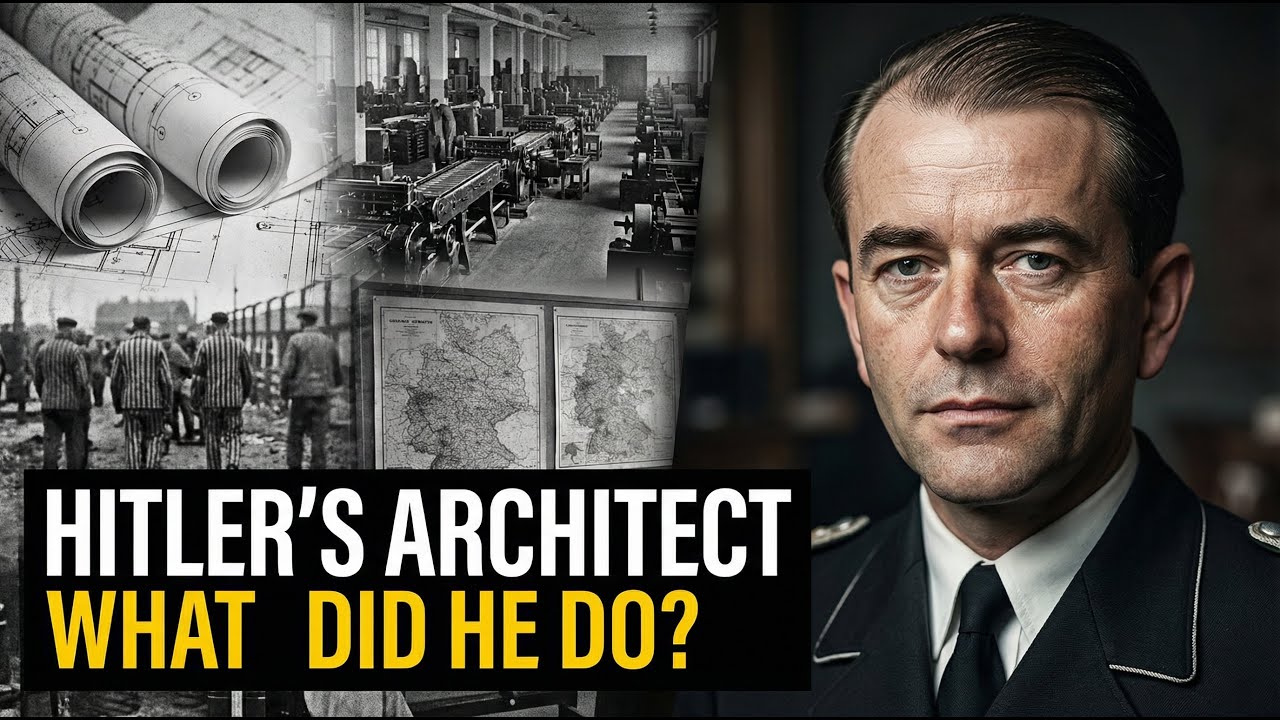
Speer’s rise had been steady and deliberate. Born in 1905 in Mannheim into a prosperous family of architects, he studied at the technical universities of Karlsruhe, Munich, and Berlin. He joined the Nazi Party in 1931, drawn less by ideology than by Hitler’s charisma and the opportunities the movement presented. His breakthrough came in 1933, when he was commissioned to redesign the party headquarters and stage the annual party rally at Nuremberg.
Hitler was impressed. From that point forward, Speer became the dictator’s favorite architect, the man who gave physical form to Nazi fantasies of power and grandeur. During his years as Hitler’s architect, from 1933 to 1942, Speer’s days followed a demanding but orderly rhythm. He typically rose at seven or eight, breakfasted with his wife Margarete and their children when possible, then commuted to his Berlin office.
His practice had expanded enormously under Hitler’s patronage, employing hundreds of architects, draftsmen, engineers, and administrators. Mornings were spent reviewing progress with senior staff, working through drawings, models, budgets, and schedules. Speer was known as a demanding boss, expecting long hours and exacting standards, but he also inspired loyalty and enthusiasm for the monumental projects underway. The most important meetings of the day were with Hitler.
The dictator was fascinated by architecture and would spend hours bending over plans, ordering changes, and discussing every detail. These sessions took place at the Reich Chancellery or at Hitler’s residence and could stretch for hours. Speer learned to present his work in ways that appealed to Hitler’s taste for grandeur and symbolic power. They were not simply professional consultations; they were opportunities to cement a personal relationship, to demonstrate loyalty, and to secure approval and resources.
Hitler, in turn, relished these discussions, which let him escape the burdens of governance and indulge his frustrated artistic ambitions through Speer’s talent. Afternoons were usually given over to site visits. Speer was a hands-on architect who travelled to construction sites around Berlin and beyond, checking on progress, resolving problems, and making certain the reality matched the plans. He met with supervisors, inspected work, and approved changes.
These visits served a political purpose as well, publicly demonstrating his engagement with projects that represented the regime’s ambitions. Evenings often meant social obligations: receptions, party functions, the opera, and, occasionally, Hitler’s late-night gatherings at the Chancellery or at the Berghof, where conversation could run into the early hours. Attendance was both a privilege and a burden, but it gave Speer access to the center of the regime’s power. A defining example of his architectural daily grind came in the run-up to the 1934 Nuremberg Rally.
For months, his days were consumed with planning the event’s visual and theatrical elements. He devised the Cathedral of Light, a spectacle of searchlights aimed skyward to form towering columns of light visible for miles. Engineering questions about placement and power, coordination with the military to provide equipment, supervision of temporary construction, and constant communication with party officials filled his schedule. The success of the display, which thrilled both Hitler and the German public, established Speer as the regime’s premier architect.
The war changed little at first. Even after hostilities began, Speer continued designing the transformation of Berlin into a world capital called Germania, replete with a vast north-south boulevard and a great hall meant to dwarf every structure on earth. These plans were increasingly divorced from reality, and his work became an exercise in planning a city that would never be built. But by early 1942, the strain of war made such projects impossible to sustain.
Todt’s death changed Speer’s path completely. As armaments minister, Speer’s routine transformed overnight from architectural design to industrial management on an enormous scale. His days began early, often at seven, with a quick breakfast while reviewing overnight reports. He routinely worked sixteen or eighteen hours, travelling constantly to factories and production centres across Germany and occupied territories.
His management system rested on committees and rings, organizations of industrialists, engineers, and technical experts tasked with solving production bottlenecks and boosting output. Speer was famously devoted to statistics, personally reviewing output figures for every major weapon system. Mornings were filled with data-driven meetings to identify problems and set priorities. He reorganized production around specific armaments, improved designs, and allocated scarce resources with ruthless efficiency.
Mid-morning brought sessions with industrialists and factory managers. The German economy ran on a mix of private industry and state control, and Speer needed the cooperation of major corporations to hit his targets. He combined persuasion, pressure, and material resources to motivate compliance. He could speak with engineers as an equal and with businessmen about profit and production, and he was not above political threats to overcome resistance.
Lunch was almost always working, often taken in transit between meetings and factory sites. His inspection tours were central to his management style; he arrived unannounced, toured facilities, spoke directly with workers and engineers, and made rapid decisions on the spot. These visits gave him information no report could convey and demonstrated that the armaments minister was personally involved in the effort. The central moral weight of Speer’s work lay in the forced labor system.
The German armaments industry depended on millions of concentration camp prisoners, prisoners of war, and conscripted workers from occupied territories, who were held under horrific conditions and died by the thousands from exhaustion, maltreatment, and industrial accidents. Speer’s ministry was directly involved in requesting and distributing this labor, coordinating with the SS to supply factories. His daily activities included meetings and correspondence about labor allocation and visits to plants where forced laborers worked. His postwar claims of ignorance or marginal involvement are contradicted by documentary evidence showing he was a driving force in expanding the use of slave labor to increase production.
His afternoons were frequently occupied with negotiations involving the armed forces. The navy, army, and air force competed for limited resources, and each demanded priority. Meetings could become contentious, with commanders blaming production shortfalls for battlefield defeats and Speer pointing to unrealistic demands and poor planning. He used his relationship with Hitler as leverage when necessary, but also built working relationships with senior officers who recognized his competence.
Later afternoon and evening were often reserved for Hitler, with Speer reporting production figures, defending decisions against rivals, and trying to manage the dictator’s expectations. Hitler remained obsessed with miracle weapons and new technologies, while Speer had to balance those fantasies against material and industrial realities. These meetings were politically delicate; Hitler could turn violently against subordinates who disappointed him, and Speer survived largely by delivering genuine increases in production and by presenting his work with skill and loyalty. Allied bombing became a constant factor from 1942 onward.
Speer’s days included reviewing damage reports, visiting destroyed factories, organizing reconstruction, and shifting production to dispersed and underground sites. He created mobile repair teams to restore damaged plants quickly and pushed construction of subterranean facilities to shield output from bombs. These efforts consumed enormous time and energy and demonstrated his commitment to keeping the German war machine functioning whatever the human cost. From 1943 onward, crisis management dominated his schedule.
Germany faced mounting shortages of raw materials, fuel, and labor. Bombing destroyed factories faster than they could be rebuilt. Territory losses meant lost resources. The Red Army advanced from the east and the western Allies from the west.
Still, Speer’s organizational talent kept production going, prolonging a criminal regime and extending the suffering it caused. In the final months of the war, Speer’s days shifted in character. According to his memoirs, he recognized that Germany was defeated and began working to countermand Hitler’s scorched-earth orders, meeting with commanders and industrialists to preserve infrastructure rather than destroy it. He even claimed to have considered assassinating Hitler.
Historians remain divided on whether this reflected genuine moral awakening or self-interested positioning for the postwar world, and documentary evidence shows only that he took some limited steps to moderate destruction. When the war ended in May 1945, Speer was arrested. His routine became that of a prisoner and then a defendant. At Nuremberg, he adopted a strategy unlike that of his co-defendants: rather than deny involvement or claim to have merely followed orders, he accepted general responsibility for the regime’s crimes while insisting he had known nothing about the Holocaust.
He presented himself as an apolitical technocrat who had been seduced by Hitler and focused only on his work. The strategy partly succeeded. Convicted of war crimes and crimes against humanity for his use of forced labor, he escaped the conspiracy charge and the death sentence. He received twenty years in Spandau prison.
For two decades, from 1946 to 1966, Speer’s days were shaped by prison regulations. He woke early, gardened, performed other assigned labor, walked the yard for exercise, and devoted long hours to reading and writing. He kept extensive journals that later became the basis for his bestselling memoir, Inside the Third Reich, published in 1969. His time in prison was, in effect, preparation for his postwar career as the most famous reformed Nazi, carefully reconstructing his public image.
After his release in 1966, Speer lived comfortably, earning substantial income from his books and controlling his interviews carefully. He presented himself as a cautionary example about the dangers of totalitarianism and the moral responsibilities of professionals. The gap between that carefully crafted image and the historical record is wide. He claimed to have been an apolitical technocrat, but his daily work directly sustained genocide and aggressive war.
He claimed ignorance of the Holocaust, but he attended meetings where the persecution and murder of Jews were discussed, visited camps where his forced laborers were worked to death, and received reports that made the reality unmistakable. He claimed to have turned against Hitler, yet he served the regime effectively until its collapse. His daily activities, whether designing monuments to dictatorship or managing a war economy built on slave labor, reveal the truth. Albert Speer was not a passive figure carried along by events.
He was an active, competent, and essential participant in Nazi crimes.
