The word came down the line in whispers: the Germans were coming out, white flags raised. Lieutenant Hardin, crouched behind a shattered tree stump with a radio pressed to his ear, could barely believe it. He lifted his head, peered through the drifting fog, and saw them—shapes moving out of the treeline, rifles held high, strips of white cloth fluttering from the barrels. His men lowered their weapons.
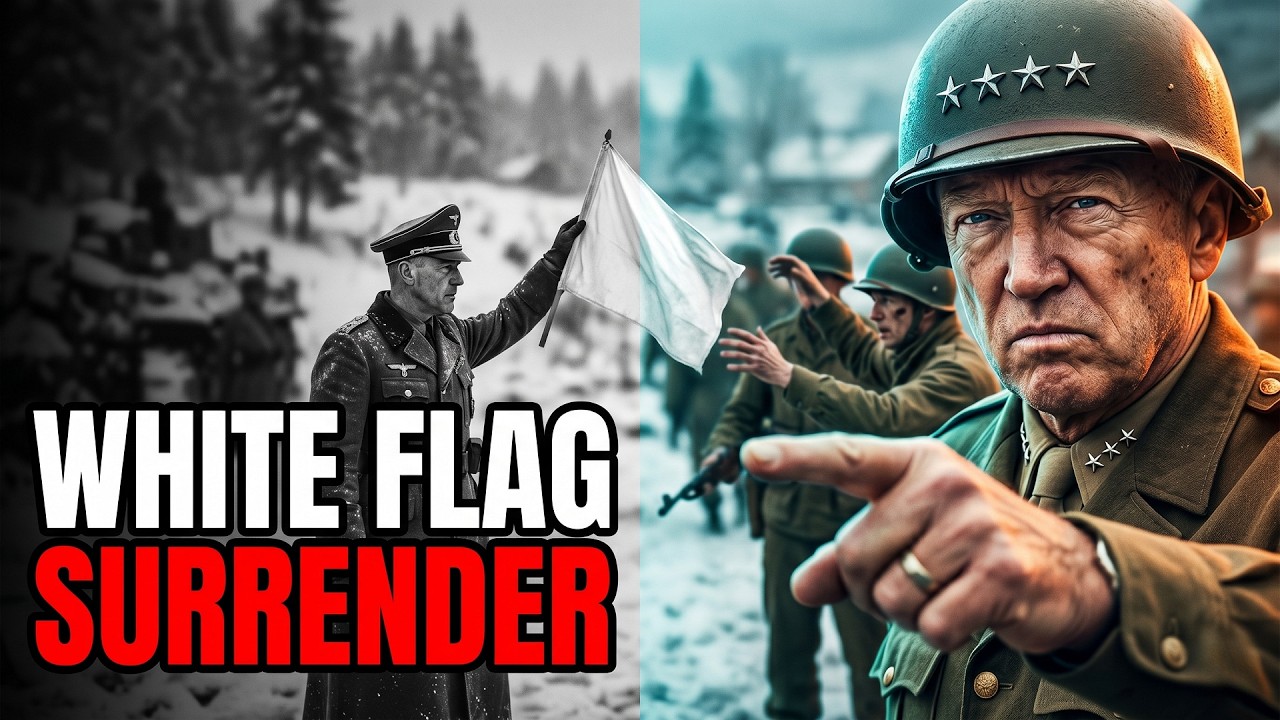
Relief moved through the frozen foxholes like a current. Then the voice of General George S. Patton crackled through the receiver, and Hardin felt his stomach drop. Do not stop.
Do not accept it. Keep firing. Blow them to hell. It was late 1944.
The German army was retreating across Europe, bloodied and pushed back, but retreat did not mean broken. The men who still held the line were disciplined, experienced soldiers who knew the terrain and knew how to punish an advancing column with every mile it gained. Patton’s Third Army was driving hard into the heart of the enemy’s defenses, and Patton believed above all else that speed was survival. Armor had to keep rolling.
Infantry had to keep pressing. Every pause, every halt, every polite hesitation handed the enemy time to regroup, to aim, to kill. And time was the one thing the Germans needed most. But to the men on the ground, none of that strategic urgency mattered.
They saw the white flags and their minds latched onto a single, overwhelming hope: the nightmare might pause. They had not slept. Their clothes were wet, their ears ringing, their fingers too numb to feel the triggers they held. Behind them, under a blanket, lay the body of a friend who would not be getting up.
They were exhausted beyond reason, tired of killing men they could not even see. When the enemy raised white cloth, that exhaustion turned into a desperate grab for peace. They stood taller. They lowered their barrels.
They looked for an officer to receive the surrender. They forgot, for one breath, that the enemy might still be thinking. That breath was what could kill them. The German commanders understood the psychology of the front line perfectly.
They knew American troops respected the laws of surrender. They knew a white flag created hesitation, forced men to question before they fired. And in mechanized warfare, one question could cost twenty minutes. Twenty minutes could turn a valley into a graveyard.
At Patton’s command post, miles behind the line, the radio report did not bring relief. It brought suspicion. He studied the map of the valley where his column was advancing. The ground lay open in the center, but the Germans still held cover near the woods and on the higher ground beyond.
To a tired soldier in a foxhole, it looked like surrender. To Patton, it looked like a trap. He knew German artillery crews did not need to be brave to kill his men. They needed coordinates.
They needed time to pull anti-tank guns into position. They needed a pause long enough to range the American armor, load the shells, and prepare the kill zone. Patton had studied the German way of war. He knew their units did not give up useful ground while they still held a tactical advantage.
If they were offering a ceasefire in perfect ambush terrain, there had to be a reason. And the reason was not peace. The white flag was not an ending. It was a stopwatch.
If the Americans stopped to negotiate, the tanks would halt in the open. Infantry would leave cover. Officers would step forward. Radios would chatter.
Men would relax. And behind the German line, crews would finish setting the guns. Patton could see the outcome before it happened: Shermans burning in the field, turrets blown open, infantry shredded by steel fragments, medics crawling through mud while German guns fired from concealed positions. He reached for the field telephone.
The officer on the other end did not want the order. No decent man would. “General, they appear unarmed. They are carrying a flag.
”
Patton cut him off. “It is a trap. Keep the armor moving. Do not stop in that valley.
Fire at will. ”
The officer hesitated because the dilemma was real. If the Germans were genuinely surrendering, firing on them would stain every man involved. It could destroy careers, invite investigation, and follow Patton for the rest of his life.
But if Patton was right, stopping would get his men slaughtered. That was command: not clean choices, not heroic speeches, just seconds of pressure, incomplete information, and consequences paid in blood. Patton took the responsibility. He ordered the attack.
The command traveled down the line. Do not halt. Advance. The soldiers who had been preparing to receive prisoners froze, confusion flickering across their faces.
Then training took over. Sherman engines roared forward. Infantrymen tightened their grips on their rifles. Machine guns swung toward the treeline.
High-explosive shells were loaded into the breeches. The Germans with the white flag saw the Americans were not stopping. And then the mask slipped. The so-called peace party did not keep walking with raised hands.
Men dove into the mud. Weapons appeared from beneath coats. The white cloth dropped. The quiet erupted into fire.
But the real proof lay behind them. As the American tanks smashed forward into the German position, they found what Patton had feared most. Hidden near the woods stood German 88-millimeter anti-tank guns. Some were not fully positioned.
Barrels were still being raised. Shells were stacked close at hand. Crews were still preparing their firing angles. They were not ready.
They were almost ready. That was the difference between survival and disaster. The 88 was one of the most feared weapons on the Western Front. Against a Sherman tank, it could be devastating.
From concealment, with a clear field of fire and minutes to settle in, a battery of 88s could tear an armored column apart before it knew what was coming. The Germans had planned to stop the Americans with mercy. Not real mercy—the appearance of mercy. They expected the GIs to lower their guard.
They expected officers to step forward and negotiate. They expected engines to idle and men to believe the fighting was done. They expected Patton’s men to become honorable, stationary targets. Instead, the tanks kept coming.
The Shermans fired at close range. Machine guns cut through the positions. The crews around the 88s were caught in the open before the ambush could mature. Guns were smashed.
Ammunition stores exploded. Men who had been seconds away from killing Americans suddenly scattered for cover. The trap collapsed before it could close. When the smoke cleared, the valley was still in American hands.
The cost had been light compared with what might have happened had the ambush been allowed to spring. Afterward, the officers who had questioned the order walked through the German position. They saw the guns, the shells, the firing angles aimed directly into the open ground where the American tanks would have waited. And the realization hit them hard: their decency had almost been used against them.
Patton’s ruthlessness had saved their lives. That is why this story remains dangerous. Not because it is simple—because it is not. War depends on rules.
Real surrender matters. A white flag is supposed to mean a man is done fighting. When soldiers stop trusting that, the battlefield becomes even more savage. A false surrender does more than set one ambush.
It poisons every surrender that comes after. It makes soldiers hesitate before sparing enemies who may truly be defeated. It turns mercy into a risk. The cruelty of the trick ran deeper than the trap itself.
The Germans had not only tried to kill American troops. They had tried to weaponize the laws meant to keep war from becoming pure butchery. They had tried to use American honor as bait. Patton understood that logic.
He also understood momentum. In his world, a stopped column was a target. A polite pause in the wrong terrain was suicide. That did not make the order clean.
It made it necessary. And that is why his men followed him. Patton was arrogant, profane, theatrical, and often impossible. But his soldiers believed one thing: he wanted to win fast, because winning fast meant fewer of them died slowly.
On that frozen field, he did not have the luxury of looking civilized. He had to decide whether the flag in front of his troops was surrender or bait. He chose bait.
And the guns behind the treeline proved him right.
