In the spring of 1931, along the western shores of Narragansett Bay, stood a property locals called the Pemrook Estate. The house was a Georgian Revival structure built in 1892 by a textile merchant named Cornelius Pembrook. For nearly forty years it had been one of the finest private residences in Washington County, with seventeen rooms filled with European furniture and grounds maintained by a staff of groundskeepers. But by the time a graduate student named Josiah Corrigan began researching the property in 1958, all that remained were photographs, land deeds, and the testimonies of those who had witnessed what transpired there during those desperate months when the house changed hands.
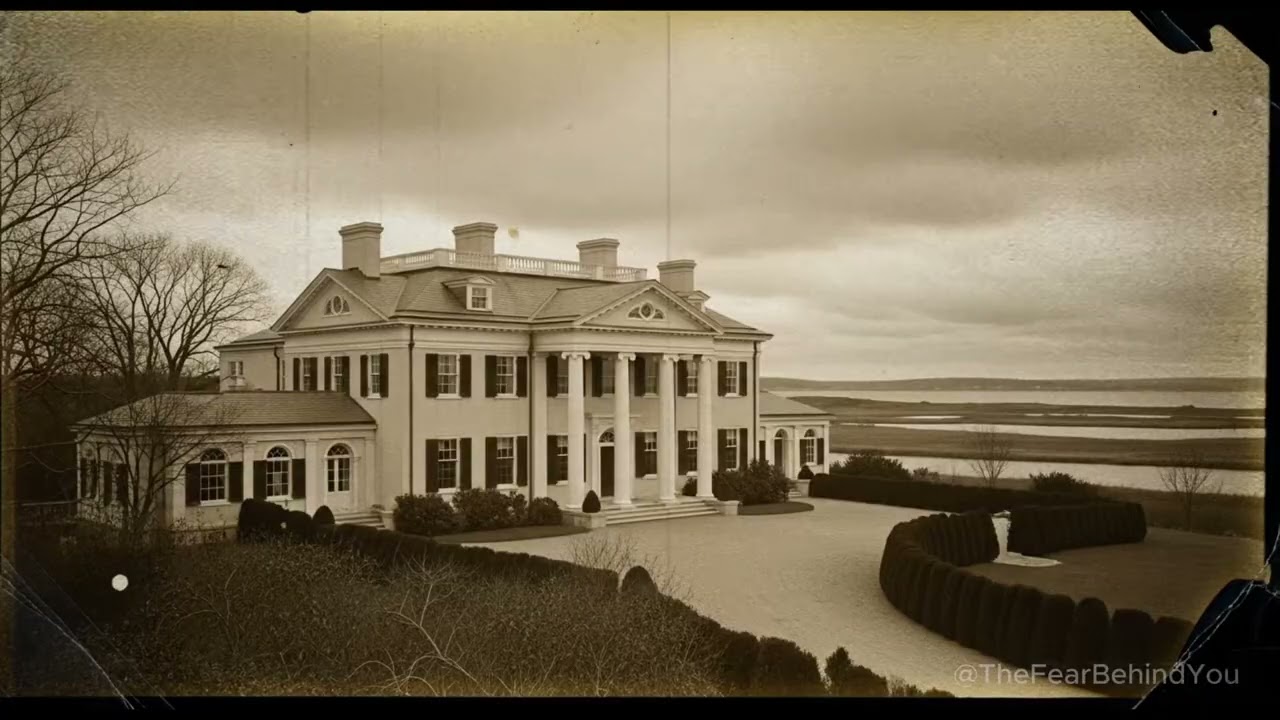
Corrigan was researching the economic impact of the Great Depression on Washington County’s property markets. His thesis contained an entire chapter devoted to what he termed anomalous transactions—properties that changed ownership under circumstances that defied the typical patterns of foreclosure, auction, and resale. The Pemrook Estate occupied nearly forty pages of his research. The events surrounding that property between March and November of 1931 remain among the most disturbing documented in that work.
To understand what happened, one must understand the economic reality of Rhode Island in that period. The textile industry, the backbone of the state’s economy for generations, had been in decline throughout the 1920s. When the stock market collapsed in October of 1929, it accelerated a destruction already well underway. By 1931, unemployment in the state reached thirty-two percent.
In Washington County, the situation was even more dire. The once prosperous summer colonies along the coast had emptied as wealthy families could no longer afford their seasonal residences. Grand houses stood vacant, their windows dark, their gardens returning to wilderness. Cornelius Pembrook had passed away in 1927, leaving the estate to his only surviving heir, a nephew named Desmond Vickers.
Vickers was forty-three years old, a junior partner in a Providence law firm specializing in maritime contracts. He had never married, lived modestly in a rented apartment, and had no particular interest in managing a large estate. What he inherited was essentially a magnificent house surrounded by fifty-seven acres of land, with barely enough capital to maintain either for more than two years. Vickers made his first attempt to sell the property in the autumn of 1929, just weeks before the market collapse.
Negotiations fell apart when the crash rendered the prospective buyer’s financial position untenable. Throughout 1930, Vickers lowered his asking price repeatedly, from $120,000 to ninety, then seventy, then fifty. There were no serious offers. The property taxes alone amounted to nearly $3,000 annually, and Vickers watched helplessly as his inheritance drained away month by month.
In January of 1931, Vickers received a letter that would change everything. The letter came from a man named Aldrich Suall, who identified himself as a representative of a private investment group based in Hartford, Connecticut. Suall expressed interest in purchasing the Pemrook Estate not as a residence but as a commercial venture. His clients believed the economic crisis would not last forever.
They intended to acquire distressed properties throughout southern New England, restore them, and either sell them at a profit when the economy recovered or convert them into hotels for the tourist trade that would eventually return to the coastal regions. The letter offered $45,000 for the estate and its contents. What struck researchers about the letter was not what it said, but what it implied. Suall’s investors were not named.
The Hartford address corresponded to a building that housed numerous small businesses, none of which appeared to have any connection to real estate investment. The letter was dated January 12th, 1931. Vickers responded within a week accepting the terms. The sale was completed on March 15th of that year.
Vickers signed over the deed and received a check drawn on the Industrial Trust Company of Providence. He moved to a boarding house in Wickford. What Vickers did not know was that the check he had deposited would clear only after several weeks of unexplained delays, and that the investment group that Suall represented existed only on paper. Aldrich Suall arrived at the Pemrook Estate on March 20th, accompanied by his wife Lucretia and a team of four workers whose names appear nowhere in official records.
Suall was forty-eight years old, a tall man with prematurely white hair and a manner that neighbors later described as excessively formal. His wife was perhaps a decade younger, slender and dark-haired, with a habit of wearing gloves even indoors. The workers were all men in their thirties or forties, and they spoke little to anyone outside the property. Within the first week, Suall visited nearly every business in the nearby villages of Wakefield and Kingston, placing orders for lumber, paint, hardware, and plumbing fixtures.
He paid for everything in cash. The local merchants, many of whom had not seen such consistent business in months, were initially delighted. Suall told the proprietor of the Wakefield hardware store that he intended to restore the Pemrook Estate to its original condition and then convert it into a private club for wealthy sportsmen. One hardware store proprietor remembered Suall’s hands, which were smooth and uncalloused—the hands of a man who had never performed manual labor.
He remembered Lucretia Suall’s voice only once, when she accompanied her husband to purchase cleaning supplies. Her accent, he said, was not from Connecticut or anywhere in New England. He thought it might be European, perhaps German or Austrian. Most of all, he remembered the question Suall asked about the estate’s previous occupants.
Suall wanted to know everything about Cornelius Pembrook and his family, about the servants who had worked there, about any incidents or accidents that might have occurred on the property. The restoration work proceeded rapidly throughout April and May. Neighbors saw the workers on the roof replacing damaged shingles and in the garden clearing years of neglected growth. The house had been empty for nearly four years, and water had seeped through cracks in the foundation, warping the floorboards in the basement.
The Sualls and their team addressed each problem with what appeared to be unlimited resources and expertise. In early June, the first peculiar incident occurred. A woman named Hester Driscoll, who lived on a small farm about half a mile from the estate, was walking along Tower Hill Road at dusk when she heard sounds coming from the direction of the house. The sounds were rhythmic and repetitive, like hammering, but with a quality she found difficult to describe.
They seemed to come not from the house itself, but from beneath it, from somewhere underground. Driscoll quickened her pace and did not take that road again after dark for several weeks. Other neighbors reported similar experiences throughout June and July. The sounds were heard only at night, usually between midnight and three in the morning.
They varied in character, sometimes resembling construction work, other times more like digging or scraping. When anyone asked the Sualls about the noises, they were told that foundation work was being conducted. But Corrigan discovered through careful examination of building permits and supply orders that the Sualls had not applied for any permits to work on the foundation. The materials they had purchased were appropriate for surface repairs, painting, and landscaping.
There was no record of concrete, reinforcing steel, or any of the other materials that foundation work would require. Moreover, the workers had been seen leaving the property on several occasions during the day, apparently to visit towns as far away as Westerly and Narragansett, while the nighttime work continued unabated. The implication was that the Sualls themselves were conducting whatever activity produced those sounds. In late July, the Sualls made an unusual request.
They approached the pastor of the Kingston Congregational Church, a Reverend Osgood Thorne, and asked whether the church maintained any records from the colonial period. They asked specifically about the land on which the Pemrook Estate now stood. They wanted to know who had owned it before Cornelius Pembrook’s grandfather purchased it in 1847, and what, if anything, had stood there previously. Thorne spent several days searching through the church archives.
The land had been part of the original Pettaquamscutt purchase of 1658, one of the earliest European land acquisitions in what would become Rhode Island. For nearly two centuries, it had been agricultural land. In 1815, a structure was built on the property, though the records did not specify what kind of structure or who built it. This building apparently burned in 1833, and the land sat empty until the Pembrook family acquired it.
Thorne was troubled by the encounter. When he mentioned the fire of 1833, Lucretia Suall had leaned forward with such eagerness that he found himself involuntarily stepping back. She asked whether anyone had perished in the fire, whether the building had been a residence or something else, whether there had been any legal disputes or unusual circumstances surrounding the event. Thorne did not have answers to these questions.
Throughout August, the Sualls’ behavior became increasingly erratic. They began refusing deliveries. They stopped appearing in public together. The workers became less visible, though neighbors reported that the trucks remained parked in the carriage house and that lights burned in the windows late into the night.
It was during this period that Corrigan’s research uncovered its most disturbing detail. Among Desmond Vickers’s papers, Corrigan found a letter that Vickers had received in early September of 1931. The letter was from a law firm in Hartford, and it informed Vickers that the investment group that had purchased the Pemrook Estate had been dissolved. The entity that Aldrich Suall represented had never been a legitimate business.
Its formation and dissolution had occurred within a span of four months, and its only recorded transaction was the purchase of the Pemrook Estate. On September 15th, Vickers drove to the Pemrook Estate to confront the Sualls. He arrived in the late afternoon. The grounds had been transformed.
The garden was immaculate, the hedges trimmed, the lawns mowed. Fresh paint gleamed on the window frames and shutters. The house looked better than it had at any time in Vickers’s memory. But something was wrong.
The air seemed heavier, the light dimmer. The sounds of birds and insects, which normally filled the coastal landscape, were absent. There was only silence, broken occasionally by a faint rhythmic sound from somewhere beneath his feet. Vickers knocked on the front door and waited.
No one answered. He walked around the house, peering through windows. In the parlor, on the mantelpiece where his uncle had always kept a collection of nautical artifacts, there now stood a row of glass jars. The jars appeared to contain earth or soil of some kind, each one labeled with a small tag.
He tried the back door and found it unlocked. The interior was cool and dim, the windows draped with heavy curtains that admitted little light. Every room had been meticulously restored, but each room also contained objects that seemed entirely out of place. In the dining room, the mahogany table was surrounded by chairs.
But one of the chairs was different from the others. It was older, much older, with a style of carving that he associated with the early colonial period. It did not match the rest of the furniture at all. Yet it had been placed at the head of the table as though it were the most important seat in the room.
In the library, he found the floor partially removed. Several boards had been lifted and set aside, revealing the dark space beneath. A ladder extended down into the space, and from somewhere below, Vickers heard that rhythmic sound again, clearer now. It was not hammering.
It was scraping, like metal against stone or earth. Vickers did not descend the ladder. He backed out of the library and made his way quickly toward the front door. As he reached the entrance hall, he heard footsteps above him on the second floor.
They were slow and deliberate, moving toward the staircase. Vickers did not wait to see who was descending. He ran. Later that evening, Vickers went to the North Kingstown Police Station and filed a report.
He told the sergeant on duty that he believed the Sualls were engaged in some kind of illegal activity. The sergeant was sympathetic but unhelpful. The Sualls owned the property legally. They had not threatened anyone or caused any disturbance.
Unless Vickers could provide evidence of a crime, there was nothing the police could do. It was Hester Driscoll who discovered what the Sualls had found. On the morning of September 23rd, Driscoll saw smoke rising from the direction of the Pemrook Estate. She assumed at first that the Sualls were burning brush.
But as the smoke increased in volume, she grew concerned. Flames were rising from the west wing of the house. The fire brigade from Wakefield arrived shortly thereafter, but by that time the west wing was fully engulfed. The firefighters focused on preventing the flames from spreading to the rest of the structure.
The fire seemed to resist their efforts, flaring up repeatedly in areas they thought they had extinguished. By evening, the west wing was destroyed. The rest of the house survived, though with significant smoke damage. The firefighters entered the structure to ensure that no one was trapped inside.
What they found was evidence of sudden departure. Personal belongings remained in the bedrooms. Food sat partially prepared in the kitchen. The Sualls’ trucks were still parked in the carriage house.
But the Sualls themselves and their four workers were gone. The fire marshal conducted an investigation that lasted several weeks. His final report concluded that the fire had originated in the basement of the west wing. The cause was listed as unknown.
The basement floor had been excavated to a depth of approximately eight feet in one corner, revealing what appeared to be the remains of an earlier structure beneath the foundation of the house. Within this excavation, the marshal found ash and charred fragments that did not match the materials used in the construction of the Pemrook Estate. More troubling were the items found elsewhere in the house. The jars Vickers had observed on the parlor mantelpiece contained soil samples from various depths of the excavation, each labeled with a date and a notation in a language that none of the investigators could identify.
In the library, beneath the removed floorboards, they found a stone chamber approximately six feet square and four feet deep. The chamber was empty, but its walls bore marks that suggested something had been stored there for a very long time. In the master bedroom, investigators discovered a journal that appeared to belong to Lucretia Suall. Most of its pages had been torn out, but those that remained contained sketches of architectural features, measurements, and repeated references to something she called the foundation offering.
The Sualls were never found. The checks they had drawn on accounts at banks in Hartford, Providence, and New York proved to be backed by funds that had been deposited and withdrawn within days of each transaction, leaving no trail. The workers they had employed were never identified. The trucks in the carriage house were traced to a dealer in Springfield, Massachusetts, who reported that they had been purchased with cash by a man matching Aldrich Suall’s description.
Desmond Vickers spent the remainder of his life attempting to understand what had happened to his uncle’s estate. In 1937, he located an obscure reference in the papers of a Providence antiquarian. The reference mentioned a structure known as the Wall-E house, which had stood on a promontory overlooking Narragansett Bay in the early nineteenth century. The Wall-E house, according to this account, had been built by a family of Dutch origin who had migrated to Rhode Island from New Amsterdam in the seventeenth century.
The family had practiced what the antiquarian delicately termed heterodox religious observances, and their house had been destroyed by fire under circumstances that the local authorities declined to investigate. Vickers continued his research until his death in 1949. His papers contain a hypothesis that is never fully articulated but can be reconstructed from his notes. Vickers believed that the Wall-E family had buried something beneath their house, something of sufficient value or significance that it had attracted the attention of the Sualls nearly a century later.
He believed that the Sualls had come to Rhode Island specifically to locate and retrieve this object, and that the fire of September 1931 had been either an accident during their excavation or a deliberate act to cover their tracks. What the object might have been, Vickers could not determine. His notes suggest various possibilities, ranging from valuable artifacts to religious relics to something he cryptically refers to as a binding vessel. The term appears repeatedly in the final months of his research, always in connection with the Wall-E family’s heterodox practices.
Vickers seemed to believe that the Wall-Es had attempted to contain something, to trap it beneath their house, and that this containment had required a physical vessel of some kind. When the house burned in 1833, the vessel remained buried. When the Pemrook Estate was built over the same location, the vessel remained undisturbed. It was not until the Sualls arrived that the excavation began.
Josiah Corrigan completed his thesis in 1959 but never defended it. He withdrew from the doctoral program, citing personal reasons, and took a position as a high school history teacher in Cranston. He never published his research on the Pemrook Estate. When contacted years later, he was reluctant to discuss the case.
He told the researcher only that some histories are better left unwritten, and that certain questions once asked cannot be answered without cost. Corrigan passed away in 1972. His thesis notes remain the most comprehensive account of the events at the Pemrook Estate. He documented everything with the precision of a trained researcher, but his conclusions are notable for their absence.
He presents the facts, the testimonies, the physical evidence, and then he stops. Vickers died of heart failure on March 15th, 1949. The official cause was listed as natural causes. But his widow told Corrigan that Vickers had been healthy until the night before his death, when he woke screaming from a nightmare he refused to describe.
She said he spent his final hours sitting by the window, staring at the bay and muttering words she could not understand. She thought they might have been prayers, but she was not certain. When she asked him what was wrong, he told her only that he had made a mistake many years ago, and that he was afraid the bill was finally coming due. The Pemrook Estate was sold at auction in 1933.
The buyer was a family from Massachusetts who converted it into a summer residence. They made no further excavations, experienced no unusual disturbances, and lived there peacefully until 1961, when they sold the property to a developer who demolished the house and subdivided the land into residential lots. Today, the site is occupied by a cul-de-sac of modest homes whose residents have no knowledge of the estate that once stood there. The stone chamber beneath the library floor was filled with concrete before the demolition in 1961.
Whatever was contained there, whatever the Sualls retrieved, is now part of a history that most people will never know.
