The cabin smelled of wood smoke now, a low, faint thread of it. The hearth, which had been cold when he entered, held a small bed of orange coals, not a fire, just embers, as if a blaze had burned for some time and someone had let it die down. The candle on the table was lit. There was food on the plates.
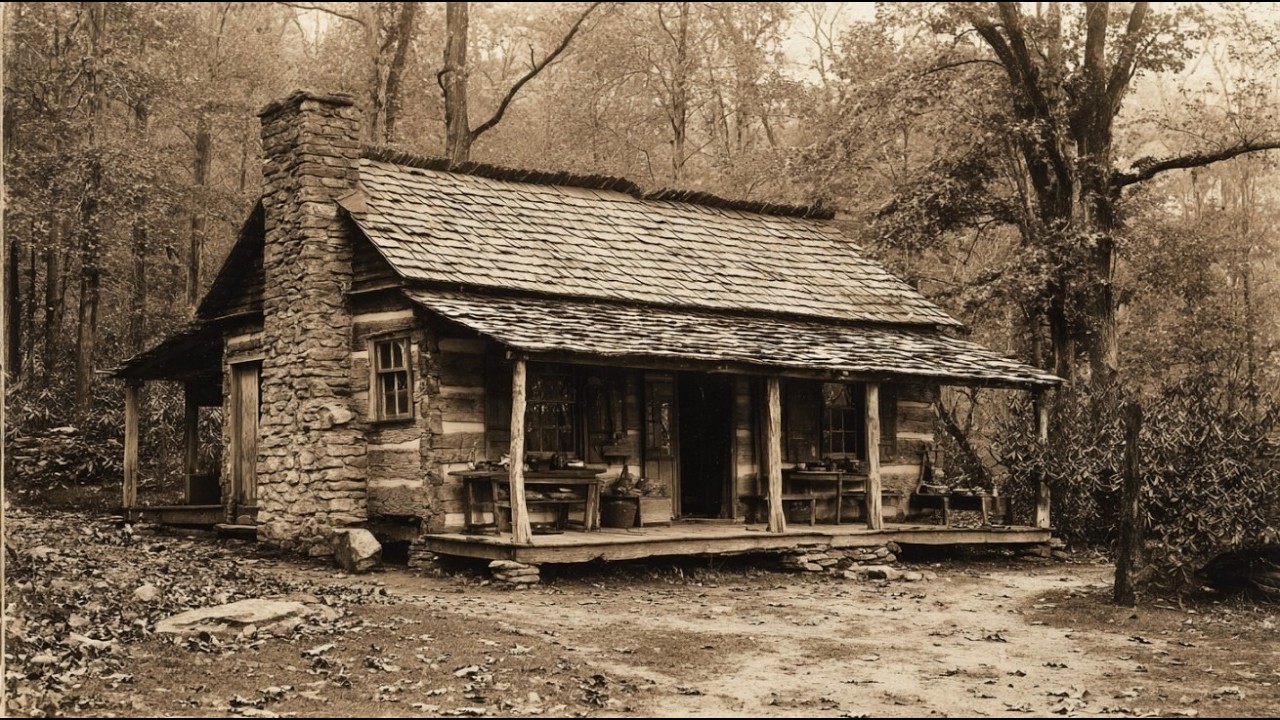
Wilkin Yarrow stood inside the door and looked at the table. He counted, without meaning to, six plates with food on them: bread, a wedge of yellow cheese, a piece of cold pork, a spoonful of beans, set out the way a country supper is set when the women have come back from the fields. And one plate empty. He knew which plate.
The chair at the head of the table was pulled out just slightly, just enough that it was no longer pushed in, the way a chair sits when somebody has stood up from it recently and forgotten to push it back. A voice said, “Won’t you sit? ”
It was a woman’s voice, low, soft, polite. It was very close to his ear.
He felt the breath of it on his neck. He did not turn around. He took a step backward. He felt the cool air of the outside on the porch boards behind him, and he understood that the door was still open behind him, which meant that whatever had spoken had not come through the door.
Which meant that whatever had spoken had been in the cabin with him the whole time. He stepped backward all the way out onto the porch. He turned slowly and looked back in. The room was empty.
The table was set. The candle was lit. The chair at the head of the table was pulled out. But there was no one in the room.
Then on the bench by the wall, where his satchel had been, he saw something he had not seen before: a small pile of objects laid out neatly, the way a man might lay out his pocket things at the end of a day. A surveyor’s pipe. A folded coat. A pair of wire-rimmed spectacles.
His own spectacles. He put his hand to his face. His spectacles were still on his face. He felt them.
He could see through them. There were two pairs, his own on his face, and another pair, exactly identical, laid out on the bench beside the pipe. He understood then what the cabin was doing. He understood the way a man understands the look on the face of an animal that has decided it is no longer afraid of him.
The spectacles on the bench were not a warning. They were an arrangement. They were where his spectacles would be soon, when he was the one whose coat hung on the peg by the door. He turned and ran.
He ran across the porch, down the three stone steps, across the wild garden, through the gap in the rose canes, and out onto the path that led down through the hemlocks. He did not look back. The light was going fast. The trees had begun to lose their shapes.
The path was a pale ribbon of leaves under his feet, and he ran on it, and he did not look at the trees, because the trees, very faintly in his side vision, had begun to do something he could not afford to see. Behind him, the soft, polite voice was still close. It did not seem to be getting any farther away. “Won’t you sit, Mr.
Yarrow? We always set a place. ”
He ran. The path was steep going down.
He slipped twice, tore his trousers at the knee, skinned the heel of his hand on a root. He did not stop. He could feel something walking at exactly his pace just behind his right shoulder. He could feel the soft brush of cloth at the back of his collar.
He thought, very clearly, in his running, about Pell Divine. About a coat on a peg. About a name freshly carved into the underside of a chair. About what it must feel like to a man to sit down at a table and not realize, for some hours, that he is no longer the guest.
That he is the meal. He came around the last bend. The path opened out. The creek was there.
And on the other side of the creek, in the very last gray of the dying light, was Halsey Penny in his wagon with his small horse. Exactly where he had said he would be. The look on Halsey Penny’s face when Wilkin Yarrow came stumbling across that creek with his trousers torn and his hair wet with sweat and his eyes the way they were—that look is something I have been told about by a man who heard it from a man who heard it from Halsey Penny himself. Halsey Penny did not say a word.
He took the reins. He brought the horse around and drove Wilkin Yarrow back down the logging road in the dark faster than was safe, faster than any sane wagoner would drive a small wagon on a bad track in the West Virginia mountains after sundown. He did not stop. He did not slow.
He did not speak. Once, on the way down, the small horse threw her head and tried to stop, and Halsey Penny spoke to her very low, and the horse went on. They reached the edge of town at almost ten o’clock at night. Halsey Penny pulled the wagon up in front of the boarding house.
He did not get down. He sat with the reins in his hands, looking straight ahead at the dark street. Finally, without turning, he said, “You stayed past supper, didn’t you? ”
Wilkin Yarrow could not answer.
He nodded. Halsey Penny nodded back, just once. Then he said, “I will not come up to your room, mister. I will not sit at any table with you, either.
You take no offense at it, but I will not. You go on inside. You wash. You sleep if you can.
And you take the morning train out of this place, and you do not come back. ” He flicked the reins and was gone. Wilkin Yarrow went into the boarding house. He climbed the stairs.
He sat on the edge of the bed in room number four with his satchel still on his lap, and he did not turn down the lamp until the eastern sky had begun to gray. And even then, he only turned it down. He did not put it out. He took the morning train.
He filed his report at the courthouse three days later. It was a short report. It was not an honest report. There were things in it that any honest county recorder would have written that Wilkin Yarrow did not write.
He listed the acreage, the structure, the spring, the timber. He recommended a low, unattractive value. He recommended that the property be marked unsuitable for resale and entered into the county’s permanent inventory as a hold parcel. He recommended that no further assessor be sent up to look at it for at least twenty years.
He recommended that the access road be allowed to grow over. His superior, an older man named Ovid Trill, read the report without comment. He looked at Wilkin Yarrow for a long moment. He said, “We had similar from the man we sent in 1875.
” Then he said, “Thank you, Mr. Yarrow. ” He signed the report. He filed it in a cabinet that was already half full of similar reports.
Nobody went up to the Whitlock cabin again, that I have ever heard tell of, for the next twenty years. Before this story goes any further, a note is owed. What you have just read is drawn from a longer account, one that was told aloud, in a voice meant to be listened to in the dark. The details stand as they were told: the seven place settings, the diary, the carved names under the chairs, the fresh cut that read W.
Yarrow, 1923. The rest of Wilkin Yarrow’s life, and what became of him, follows as it was recorded. Wilkin Yarrow lived a long life. He married the following spring, a kind and steady woman named Hesper Mauld, who worked at the county library and who liked him without quite knowing why.
They had no children. He never spoke to her about what had happened in the autumn of 1923. He never spoke to anyone about it. He continued his work as a county recorder for thirty-one more years, until he retired.
Then he sat on a small porch, in a small house, on a small street, in a small town that was nowhere near the mountains. He read his books. He kept his garden. He did not, by anyone’s account, seem to be a haunted man.
Except for one thing. Every evening of his married life, from the spring of 1924 until the night he died in the autumn of 1966, Wilkin Yarrow set an extra place at the supper table. He did it without thinking about it. He laid down a plate, a fork, a knife, a spoon, a cup.
He set it across from himself. If Hesper asked him, in the beginning, why he did it, he would smile at her and say it was a habit from his mother’s table. And she would let it go, because she loved him, and because his face, when she asked, was not quite the face she knew. So she stopped asking.
After a while, the extra plate was simply a thing on the table, a custom of the house. Their nieces and nephews, when they came to visit, were told it was Uncle Wilkin’s way, and there was no need to ask about it, and they accepted it the way children accept the customs of older relatives, completely, without curiosity, until they were grown. Hesper died in the winter of 1963. After her death, Wilkin Yarrow set two extra places.
One for Hesper. And one for whatever it was that had walked behind his right shoulder all the way down the path in the autumn of 1923. His grandnephew, a young man named Casper Maul, came to live with him in the last year of his life to look after him, because Wilkin Yarrow was old then, and his hands had begun to shake, and he could no longer manage the stove. Casper Maul later told a story that he never told anyone but his own children, and only when his own children were grown enough to handle it.
He said that on a cold November evening in 1966, about a week before Wilkin Yarrow’s eighty-first birthday, he heard his great-uncle speaking very softly in the kitchen. Casper Maul stopped in the hallway and listened. There was no one else in the kitchen. Just Wilkin Yarrow, sitting at the table with the two extra plates in front of him, in the dim light from the one lamp.
And Wilkin Yarrow was saying, in a low, even voice, the voice of a man finishing a polite negotiation that had taken many years, “I’m not ready yet. ” And then, “But I will be soon. ” And then, after a pause, the kind of pause a man takes when somebody he respects has spoken to him, the kind of pause that suggests an answer: “All right. All right, then.
I understand. ”
Casper Maul did not go into the kitchen. He went back to his room. He never asked.
Wilkin Yarrow died in his sleep on the night of his eighty-first birthday, which was the ninth of November, 1966. He died peacefully. His face, the undertaker said, was the face of a man who had finished a long piece of work and was glad to set it down. The wake was held at the small house on the small street.
Family came. Neighbors came. The table in the parlor was laid for the meal afterward, as is the custom in the country, and the women of the family had set down a great many plates, more plates than there were people, because that is the country way of saying that the dead are welcome, too. When everyone had gone home late in the night, Casper Maul was the last one left, washing the dishes in the small kitchen.
When he came back through the parlor with the last of the plates, he stopped. He counted. There were exactly two more places set than the women had laid out. One was at the head of the table.
One was beside it. The plates were the same plates. The forks were the same forks. The cups were upright and dry.
No one in the family had set them. Casper Maul stood there for a long time with a dish towel in his hand. Then he put the dish towel down on the back of a chair, and he went around the table, and he picked up each plate very carefully, and he set them back in the cupboard. He picked up each fork and knife and spoon and cup, and he set them back in the drawers.
He blew out the lamp. He never spoke of it. He told the story to his children once, when they were old enough. He told them he believed his great-uncle had kept a promise all his life by setting a place.
He told them he believed that when his great-uncle died, the promise had been kept, and there had been nothing more to wait for. He told them he believed his great-uncle had gone, finally, to sit at the table he had been politely refusing to sit at for forty-three years. And he told them that for a man who had been refusing for forty-three years, his great-uncle had looked in the coffin surprisingly like a man who was glad to be going home. The cabin by then was long since abandoned.
The road up the hollow had grown over, the way Wilkin Yarrow had recommended. Nobody walked that path anymore. Nobody had walked it in a long, long time. But somebody who knew the country told me once that if you go up there now, on a still autumn afternoon, and you find the place where the path used to be, and you climb up to the shelf above the spring, and you stand quietly in the clearing where the rose canes have long since covered what used to be a garden—you can still see the corner of the cabin leaning gently into the trees that have begun to grow up through its floor.
And if you watch the chimney for a while, on a cold day, in the right kind of weather, you’ll sometimes see a thin thread of smoke. Not much. Just enough to know that someone up there has lit a fire. Just enough to know that the table has been set.
And just enough to know that they’re still hoping, very patiently, for a guest.
