On September 18, 1873, the banking house of Jay Cooke and Company closed its doors. The firm had financed the Union during the Civil War and funded railroad construction across the North. Everyone assumed it was invincible. If Jay Cooke could fail, anyone could fail.
Within hours, panic swept Wall Street. Depositors rushed to banks demanding their money. Stock prices plummeted. Trading on the New York Stock Exchange was suspended for ten days, the first time that had ever happened.
The Panic of 1873 had begun, triggering the longest depression in American history up to that point. Over 18,000 companies would fail, banks collapsed by the hundreds, and unemployment in some cities reached 25 percent. But for men like Cornelius Vanderbilt, Andrew Carnegie, and John D. Rockefeller, the panic was opportunity.
The depression destroyed weak companies and created bargains for strong ones. If you had cash when everyone else was desperate, you could buy assets for pennies on the dollar. This was not an accident. It was the logic of an era that had been built for exactly this kind of concentration.
The Gilded Age did not simply happen. It was created by specific events, technologies, and decisions. Less than 150 years ago, America had no income tax, no antitrust laws, no labor protections, and no safety regulations. A man could control 90 percent of an entire industry.
Fortunes could go from nothing to unimaginable wealth in a single generation. The era began not in a mansion or boardroom, but on a spring day in Virginia when a war ended and a new kind of American economy became possible. In April 1865, the Civil War had lasted four years. Over 600,000 men were dead.
The South was devastated, cities burned, infrastructure destroyed. On April 9, Robert E. Lee rode to Appomattox Courthouse to meet Ulysses S. Grant.
The surrender was brief and dignified. Grant offered generous terms. Confederate soldiers could go home. Officers could keep their sidearms.
Men who owned horses could take them for spring planting. The war was over. But something else had happened during those four years. The war had transformed the American economy.
Before the war, America was a collection of regional economies. The North manufactured, the South grew cotton, the West was mostly empty. Transportation between regions was slow and expensive. There was no truly national market.
The war changed that. Both sides needed to move troops and supplies quickly over long distances, which required railroads. By war’s end, the North had over 20,000 miles of track. The war also proved that large organizations could coordinate complex operations on scales previously unimaginable.
Men who managed those operations learned skills that would prove valuable in business. The federal government had grown dramatically. It mobilized millions of men, issued bonds, printed currency, and coordinated industrial production. With southern representatives gone during the war, northern economic interests passed policies easily, high tariffs, railroad subsidies, and banking regulations favorable to northern industry.
By war’s end, the federal government strongly favored northern industrial interests. Abraham Lincoln’s assassination five days after Lee’s surrender shocked the nation. His successor, Andrew Johnson, was weaker and less able to resist the forces gathering momentum. The soldiers returned home, hundreds of thousands of young men accustomed to hardship, trained in organization, looking for opportunities.
They returned to an economy with almost no regulations. No income tax, no antitrust laws, no labor laws, no safety requirements, no restrictions on child labor. Nothing prevented ambitious men from pursuing wealth by any means necessary. The banking system had been reformed during the war.
National banks now existed, currency was more uniform, and credit was easier to obtain. The telegraph had spread, allowing news and information to travel instantly. Immigration was about to accelerate, providing a cheap labor force for industrial expansion. The stage was set.
Infrastructure existed. Political opposition was eliminated. Regulations were absent. Labor would soon be abundant.
Technology was advancing. Financial systems were modern. The men who would build Gilded Age fortunes just needed one more piece, a technology that would connect everything and create a truly national market. That technology was already under construction, racing from both coasts toward a meeting point in Utah.
Two companies took the challenge. The Union Pacific would build westward from Omaha, Nebraska. The Central Pacific would build eastward from Sacramento, California. The federal government made it financially attractive.
For every mile of track completed, the companies received land grants and government loans. Construction began in 1863, but progress was slow initially. After 1865, momentum built rapidly. The Central Pacific faced the harder job, crossing the Sierra Nevada mountains.
Workers used black powder and nitroglycerin, progress measured in inches per day through solid granite. The labor force was mostly Chinese, thousands of men recruited from California and brought from China. They were paid less than white workers, around thirty dollars monthly, worked longer hours, and took the most dangerous jobs. Avalanches buried work camps, explosions went wrong, men fell from cliffs, and disease spread through crowded quarters.
No one kept exact records of Chinese deaths. Estimates suggest hundreds died, possibly over a thousand. The Union Pacific had different challenges. Flat terrain made construction faster, but supply lines stretched hundreds of miles.
At peak, the company employed over 10,000 men, many of them Irish immigrants. They were paid around thirty-five to forty dollars monthly. Native American tribes, watching their lands being carved up without consent, fought back. Cheyenne and Sioux warriors raided work camps, tore up sections of track, and attacked supply trains.
The company hired guards, and skirmishes were common. The line was being built through territory that was being taken. Both companies raced, incentivized by federal subsidies paid per mile of track. Track was laid quickly, sometimes poorly.
By 1869, both were working at furious pace. On May 10, 1869, officials from both companies gathered at Promontory Summit, Utah. A golden spike would connect the rails. Telegraph operators sent a one-word message, done.
It traveled instantly to both coasts. Celebrations erupted in cities across America. What had taken six months by wagon now took six days by train. A national market now existed.
Goods produced in one region could reach another quickly. This created opportunities for companies that could operate at scale. The transcontinental line also proved that massive infrastructure projects could succeed, that with enough capital and organization, seemingly impossible tasks became achievable. This lesson shaped everything that followed.
Cornelius Vanderbilt watched closely. He’d made his fortune in shipping, but he understood rail was the future. Whoever controlled movement of goods and people controlled the economy. Born in 1794 on Staten Island, Vanderbilt quit school at 11 to work on boats.
By age 16, he borrowed one hundred dollars from his mother, bought a small sailboat, and started his own ferry service. He undercut competitors, drove them out, then raised prices once he controlled the route. The pattern was set. By the 1850s, he was one of the wealthiest men in America, known as the Commodore.
In the 1860s, he began buying rail companies and consolidating them into networks. He replaced management, standardized operations, and negotiated exclusive deals. He bribed politicians systematically. In 1868, he reportedly spent over a million dollars bribing New York legislators to block a bill that would harm his interests.
By 1870, Vanderbilt controlled the New York Central, the key line connecting New York City to the Great Lakes. He set the rates. There were no alternatives. The profits were staggering.
When Vanderbilt died in 1877, his fortune was estimated at over one hundred million dollars, the largest American fortune to that point. He left most of it to one son, William, who doubled it within a decade. But the Commodore’s real legacy was the model. He demonstrated that extreme wealth concentration was possible, that aggressive tactics, political corruption, and monopoly power could build fortunes beyond imagination.
Other men were watching. Andrew Carnegie had worked for railroads and understood what they needed, steel rail, lots of it. The Bessemer process could produce steel faster and cheaper than old methods. Carnegie built huge mills around Pittsburgh using this technology.
The key was scale. A huge mill running constantly achieved costs no competitor could match. By 1890, Carnegie Steel produced more steel than all of Britain. His real advantage was vertical integration.
He bought iron ore mines, coal mines, ships, and railroads, bringing every step in-house. During good times, this meant higher profits. During bad times, it meant survival. John D.
Rockefeller took a different path. He started with one oil refinery in Cleveland in 1870. His insight was simple. Don’t compete on drilling, which was too risky.
Compete on refining and distribution. Whoever controlled refining controlled the industry. His tactic was brutal. He negotiated secret deals with railroads, getting lower rates than competitors in exchange for shipping all his oil on their lines.
This let him undercut rivals on price. Competitors either sold to Rockefeller or went bankrupt. By 1880, Standard Oil controlled roughly 90 percent of American oil refining. He created a trust structure that let him operate nationally while avoiding state-level regulation.
The Panic of 1873 had accelerated concentration across industries. Strong companies with cash used the depression to crush or acquire weaker competitors. By 1878, when the economy began recovering, the business landscape had changed fundamentally, more concentrated, more controlled by fewer hands. The gap between rich and poor widened dramatically.
Economic crisis didn’t have to hurt you. If you were positioned correctly, crisis became opportunity. The fortunes were built on a foundation most people never saw, immigrants. Between 1870 and 1890, over 10 million immigrants arrived in the United States.
They arrived poor, needed work immediately, and had no bargaining power. A steel worker in the 1880s might earn twelve dollars for a 72-hour work week. Steel mills were hot and dangerous. Men worked 12-hour shifts, 7 days a week.
There was no workers compensation. If you got hurt, you were fired. If you died, your family got nothing. Coal mines were worse.
Children worked too, some as young as eight or nine. The immigrants lived in tenement buildings with no running water and no indoor toilets. Disease spread rapidly. Employers exploited ethnic divisions deliberately, pitting groups against each other to keep wages depressed and prevent unified labor action.
Politics was for sale openly. New York’s Tammany Hall perfected the model. William Marcy Tweed, known as Boss Tweed, ran the operation from the late 1860s until 1871. Between 1865 and 1871, Tweed and his associates stole between 30 and 200 million dollars from New York City.
At the federal level, senators were chosen by state legislatures, making them easier to influence. Railroad companies kept cash in Washington specifically for influencing lawmakers. The spoils system meant government employees were hired based on loyalty, not competence, making regulators easy to manipulate. All of this created an environment where men like Carnegie and Rockefeller could operate freely.
They compensated lawmakers for favorable treatment and influenced judges to rule in their favor. The judiciary became a fortress defending concentrated wealth. The tax system aided accumulation. No federal income tax existed.
No inheritance tax. Wealthy people paid almost nothing compared to their income and wealth. The wealthy themselves believed their success was deserved. They’d worked hard, been clever, taken risks.
That they’d also bribed officials, crushed competitors, and exploited workers didn’t diminish their sense of accomplishment. By 1890, the system was self-perpetuating. Monopolies controlled their industries completely. Standard Oil refined 90 percent of American oil.
Carnegie Steel produced more than Britain. The railroads had divided territory among themselves. When you control an industry, you set prices. The profits accumulated faster than anyone could spend them.
Carnegie’s personal income in a good year exceeded twenty million dollars. Rockefeller’s exceeded that. A fortune of ten million in 1870 could become fifty million by 1890 through reinvestment alone. The children of robber barons inherited fortunes that generated income without work.
The social system legitimized the inequality. In 1883, Alva Vanderbilt, married to one of the richest men in America, faced a problem. New York society wouldn’t accept the Vanderbilts. They were new money, and Caroline Astor, who controlled society, had never invited Alva to her events.
Alva planned her revenge carefully. She would throw a costume ball so spectacular that Mrs. Astor couldn’t ignore it. She spent over two hundred fifty thousand dollars, equivalent to over seven million today, for one party.
Young Carrie Astor, Mrs. Astor’s daughter, desperately wanted to attend but couldn’t without her mother’s acknowledgment. Mrs. Astor faced a choice, maintain her principles or gain her daughter entrance to the social event of the season.
She chose her daughter and had her servant deliver a calling card to Alva Vanderbilt’s home, acknowledging Alva’s existence. Alva responded by sending an invitation. The night of the ball, 1,200 guests arrived in elaborate costumes. The New York Times covered it extensively over multiple pages.
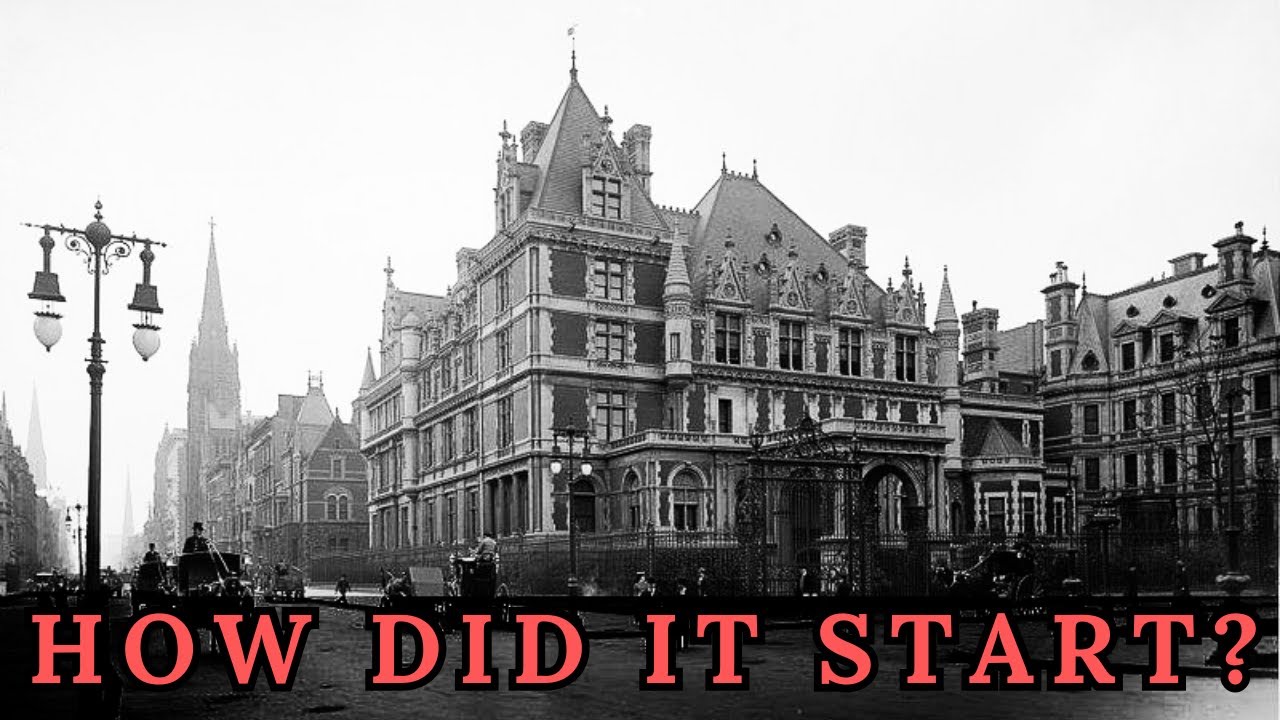
The ball established Alva as a society leader and changed the rules. Before 1883, old money controlled society completely. Afterward, new money could buy its way in. The wealthy began building mansions along Fifth Avenue, each grander than the last.
Richard Morris Hunt, the architect everyone wanted, designed William K. Vanderbilt’s mansion for three million dollars in construction, plus another two million in furnishings. Carnegie commissioned a mansion that cost over a million dollars and occupied an entire block. Within twenty blocks lived families worth hundreds of millions collectively.
But cracks were forming. In 1893, Chicago opened the World’s Columbian Exposition, celebrating American industrial power. Twenty-seven million people visited over six months. It was America showing the world what it had become.
But while Chicago celebrated, economic trouble was building. The Panic of 1893 started in May, just as the exposition opened. The Philadelphia and Reading Railroad declared bankruptcy. Within weeks, other railroads followed.
Banks began failing. The stock market crashed. This panic was worse than 1873. More banks failed, more businesses closed, unemployment reached 20 percent in some cities.
The depression would last four years, exposing the class tensions that prosperity had masked. The exposition closed in October 1893. The White City was dismantled, the buildings temporary, designed to last only for the exhibition. The symbolism was hard to miss.
By 1897, the economy was recovering, but something had shifted. The 1890s depression showed the system’s vulnerabilities. It demonstrated that extreme inequality created instability and proved that concentration of wealth in few hands made the economy fragile. These lessons weren’t immediately acted on, but they were learned.
Looking back, 1893 was the hinge point. Before it, the Gilded Age seemed permanent and invincible. After it, cracks appeared, not enough to bring immediate collapse, but enough to show that the system wasn’t eternal. The wealthy attending the Chicago Exposition couldn’t see this.
They saw American triumph and believed their world would last. They were building mansions designed to stand for centuries. They couldn’t imagine that within thirty years many of those mansions would be demolished, that income taxes would claim much of their fortunes, that regulations would constrain their businesses, that labor would organize successfully, that World War I would reshape everything. In 1893, the present seemed glorious, and the future seemed even more magnificent.
The Gilded Age had reached its peak, and the forces that would eventually dismantle everything the robber barons had built were already gathering.
