On the morning of November 6, 1895, Fifth Avenue was packed from curb to curb. Around St. Thomas Church at the corner of 53rd Street, the crowd had been gathering for hours. Thousands of people pressed against the carriages, and a line of police held them back from the doors.
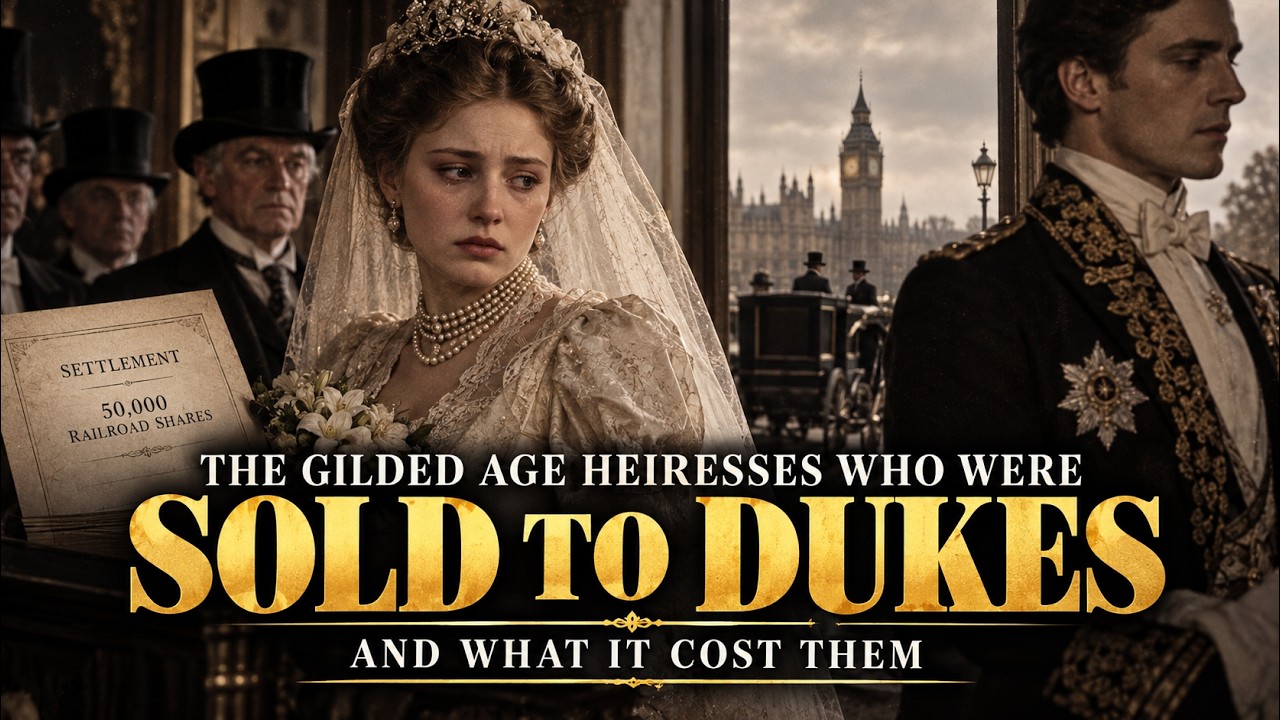
Inside, the church smelled of flowers. The New York Times would spend seven paragraphs on the flowers alone. The papers would call the music perhaps the finest ever played at such an occasion. The groom was Charles Spencer Churchill, the ninth Duke of Marlborough, twenty-four years old, heir to a palace in Oxfordshire that his family could no longer afford to run.
The bride was Consuelo Vanderbilt. She was eighteen. She wore satin with a train five yards long, embroidered with pearls and silver in a pattern of rose leaves, and a veil of fine Brussels net. The veil mattered.
Under it, the guests near the aisle could see that she had been crying, and she was still crying when she reached the altar. Somewhere in a lawyer’s file there was a settlement already drawn up, and it was worth more than the church. Hundreds of guests in their best clothes watched a teenage girl weep, and nobody stopped the ceremony. For forty years, American families had sent their daughters to Britain with fortunes attached, and British families had taken them.
The questions this story is really about are who was actually buying and who was being sold, why the richest families in America would pay millions for a word in front of a name, and what happened to the women after the wedding, when the crowds went home and the money was spent. Each of these marriages answers a piece of those questions. None of them answers all of it. To understand why this happened, start with two problems on two sides of the ocean.
In New York, the problem was a door. After the Civil War, railroad and steel and dry goods money poured into Manhattan faster than the old families could absorb it. The old families answered by closing ranks around Caroline Astor, the Mrs. Astor, and her adviser Ward McAllister.
On February 16, 1892, the New York Times printed McAllister’s list of the 400, the people who counted. It held 319 names from 169 families. New money could build a mansion on Fifth Avenue and still wait years for an invitation. In Britain, the problem was the land.
From the 1870s, cheap wheat from the American prairies came across by steamship and undercut British farms. The price of wheat fell by more than half. Tenants fell behind on rent, and the great estates that had paid for palaces for two hundred years stopped paying for themselves. One side had money and no rank.
The other had rank and a leaking roof. The first famous crossing came before anyone had a word for it. In August 1873, at a sailing regatta at Cowes on the Isle of Wight, the Prince of Wales introduced a nineteen-year-old from Brooklyn named Jennie Jerome to Lord Randolph Churchill, the third son of the Duke of Marlborough. They were engaged within three days.
Then the families took over. Jennie’s father, Leonard Jerome, a Wall Street speculator who had made and lost fortunes, sat across from the Duke’s side and argued over money for months. The negotiations were ugly enough that biographers still describe them that way. The final figure was £50,000, and Leonard Jerome insisted on one condition, that £1,000 a year of it go to Jennie herself.
The Duke paid off his son’s debts. On April 15, 1874, the couple married at the British Embassy in Paris. Less than eight months later, at Blenheim Palace, Jennie gave birth to a son named Winston. Two years after Jennie, another American girl went further.
Consuelo Yznaga was born in New York to a Cuban father and an American mother, and she was one of the great beauties of her season. On May 22, 1876, at Grace Church in Manhattan, she married George Montagu, Viscount Mandeville, heir to the Duke of Manchester. The press loved it. The marriage itself went wrong almost at once.
Mandeville spent heavily on gambling and on other women, and within ten years her fortune was largely gone. His own father sent the couple away to Tanderagee Castle in County Armagh in Ireland to keep them out of London, and the Manchester estates were bleeding at the same time. The collapse of land rents in the 1880s dropped the family’s income from £90,000 a year to £25,000. In 1890, Mandeville became the eighth Duke of Manchester and took his seat in the House of Lords.
That same year, he was declared bankrupt. He died at Tanderagee Castle on August 18, 1892, of cirrhosis. He was thirty-nine. Consuelo Yznaga was left a widowed duchess with a bankrupt estate behind her.
Then the worst part came. She had twin daughters, May and Nell, born in 1879. May died in 1895 at sixteen of what was believed to be tuberculosis. Nell died in 1900 at twenty of consumption.
Consuelo stayed in London close to the Prince of Wales and his circle and became one of the best known hostesses in the city. But one more thing about her matters for this story. Back in New York, her closest childhood friend had married a Vanderbilt and had a daughter, and that daughter was named after her. The little girl was her goddaughter.
Her name was Consuelo Vanderbilt. By 1890, the traffic was steady enough to need a directory. In March of that year, a New York publisher called Street and Smith printed a book titled Titled Americans, a list of American ladies who have married foreigners of rank. The preface said that the increasing frequency of these marriages made such a book desirable and even necessary as a work of reference.
Each entry read like a stud book: the bride’s maiden name, her father’s business, the date of the wedding, the husband’s full title, the children and their birth years, the family seats. One page tallied the fortunes that American wives had brought with them. Next to one American duchess, the book printed $7 million. Then at the back came the part that tells you what the book was for.
It carried a heading: a carefully compiled list of peers who are supposed to be eager to lay their coronets and incidentally their hearts at the feet of the all-conquering American girl. It was a shopping list with acres and incomes, sold to the mothers of Fifth Avenue. Every name on it came with a figure attached, and every mother reading it knew what the figure meant. The version America received was that the girls were conquerors.
The best example on the surface was a woman from Chicago. Mary Leiter was the daughter of Levi Leiter, a partner in the dry goods business that became the Marshall Field empire. In 1890 in London, she met George Curzon, a Conservative member of Parliament, thirty-five years old, brilliant, ambitious, and in a hurry. They became engaged in secret, and she waited two years while he traveled through Asia and finished what he wanted to finish before marrying.
On April 22, 1895, they married at St. John’s Church on Lafayette Square in Washington. Three years later, Curzon was named Viceroy of India. On December 30, 1898, the couple landed at Bombay to royal salutes.
A girl from Chicago was now the highest ranking woman in British India, with a palace in Calcutta and a summer residence in the hills at Simla. The high point came in January 1903 at the Delhi Durbar, the vast ceremony held to mark Edward VII as emperor of India. At the state ball, Mary Curzon wore a gown designed by the House of Worth in Paris and embroidered by craftsmen in India in gold and silver thread. The pattern was peacock feathers, and in the eye of every feather sat a blue-green beetle wing.
The dress weighed nearly ten pounds. Under the lights it shimmered like armor made of jewels. Photographs and portraits of her in that gown were printed again and again, and that was the image the country saw. Behind the pageant, Mary’s body was failing.
The Indian climate, the demands of the office, three pregnancies, a miscarriage followed by a long infection that nearly killed her, and surgery afterward wore her down year by year. In 1904, back in England at Walmer Castle on the Kent coast, she fell seriously ill again, and newspapers later wrote that she never fully recovered from it. Curzon himself blamed the damp old castle. Meanwhile, the pressure on the girls who had not gone yet was growing.
For every Mary Leiter who chose her husband, there were mothers doing the choosing, and they read the same newspapers and the same reference book. The most determined of them had a summer house in Newport called Marble House, built between 1888 and 1892 and reported to have cost $11 million. It had been a birthday present from her husband. In March 1895, she divorced him on grounds of adultery, walked away with a settlement of more than $10 million, and turned all of her attention to one project.
Society had been slow to forgive a divorced woman. A duke for a son-in-law would settle that argument for good. She had already decided which duke. Her name was Alva Vanderbilt, and it brings the story to the girl named after a duchess.
Consuelo Vanderbilt was born on March 2, 1877, in Manhattan, the daughter of William Kissam Vanderbilt and Alva Vanderbilt. Alva had spent years fighting her way into Mrs. Astor’s society with ballrooms and building projects. Her daughter was raised to be the final proof.
In her memoir, The Glitter and the Gold, published in 1953, Consuelo described her bedroom at Marble House as gloomy and austere. Her mother, she wrote, did not allow her own belongings to intrude on it. She was taught to sit straight, to answer correctly, and to obey. By the time she was seventeen, she had fallen in love.
His name was Winthrop Rutherford, a New York society man fifteen years older than she was. Consuelo and Winthrop became secretly engaged. They planned to elope. Alva found out.
According to Consuelo’s own account, her mother locked her in her room and threatened to murder Rutherford. That is Consuelo’s telling, written almost sixty years later, and she was not a neutral witness. But the next step is backed by more than one account. When locking the door did not break her daughter, Alva became ill.
She took to her bed and let it be known that her heart was failing and that Consuelo’s refusal was what was killing her. In Consuelo’s telling, a family friend carried the message to her: your mother is dying and you are the cause. Picture being eighteen and hearing that. Consuelo gave up Winthrop Rutherford and agreed to marry the Duke of Marlborough.
Alva recovered almost at once. What Consuelo felt when she saw her mother walking again, she wrote about only in old age and only briefly. That moment matters because it is the only real choice she makes in this whole story. She was eighteen.
She had a man who wanted her and a plan to leave. She could have gone. Instead, she chose her mother’s life, or what she was told was her mother’s life, over her own. On the wedding morning, by her own account, she cried until her eyes were red and swollen, and she later called the veil a blessing because it meant no one could see her face.
As for Winthrop Rutherford, he waited a long time. In February 1920, he married a young woman named Lucy Mercer, who had once been Eleanor Roosevelt’s social secretary and whose name would one day be tied to Franklin Roosevelt’s. Now the money. The settlement put 50,000 shares of Beech Creek Railroad stock into trust for the Duke, valued at $2.
5 million, with a guaranteed income of at least 4 percent, $100,000 a year. A local historical society in Southampton, where Consuelo spent her last years, records that the Duke himself arrived late at the church because of last-minute negotiations to get more out of the Vanderbilt fortune. Whether that delay happened exactly as told, nobody can verify. What the documents establish is the trust, the shares, and the income.
Most of the Vanderbilt family did not come to the wedding. William Kissam Vanderbilt and Alva had divorced earlier that year, and the ceremony was Alva’s production from start to finish. The honeymoon is where the facade fell off. According to Consuelo’s account, her new husband told her plainly that he had given up a woman he loved in England to marry her, and that he had done it for one reason.
Her money was the only way to save Blenheim. He did spend it there. The palace had been declining through the agricultural depression, and Vanderbilt money went into restoring the state apartments, the gardens, the library, and the estate buildings that had fallen into disrepair. Consuelo did her part as well.
She gave birth to John, the future tenth Duke, in 1897, and to Ivor in 1898. She is credited with the phrase, the heir and the spare. She was twenty-one years old and had done the one thing the contract was written for. She stayed eleven years in all.
Blenheim was not a home in any sense she recognized. It was a building of more than a hundred rooms, a monument to a battle fought in 1704, where the family lived in a corner and the rest belonged to history and to visitors. She learned to run a house with scores of servants, to give dinners for royalty, to host shooting parties and balls, and the English grew fond of her. But the marriage was empty.
The Duke had fallen for another American, an eccentric beauty named Gladys Deacon. In 1906, Consuelo and the Duke formally separated. The story of Alice Thaw begins in Pittsburgh. She was born on January 2, 1880, the daughter of William Thaw, a railroad and coal magnate counted among the hundred wealthiest people in America.
Her brother was Harry Kendall Thaw. In 1903, Alice became engaged to George Seymour, the Earl of Yarmouth, heir to the Marquess of Hertford. The Earl was thirty-one, broke, and had spent part of his twenties on the stage in America under the name Eric Hope, and earlier in Australia doing dance imitations under a woman’s stage name. The wedding was set for April 27 at Calvary Church in Pittsburgh.
The church was full. Crowds filled the streets outside. What happened that morning is told in two versions, and they point the same way. According to later accounts retold by Smithsonian magazine, the groom was arrested on the morning of the wedding over unpaid debts, and the delay turned into a fresh round of negotiations over the dowry.
The ceremony went ahead only after those talks. The biographical record puts it more bluntly. At the wedding, it says, the Earl pressed her family to increase the dowry under the threat that he would not go through with the marriage. If those accounts are right, the bride waited in her gown while the men settled her price.
Then the couple married and sailed for England aboard the St. Paul. Before he left, the Earl told reporters that his father had given money to pay his debts and that he wanted it understood that his wife was not paying them for him. Then came 1906.
On the night of June 25, on the rooftop theater of Madison Square Garden during the finale of a musical called Mamzelle Champagne, Alice’s brother Harry walked up to the architect Stanford White and shot him dead in front of the audience. The Thaw name was on every front page in the English-speaking world. Three weeks later in London, on July 18, 1906, Mary Curzon died at her home at One Carlton House Terrace. She was thirty-six.
She had never really gotten over the illness at Walmer Castle. Curzon, who had resigned as viceroy the year before, commissioned a marble effigy of her from the sculptor Bertram Mackennal and a memorial chapel at Kedleston, the family seat in Derbyshire, finished in 1913. She lies there in the family vault. Three women, one year.
One separated, one dead, one watching her family name turn into a murder trial. Alice went to the English courts while her brother’s case dragged on at home. His first murder trial in 1907 ended with a deadlocked jury. At the second in 1908, he was found not guilty by reason of insanity and sent to the state hospital for the criminally insane at Matteawan.
That same year in London, her own marriage to the Earl of Yarmouth was annulled on the ground of non-consummation, declared void as if it had never happened. The record says all financial interests were returned to her. She took back her maiden name, moved to Lenox in Massachusetts, and in 1913 married an American, Jeffrey Whitney, and had two sons. The Earl filed for bankruptcy in 1909 and again in 1910.
Shortly after that, he inherited his father’s titles and the family estate at Ragley Hall. Consuelo Yznaga, the first Consuelo, outlived her husband by seventeen years and both her daughters. The dates are worth setting side by side. In 1895, the same year her goddaughter walked up the aisle at St.
Thomas Church to marry a duke, her own daughter May died at sixteen. The two Consuelos were living the same bargain at opposite ends. One was just signing it. The other had already paid it off.
In her last years, she was still a fixture of the royal circle and entertained King Edward and Tsar Nicholas II of Russia. She died in London on November 20, 1909, at a house on Grosvenor Square. Of the six women in this story, she was the one who paid first, and she paid in children. The knot finally came loose in one summer.
On June 25, 1921, the ninth Duke of Marlborough married Gladys Deacon in Paris. Four days later, on June 29, Jennie Jerome, Lady Randolph Churchill, died in London. In May she had fallen down a flight of stairs in a pair of new shoes and broken her ankle. Gangrene set in on June 10.
Her left leg was amputated, and she died of a hemorrhage less than three weeks later. She was sixty-seven. And on July 4, 1921, American Independence Day, Consuelo Vanderbilt married a French aviator and officer named Jacques Balsan. By her own account and by everyone else’s, it was a happy marriage.
It lasted until his death in 1956. There was one more piece of paper. The Duke wanted to become a Roman Catholic, and for that he needed his first marriage declared null. In 1926, the case went before the church, and the decisive witness was the woman who had arranged the whole thing.
Alva, by then a leader of the women’s suffrage movement, testified that the marriage had been coerced. The words attributed to her have been quoted ever since. I forced my daughter to marry the Duke. I have always had absolute power over my daughter.
On August 19, 1926, the marriage was annulled. Nobody was ever held to account for any of it. The Duke kept Blenheim restored with Vanderbilt money and passed it to Consuelo’s son. His second marriage turned bitter too.
By one widely repeated account, Gladys kept a revolver beside her plate at dinner, and when asked why, said she might just shoot Marlborough. In 1933, he had her evicted from Blenheim with the electricity cut off and the servants sent away. He died in 1934. Gladys lived until 1977 and died at ninety-six at St.
Andrew’s Hospital in Northampton, the former asylum where she had spent her last years. The Earl of Yarmouth became the seventh Marquess of Hertford and lived at Ragley Hall until his death in 1940. No one apologized to Alice Thaw. No one apologized to Consuelo except her mother, and that apology arrived as testimony in a church court thirty-one years late.
The numbers kept growing. By the 1915 edition of that same reference book, Titled Americans counted 454 American women who had married into the nobility of Europe. Historians count about 102 of them married to British aristocrats between 1870 and 1914. Six of them dukes.
The shape of that trade is hard to miss. American wheat had emptied the rent rolls of the English countryside, and American daughters were sent over to fill them again. The money went into roofs, drains, libraries, and gardens that tourists still pay to walk through. The women went into rooms where they were outsiders for the rest of their lives, however long they lived there.
Edith Wharton, who grew up inside the same New York society, spent her last years writing a novel about exactly these girls. She called it The Buccaneers. She died before she could finish it, and it was published unfinished in 1938. The title tells you whose side she thought the money was on.
In her telling, the Americans were the raiders. The record of the marriages in this story reads the other way around. The girls were the cargo, and the families on both shores divided the proceeds. Now go back to the book from 1890, to the list at the back.
One of the eligible bachelors it printed is the Earl of Craven, the fourth of that title. The entry is short. It says he is just twenty-one years old. It says his entailed estates amount to 30,700 acres, and that on coming of age he inherited $1 million in ready money.
His family seat is given as Coombe Abbey near Coventry. Three years after that book came out, on April 18, 1893, the Earl of Craven married Cornelia Martin at Grace Church in New York, the same church where the first Consuelo had married. Cornelia was sixteen. She had not yet been formally presented to society.
Her parents were Bradley and Cornelia Martin, the couple who would throw the most criticized party of the Gilded Age at the Waldorf in 1897 and then leave for Britain for good. The marriage came with an allowance of $75,000 a year, and American money paid for a new roof at Coombe, structural repairs, and electric lights. So much for the million in ready money. The reference book had printed the capital.
It had never printed the upkeep. The Earl lived as a peer was supposed to live. He served in the government and as Lord Lieutenant of Warwickshire, and every summer he went sailing at Cowes, the same regatta where Jennie Jerome had met Lord Randolph Churchill almost fifty years earlier. In July 1921, the same summer Jennie died during Cowes Week, Lord Craven went over the side of his yacht, the Sylvia, off the Isle of Wight.
He was fifty-two and by several accounts a strong swimmer. His body washed ashore on July 12. A local history of the family records one more detail from the recovery, that the police noted the Craven crest tattooed on his chest. That is one source, and it is all there is.
What is on record is what his widow did next. In 1923, Cornelia sold Coombe Abbey to a builder. The American roof went with it. Set two images side by side.
The first is a churchyard in the village of Bladon at the edge of the Blenheim estate. Jennie Jerome lies there next to Lord Randolph. Consuelo Vanderbilt, who died in Southampton, New York, on December 6, 1964, was buried there too, near the palace she had paid for and walked out of. Weeks later, Winston Churchill was buried in the same churchyard.
The second image is a sixteen-year-old at Grace Church in New York under palm trees forty feet high, with an entry from a price list waiting for her at the altar. Every generation asks some version of the same question. What is a name worth, and who pays for it? The families on both sides of the Atlantic got what they wanted.
The daughters got the bill. The Duke of Marlborough saved his house with a girl he did not love. He never did find out what she could have saved on her own.
