On July 20, 1969, the world watched Neil Armstrong take humanity’s first steps on the moon. His words, “One small step for man, one giant leap for mankind,” became immortal. But while history was being made, Armstrong was not just an astronaut or an American hero. He was also a husband and a father.
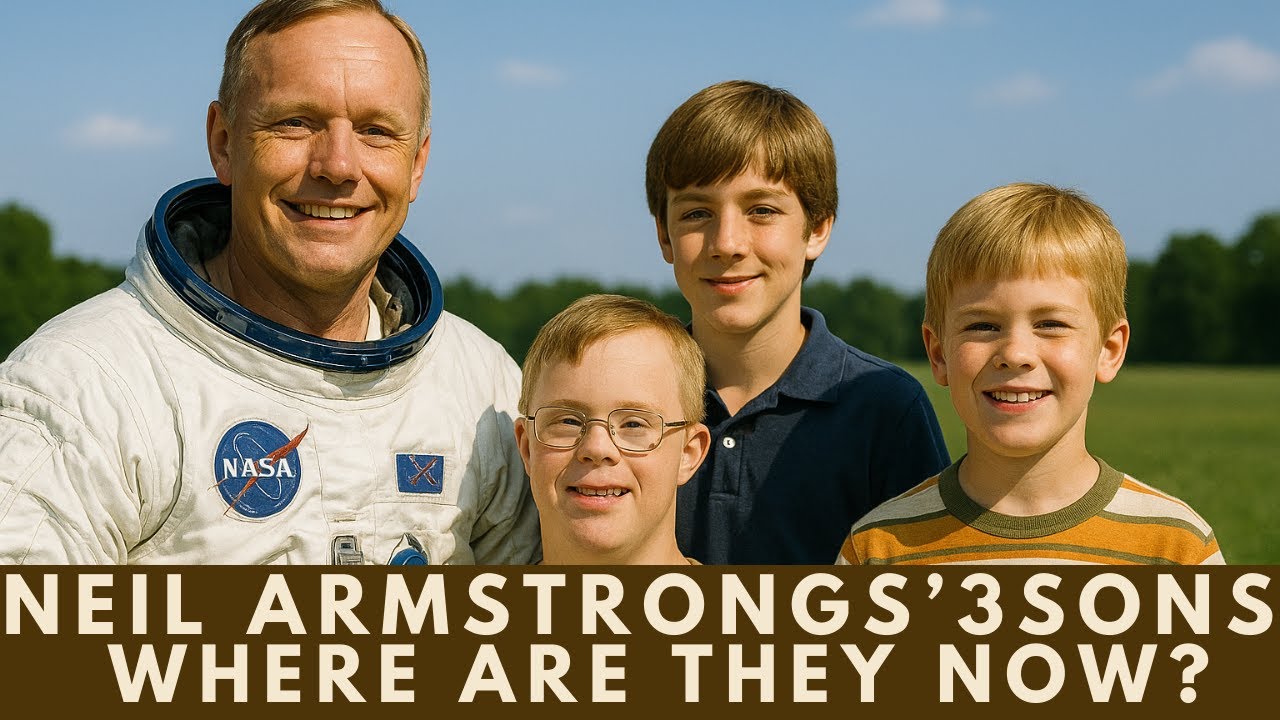
Behind the visor and the headlines were children growing up in the shadow of his incredible achievement. This is the story of Eric, Mark, and Karen Armstrong, and what happened to the family of the first man on the moon. Armstrong’s path to the moon began long before Apollo 11. Born in 1930 in the small town of Wapakoneta, Ohio, he was fascinated by flight from the start.
At just 16 years old, before he even had a driver’s license, he earned his pilot’s license. Friends from his youth recalled how he would spend hours building model airplanes and staring at the sky. One classmate said, “Neil wasn’t loud or flashy. He was the quiet one who was always focused, always steady.
” He went on to study aeronautical engineering at Purdue University, where his studies were interrupted by military service. During the Korean War, Armstrong flew 78 combat missions as a Navy pilot. After the war, he returned to Purdue and then pursued a career as a test pilot at Edwards Air Force Base in California. There he flew some of the most experimental aircraft ever designed, including the X-15 rocket plane, which could skim the edge of space at nearly 4,000 miles per hour.
In 1962, NASA selected Armstrong as part of its second group of astronauts. Seven years later, he would step onto the lunar surface as commander of Apollo 11. The honors that followed were immense: the Presidential Medal of Freedom, the Congressional Space Medal of Honor, the Congressional Gold Medal, and countless international awards. But Armstrong never embraced the role of celebrity.
He turned down endorsement deals and television opportunities. Instead, he returned to teaching engineering at the University of Cincinnati. A fellow professor remembered that he could have cashed in on his fame a hundred times over, but that wasn’t Neil. He wanted to be in the classroom sharing what he knew.
For all his achievements, Armstrong remained a deeply private man, someone who rarely spoke about himself and often deflected praise. His biographer, James Hansen, once said, “If you really want to understand Neil Armstrong, you have to look at how much he valued his family and his privacy. That’s where he was most himself. ”
The family story began in the mid-1950s when he met Janet Elizabeth Sheeran at Purdue University.
Neil had returned from the Korean War to finish his degree while Janet was studying home economics. On January 28, 1956, they were married in Wilmette, Illinois. The ceremony was modest, attended by family and a few close friends. Janet later reflected, “We weren’t thinking about the risks or the future.
We were young and we believed in each other. ” Their first years together were spent near Edwards Air Force Base, where Neil flew experimental aircraft. Life there was challenging: long hours, dangerous missions, and constant uncertainty. Neighbors remembered the Armstrong home as welcoming.
One fellow test pilot’s wife recalled, “Janet made sure the house was a place of peace. Even when Neil was off pushing the edge of the sky, she kept the family grounded. ”
In 1957, their first child, Eric, was born. Two years later, their daughter Karen arrived, nicknamed Muffy by the family.
She was lively and curious. But in 1961, tragedy struck. Karen was diagnosed with a malignant brain tumor. The Armstrongs pursued every possible treatment, but she passed away in January 1962 at just 2 years old.
Those close to Neil said the loss forever changed him. A NASA friend later reflected, “Neil rarely spoke about it, but you could see the grief behind his eyes. It made him even more private, even more determined. ” Later that same year, their third child, Mark, was born.
Janet described his arrival as a gift that brought light back into their home. For Neil, Mark’s birth was a turning point. Life doesn’t stop after tragedy. Despite Neil’s demanding schedule, test flights, astronaut training, and eventually the Apollo missions, Janet carried much of the responsibility at home.
She acknowledged the strain but also her pride: “You had to live with risk every day, but you trusted Neil. And when he walked back through that door, that was enough. ” Their marriage was often described as a partnership built on quiet resilience. Eric Armstrong, the eldest son, was born in 1957.
He was just 12 years old when the world watched his dad step onto the lunar surface. In interviews years later, Eric admitted, “To us, he wasn’t a hero. He was just dad. We didn’t see him the way the rest of the world did.
” Growing up, Eric shared his father’s fascination with aviation and engineering. As an adult, he pursued a career that reflected both his technical background and his independent spirit. While he never sought the spotlight, he worked in fields connected to engineering and business. He also supported projects that honored his father’s legacy, appearing occasionally at space-related events.
Much like his father, he avoided the celebrity attention that surrounded Apollo 11. At the 40th anniversary of Apollo 11, Eric told reporters, “What matters most isn’t the fame. It’s the reminder of what people can accomplish when they work together. ”
Mark Armstrong was born in April 1963, just a year after the family had endured the devastating loss of their daughter Karen.
For Neil and Janet, Mark’s arrival was a moment of renewal. Janet once reflected, “Mark was our light after the darkest time. His laughter brought us back to life. ” Unlike Eric, who was old enough to remember the Apollo years clearly, Mark was only 6 years old when his father walked on the moon.
He recalled watching the landing on television with neighbors and friends, saying later, “I saw it the way everyone else did on a little black and white TV, except my dad was the one on the screen. ” He often joked, “My dad went to the moon and I had to go back to first grade the next morning. ” Mark pursued studies in engineering and found his place in the technology sector, working in software and business development. He also became an accomplished guitarist and songwriter.
Over the years, Mark became more publicly visible than his older brother, often representing the Armstrong family at space-related events. When consulted for the film First Man in 2018, he helped ensure that Neil was portrayed truthfully. “We wanted people to see him as he really was, not larger than life, but human,” Mark said. Eric and Mark grew up in a world unlike most children, yet they both managed to shape their own paths while carrying the weight of their father’s historic legacy.
Eric leaned into a life of privacy and family. Mark found himself more comfortable in public roles, not for personal recognition, but as a caretaker of authenticity. One family friend summarized it well: “Eric carries Neil’s quiet side, and Mark carries his voice. Together, they keep their father’s legacy whole.
”
When Neil Armstrong passed away in August 2012, tributes poured in from around the world. President Barack Obama said, “Neil was among the greatest of American heroes, not just of his time, but of all time. ” Fellow astronaut Buzz Aldrin called him “a true American hero and the best pilot I ever knew. ” Armstrong was laid to rest at sea in a private ceremony conducted by the US Navy on September 14, 2012, aboard the USS Philippine Sea in the Atlantic Ocean.
Family, including Eric and Mark, watched as his ashes were committed to the sea. For his sons, the ceremonies were both public and deeply personal. Mark later said, “The world lost a hero, but we lost a father. ” Eric echoed the same sentiment: “The best way to honor dad is not to put him on a pedestal, but to live by the values he carried: humility, persistence, and respect for others.
”
Today, Neil Armstrong is remembered not only in history books but in the living legacy his children protect. Eric honors him through his quiet strength, his family life, and his engineering-minded career, while Mark honors him by sharing his story with the world, ensuring the legend never overshadows the man. His words from the moon still echo across generations.
But his truest legacy lives on in the sons who remember him simply as dad.
