Some cases end. This one did not, not the way a case is supposed to end. In the marshes south of the Atchafalaya, the water weaves through channels that never settle in one place. A man can steer his boat down a bayou he has known since childhood and find himself in a stretch of swamp that has no name on any map.
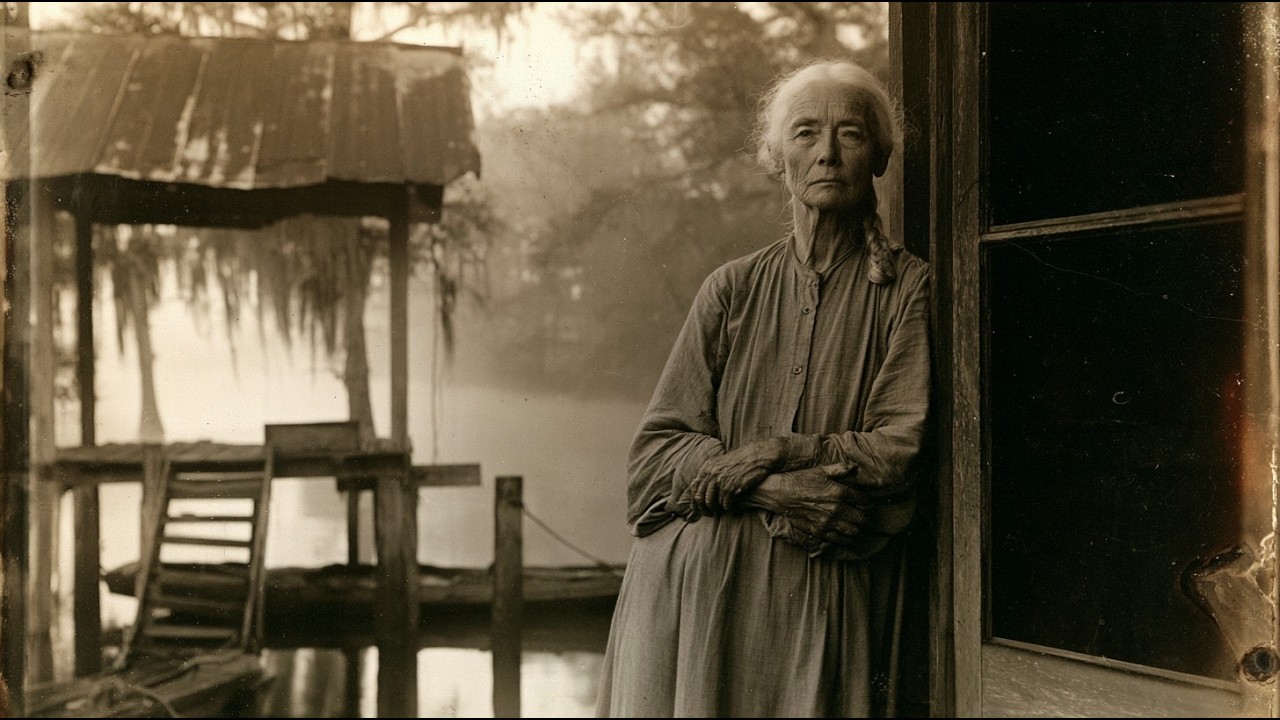
That is the country this story comes from, and the man who walked into it was Ansel Trebeck, a 44-year-old insurance adjuster from New Orleans who had spent twenty years listening to people lie about their barn fires. He was sent to Black Rush because a trapper named Ozius Daughtfire had vanished two weeks earlier. Daughtfire carried a small life insurance policy with Trebeck’s company, and his widow was pressing for payment. The company preferred to pay out on a body it had actually seen, so Trebeck was dispatched to find one.
He met the sheriff in a wooden office that smelled of coffee and river mud. Sheriff Renard Boaz was 49, broad-chested, with a thick black mustache going gray at the ends and eyes that had seen enough that he did not waste his gaze. He did not stand when Trebeck entered. He gestured to the chair across from his desk.
“So you’re the one they sent for Ozius,” he said. Trebeck confirmed it. Boaz studied him a long moment. “Well, you won’t find him,” the sheriff said.
“And if you go where he went not to be found, we won’t find you either. So stay close to the road, Mr. Trebeck. ”
Trebeck said something about having to at least try.
Boaz shrugged. “Suit yourself. But don’t go past the last house on stilts in West Run. That’s Margaret Holo’s place.
”
Trebeck asked the question every man before him had asked. “Who is Margaret Holo? ”
The sheriff took a long time to answer. He turned his coffee cup between his hands, looked at the wall, looked at the ceiling, set the cup down.
“Margaret Holo is an old woman who lives two miles up West Run in a house on stilts her daddy built before the war. She’s about seventy. She sells herbs. She sells salves.
She sells a kind of paste that draws the inflammation out of a wound overnight, where a doctor needs a week. She’s done it for most folks in Little Cayenne at one time or another, and there are five or six of us in this town, including me, who would have died without her. And she is also, Mr. Trebeck, the reason grown men in this parish don’t go past the third bend in West Run after dark.
”
When Trebeck asked why, Boaz was silent a moment. Then he said, “Because things go still around her. Because animals don’t cross her yard. Because in 1889, a preacher came down from Baton Rouge to cast her out, and the swamp gave him back three days later with no shoes and hardly any mind left.
Mr. Trebeck, I’ve known that woman for thirty years. She has never done a thing to me. But I don’t go past the third bend either.
That’s the truth of it. ”
That night Trebeck rented a room at the boarding house and wrote in his notebook for two hours by the light of a dim oil lamp. He wrote down the sheriff’s words precisely. He wrote the names of the missing.
Ozius Daughtfire, 41, trapper, disappeared in early October. A man named Delphin Farrow, 52, gone the same month. A cypress cutter named Renoir Sykes, 36, gone the last week of the month. Three men in three weeks.
All experienced on the water. All familiar with West Run. Not one of them found, not their boats, not their gear, not even a coat. In the margin Trebeck wrote the word pattern and underlined it, then wrote a second word beneath it: Margaret.
He did not underline that one. He was not the type to underline a name before he had reason. In the morning he rented a small boat and hired a young man of about twenty to row it. The young man’s name was Cyprian Rock.
He did not want to go, but Trebeck paid him nine dollars, more money than Cyprian Rock had ever held in his hand at one time, so they went. The water in West Run was black, not brown, not tea-colored, but black the way a thing is black when the light does not want to touch it. Cypress roots jutted from the water like knuckles of something buried. There was no birdsong.
Cyprian noticed it first. “Sir, listen,” he said. “There’s supposed to be birds. ”
Trebeck listened.
There were no birds. There was the light liquid sound of the paddle in the water, the creak of the boat, and once, very far off, a single low note that might have been a bullfrog or might have been something a bullfrog would hide from. Then nothing for a long time. Cyprian rowed more slowly after that.
Trebeck did not ask him to speed up. Around noon, in a stagnant channel where the current ran thin, they found Ozius Daughtfire’s boat. It was tied off. That was what stopped Trebeck.
It was tied with a tight fisherman’s knot to the root of a bald cypress, and inside were Daughtfire’s paddle, his metal lunch pail with the lid sealed, and his coat folded carefully on the seat with its buttons done up. A man planning to be gone a while does not fold his coat like that. A man planning to be gone a while wears it. Trebeck looked at the coat a long time.
Then he opened the lunch pail. Inside was bread gone black with a hard green ring around it, an apple shriveled to the size of a walnut and colored like wet skin, and a folded square of paper. On the paper, in careful working-man’s handwriting, was a single sentence. “I heard it calling me.
”
That was all. No signature, no date. And the paper was dry in a swamp, on a rotting boat, in a pail that was not airtight, after two weeks. Trebeck took the paper.
He left the pail and the coat. Cyprian did not speak a word on the way back. When they reached the Little Cayenne landing, the boy refused his second payment. He handed back four dollars.
“Sir, I’m done,” he said. “I won’t go west again. ” Then he said something Trebeck wrote down that night because the wording was strange. “You shouldn’t have opened that pail.
”
Trebeck asked why. “Because she knows now that you found it,” Cyprian said. Trebeck asked who she was. Cyprian did not answer.
He tied the boat and walked up the road without looking back. Trebeck stood at the landing a long minute with the folded paper in his coat pocket. It felt heavier than paper ought to be. He told himself that was nonsense.
He convinced himself he was a bookkeeping man, not the sort to be frightened by a boy raised on ghost stories. He told himself all of it on the walk back to the boarding house. He did not sleep much that night. He lay on a narrow bed stuffed with horsehair, his shoes off, his coat hung on the chair by the door, listening to the silence of the house around him.
Somewhere downstairs a clock ticked. Somewhere in the yard a dog barked at something that was not there. And beneath it all, if he stayed perfectly still, he could almost hear the swamp—not the frogs, not the crickets, but something under the frogs and crickets. A slow, faint draw, like breath pulled through cloth.
He told himself he was tired. He told himself a tired man’s mind makes things up. He turned on his side, faced the wall, and did not sleep. He did not light the lamp either, because he was not yet ready to admit he wanted to.
He rose before dawn and stood on the little porch of the boarding house with a cup of chicory coffee that had sat on the stove all night. The town below was gray. The river was gray. The moss on the trees at the edge of town was gray.
The whole world was the color of something that had lost its name. He thought about writing the company to ask to be released from the case. He thought about it through the whole cup of coffee, then threw the rest off the porch and went inside to put on his gray suit. He was Ansel Trebeck, who had never once in twenty years walked away from a policy he’d been sent to close.
The next day he did what he was good at. He went to the parish courthouse in Little Cayenne and asked for the record. The clerk was a thin, dry man named Percival Cain who wore glasses thick enough to bend light. He did not want to give Trebeck the record.
He wanted a signed request from the company on official letterhead, in triplicate, plus a modest service fee for the trouble. Trebeck had spent twenty years dealing with men like Percival Cain. He paid the modest service fee, got the record, and sat in the back of the courthouse for six hours reading it. What he found was this.
Margaret Holo was born in 1843 to a mother named Overa Holo and a father the record could not be bothered to name. The father built the stilt house on West Run in 1852 and drowned in 1858 under circumstances the record described only as happening at night, alone, in the water off his own dock. The mother, Overa, lived in the house with her daughter until 1869, when she walked into the swamp on a Sunday morning without a coat, a hat, or a word to anyone, and never came back. The daughter, twenty-six by then, kept living in the house alone.
From 1869 to 1912 was forty-three years alone in a house on stilts in a Louisiana swamp. Trebeck leaned back and thought about that number. He tried to imagine the woman she would have become. He could not.
The record went on. In 1871, a suit was filed against Margaret Holo by a farmer named August May, who claimed she had cursed his cows to give bitter milk. The suit was dismissed. In 1879, a suit was filed against her by a preacher named Isaac Venn, who called her a witch and demanded she be removed from the parish.
The suit was dismissed. In the margin, someone had written in pencil: “Preacher Venn returned to Baton Rouge in failing health. Never preached again. ” In 1889, a formal complaint was filed by a man named Bethwell Cargus, who claimed she had killed his brother by looking at him across a fence.
The complaint was withdrawn eleven days later by Bethwell Cargus himself, in writing, and the withdrawal letter was attached. The letter said only: “I was mistaken. Please withdraw my complaint. I am leaving the parish.
”
The record grew thinner after that. Fewer people wanted their names near Margaret Holo’s. Pages had been torn out in places, and there were entries referring to earlier entries on pages that no longer existed. Someone had gone through the record sometime in the 1890s and removed whatever was there.
When Trebeck asked about the missing pages, the clerk Percival Cain just shook his head. “That was before my time here, Mr. Trebeck. Ask a man older than me.
” When Trebeck asked if such a man existed in Little Cayenne, Percival Cain said, “There isn’t. ” That was the whole answer, and the way the clerk said it made Trebeck not want to ask a second question. But sitting in the back of the courthouse with dust motes hanging in the afternoon light, Trebeck noticed something the record did that was not obvious at first. Every eight or nine years, going back as far as the record kept the pattern, there was a small cluster of unexplained disappearances in West Run.
Two men in 1870, three in 1879, two in 1888, three in 1897, two in 1905, and now in 1912, three. He counted them again. He turned the pages and counted a third time to be sure. He was sure.
The clerk watched him through his glasses the whole time, and when Trebeck finally closed the record, he said, “Mr. Trebeck, if you’ll permit me. ” Trebeck looked up. “Whatever you think you found in there, it won’t help you.
Men have found it before. It never helped any of them. ”
Trebeck, who was a rational man, said the rational thing, which was “Thank you for the record. ” But he sat there another quarter hour after the clerk returned to his desk because he could not make himself stand up.
That second trip he hired a different boy. Cyprian Rock was done, and he had told everyone in Little Cayenne not to go with the man in the gray suit, and word travels fast in a town of two hundred. So Trebeck rowed himself. He was not very good at it.
It took him most of the morning to reach the third bend and another hour after that to see the roofline of the stilt house through the moss. He tied off his little boat and looked at the house from the water a full minute before moving. It was smaller than he had imagined. Cypress planks gone silver with decades of weather, a tin roof pitted with rust, and beneath it the stilts were smooth with something dark that was not quite moss.
No porch, just a plain door at the top of a plain stair, one window on each visible wall, no smoke rising from the tin chimney even though the morning was cold. Nothing in the yard. No garden, no chickens, no boat but his own tied to a stilt. And all around the place, a stillness so complete he could hear the fibers of his rope groan as his boat drifted against the stilt.
He climbed the stair. He knocked, because he was the kind of man who knocked, and the door opened. Margaret Holo was smaller than he had imagined, no more than five feet tall, thin the way a person gets from a long life of eating only what is necessary. Her hair was pure white, braided loose down her back.
Her hands were brown and knotted at every joint from what must have been a lifetime of pulling roots from black earth. Her eyes were pale gray, the color of water in a tin cup. Ansel Trebeck realized, looking at her, that he did not want to keep looking at her, but he did. “Come in, Mr.
Trebeck,” she said. “I’ve been expecting you for two days. ”
The house was one long room. Dried herbs hung from every beam in bundles tied with sisal twine.
A cast-iron stove burned low against the far wall. A rocking chair sat by the front window with a shawl folded over its arm. There was a narrow bed in the corner, made up with a gray blanket, a table, two chairs, and a shelf of glass jars whose contents Trebeck recognized and wished he did not. Everything was clean.
That surprised him. In a house in the middle of a swamp, occupied alone for forty-three years, he had expected disorder. Instead he found a room cared for by a woman who had nothing to do but care for it. She sat him at the table.
She set a tin cup of dark tea in front of him. He did not drink it. She noticed, and did not comment. She sat across from him, folded her brown knotted hands, and waited.
Trebeck was a man who made his living conducting interviews. He knew how to make silence work for him. He tried to make this silence work for him. He could not.
After a full minute he said, “Mrs. Holo? ”
She gave a very slight smile. “Miss.
”
“Miss Holo. ” He paused. “Three men have disappeared in West Run in the past month. The sheriff tells me no one dares search past the third bend because of you.
I’m here from the company about the Ozius Daughtfire claim. I found his boat yesterday. I found a note in the pail. ”
She let him finish.
When he was done she said, “And what did the note say? ”
He took the paper from his coat and laid it on the table between them. She did not touch it. She read it upside down with those water-colored eyes.
“Yes,” she said. “That’s what they say. ”
When he asked what she meant by “they,” she said, “The ones the swamp takes. I heard it calling me.
That’s what they all write, Mr. Trebeck, when they’re lucky enough to write anything at all. Some of them don’t. ”
She said it the way a doctor delivers a diagnosis he has given too many times.
Trebeck, who did not believe in swamp witches, felt a coldness run up the back of his neck from his collar and spread down across his shoulder blades. “Miss Holo,” he said, “are you telling me you called those men? ”
She looked at him a long moment. “No.
I have never called anyone. ” She paused. “I have spent my whole life keeping something from calling. Do you understand the difference?
”
He said he was not sure he did. “My father built this house on this ground because there is something in the water beneath it that doesn’t like to be alone,” she said. “It has been in the water under this house since before my father built here. Since before there was a parish here to notice.
My father didn’t know when he picked the land. He was a young man looking for cypress to cut. He found the ground solid enough for pilings, so he drove them, built the house, and brought my mother here in the spring of 1854, and I was born under this roof. My father found out about the thing in the water too late.
That’s why he drowned. My mother found out too late. That’s why she walked toward it. I found out near the end, when my mother could no longer sleep for the sound of it under the floorboards, so she told me what it was and she told me what had to be done to keep it quiet.
Then the next Sunday morning she left, because she couldn’t bear to do it anymore. And ever since, I have been the door between it and this parish. When it’s quiet, no one disappears. When it isn’t quiet, men disappear.
It isn’t quiet now. Mr. Trebeck, if you had an ounce of sense, you’d put your boat in the water, go back to Little Cayenne, catch the first train to New Orleans, and never say this parish’s name again for the rest of your life. ”
Trebeck did not know what to say to that.
He was a man who lived by ledgers, and ledgers had no column for the things in the water. He asked her, “If this is true, why don’t you leave? ”
She gave her small smile again. “Mr.
Trebeck, if I leave, there is no door. And if there is no door, it doesn’t come as a voice. It comes however it wants. And if that happens, it won’t just be this parish that empties out.
”
He asked what he could do to help. “Nothing,” she said. He said there must be something. “Mr.
Trebeck, you can go back to town and tell the company that Ozius Daughtfire can’t be found, and you can pay his widow because she’s done nothing wrong and she needs her money. That’s what you can do. ”
Then she stood, and he stood, and she walked with him to the stair. As he put his foot on the first step, she called his first name for the first time.
“Ansel. ” He looked back. “Don’t open the shutters tonight,” she said. “Whatever you hear at your window, don’t open the shutters.
”
He sat in his boat at the foot of her stair for maybe a minute before taking up the paddle. He looked at the water. The water did not look back. But he was seized by a strong, unshakable feeling, sitting there, that something was watching him from directly under the boat, and that if he leaned over the side and put his face close to the surface, he would see a face, and it would not be his own.
He did not lean over the side. He rowed the two miles back to Little Cayenne with the sun low on his right and the moss brushing his hat every third stroke. He reached the landing at dusk. He walked to the boarding house, ate a plate of red beans and rice without tasting it, climbed to his room, locked the door, closed the shutters, lowered the lamp, and sat on the edge of the bed in his coat with his shoes tied.
At about nine o’clock, by the small table clock, something began to knock on the shutter. It was a light, polite knocking. Two knocks. A pause.
Two knocks. The way a person knocks on a door in a city where knocking is a polite thing. His window was on the second floor. There was nothing to stand on out there.
Nothing at all. Trebeck sat perfectly still on the edge of the bed and listened. The knocking went on for maybe ten minutes. Then a voice came through the shutter, pitched in a tone he recognized because he had heard it that afternoon across a table with a tin cup of tea.
“Ansel. Ansel, open the shutter. ”
It was not her voice. It was almost her voice.
There was something wrong with the vowels. It was her voice the way a careful drawing of a face is that face—everything in its place, and yet not a face you would want to kiss. Trebeck did not open the shutter. He sat with his hands flat on his knees a long time.
After a while the voice stopped. After a while longer the knocking stopped. Then—and this was the part he wrote down the next morning and underlined in his notebook—something breathed. A slow, deep breath just outside his window.
The breath of a large animal at the end of a long day. It was close enough to the shutter that he felt the cold of the wood on his face from three feet away, as if that breath had drawn the heat out of the room, out of him, out of the wall between them. He did not move. He did not even breathe.
He counted to sixty in his head, the way a man does when he is trying to keep himself from doing something stupid. When he reached sixty he started again from one. He reached sixty a second time. He was around forty on the third when whatever it was left.
It left by moving down the wall. He heard it scraping as it descended. It took about as long as a large man taking a stair, with the same rhythm of pauses, as if it were thinking about coming back up. Then the yard below the window went quiet.
He did not sleep. He sat with his hands on his knees watching the shutter until its cracks showed the first gray light of morning. In the morning he opened the shutter because daylight had come. He was a man who believed in records and verification.
There were no marks on the shutter. There was nothing in the yard. There was a track in the mud beneath his window that he chose not to describe in his report. It was not a shoe print.
It was not a hoof print. It was not any animal track he knew, because he had grown up on a farm in western Kentucky and knew the look of most animal tracks. It was long, longer than a man’s forearm, and its pattern—if pattern was the right word—was not the pattern of something that walked upright, nor of something that walked on four legs. Trebeck stood over it a long time in the wet morning without any thought forming in his mind that could be put into a sentence.
Then he covered it with the toe of his shoe, scraped mud over it until the track was gone. He did not know why he did that. He would think about it later. When he came downstairs the boarding house was hushed.
The proprietress, a stout woman named Idalia Beaumont, sat at the kitchen table weeping silently. Trebeck asked what was wrong. “Cyprian’s gone,” she said, without looking up. Trebeck said, “Gone how?
” “His boat came in to the landing this morning,” she said. “Paddle in it, coat folded on the seat. My sister sent for him last night to walk her from the store, but he never arrived. Someone says they saw him at the landing at eleven o’clock heading west, calling out.
” She stopped because she did not want to say the rest. Trebeck said, “Calling what, Idalia? ” She said, “Calling that he heard it calling him. ”
Trebeck went up to his room and packed his bag.
He wrote a telegram to Baton Rouge, a telegram to New Orleans, and a telegram to the company. He walked to the little telegraph office and sent them. In each telegram he wrote different words, but the meaning was the same in all of them. He was going back to West Run.
He was not going to leave anyone else where he had left Cyprian. He went to the sheriff’s office. He told Renard Boaz everything: the pale face, the note, Margaret Holo at her table, the knocking at the window, the voice, the breath, the track in the mud. He added no embellishments.
He offered no personal commentary. He was an insurance man, and he described what he had seen the way an insurance man describes damage. When he finished, Renard Boaz was silent a long time. He sat at his desk with his big hands on his knees, looking at the wall.
Then he said, “Mr. Trebeck, there’s something I didn’t tell you the day you came. ” Trebeck said, “Tell me now. ” “My older brother disappeared in 1897 in West Run,” Boaz said.
“He was twenty-eight. He was strong on the water. He went the same way. His boat came in to the landing.
His coat was folded. There was a note in his pail that said, I heard it calling me. I hated Margaret Holo for fifteen years, Mr. Trebeck.
I could never prove she did anything. So I’ll go with you today. And anything we find in that stilt house, you’ll let me handle. Do you understand me?
” Trebeck said he understood. They took the sheriff’s flat-bottomed boat, which had a small motor that Renard Boaz did not start until they were half a mile from Little Cayenne, because he said West Run didn’t like motors and he didn’t want to provoke it before he had to. They rode under the moss with the little motor coughing. The water was blacker than the day before.
Trebeck had not thought that possible. The cypress roots looked bigger, or maybe more numerous, or more watchful. He could not say what the difference was, only that it was there. Halfway to the third bend they passed a place where the water was so still it looked poured.
Trebeck saw, or thought he saw, or would later tell himself he imagined seeing, a face just beneath the surface. Not a body. A face, turned upward, eyes open, watching. He did not point to it.
He told himself he imagined it. A hundred yards past the still place, the sheriff killed the motor. “Do you hear that? ” he said.
Trebeck listened. What he heard was Cyprian Rock, from somewhere far off among the trees, calling his name. “Sir. Sir, help me.
Sir, I’m here. ” It was Cyprian’s voice. It was exactly Cyprian’s voice, even down to the way the boy dropped the r at the end of a word. Trebeck almost stood up in the boat.
He almost answered. The sheriff’s big hand clamped down on his shoulder and pushed him back onto the seat. Renard Boaz put his finger to his lips. He shook his head very slowly.
He mouthed the word no. They sat in the boat. The voice called again from a different direction, then a third, then terrifyingly from directly under the boat, a wet, small whisper against the planking, and Trebeck felt the wood beneath his shoes go cold. Renard Boaz started the motor.
He turned the boat. He took them the rest of the way to the third bend at a speed that was probably not safe. The boat skimmed the surface and struck a low root that would have stopped them cold if the sheriff hadn’t lifted the motor in time. Trebeck gripped the seat with both hands.
Behind them the voices multiplied. He heard Ozius Daughtfire, whose voice he had never heard in life, calling his widow’s name. He heard Delphin Farrow mentioning a debt he still owed. He heard Renoir Sykes singing something without words, which was somehow worse than any words.
They came around the third bend to the stair of Margaret Holo’s house. When they tied the boat, the swamp behind them was thick with the voices of every man lost in West Run, calling in the voices of men who had died long before Ansel Trebeck was born. Margaret Holo stood at the top of the stair in the same gray dress. She looked at Renard Boaz.
“Renard,” she said. Boaz said, “Margaret. ” She said, “You shouldn’t have brought him. ” Boaz said, “I know.
” She said, “Come up. ” They climbed. Inside the long clean room, the stove was burning hotter than the day before. Three lamps were lit, though it was full daylight.
The bundles of herbs swayed slightly on their strings, though no window was open and no breeze moved in the house. She sat them at the table. She did not serve tea. “It’s under the floorboards,” she said.
“It’s been under the floorboards since yesterday afternoon. It’s angry that I didn’t give it your name yesterday, Mr. Trebeck. It’s angry that I didn’t open the door I keep.
It wants a name to answer to. If I give it a name, it will take that person and be quiet for another eight years. If I don’t give it a name, it will come up through the floor tonight and take every soul in Little Cayenne by morning. That’s the choice.
”
She said it in the tone of a woman reciting the weather. Renard Boaz said, “Margaret. ” She said, “Renard. ” He said, “My brother.
In ’97? ” She said, “Yes. ” He said, “Was it you? ” She looked at him a long time.
“No,” she said. “But I chose not to speak the name that would have saved him. I chose silence that year, because the man I would have had to name was a man I loved forty years ago, when I was young enough to think someone in this parish would marry a Holo girl, and I wasn’t strong enough, Renard, so your brother went instead. And I have paid for that choice for fifteen years, and I will pay for it until the day I close my eyes for the last time.
”
Renard Boaz put his face in his hands. He did not weep. He sat that way for a long minute. Then he stood and went to the window and looked out at the water.
Margaret Holo looked at Ansel Trebeck. “Mr. Trebeck, there’s a way out of this tonight,” she said. “It’s not a kind way, but it’s a way.
” And Ansel Trebeck, the records man who had come south to identify a dead widow’s claim, said the four words that would haunt him for the rest of his life: “What do you need? ”
“I need you to sit in that rocking chair,” she said. “I need you to stay in that chair until sunrise, no matter what you hear. I need you to keep your eyes on this.
” She took a small clay bowl from the shelf and set it on the table. In the bowl was an ordinary river stone, dark, about the size of a hen’s egg. “This is the door,” she said. “This is what my father made when he built this house.
This is what I have kept for forty-three years. It has to be guarded by someone who has never lied to it. That’s the only rule. I can’t guard it because I lied to it once.
Renard can’t guard it because he’s hated me for fifteen years and he’d smash it in the first hour if he got the chance. You haven’t been here long enough to lie to it, Mr. Trebeck. So you’ll guard it.
And Renard and I will go down to the water tonight, because that’s where the dispute is, and someone has to fight it, and we’ll come back before sunrise, or we may not come back. ”
He asked what would happen if he looked away from it. “It will speak in a voice you know,” she said. “It will call you by the name your mother gave you.
It will ask you a question you’ve wanted the answer to for thirty years. It will show you the face of someone you’ve wanted to see that whole time. And if you take your eyes off the stone, Mr. Trebeck, even once, it will come through the stone, and there’ll be no stopping it after that.
Do you understand? ” He said he understood. “Good,” she said. “Eat something, then.
It’s a long night. ”
Trebeck did not remember eating anything. He remembered sitting in the rocking chair. He remembered the door closing behind Margaret Holo and Renard Boaz, the slow wet sound of their steps on the stair going down, the distant push of the small boat away from the pilings toward West Run.
He remembered the little clay bowl on the table under the yellow lamp, the plain dark stone inside it, and how it looked like nothing at all. He remembered the swamp beginning to call again, but closer this time. He remembered hearing his mother’s voice at the window—his mother, dead nineteen years. He remembered hearing his own name in the voice of a woman he had loved and lost in the summer of 1893, a woman whose name he had not spoken aloud since the day she was buried.
He remembered the shutters creaking. He remembered a slow wet sound climbing the stair outside—the same sound the sheriff’s boots had made going down, but heavier and heavier. He remembered his hands going white where they gripped the arms of the rocking chair. He remembered the cabin door, which was barred, beginning to shudder gently, as if someone on the other side were leaning against it with a palm, and he remembered a woman’s voice saying, softly, “Here at the crack of the door, Ansel.
It’s not a big request. Just look at me. Look at my face. It’s been so long.
”
And Ansel Trebeck, who had loved a woman named Charity Fairlaine when he was twenty-four and buried her at twenty-five before the wedding costs were even settled, felt every muscle in his neck harden against the urge to look up. He kept his eyes fixed on the stone. The stone did nothing. Nothing at all.
It sat in the little clay bowl like any river stone you might pick up on a walk. He remembered the door shuddering harder. He remembered a second voice joining it, a faint man’s voice he did not recognize, and a third that was his father’s voice, dead since the winter of 1889. He remembered that he did not look away.
He remembered the stone in the bowl beginning to emit a very faint hum around two in the morning. A low note, like a finger running around the rim of a wet glass. He remembered that he did not look away. He remembered the hum growing louder, the way a tuning fork grows louder when a string touches it, until the tin cup on the table was vibrating against the wood, until the herbs hanging on their strings above him were swinging in slow arcs, as if a hand had touched each one and set it moving.
Then everything stopped. Everything. The hum. The voices.
The rattling at the door. The scraping on the stair. The shutters stopped moving. He remembered a very long time when nothing happened at all, which was somehow worse than what had come before, because in that nothing he had to listen to his own breathing, and his breathing was the only sound in the world.
He remembered that nothing came through. Sometime near dawn he must have fallen asleep in the rocking chair, his eyes still fixed on the stone, because he woke to gray light and the sound of the door. Renard Boaz came in first. He was soaked to the collarbone.
His hair was plastered to his skull. His face was pale. He carried his hat in his hand, which was strange because he had worn it low the whole way out. He looked at Trebeck.
He looked at the stone in the bowl, which was quiet again, looking like an ordinary stone. “She’s not coming back,” he said. Trebeck said, “What happened? ” Renard Boaz said, “She went into the water and gave it a name.
” Trebeck said, “Whose name? ” Boaz sat in the other chair. “Her own,” he said. “She told it her name.
She said, I am Margaret Holo, and I am the door. Take me, and be quiet for another hundred years. She said it three times, and the water went still, and it took her, and she never came back up. That’s what happened.
”
Trebeck said nothing. He looked at the stone. It looked like a stone. After a while Renard Boaz got up, walked to the shelf, and took the bowl.
He carried it to the stove. He opened the stove door, set the bowl inside on the coals, closed the door, and stood there a full minute with his big flat hand pressed against the stove door. Neither of them spoke. Outside the window the sky was turning the color of old copper, and the water under the pilings was beginning to move again.
Small, ordinary ripples. Small, ordinary sounds. The swamp settling back into being a swamp. A bird called from the far side of the channel, then another.
Boaz lifted his hand from the stove door and turned. “We have to go. ”
They came back to Little Cayenne in the sheriff’s boat with the motor off, because there was no need for it. The swamp was quiet on the way back.
There were birds. At the second bend Trebeck heard a red-winged blackbird and nearly wept, which was not his habit. When they reached the landing, the townspeople were coming out to meet them, because word had spread the way word spreads in a town of two hundred that had stayed up all night listening. Idalia Beaumont was at the front of the crowd.
Trebeck did not know what he was going to say to her. Then, from the far side of the landing, out of the reeds where the water met the planks, Cyprian Rock came walking. His clothes were soaked through. His face was empty of expression.
He remembered nothing from the moment he tied his boat at eleven o’clock the night before until the moment he woke in the mud at the edge of the channel at dawn. He was very cold and very hungry. There was a small wound in the palm of his right hand that he did not know how he got, but he was whole. He was alive.
Idalia Beaumont fell to her knees on the planks. Cyprian said, “Mr. Trebeck. ” Trebeck went to him and put his own coat over him, because Cyprian’s coat was folded on the seat of his boat, and neither of them mentioned it.
Ozius Daughtfire’s widow was compensated. Delphin Farrow’s widow was compensated under a policy Trebeck was not obligated to open, but he opened it anyway. Renoir Sykes had no widow, but he had a sister in New Orleans, and Trebeck made sure the small amount due the estate reached her without any trouble. He delivered the checks to their homes himself, hat in hand, answering every question they asked, and never once in front of any of them spoke the name Margaret Holo.
The company accepted Trebeck’s report, which described the matter as accidental deaths in the Louisiana swamps, bodies unrecoverable due to the nature of the terrain, and did not mention Margaret Holo at all. His supervisor, a man named Averid Prather, read the report and looked at Trebeck across the office in New Orleans and asked one question: “Is there anything in that parish that might come back to haunt us? ” Trebeck said, “No, Mr. Prather.
Nothing in that parish will ever haunt anyone again. ” Prather signed the report and filed it, and it stayed there for thirty years until the cabinet was emptied and the file was sent to archives, never read by human eyes a second time. Renard Boaz stayed sheriff of Little Cayenne until 1928, when a stroke put him in a chair by a window for the last two years of his life. He never married.
He never took a boat past the third bend of West Run again. He sat at that window watching the water and drinking chicory coffee. Once, near the end, a young deputy who had come to check on him asked what he was watching out there all that time, every day. The old sheriff only said, “I’m watching to see if she comes back.
” The deputy asked, “Who comes back? ” Renard Boaz did not answer, and the deputy did not repeat the question, because something in the way the old sheriff looked at the water made the deputy not want to be a part of it. The stilt house stood empty. In 1921 a hurricane took the roof, then the walls, then finally the pilings in 1936.
By the time of the war, the pilings had gone back into the water without a trace. But the men of Little Cayenne noticed something and passed it quietly from father to son without writing it in any record. Every eight years from 1912, the pattern that should have started again did not happen. No men disappeared in West Run.
Not in ’20, not in ’28, not in ’36, not in ’44, not in ’52. It was quiet for a very long time. As quiet as she said it would be. Ansel Trebeck returned to New Orleans.
He worked for the company another eleven years. He never again took a case in a parish with standing water. He wrote a private account of what happened in the autumn of 1912, sealed it, and it went to his son when he died in 1941. In the 1960s, his son gave it to a small university library that kept boxes of such things.
That is how the story I am telling you tonight is known. On the last page of the account, in his precise, ink-stained handwriting, Ansel Trebeck wrote something I would like to leave with you. “I do not know what Margaret Holo was. I have thought about it every day of my life since.
I thought she was a witch. I thought she was a saint. I thought she was a woman doing a job no one asked her to do, that no one thanked her for, that no one ever released her from. And I have come to think that is probably the truest thing I can say about her.
But now and then, on a quiet night with the window open, I think about the stone in the fire. And I think she said it would be a hundred years exactly. I wonder what happens in the year after the hundred. I wonder that too, because if its clock started in 1912, the hundred years are long past by now.
”
The maps in the parish office no longer show Black Rush. West Run has silted up so badly that you cannot pass a small boat past the first bend, and no one has looked for anything under those pilings in a very long time. Little Cayenne is barely a place now. A dozen houses, a gas station that closes at six, a post office that opens three days a week, the last time I checked, and I checked because I wanted to know.
The parish courthouse still stands, but the record Trebeck sat with for six hours in 1912 burned in a fire in 1948 and no copy was ever made of it. So there is no record left to count from now. No one is watching the eight-year clock. Perhaps she bought more time than she said.
Perhaps she bought eternity. I hope she did. But I do not believe she did. I believe a hundred years is a long time for a human being and a very short time for something that was under those floorboards.
And I believe the pattern has come due somewhere out there in what used to be West Run, in water no boat visits and no map records.
