On the night of October 15th, 1946, hours before he was scheduled to mount the gallows, Hermann Göring bit down on a cyanide capsule and died. He was fifty-three years old. The suicide infuriated the Allied authorities, who found the man who had been in many ways the face of the Nazi regime at Nuremberg had slipped through their hands in the final hours. It denied the tribunal the symbolic finality of carrying out its sentence.
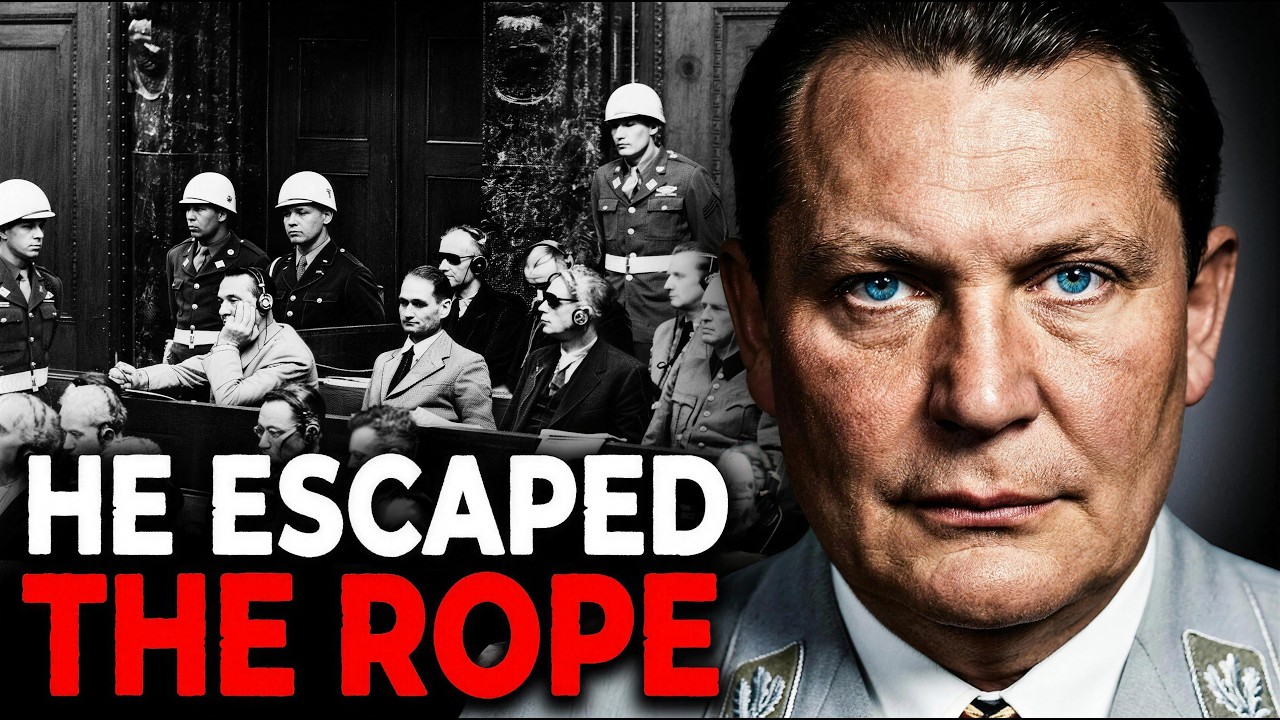
Göring had escaped justice in the narrowest possible sense, choosing his own end over the hangman’s rope, which he considered an undignified death for a soldier. He beat the hangman. He did not beat history. The story of how he arrived at that small cell in Nuremberg begins in Rosenheim, Bavaria, where Hermann Wilhelm Göring was born on January 12th, 1893, the fourth child of Heinrich Ernst Göring, a former German colonial governor in what is now Namibia, and his wife Franziska.
His early childhood was unconventional. His father spent much of Hermann’s infancy abroad, and for the first years of his life, the boy was essentially raised by his godfather, Hermann von Epenstein, a wealthy Jewish physician and landowner who had been a close friend of the family for decades. The irony, that the man who would later help architect the legal persecution and murder of European Jews spent his formative years in the care of a Jewish patron, was not lost on historians who studied Göring’s life. Von Epenstein owned two medieval castles, Veldenstein and Mauterndorf, and it was within these dramatically romantic settings that young Hermann developed a lifelong obsession with medieval grandeur, heraldry, hunting, and the aristocratic life.
He grew up dressing in armor, playacting as a knight, and imagining himself a lord of some feudal realm. These fantasies never entirely left him. His school years were characterized by a reckless, combative spirit. He was sent to cadet school at the age of eleven, and accounts from the period describe a boy who was physically brave, easily bored, contemptuous of rules he considered beneath him, and possessed of a natural charisma that made him both popular and dangerous.
He excelled in athletics and military subjects, graduated with distinction, and entered the German Imperial Army as a lieutenant in 1912. He served initially as an infantry officer, but the static horror of trench warfare quickly convinced him to seek a more exciting posting. In 1915, he transferred to the Imperial German Air Service, and it was in the skies over the Western Front that Göring first achieved genuine distinction. He proved to be an exceptionally gifted combat pilot, shooting down twenty-two confirmed enemy aircraft by the armistice of November 1918, earning the Pour le Mérite, the highest military decoration in the German Empire, known informally as the Blue Max.
He was commanding the legendary Jagdgeschwader 1, the same fighter wing previously commanded by the Red Baron, Manfred von Richthofen. Göring was twenty-five years old, decorated, famous, and celebrated. Then Germany surrendered, and everything collapsed. The Treaty of Versailles dissolved the German air force entirely.
Göring, like thousands of other officers who had defined themselves entirely through military service, found himself suddenly without purpose, without income, and without a role in the new civilian republic he despised. He worked briefly as a commercial pilot in Sweden, where he met Karin von Kantzow, a Swedish noblewoman who was already married. Their affair was passionate and reckless. Karin divorced her husband, married Göring, and became the great love of his life.
They moved to Munich, and it was in the turbulent beer halls of postwar Bavaria that Göring’s politics began to take shape. He attended a speech by a struggling Austrian agitator named Adolf Hitler in 1921, and the encounter changed the course of his life. Göring was electrified. He joined the Nazi party almost immediately, was placed in command of the Sturmabteilung, the SA, the party’s paramilitary street-fighting force, and threw himself into the work of building Hitler’s movement with the same reckless energy he had once poured into aerial combat.
On November 8th, 1923, he marched with Hitler in the Munich Beer Hall Putsch, the failed coup attempt that ended with police gunfire in the streets and Hitler arrested. Göring was shot in the groin, a wound so painful and so badly treated in the aftermath that he was given large doses of morphine to manage the agony. He would spend the next four years in exile in Austria and Italy, his wound refusing to fully heal, his dependency on morphine deepening into an addiction that would torment him for the rest of his life. He was declared legally insane at one point during this period and briefly institutionalized.
He gained enormous weight and became erratic and frightening. But he did not break from Hitler or from the Nazi movement. When a general amnesty allowed him to return to Germany in 1927, Göring came back a changed man: physically bloated, emotionally volatile, but politically sharper than ever. He leveraged his status as a war hero and his personal connections with the German aristocracy and business community to open doors for the Nazi party.
He won election to the Reichstag in 1928, and by 1932 had become its president, the speaker of the German Parliament, wielding enormous procedural power over the body that would soon vote to hand Hitler dictatorial authority. When Hitler was appointed Chancellor on January 30th, 1933, Göring was rewarded for his decade of loyalty. He was named Minister of the Interior for Prussia, the largest German state, and given control of the Prussian police. Within weeks of taking office, he purged the police of political opponents, replacing them with loyal Nazi officers.
Then he created an entirely new instrument of state terror. On April 26th, 1933, Göring officially established the Geheime Staatspolizei, the Gestapo. The founding of the Gestapo stands as one of Göring’s most consequential and horrifying crimes. He did not pull any particular trigger himself in those early days, but he created the institutional machinery through which the Third Reich would identify, arrest, torture, and murder its political opponents for the next twelve years.
The Gestapo was not merely a police force; it was a political surveillance apparatus explicitly designed to operate outside the normal legal framework. Göring gave it authority to arrest suspects without judicial oversight, to hold them in protective custody indefinitely, to conduct interrogations using methods that were explicitly and legally excluded from the usual prohibitions on police brutality, and to hand prisoners directly to the concentration camp system rather than to the courts. The first concentration camp at Dachau had already been established by Heinrich Himmler in March 1933. Göring’s Gestapo became the pipeline through which enemies of the state flowed into that system.
Communists, socialists, trade union leaders, journalists, clergy, and eventually Jews were swept up and deposited in camps where beating, starvation, forced labor, and murder were daily realities. This was not an accident. This was the design. In the same period, Göring was deeply involved in the construction of the broader Nazi police state.
On the night of February 27th, 1933, the Reichstag, the German Parliament building, was set on fire in circumstances that have never been conclusively explained. A young Dutch communist named Marinus van der Lubbe was arrested at the scene and later executed for the arson. Göring, who arrived at the fire within minutes and surveyed the burning building with what many witnesses described as undisguised satisfaction, immediately declared the fire a communist conspiracy and used it as the pretext for the Reichstag Fire Decree, which Hitler signed the very next day. The decree suspended the Weimar Republic’s guarantees of individual liberties, allowed for indefinite detention without trial, and gave the central government the power to override state governments.
It was the legal foundation of the Nazi dictatorship, and Göring was the man who provided its justification. Whether or not he orchestrated the fire, a question historians have debated for decades without resolution, he unquestionably exploited it with the speed and ruthlessness of someone who had been waiting for exactly this kind of opportunity. By 1935, Hitler had appointed Göring commander-in-chief of the newly revealed Luftwaffe, the German air force, whose existence had been kept secret in violation of the Treaty of Versailles. Göring threw himself into building the air force with genuine passion.
He recruited talented officers, oversaw the development of aircraft like the Messerschmitt Bf 109 and the Junkers Ju 88, and presided over a military expansion that would make Germany’s air arm one of the most formidable in the world. The Luftwaffe’s early performance in the Spanish Civil War was electrifying. The bombing of the Basque town of Guernica on April 26th, 1937, by the Condor Legion, a unit of German and Italian aircraft, killed hundreds of civilians and demonstrated to the world both the power and the willingness of German air power to strike at civilian populations. In 1936, Hitler appointed Göring plenipotentiary for the Four Year Plan, the Nazi economic program designed to prepare Germany for war within four years.
This gave him sweeping authority over the entire German economy: industry, agriculture, labor, raw materials, and foreign trade. He used this authority partly to accelerate military production and partly to enrich himself and his political allies. Jewish-owned businesses were seized under the expanding legal framework of anti-Semitic legislation and either liquidated or transferred to Aryan ownership at a fraction of their market value. Göring himself was a direct beneficiary of this process.
It was also Göring who signed the document that set the Holocaust formally in motion. Following the Kristallnacht pogrom of November 9th and 10th, 1938, two nights of organized violence against Jewish communities across Germany and Austria in which synagogues were burned, Jewish businesses smashed and looted, nearly one hundred Jews killed outright, and some thirty thousand Jewish men arrested and sent to concentration camps, Göring convened a meeting on November 12th. The minutes survive. Attended by senior Nazi officials including Propaganda Minister Joseph Goebbels and SS chief Heinrich Himmler, Göring expressed irritation not at the violence but at the economic disruption it had caused.
He reportedly said he wished they had killed two hundred Jews instead of destroying so much property. He then moved methodically to establish the legal and economic framework for the complete expropriation of Jewish wealth. Jews were collectively fined one billion Reichsmarks. Jewish-owned businesses were forbidden from operating.
The process of Aryanization was dramatically accelerated. On January 24th, 1939, Göring issued a formal directive to Reinhard Heydrich, chief of the SD, the SS intelligence service, ordering him to solve the Jewish question through immigration and evacuation. In early 1939, Nazi policy still envisioned forcing Jews out of Germany through emigration. But the directive established Göring as the official responsible for coordinating Jewish policy across all German institutions, and it created the bureaucratic framework that would two and a half years later be redirected from forced immigration to systematic mass murder.
On July 31st, 1941, with Germany deep into the invasion of the Soviet Union, Göring signed a second directive to Heydrich. It instructed him to carry out all necessary preparations with regard to organizational, financial, and material matters for bringing about a complete solution of the Jewish question in the German sphere of influence in Europe. The German phrase was Endlösung, the Final Solution. Historians consider this document the formal authorization of what became the Holocaust.
Heydrich brought it to the Wannsee Conference of January 20th, 1942, where fifteen senior Nazi officials coordinated the logistics of murdering the eleven million Jews of Europe. Six million Jews were murdered in the years that followed, alongside millions of Roma, Soviet prisoners of war, Polish civilians, people with disabilities, homosexuals, and others the regime had designated as enemies. Göring’s defenders argued at Nuremberg, and he argued himself, that he had not known what Heydrich would do with the directive, that Endlösung did not necessarily mean murder, that he had assumed emigration and resettlement rather than extermination. The tribunal rejected this argument.
By July 1941, the Einsatzgruppen, the mobile killing units, were already murdering Jews by the hundreds of thousands in the occupied Soviet territories, and senior Nazi officials, including Göring, received regular reports on these operations. The bombing campaigns conducted by the Luftwaffe under Göring’s command also deserve examination in their own right. The turning point came in the late summer and autumn of 1940 during the Battle of Britain. In July 1940, the Luftwaffe began a campaign to achieve air superiority over England.
German aircraft attacked RAF airfields, radar stations, and aircraft factories in a campaign that came close to overwhelming Fighter Command. Then, on the night of August 24th, 1940, a small force of German bombers accidentally dropped bombs on central London, violating Hitler’s standing orders against targeting civilian areas of the capital. Churchill ordered retaliatory raids on Berlin. Hitler, enraged, ordered Göring to shift the Luftwaffe’s attacks from RAF infrastructure to British cities.
Göring was delighted. He had been arguing for exactly this kind of strategic bombing campaign, convinced that bombing London and other British cities would break civilian morale. He was catastrophically wrong. From September 7th, 1940, the Blitz began in earnest.
Night after night, hundreds of German bombers pounded London, killing civilians, destroying homes, hospitals, and churches, turning large swathes of the East End into rubble. Approximately 43,000 British civilians were killed over the course of the Blitz, and more than a million homes were damaged or destroyed. Then came the provincial blitz: the bombing of Coventry on the night of November 14th, 1940, which killed nearly six hundred people and destroyed or damaged over forty thousand buildings, including the city’s medieval cathedral. Birmingham, Liverpool, Bristol, Glasgow, Plymouth, and dozens of other cities were attacked in turn.
For decades, a claim circulated that British intelligence, having broken the Enigma codes, had advanced knowledge of the Coventry raid but deliberately allowed it to proceed rather than reveal that the codes had been compromised. The truth is more complicated. British intelligence did receive signals suggesting a major attack on a target in the English Midlands, but the precise target was not identified until it was too late to mount an effective defense. The deception apparatus around Enigma was not the primary reason for the failure.
But the story itself tells something about the character of the raid: it was large enough, devastating enough, and symbolically destructive enough that it required explanation. The worst of the Luftwaffe’s crimes under Göring’s command were committed on the Eastern Front. Operation Barbarossa, the invasion of the Soviet Union that began on June 22nd, 1941, was not a conventional military campaign. It was conceived by Hitler as a war of racial extermination.
Göring, as both commander-in-chief of the Luftwaffe and plenipotentiary for the Four Year Plan, was one of the primary architects of the so-called Hunger Plan, a deliberate policy of starvation developed in the spring of 1941. Göring’s economic planning staff estimated explicitly in written documents that survive that the policy would result in the deaths of many tens of millions of Soviet civilians, deaths by starvation accepted and incorporated into German economic planning. Göring signed off on this plan. Combined with direct military operations, the policies implemented in the occupied Soviet territories would result in the deaths of an estimated 27 million Soviet citizens, by far the largest national death toll of any country involved in the conflict.
Let us now examine what may be the most personally characteristic of Göring’s crimes: the systematic looting of Europe’s cultural heritage. For Göring, art theft was not merely a perk of power. It was a passion. Under the Aryanization laws, Jewish art collections were seized.
A network of auction houses and dealers flowed stolen artworks into the private collections of senior Nazi officials. Göring was by far the most aggressive acquirer. When the war expanded, so did the looting. An organization called the Einsatzstab Reichsleiter Rosenberg, the ERR, was established to confiscate Jewish-owned and ownerless cultural property across occupied Europe.
Göring made thirty-six visits to the ERR’s warehouses and processing centers in Paris, where confiscated art was cataloged and assessed. On each visit, he selected works for his personal collection. His acquisitions from France alone numbered in the hundreds. He acquired works by Rubens, Rembrandt, Vermeer, Cranach, and dozens of other masters.
By the end of the war, Göring’s personal art collection numbered approximately 1,375 paintings, along with several hundred sculptures, tapestries, decorative objects, and pieces of armor. It was housed primarily at his enormous country estate of Carinhall, north of Berlin, named after his first wife Karin, who had died in 1931 and whose remains he had had disinterred and re-interred at the estate in an elaborate ceremony. When the Red Army closed in on Berlin in early 1945, he had the collection crated up and evacuated by a train of some twenty-four railway wagons. A significant portion was recovered by Allied forces after the war and cataloged for restitution, but the process of tracing ownership and returning works to the families from whom they had been stolen has continued for decades.
As late as the 2000s and 2010s, litigation over works that had passed through Göring’s collection was still being pursued. Some families never recovered their works at all because the heirs themselves had been murdered in the Holocaust. Göring’s political relationship with Hitler became increasingly strained as Germany’s military fortunes worsened. During the Battle of Britain, Göring had assured Hitler the Luftwaffe could bring Britain to its knees.
He was wrong, and Hitler was furious. Then came Stalingrad. When Field Marshal Friedrich Paulus’s Sixth Army was encircled by the Soviet counteroffensive in November 1942, Göring made the promise that would define his wartime legacy. He assured Hitler the Luftwaffe could supply the encircled army by air.
Military aviation experts warned that this was impossible. Göring overruled them and gave Hitler his personal guarantee. The airlift was a catastrophe. The Luftwaffe never came close to delivering the supplies needed.
The minimum daily tonnage required was approximately 700 tons per day; the maximum the available transport fleet could realistically deliver was between 100 and 200 tons. The encircled army slowly starved and froze. On February 2nd, 1943, the remnants of the Sixth Army, approximately 91,000 surviving soldiers, surrendered. Fewer than 6,000 would survive Soviet captivity to return to Germany after the war.
Göring’s promise had contributed directly to the deaths of hundreds of thousands of German soldiers, and Hitler never forgave him. Göring’s health deteriorated alarmingly. His morphine addiction reasserted itself, later replaced by paracodeine pills, and he wore increasingly theatrical uniforms of his own design: white tunics, elaborate decorations, jeweled batons. He spent long periods at Carinhall hunting and reviewing his art collection while the Reich crumbled.
By 1943, he still held the title of Reichsmarschall, the highest military rank in the German state, created specifically for him, but his actual influence was declining sharply. The final act began on April 23rd, 1945, as Soviet forces fought through the suburbs of Berlin. Göring, at his Obersalzberg retreat in Bavaria, sent a telegram to Hitler announcing that pursuant to Hitler’s 1941 decree establishing him as successor, he was prepared to assume leadership of the Reich. Hitler interpreted the telegram as treason.
Martin Bormann ensured Hitler’s fury was stoked to its maximum. Göring was stripped of all offices and ranks, placed under house arrest by the SS, and sentenced to death, a sentence suspended apparently because Hitler retained some residual sentiment toward the man who had been his most prominent supporter for twenty years. On May 8th, 1945, the day Germany surrendered, Göring surrendered himself to American forces and was taken into custody by the 36th Infantry Division. The soldiers who first encountered him were struck by his jovial manner, by the enormous quantity of luggage he had brought, including several suitcases of paracodeine pills, and by his apparent conviction that he would be treated as an honored prisoner of war.
He dined with American generals at first. But as the scope of what the Allied forces were finding, the concentration camps, the death camps, the mass graves, became fully apparent, the atmosphere shifted. He was indicted as one of the original defendants at the International Military Tribunal at Nuremberg, which opened on November 20th, 1945. He was charged on all four counts: conspiracy to wage aggressive war, crimes against peace, war crimes, and crimes against humanity.
By this point, the American army had overseen his detoxification, and the Göring who appeared in the dock was sharper, more focused, and more intellectually dangerous. He had decided he would conduct his defense not by begging for mercy, but by arguing the case for German nationalism and Hitler’s historical legitimacy as forcefully as he could. His performance under cross-examination by the American Chief Prosecutor, Justice Robert Jackson, on March 18th, 1946, is considered one of the most extraordinary exchanges in the history of international law. Göring was quicker, more verbally agile, and more skilled at turning questions to his own advantage than Jackson had anticipated.
He challenged the legitimacy of the trial itself: victors sitting in judgment of the vanquished was not justice but politics. He questioned whether the Allied bombing campaigns of German cities were any different from the Luftwaffe campaigns with which he was charged. The exchange became so heated that the tribunal’s president had to intervene repeatedly. The American delegation was reportedly furious.
The judgment was delivered on October 1st, 1946. Göring was found guilty on all four counts. The tribunal found that he was the principal figure who had directed the preparation of the Final Solution. It found that he had been responsible for the deportation of millions of civilians for slave labor.
It found he had been the moving force behind anti-Semitic policy. He was sentenced to death by hanging. Göring accepted the sentence with a kind of theatrical stoicism and then began plotting how to deny his execution. He had somehow retained or obtained a cyanide capsule.
Precisely how it came to be in his possession has never been fully resolved. The most widely accepted explanation is that an American officer with some sympathy for Göring had agreed, in exchange for gifts, to smuggle it to him. A 2005 investigation by a German researcher identified a likely intermediary as First Lieutenant Jack G. Wheelis, an American army officer who had developed a personal rapport with Göring and whose family confirmed after Wheelis’s death that he had admitted to having some role in the matter.
What became of the people most closely associated with Göring after the war? His second wife, Emmy, survived and lived quietly in Germany until her death in 1973, writing a memoir criticized for its studious avoidance of questions about what she knew. Their daughter Edda, born in 1938, grew up in postwar Germany, became a nurse, and lived a relatively private life while maintaining her father’s innocence publicly until her own death in 2018. The authorities scattered Göring’s ashes in the Isar River near Munich, a deliberate choice to ensure there would be no grave that could become a site of pilgrimage.
Of the twelve defendants sentenced to death at Nuremberg, ten were hanged on October 16th, 1946. Göring had already been dead for more than twelve hours. The account of the prison psychologist Gustav Gilbert, whose recorded conversations with the defendants were later published, noted that Göring seemed to genuinely enjoy the intellectual game of the trial while remaining essentially unmoved by its content. When shown photographs of concentration camp victims, his reported reaction was professional curiosity about the documentary value of the photographs rather than emotional engagement with what they depicted.
In one widely quoted exchange, Göring told Gilbert: “The people can always be brought to the bidding of the leaders. That is easy. All you have to do is tell them they are being attacked, and denounce the pacifist for lack of patriotism and exposing the country to danger. It works the same in any country.
” The man who said this had used precisely those techniques to help build and maintain one of the most aggressive and destructive military machines in history. After the war, many senior Luftwaffe officers were recruited by the Western powers. The Cold War created a strategic environment in which West Germany’s rapid rearmament was considered essential, and former Luftwaffe officers, including some who had participated in the bombing campaigns, found themselves given new commissions. Adolf Galland, one of the most celebrated Luftwaffe fighter pilots, survived to become a highly paid military aviation consultant, employed by Argentina among other countries, and wrote a widely read memoir that portrayed himself and other fighter pilots as professional soldiers rather than ideological warriors.
This distinction was accepted readily by postwar audiences, but the reality of the Luftwaffe’s war does not support the clean war mythology. The restitution of Nazi-looted art remains genuinely unfinished business. The 1998 Washington Principles established a framework for identifying looted works, and many institutions have made progress, but the process faces fundamental challenges. Many original owners and their immediate heirs are dead.
Documentation was deliberately destroyed. Works have changed hands multiple times. The German Lost Art Foundation maintains records of confiscated cultural property, but the pace of return has been slow relative to the scale of what was taken. What remains disputed, what may never be fully resolvable, is the question of how such crimes become possible.
Göring was certainly less ideologically consistent than Himmler, less obsessively focused on race than Goebbels. His anti-Semitism seems to have been more casual than fanatical in its origins. But the question of what he personally believed matters very little compared to what he personally did. He signed the directive authorizing Heydrich to prepare the Final Solution.
He signed off on the Hunger Plan. He founded the Gestapo. He directed the bombing campaigns against civilian populations. He supervised the looting of Europe’s Jewish cultural heritage.
Almost everyone who met him, Allied officers, fellow defendants, prison guards, journalists, came away noting that there was something genuinely likable about the man in person. He was funny. He told stories. He was generous with food and drink.
He adored his second wife and was reportedly a devoted and tender father to his daughter. This is perhaps the most disturbing thing about Hermann Göring. The man who signed the directive authorizing the Holocaust was not a monster in the way we generally imagine monsters. He was charming and funny and generous and petty and vain and greedy and entirely capable of ordering the murder of millions while maintaining a warm personal manner with the people immediately around him.
The lesson of Göring is that evil is rarely demonic. It is usually human, and that is what makes it so terrifying. The crimes were real. The deaths were real.
The families destroyed were real. The paintings stolen from murdered Jews are real, and many of them are still out there in museums and collections, their origins incompletely acknowledged, waiting for a reckoning that has been too long delayed. That is the legacy of Hermann Göring: the millions of people whose deaths were enabled, authorized, and in some cases directly ordered by a man who was brave, funny, cultivated, greedy, vain, and capable of extraordinary evil without ever fully understanding that word to mean something that applied to him.
