The New York attorney was one of the best in the city, and Jackie Kennedy had retained him for one reason: to end her marriage. It was the mid-1950s, before her husband was president, when he was still a senator from Massachusetts, and she had reached her breaking point. The affair she had just learned about had begun only a week after she gave birth to their stillborn daughter, Arabella. Her sister-in-law, Patricia Kennedy Lawford, had told her about it, and Jackie confronted her husband at Hammersmith Farm, her family’s estate in Newport, Rhode Island.
According to biographer J. Randy Taraborrelli, she barely let him through the door before demanding to know who “Trailer Park Joan” was. The woman in question was a flight attendant named Joan Lundberg, and the confrontation was serious enough that Jackie had begun the process of divorce. But Joe Kennedy, JFK’s father and the patriarch of the Kennedy family, had far too much invested in his son’s political future to let a divorce derail everything.
He met with Jackie at Le Pavillon, a French restaurant in New York, and made her an offer that was equal parts business deal and family arrangement. If Jackie agreed to stay in the marriage, Joe told her she could have complete freedom to do whatever she liked, and he would pay her $100,000 upon the birth of her first child carried to term. In today’s money, that is roughly a million dollars. Jackie accepted the deal, though she reportedly told Joe that the price would jump to twenty million dollars if Jack brought home any venereal diseases from his affairs.
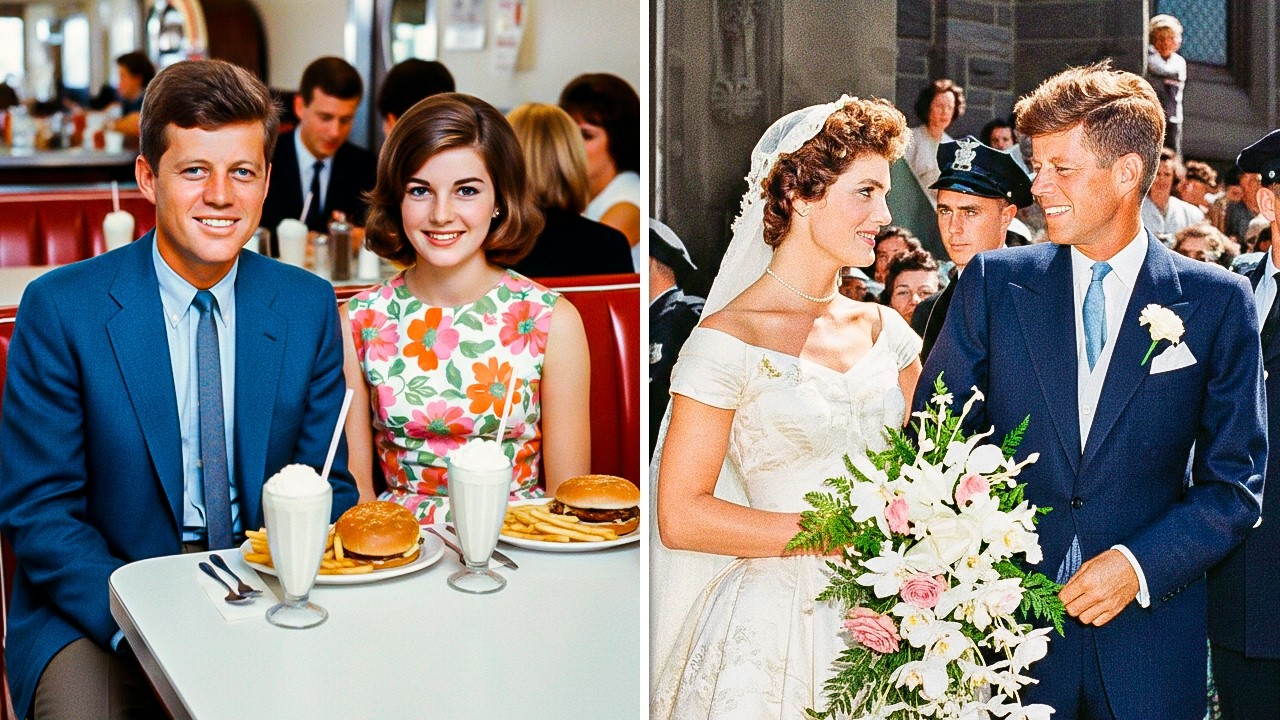
It was a transactional arrangement that turned their marriage into something closer to a political partnership than a love story. That partnership was built on a foundation that nearly crumbled before it began. Ten days before Jacqueline Bouvier was set to marry Senator John F. Kennedy on September 12th, 1953, disaster struck at the New York City studio of designer Ann Lowe.
A water pipe burst in her atelier, flooding the workspace and completely destroying the bride’s wedding gown along with nine of the fifteen bridesmaids dresses that had taken weeks to create. The accident soaked the delicate fabrics in water, rust, and grime, leaving them completely ruined. What made the catastrophe even more stressful was that Lowe decided to keep the entire incident a secret from the Kennedy family and from the bride herself. The original gown had required eight weeks of meticulous work, featuring more than fifty yards of ivory silk taffeta with a fitted bodice, a portrait neckline, and a bouffant skirt embellished with elaborate flounces.
With only ten days remaining until one of the most anticipated society weddings of the decade, Lowe and her team had to recreate everything from scratch. She assembled a crew of seamstresses who worked around the clock, non-stop, to remake the bride’s gown and all nine destroyed bridesmaids dresses in time for the ceremony. The financial impact was devastating. Lowe had expected to make a profit of seven hundred dollars from the entire commission, but the disaster forced her to purchase all new materials and pay for additional labor.
By the time the dresses were completed, she had lost $2,200 on the project. She delivered them on time, and when she arrived at the Auchincloss estate, she insisted on entering through the front door rather than the back, threatening to take the dresses back with her if she was not granted proper entry. Jackie wore the hastily recreated gown down the aisle, never knowing that it had been made in just over a week under emergency conditions. What she did know, even before the wedding, was that the dress was not what she wanted.
She later confessed to friends that she felt like she looked like a lampshade. She had wanted something simple and French, elegant, understated, the opposite of the ornate traditional gown she wore. The decision had been made for her by Joseph P. Kennedy, who wanted the wedding to create what one fashion historian described as an “American royalty moment” that would establish his son as the heir to the family dynasty.
When Joe saw Ann Lowe’s proposal, he loved it and essentially overruled Jackie’s preferences. When reporters asked who designed the dress, they did not get the answer they expected. Instead of celebrating the talented designer, Joe dismissed the question with a curt response: “A colored dressmaker did it. ” Ann Lowe was no ordinary dressmaker.
She had established herself as society’s best-kept secret, creating exquisite gowns for some of America’s wealthiest families, including the Rockefellers, the DuPonts, and the Roosevelts. The wedding should have been her career-defining moment, especially since it was covered extensively by the press and attended by over eight hundred guests. But on the day of the wedding, Joe Kennedy controlled the press narrative. Only one reporter, Nina Hyde from the Washington Post, even mentioned Lowe’s name in coverage of the event.
Jackie herself, when asked about the dress, reportedly said, “I wanted to go to France, but a colored dressmaker did it. ” It was not until decades later, long after Ann Lowe’s death in 1981, that she received proper public credit for designing Jackie Kennedy’s dress. Jackie’s role in her husband’s career, however, went far beyond wearing a dress she hated. While they were still dating in early 1953, Senator Kennedy needed to establish himself as a serious voice on foreign policy, particularly regarding Vietnam, where France was struggling to maintain colonial control.
The problem was that most of the important research about French Indochina was written in French, a language Kennedy could not read fluently. So he turned to Jackie, who had spent her junior year studying at the Sorbonne in Paris and was completely fluent. What she took on was far more than a translation job. Kennedy asked her to read approximately ten books about the history of Vietnam, determine which passages were relevant, translate them from French into English, and synthesize all of it into one comprehensive report.
The assignment covered France’s political, military, economic, and social control over its Indochinese colony. Jackie worked on the project throughout late March of 1953 and produced an 84-page report that became the foundation for Kennedy’s foreign policy positions. He used substantial sections from it for his first major foreign policy speech to the Senate in 1953. The following year, he delivered another speech based on the same research, and this one earned him his first significant national press coverage as a potential presidential candidate.
According to Kennedy aide Ted Sorensen, whatever political work Jackie did for the senator, they kept strictly between themselves, which is why the story remained largely unknown for decades. Her career, such as it was, had already been taken from her. Jackie had every intention of returning to her job as the Inquiring Camera Girl at the Washington Times-Herald after her honeymoon. She loved her work as a roving photographer and columnist, approaching strangers on the streets of Washington with her heavy Graflex camera, asking them quirky questions and snapping their portraits for the newspaper’s daily feature.
She had written in her 1947 high school yearbook that her ambition was not to be a housewife, and even as an engaged woman in the 1950s, she held on to the idea that she could have both a husband and a career. But the Kennedy family, particularly Joe, had other plans. Without consulting Jackie directly, a public relations firm working for the family issued a press release announcing the engagement. The wording was very specific: it stated that Jackie formerly worked for the Washington Times-Herald, using the past tense even though she was still actively working there.
Once the announcement went out to newspapers across the country, there was no way for Jackie to show up at work the next day without contradicting the official statement from her future husband’s family. Biographer Carl Sferrazza Anthony notes that she had been very clear about her intentions to continue working. The maneuver by the Kennedy family made the decision for her. The pressure to marry well had come from her own family long before the Kennedys entered the picture.
Jackie’s mother, Janet Lee Bouvier Auchincloss, had raised both Jackie and her sister Lee with a specific worldview: money and power were the keys to happiness and security. In January of 1952, Jackie got engaged to a stockbroker named John Husted Jr. In a letter written to a confidant shortly after, she described it as the happiest feeling in the world. The couple planned to marry in June.
But when Janet discovered that Husted was earning $17,000 a year, roughly $159,000 in today’s money, she was furious. At their own engagement party in March of 1952, Jackie returned the ring to Husted, reportedly at her mother’s insistence. Around the same time, she was introduced for a second time to Senator John F. Kennedy.
Unlike Husted, Kennedy checked all of Janet’s boxes: money, power, and political influence. Jackie and JFK began dating seriously, and by September of 1953 they were married. The engagement itself had been remarkably unromantic. For the first ten years of their marriage, there had never been a real proposal at all.
When Jackie returned from covering Queen Elizabeth’s coronation in England in 1953, JFK simply said a few words to her at the airport that amounted to agreeing they should get married. No bending down on one knee, no romantic speech. They announced their engagement on June 25th, 1953, and married that September. It was not until their tenth wedding anniversary in September of 1963 that JFK finally decided to do things properly.
By that point, the couple had endured the devastating loss of their newborn son Patrick just weeks earlier. The tragedy seemed to bring them closer than they had ever been, and those around them noticed a genuine shift. For their anniversary, JFK commissioned a special ring from Van Cleef and Arpels in New York, a gold and emerald design that he said represented the fighting spirit of the Irish that he had witnessed in their infant son’s brief struggle for survival. When he presented it to Jackie, he slipped it onto her finger next to her wedding band, then got down on one knee to officially ask her to marry him—something he explained he had never actually done before.
Jackie was deeply moved. In the final months of his life, JFK had made a secret plan that the public never got to witness. He had decided to renew their marriage vows at Hammersmith Farm in September of 1964, just ahead of what would have been their eleventh anniversary. The estate held deep significance.
It was the sprawling 300-acre oceanfront property in Newport, Rhode Island, where the couple had held their wedding reception back in 1953, with more than 1,200 guests dancing under a huge canopy while Meyer Davis and his orchestra played. Now, eleven years later, JFK wanted to return to that same location. The death of Patrick had profoundly changed their relationship. Secret Service agents noticed it immediately.
The couple who had previously been restrained and formal in public were now holding hands and showing genuine affection. For the first time in their marriage, JFK seemed fully committed to Jackie, telling his brother’s wife Joan that he feared God was punishing him for his bad behavior and admitting, “I haven’t been the best husband and it’s very painful. And by painful, I mean shameful. ” The vow renewal ceremony never happened.
On November 22nd, 1963, just two months after their tenth anniversary, the president was assassinated in Dallas. The secret plan died with him. By then, Jackie had spent years navigating the realities of her husband’s infidelities with a quiet form of self-protection. When the Kennedys moved into the White House in 1961, the First Lady took an extraordinary step.
She secretly installed a spy in the office of JFK’s personal secretary, Evelyn Lincoln, with very specific instructions. According to Taraborrelli, who interviewed the alleged spy in 2024, Jackie told her, “I need you to keep an eye on what’s going on. Just keep me posted of anything that perks your ears. ” The informant was essentially Jackie’s eyes and ears, monitoring the flow of communications and watching for suspicious activity.
The role became particularly important when calls started coming in from women with connections to the president. One of the people who allegedly called the office regularly was singer Judith Campbell, whom JFK had met through Frank Sinatra. None of the women in JFK’s life troubled Jackie quite like Marilyn Monroe. According to biographers who interviewed White House insiders, Jackie spoke directly to her husband about the actress, and her words turned out to be chillingly prophetic.
She told him, “This one’s different, Jack. This one worries me. I think she’s a suicide waiting to happen. ” Jackie was urging him to end the affair because she could see something dangerous unfolding.
She felt genuine concern for Monroe’s well-being, not just anger about the affair. The conversation reportedly took place sometime in 1962, the same year Monroe famously sang “Happy Birthday, Mr. President” at Madison Square Garden in a sheer, nude-colored dress. Jackie had refused to attend, telling people she was not going to be humiliated.
Just months after that conversation, on August 5th, 1962, Marilyn Monroe died from a drug overdose at her Los Angeles home at age 36. Her death was ruled a probable suicide. According to people close to Jackie, when she heard the news, she felt genuinely sad. One insider told the National Examiner years later that of all the women in JFK’s life, it was Marilyn who Jackie felt sorry for, and she wondered if Jack had listened to her warning, whether Marilyn might have been saved.
The two women had actually spoken directly when Monroe called the White House looking for the president. The call came in on Jackie’s personal line in the Kennedys’ private quarters, bypassing the usual switchboard. When Jackie picked up and heard Marilyn’s voice asking for Jack, she did not politely transfer the call. She responded with a curt question: “What is this about?
” Marilyn’s response was almost painfully transparent: “Oh, nothing in particular. I just wanted to say hello. ” Jackie quickly ended the conversation. According to those close to her, this phone call became one of the moments that haunted her for years after JFK’s death.
What made this affair different in Jackie’s mind was that Monroe was a cultural icon whose involvement with her husband could become public knowledge in a way other affairs might not. Whether JFK’s behavior was driven by character, opportunity, or something else entirely is a question historians still debate. According to presidential historian Mark K. Updegrove in his book Incomparable Grace: JFK in the Presidency, Kennedy’s sexual appetite was reportedly ramped up by the daily cortisone shots he received to manage his chronic back pain.
The condition began during his time as a naval officer in World War II and worsened after a PT boat collision in 1943. By the time he reached the White House, his back pain was so intense that he required constant medical intervention just to maintain his public image of youthful vigor. Medical experts have long understood that corticosteroids can have significant effects on mood, behavior, and libido. Updegrove wrote that Kennedy’s sexual appetite was fed all too readily by friends and acolytes eager to indulge him by finding willing partners, including socialites, movie stars, White House secretaries, and interns, and even high-end prostitutes.
The same medical treatments that allowed Kennedy to project an image of health may have intensified the very behaviors that threatened his marriage. Behind the glossy photographs and Camelot mythology lay a marriage stranger than fiction, built on political deals, secret spies, tragic losses, and a wedding dress that nearly did not make it down the aisle. The wedding dress, the one Jackie hated, was the gown that almost never existed. When she walked down the aisle on September 12th, 1953, she wore one of the most photographed and iconic wedding gowns in American history.
She also wore the weight of a deal her father-in-law had not yet offered her, a career she had been forced to give up, and a proposal she would not receive for another decade. Years later, Jackie would reflect on her mother’s influence, understanding that her path to becoming First Lady had been built on the conviction that security and social status mattered more than romantic love alone.
