Field Unit Two of Section 22, an Australian signals detachment working under American air command in the Southwest Pacific, had solved a puzzle that had been nagging at the Allies for months. Japanese aircraft kept arriving in the right piece of sky at the right moment to meet the bombers, and now the Australians knew why. Their finding went into a report, and the report went into a cabinet. The machinery the report described had switched on for the first time four months earlier, on a coral shelf called Bosnek, about a long stone’s throw from a divisional clearing station that was already filling up.
Bosnek sits on the south coast of Biak, an island in Geelvink Bay off the western end of New Guinea. The ground there is most of the story of what happened on it. Biak is coral rather than earth. An escarpment runs the length of that south coast a few hundred yards inland, rising sheer in places and coming right down to the water at Parai, leaving room for a road and nothing else.
Behind it, the land steps up onto a plateau of broken limestone under scrub, which turns to forest a few miles further in. There are no rivers worth the name. Rainwater sinks straight through the coral into caves, which is why the Japanese garrison lived underground, and why the American infantry that came ashore on the 27th of May 1944 had its drinking water rationed from the first day. The clearing station had two problems, and only one of them was enemy action.
Heat came off the coral all day and kept coming off it after dark, and men went down with heat exhaustion in numbers that filled cots as fast as gunfire did. Underneath that ran an epidemic of scrub typhus carried by mites in the undergrowth the troops were digging into. The 41st Division’s own medical report put the difficulty in one sentence, saying that in the typhus epidemic then running on Biak there was no way of telling whether a man had it until he had been sick for ten days. On the 31st of May, four days into the landing, three separate things arrived on that ground.
The division’s third regiment, the 163rd Infantry, came ashore that morning after a hard month at Wakde and Sarmi. An advanced detachment of the 308th Bomb Squadron Wing Headquarters had reached Bosnek the day before and was learning what the local hardships consisted of. And the ground controlled interception station arrived, the radar and plotting apparatus that would tell fighters where to go and, more to the point, tell the controllers which returns on the scope were friendly when on the air. The station belonged west of Bosnek, where an assault fighter control center had opened on the day of the landing.
A Japanese counterattack drove the control units back into Bosnek village itself. The perimeter there was small enough that sighting a radar aerial became an exercise in finding any flat coral not already occupied by something else. The case against the whole arrangement almost writes itself. Charge one is the ground.
A radar wants height, a clear horizon, and space behind the aerial for the interrogator gear. Bosnek offered a strip of coral under a cliff with an army camped on it. The official Air Force history of the campaign records that the station could not operate with efficiency. Charge two is the equipment, and to see what was wrong with it, the thing has to be taken back to the beginning.
The first identification sets fitted to Royal Air Force aircraft from 1939 were not transmitters in any real sense. Each one was a receiver wired to feed its own output back into itself so that when it heard a radar pulse, it re-radiated an amplified copy on the same frequency, stretching the blip on the operator’s screen into something longer than the blips around it. The gain had to be set by hand. Set too low, it did nothing.
Set too high, it howled. And it drifted in flight, so it got the answer right about half the time. The second generation replaced hand tuning with a small motor and a set of cams that swept the receiver across a band of frequencies over and over. By 1942, there were close to a dozen variants of that set in service.
Each was cut to a different family of radars, and not one of them could answer every radar an aircraft might fly past. In November 1940, the Tizard mission arrived in the United States carrying the best of British radar work, including one of those swept band identification sets. American researchers had their own program running by then. By any technical measure, it was the better one.
The Naval Research Laboratory had a design working up around 500 megacycles, clear of the radar bands with room above it to grow. The apparatus from Britain was cruder in every particular. It answered on the radar’s own frequency. It depended on a motor and a cam to find it.
And it came in a dozen incompatible flavors. The Americans looked at both systems. Then they looked at the number of Royal Air Force machines already flying with the swept band box and the number of factories already tooled to build it, and in early 1941 they decided to fit that box themselves and shelved their own. They gave up the better machine on purpose.
Five hundred of the resulting sets went to the Soviet Union. Charge three is the men flying with it. A report by Coast Artillery in the Southwest Pacific found that one returning crew in two did not switch the identification set back on after a mission over enemy ground, which meant half the aircraft approaching a friendly radar were announcing nothing at all. Crews switched off before crossing into hostile airspace so that the answer could not be used as a beacon, then had to remember to switch on again on the way home at the end of a long flight in an airplane with other things to do.
The set also carried an explosive charge fitted so that it would destroy itself if the machine came down where it should not. In Australian Beaufighters, the detonator held three charges about three inches long slotted into the front of the equipment, and it could be fired by pressing two buttons together or left to an impact switch. Aircrew had orders to isolate it just before landing because a heavy landing counted as an impact. Corporal John Frederick Laverty was fined two pounds for blowing up an identification set in a Beaufighter while testing that switch.
Charge four belongs to the enemy, and it is the serious one. In October 1944, the senior air staff officer of Northwestern Area warned operational squadrons that Japanese radar might be triggering the transponders in Allied aircraft. Two enemy search types had upper frequency limits that overlapped the lower edge of the band the coalition’s sets replied on. A search operator hunting for an echo could therefore ask a question he did not know he was asking and get an answer.
Field Unit 2 of Section 22, tracking the problem, found crews leaving their sets running until about ten minutes from the target. On a flight to Davao in September 1944, the equipment was triggered over and over by enemy signals, and the report noted that this gave Japan better warning of the raid’s arrival than her own radar was providing. Field Unit 9 ran into the same behavior on the transponder carried by American naval aircraft. The Australians were in effect watching a bomber force ring a doorbell all the way in.
Every one of those four charges is true, and the system beat the Japanese air defense apparatus anyway, on that island and everywhere else. The apparatus won because of what it did on a scope. A radar set produces a trace. An airplane shows up on that trace as a mark, and a mark tells an operator range and bearing and nothing whatever about who was flying it.
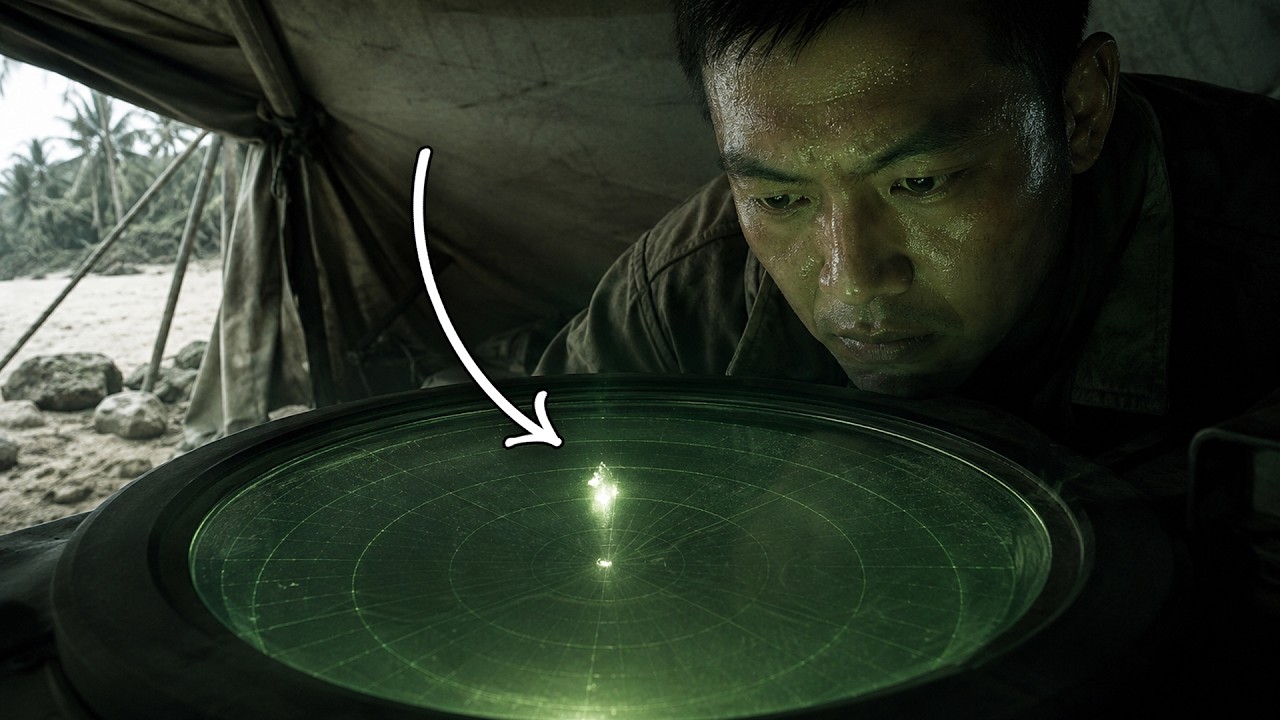
What the Mark III system added was a separate transmitter, receiver, and aerial at the radar station called an interrogator, and a matching transmitter and receiver in the aircraft called a transponder. When the operator pressed the interrogator key, it sent out a pulse on one agreed band. Every transponder in range heard that pulse and answered on the same band. On the display, the answer appeared as a second mark printed below the mark of the machine that sent it, and on some sets the trace split in two to show it.
A mark with an answering mark beneath it belonged to the coalition, and a mark without one was unidentified. Yet unidentified is a different word from hostile, and the controllers were taught to treat it as one. Silence had too many innocent causes. A set could be switched off or broken or out of range, or its crew could be one of the many who forgot.
So an aircraft that failed to answer bought itself an investigation rather than a fighter. The answer could also be dressed up. Codes were available so that a particular operation or a particular formation returned a distinctive pattern. A separate reply band was reserved so that fighters could be told apart from everything else in the air.
And the pilot had a switch that widened his answer into a distress signal any station in the theater could read. None of that came free. The common band meant that every radar station in the coalition had to acquire and man a complete second radio installation whose whole job was to ask a question. And the interrogator gear at Bosnek was competing for flat ground with the tents, the water point, and the road.
That was the bill. It was paid at every station from the Solomons to the Channel. What the bill bought sits in one word in the middle of the description: agreed. One band, the same band for every radar run by every air force and every navy in the coalition, so that a transponder built in Britain and fitted to an Australian Beaufighter answered an American interrogator standing on a coral shelf in Dutch New Guinea.
The set from Britain was the R3090. The American copy of it, built by Hazeltine for the United States Navy and issued to the Army Signal Corps under a number of its own, is described in the manuals as mechanically and electrically interchangeable with the original. Two factories on two continents turning out a box that could be swapped either way without a spanner being touched. That is what the Americans bought when they shelved the better set.
They bought interchangeability, which is a duller thing than performance and beats it. Now look at the other side of the same problem. Japan had the physics, the valves, and the engineers. Work on identification apparatus did exist there and did produce designs.
What it never produced was a system in the field, because the Imperial Army and the Imperial Navy pursued separate schemes and took no interest in each other’s. The separation was formal rather than casual. Firms building radio and radar for both services had to run separate facilities for each with no technical exchange permitted between them. So one company could serve two customers out of two buildings with neither set of engineers seeing the others work.
In the meantime, a search radar sitting near the bottom edge of the coalition’s reply band could pick up transponder emissions and serve as a warning receiver, which left Japan reading an identification signal she had never managed to field herself. The honest seam in this account runs through that last point. A wartime American report on the compromise of the Mark III system in the Pacific exists, and its cables describe attacks on a United States naval task group in the Philippines that used false identification replies and record that the raid on Biak on the 31st of May, 1944 carried faked codes. That document is the only detailed evidence on offer.
No one has reproduced it elsewhere, and the Fifth Air Force operational narratives for that day say nothing of the kind. The narrower claim holds up better. The enemy knew the band. Enemy equipment interacted with it.
And the Allied commands worried enough about both to circulate warnings. The set at Bosnek did not stay where it was. As the fighting cleared the islands of Owi and Wundi, the wing put radar stations on both to widen the base of the warning network. And on the 26th of June, it lifted the interception station out of Bosnek village altogether and rebuilt it at Tamayo on ground that gave it a horizon.
What it had covered in the meantime can be totaled up. Japanese air operations against Biak from the day of the landing to the end of June came to 22 attacks by 71 aircraft, most of them at night, none of them decisive, all of them met by fighters that had been told which way to turn. Against that stands the other column, the one the terrain filled in. More men left Biak sick than left it wounded, most of them carrying typhus from the mites in the undergrowth or fevers the medical units could not put a name to, or the plain effects of heat coming off the coral.
The identification apparatus sorted friend from stranger on a scope inside a perimeter too small to sight it in, under a cliff on an island with no drinking water. It managed that because a box made in Britain and a box made in America answered the same question in the same way, and because two allies had settled on an answer that neither of them thought was the best one available.
