In the late spring of 1936, in a Georgian house on St. James’s Square in London, the ambassadors of the United States and Russia were playing musical chairs alongside Adolf Hitler’s special envoy to Britain. The woman who had ordered them onto their feet held no office, ran no ministry, and could not command a single vote in the British cabinet. What she commanded instead was a house, 375 acres above the Thames, handed to her as a wedding present by the richest American in England.
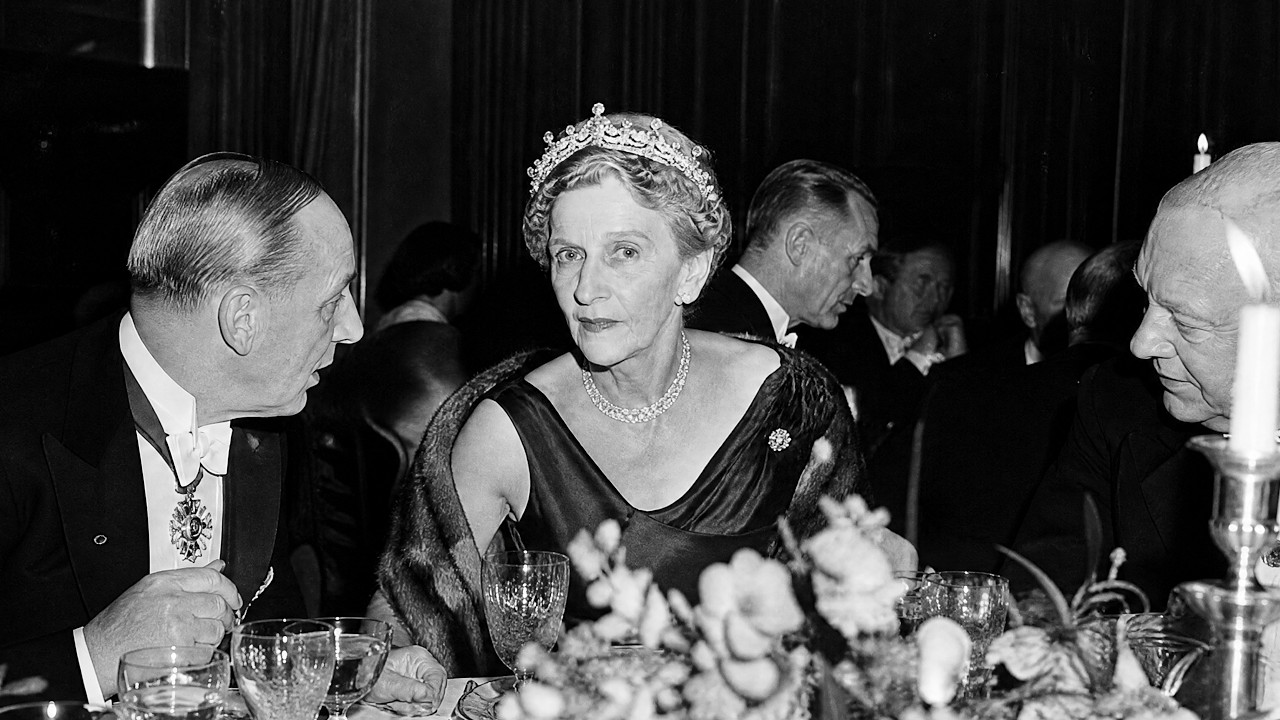
For thirty years, the men who governed Britain came to her table and went away with their minds changed. When the reckoning finally came, the country did not blame the foreign secretary, or the editor of The Times, or the ambassador to Berlin, all of whom were regulars at her table. It put her name on it. Her father rebuilt a ruined Confederate fortune on railroad contracts and taught his daughter everything she would later use against him.
Nancy Witcher Langhorne was born in Danville, Virginia, on the 19th of May, 1879. That is the date she gave for the whole of her adult life, and the date now carved on every record and every monument. It was not the date she was born; the archive that holds her papers worked that out much later. The answer to why she lied about it sits at the very end of the story, in a bedroom in Lincolnshire, eighty-five years away.
Her father, Chiswell Dabney Langhorne, was born in 1843 into a Virginia planting and slave-owning family that had come down in the world before the war and lost everything in it. He was a cousin of the Confederate cavalry general J. E. B.
Stuart. What he actually did in the war cannot be settled by the record: one account has him discharged for disability in 1861, another has him answering Stuart’s call to the cavalry the following year. Nobody can name his regiment. Everyone called him colonel, but no commission has ever been produced.
What is certain is what happened afterwards. He married Nancy Witcher Keen in 1864, in the middle of the war, when she was sixteen. When the fighting ended, the family had nothing. They lived in a four-room bungalow in Danville, where he worked as a night clerk in a hotel, then ran a livery stable, then became an auctioneer.
Danville was the center of the bright-leaf tobacco trade, and Langhorne stood on the warehouse floors and sold. The family always claimed he invented the auctioneer’s fast-talking chant, turning selling two bales a minute into a comedy routine that drew crowds, though every source that repeats it hedges the claim. The money came in 1874, when he won a construction contract with the Chesapeake and Ohio Railroad. Every account says he got it through the influence of a commanding officer from the war, but no source has ever named that officer, explained what he built, or stated how much he made.
There is no dollar figure anywhere for the Langhorne fortune, only the fact of it arriving suddenly in a house that had been poor. He was a gambler, a drinker, a bully, a glutton, and a spitter. That summary matters more than the money, because his daughter’s most famous conviction was formed by watching him. She spent her life campaigning against alcohol, and she learned to hate it at her own dinner table.
There were eleven children; three died in infancy. Among the eight who survived, Nancy was the middle of the five sisters who would make the family famous. In 1892, when she was thirteen, her father bought Mirador in Albemarle County, a house built in 1842 for a prosperous miller, and added wings to it. She wrote about it half a century later in an unpublished memoir: “When I was 12, we went to Mirador, and it was the beginning of a new and wonderful life.
Mirador was a lovely old colonial house, standing in large grounds, to a child, a sort of paradise. Now, when I think of those days, it seems to me the sun was always shining. I have never been so happy as I was there. ”
She rode.
She and her sister Phyllis became outstanding riders in a family where hunting and hospitality mattered more than formal education, especially for a girl. In 1896, aged seventeen, she was sent to New York to be finished at Miss Brown’s Academy for Young Ladies. She hated it, and what she did there is the first clear sight of the woman she became. The other girls talked about nothing but their wardrobes and their fathers’ money, so she set out deliberately to shock them.
She wore a yellow blouse with a pink bow on one side and a green bow on the other. She told them her father was a drunk and her mother a washerwoman. The first half was substantially true. Her own verdict on the experience: “I nearly finished the school instead of it finishing me.
”
Her biographer Martin Pugh gives the sketch that explains everything that followed: a small, trim figure with piercing blue eyes who lacked the good looks of her sister Irene, the acknowledged southern beauty the family called Queen Bee. “From an early age, she used her ready wit, which often deteriorated into mere rudeness, to fight for a dominant role in a large and competitive family. Her outward aggression hid considerable insecurity, and all her life she found it difficult to form close relationships. ” She had, Pugh writes, a lifelong aversion to alcoholic drink and a rooted fear of physical relationships.
That was the equipment she was issued: no fortune, no beauty by the standards of her own household, and a mouth with no fear of embarrassment whatsoever. Irene got there first. In 1893, the society arbiter Ward McAllister invited her to lead the grand march at the Patriarchs’ Ball at Delmonico’s in New York, the first southern girl ever to do it. The following summer, at a dinner in her honor at the same restaurant, she was seated beside the illustrator Charles Dana Gibson.
He came to Mirador in 1895 to ask for her, and her father, unimpressed, saw no reason why a daughter with that many suitors should marry some Yankee sign painter. He was talked round, and they married in Richmond that November. Irene became identified forever with the Gibson Girl. The beauty of the family married the man who drew America.
The plain one, the loud one, the one who told strangers her mother was a washerwoman, would have to find another route entirely. She found it at eighteen, and it was a catastrophe. She was eighteen when she left Robert Gould Shaw II for the first time, on their honeymoon, which tells you everything about the next six years. He was a first cousin of the Colonel Robert Gould Shaw who commanded the 54th Massachusetts, the first regiment in the Union Army made up of Black soldiers.
What matters is the money behind him: his father, Quincy Adams Shaw, was one of the wealthiest men in Massachusetts through his stake in the Calumet and Hecla Mining Company. Robert was a landowner, a socialite, and an international polo player. He also had, as an adult, a reputation for heavy drinking and for other women. They married in New York on the 27th of October 1897.
She was eighteen; he was twenty-five. She left him for the first time on the honeymoon, and then numerous times after that. Shaw’s friends said she turned puritanical and rigid the moment she married. Her friends said he was an abusive alcoholic and a womanizer.
Pugh’s judgment from the outside is the harshest and probably the truest: she had a lifelong aversion to alcohol and a rooted fear of physical relationships, and she had married a man who wanted both. Her own account is one sentence she never softened: “I hadn’t been married a month before I found out that he drank. I’ve always had a perfect horror of that. ”
Not one named incident of physical violence by Robert Gould Shaw survives in any account.
What survives is documented alcoholism, documented promiscuity, repeated desertions, and a wife who kept walking out. Their son was born at Beverly, Massachusetts, on the 18th of August 1898. They called him Bobby. He was Robert Gould Shaw III, and he would be the only child in the house she was about to marry into with no claim on the title or the fortune.
They separated in 1901; the divorce came in 1903, on grounds that have never been established. Years afterwards, the member Horatio Bottomley attacked her over a divorce reform bill she opposed by pointing out that it would allow British women the same kind of divorce she had obtained in America, and painted her as a hypocrite for being divorced at all. That points to a ground available in an American court and not an English one — most likely desertion. It is inference, not fact.
What is fact is that she got custody of her son, and that the mockery landed because she went on to oppose equal divorce rights for women while being a divorced woman herself. Her mother died the same year. Nancy went back to Mirador and tried to run her father’s household, and could not do it. In 1904, she took Bobby on a tour of England and fell in love with the country.
It was her father who pushed her to go for good, telling her it had been her mother’s wish as well, and suggested she take her younger sister Phyllis with her. The two moved to England in 1905. She arrived into a society that already knew what to do with a rich young American woman, because it had been absorbing them for thirty years. What it did not know what to do with was this one.
She was saucy in conversation and almost prudish in behavior, a combination that confused English men and delighted some of the older women. She was twenty-six, divorced, and traveling with a small boy, which in that decade should have closed most doors in London. Instead, she turned it into the joke that made her. An English woman asked her outright whether she had come over to get their husbands.
“If you knew the trouble I had getting rid of mine,” she said. That is the whole method in one line, a year before she was handed the house that would make her formidable. Robert Gould Shaw stayed behind, married again, had four more sons, and played almost no part in Bobby’s life. He died at the Plaza Hotel in New York on the 29th of March 1930, of pneumonia, and the New York Times headline called him the first husband of Lady Astor, which by then was the only thing about him that sold papers.
She and Waldorf Astor shared a birthday, and a London clergyman had threatened to stand up in church and stop the wedding. Waldorf was born in New York on the 19th of May 1879, the same day she claimed as her own. He was the eldest son of William Waldorf Astor, whose departure from America was the story of a man losing a fight over a name. When his mother died, William Waldorf Astor held that his own wife should be the Mrs.
Astor of New York society, because he represented the senior line. His aunt Caroline Schermerhorn Astor refused. So in 1890, he began building a thirteen-story hotel directly beside her mansion and called it the Waldorf. Seven years later, her son moved her uptown and put up a slightly larger hotel in her place, and the two names were joined.
Then William Waldorf left, moved to England, and became a British subject in 1899. In 1893, he bought Cliveden from the first Duke of Westminster for £250,000, from a duke said to be selling to provide for fifteen children. Then he bought a peerage, and everybody said so. He was made a baron in 1916 and a viscount the year after, and his New York Times obituary carried the subheadings “Peerage came as reward for war gifts” and “His pursuit of title evoked bitter criticism.
” The gifts were real and itemized: $125,000 to the Prince of Wales’s National Relief Fund, $200,000 to the British Red Cross, and $250,000 to Great Ormond Street. His son was a different article. Waldorf went to Eton and New College, Oxford, won distinction at polo and fencing, and was then told he had a weak heart and forbidden to ride. He was earnest, shy, capable, and decent, and he had the one quality the Langhornes had never encountered in a rich man: restraint.
They met on a transatlantic crossing in the autumn of 1905. Phyllis’s own account names the ship as the White Star liner Cedric; a rival story has them meeting at a London dinner party and has never had a source behind it. Within six months they were married. The wedding was on the 3rd of May 1906, at All Souls Church, Langham Place.
Neither father was there; both were too ill to attend, and both, oddly enough, were laid up with severe attacks of gout. Charles Dana Gibson, who had married her sister, led her to the altar. Waldorf was supported by his brother, John Jacob Astor V. Afterwards, the couple drove down to the Victoria Embankment to the Gothic estate office William Waldorf Astor had built for himself for $1.
5 million, where he lay ill, to collect his congratulations. Two details from the wire report that morning explain the whole marriage. The first is that the date had been moved: the London papers had announced the wedding for the 19th of May, and the gout in both households forced it forward, so the ceremony missed by sixteen days the birthday the bride and groom shared. The second is why it was held so quietly, with a small congregation and almost no notice.
The report says it plainly: the object was to prevent the service being interrupted by certain of the London clergy who objected to the marriage of divorced persons in church, whether they were the aggrieved party or not. One of them had threatened to stand up and object to this particular wedding. Then came the present. The estate came with all its contents.
That phrase is in the contemporary report, and it kills a legend that has attached itself to this story for a century: that William Waldorf Astor stripped the house of his pictures and possessions before handing it over. He gave his son 375 acres above the Thames, a house rebuilt by Charles Barry in 1851, gardens laid out with a four-acre parterre and a seventeenth-century balustrade shipped from the Villa Borghese in Rome, and everything inside it. He called it the most magnificent wedding gift ever made, he should imagine. To the bride he gave a tiara, set with the Sancy diamond, described in the report of the day as weighing 53 ½ carats and valued at $75,000.
It was a pale yellow shield of a stone that had already been lost by Charles the Bold at a battle in 1476, worn by Henry III of France in the cap that hid his baldness, sold to James I for 60,000 French crowns, and stolen from the French crown jewels in 1792. The Astors would hold it for seventy-two years; her grandson sold it to the Louvre in 1978 for $1 million. She wore it on state occasions for the rest of her life, and she was perfectly clear about whose money it was: “I didn’t marry Astor to spend my own money. ” She was twenty-six years old, divorced, American, and in possession of a palace.
Two hundred feet above the river, at the edge of the woods, stood a small octagonal building with a domed roof. Giacomo Leoni had designed it in 1735 as an ornament, a place to sit and look at the view. In 1893, the new owner had it fitted with mosaics and consecrated as a chapel, then adapted as something else. It was the family mausoleum now, and it was empty.
Over the next sixty-four years, it would take five of them. Her father-in-law’s decoration lasted precisely as long as it took her to walk through the front door. Her son Michael wrote the best account of it more than fifty years later: “Cliveden could not withstand her. The solemn feeling that went with punctuality, Victorian furniture, and my grandfather flew out of the windows when she came in at the door.
Tables, desks, carpets were moved. Flowers appeared everywhere. Even something about the servants altered. Nothing was sacrosanct.
The few well-tried friends who had fitted in so perfectly with the quiet atmosphere and the heavy mahogany became as redundant as the antimacassars, the tiger skins, and the plant stands in the hall. ” The National Trust records the phrase she used for what she found there. She called it “the splendid gloom,” and replaced it with chintz, fresh-cut flowers, and electric light. The single change that survives is the floor of the great hall.
William Waldorf Astor had knocked three of Charles Barry’s rooms together to make that hall, panelled it in English oak, and laid it with Minton encaustic tiles given to the previous owners by the factory itself. She had them taken up in 1906 and present flagstones laid in their place. They are still there. It took her one year to tear out a floor the Minton factory had given the Sutherland-Leveson-Gowers, and she did it because she did not like looking at it.
Around that hall, the house was already a museum of somebody else’s taste, and she kept the parts she could use: a sixteenth-century fireplace bought at a Paris sale in 1893, with the portrait John Singer Sargent painted of her hung beside it in time; a dining room lined with gilded rococo panelling stripped out of a château once leased to Louis XV and Madame de Pompadour and found to fit the Cliveden room exactly; a library panelled in cedar which the family called the cigar box. Outside, the scale is easier to state than to imagine. The terrace the house stands on runs 400 feet long and 20 feet high, and it is the only surviving piece of the first Cliveden, built in 1666 by the second Duke of Buckingham and burnt down in 1795. The parterre below it covers four acres, one of the largest in Europe.
The clock tower is 100 feet high, a working water tower that still supplies the house, which Nikolaus Pevsner called “the epitome of Victorian flamboyance and assertiveness. ” There are eight Roman sarcophagi in the forecourt, a maze covering a third of an acre, a section of Californian redwood 16 feet 6 inches across, and two Egyptian baboons thought to be 2,000 years old, bought in Rome in 1898. The roof was designed to be walked on. From it on a clear day, a guest could see Windsor Castle.
Running it was a profession, and the man who ran it was Edwin Lee. He came from a farm at Dudleston in Shropshire, the youngest of five, started as a page boy in Lancashire, worked his way up through Derbyshire as a footman, and was recruited through an agency as steward to the Astors. He stayed fifty years. He was Waldorf’s valet before he was butler, and he said of Waldorf that he was the finest gentleman he had ever had the privilege to serve.
Nancy called him Lord Lee of Cliveden. How many staff it took is genuinely disputed: one account of the 1906 handover says the house came with a staff of over 100; another says some thirty household servants pampered the regular weekend guests. Neither figure is footnoted. The likeliest answer is that thirty is the indoor staff and the larger number counts the gardeners, the stud, and everyone who worked the estate.
Even Lee reached his limit. The story told in the butler trade has her inspecting a table laid for forty, climbing onto it in her stockings, announcing that it would not do, and kicking the glasses onto the floor. He said, “My lady, I must give my notice,” and walked out of the dining room. She jumped down off the table, ran after her own butler, and told him: “In that case, Lee, tell me where you’re going, because I’m coming with you.
”
In 1928, a stonemason’s daughter from a village near Ripon arrived to be her personal maid. Her name was Rosina Harrison, and she stayed thirty-five years. Lee’s warning to her on arrival: “She’s not a lady, as you would understand a lady. ” Reviewing Harrison’s memoir in 1975, Kirkus noted that she does not hesitate to say her mistress was sadistic and sarcastic, that she mimicked people in order to hurt them, and that their arguments were usually closed by Lady Astor’s final “Shut up, Rose.
”
The weekends themselves ran on a routine. Guests boated on the Thames, played tennis and croquet, rode, swam, and fished. In the evening, a jazz band played in the hall. She hired the best bands in England for form’s sake and disliked music in all its manifestations.
She policed her own dinner table for wandering conversation: “I’ve no time for this nonsense. Come to the point and stick to it. ” And when the talk flagged she would perform. Harold Nicolson’s diary, the 29th of November 1930: “After dinner a desultory, dreary time.
In order to enliven the party Lady A dons a Victorian hat and a pair of false teeth. It does not enliven the party. ” Her great-nephew James Fox catalogued the equipment she brought to a room: lack of caution, deadly mimicry, comic timing, an uncanny intuition for hitting the weak nerve. And Fox adds: “She could be prejudiced, bullying, and deliberately tactless, and could act with the instincts of a gangster.
” Charlie Chaplin, who came, put it more kindly in his autobiography: “Lady Astor would have made a wonderful actress. ”
The guest list across the decades reads like a register of the century: Churchill, Balfour, Curzon, Lloyd George, Kipling, Henry James, Edith Wharton, Shaw, Chaplin, Gandhi, Amy Johnson, Lawrence of Arabia, Neville and Anne Chamberlain, Joseph Kennedy, two kings and two queens, and one weekend not long before Sarajevo, the Archduke Franz Ferdinand. In 1914, Waldorf offered the grounds to the Canadian Red Cross, and a military hospital went up on the estate. It opened with 100 beds and grew to 600 when the Astors gave over their polo ground.
24,000 patients were treated at Cliveden during the First World War. One of the visitors who came out and helped mow the lawn was the American assistant secretary of the Navy, Franklin Roosevelt. By 1924, she had the king and queen at Cliveden alongside senior members of Ramsay MacDonald’s Labour government, several of whom had never met royalty in their lives. After the general strike of 1926, she had trade union leaders and employers down for the same weekend.
She had built the room. What she had not yet got was a reason for the men in it to have to listen to her. In October 1919, her father-in-law died and handed her one. William Waldorf Astor died on the 18th of October 1919.
The moment he stopped breathing, his son became the second Viscount Astor and was disqualified from the House of Commons, where he had sat for Plymouth since 1910. Waldorf fought it. He campaigned furiously for the right to give the title up, and he had no chance whatsoever, because it was legally impossible to renounce a hereditary peerage in Britain until the Peerage Act of 1963, forty-four years later. He would never sit in the Commons again.
So he had an idea: his wife could hold the seat while he kept fighting. She always insisted the notion had been his. She described her purpose in three words: to keep it in the family. The local Conservative association was not enthusiastic.
One recorded objection ran: “From what we know of Lady Astor, she is more unfitted than most of her sex. ” When the dissenters tried to convene meetings to discuss whether to adopt her, they found that the Astors had booked up every meeting room in Plymouth. The chairman of the party nationally, Sir George Younger, summarized the position: “The worst of it is the woman is sure to get in. ” He was right, and the arithmetic had been arranged in her favour before she ever opened her mouth.
The Representation of the People Act had put 17,000 new women voters on the Plymouth register, more than there were male voters in the city. She ran meetings for women only. She told hostile male crowds that even if they would not vote for her, their wives would. She polled on Saturday the 15th of November 1919 and waited thirteen days for the results while the service votes came in.
On the 28th of November, the declaration gave her 14,495 votes. William Thomas Gay for Labour took 9,292. Isaac Foot, a Methodist lay preacher and a temperance man competing with her on her own issue, took 4,139 for the Liberals. She had more votes than both of them together, and a majority of 5,203 — less than half the majority her husband had held the seat with the year before.
Among those who canvassed for her was a young man named Oswald Mosley, who eighteen years later would be leading British fascists through the East End, and who left the definitive description of her on a platform: “She had, of course, unlimited effrontery. She was less shy than any woman or any man one has ever known. She’d address the audience and then she’d go across to some old woman scowling in a neighbouring doorway who simply hated her, take both her hands and kiss her on the cheek. She was absolutely unabashed by any situation.
She was much better when she was interrupted. She must have prayed for hecklers and interrupters. She certainly got a lot. ” She got a lot.
To the men shouting at the back: “Now you Bolsheviks at the back, just you listen to me. ” To a heckler attacking her nationality: “The likes of you ought to be only too glad you have an American who will stand up and fight for what is right. ” To the men asking why she was not at home with her children: “Well, I want to help you look after yours. ” And she wrapped herself in the myth of the port: “You sent out Drake in a little ship to fight for what was right.
Now you are going to send a woman, and a little woman at that, to a great place called Parliament, where she is determined to be a help and a credit to you. ”
She also went into the slums with a reporter behind her. In a dockside dwelling with six children and a dog asleep in the bath, she took the rope of pearls from her own neck and handed it to a baby to play with, and remarked that she knew how working mothers kept their children happy. Her own six children were raised by nannies and boarding schools.
The other candidates complained that they could not compete with a circus procession. On Monday the 1st of December 1919, shortly before four in the afternoon, she walked into the chamber of the House of Commons to take her seat. She was escorted by David Lloyd George, the sitting prime minister, and Arthur Balfour, a former one. The Times reported the presence of two premiers as sponsors as a breach of parliamentary tradition, which tells you which part of the afternoon the establishment found shocking.
Lloyd George set off ahead of the others, and was pulled back and scolded by her in front of the House. Her own comment on the escort is the sharpest thing she ever said about her own position: “I was deeply conscious of representing a cause, whereas I think they were a little nervous of having let down the House of Commons by escorting the cause into it. ”
She had dressed for it deliberately. She announced that she would wear in the House nothing that the poorest woman elected to it could not wear, and she then wore effectively the same costume for twenty-six years: black skirt, white blouse, tricorn hat, a white gardenia in the buttonhole, specifically so that the newspapers would run out of things to say about her clothes.
Inside, she sat among 706 men, and she was the only woman in the building for nearly two years until Margaret Wintringham arrived in September 1921. Many members simply refused to speak to her. Churchill told her later, in terms, that they had hoped to freeze her out. Interviewed by the BBC in 1956, she said the House would rather have had a rattlesnake than her.
Her own recollection: “When I stood up and asked questions affecting women and children, social and moral questions, I used to be shouted at for 5 or 10 minutes at a time. That was when they thought that I was rather a freak, a voice crying in the wilderness. ”
The most famous line about her arrival belongs to Churchill, and it needs handling carefully, because it is not what people think it is. He told her, she said, that he felt she had come into his bathroom and he had only a sponge with which to defend himself.
That sentence is real, but it does not come from a diary written in 1919. It comes from Nancy Astor herself, standing up in the Commons in 1945, remembering what he had said to her twenty-six years before, and from Harold Nicolson writing it down that night. Her celebrated reply — that he was not handsome enough to have worries of that kind — appears in no record at all. Nicolson wrote down his half.
Nobody wrote down hers. The women’s movement, meanwhile, was not celebrating. Constance Markievicz, the first woman ever elected to that Parliament, dismissed her as “of the upper classes and out of touch. ” A former suffragette leader wrote that the first woman elected for an English constituency was an American-born citizen with no credentials to represent British women, save that she had married a British subject.
She had not marched. She had not been arrested. She had been handed a seat that belonged to her husband, in a city where his money had bought a house two years before he ever won it. And she was about to use it in a way nobody had planned for.
She built a church five minutes from Parliament and had a bell installed in it that rang when the Commons divided. The religion came first, and it arrived in the spring of 1914 in a sick room. She had been in bed for eight months and tired for eight years, and one of the best medical men in London told her it would be many years before she could lead a normal life. Her sister Phyllis handed her a copy of Mary Baker Eddy’s Science and Health with Key to the Scriptures, thinking she might find it interesting.
Phyllis herself never converted. Nancy did, immediately and totally, and she described the moment afterwards in a sentence she never revised: “I can never forget that first flash into my consciousness that God made neither sin nor sickness, that God created only good and man in His image and likeness. ” Her argument for it was practical rather than mystical: it couldn’t be that God made sickness, because sickness turned people into useless, self-centred people who became a burden to themselves and everyone else. Asked why she spent so many hours a day with the book, she said: “It means everything to me.
It’s how I run my life, you know. ”
Then she started converting other people. Her closest political friend, Philip Kerr, resigned as managing editor of a national newspaper in February 1922 to devote more time to religious study, and three months later wrote to a friend that he had joined the Christian Science movement and was convinced it was “the real key to all our problems, political and economic, no less than personal. ” Waldorf resisted for years and gave in eventually.
She tried it on Hilaire Belloc’s daughters and caused a rift with their father. She gave a copy of the book to the Duchess of York as a wedding present. And the three of them — Nancy, Waldorf, and Kerr — became founding members of a new Christian Science church on Marsham Street, minutes from the Houses of Parliament. Inside it they had a bell installed that rang to signal divisions in the House of Commons, so that a member at prayer could get to the lobby in time to vote.
The drink came from further back. On the 24th of February 1920, she rose to make the first speech ever delivered by a woman in the Commons Chamber, in front of an audience of more than 500 largely hostile men. The subject she chose was drink. “I shall not begin by craving the indulgence of the House.
I am only too conscious of the indulgence and the courtesy of the House. I know that it was very difficult for some honourable members to receive the first lady member into the House. It was almost as difficult for some of them as it was for the lady member herself to come in. ” And within the same speech: “I do not want you to look on your lady member as a fanatic or lunatic.
I am simply trying to speak for hundreds of women and children throughout the country who cannot speak for themselves. ”
Three years later she carried a bill: the Intoxicating Liquor (Sale to Persons under 18) Act, passed on the 31st of July 1923. It raised the age at which a person could buy alcohol in a public house from fourteen to eighteen. It was the first private member’s bill ever carried through Parliament by a woman, and it is the only piece of legislation she ever put on the statute book in twenty-six years.
People called it Lady Astor’s Bill, and the University of Reading makes the point about that nickname sharply: it was given to the act by her opponents specifically so that it could be used against her at elections. It worked. Her majority was cut in 1922 after the brewing interest ran an independent candidate against her. In a naval and brewing city where the Barbican district by the fish market was described by one biographer as “a place of violence, extreme drunkenness and abject poverty, a Calcutta-like inferno of human misery on the coast of Devon,” she toured for it, writing to an American friend in the later 1920s that she had been speaking at Glasgow, Leith, Grimsby, and Cardiff with meetings every evening.
She once made a speech blaming alcohol for the England cricket team’s defeat by Australia, and both teams objected. And all the while, the wine went round her own table. The University of Reading states it without embarrassment: although neither she nor Waldorf drank alcohol, she often served it to guests at her many parties. Waldorf, who drank none for pleasure, would taste the champagne himself before it was poured, to satisfy himself that it was good enough for the people he was giving it to.
Now, the mechanism. In 1934, she published a memorandum arguing for universal nursery provision, working with Margaret McMillan of the Independent Labour Party, a woman whose theosophy and claimed contact with her dead sister were expressly forbidden to a Christian Scientist, and with whom she corresponded anyway. Waldorf bought the site for a training college for nursery teachers. And in 1935, she got a leaflet setting out her ten-year plan for children delivered to the Board of Education by the editor of the Times.
That is what a court is for. She did not table a motion or lobby a minister through the proper channels; she handed a piece of paper to a man who came to her house at weekends, and he walked it into a government department because he was the editor of the most important newspaper in the country and she was his hostess. She used the same network elsewhere. She held Baldwin’s government to its promises on equal franchise, and when the Equal Franchise Act passed in July 1928, the women’s organizations came to Cliveden for a garden party.
She received up to 2,000 letters a week from women. And she used it against things too. She opposed equal divorce rights for women in the early 1920s while divorced, and was hostile to the birth control campaign, regarding contraception, in Pugh’s phrase, in Victorian terms as “almost calculated to lower women to men’s standards. ”
Meanwhile, the house filled up.
George Bernard Shaw signed the visitors’ book for the first time in 1926 and wrote a play there in 1928. Lawrence of Arabia came and took her out on the back of his motorcycle, to her husband’s horror. When she met Gandhi, she clapped her hands in his face, called him “the wild man of God,” and told him off for making so much trouble in the world. He appears to have enjoyed it.
He had been warned to beware of Lady Astor, he said. Perhaps she was a wild woman of God. In the chamber, one newspaper counted her interrupting fifteen speeches in a single day, and breaking off in the middle of her own to shout at other members. Aneurin Bevan’s verdict was four words: “The noble lady gabbles and gabbles.
”
She was fifty-two years old. She had a house, a church, a newspaper family, and a seat. And in the summer of 1931, the machine turned on her own son. Bobby Shaw went to prison, and not one British newspaper printed a word.
He carried the name of a Boston polo player his mother had walked out on, in a house full of Astors, and he was the only child under that roof with no claim on the title or the fortune. He was sent to Shrewsbury and then to Sandhurst, and commissioned into the Royal Horse Guards on the 21st of December 1917. He was a serious steeplechaser; he won the Grand Military Gold Cup in 1924 on a horse called Lee Bridge, and fractured his skull twice in the sport. By 1929, his drinking had made him impossible, and he retired still a lieutenant at thirty.
Michael Astor, his half-brother, wrote the fairest thing anyone ever wrote about him: “Bobby was the only one of us who uninhibitedly spoke to my father like another human being. And my father and all of us were greatly indebted to him for this. He was friendly, good-looking, and above all else, he had the human touch. If the word charm has any precise meaning, then Bobby had more of it than anyone I knew.
” In the summer of 1931, he was arrested for homosexual offences and sent to prison. The length of the sentence is disputed even now: one account says four months and carries no citation; two academic editions of the family’s correspondence say six months. His name was removed from the army list on the 17th of July 1931. None of what followed is tradition.
Her husband owned the Observer. Her husband’s younger brother owned the Times. And Lord Beaverbrook, who owned the Express titles, agreed to keep it out of his. Appeals were made for goodwill across Fleet Street, and Fleet Street obliged.
The son of a serving member of Parliament went to prison for a criminal offence, and the British press did not report it. Afterwards, she wrote to Beaverbrook to thank him, and added a sentence that has never stopped being disturbing: “For the first time in years, I am really fond of my son. ” Not sorrow, not shame. Warmth arriving at the precise moment her son became a problem she could solve.
He had spent thirty-three years unable to need her; now he needed her absolutely, and she could feel something for him again. Philip Kerr wrote to her about it too, and his letter is the coldest artifact this religion produced: “I have no doubt that the right thing is for Bobby to face the music, which I think means a period of jail. From the Science point of view, you can rejoice in it. There is no reason why what mortal mind will claim to be grief, shame, outraged pride should touch you or Waldorf at all.
Rejoice in it. ” The critic Noel Annan, reviewing her official biography, drew the line from that letter straight to everything that came afterwards. It was this same “case-hardened self-satisfaction and refusal to believe that evil existed,” he wrote, that was to make Nancy Astor such an indignant and trenchant supporter of Chamberlain. The habit of mind that could look at a son in a prison cell and call it an error of mortal mind was the same habit of mind that would look at Germany in 1938 and see a misunderstanding.
There was a price for the silence, and it was collected immediately. The Astors were due to leave for the Soviet Union. Suppressing the story cost them the option of postponing, and so his mother left the country in the same days that her son entered his cell. She traveled with George Bernard Shaw, who had been invited to Moscow for his seventy-fifth birthday, and with Waldorf, and they were granted an interview with Stalin, which almost no foreign visitor received.
She asked him when he was going to stop killing people. He told her: “When it is no longer necessary for the protection of the state. ” Even that exchange has a shadow over it: her interpreter softened a great many of her criticisms on the way through, and her question about the killing may have survived only because Stalin insisted on being told exactly what she had said. Waldorf’s own written account of the meeting is milder and stranger.
In his version, she asked how long the exiling of political opponents to Siberia would go on, and got the same answer. Then Stalin spoke with pride of Soviet nursery schools, and she laughed at him and told him that if he wanted to see how they should be run, he had better send someone over to England. He did send someone, and she showed them a Margaret McMillan day nursery. Waldorf’s closing verdict on the man: “He had quite a sense of humour.
”
She came home and disparaged the Soviet Union at every opportunity. Bobby came out of prison and praised it lavishly. Her own party looked at a Conservative member of Parliament who had toured Russia with a socialist playwright while her son made propaganda for Moscow, and decided she had gone soft. Churchill put it in print in an essay published under his own name: “Lady Astor, like Mr.
Bernard Shaw, enjoys the best of all worlds. She denounces the vice of gambling in unmeasured terms and is closely associated with an almost unrivaled racing stable. She accepts Communist hospitality and flattery and remains the Conservative member for Plymouth. ”
That is the point of no return.
She had spent the family’s press power, the accumulated goodwill of thirty years of hospitality, to bury one court case. It worked perfectly. The story never ran. And the damage arrived anyway, from a direction nobody had watched, and it left her marked as unreliable in her own party six years before anybody had heard the phrase that would finish her.
On a Saturday in October 1937, she fed thirty people. And by the following week, their conversation was national policy. Before that lunch, there was a dinner, and the dinner is the image the whole story turns on. In March 1936, days after German troops marched into the Rhineland in defiance of two treaties, Nancy Astor gave a party at 4 St.
James’s Square. She invited delegates from the League of Nations, the American ambassador, the Russian ambassador, a scattering of English friends, and Joachim von Ribbentrop, Hitler’s ambassador at large in Britain. She seated Ribbentrop next to herself. After dinner, she announced party games, and made the entire company play musical chairs.
She had quietly told the English guests beforehand that they must let the Germans win. Her niece Joyce Grenfell was there and wrote it down that week: “What do you suppose Aunt N did after dinner? Made us all play musical chairs. She really is a remarkable woman, for who else could think of such a thing.
Some of the older ones stood by thinking, no doubt, that the English are mad, quite mad. But they smiled benignly and were amused. After this, group conversations took place. ” Group conversations took place.
That is the entire method in four words, and it is why she gave the party. Ribbentrop reported back to Berlin on what he had found in London, and among the circles he judged worth cultivating, he singled out one by name. He called it the Astor group, and described it as one of the groups that wanted a fresh understanding with Germany and who held that it would not basically be impossible to achieve. That report went to Hitler.
It is German, it is contemporaneous, and it names them. Balanced against it is what she actually said to Nazis when they stood in front of her. She ridiculed Hitler to a senior emissary, saying he looked too much like Charlie Chaplin to be taken seriously. When Ribbentrop gave the Nazi salute in her house, she is said to have shouted back: “Now that’s enough of that nonsense.
” The relationship curdled so badly that her name would end up on a Nazi list of Britons to be arrested the moment the invasion succeeded. The genuine link between Cliveden and Berlin ran through one man, and she loved him. Philip Kerr, 11th Marquess of Lothian, was the grandson of the 14th Duke of Norfolk, which made him a child of the leading Catholic family in England. He went to South Africa as one of Lord Milner’s young administrators and at twenty-eight became the founding editor of a journal called The Round Table.
He was Lloyd George’s private secretary through the Paris Peace Conference, where Lord Curzon called him the second Foreign Office. He drove to the coronation of George VI in a battered Austin 7. He was the driving force behind the National Trust Act of 1937 and effectively invented the scheme by which the great houses of England were handed to the nation. He and Nancy Astor were never lovers, and they were closer than most married people.
In January 1935, he went to Berlin, met the senior Nazi leadership, and finished with a two-hour session with Hitler. He came back announcing himself convinced that “Germany does not want war and is prepared to renounce it absolutely, provided she is given real equality. ” In May 1937, he went again and told Hitler to his face that Britain had no primary interests in Eastern Europe. The American ambassador in Berlin reported that Lothian had praised Hitler for saving Germany in 1933.
That is the man who came to lunch on the 23rd of October 1937. Thirty people sat down at Cliveden that day, among them Geoffrey Dawson, editor of the Times; Sir Nevile Henderson, newly appointed British ambassador to Berlin; Edward FitzRoy, Speaker of the House of Commons; Sir Alexander Cadogan, about to replace the anti-appeasement Robert Vansittart as permanent head of the Foreign Office; Lionel Curtis, founder of Chatham House; and Lothian, the chairman of Chatham House, who was already at the table because he was married to the hostess. Lothian gave a talk on future relations with Germany. He wished, his historian records, to define what Britain would not fight for: not for the League of Nations, which he called a broken vessel, not to honour other countries’ obligations.
Britain had no primary interests in Eastern Europe, and those areas fell within Germany’s sphere. In effect, he proposed handing Central and Eastern Europe to Hitler over lunch on a Saturday. Nancy Astor’s recorded response is one sentence, and it is the single most damaging thing she said in her life: “In 20 years, I’ve never known Philip to be wrong on foreign politics. ” Dawson agreed with him.
A few days later, Dawson wrote a leader in the Times to that effect. Lionel Curtis was the only man in the room who dissented. That is the mechanism running in the open in front of thirty witnesses: an argument is made over lunch in a private house in Buckinghamshire, and within the week it is the editorial position of the British newspaper of record, written by a man who heard it at that table. No minute was taken.
No minister signed anything. No law was broken. And the policy of a great power bent very slightly in a direction chosen by people who had been invited to eat. The dinners went on.
Some months later, weeks after German troops entered Austria, the wife of the prime minister of the United Kingdom was down on all fours on the floor at Cliveden, impersonating Battleship, the horse that had won that year’s Grand National, because the hostess had decided there would be games. Chamberlain wrote about the place in his diary with the exhausted affection of a man who kept going back: “Back from Cliveden. Lord, what a party. For a long time I disliked Nancy intensely, but now I have come to regard her with something like the tolerant affection one feels for a warm-hearted, merry, and sometimes naughty child.
” A child. That is how the men who ran Britain filed the woman whose house they were sitting in. She had her own account of what she was doing, and she gave it often: “We do not entertain with any plan or plot. With a purpose, yes, but not a plot or a plan.
I am too impulsive to plot or even to plan ahead. And what I really like to have in my house is a party which contains thoroughly opposing elements, pacifists and fire-eaters, reformers and diehards, rich and poor, old and young. When they meet each other, they generally make friends. And when they make friends, they can find some of the solutions to their problems.
” A. N. Wilson’s reply to that, a lifetime later, is two sentences and it is fair: “This was disingenuous. Nancy was always planning and plotting.
” It was the finest room in England and the finest company, and it was about to be given a name by a man running a duplicated news sheet out of a rented office on £40 of capital. He printed the same facts three times, and only the third time, when he gave them a headline, did anything happen. Claude Cockburn was born in 1904 into a distinguished military and diplomatic family, one of whose forebears had been among the British troops who burned the White House in 1814. He was the Times’s correspondent in New York, and he resigned it.
In 1933, he founded a duplicated political news sheet called The Week on capital of £40. Its first issue attracted seven subscribers and very nearly failed to appear because a dog chewed the ink supply. He also wrote for the Communist Party’s Daily Worker under another name. British intelligence kept a file on him that eventually ran to twenty-six volumes.
The head of the security service, Sir Vernon Kell, wrote the fairest official verdict on him in 1937: “The Week was full of gross inaccuracies and written from a left-wing point of view. And yet on occasions Cockburn is quite well informed and by intelligent anticipation gets quite close to the truth. ”
He got close on the 17th of June 1936, in an article he called “The Best People’s Front. ” In it, he described a group he called the Astor network, said it was exercising a strong influence over British foreign policy, pointed out that its members controlled the Times and the Observer, and called it one of the most important supports of German influence.
Every substantive charge is already there. The phrase everyone remembers is missing. Then came the leak that gave him a story. In November 1937, Chamberlain sent Lord Halifax secretly to Germany to meet Hitler, Goebbels, and Göring.
The story reached Vladimir Poliakov, diplomatic correspondent of the Times, who could not get it into his own paper for the excellent reason that his editor was one of the people it was about. On the 13th of November, the Evening Standard printed the substance. Four days later, Cockburn reported in The Week that the deal had first been moulded into usable diplomatic shape at Cliveden, and that Halifax had gone to Germany as the representative of Cliveden and Printing House Square rather than of more official quarters. Printing House Square was the address of the Times.
And nothing happened. Cockburn described it himself, thirty years later, in a memoir, and the passage is the forensic heart of this entire story: “When I published the story, absolutely nothing happened. It made about as loud a bang as a crumpet falling on a carpet. A few weeks later, I ran the whole thing again in slightly different words and with similar result.
And then about a month later, I did it a third time. There were only trivial additions to the facts already published, but the tone was a little sharper. But it happened that this time it occurred to me to head the whole story ‘The Cliveden Set,’ and to use this phrase several times in the text. ” The thing went off like a rocket.
The facts had stayed the same. He gave them an address, and the address made them a scandal. Reynolds News picked it up for eighteen months. It told its readers: “Cliveden has been the centre of friendship with German influence,” and it claimed the prime minister was in protective custody there.
David Low drew the circle in the Evening Standard holding aloft a banner reading “Any sort of peace at any sort of price,” and drew Nancy Astor dancing in a tutu to the tune of Goebbels. Those cartoons did more damage than any prose ever written about her. Photographers took up permanent position outside 4 St. James’s Square.
In Cockburn’s copy, Cliveden became Schloss Cliveden, and the Times a German-language newspaper, and he called the Astors Hitler’s fifth column. Within six months, the phrase had run in almost every leading newspaper in the Western world, and an American journalist gave it a chapter in a book called Secret Armies in 1939 that fixed it permanently in the American mind. Then, on the 25th of February 1938, Anthony Eden resigned as foreign secretary and was replaced by Lord Halifax, who spent his weekends at Cliveden. The left-wing press announced that the coup had been organized there.
That was the moment the theory acquired what looked like proof. The reputational damage is measurable, and the measurement comes from a foreign secretary. Eden, visiting the United States, wrote back to Stanley Baldwin in something close to despair: “Nancy Astor and her Cliveden set has done much damage, and 90% of the US is firmly persuaded that you and I are the only Tories who are not fascists in disguise. ” In the Commons, Sir Stafford Cripps called her the Member for Berlin.
The News Chronicle asked whether this lady’s spiritual home was not in Berlin. She fought it in the only register she had, which was ridicule. In the Saturday Evening Post in March 1939, she wrote: “Cliveden set, there is no such thing. It is a fantastic invention.
It has no existence. It never did exist. ” Then she listed the people she said really belonged to it, among them a general of the Salvation Army and two Bolsheviks, one long dead and one purged, which meant she suggested that “Kremlin set” might be a more apt title. George Bernard Shaw defended her in print the same month: “You meet everybody worth meeting, rich or poor, at Cliveden.
According to English notions, all Americans are insanely hospitable. But Lady Astor is phenomenal even among American hostesses. I could prove that Cliveden is a nest of Bolshevism. Never has a more senseless fable got into the headlines.
” Shaw was at that date an open admirer of both Hitler and Stalin. He was still the best witness she had. And here is the part that almost nobody knows. Cockburn admitted where his material came from.
Poliakov of the Times was one source feeding him the stories his own editor would not print. And there was another: “Vigorous anti-Nazis in the City,” Cockburn wrote, “and on the so-called Churchillian wing of the Conservative Party were also very ready with inside information. ” The Cliveden set story was in part Churchillian counterpropaganda laundered through a communist news sheet. He also knew exactly what he had built and said so: “Within a year or so, the Cliveden set had ceased to represent in anybody’s mind a particular group of individuals.
It had become the symbol of appeasement. People who wanted to explain everything by something and were ashamed to say sunspots, said Cliveden set. ” Asked to retract, he refused: if he announced on the wireless that he had invented the whole thing, people would simply conclude he had been got at by the Cliveden set. So what is the verdict?
The scholarship has swung hard, and both ends of it deserve to be heard. For the defence, Andrew Roberts, biographer of Halifax, writes that “the myth of Cliveden being a nest of appeasers, let alone pro-Nazis, is exploded. ” Carroll Quigley, whose entire book argues that this network was a real and secretive power structure, and who is therefore a hostile witness, still rejects the German charge in one line: “They were neither anti-German in 1910 nor pro-German in 1938, but pro-Empire all the time. ” And there is a hole in Cockburn’s specific story big enough to walk through: the secret plot to remove the foreign secretary was supposedly hatched at an event the foreign secretary attended as guest of honour.
For the prosecution, the factual base was never in dispute and still is not. The family really did own the Observer. The brother really did own the Times. And the editor of the Times really did come to lunch and write leaders reflecting what was agreed there.
Lothian really did meet Hitler twice. Ribbentrop really did report the Astor group to Hitler by name. And Norman Rose, whose book is the standard demolition of the conspiracy theory, concedes almost everything else: “There can be no doubt that, broadly speaking, they supported the government’s attempts to reach an agreement with Hitler’s Germany, or that their opinions, propagated with vigour, were condemned by many as embarrassingly pro-German. ” The honest formulation is short.
The plot was fiction. The influence was real. And there was one more thing which was neither fiction nor influence, and which she wrote down in her own hand. When the News Chronicle called her fanatically anti-Jewish, she wrote in to deny it, and the paper printed one sentence underneath.
On the 28th of February 1938, in a corridor of the House of Commons, a Conservative member named Alan Graham told Nancy Astor that he did not think she had behaved very well. She turned on him: “Only a Jew like you would dare to be rude to me. ” He replied that he should like very much to smack her in the face. Harold Nicolson, who was standing there, wrote in his diary that night: “I think she is a little mad.
” It reached the papers, and the Daily Chronicle observed that her emotions about the Jews had overcome her sense of fitness. Three weeks later, she wrote her letter of denial: “I must refute your accusation that I am anti-Jewish. It is quite untrue and has caused pain not only to me but to many of my very good friends who themselves are Jews. ” The News Chronicle printed it, and printed one line of its own directly beneath, which is the sharpest sentence anyone wrote about her while she was alive: “While Lady Astor denies she is anti-Jewish, she does not deny precise statements.
”
The precise statements exist, and the worst of them are in her own correspondence with the American ambassador to London. Joseph Kennedy arrived in Britain in early 1938, and the two of them became friends immediately. The historian who worked through the Kennedy papers put their common ground bluntly: “As fiercely anti-communist as they were anti-Semitic, both looked on Adolf Hitler as a welcome solution to both of these world problems. ” In her letters to him, Nancy Astor wrote that Hitler would have to do more than give a rough time to what she called the killers of Christ before she would favour launching Armageddon to save them.
And she added: “The wheel of history swings round as the Lord would have it. Who are we to stand in the way of the future? ” Kennedy wrote back that he expected the Jew media in the United States to become a problem. That is a serving member of the British Parliament, writing to the ambassador of the United States, describing the persecution of European Jews as a rough time and counselling him against intervention.
It is neither circumstantial nor off the cuff. It was written down in private, at leisure, in 1938. There is more, and it goes back further. At a dinner at the Savoy in 1934, she asked the League of Nations High Commissioner for Refugees whether he did not after all believe there must be something in the Jews themselves that had brought them persecution throughout all the ages.
The scholar who supplies that story also supplies the context, and the context matters: the notion that Jewish behaviour contributed to anti-Semitism was a conventional idea in Britain at the time. Friends recalled her introducing Chaim Weizmann at a dinner party as the only decent Jew she had ever met, though that one comes down at second hand with no named witness. And as the hate mail arrived through the late 1930s, she settled into the conviction that she was the victim of what she called Jewish communistic propaganda. The accusation and the prejudice fed one another until neither could be separated out.
Her anti-Catholicism is better evidenced still, and even her most sympathetic modern interpreters concede without argument. The University of Reading, which runs her centenary project and defends her on almost every other charge, states that she was anti-Catholic, that there is plenty of archival evidence for it, including her refusal to employ Roman Catholics as staff, and that her position softened only as she got older. She made a speech in the House of Commons alleging that a Catholic conspiracy was subverting the Foreign Office. She told a Nazi official she supported German rearmament because Germany was surrounded by Catholics.
She tried to convert Hilaire Belloc’s daughters to Christian Science and lost his friendship over it. And in October 1944, her youngest son, Jakie, who had spent the war in the Life Guards and then the Special Air Service and come home with a Croix de Guerre, married the daughter of the Argentine ambassador. Ana Inez Carranza was a prominent Catholic. His mother refused to attend the wedding.
She also stopped his father attending. Neither parent was in the church. Against all of this sits a body of counter-evidence that has to be put in beside it. She helped Jewish refugees, particularly academics, escape Nazi persecution through the 1930s.
And there is one case with a name attached. Felix Frankfurter, the American lawyer who would later sit on the United States Supreme Court, wrote to warn her that anti-Semitism was an essential aspect of Nazism and that persisting in her line would lead people to infer sympathy with Hitler’s anti-Semitism. The same Felix Frankfurter also asked her to intervene when his uncle was detained by German forces in Vienna. She did intervene, and the man was released.
Both letters came from the same man. Both are real. She was capable of writing the sentence about the killers of Christ and then getting an elderly Jewish man out of occupied Vienna. And there is no version of her in which those two facts resolve into one another.
Her family kept a private list of her fixed hatreds and called them her “array of dragons”: socialism, Roman Catholicism, psychiatry, the Jews, the Latins, and the Observer. Underneath all of it ran one organising principle, and it was there long before Hitler existed: she was a ferocious anti-communist, and she had put it in her election address in 1919. Her biographer Adrienne Fort adds a motive nobody talks about on European matters: “A paramount influence on her was an aversion to the French and to Latins in general. A great deal of what looked like a preference for Germany was a dislike of everybody else.
” And then the bombs came to Plymouth, and for four years, none of it mattered. Plymouth was a target because of Devonport, one of the three principal dockyards of the Royal Navy, where the ships damaged in the Battle of the Atlantic were repaired. The first bombs fell on the 6th of July 1940. Over the next four years, the city took fifty-nine recorded raids, more than 6,600 high explosive bombs, and over 200,000 incendiaries.
Seven nights did most of it: two in March 1941 and five in April. Around 900 of the city’s dead were killed in those seven nights alone. In total, Plymouth lost 1,174 civilians and had 4,448 injured. 3,754 houses were destroyed and 18,398 seriously damaged.
Twenty-six schools, eight cinemas, and forty-one churches went. Both main shopping centres were levelled, and around 30,000 people were made homeless. And every evening, up to 50,000 of them walked out. They left on foot and on lorries for the countryside twenty and thirty miles away, and slept in church halls and barns and tents and hedges and ditches, and came back in the morning to work.
The city was voting with its feet every night for months. Waldorf Astor was Lord Mayor of Plymouth for five successive years, from 1939 to 1944, the entire critical period. He had never been elected to the council. In September 1941, while the city was still burning, he set in motion the commission that produced the plan for Plymouth, the most influential piece of postwar reconstruction planning in Britain.
His wife stayed in the constituency for all of it. She organized the evacuation of the children. She arranged tea dances on Plymouth Hoe to hold the city’s nerve together, and took a turn round the floor with the sailors herself. She went from shelter to shelter during raids.
Her own house on the Hoe was hit while she was inside it; the glass was blown out of the front door, and a fire in the roof was put out with buckets of sand and water. In March 1941, the king and queen came to Plymouth to see the damage, and hours after they left the city took one of the worst raids of the entire war. When Churchill came in May and stood in the ruins, she said the only thing to him anybody remembers her saying: “It’s no good crying, Winston. You’ve got to do something.
”
By then, she had already done the largest thing of her political life. In May 1940, she joined the Conservative rebels who forced Neville Chamberlain, her friend and one of her most frequent guests, out of office, and voted to put Winston Churchill into Downing Street. The British government regularly asked her to broadcast to the United States, urging Americans into the war. All four of her sons by Waldorf were on active service abroad by the end.
Cliveden went to war too: Waldorf rented the grounds to the Canadian Red Cross for one shilling a year, a hospital went up again, and 25,068 more patients were treated there before the war ended. And in 1942, with the accusation still live in every American newspaper, the Astors gave the house itself to the National Trust with an endowment of £250,000, on the condition that the family could go on living in it as long as they wished. In September 1945, a list was found in Berlin. It was the Special Search List for Great Britain: 2,820 names of people to be arrested the moment an invasion succeeded.
Nancy Astor was on it, alongside Noël Coward, Virginia Woolf, H. G. Wells, Paul Robeson, and Charles de Gaulle. She seized on it: it was, she said, the complete answer to the terrible lie that the so-called Cliveden set was pro-fascist.
It was a wide net, and inclusion on it proves less than she wanted it to. Her family treated it as an acquittal and never revisited the question again. And in the middle of the war, a story attached itself to her that was false, and it stuck harder than anything true. It is still said that she called the Allied troops fighting in Italy the D-Day Dodgers, as though they were shirking the real war.
There is no record of her saying it anywhere, and she denied it flatly. The soldiers had coined the phrase themselves, bitterly, about themselves, because the newspapers had swung to Normandy while they were dying at Monte Cassino and Anzio. Some of them wrote to her and signed the letter “from the D-Day Dodgers. ” She wrote back and opened it “Dear D-Day Dodgers.
” Their commanding officer, who read all outgoing mail as a matter of policy and had never seen the letter she was answering, was horrified and escalated it. Montgomery himself backed her denial. The legend stuck because by 1944, she had become the kind of person to whom such a thing could plausibly be attributed. Her reputation had started generating accusations on its own.
Churchill got one last dig in. In December 1944, in the middle of a long speech on Greece, he paused at the dispatch box: “At this point, I will take a little lubrication, if it is permissible. I think it is always a great pleasure to the noble lady, the member for the Sutton division of Plymouth, to see me drinking water. ” She was sixty-five years old by then, and so was her husband, and something in her performance had gone.
Noel Annan put it in one sentence that cannot be softened: “She never forgave her family for forcing her to resign her seat at the end of the war, when she had lost the power of making a coherent speech. ” The Minister of Information interrupted her mid-debate to ask whether the noble lady would tell the House exactly what she meant. Harold Nicolson said that debating her had become like playing squash with a dish of scrambled eggs. The Conservative Party had concluded she was a liability, and Plymouth had not forgotten 1937.
So her husband ended it. Their son Michael, writing while both of them were alive, left the only eyewitness account there is: “Towards the end of the war, my father judged that my mother’s performance in Parliament had lost its initial purpose. Many of the aims she had fostered, mostly concerned with women’s rights, had already been achieved. She appeared to be becoming increasingly personal and destructive, and it pained him to see her, whom he loved, ridiculed by lesser people who had never sampled her true quality.
And so, much against her will, he made her retire from public life. And for the first time in their lives, they fell out with each other. ” For the first time in their lives. They had been married for thirty-nine years.
Waldorf told her that if she stood again, the family would not support her, and the children agreed with him, and it was over. She left the Commons at the dissolution on the 15th of June 1945, after twenty-five years and six months. Her farewell was almost gentle: “I will miss the House. The House won’t miss me.
It never misses anybody. The House is like a sea. Members of Parliament are like ships that sail across it and disappear over the horizon. Some of them carry a light, others don’t.
That’s the only difference. ” Then she went home, and did not speak properly to her husband for seven years. Her sons wrote it all down. One of them spent an hour a day on Anna Freud’s couch for years, trying to understand what his mother had done to him.
David Astor edited the Observer for twenty-seven years. Most mornings, the car taking him from St John’s Wood to the office would turn aside first to Maresfield Gardens in Hampstead, to the house where Sigmund Freud had died and where his daughter Anna still saw patients. There David Astor lay on a couch and worked session after session, year after year, on one subject. Near the end of his editorship, a journalist proposed a series of interviews with him.
Astor suggested the theme: not “How did a rich boy come to be so idealistic? ” He wanted it to be “How did I come to have some success? ” He meant mental damage, and he believed only the analysis had saved him from destroying himself through anxiety and depression. His mother had written to him when he was young and trying to get away: “I wish you’d been born an ugly girl.
Then you couldn’t leave me. ”
Michael Astor put it into a book. He published Tribal Feeling in 1963, while she was alive, in the same year the Profumo affair broke over his brother. It is the most honest document the family produced: “My mother’s urge to control the minds of her children made her wish to get too close and made me want to back away.
Either I would have a prolonged tussle on my hands or else I would have to change my ground. ” He described the letters arriving at his Oxford lodgings most weeks, containing no news, only appeals to read the Bible and go back to praying. He described what he was up against as a strong streak of possessiveness running through the Langhorne family, and noted almost in passing that two of his cousins had already left England to escape their own mother’s grip, and that both of them eventually met a tragic end. Then he reached for Greek myth and produced the strangest and best passage anyone has written about Nancy Astor: “My study of Greek mythology and history taught me that the young Spartans, whose measures seemed extreme, threw their mothers over cliffs.
Perseus, showing a greater insight and more restraint in combating the Gorgon, knowing that he would be lost if he looked her in the eye, mirrored her reflection in a shield. The hero, defeating that aspect of woman that could have defeated him, adopted tactics that were oblique. I was also encountering qualities which if allowed to run riot would bring about my destruction. ” He got out at twenty-one, on money his grandfather had left him.
His mother told him his exodus showed base ingratitude, that he had been corrupted by money, and that he would rue the day he denied God. His father stayed silent. And on the household he left behind, Michael wrote the sentence that explains why nobody else ever escaped: “All the members of her household, secretaries and servants, as well as those of her relations who were still regularly in attendance, came completely under her spell. She worked on them a strange enchantment, both fortifying their lives and at the same time disqualifying them in some mysterious way from living life fully in any other context.
”
The religion did the rest. In 1929, her only daughter, Wissie, then twenty years old, had a serious riding accident and injured her spine. Her mother’s faith in Christian Science was the reason a spinal surgeon was not called at once. Wissie never fully recovered, and neither did her attitude to her mother.
Nancy could never understand why; once her daughter had a house of her own, she was never asked round for a meal. Michael himself nearly died at Eton of pleurisy and pneumonia: “I was whisked home and spent a tormented three weeks lying on a couch in my mother’s bedroom, hanging between life and death. Christian Science nurses and a practitioner were rushed to the scene, but my condition continued to deteriorate. My parents became really anxious and finally summoned a doctor, who arrived empty-handed and stared at me from a distance like a detached spectator viewing the victim of a road accident.
” The doctor was a lapsed Christian Scientist. He was permitted to look at the boy, provided he attempted no laying on of hands. The practitioners came and went. Michael’s line about them is the funniest in the book and the coldest: “They were rotated like crops.
Some of them recurred, others were ploughed in and forgotten. ” One of them asked what would have happened if Nancy had ever met Mary Baker Eddy, the founder of the religion, and said that Mary Baker Eddy would have taken off and jumped over the clock tower. They developed a private language for it. Asked once what a book about the family ought to be called, the youngest of them, Jakie, answered instantly, to his mother and the room at large, that the title should be “Guilty but Insane.
” Years later, he told her to her face: “All your children are cases of arrested development. ” Two of them, at lunch, said the same thing in a better sentence: “Mother, you’ve got a heart full of God and a belly full of hell. ”
Her biographers reached the same place from outside. Christopher Sykes judged that she had a strong streak of cruelty in her and a possessiveness that nearly estranged her children, and that she was exceptionally lucky to have had such affectionate sons who all took hard knocks from her.
John Grigg wrote that she lacked the two qualities most desirable in a parent: calm, and the readiness to praise. And Michael, who had the best reason of any of them to write a hatchet job, refused to: “When she came to Cliveden, and when she came to know my grandfather, she saw that his family had reached an impasse. Its members were aloof and desperately shy. Like a bundle of heavy logs that had become jammed in a river, they needed some propellant to set them moving with the current.
Here she acted like an explosive force, illuminating, disrupting, opening up new and exciting avenues into life and certain retreats from life as well. Her methods were sometimes inspired and sometimes extreme, but they were impelled by a desire to give, to share with others her personal vision of life. ” She had built a machine that could move a foreign secretary. She had never built one that could sit quietly in a room with her own daughter.
She dated the ruin of her marriage to the exact day her husband made her leave the House of Commons. After 1945, they lived apart. She was in London and in Kent, at the fifteen-bedroom house by the sea at Sandwich Bay that she insisted on calling her cottage. He was at Cliveden.
They traveled separately. In his last years, he moved steadily leftward, which made it worse, and the sharpest instance of it was already sitting in her list of dragons: Waldorf had installed their son David as editor of the Observer, against her violent and continuing opposition, and the paper became, week after week, the argued opposite of everything she believed. She counted the years herself, and the arithmetic is unbearable: “These last seven years have been heartbreaking. How it makes me grieve for the years wasted.
” Seven years. 1945 to 1952. She dated it from the day he made her stand down, and she was still counting when he died. Waldorf Astor died at Cliveden on the 30th of September 1952, aged seventy-three.
No accessible record states the cause. No accessible record states where his wife was. Three sources assert that they were reconciled before the end, and not one of them gives a date, a place, or a scene. The most careful version says only that the tension eased in his final decline, and that she missed him once he was gone.
The New York Times obituary the next morning gave the whole family its verdict in a headline: “Viscount Astor, 73, dead at Cliveden. American-born peer was one of ‘set’ in the 1930s that failed to recognize Nazi threat. ” Not Plymouth. Not the hospital he built twice.
Not the newspaper, or the National Trust, or the five years as Lord Mayor of a burning city. The Cliveden set, in the headline of his death notice. Her own summary of the marriage was six words longer than his obituary needed to be: “Waldorf was no good without me. And alas, I am no good without Waldorf.
” She was seventy-three, and she had eleven years and seven months left. She traveled. She went to America repeatedly and got bad press almost every time she opened her mouth. In 1953, she met Senator Joseph McCarthy and told him she wished the glass of whiskey in his hand were poison, which caused one American editor to demand her arrest.
And in the same years, she said things that no amount of context redeems. In Rhodesia, she told the white minority government leaders proudly that she was the daughter of a slave owner. On an American tour, she told a group of Black students that they should aspire to be like the Black servants she remembered from her Virginia childhood. On another, she told a Black congregation that they should be grateful for American slavery because it had introduced them to Christianity.
She was in her seventies. The world had moved, and she had not, and her public standing fell away accordingly. The people went too. Philip Kerr had died in Washington in 1940, refusing a doctor.
Her ally Ellen Wilkinson died in 1947. George Bernard Shaw died in 1950. Every one of her brothers and sisters was dead. After 1956, she became increasingly isolated, and she said herself that her final years were lonely.
One person stayed. Rosina Harrison had come to her as a lady’s maid in 1928 and was still there thirty-five years later, arguing with her, dressing her, and being told to shut up. Bobby Shaw once asked Rose what she would most like in this world. She thought about it and said: to live her life over again.
Writing it down in 1975, she said her answer would be the same. In July 1959, at eighty, Nancy Astor was given the freedom of the city of Plymouth, and was delighted by it. The same year she launched a ship named for the city, the first to carry the name in 250 years. And she went on saying the truest thing anyone ever said about her, which she had made up herself: “My vigour, vitality, and cheek repel me.
I am the kind of woman I would run from. ”
In the spring of 1964, she went to visit Bobby in hospital after one of his failed attempts to kill himself. From that bedside, she traveled north to Grimsthorpe Castle in Lincolnshire, the house of her daughter Wissie, the daughter who had waited for a practitioner instead of a surgeon. She arrived on the 18th of April and had a stroke and was put to bed.
Her family took turns at the bedside for two weeks. As she began to go, the account kept by her own city says she called out for Waldorf. And at some point she woke and found all of her children in the room, and asked her youngest son a question: “Jakie, am I dying, or is this my birthday? ” He said: “A bit of both, Mum.
” The wording drifts between tellings, as family stories do. What does not drift is the question. Nancy Witcher Langhorne was not born on the 19th of May. She was born on the 30th of January 1879.
The 19th of May belonged to Waldorf Astor, and at some point in her twenties, for no reason she ever explained to anybody, she took it and wore it for the rest of her life as though it had always been hers. She died on the 2nd of May 1964, seventeen days short of it, asking whether it was her birthday. It never had been. When Plymouth asked how she wished to be remembered, she told them to buy litter bins and keep the city clean.
She did not live to see what the house did last. In July 1961, at the Cliveden swimming pool, a nineteen-year-old woman named Christine Keeler was introduced to John Profumo, forty-six years old, Secretary of State for War, at a party her son Bill was giving for the President of Pakistan. Keeler was staying in Spring Cottage on the riverbank with Stephen Ward, the osteopath who had treated Bill Astor and been given the cottage at a nominal rent. Two years later, in a magistrate’s court in Marylebone, Mandy Rice-Davies was told that Lord Astor had denied her allegations, and gave the answer that ended an era in four words: “He would, wouldn’t he?
” Bill Astor never recovered. He was investigated by the police, dropped by his friends, and made a national joke. His last order to his tailors in 1965 was for the preservation of his parliamentary robe, his coronation robe, and his coronet. He died of a heart attack in Nassau on the 7th of March 1966, at fifty-eight, and his obituary in the New York Times named the scandal in its headline.
Four years after that, on the 10th of July 1970, Bobby Shaw killed himself. He was seventy-one. He had outlived his mother by six years and his half-brother by four. They are all in the same building: two hundred feet above the Thames, at the edge of the Cliveden woods, in the little octagonal temple that Giacomo Leoni built in 1735 as somewhere pleasant to sit.
There are now five Astors: the first Viscount, who bought the house and gave it away; Waldorf, who gave it to the nation; Nancy, whose ashes went in beside his; Bill, destroyed by a swimming pool; and Bobby, who was never an Astor at all, whose prison sentence his mother’s newspapers buried, and whose ashes his mother’s family took in anyway. The house survived all of them. Waldorf handed it to the National Trust in 1942, and the family left it in 1966. It is a hotel now, forty-eight bedrooms, every one of them named after somebody who owned the place or came to stay.
In 2025, 563,416 people paid to walk around the gardens she filled with flowers. And Plymouth built her a statue. On the 28th of November 2019, exactly one hundred years after her election, Theresa May unveiled it on the Hoe. Within a day, the headlines had turned.
One magazine ran the words: “Theresa May unveiled a statue to a racist MP. ” The Jewish Chronicle reported that she had been branded a vicious antisemite. In June 2020, in the weeks after the Colston statue went into Bristol Harbour, somebody sprayed a single word across her: “Nazi. ” And in October 2025, the statue had to be lifted off its plinth and taken away because the sea wind had given it a wobble.
Nancy Astor never wrote an autobiography and never asked for any of it. When the council raised the question of a memorial, she told them to spend the money on litter bins. So what did her power actually make possible? Not a body of law: one bill in twenty-six years, raising the drinking age from fourteen to eighteen, and a name attached to it by her enemies.
She was no suffragette, and neither was a single one of the thirty-six women who entered that Parliament between the wars. She opposed equal divorce while divorced. She opposed birth control. She refused to employ Catholics.
And she wrote about the killers of Christ. What she made possible was cruder and harder to take away. She walked into a chamber of 706 men who had hoped to freeze her out, and she did not leave. She was shouted down for ten minutes at a time and came back the next day.
She interrupted fifteen speeches in an afternoon. She was drawn in cartoons dancing to a Nazi tune, called the Member for Berlin on the floor of the House, accused of a conspiracy she never ran, and blamed for an insult she never made. And she stood for that seat seven times and won it seven times. Every woman who has stood up in that room since has stood in a place where the sight of a woman refusing to go is ordinary.
She made it ordinary by being impossible to remove. And the men who sat at her table with the same opinions in their mouths walked away clean. Halifax became a wartime ambassador. Dawson edited the Times until 1942.
Chamberlain is remembered for an umbrella and a piece of paper. The scholar who has spent her career on Nancy Astor puts it in one line: “She has almost become more synonymous with the prejudices of her time than the many men who held similar views but escaped similar censure. ”
Go back to that Georgian room in St. James’s Square in March 1936.
The ambassadors are on their feet. The chairs are going round. The German is winning because she has arranged for him to win. And she is watching from the edge of the room, with her purpose and no plan.
Every man in that room had a title, a department, a dispatch box, an official car. She had a house and a voice. They got the history.
She got the label.
