In Flint, Michigan, in 1987, a fifty-two-year-old man walked out of the gates of the plant where he had worked for thirty years, carrying a cardboard box. He had done everything right. He had shown up, done the work, built the cars. He was not being let go because he had failed at his job.
Someone he had never met had looked at a spreadsheet and decided he cost too much. That moment, that man, that box, was not the beginning of the story. It was the end of a long unraveling, a decline that had been set in motion decades earlier, when the people who ran Detroit stopped believing in the car and started believing in the quarterly report. Back in 1955, the words “made in Detroit” meant something.
They were a promise, a covenant between the people who built the thing and the person who drove it home. American automakers held over ninety percent of the domestic car market. Not sixty, not seventy-five. Ninety.
Dwight Eisenhower was president, rock and roll was brand new and slightly terrifying to anyone over thirty, and the Interstate Highway System was being laid down in ribbons of fresh concrete stretching to every horizon. America was buying cars to fill those roads. Detroit was the fourth largest city in the country. A factory job paid enough to buy a house, raise a family, take a summer vacation, and retire with a pension.
That was the deal, union-negotiated and hard-won. For a long time, Americans believed their cars were the best in the world, and for a long time, they were right. Detroit in its prime was not just an industry. It was a living organism.
Steel mills fed stamping plants, which fed assembly lines. Rubber, glass, upholstery. One car contained fifteen thousand parts, almost all of them made within two hundred miles. You could smell hot metal in the air and hear the hiss of welding torches three blocks from the plant.
The wages were real. A line worker at GM in 1965 could buy a new car every two years, own his home, and send his kids to college. His work was physical, honest, skilled, and it was enough, more than enough. And the cars themselves were not appliances.
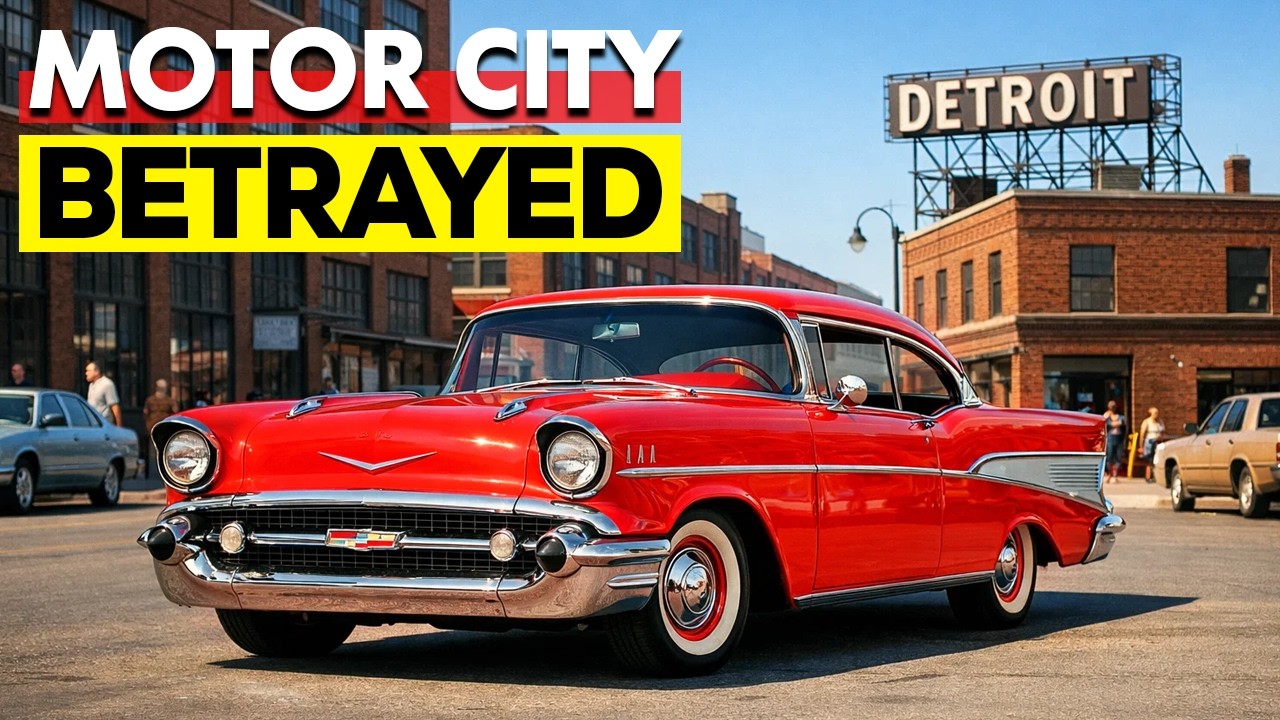
They were desire on four wheels. Fins, chrome, two-tone paint that gleamed like a promise. Every year brought something new, a new engine note, a new silhouette, a new reason to walk into a showroom and feel your pulse climb. When the 1957 Bel Air arrived, dealers had crowds lined up before the doors opened, kids pressing their faces to the glass, adults too.
It was part car, part religion, proof the future was something to run toward. Detroit had that pull for twenty straight years. The decline that followed was not fate. It was a series of choices, and the first wrong choice was made when everything still looked perfect.
The problem with being on top is that you start making decisions that only make sense if you assume you will always be there. By the late nineteen-sixties, engineering answered to accounting. The men who understood what a well-made car felt like, the weight of a door closing, the tightness of a seam, were being replaced by men who counted things, managed things, and optimized spreadsheets. Small imports were already on American roads.
Beetles, early Toyotas. Detroit shrugged. Novelties, they thought. Toys for people who could not afford a real car.
In 1965, Ralph Nader published Unsafe at Any Speed, targeting the Corvair’s handling. General Motors did not fix the car. Instead, they hired private investigators to follow Nader, to dig up dirt, to intimidate a private citizen for writing a book about safety. The largest corporation in the world was caught trying to crush a critic instead of fixing the product.
GM’s president was hauled before a Senate subcommittee and apologized on national television. That was the invisible deal. Protecting the institution mattered more than improving the car, and it would define everything that came after. Then, on October 17, 1973, OPEC announced an oil embargo.
Within weeks, gas prices quadrupled. Lines at stations stretched for miles. Americans sat in their enormous V8-powered cars and did the math. For the first time in a generation, the cost of driving was a real problem.
Families restructured budgets, and a quiet, grinding anxiety settled over the country like weather. And Toyota had exactly what America suddenly needed. Small, fuel-efficient cars that were not glamorous. Nobody pressed their face to the glass for a Corolla, but they started every morning.
They sipped fuel. They did not rust through in two winters. Here was the gut punch. That Japanese reliability was not cultural mystique.
It had been engineered by an American. W. Edwards Deming, an American statistician, had taught Japanese manufacturers continuous improvement, kaizen. Every worker was empowered to stop the line if they spotted a defect.
Deming had offered these ideas to Detroit first. They were not interested. Empowering line workers in Detroit’s top-down culture was heresy. So the most important manufacturing insight of the century walked out the door and across the Pacific.
Then Ford rushed the Pinto to market. The fuel tank sat where it could rupture in a rear collision. Ford knew. An internal memo weighed the cost of a recall against the cost of paying out lawsuits.
The accounting was more important than the engineering. That memo became the symbol of everything rotten, what happens when the people counting the cars completely replace the people building them. Toyota and Honda did not invade. They offered what Detroit refused to offer, reliability.
American buyers, rational, doing the math, walked into those showrooms. Detroit handed them the keys. The cars Detroit built through the late seventies and eighties had a reputation. Rust after two winters.
Electrical gremlins nobody could trace. Fit and finish that, next to a Civic, felt like it had been slapped together on a Friday afternoon. Every bad car that rolled off the line sent another buyer to a Toyota dealer, and that buyer never came back. Take Flint, Michigan.
In 1970, GM employed nearly eighty thousand people there. By the late eighties, that number had been halved, then halved again. Entire streets emptied. Houses, churches, corner stores that had been open for forty years, all emptied.
Not because the neighborhood changed, but because the plant closed and there was nobody left to buy anything. The Packard plant, built in 1903, once the most sophisticated auto factory in the world, by the eighties had collapsing floors and trees growing through the roof. It was not demolished. It was just left, a cathedral of American industry quietly returning to the earth.
General Motors’ bankruptcy in 2009 is usually treated as the ending, but the story had been over for thirty years. The bankruptcy was just the paperwork. What Detroit lost was not customers. It was a promise.
And the bosses did not kill Detroit alone. American car companies paid workers health care and pensions. In Japan and Europe, the government did. That added over a thousand dollars to the cost of every American car before one bolt was tightened.
And unions pushed back on changes, not because they were greedy, but because every time they gave an inch, someone took a mile. Other companies had the same problems and figured it out. Detroit’s problems made the fall harder. Detroit’s choices made it certain.
That man in Flint, the cardboard box in his hands, is the story. Not the charts, not the spreadsheets. The men who made those decisions, who never met the people their choices displaced, moved on to other industries and made the same mistake. Airlines shrinking your seat.
Tech companies selling you stuff that barely works. Hospitals run by Wall Street. Different industry, same mistake. The spreadsheet became the product.
The actual product became an afterthought. And it is not old history. It is happening right now, to someone, somewhere, a man walking out of a gate with a cardboard box, because someone he has never met decided he cost too much.
