The letter from Johannesburg arrived at Harrow in the summer of 1891, postmarked from the other side of the world. He had written to his father nine times before this, nine letters over more than three years of school, and this was the first answer he had ever received. The boy was fifteen. Lord Randolph Churchill, former Chancellor of the Exchequer and leader of the House of Commons, had found time to write to his son exactly once, and he had written from South Africa.
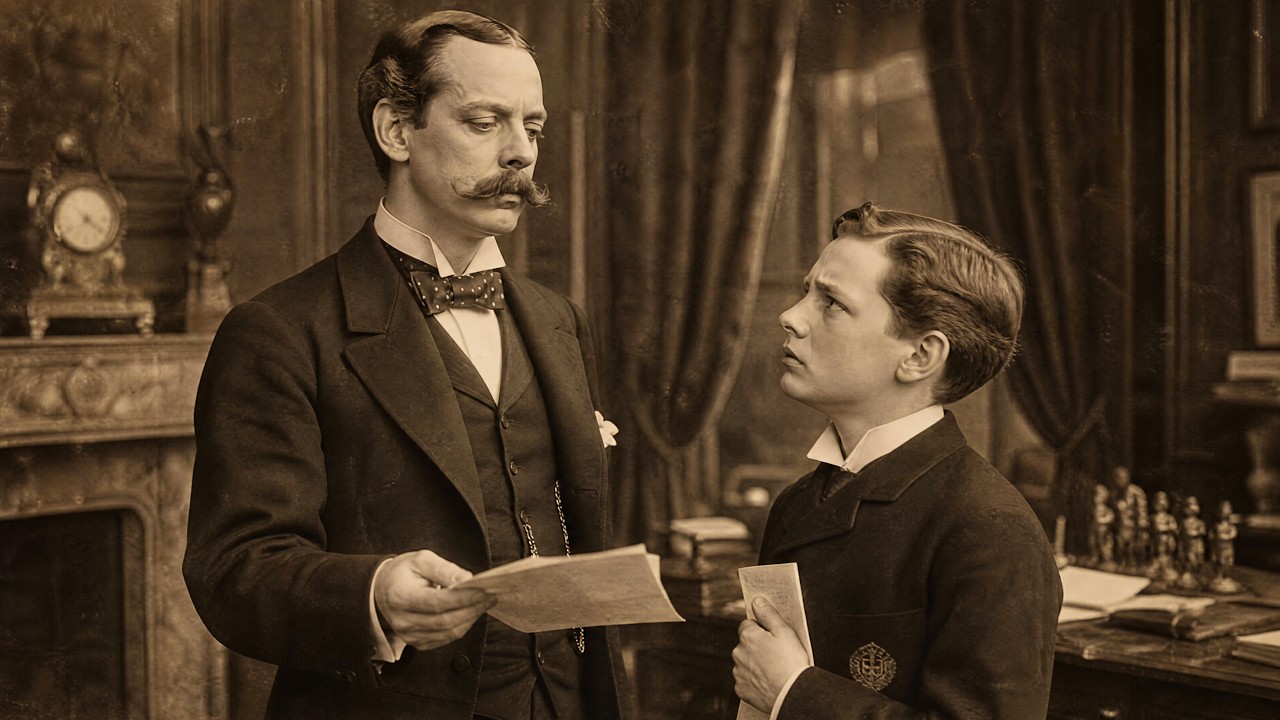
The son, Winston, had spent those three years learning what his father thought of him. It had been made plain long before the letter came. When he was thirteen, his father had walked into the nursery at home, looked at the toy soldiers spread across the floor, and asked if he would like to go into the army. Winston said yes at once.
For years afterward he believed his father had seen in those twenty minutes of inspection some promise of military genius. He was told later the truth: his father had concluded simply that the boy was not clever enough for the bar. The toy soldiers, as he would write, turned the current of his life. That was the father he had.
And the mother was the mother she was—a celebrated beauty, an American among the English aristocracy, a woman who shone for him like the evening star. He loved her dearly, but at a distance. It was the way he would come to love both of his parents. He had been born in the wrong house, at the wrong time, attended by the wrong doctor.
In the last week of November 1874, his mother, Jennie, twenty years old and married barely seven months, had gone walking with the shooting party at Blenheim Palace and fallen. A rather imprudent drive followed. On the Saturday night, labor began. The couple had not meant to be at Blenheim for the birth at all; they were staying only while their own house in Mayfair was being made ready.
A country doctor did the work. The London physician the family had engaged arrived after it was all over. The baby was born at one in the morning on Monday, the 30th of November, after about eight hours of labor. They named him Winston Leonard Spencer Churchill.
The family explanation was that he had come early—six weeks early in one account, two months in another. The historian Roy Jenkins added a quiet caution: there was no certainty that the baby was really premature at all. Some biographers went further and suggested the child had been carried to full term and the story of the fall and the drive was a way of covering a pregnancy that began before the wedding. Nobody knows.
The letters do not say. What is certain is the place he was born into and what it did and did not promise him. Blenheim Palace was the seat of the Dukes of Marlborough, and a duke stands at the very top of the British peerage. His grandfather was the seventh Duke.
His father was not. Lord Randolph was a younger son, a lord by courtesy only, and the courtesy did not pass down to his son. The palace, the land, and the title would all pass to his elder brother. The child born in the little room off the great hall—a room that happened to be in use for coats—was born in a palace that would never be his.
The people who shaped his childhood were his two young parents and the one woman they hired to look after him. His father was twenty-five, a young man in a hurry, almost in a constant frenzy of impatience. His mother was twenty, the daughter of a New York financier. They had married in Paris in April 1874, in a hurry and in debt, and in the middle of a quarrel about money that very nearly stopped the wedding altogether.
The two families had argued over the marriage settlement for months. Jerome, the bride’s father, had twice been bankrupted, and the Duke was uneasy about him. Jerome, for his part, objected that under English law a wife’s property passed into the control of her husband. He wanted the money he settled on his daughter kept in her hands.
They settled on a sum yielding about £2,000 a year, split evenly between them. Roy Jenkins put the whole into modern terms: the young couple had the equivalent of a present-day income of a little more than £15,000 a year, a sum which guaranteed that they would live constantly above their income and be always in debt. They were glittering and expensive. Even the great family they had married into was feeling the pinch; the Marlboroughs, by the time the boy was born, had been reduced to selling the family silver.
The young Churchills moved in the Marlborough House set, the circle around the Prince of Wales. Their affairs, social and intimate, occupied them constantly. Jennie’s name became the subject of gossip that followed her for the rest of her life—biographers have named the Prince of Wales himself, Count Kinsky, Herbert von Bismarck, King Milan of Serbia. One writer concluded there is really very scant evidence for the royal affair.
The gossip was real. The proof for most of the names is not. Neither parent was raising the child. That was not unusual in their world; a boy of his class was handed to a nurse, then a governess, then at seven or eight to a boarding school.
But even by the standards of that world, the Churchill household was a distant one. The official biography judged the neglect remarkable, even judged by the standards of late Victorian and Edwardian days. Within two years of the boy’s birth, a scandal carried the whole family out of England. Randolph’s elder brother was caught up in the Aylesford affair, and Randolph, in the middle of it, threatened the Prince of Wales himself.
The Duke found a solution: in the last weeks of 1876 he accepted the post of Viceroy of Ireland and took his younger son with him as private secretary. It was a polite exile. The little boy went with them. He was two years old.
The one person in his world who would stay with him through Ireland and everything that came after was not his mother or his father. She was a nurse from Kent, and he could not yet say her name. The nearest he could get to “woman” was “Woom,” and Woom she became—or “Woomany” when he was feeling tender. Her name was Elizabeth Anne Everest.
She had never married; the “Mrs. ” was a courtesy title. She came to the Churchills in early 1875 when the baby was only weeks or months old, after twelve years looking after a clergyman’s daughter in Cumberland. She stayed with the family for the best part of the next two decades.
“My nurse was my confidante,” he wrote in his memoir, My Early Life, published in 1930. “Mrs. Everest it was who looked after me and tended all my wants. It was to her I poured out my many troubles both now and in my school days.
” It was Mrs. Everest who taught him to read, using a primer with the hopeful title Reading Without Tears. “It certainly did not justify its title in my case,” he wrote. His memories of Dublin are among the earliest things he ever set down—strange, vivid fragments.
He remembered being frightened of the Fenians because his nurse was nervous of them. One day out riding on his donkey, the party thought they saw a long dark procession coming toward them. In the alarm, the boy came off. “I was thrown off and had concussion of the brain,” he wrote.
“This was my first introduction to Irish politics. ” He remembered a kind man called Mr. Burke, who gave him a drum. Two years afterward, back in England, he was told that Mr.
Burke had been murdered by the Fenians in that same Phoenix Park. It happened in May 1882, a few months before the boy was sent away to school. He remembered the day a governess was announced; he described her arrival as the approach of a sinister figure. “I took to the woods,” he wrote.
“I hid in the extensive shrubberies—forests they seemed. ”
In Dublin, too, his brother was born—John Strange Spencer Churchill, always called Jack, on the 4th of February 1880. In time, the gossip that surrounded their mother reached even him. Whispers named another man as Jack’s father; different writers have named several candidates.
The historians Celia and John Lee, working through the family papers, rejected every one of those claims. The International Churchill Society says there is no substantiation for the story. His mother, above all, seemed to him to belong to another world. He remembered her in Ireland in a riding habit fitting like a skin and often beautifully spotted with mud.
He described her as a fairy princess, a radiant being possessed of limitless riches and power. Then he wrote the sentence every biographer since has quoted: “She shone for me like the evening star. I loved her dearly, but at a distance. ” The nurse was near.
The parents were the lights in the sky, beautiful and unreachable. In the autumn of 1882, when he was nearly eight, the gap grew wider. His parents decided the time had come for school. He was not asked.
“I was no more consulted about leaving home,” he wrote later, “than I had been about coming into the world. ” The school they had chosen stood near Ascot. It was one of the most expensive in the country and one of the most fashionable. One November day, his mother took him to the station in a handsome cab and pressed three half-crowns into his hand—seven shillings and sixpence.
He dropped them. They fell to the floor of the cab, and mother and son had to scramble about in the straw to find them again. He remembered exactly what he was leaving behind. “I had such wonderful toys,” he wrote—a real steam engine, a magic lantern, and a collection of soldiers already nearly a thousand strong.
Now it was to be all lessons. The date was the 3rd of November, 1882. He would be eight at the end of the month. In his book he never names the school; he calls it St.
James’s, a thin disguise. Its real name was St. George’s, founded only five years before by a young clergyman, the Reverend Herbert William Sneyd-Kynnersley. It modeled itself upon Eton and aimed at being preparatory for that public school above all others.
Seven or eight hours of lessons every day except half holidays, football or cricket in addition. His schooling began almost at once with an encounter he never forgot. On his first day, the form gave him a Latin word to learn: mensa, a table. The boy asked the obvious question.
“What does it mean, sir? ” “It means what it says,” came the answer. “Mensa, a table. ” The boy pressed on and came to one of the word’s odder forms.
“O table,” the master explained. “You would use that in addressing a table, in invoking a table. You would use it in speaking to a table. ” “But I never do,” the boy blurted out in what he called honest amazement.
The reply came with a chill: “If you are impertinent, you will be punished. And punished, let me tell you, very severely. ”
He was by his own description a troublesome boy. He was stubborn.
He would not learn what did not interest him. “Where my reason, imagination, or interest were not engaged, I would not or I could not learn. ” History was the one subject he loved. At St.
George’s, those qualities met something else. The whole purpose of a school like this was to take a small boy and make him fit for Eton. The headmaster was then in his thirties, the son of a Birmingham magistrate, renowned according to the auction house Sotheby’s for his severe floggings. He did not bend for anybody.
In September 1883, William Gladstone, the prime minister of Great Britain, wrote asking for a boy to be given an extra week’s holiday. The headmaster refused. “I cannot do otherwise,” he told the prime minister, “then decline to grant the indulgence for which you ask. ” If the prime minister could not move him, a small boy from Mayfair had no chance at all.
Churchill described what happened at the school in plain words. “Flogging with the birch in accordance with the Eton fashion was a great feature in its curriculum. ” Then he described the ritual. “Two or three times a month the whole school was marshaled in the library, and one or more delinquents were haled off to an adjoining apartment by the two head boys, and there flogged until they bled freely, while the rest sat quaking, listening to their screams.
” The boys who were not being beaten were made to listen. That was part of the lesson. “The punishments,” he wrote, “exceeded in severity anything that would be tolerated in any of the reformatories under the Home Office. ” The reformatories were where the state sent young offenders.
The sons of the rich, at one of the most expensive schools in England, were being beaten harder than they were. His account does not stand alone. Another boy had passed through the same school under the same headmaster a few years earlier—Roger Fry. In the biography Virginia Woolf published in 1940, drawn from his own recollections, the school appears again.
Fry described the man vividly: “a tall, thin, loose-limbed man with an aquiline nose and angular features and a pair of floating red Dundreary whiskers. He was decidedly vain, and a bigoted and ignorant high church Tory. ” Fry had been head boy, and as head boy he was made to take part in the floggings; it was his duty to hold the victim down. He remembered the furniture of the room.
“In the middle of the room was a large box draped in black cloth. ” His description of what followed is hard to read. “The swishing was given with the master’s full strength. And it took only two or three strokes for drops of blood to form everywhere.
It continued for 15 or 20 strokes when the wretched boy’s bottom was a mass of blood. ” Sometimes, he added, there were scenes of screaming, howling, and struggling. Fry drew his own conclusion: “I think this fact alone shows that he had an intense sadistic pleasure in these floggings. ” Even the day of rest was poisoned.
Sunday, Fry remembered, was spoiled for him by the anticipation of the next morning’s session. The school left him with a morbid horror of all violence between men. The young Winston was exactly the kind of boy who ended up in the room beside the library. His school reports survive, and they read like a charge sheet.
His first report in December 1882 placed him last in his class and called him a regular pickle. By the summer of 1883, his composition was very feeble, his writing terribly slow, his spelling about as bad as it well can be. He had been late nineteen times in a single month. History was his best subject, and it was nearly the only good news.
In a school that flogged its boys until they bled, a report like that was a warning of what was coming. By the spring of 1884 the verdict had hardened: “He is a constant trouble to everybody, and is always in some scrape or other. He cannot be trusted to behave himself anywhere. ”
Yet his letters home give almost no sign of any of it.
In his very first term, he wrote to his mother that he was very happy at school. What he wrote after that was not a description of the library. It was a question. In February 1884, a nine-year-old boy wrote: “I am wondering when you are coming to see me.
I hope you are coming to see me soon. You must send someone to see me. You must send someone. ” If his mother could not come herself, he would settle for anyone at all.
The biographer David Lough found a pattern that held through all his school years: Jennie wrote to him regularly. She seldom visited despite his entreaties. Someone did in the end come to see him, and it was the person who always came. The most often repeated account is that Mrs.
Everest saw the marks of the birch on the boy’s body and raised the alarm. Another version says it was the family doctor, Robson Roose, who examined him and found his body yellow and blue. Neither account rests on a surviving document. Churchill himself said only this: “I fell into a low state of health at St James’s school and finally after a serious illness my parents took me away.
”
He left at the end of the summer term of 1884. That autumn he arrived at a very different place, a small school kept by two sisters, the Misses Charlotte and Kate Thomson, at 29 and 30 Brunswick Road in Hove, beside Brighton. “There was an element of kindness and of sympathy there,” he wrote, “which I had found conspicuously lacking in my first experiences. ” At this school, he was allowed to learn things which interested him: French, history, lots of poetry by heart, and above all riding and swimming.
Brighton was not free of trouble—in December 1884, another boy stabbed him in the chest with a penknife during a drawing lesson. He survived it. He was still a difficult boy. But here he was, a difficult boy among people who were kind to him.
His parents’ visits did not become more frequent with the change of school. One of his letters that first winter carried a joke with an edge to it: “You must be happy without me. No screams from Jack or complaints. It must be heaven on earth.
” She did come down in February 1885. It was the kind of visit he would have to earn in the years ahead by being ill or in trouble. The letters of that autumn show the pattern plainly, and they are dated, so they can be set side by side. On the 29th of September 1885, he wrote: “When do you think Papa will come and see me?
” Three weeks later, on the 20th of October, he wrote to his father directly. Lord Randolph had been in Brighton and had not called. “I cannot think why you did not come to see me while you were in Brighton,” the boy wrote. “I was very disappointed, but I suppose you were too busy to come.
” In November, the plea came again: “I wonder when you are coming down to see me. ” And then a little later, a line that says more than all the rest together: “I am not very happy, but quite well. I want you to come and see me when the elections are over. ” He was ten years old.
There was a reason his father was always too busy. Lord Randolph Churchill was on his way to the top of British politics. He had built his name in Parliament by attacking everyone, including the leaders of his own Conservative Party. He took up a cause he called Tory democracy.
He was privately candid about what it meant: “To tell the truth, I don’t know myself what Tory democracy is, but I believe it to be principally opportunism. ” In 1885 he became Secretary of State for India. That same year he was elected for Paddington. The rise had only begun, and it left very little room in his life for a small boy in a school by the sea.
The boy found his own ways to be near his famous father. At school in Hove, according to the Sussex Express, he sold Lord Randolph’s autograph to the other boys. It was a clever trade and a sad one: the only thing of his father’s that he could offer his friends was a signature. In the spring of 1886, the boy in Hove very nearly died.
On the 17th of March he fell ill with pneumonia, and his temperature climbed. In the days before antibiotics, everything depended on getting through the crisis—the point at which the fever either broke or the patient died. The family doctor, Robson Roose, came to his bedside working alongside another doctor, Joseph Rutter. His temperature reached 104.
3°. Word went round. The prime minister, Lord Salisbury, asked after him. So did the Prince of Wales.
A boy who could not get his parents to Brighton now had the prime minister and the heir to the throne asking after his health. And this time his parents came. The father and mother who had declined so many earlier invitations to visit him at school rushed to his bedside. The boy wrote to his nurse as he recovered, and the letter is heartbreaking in its plainness: “I am feeling very weak.
I feel as if I could cry at everything. ” He came through in April. His father came down to Brighton and gave him a toy steam locomotive. Four years earlier, on his way to Ascot, the boy had listed the steam engine among the wonderful toys he was leaving behind.
Now at eleven, lying weak in a school bed by the sea, he had another one—and this time it came from his father’s own hand. It is one of the very few presents from Lord Randolph that the record preserves, and it took a fever of 104 to bring it. The rest of that year belonged to his father’s career, and it was the most extraordinary year of Lord Randolph’s life. In 1886 the Conservatives returned to power, and Lord Randolph was given two of the greatest offices in the land: Chancellor of the Exchequer, the minister in charge of the nation’s money, and Leader of the House of Commons, the man who ran the government’s business in Parliament.
He was thirty-seven years old. Before the year was out, he had thrown it all away. That December he picked a fight with the War Office over the size of the army’s budget. On the 20th of December 1886 he sent Lord Salisbury his resignation, making it plain that the prime minister must choose between his chancellor and the military spending.
It was meant as a threat. Salisbury called his bluff, accepted the resignation, and appointed George Goschen in his place. The resignation was made public on the 23rd of December. Lord Randolph never held office again.
His son, twelve years old and back at school in Hove, grew up in the shadow of that moment. Many years later he wrote that one could not grow up in his father’s house without understanding that there had been a great political disaster. His mother, meanwhile, was finding her elder son as difficult as ever. That same December, as her husband’s career fell apart, Jennie wrote to her sister: “I could not undertake to manage Winston without Everest.
I am afraid even she can’t do it. ” Jennie was thirty-two. Her son was twelve. In March 1888, a thirteen-year-old boy sat down to the Latin paper of the Harrow entrance examination and wrote his name at the top of the page.
That was, by his own account, very nearly the only thing he wrote. “I wrote my name at the top of the page. I wrote down the number of the question, one. After much reflection, I put a bracket around it thus.
Then nothing came. Incidentally, there arrived from nowhere in particular a blot and several smudges. I gazed for two whole hours at this sad spectacle. And then, merciful ushers collected my piece of foolscap with all the others and carried it up to the headmaster’s table.
” The headmaster of Harrow was J. E. C. Welldon, and to the boy’s lasting gratitude, he let him in.
“It was from these slender indications of scholarship that Mr Welldon drew the conclusion that I was worthy to pass into Harrow. It is very much to his credit. It showed that he was a man capable of looking beneath the surface of things. ”
He entered Harrow on the 17th of April 1888.
He was placed in the third or lowest division of the fourth or bottom form. He continued in this unpretentious situation for nearly a year. “I was in fact only two from the bottom of the whole school, and these two, I regret to say, disappeared almost immediately through illness or some other cause. ” The grandson of a duke, the son of a former Chancellor of the Exchequer, spent his first year at one of England’s great schools very nearly at the bottom of it.
There was one piece of luck in this. Because he was in the lowest form, he was taught English by a master named Robert Somerville, whose job it was to teach the stupidest boys the most disregarded thing—namely, to write mere English. Churchill never forgot him. Mr.
Somerville drilled into him the essential structure of the ordinary British sentence, which is a noble thing. The boy who could not construe Latin learned in the bottom form at Harrow how an English sentence is built. Half a century later, the whole world would hear the result. In his first term he won a prize open to the whole school for reciting to the headmaster 1,200 lines of Macaulay’s Lays of Ancient Rome without making a single mistake.
But his housemaster saw only the problems. In July 1888, Mr. Davidson wrote to Lady Randolph: “I do not think that he is in any way wilfully troublesome, but his forgetfulness, carelessness, unpunctuality, and irregularity in every way have really been so serious that I write to ask you when he is home to speak very gravely to him on the subject. He is a remarkable boy in many ways, and it would be a thousand pities if such good abilities were made useless by habitual negligence.
” Other masters saw the same boy: “He had always a brilliant brain, but he would only work when he chose to. ” The school’s records show him reported at various times for unpunctuality, slovenliness, cutting school, disobedience, and impertinence. Welldon himself once warned him that if certain articles appeared again, “it might become my painful duty to swish you. ” There is no record that the headmaster of Harrow ever carried out the threat.
After Ascot, it was a school where a threat could stay a threat. The boy had already offered his own defense in a letter to his mother that June: “I am not lazy and untidy, but careless and forgetful. ” At thirteen, he could already draw a fine distinction when he needed one. It was around this time that his father came to a decision about his future, and it came about through the toy soldiers.
By now the boy’s collection had grown enormous; he had ultimately nearly 1,500. The day came when his father himself paid a formal visit of inspection. Lord Randolph spent twenty minutes studying the scene, which his son wrote was really impressive. At the end, he asked if he would like to go into the army.
“I said yes at once, and immediately I was taken at my word. ” For years he thought his father, with his experience and flair, had discerned in him the qualities of military genius. “But I was told later that he had only come to the conclusion that I was not clever enough to go to the bar. The toy soldiers turned the current of my life.
”
He would keep asking for his parents’ attention. The letters are a small campaign. In June 1889, at fourteen: “Please come alone when you come, as I like to have you all to myself. ” And then: “Do do come down tomorrow.
I would be disappointed if you did not come. ” And then, as the hours ran out: “Please wire immediately you receive this. Don’t wait till 12 or 1. ” His mother pleaded illness and did not come.
That same month, the boy fell off a bicycle and suffered what was described as a slight concussion of the brain. A year later, in June 1890, she sent him his school report with a letter of her own. It survives among the family papers, and it shows a mother who was not indifferent but who expressed her care as disappointment. “Your report which I enclose is, as you will see, a very bad one.
Your work is an insult to your intelligence. It is that thoughtlessness of yours which is your greatest enemy. You work in such a fitful inharmonious way that you are bound to come out last… I had built up such hopes about you and felt so proud of you…
You know, dearest boy, that I will always help you all I can. ”
His father wrote far less, and when he wrote at all, he wrote coldly. The record is precise because the Churchill scholar Jeffrey Fletcher has counted the letters. During his Harrow years, the boy wrote to his father nine times before he received a single reply.
When the first reply finally came, it was dated the 27th of June 1891, and it came from Johannesburg. By then, his son had been at Harrow for more than three years. Lord Randolph visited Harrow, by Fletcher’s count, only once, in November 1891. None of the accounts describes a father who came often.
There was one visitor the boy could count on. Mrs. Everest came to Harrow, and according to the Churchill scholar James Muller, the boy kissed her in the high street. She was the one person in his life to whom he never had to write, asking when she was coming.
In July 1892, at his first attempt at the Sandhurst entrance examination, he placed 390th out of 693 candidates. In one paper alone, English history, he came 18th out of 415. He could shine in the subjects he loved. It was not enough.
He tried a second time and failed again. At the end of 1892 he left Harrow. That winter, on the 10th of January, 1893, on his aunt’s estate at Bournemouth, a boy of eighteen ran onto a rustic bridge with his brother and his cousin behind him. His aunt, Lady Wimborne, had lent the family her comfortable estate for the winter.
Across the grounds ran a deep cleft called a chine, and across the chine ran a rustic bridge nearly 50 yards long. His younger brother, aged twelve, and a cousin, aged fourteen, proposed to chase him. With the chase closing in on the bridge, he jumped for a fir tree. “The measured fall was 29 feet onto hard ground,” he wrote.
“It was 3 days before I regained consciousness and more than 3 months before I crawled from my bed. ” He had ruptured a kidney. Much later, it emerged that he had broken his thigh as well—an injury, according to one account, not discovered until 1963. When he recovered, he was sent to a crammer in the Cromwell Road in London, run by a Captain Walter James.
“It was said,” Churchill wrote, “that no one who was not a congenital idiot could avoid passing thence into the army. ” Captain James was not dazzled. On the 7th of March, 1893, he wrote to Lord Randolph: “I think the boy means well, but he is distinctly inclined to be inattentive and to think too much of his own abilities. ” It was the same complaint his teachers had made since he was eight.
In these same years, the household was quietly dismantling the one part of his childhood that had never failed him. As the boys outgrew the nursery, Woom was moved on. She was found a place as housekeeper to his grandmother. Then she was dismissed again, and this time she was dismissed by letter.
The accounts of when exactly it happened differ, but the way it happened is not in doubt. After some seventeen or eighteen years with the family, she was out of service. The boy was furious. He wrote to his mother protesting that his nurse was being cast adrift, and he called it cruel and rather mean.
He helped to support her from his own money. She had never stopped writing to him. A letter from November 1891 survives in the Churchill archive: “Will you kindly favor me with a few lines? Out of sight, out of mind with Winnie.
” She had never stopped trying to look after him either. When he was a teenager, she intercepted one of his letters to his mother asking for money and added a note of her own: “I do not think it wise to give him money to throw away. ”
The crammer did its work in the end. On the 28th of June 1893, he qualified in 95th place out of 389 candidates.
When he entered the college that September, he was 18 years and 10 months old and 5 foot 6 inches tall. It had taken him three attempts. For a boy whose father had decided he was not clever enough for the bar, it was a steady climb. His father did not see it that way.
He had passed at the third attempt, but he had not passed well enough for the infantry, which was what his father had wanted. He passed only for the cavalry, which demanded lower marks and cost a good deal more money. He was delighted anyway, and he wrote to his father to say so. His father’s answer arrived in August.
It is the most famous letter Lord Randolph Churchill ever wrote to his son. It was dated the 9th of August, 1893, and the boy it was written to could still recite parts of it thirty-seven years later. It began with contempt for the boy’s pleasure. “I am rather surprised at your tone of exaltation over your inclusion in the Sandhurst list.
There are two ways of winning in an examination, one creditable, the other the reverse. You have unfortunately chosen the latter method. ” The first extremely discreditable feature of your performance was missing the infantry. His son had come up, he said, among the second-rate and third-rate class, who are only good for commissions in a cavalry regiment—and the cavalry was expensive.
By accomplishing the prodigious effort of getting into the cavalry, Lord Randolph wrote, “you imposed on me an extra charge of some £200 a year. ” He dismissed the boy’s whole school career; it had shown “a slovenly, happy-go-lucky, harum-scarum style of work. ” Then came the sentence that the boy carried for the rest of his life. If he went on as he had, his father warned, “you will become a mere social wastrel, one of the hundreds of the public school failures, and you will degenerate into a shabby, unhappy, and futile existence.
If that is so, you will have to bear all the blame for such misfortunes yourself. ” It was signed, “Your affectionate father, Randolph S. C. ”
The boy’s reply was humble.
“I am very sorry indeed that you are displeased with me,” he wrote, and he promised to try to modify his father’s opinion of him by his work and conduct at Sandhurst. Many years later he described his feelings more simply: “I was pained and startled by this communication. ” Within weeks he was writing to his father again, trying to find a way to please him and finding none. “If, on the other hand, I write a plain and excessively simple letter, it is put down as slovenly.
”
The father who wrote that letter was a sick man, and he was getting sicker. In February 1893, members were horrified by his white and prematurely aged face. His speech grew slurred. His last speech in the Commons in June 1894 was, in one account, a painful failure.
His old friend Lord Rosebery called it “a waking nightmare. ” Rosebery later wrote the epitaph that has stayed with Lord Randolph ever since: “He died by inches in public. ” In the spring of 1894, his son wrote, “It became clear to all of us that my father was gravely ill. ” That June, Lord Randolph set off on a journey around the world with Jennie and a doctor.
In December 1894, the boy passed out of Sandhurst 20th in a class of 130. He had done well at last. His father was brought home to London that same month, and he was no longer in a condition to be proud of anyone. Lord Randolph Churchill died on the 24th of January, 1895, at his mother’s house at 50 Grosvenor Square.
He was forty-five years old. The death certificate gave the cause as bronchial pneumonia from paralysis of the brain. The Lancet called it typical of general paralysis. What lay behind that diagnosis has been argued over ever since.
Most of his biographers and the doctors who treated him believed it to be the final stage of syphilis. Others have argued for a tumor deep on the left side of the brain, or multiple sclerosis. The one detail that comes close to the family is this: in his seventies, according to the historian Andrew Ellis, Winston told a private secretary that his father had died of locomotor ataxia, which he called the child of syphilis. On the day of his father’s death, the boy was twenty.
The dream of his whole childhood had been to work beside his father in Parliament one day. He wrote about it thirty-five years later in some of the plainest sentences he ever sat down: “All my dreams of comradeship with him, of entering Parliament at his side and in his support, were ended. There remained for me only to pursue his aims and vindicate his memory. ” Crowds lined the streets as the coffin passed through London.
There was a memorial service at Westminster Abbey, and then the body was carried to the little churchyard of St. Martin’s at Bladon, within sight of Blenheim Palace, and buried there. The son had lost a father who had given him three or four real conversations. He did not yet know that before the summer was out there would be another grave, and that this one would cost him more.
The telegram reached his barracks at Aldershot at the beginning of July 1895, and it said that Mrs. Everest was critical. He had been a soldier for only a few months. On the 20th of February, twenty-seven days after his father’s death, he had been commissioned into the 4th Queen’s Own Hussars, a cavalry regiment, on pay of £120 a year.
The cavalry that had cost his father an extra £200 a year, and that his father had called fit only for the second rate, now paid his son £120. The young officer left Aldershot and went to her. She was lying ill at a house at 15 Crouch Hill in North London. According to one account of that night, she was more worried about him than about herself.
He had come through the rain, and his coat was wet, and she would not be comforted until he had dried it. He held her hand. She died at a quarter past two in the morning on the 3rd of July, 1895. The cause was peritonitis.
She was, by the reckoning on her gravestone, sixty-two years old. He wrote about her death in My Early Life, and his words are among the gentlest in the book. “Death came very easily to her. She had lived such an innocent and loving life of service to others.
” Then he wrote the sentence that settled once and for all the question of who had raised him: “She had been my dearest and most intimate friend during the whole of the twenty years I had lived. ” Not his mother, not his father—his nurse. Four days after her death, on the 7th of July, he wrote a letter that is now in the Churchill archive: “I feel very low, and find that I never realized how much poor old Woom was to me. ” He telegraphed her old employer, the venerable Reverend Thompson Phillips, whose daughter she had nursed for twelve years before the Churchills ever hired her, and the two men attended her funeral together.
The clergyman whose daughter she had raised stood beside the young man she had raised. She was buried in the City of London Cemetery at Manor Park. The grave is marked by a white cross, and the stone carries an inscription he and his brother paid for: “Erected to the memory of Elizabeth Anne Everest, who died 3rd July 1895, aged 62 years, by Winston Spencer Churchill and John Spencer Churchill. ” The parents who employed her for almost two decades do not appear on it.
Between the death of his father in January and the death of his nurse in July, about five months had passed. She had come into his life when he was a few weeks or months old. She left it when he was twenty. There was no year of his childhood that she had not been part of.
He did not forget her. According to his son Randolph, he paid a florist every year to look after the grave. The International Churchill Society and the family look after it still. A small photograph of her in a red frame stood near his desk at Chartwell—one account says the picture was in his bedroom instead.
Either way, it stayed with him. She found her way into his writing, too. In his novel Savrola, written a few years after her death, the hero has an old nurse named Betine. “She had nursed him from his birth up with a devotion and care which knew no break.
” And then a line that reads like a private confession tucked into a public book: “It is a strange thing, the love of these women. Perhaps it is the only disinterested affection in the world. ” Disinterested—love that asked for nothing in return. In the whole of his childhood, only one person had offered it.
In the summer of 1895, the two halves of his childhood were gone. The father he had spent twenty years trying to please was dead, and so was the woman who had loved him without being asked. But there was one thing his father had left him, and he set to work on it. He learned his father’s speeches by heart, many of them.
In his first speech to the House of Commons in 1901, he spoke of “a certain splendid memory which many honorable members still preserve. ” It was a son’s first move in a long campaign. The historian Paul Addison writes that the young man exploited his father’s political contacts and that he spoke of having come to pick up the tattered flag. He learned his father’s words.
He wrote his father’s life. He wore his father’s robe. The life came first. In January 1906, at thirty-one, he published a two-volume biography, Lord Randolph Churchill.
It was a son’s defense of a father. Of the illness that killed Lord Randolph, the book spoke only of strain, of vexations and disappointments, and it described the end in a single delicate sentence: “The numbing fingers of paralysis laid that weary brain to rest. ” Not everyone admired it. Theodore Roosevelt dismissed it as “a clever, forceful, rather cheap, and vulgar life.
” The historian J. H. Plumb later charged that the son had deliberately doctored the evidence. Whatever its faults, it did what the son intended: it set his father’s name back in front of the public, and it put his own name beside it.
The robe came nearly twenty years after that. In 1924, Stanley Baldwin offered him the office his father had held for those few months in 1886. He was to be Chancellor of the Exchequer. His reply to Baldwin has survived: “This fulfills my ambition.
I still have my father’s robe as Chancellor. I shall be proud to serve you in this splendid office. ” He had kept the robe for almost forty years. The ages tell their own story.
The father had reached the Treasury at thirty-seven and lost it within the year. The son reached it at forty-nine. In 1893, Lord Randolph had told his son that he would degenerate into a shabby, unhappy, and futile existence. Thirty-one years later, the son held his father’s office in his father’s robe.
He had not answered the letter in words. He had answered it with a career. The money his father left was another matter. Winston’s own account was that his father’s debts almost exactly equaled his assets.
The historian David Lough, working through the ledgers of the Rothschild Bank, found something different. Lord Randolph’s gross personal estate came to £75,977. Three weeks before he died, the Rothschild ledgers show he owed only £12,758. Years earlier he had bought 5,000 shares in Rand mines at five shillings each with borrowed money.
At his death he still held 2,300 of them, each worth more than a hundred times what he had paid for it. They were sold in March 1895 for £26,000 and £38,675. The trust that remained held a little over £50,000, its income left to Jennie for life. His will made no immediate provision for his children.
Yet in these years, mother and son finally found each other. With Lord Randolph gone, Jennie became her son’s most tireless ally. She pulled every string she had to launch his career. He said as much himself: “She left no wire unpulled, no stone unturned, no cutlet uncooked.
” They worked together, in his words, on equal terms—more like brother and sister than mother and son. He called her his ardent ally. She told him she was “a great believer in your star. ” Her own life after Lord Randolph’s death was restless.
On the 28th of July 1900, she married George Cornwallis-West, a man just sixteen days older than her son. They divorced in 1914. In June 1918 she married again, to Montagu Porch. Three years later, in June 1921, after a fall and the amputation of her leg, she died at the age of sixty-seven.
She was buried at Bladon. The woman who shone like the evening star had come down to earth now that her son was a grown man with a career worth pushing. Where she had seldom come to his schools, she now worked for him. His father could never come down to earth.
He was buried at Bladon. And yet, in a sense, the son never stopped talking to him. He wore his robe. He quoted his speeches.
He wrote his life. One foggy afternoon in November 1947, an old man was painting in his studio at Chartwell, copying a torn portrait of his father. He was seventy-two years old. And as he worked, he wrote, he became aware that someone was sitting in the chair beside him.
It was his father. The portrait he was copying had been painted for one of the Belfast Conservative Clubs about the time of his father’s visit to Ulster in the home rule crisis of 1886. The canvas had been badly torn, and though he was very shy of painting human faces, he thought he would try to make a copy of it. More than fifty years after the funeral at Bladon, the son was still trying to repair his father’s face.
He wrote the scene down and called it “The Dream. ” It was not published in his lifetime. It appeared in the Sunday Telegraph on the 30th of January, 1966. It is a work of imagination, but what he chose to imagine tells a great deal.
The ghost’s first question was simple: “Tell me, what year is it?… Then I don’t remember anything after 94. I was very confused that year. ” The ghost remembered nothing after the year of his last illness.
Asked about himself, the son offered only that he had been a major in the Yeomanry, and the old contempt was there, exactly as the boy had known it: “I never brought you up to anything. I was not going to talk politics with a boy like you ever. Bottom of the school, never passed any examinations except into the cavalry. ” It is the voice of the letter of August 1893, more than half a century on, in spirit if not in words.
He had carried the sentence for fifty-four years, and he could still hear it. Then, as the son talked on, the ghost paid him the only compliment he could imagine his father paying: “When I hear you talk, I really wonder you didn’t go into politics. You might have done a lot to help. You might even have made a name for yourself.
” “He gave me a benignant smile,” the son wrote. “He then took the match to light his cigarette and struck it. There was a tiny flash. He vanished.
The chair was empty. Also, my cigar had gone out, and the ash had fallen among all the paints. ” The old man, at seventy-two, still imagined his father not knowing who he had become. The recognition he had waited for as a boy never came—not even in a dream.
He had tried as a father himself to break the pattern. The historian Josh Ireland, in his study of Winston and his son Randolph, records a night in the 1920s at one in the morning when the father turned to his boy and said: “You know, my dear boy, I think I have talked to you more in these holidays than my father talked to me in the whole of his life. ” A line has been attached to the two generations, though who first said it is not clear: “Few fathers have done less for their sons. Few sons have done more for their fathers.
”
What the childhood did to him inside has been argued over for decades. Anthony Storr, writing in 1969, traced the dark moods Churchill called his “black dog” to the neglect of his early years. That is a theory. Churchill himself used the phrase.
In 1911 he wrote to his wife about a doctor who might be “useful to me if my black dog returns. He seems quite away from me now. ” His daughter Mary Soames had no patience with the theory: “A lot has been made of depression in his character by psychiatrists who were never in the same room with him, but I never saw him disarmed by depression. ” The writer Ferdinand Mount put the other side of the argument in five words: Churchill, he wrote, “was emotionally starved into greatness.
”
Churchill himself had written something close to it as a young man in The River War: “Solitary trees, if they grow at all, grow strong. And a boy deprived of a father’s care often develops, if he escapes the perils of youth, an independence and vigor of thought which may restore in afterlife the heavy loss of early days. ”
What is certain is the date that haunted him. In January 1953, according to his private secretary, Jock Colville, who told the story thirty years later, Churchill remarked: “Today is the 24th of January.
It’s the day my father died. It’s the day I shall die, too. ” Colville never forgot it. “I can’t explain it.
It may be coincidence, but it is the oddest single experience I’ve ever had. ”
Winston Churchill died on the morning of Sunday, the 24th of January, 1965—seventy years to the day after his father. He died at his home at 28 Hyde Park Gate in London. The boy who had begged his parents to come and see him was ninety years old.
The birch at Ascot belonged to the school. The silence belonged to the family. He gave the school a few paragraphs of his memoir. He gave his father the rest of his life, trying to earn the notice of a man who never gave it.
Writing about an ancestor of his, he once offered a theory that might have been about himself: “It is said that famous men are usually the product of unhappy childhood. The stern compression of circumstances, the twinges of adversity, the spur of slights and taunts in early years, are needed to evoke that ruthless fixity of purpose and tenacious mother wit without which great actions are seldom accomplished. ”
He was buried in the little churchyard at Bladon, near his parents and his brother, within sight of the palace where he was born.
After a whole life spent trying to reach them, he lies beside the mother and father he had loved so dearly, and for so long, at a distance.
