In July 2022, a woman was buried beside the first fairway of a private golf club in Bedminster, New Jersey, on land owned by her former husband. The name carved on the headstone is Trump. She carried that name for 31 years after the marriage ended. The popular story says that her parents-in-law ultimately loved her, that Czech immigrant who charmed Queens.
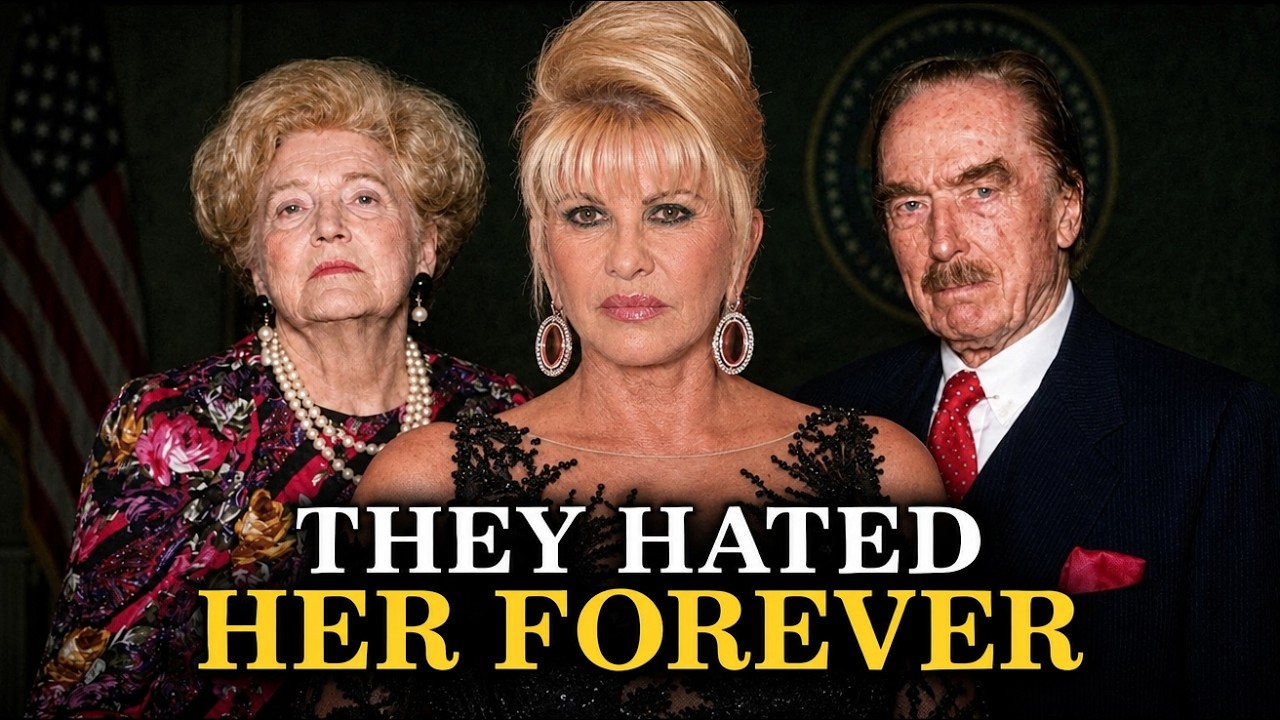
Days before the wedding in 1977, she signed an agreement drafted by Roy Cohn at Fred Trump’s insistence. The agreement was rewritten four more times. Fred’s own wife had arrived from Scotland as a servant. So what exactly were they protecting, and from whom?
Begin with the papers, because the papers are the core of the relationship. In March 1977, about six months after they met, Ivana Zelníčková sat down with Donald Trump to negotiate the terms of ending their marriage. She was 28. The wedding was a few weeks away.
Across the table sat Roy Cohn, the lawyer who had made his name as an adviser to Joseph McCarthy and by the mid-1970s served as the legal arm of the Trump family. Cohn drafted the agreement; Donald negotiated. One clause stipulated that gifts, jewelry, and furs—everything a husband gives his wife—had to be returned if the marriage ended. She fought that clause.
She later said the document made her cry and that she almost backed out. She signed. The agreement was renegotiated four more times over the next decade, not once. It was reassessed again and again through the birth of three children and the building of an empire.
Most marriages get a document at the start and then forget it exists. This marriage got a continuous review. Here is what makes the whole thing stranger than the gossip narrative. The man who insisted so strongly on that protection was not the groom.
According to the family’s documented biography by Gwenda Blair, Fred Trump—Donald’s father, the builder from Queens who controlled every dollar in the Trump Organization—was the one who pushed for a prenuptial agreement, making clear the family fortune would not be exposed to a bride nobody in Jamaica Estates had met two years earlier. And Fred Trump had married a woman who arrived in New York in 1930 with almost nothing. Mary Anne MacLeod came from Tong, a farming village on the Isle of Lewis in the Outer Hebrides, the tenth daughter of a fisherman. She reached America at eighteen and worked as a domestic servant, or governess according to the popular account, for a wealthy suburban family.
She met Fred Trump at a dance. They married in 1936. She became a citizen in 1942. She raised five children in a 23-room colonial brick home on Midland Parkway and developed, by every account including her sons’, a deep passion for appearances.
Mary Brenner, in a report for Vanity Fair, noted that of the two parents, Mary was the one who venerated luxury, followed royal processions, and loved the glitter of things. The easy explanation collapses immediately. They did not look down on Ivana for being a foreign girl who had married above her station. That was the family’s founding story.
The objection was about something else entirely, and it took years to become visible. Think about what Mary Anne MacLeod gave up to get the house on Midland Parkway. She had her husband’s name and no independent income. Fred ran the company.
Fred owned the properties. Fred decided the costs of things. He was known for legendary frugality. He picked up unused nails at construction sites.
He turned down the thermostat. He drove himself to collect the rents. His wife’s role was absolute and absolutely limited. She was the mother, the hostess, the charity volunteer.
She had no title, no salary, no interviews. That was the arrangement. Not prejudice—a rule. Ivana Zelníčková had no intention of accepting that arrangement, and she had already proved it once before anyone in New York knew her name.
She was born in Zlín, in what was then Czechoslovakia, in February 1949, the only daughter of an electrical engineer who put her on skis before she was old enough to object. She raced. She trained. She studied physical education in Prague.
The story she told for decades—that she was an alternate on the Czechoslovak team for the 1972 Winter Olympics—was never confirmed by Czech sports officials, who said no such record exists. The honest version is that it belonged to a category of claims she repeated and nobody could document. What is better documented is more interesting anyway. In 1971, she married an Austrian ski coach named Alfred Winklmayr.
The marriage gave her Austrian citizenship, which gave her a passport, which gave her the ability to leave a communist state without defecting and without leaving her parents stranded. They divorced in 1973. She was candid that the arrangement was practical. She described it, in later interviews, as a Cold War marriage.
Hold that thought for a moment. The woman Fred Trump wanted to protect the family money from had already used a wedding as an exit visa. She was in Montreal then, working as a model and speaking four languages, and in the summer of 1976 she came to New York with a group of models to promote a Canadian fashion event. They went to Maxwell’s Plum, the stained-glass restaurant on First Avenue that was the most sought-after place in Manhattan during the 1970s.
It was packed. A 30-year-old real estate developer got them a table. Her own account of that evening is not romantic. He sent her home in his car, then showed up at the hotel before she arrived, waiting for her.
She wrote: “I was 27, and I had been fending off the advances of countless men since I was 14. ” That is how The New Yorker summarized the passage in her memoir, noting that the gesture did not impress her. Still, she accepted his call the next day. They were engaged within months.
What each of them was getting is no mystery, and pretending otherwise flattens the story. Donald Trump in 1976 was a Queens real estate developer trying to become a Manhattan developer. He had the Commodore Hotel deal in the works, and a family name that meant, in city neighborhoods, leases and federal housing subsidies. What he lacked was polish.
Ivana had an accent that sounded European rather than suburban New York, looked stunning in photographs, understood fashion, and knew how to command a room. She was, in the literal commercial sense, an upgrade in public image. She was getting New York, a builder’s fortune behind a man, and permanent legal status in the United States. She was also, by everything that remains in the records, genuinely taken with him.
The energy, the speed, the sheer momentum of a man who talked about buildings that did not exist yet as if they were already fully leased. Both things were true. The romance was real. It was also mutually advantageous.
The Trump family met her, but Fred did not warm to her. Ivana’s memoir, published in 2017 and written by a woman who had given birth to three of Trump’s children and had every reason to be kind, still preserves traces of that discord. There was a family lunch ritual. The Trumps ordered steak.
She did not. Fred cut her off because of it. He objected to her clothes. On one occasion, she wore a dress with a high neckline, and he praised her modesty.
She turned around to show him the dress was backless, cut down to the base of her spine. She put that anecdote in her own book. She is the one who wanted you to know she turned around. This is not a woman recounting a misunderstanding with her father-in-law.
This is a woman documenting a small, deliberate act of defiance against a man who tried to impose his terms on her public appearance, then keeping that evidence for forty years. The steak and the dress seem trivial. They are not. They are the two things Fred Trump actually controlled in that house: what the family did together, and how the family looked to outsiders.
Ivana rejected both, on site. Then came the agreement, and the agreement told her what the family thought of her. Donald said over the years that his father simply insisted it was wise not to marry without one. Fine.
But look at the structure. The document did not merely protect the premarital assets of a 30-year-old developer who, at that moment, owned very little in his own name. It protected Trump assets, his father’s assets, by ensuring that nothing Donald acquired or built could leave the family through a wife. The prenuptial agreement was less a marriage contract than a fence around Fred’s estate, and Ivana was asked to sign her own exclusion before she wore the ring in public.
She negotiated. She lost the big points and won the small ones. She signed before the wedding date of April 7, 1977, at Marble Collegiate Church on Fifth Avenue. The minister was Norman Vincent Peale, author of The Power of Positive Thinking, which was closer to a declaration of the family’s religion than a choice of clergyman.
Fred Trump had attended Peale’s church for years, and the principle, simplified, was that acknowledging a problem is the first step toward making it happen. It was a society wedding, with about 600 guests, including Mayor Abraham Beame. The reception was held at the 21 Club. Her father, Miloš Zelníček, flew in from Czechoslovakia.
There is a photograph from that day. Fred and Mary Anne Trump stand on one side, Ivana’s parents on the other, the couple in the middle. Ivana herself chose to publish it four decades later, in a book about raising her children. Look at who holds the camera in that arrangement.
Four parents, two countries, and one contract signed the previous month that none of the guests knew about. The press covered it as a society wedding. In practice, it was closer to an announcement of a corporate merger. The son of a Queens builder acquired a European facade for a company about to try to take a piece of midtown Manhattan.
The bride acquired a family name about to become the most aggressively marketed word in American real estate. And here is the part that would take 13 years to explode. Neither side raised the only question that mattered: whether the woman who had already used one marriage as a tool intended to stay within the limits Mary Anne MacLeod had accepted in 1936. She did not.
The Commodore Hotel deal closed in 1978, and the building that resulted—the Grand Hyatt, with all its bronze and reflective glass on 42nd Street—carried her fingerprints in the interior design. She worked on the design. She attended the meetings. By the time it opened in 1980, she had taken charge of the building’s appearance.
And the building’s appearance was the essence of the entire pitch, the idea that a dreary place next to Grand Central could project wealth. It was the first crack in the arrangement, almost unnoticed at the time, including probably by the people in the room. Fred Trump had backed the deal. The financing flowed back to the Trump Organization through the Brooklyn and Queens rent rolls, and through a father who signed as guarantor and quietly supported his son for years.
Decades later, a New York Times investigation, published October 2, 2018, revealed that mechanism in detail: loans that were not real loans, ownership stakes transferred to the children, hundreds of millions moving from father to son over a lifetime. For our purposes, one thing matters from all of that: the money was Fred’s. It moved to Donald. It did not move to Donald’s wife.
She worked on the buildings. She owned no shares in them. Three children came in the midst of that. Donald Jr.
in December 1977, eight months after the wedding. Ivanka in October 1981. Eric in January 1984. Ivana returned to work immediately each time, which was not ordinary behavior in that family.
Her mother-in-law raised five children in a Jamaica Estates home and never worked during that time. Ivana had three children, a staff of nannies, and a construction schedule. The house itself told you who owned what. The Trumps lived in a three-story apartment in Trump Tower once it opened in 1983.
His building, his name on the canopy, his tenants. Weekends at the Greenwich estate on North Ridge Road, bought in 1982, which would matter enormously later. Mar-a-Lago in Palm Beach starting in 1985, 128 rooms that Ivana began restoring. She chose the fabrics.
She hired the staff. She oversaw the gold leaf. She owned none of it. Mary Anne MacLeod would have recognized this situation completely: a woman decorating a man’s properties and being praised for her taste.
But then Ivana did the one thing her mother-in-law never did. In 1985, Donald put her in charge of Trump Castle, the Atlantic City casino, and gave her a title: president. She ran it herself. She helicoptered in.
She walked the floor. She fired staff. She pushed the property’s numbers upward. For a time, the casino outperformed its neighbor.
Then in 1988, he bought the Plaza Hotel for $407 million and made her president of it. And then he said the line: “My wife, Ivana, is a great manager. I’m going to pay her one dollar a year and all the dresses she can buy. ” He said it publicly.
The line got repeated everywhere. He meant it as a compliment, as a bit of showmanship, the kind that gets laughs at a press conference. Contemporary reports treated it as part of his charm. Consider the actual content for a second.
The president of the Plaza, a woman running one of the most famous properties in American hospitality, with hundreds of employees, was being paid one dollar a year plus whatever clothing she was allowed to purchase. She had the title. She did not have the salary. Her access to money ran through a husband who had already bound her in writing to return the jewelry if it ended between them.
That is not an executive job. That is an allowance with a business card. Here is the thing that turned personal friction into an open wound. In 1988 and 1989, Ivana Trump stopped being a wife who appeared in photographs and became a figure the press covered on her own.
She made magazine covers. She gave solo interviews. She was described as the woman who actually ran things while her husband bought boats and airlines. She had the look—the hair, the clothes, the accent—that made her an instantly reproducible icon on the magazine racks.
She became famous at her own frequency. Mary Brenner’s article “After the Gold Rush,” published in Vanity Fair in September 1990, is the essential contemporary document of what that did inside the family. It is worth saying plainly that Brenner documented it at the time with informed sources and direct access, not decades later from memory. The portrait shows a marriage in which the wife’s fame had become the problem.
The Plaza staff, the separate operations, two people running two public shows under one family name. Donald’s own view of the matter is preserved in his words. In the March 1990 issue of Playboy—note the timing, exactly as the marriage was publicly collapsing—he said he had made a mistake in employing his wife, that it was bad for the marriage, that he preferred a woman who stayed at home. Four years later, on ABC’s PrimeTime Live, he still echoed those formulations.
If he came home and dinner was not ready, he would lose his temper completely. The man who had given her the title now described the title as the damage. Fred Trump, watching from Queens, had the evidence for what he had suspected since the lunch where she refused the steak. His daughter-in-law had a career, a salary, a media machine, three Trump heirs, and a signature on an agreement she had once tried to renegotiate.
The prenuptial agreement was rewritten in 1978, again in 1979, 1984, then in December 1987. Each time her value rose, the fence was moved. That December 1987 version would decide everything. Its disclosed terms estimated the value at about $20 million plus the Greenwich house in the event of divorce.
A huge sum by any ordinary standard, but a fraction of a percent of what her husband claimed to own. The records indicate she signed it at a moment when she was told it was mere routine. She had signed four agreements before. There was no obvious reason this one was different.
Then came Aspen. The Trumps went to Colorado for Christmas, as they always did. On December 20, 1989, at the mountain restaurant Bonnie’s at the base of Ruthie’s Run on Aspen Mountain, Ivana Trump met a young woman named Marla Maples. What was said exactly has been relayed in several versions: Ivana’s, Marla’s, and dozens of secondhand accounts from people on the terrace.
The versions do not match in wording. What is beyond dispute is that a public confrontation took place in front of skiers, and that reporters had the story within weeks. The affair was not news to everyone in that restaurant. That is the part that should leave its mark.
The relationship between Donald Trump and Marla Maples had been going on for nearly two years by then, within a social circle that intersected Ivana’s, meaning a great many people who had dined with her in New York knew about it. The marriage had become something her friends managed behind her back. February 1990: the New York Post ran the story on the front page, day after day for weeks. On February 16, the headline appeared that remains the most famous tabloid cover of that decade: “Best Sex I’ve Ever Had.
” The phrase was attributed to Marla Maples. A quotation whose true origin has been disputed for 35 years, never confirmed by Maples, who told a reporter: “It doesn’t matter whether she said it. ” The headline was at every newsstand in the city, next to the Plaza Hotel, where Ivana worked. Now watch what she did, because here she stops being the victim of the story and starts being the strategist.
She did not go on television to denounce him. She did not sell a press interview. She kept coming to the Plaza. She was photographed looking flawless, continuing her work through the worst media cycle of her life.
In April, she walked into a charity gala in an evening gown and received warm applause from a room full of New Yorkers who had read every word. She hired Michael Kennedy and began challenging the 1987 agreement. Her legal position was that the prenuptial agreement should be voided, that she had signed under circumstances and representations that did not hold up, and that the sums involved bore no relation to what had been built during 13 years of marriage, on which she had worked. She demanded a share of the empire.
The figures circulating at the time estimated her claim at $2. 5 billion. That was the moment the family’s 13-year-old insurance policy was tested, the moment it became clear whether Fred Trump’s judgment from 1977 had paid off. It had.
In November 1990, Judge Phyllis Gangel-Jacob upheld the agreement. Ivana’s challenge failed. The fence held. But something else was happening that fall, in Atlantic City and in a lawyer’s office in Queens, that makes the entire protective structure look very different in retrospect.
The empire the prenuptial agreement had been written to protect from Ivana Trump was, in the fall of 1990, days away from collapse. The man about to save it was not Donald. It was the 85-year-old builder who had insisted on the paperwork in the first place. On December 17, 1990, a lawyer named Howard Snyder walked into Trump Castle, the casino Ivana had run, and bought $3.
35 million in gambling chips with a certified check drawn on an account belonging to Fred C. Trump. He did not gamble. He walked out with the chips.
The next day, a second purchase brought the total to nearly $3. 5 million. The casino needed cash to meet an $18. 4 million bond payment.
The chip purchase was not classified as a loan under New Jersey regulations, which meant it did not require disclosure or approval the way loans did. The New Jersey Casino Control Commission looked into it, called it by its real name, and fined the Castle $30,000 in 1991. Compare the dates side by side. The divorce was granted on December 11, 1990, on grounds of cruel and inhuman treatment.
The financial settlement was still contested. Six days later, the father who had demanded the 1977 prenuptial agreement to keep the family fortune away from his daughter-in-law was effectively moving millions in cash into his son’s casino to keep the company going through the weekend. The fortune was never in real danger from Ivana. That is the reversal the whole story turns on, and it reframes 13 years of in-law tension.
Fred Trump’s money was being spent at that very moment to cover the losses of the son he had spent his life financing. The wife had cost him nothing at all. She had worked on the Hyatt, restored Mar-a-Lago, run two properties, and produced three heirs, for one dollar a year. Donald had bought the Plaza for $407 million and an airline nobody wanted, and by 1990 his personal guarantees ran into the hundreds of millions.
There is another document from that period that completes the picture. In late 1990, according to the New York Times investigation published in October 2018, Donald sent his father a codicil to Fred’s will, an amendment that would have given him control of his father’s estate. Fred Trump refused to sign it. Family members described him as furious about it.
Instead, he drew up new documents distributing control among his children. Read that sequence in order. The father spends $3. 5 million to save his son in December.
The same father refuses to hand that son the keys to the estate. The fence built in 1977 was not only pointed outward. It was pointed inward. Ivana was simply the only person in the arrangement who could be forced to sign something.
She settled in March 1991, for about $14 million in cash, the Greenwich house on North Ridge Road, about $650,000 a year in child support and alimony, a $4 million housing allowance, and one month per year at Mar-a-Lago. She also kept the name. That decision was treated for 30 years as a punchline. It was the smartest move she ever made, and it traces directly back to the woman who used a 1971 marriage certificate to get a passport out of Czechoslovakia.
She understood the value of legal instruments. In 1991, Ivana Trump was 42, a household name in every checkout line in America, and for the first time in her adult life, she owned money that legally belonged to her. Her next move was not to retreat. In 1992, she published For Love Alone, a novel about a European beauty who marries an American business tycoon, and she published it under her own name.
She followed it with another. She wrote a self-help book, The Best Is Yet to Come, about getting through divorce. She licensed the name “Ivana” to be placed on clothes, perfume, and jewelry, and sold the products herself on QVC on camera for years. She had spent 13 years building a brand she did not own.
She spent the next three decades building a brand she did own. There is a more difficult episode from that period, and it needs to be handled precisely, not melodramatically. In 1993, journalist Harry Hurt III published The Lost Tycoon, based partly on a sworn deposition Ivana gave during the divorce describing an incident in 1989. The word she used in that deposition was rape.
Before the book was published, as part of the confidentiality terms of the divorce settlement, she issued a statement printed at the front of the book, saying she did not want her words interpreted in a literal or criminal sense, that she felt violated, and that she did not want the characterization treated as a criminal accusation. Donald Trump denied the entire underlying story. The deposition exists. Her statement exists.
Both are part of the record, and the honest position is that she refused, publicly and permanently, to allow it to be treated as a criminal charge. She also refused, for the rest of her life, to attack him in the press. That restraint was not sentiment. She had three children bearing his name inside his companies, and a continuing financial relationship with the man.
Donald Jr. and Eric would run the Trump Organization. Ivanka would stand beside her father in the White House. Whatever the marriage had been, it produced the only Trump heirs who mattered, and Ivana—not Marla, not anyone later—was the mother of all of them.
Mary Anne MacLeod’s position had been protected by never leaving. Ivana’s position was protected by leaving the right way. Fred Trump died in June 1999. Mary Anne died in August 2000.
Ivana outlived both of them by more than two decades, which meant that the woman they had opposed in 1977 ended up the longest survivor of everyone in Marble Collegiate Church. Then she did the thing that closed the circle. Raising Trump was published in September 2017, eight months into her ex-husband’s presidency. Structurally, it is a document of loyalty.
It is also the book in which she chose to memorialize the lunch where Fred Trump ignored her over a steak, and the backless dress she turned around to reveal after he praised her modesty. She controlled which family stories survived. She published the ones that showed her standing tall and left the rest. She also went on a press tour, and on Good Morning America in October 2017, she said she had a direct line to the White House, that she did not call often because she did not want to cause jealousy, and that she considered herself Trump’s first wife.
“I am the first lady, okay? ” She added that she had been offered the ambassadorship to the Czech Republic but turned it down because she loved her life in New York, Miami, and Saint-Tropez. The response came the same day from the East Wing, through Stephanie Grisham, Melania Trump’s spokeswoman, who described the statements as noise designed to attract attention and serve herself. Forty years after her father-in-law objected to a woman who wanted a public voice, the administration was issuing press releases to contain her.
Ivana Trump died on July 14, 2022, at her home on East 64th Street after a fall. She was 73. Her children’s statements described her as an incredible woman. Her ex-husband wrote that she was a great, beautiful, and amazing woman who lived a great and inspiring life.
She was buried on July 20 at the Trump National Golf Club in Bedminster, New Jersey, on a plot near the first tee. A simple stone. A hedge fence. The club had held approvals since 2015 permitting a cemetery on the property, and under New Jersey law, land used as a cemetery is exempt from property, income, and inheritance taxes.
Journalists noticed the overlap immediately. The family never said the tax status was a factor. There is no evidence it was the reason. But the exemption is in the public records, and so is the fact that she is the only person buried there.
Go back to the papers. In March 1977, a 28-year-old woman sat across the table from Roy Cohn and signed a document designed to ensure she left the Trump family with nothing that belonged to them. Fred Trump insisted on it. The fence was redrawn in 1978, 1979, 1984, and 1987, each time to keep pace with what she was becoming, because what she was becoming was the problem.
Not her accent, not her village, not her title, not her salary, not her press clippings, not her signature on anything. They were protecting the property from the wife. She now lies inside the property. The woman paid one dollar a year to run the Plaza is buried on Trump land under the Trump name on a plot that may ease the family’s tax burden.
The final accounting entry in a marriage that was negotiated, repriced, litigated, and settled five separate times before anyone put a shovel in the ground. Fred Trump spent $3. 5 million in casino chips to keep his son solvent but refused to hand him the estate. Mary Anne MacLeod accepted a house in Jamaica Estates and never got a title of her own.
Ivana Zelníčková was told she could not own what the family owned, so she went out and built her own version, which she sold on television. Three children carry the name into the next generation, and all three are hers. Look at the headstone again.
It is the one thing in this entire story Donald Trump cannot renegotiate.
