On June 8th, 1962, at 2:47 in the afternoon, the corner of 125th Street and Lenox Avenue in Harlem was heavy with summer heat. The asphalt had gone soft enough to hold bootprints, and the air smelled of exhaust fumes mixed with fresh bread from the bakery. Marisol Johnson walked out of the grocery store carrying two bags. She was 51 years old and had been married to Bumpy Johnson for 23 years.
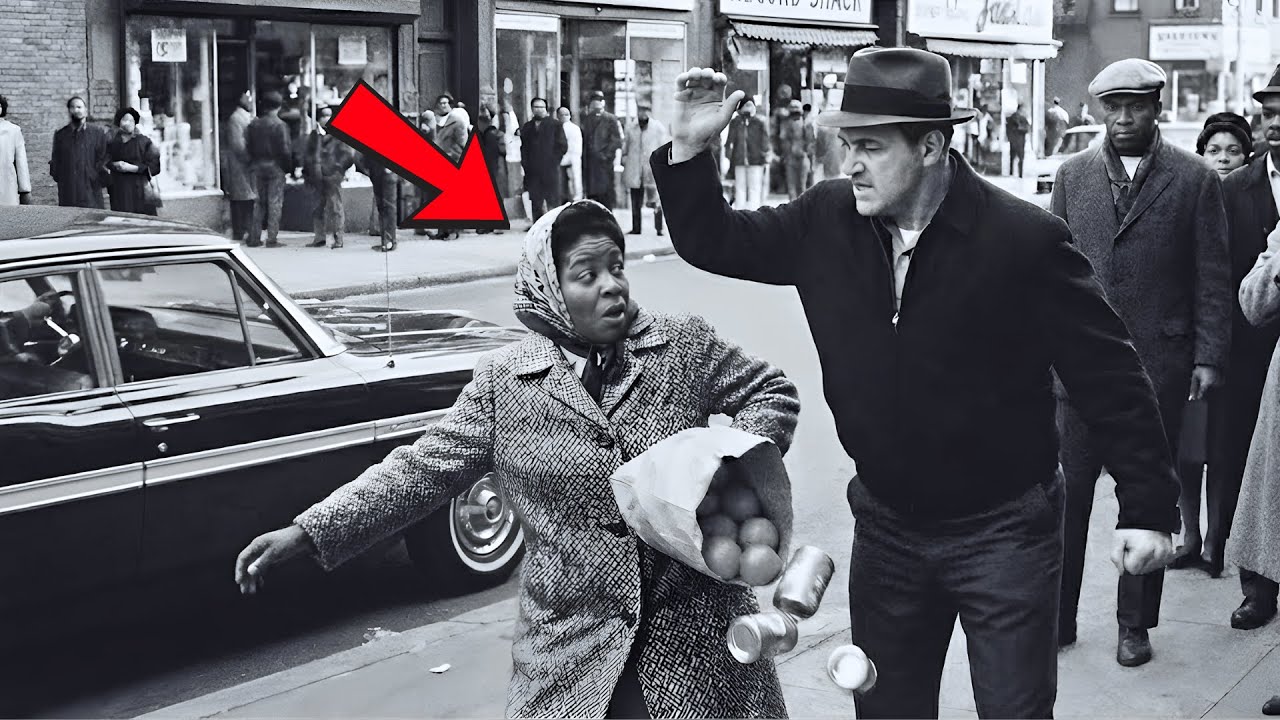
When Vincent Teranova stepped directly into her path and planted his feet like he owned the sidewalk, she stopped. He did not move. Behind him, two men in cheap suits stood with their hands near their belts, where pistols pressed against their ribs. Duke Ellington was playing on the radio inside the bar across the street.
The music cut off mid-note when someone inside saw what was happening and killed the power. Vincent looked at Marisol like she was dirt on his shoe. “You tell your husband that Harlem belongs to the Genevese family now. You tell him we are done asking permission like he is some kind of king.
You tell him if he wants to discuss it, we can meet in an alley and I will bring gasoline and matches. We will see how much respect he gets when his buildings are burning. ”
Marisol stared at him. She had watched men threaten her husband with guns and knives and bombs.
She had watched those men disappear, some into Rikers, some into the East River with their ankles wired to engine blocks. She was not afraid of Vincent Teranova. “I will tell him now. Get out of my way.
”
Vincent’s smile showed too many teeth. “You do not tell me what to do. Not here. Not anymore.
This is my street now. ”
Then he slapped her. Open palm across the left side of her face, hard enough that her head snapped sideways and her neck popped like cracking knuckles. One of the grocery bags fell.
Oranges rolled across the sidewalk into the gutter. A can of soup bounced twice and came to rest against the curb. The sound of the slap echoed down the block like a gunshot. Every person within thirty feet stopped moving.
The man sweeping the barbershop sidewalk froze. The woman at the bus stop turned with her purse clutched to her chest. Two kids playing stickball dropped their bat, and it clattered on the pavement. Harlem stopped breathing.
Not because of the violence. Harlem had seen men beaten with tire irons over twenty-dollar debts, seen throats opened with straight razors in card games, seen buildings torched with families still inside. Violence was not new. But this was different.
This was a violation of the one rule that kept this world from becoming a slaughterhouse. Marisol Johnson was not just Bumpy’s wife. She was the daughter of Stephanie Sinclair, the woman who had run Harlem’s numbers racket in the thirties when Dutch Schultz tried to muscle her out. Stephanie had responded by taking a full-page ad in the Amsterdam News listing every corrupt cop in the city by name, badge number, and weekly bribe amount.
She had survived three assassination attempts. One would-be killer ended up floating in the Hudson with his face beaten unrecognizable. Another lost both hands in what newspapers called an industrial accident. The third left New York and never came back.
Touching Marisol was not just an insult. It was declaring you did not care about rules, history, or consequences. Vincent Teranova was 29 years old and had been collecting debts for the Genevese family for four years. When people did not pay on time, Vincent broke their fingers with a ball-peen hammer on the knuckles, starting with the pinky and working toward the thumb, while two men held the debtor’s arm flat against a table.
He burned cars and torched storefronts. He put a man in the hospital for three weeks because the man looked at Vincent’s girlfriend wrong in a bar. Vincent walked into that hospital room two days later, while the man’s jaw was still wired shut, and broke it again. He thought public violence created fear.
That if people saw you hurt someone and walk away laughing, they would remember and step aside. He thought Harlem was like Little Italy, that you claimed territory by cracking skulls and burning buildings until everyone understood who ran things. He was wrong. Harlem did not respect men who were loud.
Harlem respected men who were quiet and final. Men who did not make threats, because threats were noise. Men who made problems disappear so completely that six months later, people wondered if the problem ever existed. Vincent bent down and picked up one of the oranges.
He looked at it, tossed it up, and caught it. Then he threw it hard against the brick wall behind Marisol. It exploded into pulp. Seeds stuck to the wall like shrapnel.
“That is what happens to things that get in my way. You tell your husband I will be back next Friday. Same time, same corner. He better have an answer I want to hear.
Otherwise, we start burning buildings. His buildings first, then his friends’ buildings, then the ones where people live who think he can protect them. You understand me? ”
Marisol said nothing.
She just looked at him with a stare that showed no fear, no anger, only calculation. Vincent stepped closer. “I asked you a question. Do you understand me?
”
“I understand you just made the worst mistake of your life. ”
Vincent laughed. “Is that a threat? You threatening me?
”
“No, I am telling you a fact. My husband does not make threats. He does not need to. ”
Vincent’s smile disappeared.
His hand moved toward his belt. One of the men behind him said, “Vinnie, we should go. People are watching. ”
Vincent looked around.
Windows were open. People stood in doorways. The barber had come outside with scissors still in his hand. Everyone was watching, waiting.
Vincent turned back to Marisol. “Tell your husband what I said. Tell him I am not afraid of him. Tell him this neighborhood is changing, and he can either get with the program or get buried under it.
”
He turned and walked away. His two men followed. Their shoes clicked on the pavement in rhythm. When they turned the corner and disappeared, Harlem started breathing again.
The kid playing stickball ran over and picked up the oranges. Another grabbed the soup can. They handed Marisol the bag without looking at her face. “You okay, Miss Johnson?
”
“I am fine, thank you. You want me to get Mr. Gordon? ”
“No, I will call him myself.
”
She walked three blocks to her apartment, climbed the stairs, unlocked the door, put the groceries away, and washed her face in the bathroom sink. The left side was already turning purple where Vincent had hit her. By tomorrow, the bruise would be the size of her palm, dark enough that makeup would not cover it. She looked at herself in the mirror.
Her mother had taught her that showing weakness was how you got killed. So she did not cry, did not touch the bruise, just looked at it like a problem that needed solving. She walked to the kitchen and picked up the phone. She dialed Smalls Paradise.
Julius Gordon answered on the second ring. “Smalls Paradise. ”
“This is Marisol. Put Bumpy on the phone now.
”
“Is everything okay? ”
“Does it sound okay? Put him on the damn phone. ”
She heard Julius cover the receiver and say something.
Then Bumpy’s voice came through. Calm. Flat. “What happened?
”
“Vincent Teranova stopped me on 125th and Lenox. He told me Harlem belongs to the Genevese family now. He said if you do not like it, he will burn your buildings. He said he is coming back next Friday and you better have an answer he likes.
Then he slapped me across the face in front of thirty witnesses. ”
Silence for six seconds. Then Bumpy said, “Are you hurt? ”
“My face will bruise, but I am not bleeding.
”
“Where are you? ”
“Home. ”
“Stay there. Lock the door.
Do not open it unless you hear my voice or Julius’s voice. I am sending Marcus to watch the building. He will be there in fifteen minutes. Do not worry about this.
I will handle it. ”
“Bumpy. He is young and stupid. He does not understand what he just did.
”
“I know. That is his problem. Stay inside. I will call you tonight.
”
He hung up. Marisol set the phone down and sat at the kitchen table. Outside, the city was moving again. Car horns, voices, a radio playing down the block.
Harlem had returned to its rhythm. But everyone who witnessed what happened on 125th Street understood that the rhythm was about to break. Vincent Teranova had crossed a line that men who valued their lives knew never to cross. He had put his hand on Bumpy Johnson’s wife in public.
Now Bumpy would teach him why those rules existed. Not with guns. Not with fire. Not with the kind of violence that brought police and reporters.
Quietly. Completely. Permanently. And when it was over, Vincent would understand that some men do not need to hurt you to destroy you.
They just need to show you how easily they could have. Eleven minutes after Vincent Teranova slapped Marisol Johnson on 125th Street, Julius Gordon walked into Bumpy’s office above Smalls Paradise without knocking. Julius had worked for Bumpy for sixteen years, and in all that time, he had never once entered that office without knocking first. But some rules existed only until the moment they stopped mattering.
Bumpy was sitting at his desk reading the afternoon edition of the Amsterdam News, with a glass of wine from 1934 sitting untouched beside him. The wine had been poured twenty minutes earlier and was still perfect in the crystal glass. Sunlight came through the window at an angle that cut the room in half. Duke Ellington was playing on the record player in the corner.
Julius closed the door behind him. His face was tight. His jaw was set. Bumpy looked up from the newspaper and knew immediately that something had happened that required a response.
“What is it? ”
“Marisol. On 125th and Lenox. Vincent Teranova from the Genevese crew stopped her coming out of the grocery store.
He told her Harlem belongs to them now. Then he slapped her in front of witnesses. ”
Bumpy set the newspaper down, folded it carefully, and placed it on the desk with the edges lined up perfectly. His hands did not shake.
His face did not change. But Julius saw the way his jaw muscles tightened and the way his fingers pressed down on the newspaper hard enough to leave creases. “Is she hurt? ”
“Her face will bruise, but she is not bleeding.
She is home now. She called from there. ”
“Did anyone step in? ”
“No.
Vincent had two men with him. Everyone saw it, but nobody moved. What were they going to do? Start a gunfight in the middle of the afternoon?
”
Bumpy stood up and walked to the window. He looked down at Seventh Avenue, where people were walking home from work and kids were playing and the city was moving like nothing had happened. But something had happened. A line had been crossed.
Not just any line. The line that separated business from violation. The line that kept this whole structure from collapsing into chaos. Julius stood near the door, waiting for instructions, waiting to be told who to hurt and how badly.
Instead, Bumpy turned from the window. “Call Marcus. Tell him to go to my apartment and watch the building. Nobody goes in or out unless we know them.
Then call the building super and tell him to lock all the doors and secure all the windows facing the fire escape. ”
“What about Vincent? ”
“What about him? ”
“Do you want me to find him?
Bring him here, put him in a car, and drive him somewhere we can discuss respect. ”
Bumpy walked back to his desk and sat down. He picked up the glass of wine and took one sip. Set it back down.
“No. Not yet. First, I need to understand who we are actually dealing with. ”
Julius frowned.
“We are dealing with Vincent Teranova, collector for the Genevese family. Works out of Little Italy. Been doing enforcement for four years. Breaks fingers.
Burns cars. That is who hit my wife. ”
“But that is not who we are dealing with. Vincent is twenty-nine years old.
He is ambitious and stupid. Men like that do not make moves without permission. Someone gave him the green light to come to Harlem and make noise. Someone told him it was acceptable to put his hands on women.
That someone is who we are dealing with. ”
Julius thought about this. “You think the Genevese family authorized this? ”
“I think someone decided Harlem looks weak.
That Bumpy Johnson is getting old and does not hit back the way he used to. They think the old rules do not apply anymore. They think they can send some punk to slap my wife in public and I will do nothing because I am afraid of starting a war. ”
“Are we starting a war?
”
Bumpy looked at him. “No. We are ending one before it starts. But not with guns.
Not with bodies in the street that bring federal attention. We are going to remind the Genevese family why those old rules existed. Why smart men do not touch families. Why violence against women brings consequences that last longer than broken bones.
”
Julius waited. Bumpy leaned back in his chair. The leather creaked. Outside, a car horn honked.
Someone was shouting in Italian from the restaurant downstairs. The city kept moving. But in this room, time had stopped. Every decision made in the next hour would determine whether Harlem stayed independent or became another territory carved up by families who thought power came from public pain.
“I need you to find out everything about Vincent Teranova. Where he lives, where his mother lives, where his wife shops for groceries, where his kids go to school, what time he wakes up, what time he goes to sleep, who he talks to, who he drinks with, what bar he goes to on Friday nights, what church his family attends on Sunday. I want to know what he eats for breakfast and what brand of cigarettes he smokes. ”
“How long do I have?
”
“Tonight. I want everything by tonight. Call everyone we know. Pay whoever you need to pay.
I do not care what it costs. I want a complete map of this man’s life. ”
Julius nodded. “What are you going to do with it?
”
“I am going to teach Vincent Teranova and everyone he works for that there are worse things than dying. You can take a man’s life in five seconds with a bullet. But you can take everything he cares about without ever touching him. And when you do that, when you show him how close you came to burning down his entire world, and then you walk away without lighting the match, he spends the rest of his life knowing you could have.
That you still can. That every time he kisses his wife good night or watches his kids play, he is doing it because you allow it. ”
Julius stood there for three seconds. “That is cold.
”
“Cold keeps people alive. If I go after Vincent with guns, we start a war. Wars get people killed. Civilians.
Kids. People who have nothing to do with this but live in the wrong building or walk down the wrong street. I am not starting a war over a slap. I am teaching a lesson that ends this before it starts.
”
“What if the Genevese family does not accept the lesson? What if they see this as weakness? ”
“They will not. Because by the time I am done, they will understand that I could have killed Vincent and his entire family, and I chose not to.
That is not weakness. That is control. And control is the only thing these people respect. ”
Julius turned toward the door.
Bumpy’s voice stopped him. “Julius, one more thing. Find out who gave Vincent permission to come to Harlem. Find out which capo sent him.
Because when this is over, I want to make sure they understand that the rules have not changed. They never changed. And anyone who thinks they can ignore them is going to learn the same lesson Vincent learns. ”
Julius nodded and left.
The door closed. Bumpy sat alone, listening to Duke Ellington and looking at the wine he had not finished. The sunlight had moved, and now the entire room was in shadow. He picked up the phone and dialed his apartment.
Marisol answered on the second ring. “It is me. Are you all right? ”
“I am fine.
Marcus is here outside the building. ”
“Good. Stay inside tonight. I will come home later.
”
“What are you going to do? ”
“I am going to make sure this never happens again. ”
He hung up and sat in the quiet. Outside, Harlem was loud with voices and traffic and life.
Inside this room, the only sound was the record player, Duke Ellington playing a song about the things men do when they are pushed too far. By six o’clock that evening, Julius Gordon had made seventeen phone calls and paid out eleven hundred dollars in cash to people whose job was knowing things other people wanted kept secret. The information came back fast and precise. Vincent Teranova lived on Mulberry Street in a walk-up with peeling paint and a broken buzzer.
Wife Angela. Two kids: Michael, seven, and Sophia, four. Every morning at 8:15, Angela walked Michael to Public School 58 on Houston Street. Same route: left on Hester, right on Eldridge.
She waited outside the chain-link fence until the kid disappeared through the doors. Then she walked home holding Sophia’s hand. Never varied the route. Never checked behind her.
Vincent’s mother, Rosa, was sixty-three and lived alone three blocks away in an apartment that smelled like garlic and floor wax. Every Sunday at nine in the morning, she attended mass at Old St. Patrick’s Cathedral on Mott Street. Same pew every week: fourth row from the front, right side.
She lit candles for her dead husband and prayed for her son, even though she knew he broke people’s fingers for a living. Angela bought groceries Tuesday and Friday afternoons at the market on Grand Street. She bought bread at the bakery on Elizabeth. On Wednesday afternoons, when it was not raining, she took the kids to the park on Spring Street and sat on the same bench while they played on the swings.
Vincent came home most nights around seven, smelling like cigarettes and cheap cologne. Thursday and Saturday nights, he drank at Giovani’s bar and played cards in the back room, where men settled debts with broken noses and threats about what would happen if you did not pay by Friday. Julius brought this information back to Bumpy’s office at 8:30. He spread it across the desk like laying out autopsy photos: addresses, times, routines.
The architecture of Vincent’s life mapped down to the minute. Bumpy read through it twice without speaking. “Anyone see your people watching? ”
“No.
They know how to blend. Look like they are waiting for a bus or reading a newspaper. Nobody notices. ”
“Good.
Because if Vincent finds out we are gathering this before we deliver it, he might do something stupid, like move his family or hire protection. I need him comfortable. I need him thinking his wife and kids are safe because nobody knows where they are. ”
While Julius was building the map of Vincent’s family, Bumpy had made three phone calls of his own.
First to Samuel Klein, a jeweler in Midtown who did custom engraving on watches, rings, and anything else that needed words carved into metal. Second to Raymond Torres, a photographer in the Bronx who shot weddings, crime scenes, and private work for clients who needed evidence that could not be traced back to them. Third to Meyer and Sons Printing in SoHo, a shop that produced wedding invitations and funeral programs on heavy stock paper with gilt edges. Bumpy did not explain what he needed over the phone.
He just told each man he would visit tomorrow, that he needed several hours of their time, and that he would pay triple their usual rate for perfection and silence. All three agreed immediately. When Bumpy Johnson called asking for a favor, you said yes or you started looking for a new line of work. Julius stood by the window watching the street below.
“What are you building? ”
“Evidence. Proof that we could have killed everyone Vincent loves, and we chose not to. I want photographs of his mother walking into church, his wife buying groceries, his son walking to school.
I want times and dates and locations. I want it professional, high quality, the kind of documentation that looks like it came from someone who does this for a living. ”
“You are going to show him surveillance photos of his family. ”
“Not just photos.
A complete record assembled in a leather album with his name engraved on the cover, delivered to his door in a box wrapped like a gift. When he opens it, he will see his mother lighting candles at mass, his wife buying bread at the bakery, his son playing in the schoolyard. Page after page of proof that we were close enough to put bullets in all of them, and we did not pull the trigger. ”
Julius turned from the window.
His face was tight. “That is cold. ”
“Cold keeps people breathing. If I kill Vincent, the Genevese family retaliates.
If I kill his family, I am no better than the animals who bomb churches and shoot up playgrounds. But if I show him how close I came to doing it, and then I walk away, he spends the rest of his life knowing that his mother only prays on Sundays because I let her. His wife only buys bread on Fridays because I decided not to burn down the bakery with her inside. His son only goes to school because I did not grab him off the street and put him in a car trunk.
”
“And you think that will stop him? You think showing him photographs will make him back down? ”
“I think showing him photographs will make him understand what kind of man he is dealing with. Vincent is a street thug.
He breaks fingers when people are late on payments. He slashes tires. He thinks that is power. But power is not making someone bleed for five minutes.
Power is making someone live with fear for the rest of their life. Every time Vincent kisses his wife good night, he will remember those photographs. Every time he watches his kids play, he will know they are alive because I allowed it. That kind of fear does not fade.
It grows. ”
Bumpy walked back to his desk and sat down. He pulled out a piece of paper and started writing names and addresses. “Tomorrow morning, Raymond starts taking photographs.
Eight o’clock, he is outside Old St. Patrick’s waiting for Rosa to arrive for mass. Nine-thirty, he is at Public School 58 photographing Angela walking Michael to school. Ten o’clock, he is at the market on Grand Street.
By tomorrow night, I want fifty photographs minimum. Every location. Every routine. Proof that we have been watching for weeks, even though we only started today.
”
Julius picked up the list. “What about the album? What about the engraving? ”
“Samuel will engrave Vincent’s full name on a leather cover.
Gold lettering. The kind of craftsmanship you see on Bibles and wedding albums. Inside, Meyer will print a single page on heavy card stock. No signature.
Just one sentence. ”
“What does it say? ”
“I can touch everything you love. I chose not to.
This is your only warning. ”
Julius read the sentence twice. Then he folded the paper and put it in his pocket. “When does Vincent get this?
”
“Tuesday morning, 7:30, before he leaves for work. A package delivered to his door by someone he does not recognize. No return address. By the time he opens it and realizes what he is looking at, we will already be three steps ahead of whatever he decides to do next.
”
“And if he decides to come after you? If he decides this is a declaration of war? ”
Bumpy smiled. Not the kind of smile that shows warmth.
The kind that shows teeth. “Then he proves he is stupider than I thought. And stupid men do not last long in this business. They end up floating in the East River with their throats cut, or they disappear into car trunks that get dropped into the Hudson with chains wrapped around them.
Vincent is young, but he is not completely brain-dead. When he sees those photographs, he will understand that I could have done to his family what he is thinking about doing to mine. And he will understand that the only reason they are still alive is because I have rules he does not. ”
Violence makes people afraid until the pain stops.
But showing someone exactly how you could have hurt them, and then choosing not to, creates a different kind of fear. The kind that does not heal. The kind that wakes you up at three in the morning drenched in sweat because you dreamed about your son getting snatched off the street. The kind that makes you check over your shoulder every time you walk your wife to the market.
Vincent Teranova was about to learn that there are worse things than getting your fingers broken with a hammer. Like living every day knowing that the people you love only stayed alive because your enemy had mercy. By midnight, the plan was complete. Tomorrow morning, Raymond would start shooting.
By Tuesday morning, Vincent would open a box and find out what it felt like to be powerless. For seventy-two hours, Raymond Torres did not sleep. He spent Saturday morning outside Old St. Patrick’s Cathedral with a Leica camera hidden inside a newspaper, waiting for Rosa Teranova to arrive for nine o’clock mass.
She came at 8:55 wearing a black dress and a mantilla, clutching her rosary beads like they could protect her from what her son did for a living. Raymond shot six frames of her walking up the steps. Three more of her lighting candles inside. Two of her kneeling in the fourth pew, praying with her eyes closed.
Saturday afternoon, he was outside Public School 58 when Angela walked Michael to the gate. He shot eight frames. Angela holding Michael’s hand. Michael’s backpack hanging off one shoulder.
The moment Angela kissed the top of his head before he went through the door. The way she stood watching until he disappeared inside the building, the same way every mother watches every child, like letting them out of her sight might mean never seeing them again. Sunday morning, Raymond was at the market on Grand Street when Angela bought groceries. He shot twelve frames.
Angela picking tomatoes. Angela counting change. Angela carrying two bags while Sophia held onto her coat. Every photograph was sharp, professional.
The kind of clarity that made you feel like you were standing right there watching it happen. By Sunday night, Raymond had seventy-three photographs. Bumpy went through them in his office with Julius standing over his shoulder. Bumpy selected forty-seven and eliminated anything blurry or poorly composed.
He wanted perfection. He wanted each image to tell Vincent that someone had been standing close enough to his family to put a knife in their backs and had chosen not to. Monday morning, Samuel Klein delivered the leather album. It cost two hundred dollars.
Black leather with gold embossed lettering on the cover: Vincent Anthony Teranova. The kind of craftsmanship you saw on wedding albums that people kept for fifty years and passed down to their children. Inside, Meyer and Sons had mounted each photograph on heavy black pages with tissue paper separating them. Professional.
Respectful. Like documenting a life instead of threatening to end one. The first photograph showed Rosa walking into church. The second showed her lighting candles.
The third showed her praying. Page after page. Michael walking to school. Angela buying bread.
Sophia playing in the park. Every routine. Every location. Every moment Vincent thought was private.
On the final page, Meyer had printed a single sentence on cream-colored card stock with letterpress printing. No signature. No return address. Just fourteen words in elegant serif type:
I can touch everything you love.
I chose not to. This is your only warning. Bumpy closed the album and ran his hand across the leather cover. “This is perfect.
”
Julius looked at it. “When does he get it? ”
“Tuesday morning, 7:30, before he leaves for work. ”
“Who delivers it?
”
“Someone he has never seen. Someone who will be three blocks away before Vincent opens the door. Someone who cannot be traced back to us, even if Vincent takes this to the police. Which he will not.
”
Tuesday morning at 7:30, a man in a gray suit knocked on Vincent Teranova’s door. Vincent was drinking coffee in his kitchen. Angela was making breakfast. The kids were still asleep.
Vincent opened the door. The man handed him a box wrapped in brown paper tied with twine. No label. No return address.
The man walked away without speaking. Vincent closed the door and brought the box to the kitchen table. “Who was that? ” Angela asked.
“I do not know. Some delivery. ”
He cut the twine with a knife, unwrapped the paper, and opened the box. Inside was the leather album with his name embossed in gold.
He stared at it for five seconds. Then he opened it. The first photograph stopped his heart. His mother walking up the steps of Old St.
Patrick’s. He turned the page. His mother lighting candles. He turned the page again.
His wife and son walking to school. His hands started shaking. He turned another page. Angela at the market.
Another page. Sophia in the park. Another page. Michael on the swings.
Vincent’s coffee cup fell from his other hand and shattered on the floor. Angela turned from the stove. “What is wrong? What is that?
”
Vincent did not answer. He kept turning pages. Each photograph was a knife in his chest. Each image proved that someone had been following his family for days.
Someone had been close enough to hurt them. Close enough to grab his son off the street. Close enough to put a bullet in his mother’s head while she prayed. He reached the last page, read the sentence printed there, read it again.
His vision blurred. His throat closed. He stood up from the table so fast the chair tipped over backward and hit the floor. “Vincent, what is it?
What is in that book? ”
He could not speak. Could not breathe. He walked to the bathroom and vomited into the toilet.
When he was done, he sat on the floor with his back against the wall and stared at nothing. Angela came to the door. “Vincent, you are scaring me. What is wrong?
”
“Get the kids. Pack a bag. We are leaving. ”
“Leaving?
Leaving where? ”
“I do not know. Somewhere. Anywhere.
Just pack a bag and get the kids dressed. We are leaving now. ”
Angela stared at him. “What did you do?
What did you do that made someone send you that? ”
Vincent looked at her. His face was white. His hands were still shaking.
“I made a mistake. I crossed a line I should not have crossed. And now someone is showing me that they can take everything I love anytime they want. ”
The album sat on the kitchen table.
Forty-seven photographs. Seventy-two hours of work. Two hundred dollars in materials. And one sentence that would change Vincent Teranova’s life forever.
Not because it threatened him. Because it showed him mercy he did not deserve and made him live with the knowledge that his family only stayed alive because Bumpy Johnson had decided they were not worth killing. Vincent Teranova did not sleep for three days after he opened the album. He sat in his apartment with the blinds closed and a loaded .
38 on the table in front of him, watching the door like someone might kick it down at any moment. He did not eat. His wife brought him food, and he stared at it until it got cold. His kids asked why daddy looked scared, and Angela told them to go play in their room.
On the third night, Vincent’s hands shook so badly he could not light a cigarette. He kept seeing the photographs. His mother walking into church. His son holding Angela’s hand on the way to school.
The images played in his head on a loop. Every time he closed his eyes, he imagined what could have happened. A car pulling up next to Angela on Grand Street. A man with a knife stepping out while his mother walked home from mass.
His son disappearing between the school gate and the front door. He understood now. Bumpy Johnson had not threatened him. Bumpy had shown him mercy.
And that mercy was worse than any beating Vincent had ever given anyone. Beatings ended. Bruises healed. Broken bones mended.
But this knowledge, that his family had been watched, documented, measured for coffins, and then spared, that would never heal. On Thursday morning, Vincent got a phone call from Carlo Marchetti, a capo in the Genevese family who ran operations in lower Manhattan. Carlo’s voice was flat. “We need to talk today.
Noon. The social club on Sullivan Street. Come alone. ”
Vincent walked six blocks to the social club with his hands in his pockets and his head down, like a man walking to his execution.
The social club was a storefront with frosted windows and a locked door. Vincent knocked. Someone let him in. The room was dim.
Smoke hung in the air. Five men sat around a table in the back. Carlo Marchetti, two other capos, and two men Vincent did not know, but who carried themselves like they answered to people higher up. The leather album sat in the center of the table.
Carlo looked at Vincent. “Sit down. ”
Vincent sat. Nobody spoke for ten seconds.
Then Carlo opened the album, turned the pages slowly, and stopped on the photograph of Vincent’s mother lighting candles. He looked at it. He looked at Vincent. “You slapped Bumpy Johnson’s wife in public on 125th Street in front of witnesses.
”
“Yes. ”
“Why? ”
“I wanted to send a message that Harlem is not off limits anymore. ”
“Who told you to send that message?
”
Vincent hesitated. “Nobody. I thought it was the right move. ”
Carlo closed the album.
“You thought wrong. You crossed a line that has kept this business civilized for thirty years. You put your hands on a woman in public. And now Bumpy Johnson sent you this to show you that he could have killed your entire family and chose not to.
Do you understand what that means? ”
“It means he is threatening me. ”
“No. It means he is showing restraint.
He could have put a bullet in your mother’s head while she prayed. He could have grabbed your son off the street and mailed you pieces of him. He could have burned your wife alive and made you watch. He did not do any of that.
He sent you photographs. That is not a threat. That is a lesson. ”
One of the other capos spoke.
His voice was gravelly from cigarettes. “Bumpy Johnson runs Harlem because he understands something you do not. Power is not about how much damage you can do. It is about how much damage you choose not to do.
You break fingers and think you are feared. He documents your family and walks away. Which one of you has real power? ”
Vincent said nothing.
His throat was too tight. Carlo leaned forward. “Here is what happens now. You are done in Harlem.
You do not go there. You do not send anyone there. You do not even look north of Houston Street. If I hear you crossed into Harlem for any reason, I will personally make sure you regret it.
Understand? ”
“Yes. ”
“Good. Get out.
And take this with you. ”
Carlo pushed the album across the table. “Keep it somewhere you will see it every day, so you remember what happens when you cross lines that should not be crossed. ”
Vincent picked up the album and left.
The sunlight hit him like a slap. He walked home in a daze. When he got there, Angela was making lunch. The kids were watching television.
Everything looked normal. But nothing would ever be normal again. That afternoon, Carlo Marchetti called the head of the Genevese family, explained what Vincent had done, and explained what Bumpy had sent in response. The conversation lasted three minutes.
When it was over, Carlo called a meeting of every capo with operations in Manhattan. By Friday morning, the message had gone out to every crew, every soldier, every associate. Harlem was closed. No operations without approval from the top.
No moves without clearance. And most importantly: no touching civilians. No women. No children.
No families. The rules Vincent had broken were now reinforced with consequences everyone understood. Break them, and you would not be killed quickly. You would be made an example that people talked about in bars twenty years later.
By Saturday, every family in New York knew what Bumpy Johnson had done. Not through newspapers or police reports, but through whispers in social clubs and conversations in back rooms. The story spread like smoke. A Genevese soldier had slapped Bumpy’s wife.
Bumpy had responded without firing a shot, without breaking a bone, without spilling anything. He had simply shown the soldier that his family existed at Bumpy’s discretion, and that discretion could be revoked at any time. The lesson was clear. Bumpy Johnson did not need guns to win wars.
He just needed to show you what he could do, and then choose not to do it. And that choice, that mercy, was more terrifying than any bullet. Bullets ended things. Mercy made you live with knowing that everything you loved only continued because someone allowed it.
Harlem did not need funerals to know the war was over. No bodies floated in the East River. No buildings burned. No ambulances screamed through the streets at three in the morning collecting pieces of men who had crossed the wrong person.
The neighborhood kept breathing. But something had changed. A line had been drawn that everyone could see even though it was invisible. Vincent Teranova moved his family to New Jersey two weeks after he received the album.
He told Angela it was for work. She knew better. She had seen his face when he opened that box. She had watched him sit in their apartment for three days without sleeping, staring at the door like death was about to walk through it.
They left on a Tuesday morning, packed everything they owned into a truck, and drove across the bridge. Vincent never came back to Mulberry Street. Never set foot in Harlem. Never spoke Bumpy Johnson’s name out loud again.
He got a job working construction. Honest work for honest pay. At night, he lay awake listening to his kids breathe in the next room and thinking about the photographs. His mother lighting candles.
His son walking to school. Every time he closed his eyes, he saw those images. Every time he kissed his wife, he remembered that she was only alive because someone had decided not to kill her. That knowledge hollowed him out, made him old before his time.
Ten years later, people who knew him in Little Italy would see him on the street and not recognize the man he had become. The Genevese family kept their word. No operations in Harlem without approval from Bumpy Johnson. No soldiers crossing 110th Street unless they had business Bumpy had signed off on.
No touching civilians. No women. No children. The rules Vincent had broken became law.
Not written law. The kind that gets enforced in basements and alleys when someone forgets and needs reminding. For Bumpy Johnson, nothing changed except his reputation. The story of the album spread through every borough.
Brooklyn. Queens. The Bronx. New Jersey.
Even families that had no business in Harlem heard about what he had done. How he had responded to a public insult without firing a shot. How he had shown mercy that was more terrifying than violence. Men who had never met Bumpy started speaking his name with a different kind of respect.
Not the respect that comes from fear of getting hurt. The respect that comes from understanding you are dealing with someone who thinks three moves ahead while you are still trying to figure out the first one. On June 12th, 1962, four days after Vincent Teranova slapped Marisol Johnson on 125th Street, the Genevese family issued a quiet order that would last for the next decade. Harlem was closed to territory.
The borders were clear. The consequences for crossing them were understood. And Bumpy Johnson never needed to remind anyone again. The album had done the work.
The message was permanent. Every man who heard the story understood that mercy from someone like Bumpy was not weakness. It was the most dangerous kind of strength.
The kind that let you live, so you could spend every remaining day knowing you only lived because someone allowed it.
