In the spring of 1889, any woman in England or America could walk into a pharmacy and, for the price of a loaf of bread, buy enough arsenic to kill twenty men. The arsenic trioxide that saturated the Victorian world lived in green wallpaper, in facial creams, in patent tonics, and most conveniently, in the flypaper sold for two pennies a sheet. Soaked overnight in water, a single sheet released enough soluble poison to kill a man twice over. Medical science could not reliably distinguish the work of a wife from the work of the wallpaper, because arsenic produced the same symptoms as bad oysters, summer flu, or a failing heart.
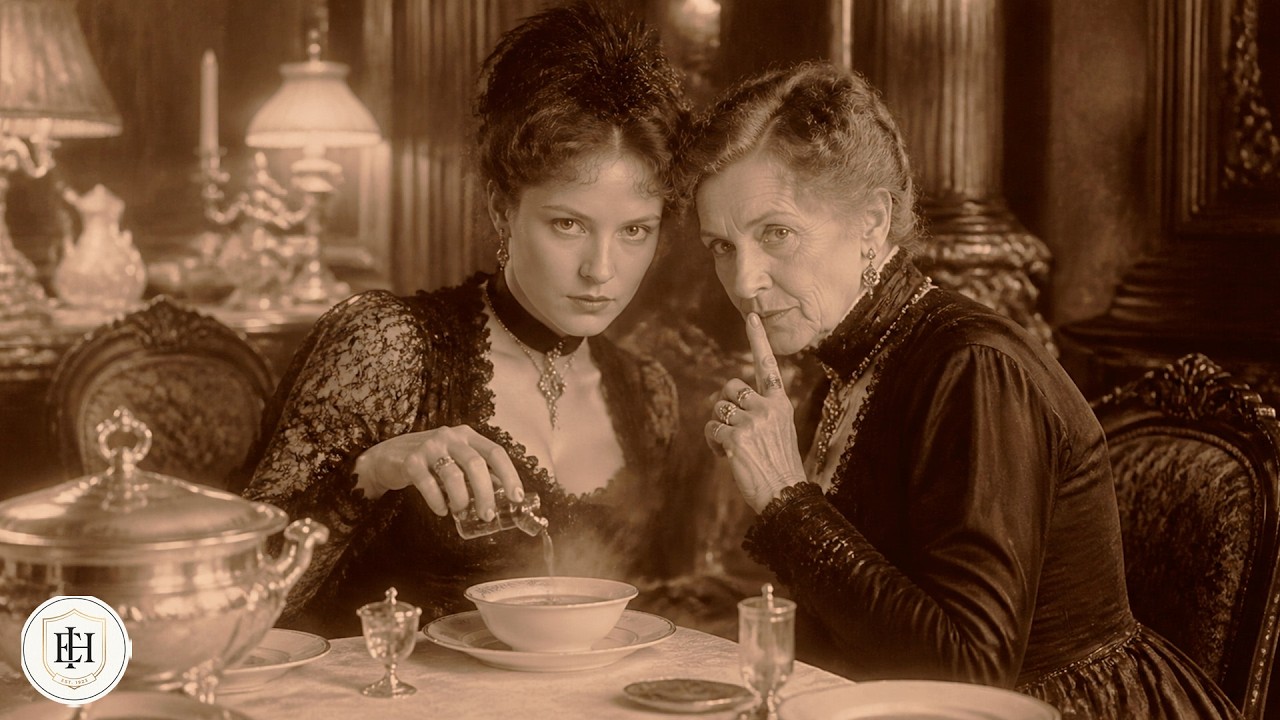
The law required druggists to keep records and to tint the poison, but flypaper was exempt, cosmetics were exempt, and a woman who wanted arsenic did not need to sign for it. She only needed to walk to another shop. The cage these women lived in was made of law. Under the common law doctrine of coverture, a married woman had no separate legal existence.
Her property belonged to her husband, her earnings belonged to him, and her children belonged to him. In a separation, custody went by default to the father, even if he was a drunkard or a brute. Reform laws had begun chipping at this wall since Mississippi passed the first married women’s property act in 1839, followed by New York in 1848 and English legislation in 1870 and 1882, but the reforms were fragmentary. The most powerful financial instrument of the Gilded Age, the life-interest trust, still locked a woman’s inheritance behind trustees and male administrators.
She received the income, but never the capital. She could wear the diamonds, but she could not sell them, and she could not leave. Divorce was legally possible but socially catastrophic, costing a woman her place, her invitations, and often her children. Against that architecture, murder was cheaper than marriage.
The first of these women climbed aboard the SS Baltic in March 1880. Florence Elizabeth Chandler was seventeen, traveling first class, and by the sixth day at sea had accepted a proposal from James Maybrick, a Liverpool cotton merchant twenty-four years her senior. Born in Alabama in 1862, Florence was the daughter of a Mobile banker and the granddaughter of Darius Blake Holbrook, a land speculator whose supposedly vast property in Cairo, Illinois, was the family’s floating rumor of wealth. Her mother, by then the Baroness von Roques, had reinvented herself as the wife of a Prussian cavalry officer and moved her daughter through the Atlantic seasons in search of an advantageous match.
James Maybrick looked like one. What Florence did not know was that he had spent nearly a decade living with a woman named Sarah Ann Robertson, who used his surname and had borne him five children, and that he was addicted to arsenic. For years he had consumed it daily as a tonic, stimulant, and supposed aphrodisiac, taking doses several times a day that would have killed an ordinary man. They married on 27 July 1881 in St.
James’s Church, Piccadilly. Sarah Ann Robertson was not on the guest list. The marriage settled into the form of prosperity. They lived between Norfolk, Virginia and Liverpool, and in 1886 James rented Battlecrease House, an eighteen-room villa in the Aigburth district.
Florence gave birth to a son, James Chandler Maybrick, called Bobo, in 1882, and a daughter, Gladys Evelyn, in 1886. By the late 1880s, the private reality was rotting. James’s arsenic consumption was increasing, his character was shortening, and his cotton business was buckling under falling prices. On 29 March 1889, after a domestic argument, he struck his wife and left her with a black eye.
A servant saw the injury, as did Florence’s friends. The next day she told a confidante she abhorred her husband. Four weeks earlier, in London, she had begun an affair with Alfred Brierley, a young cotton trader and business partner of her husband. She had spent three days with him at a Holborn hotel, and after he ended the affair she wrote him passionate, reckless letters.
James had made a will leaving most of his estate in trust for his children, with Florence receiving only a life interest in the household effects. On 27 April, James returned from a business trip ill, complaining of numbness, vomiting, and stomach pain. His regular doctor believed he was treating chronic dyspepsia complicated by exhaustion and prescribed bismuth, diluted prussic acid, and arsenic drops, adding more poison to a man already being devoured by it. Florence nursed her husband.
On the morning of 8 May, the nursemaid, Alice Yapp, entered Florence’s bedroom and saw several sheets of yellow flypaper soaking in a porcelain basin. The water had turned a muddy brown. Alice Yapp knew what flypaper contained and remembered it. Florence’s explanation was that the arsenic solution was a widely advertised cosmetic preparation for clearing the complexion.
That same night, Florence wrote a letter to Brierley saying that her husband was gravely ill and might die. She gave it to Alice Yapp to mail. Yapp later claimed the envelope had fallen in a puddle and she had opened it to check the address; almost no one believed her. Within hours, the letter was in the hands of James’s brothers, who had always distrusted the young American wife.
On 11 May, Florence was effectively placed under house arrest in her own home, confined to a bedroom and barred from her husband’s sickroom. James Maybrick died that night around 8:30. A bottle of Valentine’s meat juice, a commercial tonic for invalids, stood on his nightstand. Florence had handled it that day; when chemists analyzed it after his death, it contained just under half a grain of arsenic, about 32 milligrams.
The autopsy found arsenic in James’s liver, but only about 20 milligrams, roughly one fifth of what a standard forensic threshold regarded as a lethal deposit. He had died with arsenic inside him, but not, by the strict arithmetic of the Marsh test, obviously because of it. He was a chronic arsenic eater whose own doctor had prescribed poison and whose own chemist had sold it to him five times a day. The flypaper in the basin gave the Maybrick brothers a narrative, the letter gave them a motive, and the meat juice bottle gave them a weapon.
On 14 May, Florence Maybrick was charged with murder. She was twenty-six years old, and her children were taken from her. The trial opened on 31 July at St. George’s Hall in Liverpool, so crowded that spectators fainted in the galleries.
The Attorney General, Sir Charles Russell, personally led her defense, an extraordinary intervention. The prosecution presented the soaked flypaper, the letter, the meat juice bottle, the London hotel, the black eye, the strained finances, the will. Alice Yapp described the basin and the letter. Russell established that James had been a lifelong arsenic consumer, introduced testimony that soaking flypaper for cosmetic facial treatments was common practice, and stressed that the arsenic recovered from the organs fell below the standard fatal threshold.
Under any reasonable reading, it was a case of reasonable doubt. But the judge, Sir Fitzjames Stephen, was visibly unwell. His memory was failing and his temper erratic. His summing-up occupied two full days, on 7 and 8 August, and compulsively returned to Florence’s adultery.
He told the jury that when a woman had committed adultery, the line from that sin to murder was not long. The jury deliberated for thirty-eight minutes and returned a verdict of guilty. Stephen placed the black cap on his wig and sentenced Florence to be hanged. The verdict erupted on both sides of the Atlantic.
Petitions gathered hundreds of thousands of signatures, the American ambassador intervened, and Russell pressed the Home Office directly. On 22 August, the Home Secretary issued an extraordinary memorandum: the evidence led him to believe Florence had administered poison with intent to murder, but it could not be conclusively proven the poison she administered had caused the death. The death sentence was commuted to life imprisonment. She was taken to Woking prison and then to Aylesbury, where she would spend fifteen years in a cell a few square meters in size, her hair cut short, her name reduced to a number.
The judge’s mental deterioration accelerated; he was institutionalized and died in 1894. Alice Yapp married and disappeared from the public record. Brierley went abroad. The children were raised by James’s brother Thomas.
Nine years later, on 9 August 1898, a box of chocolates arrived on a porch in Dover, Delaware, bearing a tender note and enough arsenic to kill six people. The porch belonged to Mary Elizabeth Dunning, who was raising two small daughters while her husband, John Preston Dunning, a war correspondent for the Associated Press, covered the final weeks of the Spanish-American War in Puerto Rico. The woman who sent the box was Cordelia Botkin, a forty-four-year-old San Francisco beauty with a wealthy husband she did not live with and a son she did not raise. She and Dunning had been lovers for three years.
When Dunning wrote that the war was over and he was returning to his wife, Cordelia went to a druggist, signed the poison register with a name, and bought about 57 grams of white arsenic. She opened several chocolates, inserted the poison, resealed them, wrapped the box, and wrote a note in disguised handwriting suggesting a common acquaintance. Mary Elizabeth died on 10 August. Her sister, Mrs.
Joshua Deane, died the same day. Two children who had eaten from the box slowly recovered. The wrapping paper was traced to a San Francisco stationer, the chocolates to the George H. Candy Company, the poison purchase to the druggist.
Cordelia was arrested, tried in San Francisco under the theory that the fatal act had occurred in California, and convicted of first-degree murder. She was sentenced to life in San Quentin. The case established an important jurisdictional precedent for interstate crimes. John Preston Dunning, the man whose abandonment had set the tragedy in motion, saw his career collapse, drank, and died in poverty in a New York boarding house in 1907, three years before Cordelia died in her cell.
Three years earlier still, on the afternoon of 30 August 1895, a ten-year-old girl named Grace Fleming carried a tin pail of clam chowder through Harlem to her grandmother’s door. Her mother, Mary Alice Livingston Fleming, was a member of one of the oldest and most distinguished families in New York, whose ancestors had signed the Declaration. Mary Alice was a single mother of three children, pregnant with a fourth, and dependent on an inheritance held in a life-interest trust. When her mother’s second husband, Henry Bliss, informed her the monthly allowance would be cut, she prepared the chowder, added arsenic, sealed the pail, and sent her daughter with instructions to deliver it as an act of filial tenderness.
Evelina Bliss ate a bowl at dinner. By night she was desperately ill; by morning she was dead. The stomach contents tested positive for arsenic, as did the remaining soup. Mary Alice was arrested, gave birth to her fourth child while in custody at the Tombs, and was tried in the spring of 1896.
The defense did not dispute the physical evidence. Instead it built its case on the impossibility of what the prosecution asked the jury to believe: that a mother would turn her own ten-year-old daughter into an instrument of murder against her own mother. The jury could not say yes. They acquitted her.
Within years, the machinery of the Livingston trust quietly reorganized itself. The $80,000 inheritance flowed into her hands. She lived comfortably, traveled in Europe, raised her children, and died in 1948 at the age of ninety-four. Grace Fleming, the girl who carried the pail, grew up, married, and, as far as the surviving records show, never received an explanation of what she had truly carried that day.
The difference between the verdicts was not the weight of the evidence. Cordelia Botkin fit a template the jury already had: the spurned mistress, the unnatural woman who had dared to want a man too much. Florence Maybrick fit a template too: the adulteress, the foreigner, whose character made the line from sin to murder short. Mary Alice Livingston Fleming did not fit a template the jury could swallow.
She was a mother, and the culture of 1896 still held the mother as a moral bulwark. It was easier to acquit than to accept that the bulwark had a crack. The verdicts were verdicts about imagination. The Marsh test could tell a jury whether arsenic was in the body; it could not tell them whether they were willing to believe a woman like this had put it there.
Florence Maybrick left Aylesbury prison on 25 January 1904, aged forty-one, after fifteen years inside. She had not seen her children in fifteen years. Bobo was twenty-one, Gladys seventeen, and they had been raised by Thomas Maybrick in Wales, told that their mother was a woman they did not need to know. Florence went first to a convent in Cornwall, then returned to America, where she was briefly a celebrity of a morbid kind.
She wrote a book titled My Fifteen Lost Years, went on a lecture tour about prison conditions, and helped build the campaign that led to the English Court of Criminal Appeal in 1907. The lectures faded. By 1910 she was taking odd jobs. In 1911 her son Bobo, working as a mining engineer in Canada, drank from a glass of water contaminated with cyanide solution in a laboratory; his death was ruled accidental.
Florence received the news in a small New York boarding house. Gladys married and made clear she did not wish to be publicly associated with her mother. Florence settled in a three-room cabin in Gaylorsville, Connecticut, and began raising cats. Neighbors called her the cat lady of South Kent.
She kept a scrapbook of her trial, photographs of Battlecrease House, and a pressed flower. She died alone in that cabin on 23 October 1941, aged seventy-nine. Neighbors found her on the floor, her cats still around her. The New York Times ran her obituary on the front page the next morning.
Cordelia Botkin died in her cell at San Quentin on 7 March 1910, aged fifty-six, after eleven years of confinement, her health declining into confusion and paranoia. Mary Alice Livingston Fleming collected her inheritance and lived another fifty-two years, her death noted in a brief paragraph few readers could have explained. The contrast is almost grotesque. Cordelia, who killed two people over a broken affair, died a prisoner.
Florence Maybrick, whose case may never have been murder at all, lost fifteen years and died alone with her cats. Mary Alice, who according to the evidence turned her own child into a weapon to poison her own mother, inherited her fortune and lived to ninety-four. If she did what the prosecution said she did, then in at least one documented case of the Gilded Age, murder worked. For every husband whose death became a newspaper scandal, dozens more were buried quietly under a diagnosis of gastric fever, and no one asked why.
The number cannot be known; a successful poisoning by definition leaves no mark on the public record. Exhumations conducted for unrelated reasons occasionally found arsenic in the hair and nails of men buried long before, and the findings were suppressed or dismissed. The families preferred silence to scandal. Historians who have tried to estimate the scale suggest that for every poisoning that ended in trial, there may have been between five and fifteen that were never suspected.
The unknown vastly exceeds the known. Against that background, the three women who came to trial were the unlucky ones. Florence was unlucky because she soaked flypaper in front of a resentful nursemaid and wrote a passionate letter. Cordelia was unlucky because she signed the poison register and wrote the address in her own hand.
Mary Alice was lucky because her family name could not be comfortably joined to the word matricide by twelve New York men. Luck and error are what brought their stories to light; competence is what kept the others in darkness. The villainy, insofar as there was any, did not reside primarily in three individual psyches. It resided in a structure: a legal system that stripped women of their property, their children, and their ability to leave; a pharmaceutical industry that sold deadly substances for two pennies a sheet; a culture that measured a woman’s worth by marriage and punished her unbearably for abandoning it.
Given those conditions, a small percentage of desperate, determined women was always going to walk to the druggist’s counter. The wonder is not that a few did. The wonder is that so many did not. The cage of silk was made of law, and at bottom it was made of silence.
And silence, unlike arsenic, cannot be bought for anything at all.
