On a cold day in December 1963, in South Bend, Indiana, the Studebaker Corporation shut down its main manufacturing plant. More than ten thousand workers lost their jobs. But the greater blow came when the company terminated its pension plan and the fund proved nowhere near large enough to cover its obligations. Roughly 3,600 older retirees and workers already eligible for retirement received their full benefits.
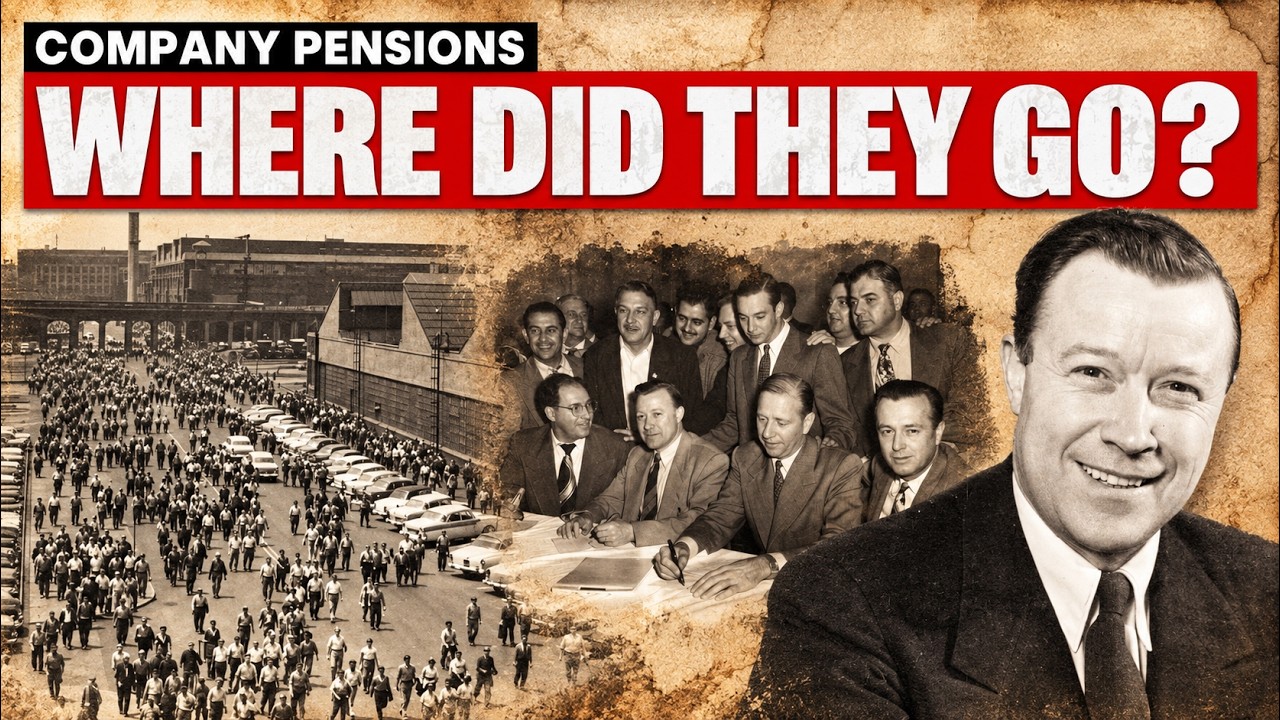
About 4,000 workers between the ages of 40 and 59, people with an average of 23 years of service, received roughly 15 cents for every dollar they had been promised. The remaining 2,900 workers, those under 40, received nothing at all. Decades of loyal service, of regular contributions, gone in an instant. The collapse sent shock waves through the American labor movement.
If a company could simply walk away from its pension obligations with zero consequences, workers across the country began to ask, then what was the point of having a pension in the first place? To understand how that question came to define the fate of an entire generation, it helps to go back further, to a time when the very idea of retirement for ordinary people did not exist. Before the Civil War, there was no concept of retirement for most Americans. You worked until you physically could not, and then your family took care of you.
If you had no family, that was your problem. The industrialization of the late 1800s changed everything. Railroads, steel mills, factories—these were dangerous, physically demanding jobs, and workers were aging out of them faster than ever. The idea of providing financial support for workers who could no longer labor did not originate in the United States.
It came from Germany. In 1889, Chancellor Otto von Bismarck introduced one of the first state-sponsored pension systems in the world. Bismarck was not exactly motivated by generosity. He was worried about the rise of socialism and figured that giving elderly citizens a guaranteed income might keep them from revolting.
The retirement age was set at 70, which at the time was well beyond the average life expectancy. In other words, the system was designed so that most people would die before they ever collected a single payment. Brutal, but effective. In America, the idea caught on more slowly.
In 1875, the American Express Company became one of the first private companies in the United States to establish a formal pension plan for its employees. By the turn of the century, several major railroads and utilities had followed suit. But these early pensions were nothing like what would come later. They were entirely voluntary, completely controlled by the employer, and they could be revoked at any time for any reason.
There were no laws governing them, no regulations, no protections. If a company decided tomorrow that it did not feel like paying your pension anymore, it could simply stop. And many did. Workers had no legal recourse whatsoever.
The pension was not a right. It was a gift. Then came the Great Depression. The economic catastrophe of the 1930s devastated the American workforce.
Unemployment hit 25 percent. Banks collapsed. Savings vanished overnight. Millions of elderly Americans were left with absolutely nothing—no pensions, no savings, no social safety net of any kind.
The suffering was so widespread and so visible that it became politically impossible to ignore. In 1935, Franklin Roosevelt signed the Social Security Act. For the first time, the federal government guaranteed a basic income for retired workers. It was not much, but it was something: a floor beneath which no American was supposed to fall.
But Social Security alone was never meant to be enough. It was designed as one piece of a larger system. The second piece was private pensions, and it was during the Second World War that private pensions truly exploded across the American economy. During the war, the federal government imposed strict wage controls.
Companies could not raise salaries to attract workers because the government had frozen wages to control wartime inflation. But the labor market was incredibly tight. Millions of men were overseas fighting, and factories desperately needed bodies. So companies got creative.
If they could not offer higher pay, they offered better benefits: health insurance, vacation time, and crucially, pensions. These benefits were not subject to wage controls, so they became the primary tool for attracting and retaining workers. And it worked. Between 1940 and 1960, the number of Americans covered by private pension plans jumped from roughly 3.
7 million to over 19 million—a five-fold increase in just two decades. By 1950, pension plans had become a standard part of the employment package at most large American corporations. General Motors, Ford, U. S.
Steel, General Electric—all the industrial giants offered them. If you got hired at one of these companies, you knew that if you stuck around long enough, you would be taken care of when you retired. This was not just altruism. The math worked out beautifully for the companies, too.
These were what we call defined benefit plans. The company promised to pay you a specific amount every month in retirement, usually calculated based on your salary and years of service. The company funded these plans by making regular contributions into a pension fund, which was then invested in stocks, bonds, and other assets. As long as the investments performed reasonably well and the company kept making contributions, the system was sustainable.
And here was the thing that made it all possible: during this era, people did not live very long after they retired. In the 1950s, the average American man who retired at 65 lived for roughly another three to five years. That was it. The company was on the hook for maybe five years of pension payments—a manageable liability.
The system was affordable precisely because most people did not survive long enough to collect very much. Unions played a massive role in this expansion. In 1949, a landmark Supreme Court ruling established that pension benefits were a mandatory subject of collective bargaining. Unions could now negotiate for pensions during contract talks, and companies were legally obligated to bargain over them in good faith.
The United Auto Workers, under the leadership of Walter Reuther, became one of the most aggressive advocates for pension rights. In 1950, the UAW negotiated a groundbreaking contract with General Motors that included a fully funded pension plan. This agreement, sometimes called the Treaty of Detroit, essentially set the template for labor relations in America for the next 30 years. Big company, strong union, guaranteed pension.
That was the formula. By the late 1960s, the American pension system seemed nearly untouchable. Around half of all private sector workers were covered by a defined benefit plan. The economy was booming.
Corporate profits were high. And the stock market was delivering steady returns that kept pension funds healthy and well capitalized. But underneath this prosperity, there was a ticking time bomb, and it detonated in South Bend. The Studebaker disaster gave the UAW under Reuther the political ammunition it needed.
The union had already been pushing for pension insurance—a system where the government would step in and guarantee benefits if a company’s pension plan failed. But Washington moved slowly. It took more than a decade of congressional hearings, lobbying, and political maneuvering before anything actually happened. Along the way, there were more pension failures, more workers left with nothing.
And there was also the very public spectacle of Teamsters boss Jimmy Hoffa, who was convicted of pension fund fraud, having systematically looted the union’s retirement funds for personal gain. The combination of corporate negligence and union corruption made pension reform a political necessity. Finally, in 1974, President Gerald Ford signed the Employee Retirement Income Security Act into law. ERISA, as it became known, was supposed to be the definitive solution to the pension crisis.
It established minimum funding requirements for pension plans. It set vesting standards so that workers would earn the right to their benefits after a certain number of years. It created the Pension Benefit Guaranty Corporation, a federal agency that would ensure pension benefits if a company went bankrupt. And it imposed fiduciary duties on the people who manage pension funds, requiring them to act in the best interests of the workers.
On paper, ERISA was a landmark achievement. It gave American workers more pension protections than they had ever had. But here is the irony, and it is a bitter one. ERISA, the law that was supposed to save the American pension, may have actually accelerated its death.
The law imposed significant new costs on companies that offered defined benefit pensions. The funding requirements meant companies had to set aside more money. The reporting requirements meant more paperwork, more compliance costs, more legal fees. The insurance premiums paid to the Pension Benefit Guaranty Corporation added another layer of expense.
For large, profitable companies, these costs were manageable. But for smaller firms and for companies operating on thin margins, ERISA made offering a traditional pension plan significantly more expensive and more risky. Many companies looked at the new regulatory burden and decided it simply was not worth it. And then something happened that nobody anticipated.
A small provision in a tax bill, buried deep in the Internal Revenue Code, quietly created an alternative that would eventually displace the entire pension system. In 1978, Congress passed the Revenue Act. Tucked inside this sprawling piece of legislation was a provision called Section 401(k). The provision itself was fairly narrow.
It was designed to clarify the tax treatment of deferred compensation arrangements, essentially codifying the rules around a practice that some companies were already using. No one in Congress debated whether this provision would replace pensions. No one even considered the possibility. It was a technical fix, a piece of legislative housekeeping.
It went into effect on January 1, 1980. And then a man named Ted Benna saw something that nobody else did. Benna was a benefits consultant working for a company called the Johnson Companies in suburban Philadelphia. He had been hired by a banking client that wanted to create a retirement plan for its executives, one that would reduce their tax burden on bonuses.
While reviewing the new tax code, Benna realized that Section 401(k) could be interpreted much more broadly than Congress had intended. He saw that the provision could be used to create a completely new kind of retirement plan, one where employees would contribute a portion of their own salary into an investment account with the employer matching some portion of that contribution. The contributions would be tax-deferred, meaning workers would not pay taxes on the money until they withdrew it in retirement. Benna’s client rejected the idea.
But Benna was so convinced of its potential that he created the first 401(k) plan for his own company. He then lobbied the IRS to issue rules that would make it easier for other companies to adopt similar plans. In 1981, the IRS issued those rules, and the floodgates opened. Within just a few years, corporations across America were scrambling to set up 401(k) plans.
And the reason was simple. From a company’s perspective, a 401(k) was dramatically cheaper and less risky than a traditional pension. With a defined benefit pension, the company bore all the risk. If the stock market crashed, if interest rates moved the wrong way, if retirees lived longer than expected, the company was on the hook for making up the difference.
The pension obligation was a liability that sat on the company’s balance sheet, growing larger every year, subject to volatile market forces that the company could not control. A 401(k) flipped that equation entirely. Now the risk fell on the worker. The company’s obligation ended the moment it deposited its matching contribution into the employee’s account.
If the market crashed and the worker’s account lost half its value, that was the worker’s problem. The company’s books were clean. No long-term liabilities, no actuarial risk, no uncertainty. For corporate America, the 401(k) was a dream come true, and the timing could not have been more perfect.
The 1980s brought a wave of economic and political forces that accelerated the shift away from pensions at breathtaking speed. First, there was globalization. American manufacturers suddenly faced intense competition from Japan, Germany, South Korea, and eventually China. Profit margins were squeezed.
Companies that had been dominant for decades were suddenly fighting for survival. And those generous pension plans, the ones that had been negotiated during an era of unquestioned American industrial supremacy, now looked like anchors dragging these companies toward insolvency. Second, there was the decline of unions. In the 1950s, about a third of all American workers were union members.
By the 1980s, that number had fallen to roughly 20 percent, and it would continue to drop in the decades that followed. Without strong unions at the bargaining table, workers had far less leverage to demand the continuation of traditional pension plans. Companies could freeze, reduce, or eliminate pensions with relatively little resistance. Third, new accounting rules changed the game entirely.
In 1985, the Financial Accounting Standards Board issued a new standard, Statement Number 87, that required companies to report their pension obligations on their balance sheets using a standardized methodology. Before this, companies had enormous flexibility in how they accounted for pensions. Many understated their obligations, making their financial health look better than it actually was. The new rules exposed the true cost of pensions for the first time, and Wall Street did not like what it saw.
Companies with large underfunded pension plans saw their stock prices suffer. This created enormous pressure from shareholders and analysts to get pension liabilities off the books. Fourth, interest rates played a devastating role. Pension funds use interest rates to calculate the present value of their future obligations.
When interest rates fall, the present value of those obligations rises, meaning companies need to put more money into their pension funds. Throughout the 2000s, interest rates declined to historic lows, and pension deficits ballooned. Companies that had thought their pension funds were adequately funded suddenly found themselves facing shortfalls of billions of dollars. These deficits showed up as massive liabilities on corporate balance sheets, terrifying investors and dragging down stock prices.
And fifth, and perhaps most fundamentally, people started living a lot longer. Remember that calculation from the 1950s, where a retiree might collect a pension for three to five years. By the 2000s, a worker who retired at 65 could reasonably expect to live another 20 years. Some would live 30.
That meant pension obligations were lasting five, six, even eight times longer than the original plans had anticipated. The entire actuarial foundation of the defined benefit pension system had been invalidated by improved medicine and longer lifespans. The result was a slow-motion catastrophe. One by one, America’s largest and most iconic companies began freezing or terminating their pension plans.
In 2006, IBM, one of the most profitable technology companies in the world, announced that it would freeze its $48 billion pension plan. The company said it would save between $450 million and $500 million in the first year alone, and up to $3 billion over five years. That same year, General Motors froze its pension for roughly 42,000 salaried employees. Ford had already made the same move.
Verizon froze its pension. Hewlett-Packard stopped offering pensions to new hires. DuPont, Sears, Motorola, NCR—the list went on and on. And it was not just struggling companies.
This was the critical distinction. In the past, pension failures had been associated with companies that were going bankrupt—companies like Studebaker, or later companies like United Airlines, which defaulted on its pension obligations during bankruptcy in 2005, dumping $4. 7 billion in unfunded liabilities onto the Pension Benefit Guaranty Corporation. But now, perfectly healthy, wildly profitable companies were choosing to eliminate their pension plans, not because they could not afford them, but because Wall Street did not want them to have them.
Shareholders viewed pension obligations as dead weight. Every dollar a company spent on pensions was a dollar that was not going towards stock buybacks or dividends. This brings us to what might be the most cynical part of this entire story. The 401(k) was never designed to replace the pension.
Ted Benna himself has said this repeatedly. He intended it as a supplement, an additional savings vehicle that workers could use on top of their pensions and Social Security. It was supposed to be the third leg of a three-legged stool. But corporate America saw an opportunity to remove two of those legs and tell workers that one was enough.
And how has that worked out? The numbers tell a devastating story. As of 2022, only about 54 percent of American families had any retirement account at all. That means nearly half of all families in the richest country in human history had saved nothing for retirement.
Among those who did have a 401(k), the median balance was profoundly inadequate. According to Vanguard’s data, the median 401(k) balance for workers between the ages of 55 and 64—people on the verge of retirement—was around $87,000. These are people who have worked their entire adult lives, who have contributed to these accounts for decades, and the typical balance would not cover three years of basic living expenses. The average balance looks better, somewhere around $244,000 for that same age group.
But averages are misleading because they are skewed upward by a relatively small number of wealthy individuals with massive accounts. The median, the number that represents the experience of the typical worker, is far more revealing. A study by the National Institute on Retirement Security found that among all working-age Americans between 21 and 64, including those who had not saved anything, the median amount saved in a defined contribution plan was just $955. Not $955,000.
$955. That is a single month’s rent in most American cities. Some will argue that this is a matter of personal responsibility—that if workers had been more disciplined about saving, more informed about investing, more engaged with their retirement planning, the outcomes would have been better. And there is a kernel of truth in that.
Financial literacy in this country is dismal, and many workers do not contribute enough to their 401(k) plans to take full advantage of employer matching. But here is the fundamental problem with that argument. It assumes that every individual worker has the knowledge, the discipline, the earning power, and the emotional fortitude to effectively manage what is in essence a small investment portfolio over the course of a 40-year career. Professional fund managers, people who do this for a living with billions of dollars and teams of analysts and advanced computational models, frequently underperform the market.
And yet we expect a factory worker in Ohio, or a school teacher in Mississippi, or a retail clerk in Nevada to navigate the complexities of asset allocation, fund selection, expense ratios, and market timing while also working full-time, raising a family, paying off student debt, and dealing with all the other financial pressures of modern life. With a traditional pension, none of that mattered. You did not have to understand the difference between a growth fund and a value fund. You did not have to decide how much to contribute or which investments to choose.
You did not have to worry about sequence of returns risk or whether the market would crash the year before you retired. The company handled all of that. Professional money managers invested the pension fund. Actuaries calculated the liabilities.
And when you retired, you got your check every month for the rest of your life. That was the deal. The shift from pensions to 401(k) plans represents one of the largest transfers of financial risk in American history. Trillions of dollars in retirement obligations were moved from the balance sheets of corporations onto the shoulders of individual workers.
And the workers were never told that this was happening. They were not given a vote. They were not offered a choice. One day they had a pension, and the next day they had a 401(k) and a brochure explaining how to pick mutual funds.
And who benefited from this transfer? Follow the money. Wall Street saw an enormous new market open up virtually overnight. Those 401(k) accounts needed to be invested somewhere, and the financial services industry was more than happy to provide the vehicles.
Mutual fund companies, brokerage firms, insurance companies—all of them descended on the 401(k) market like sharks sensing blood in the water. The fees they charged on these accounts—management fees, administrative fees, expense ratios, all of them perfectly legal—generated billions of dollars in revenue every year. Even small fees, a 1 percent annual management fee, for example, can consume an enormous portion of a worker’s returns over a 40-year career. Studies have shown that fees alone can reduce a worker’s final retirement balance by 20 to 30 percent.
Ted Benna himself, the man who invented the 401(k), has publicly called his creation a monster. He said it should be, and these are his words, blown up. He has been saying this since at least 2011. The man who built the system is telling us that the system is broken.
But the pension did not die everywhere. That is an important distinction. While private sector pensions have been decimated, public sector pensions remain largely intact. Teachers, firefighters, police officers, government employees at the federal, state, and local levels still overwhelmingly have access to traditional defined benefit pension plans.
Public sector workers, roughly 15 million of them across the country, enjoy a level of retirement security that most private sector workers can only dream of. Of course, public pensions have their own problems. Many state and local pension funds are significantly underfunded, meaning the governments that sponsor them have not been setting aside enough money to cover their future obligations. By some estimates, the total unfunded liability across all state and local pension plans exceeds several trillion dollars.
This creates enormous fiscal pressures, particularly in states like Illinois, New Jersey, and Kentucky, where pension obligations consume a growing share of the state budget, crowding out spending on education, infrastructure, and other public services. And this is where the politics get really interesting. There are powerful interests that want to eliminate public pensions, too. Using the same playbook that was used to eliminate private pensions, they point to the unfunded liabilities and the fiscal pressures and argue that defined benefit plans are unsustainable.
They propose replacing public pensions with 401(k)-style plans, shifting the risk onto government workers in the same way that risk was shifted onto private sector workers a generation ago. These proposals are fiercely resisted by public employee unions, which represent one of the last strongholds of organized labor in the United States. The battle over public pensions is in many ways a proxy war over the future of the American social contract. But step back and look at the bigger picture.
The death of the American pension did not happen in isolation. It happened alongside a much broader restructuring of the American economy, one that shifted power and resources away from workers and towards shareholders and corporate executives. In 1970, the average CEO made roughly 20 times what the average worker in their company earned. By 2020, that ratio had exploded to approximately 351 to 1.
During the same period, real wages for most American workers barely budged. Productivity increased dramatically, but the gains went almost entirely to the top. Corporate profits soared. Stock prices reached record highs.
And yet the typical American worker was working longer hours for effectively the same pay, with fewer benefits, less job security, and a retirement that looked increasingly uncertain. The death of the pension is a symptom of this larger shift. It is part of a broader pattern in which the institutions that once protected ordinary workers—unions, regulations, social contracts between employers and employees—have been systematically dismantled in the name of efficiency, competitiveness, and shareholder value. And there is a deeper story here about how we as a society think about risk.
The traditional pension was built on a principle of shared risk. The company and the worker each assumed some portion of the uncertainty inherent in retirement planning. The company took on the investment risk and the longevity risk. The worker contributed years of labor.
It was a partnership, imperfect and sometimes abused, but fundamentally built on the idea that employers and employees were in this together. The 401(k) obliterated that partnership. It says that the worker is on their own. Sink or swim.
Make good decisions and you might be okay. Make bad decisions and that is your fault. It is the financialization of personal responsibility—the idea that the market will sort everything out, that individuals armed with enough information and enough discipline can do for themselves what entire institutions used to do for them. And for a small number of highly educated, well-paid professionals who max out their contributions and invest wisely, the 401(k) works well.
But for the vast majority of American workers, it has been a poor substitute for what came before. The data is unambiguous on this point. Americans are not saving enough. They are not investing wisely enough.
And they are not going to be able to retire with anything close to the security that the previous generation enjoyed. Now, where does this leave us? There are roughly 10,000 Americans turning 65 every single day. This wave of retirements is going to continue for years, and a staggering number of these retirees are going to enter old age with insufficient savings.
Many will rely almost entirely on Social Security, which was never designed to be a sole source of retirement income. The average Social Security benefit in 2026 is roughly $1,976 per month. Try paying rent, buying food, covering medical expenses, and maintaining any quality of life on that amount. The retirement crisis is not coming.
It is already here. And the decisions that created it—the gutting of pension protections, the invention of the 401(k), the deregulation of financial markets, the decline of unions—these were not inevitable. They were choices made by specific people in specific boardrooms and legislative chambers at specific moments in time. They were choices that enriched some people enormously while leaving millions of others to face their golden years with nothing but anxiety and uncertainty.
So when someone asks why American companies stopped paying workers pensions, the answer is both simple and deeply complicated. The simple version is that it was cheaper not to. The complicated version involves a century of history: a web of corporate decisions, government policies, demographic shifts, market forces, and a fundamental change in the relationship between employers and employees. The pension did not die of natural causes.
It was killed slowly, deliberately, and with tremendous profit for those who held the knife. And perhaps the most haunting part of all of this is what Ted Benna said about his own creation. He never intended the 401(k) to replace pensions. He never imagined that companies would use it as an excuse to abandon their obligations to workers.
He saw it as a tool, a supplement, one piece of a larger system. But in the hands of corporate America and Wall Street, it became something else entirely. It became a weapon, a mechanism for transferring trillions of dollars in risk from the powerful to the powerless.
And the man who built it watched it happen and called it a monster.
