Ethel Kennedy stood at the center of America’s most famous political dynasty, a woman of steel and relentless faith who became its matriarch the moment she married Robert F. Kennedy. Widowed at forty with eleven children and a nation watching, she refused to let tragedy define her family. She turned her home into a battlefield of moral conviction, raising her children to run faster, fight harder, and believe fiercely in justice.
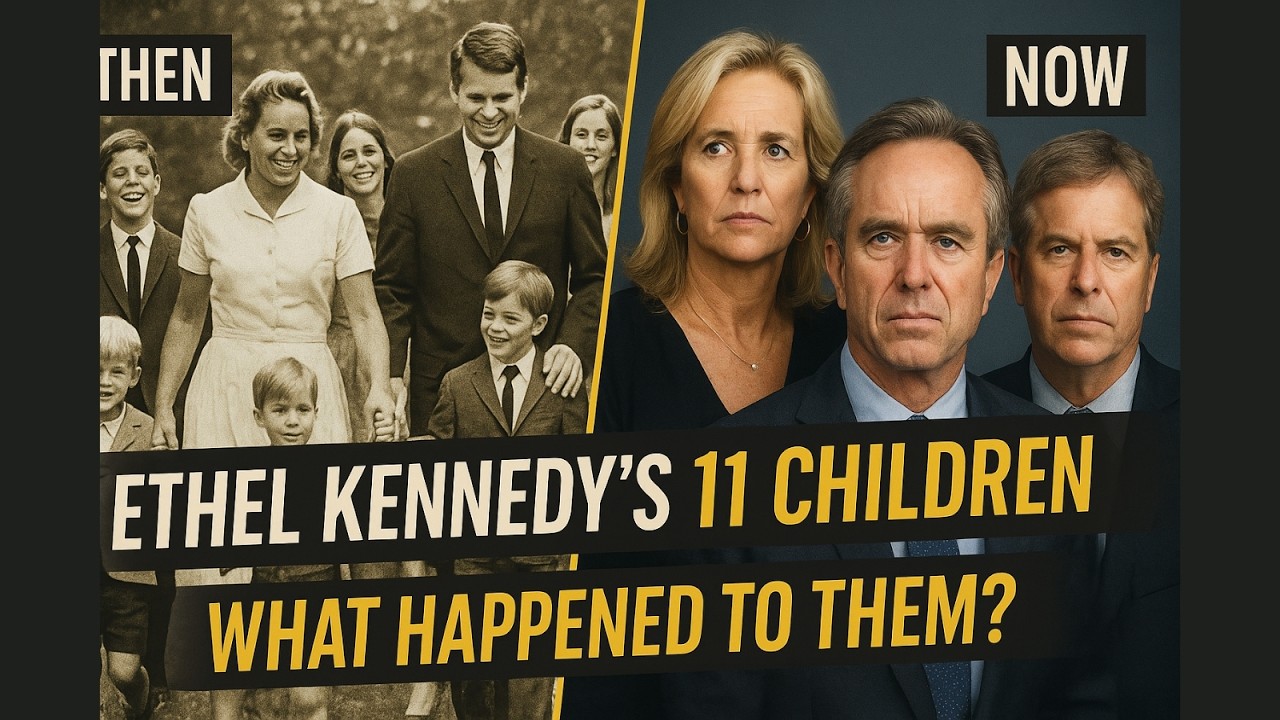
The cost of being a Kennedy—the expectations, the scrutiny, the tragedies—shaped each of their lives in ways the public could never fully understand. From the documentarian born into mourning to the gentle soul crushed by the weight of history, the eleven Kennedy children inherited both the brilliance and the burden of their lineage. Rory Elizabeth Katherine Kennedy entered the world on December 12, 1968, six months after her father, Senator Robert F. Kennedy, was assassinated.
She was the child who never met her father, the baby held by a grieving mother while the nation mourned another Kennedy gone too soon. Ethel, shattered but still fierce, poured her strength into raising her youngest daughter in a household that believed in fighting for justice and speaking truth to power. Rory found her voice not in politics but in storytelling, becoming one of the most respected documentary filmmakers of her generation. Her films focused on the forgotten, the marginalized, and the silenced—the people her father had fought for.
Works like Ghosts of Abu Ghraib, Last Days in Vietnam, and American Hollow were acclaimed for their honesty and courage. In Rory’s hands, film became activism and storytelling the continuation of the Kennedy fight. Her 1999 wedding to writer Mark Bailey was marked by tragedy when the ceremony was originally planned aboard the plane that crashed and killed her cousin John F. Kennedy Jr.
and two others. Rory, like her mother, moved forward with quiet strength, carving a path built entirely on truth. Douglas Harriman Kennedy, born March 24, 1967, entered the world during one of the most turbulent moments in American political history. Named after diplomat W.
Averell Harriman, a close Kennedy family ally, Douglas carried political gravity in his name. He was only a year old when his father was assassinated, so his memories of RFK were inherited rather than lived. Unlike many of his siblings, Douglas did not chase the political spotlight. He pursued journalism, becoming a respected reporter and correspondent, covering crime, politics, and national crisis with a journalist’s detachment rather than a politician’s conviction.
In 2012, he was involved in a highly publicized legal battle after an altercation with hospital nurses while attempting to take his newborn child for fresh air. He was acquitted, but the ordeal revealed the immense pressure of living under constant public scrutiny. Despite the challenges, Douglas built a stable family life, marrying Dr. Molly Stark and raising a large family that echoed the chaotic, love-filled home of his childhood.
Christopher George Kennedy, born July 4, 1963, arrived on Independence Day wrapped in symbolism. He was only four years old when his father was shot, leaving Ethel and the eleven children in a storm of grief. Chris became one of the clearest expressions of responsibility in the family, developing a sharp mind for economics and management at Boston College and the University of Chicago Booth School of Business. He believed business could be a tool to lift communities.
In the 1990s, he became chairman of Joseph P. Kennedy Enterprises, then president of the Merchandise Mart in Chicago, transforming it into a thriving center for design and commerce. His leadership revitalized Chicago’s River North neighborhood. He founded Topbox Foods, a nonprofit distributing affordable groceries to food deserts across Illinois and Louisiana.
In 2018, he ran for governor of Illinois, speaking with the moral urgency that shaped his father. Though he did not win, his campaign rekindled the RFK spirit. Among the siblings, Christopher stood out as the builder who fused business acumen with moral purpose, carrying his father’s convictions into boardrooms and food distribution centers. Mary Courtney Kennedy, born September 9, 1956, was among the most private of the Kennedy children.
She was eleven when her father was assassinated, thrust into the chaos of national tragedy at an age when children should be discovering the world with innocence. Courtney gravitated toward art, activism, and global causes, working with international relief organizations and living for long periods abroad, especially in African nations, where she participated in development projects and refugee support. She married environmentalist Jeff Ruhe in 1980, but the marriage unraveled. Later, she entered a long-term relationship with Paul Hill, a man wrongfully convicted as part of the notorious Guildford case in Ireland, who spent fifteen years in prison before being exonerated.
They married in 1993 and had a daughter, but the union fell apart under the weight of trauma. Courtney remained devoted to humanitarian work, environmental causes, and human rights advocacy, never seeking fame but seeking meaning. Among the eleven, she was the resistor, the one who lived boldly and vulnerably in a world that expected polished perfection. Kathleen Hartington Kennedy, born July 4, 1951, was the first of the children to fully embrace the political legacy her father left behind.
She was sixteen when RFK was assassinated, and the image of her walking behind his coffin, composed and determined, became a lasting symbol of a family both shattered and unbroken. Kathleen served as Lieutenant Governor of Maryland from 1995 to 2003, the first woman to hold that position, and became a relentless advocate for children, education, and public safety. Her method was not charisma but tireless work—visiting schools, hospitals, and prisons, fighting for gun control and equal opportunity. She ran for governor of Maryland in 2002 and lost, a defeat that reshaped her trajectory, but she continued her work in public policy and nonprofit leadership.
Her personal life carried love and tragedy; one of her four daughters, Mave, died with her son Gideon in a canoe accident in 2020. Kathleen met it with unyielding grace. Among the siblings, she was the crusader who stepped most directly onto the battlefield of public service. Joseph Patrick Kennedy II, born September 24, 1952, was the first of the children to step directly into American politics.
He was present when RFK delivered his final speech moments before being shot in Los Angeles. That trauma marked him deeply. In his twenties, Joe built Citizens Energy Corporation, a nonprofit providing discounted heating oil and energy assistance to struggling families. He delivered heating oil in trucks during freezing New England winters, physically showing up rather than just writing checks.
In 1987, he won election to the U. S. House of Representatives from Massachusetts and served six terms, earning a reputation as a fiery advocate for working-class Americans. His personal life carried turbulence—a bitter divorce and custody dispute—but he rebuilt his life.
Joe never ran for Senate or president, drawn instead to the gritty moral mission of confronting poverty and corporate greed. Among the siblings, he was the fighter who inherited the fire and relentless empathy that fueled his father’s greatest battles. Michael LeMoyne Kennedy, born February 27, 1958, was the charming mediator of the family, charismatic, warm, and committed to service. He attended Harvard and gravitated toward the operational side of service, taking senior roles within Citizens Energy Corporation, working directly on initiatives to provide affordable heating oil and electricity to low-income families.
In the late 1980s and early 1990s, he emerged as a rising star in Democratic politics, and many believed he would eventually run for Congress. But in 1997, Michael became the center of a scandal involving allegations of an inappropriate relationship with a fourteen-year-old babysitter. Though criminal charges were never filed, the media firestorm destroyed his political prospects. Months later, on December 31, 1997, Michael was killed in a skiing accident in Aspen, Colorado, at age thirty-nine, after crashing into a tree while playing football on skis.
His death stunned the nation. He left behind his wife and three children, and a legacy both admirable and tragic—a collision of brilliance and error that reminded the family that legacy is not simple. Matthew Maxwell Taylor Kennedy, born January 11, 1965, was named after General Maxwell Taylor, a legendary commander and close friend of RFK. Max was only three when his father was assassinated, growing up in the aftermath of that trauma.
He became a quiet, introspective force within the family, gravitating toward literature, history, and public justice. He compiled and edited Make Gentle the Life of This World, a collection of RFK’s speeches published in 1998 that preserved his father’s voice for a new generation. Max became a public interest environmental lawyer, fighting for conservation and community rights with discipline and detail. During the 2000 presidential election, he volunteered as a poll worker and legal adviser to protect voting access.
His personal life was marked by stability; he married educator Victoria Strauss and raised three children. Among the siblings, Max was the intellectual torchbearer, the guardian of his father’s ideals. Mary Kerry Kennedy, born September 8, 1959, was the daughter who became the most relentless defender of human rights in the entire Kennedy generation. She was only eight when her father was assassinated, and she transformed the trauma into fuel.
In 1988, Kerry founded the Robert F. Kennedy Center for Human Rights, now known as RFK Human Rights. She plunged into the world’s darkest corners herself, working with political prisoners, refugees, and victims of torture in more than sixty countries. Her activism focused on human trafficking, child labor, land rights for indigenous communities, and political imprisonment.
Her best-selling book, Speak Truth to Power, became a global movement. Her marriage to New York Governor Andrew Cuomo ended publicly and painfully, but she refused to break. Kerry remained one of the most influential human rights activists in America, the crusader who carried her father’s fire into courtrooms and conflict zones around the world. Robert Francis Kennedy Jr.
, born January 17, 1954, was the child who inherited his father’s eloquence and intensity, but whose path would diverge into one of the most controversial stories in the modern Kennedy legacy. He was fourteen when he walked behind his father’s coffin, and grief evolved into rebellion. As a young adult, RFK Jr. struggled with addiction, hitting bottom with an arrest for heroin possession in 1983.
The moment became the turning point of his life. Once sober, he became one of America’s most influential environmental lawyers, known for fierce litigation against corporations polluting rivers and land. But by the 2000s, his skepticism toward vaccines and distrust of regulatory agencies placed him at odds with mainstream science and many members of his own family. His 2024 presidential run as an independent fractured public opinion further.
Beneath the controversy, one constant remained: he shared his father’s ferocity and instinct to challenge power, though his path took him far from the consensus-driven unity that defined RFK in the 1960s. He endured tremendous personal loss, notably the suicide of his wife Mary Richardson Kennedy, and found stability in his later marriage to actress Cheryl Hines. Among the siblings, he was the rebel, the lightning rod. David Anthony Kennedy, born June 15, 1955, was the child whose life embodied both the brilliance and the unbearable weight of the Kennedy legacy.
He was twelve when his father was assassinated, present in Los Angeles on that tragic night. David was the child who saw, who heard, who understood too much too early. Trauma wrapped itself around him and never let go. In 1973, he nearly drowned in the icy waters off California while saving his younger brother Courtney from a powerful current.
The rescue succeeded, but the near-death experience deepened his emotional fractures. At Harvard, he struggled academically and personally, and his addictions worsened. He moved in and out of rehab facilities, once writing that he felt like a ghost in a room full of legends. Despite his battles, he never lost his tenderness; friends described him as empathetic and deeply moral.
On April 25, 1984, at age twenty-eight, David was found dead in a Palm Beach hotel room from a drug overdose. His death sent shockwaves through the family and the nation. He was not weak, but wounded—overwhelmed by the impossible weight of memory, expectation, and grief. The story of Ethel Kennedy and her eleven children is not simply a family biography.
It is the emotional history of America’s most mythic political dynasty—a story of triumph and devastation, courage and collapse, extraordinary purpose and painfully human struggle. The children became the living continuation of the world Robert F. Kennedy dreamed of: the documentarian of conscience, the journalist navigating truth, the builder of cities, the humanitarian on the front lines, the first woman lieutenant governor of Maryland, the congressman who carried RFK’s fire into the streets, the flawed and tragic son, the historian and environmental lawyer, the human rights warrior, the controversial rebel, and the gentle soul crushed by history. Together they formed the mosaic of an American legend—eleven children shaped by a mother’s will, a father’s ideals, and a grief that never slept.
The Kennedy legacy is not clean, not flawless, not myth. It is human: brilliant, wounded, courageous, real. At the heart of that legacy stands Ethel Kennedy, who refused to let the flame go out, raised eleven lives out of the ashes of tragedy, and turned an American family into a force that still shapes justice, politics, and conscience.
Her legacy is not carved in monuments or speeches, but in the eleven children who carried her fire into the world, each in their own way, each with their own light.
