In November 1718, a small circle of Swedish officers stood in a freezing trench beneath the walls of the Norwegian fortress of Fredriksten, watching their king do what he had always done. Charles XII climbed to the most exposed point of the forward line, leaned his chin on his hands, and stared out into the fog toward the enemy positions. He ignored the pleas of his men to take cover. A single crack broke the silence.
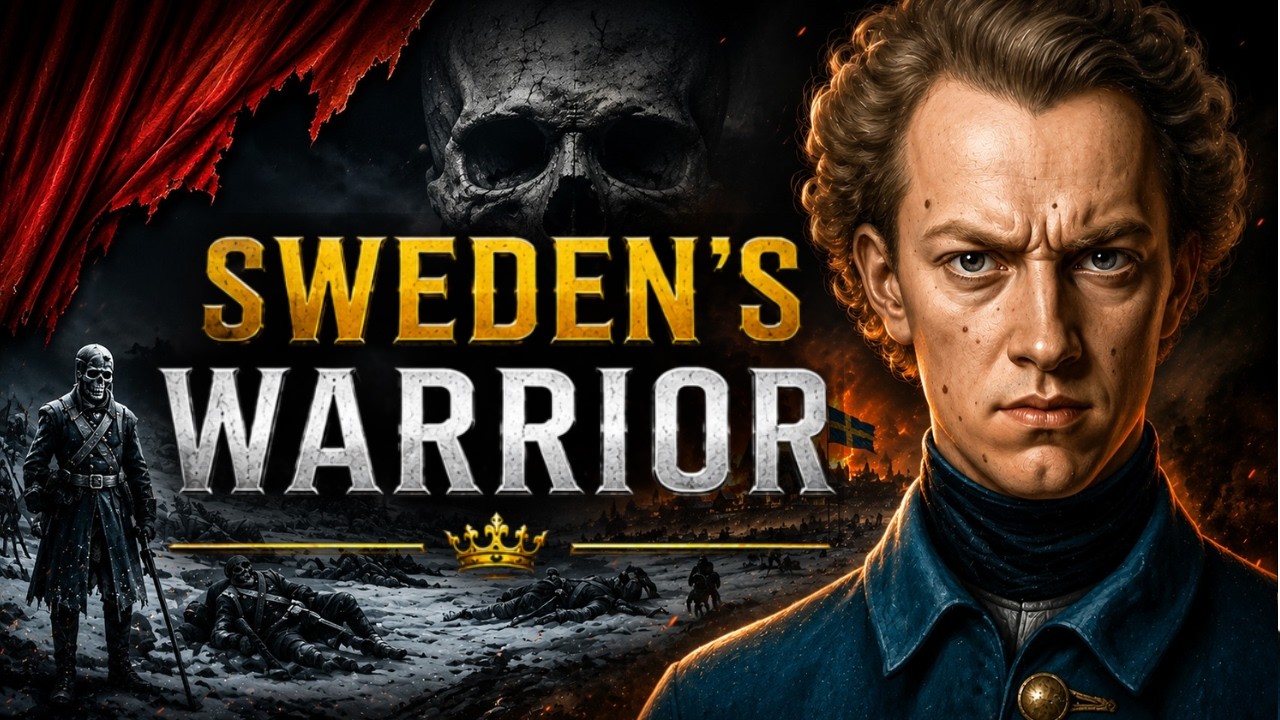
The king’s head snapped back, and he slid down the muddy embankment, dead before his officers reached him. A heavy projectile had entered his left temple and blown through the right side of his skull. There was no panic, no cry for vengeance. Within hours, the siege was lifted, the army marched home, and the Great Northern War, which had consumed northern Europe for eighteen years, simply stopped.
The official version held that the king died from random grapeshot fired by Norwegian cannons. But for centuries, rumors persisted that the bullet came from closer to home. Modern forensic analysis of the preserved skull, examined and x-rayed repeatedly over the years, confirmed that the fatal shot was a slow-moving musket ball that struck horizontally from the left. The trajectory did not match a shot from the fortress.
The evidence strongly suggested that the man who had terrorized Europe was killed not by his enemies but by his own desperate men, soldiers and officers who concluded that the only way to save Sweden was to remove the king who was bleeding it dry. Charles XII was born in 1682 into a state that was less a nation than a military barracks. His father, Charles XI, had spent decades dismantling every institution that could challenge royal authority. The nobility was stripped of its wealth, the parliament was reduced to a rubber stamp, and a brutal conscription network known as the allotment system chained the peasantry to the army.
The old king believed that only discipline, paranoia, and mechanical obedience could protect Sweden from the foreign invasions and aristocratic treachery that had haunted his own youth. Art, diplomacy, and human warmth were treated as weaknesses. The young prince was raised as a component of that war machine. His mother, a gentle and charitable woman, was marginalized by her husband’s regime and died when Charles was eleven.
Her death severed the boy’s last connection to compassion. His education was strictly martial and theological, teaching him the absolute divine right of kings and the belief that compromise was treason. As he grew, he displayed chilling psychopathic traits. He lacked fear entirely, riding untamed horses over icy cliffs and hunting lethal brown bears with only a wooden pitchfork and a net.
He showed no remorse when his dogs were torn apart or his guards mauled. Other people were not beings with rights but expendable props in his tests of endurance. When Charles XI died in 1697, the crown passed to his fifteen-year-old son. The boy immediately dismantled the regency council, forced parliament to declare him of age, and at his coronation refused to bow to the archbishop or take the oath to respect the laws of the realm.
Instead, he lifted the crown from the altar and placed it on his own head. He owed nothing to any man, church, or law. He inherited an empire at its peak. The treasury was full, the borders fortified, and the army was the largest and most disciplined in northern Europe.
His neighbors, however, saw only a vulnerable boy. Peter the Great of Russia wanted a Baltic port. Augustus the Strong of Poland-Saxony wanted lost territories. Frederick IV of Denmark wanted to break Sweden’s stranglehold on Baltic shipping.
In early 1700, the three monarchs launched a coordinated invasion without formal declarations of war, expecting the teenager to panic and beg for terms. They were catastrophically wrong. When the Swedish council erupted in panic, Charles sat in silence, then calmly announced he would never begin an unjust war, but would never end a just one without destroying his enemies. He walked out and never returned to Stockholm alive.
He first struck Denmark, landing troops at Humlebæk and wading ashore through freezing water under musket fire. Hearing the balls whistle past, he told an officer that this would be his music from then on. Denmark capitulated within weeks. He then marched east to face a Russian army of nearly forty thousand besieging the fortress of Narva.
His own force numbered roughly ten thousand exhausted men. Every general advised caution. Charles ordered an immediate attack. On November 20, 1700, a freak blizzard blew into the faces of the Russian defenders.
The Swedes advanced in silence, then hit the earthworks with a bayonet charge. The Russian lines collapsed, thousands drowned in the river, and the rest surrendered. It was one of the most stunning victories in modern military history. It was also the worst thing that could have happened to Sweden.
Narva convinced Charles that he was infallible, that the normal rules of logistics and mathematics did not apply to him. He stopped seeing his soldiers as men who needed food and rest and began seeing them as immortal extensions of his will. Instead of pursuing peace with a broken Russia, he spent the next five years chasing Augustus the Strong across Poland, obsessed with removing him from the throne entirely. During those years, Peter the Great rebuilt his army, conquered weakly defended Swedish Baltic territories, and founded St.
Petersburg on Swedish soil. Peter offered extremely generous peace terms. Augustus begged for terms. A rational statesman would have accepted, secured the empire, and returned home in triumph.
Charles rejected every offer. He refused because peace meant the end of the game, the return to a desk, the end of battle. He viewed Peter and Augustus as dishonorable treaty-breakers who deserved total destruction. Sweden bled for his obsession.
The allotment system devoured the countryside, farms failed, plague swept through the population, and the draft age was lowered. Charles, sleeping on the frozen ground of Poland, was deaf to it all. By late 1706, he had finally forced Augustus off the Polish throne. With an army of over forty thousand veterans, he turned east and ordered a march on Moscow.
Peter the Great understood that he could not beat the Swedish infantry in a pitched battle. So he refused to fight. Russian cavalry burned their own villages, torched the fields, slaughtered the livestock, and poisoned the wells. As the Swedes advanced, they found only a smoking vacuum.
By the summer of 1708, starvation forced Charles to turn south toward Ukraine, where a Cossack leader named Ivan Mazepa promised food and cavalry. The revolt never materialized in strength, and the supply train sent to relieve the army was intercepted at Lesnaya. Lewenhaupt, the commander, burned the wagons rather than let them fall to the Russians. The ammunition, the food, and the winter coats all went up in flames.
Then came the winter of 1708–1709, the coldest Europe had experienced in five centuries. Men in threadbare summer uniforms froze to death mid-stride. Surgeons amputated blackened limbs with unsterilized saws while fully conscious teenagers screamed. Charles drank cold water, slept on the snow in a single cloak, and offered no comfort.
He viewed their suffering as a failure of personal discipline. Retreat would have been an admission of error, and for a divinely appointed monarch, that was impossible. By spring, barely twenty thousand of the original forty thousand remained, dressed in rags, nearly out of gunpowder, their horses eaten. Charles nonetheless ordered this wreck of an army to lay siege to the Russian fortress of Poltava.
On June 17, 1709, a sniper’s bullet smashed through his left foot. He ignored the wound for hours, and by the time surgeons got to it, infection and necrosis had set in. He lay perfectly still while they cut away the dead flesh, watching with detached curiosity. But the infection brought fever, and for the first time in his life, the king could not walk.
Peter the Great arrived with eighty thousand fresh troops and overwhelming artillery. On July 8, the Battle of Poltava was an execution. The Swedish infantry charged into prepared redoubts and was torn apart by grapeshot. A cannonball destroyed the king’s litter, and he was thrown into the mud, placed on a harness between two horses, and forced to watch his army disintegrate.
By noon, the survivors fled. Charles fled south with his elite cavalry, leaving his wounded and his veterans behind. At Perevolochna, the remaining fourteen thousand soldiers, leaderless and abandoned, surrendered without firing a shot. They were marched in chains to Siberian labor camps, where most died building Russian cities.
Charles crossed into the Ottoman Empire and set up court at Bender in modern Moldova. For five years, he refused to go home, spending the Sultan’s money to bribe officials and agitate for a Turkish war against Russia. He ignored the desperate letters from a starving Sweden ravaged by plague and renewed invasions. In 1713, the Sultan lost patience and ordered him evicted.
When Janissaries surrounded his compound, Charles barricaded the doors and fought. The Ottomans brought up artillery, blew the roof off his house, and the burning, soot-covered king charged out hacking at the soldiers until he tripped over his own spurs. They tied him up like a common criminal. Deported in 1714, he rode under a false name across Europe and finally reached Swedish soil in December 1715.
He had not learned a single lesson. Sweden was a nation of ghosts, its men dead in Polish swamps and Russian snows, its farms abandoned, its capital ravaged by plague. Rather than return to Stockholm, he set up a military dictatorship in Lund. With a ruthless financial minister named Baron Görtz, he introduced worthless copper currency that destroyed savings, confiscated iron pots and church bells to forge weapons, and lowered the conscription age to fifteen.
Guards dragged teenage boys and elderly grandfathers into the army. Families hid their sons in the forests. Trapped on the Scandinavian peninsula, Charles launched an invasion of Norway, a strategically pointless campaign fought for the sake of fighting. By November 1718, his starving, demoralized army was stalled outside the fortress of Fredriksten in freezing rain, eating rations cut with sawdust.
The officers knew that as long as he lived, Sweden would never know peace. Then came the shot in the fog. While the main army retreated safely, a secondary force of six thousand under General Armfelt was caught in a blinding blizzard in the Tydal mountains. Lacking winter clothing, roughly three thousand men froze to death in three days, a final blood tax paid by the people for the delusions of their dead king.
Charles XII inherited a wealthy, secure, disciplined empire and treated it as a disposable weapon. He was built by a system that stripped him of empathy, and his inability to feel fear became an inability to value life. His father created an invincible military machine and removed every institutional check on the man who would command it. When he handed that machine to his son, he handed a loaded gun to a child who had never learned what he was aiming at.
The empire was not destroyed by Russians, Danes, or Poles. It was destroyed from within by a king who loved the geometry of the battlefield more than the living citizens he was sworn to protect.
