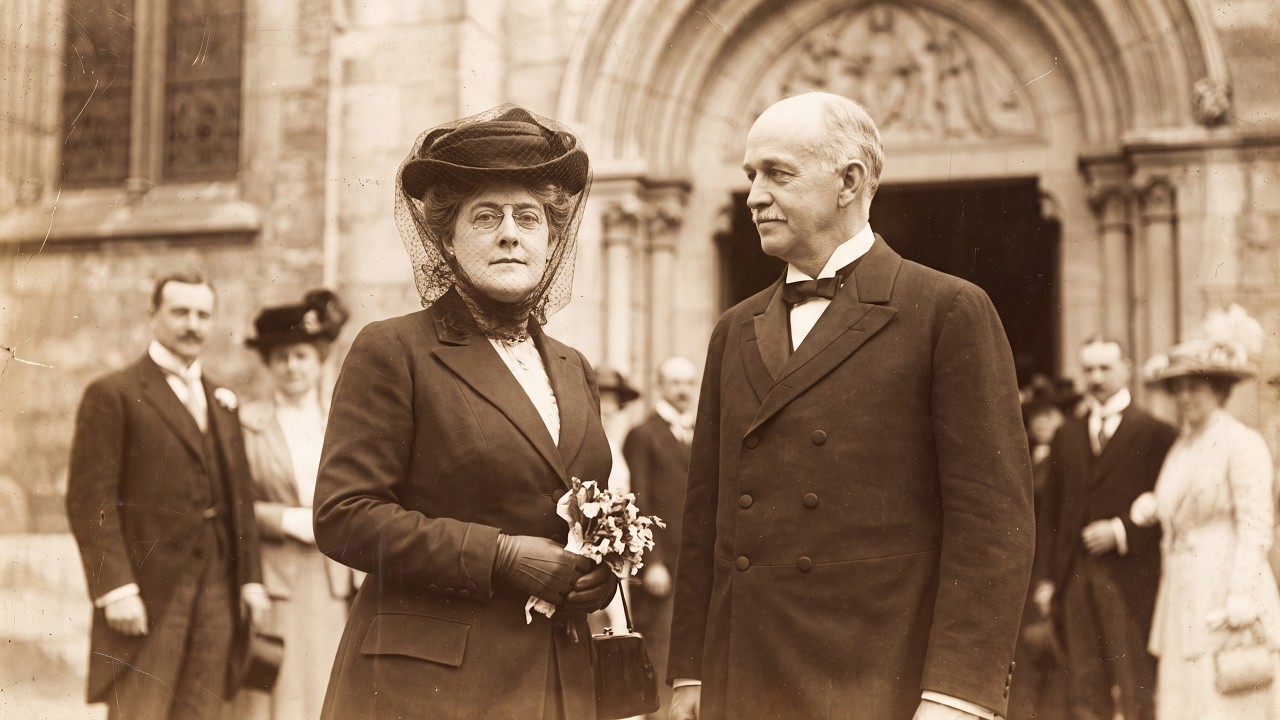
On the sixteenth of July 1913, at noon, inside the American church on the Rue de Berri in Paris, a woman stood before a minister to marry her own husband’s nephew. The guest list numbered barely a dozen. When the register asked her age, she did not tell the truth. She gave a birth year that made her seven years younger than she almost certainly was, on the one document in her life where the truth was easiest to check.
It was not the first time she had done this. It would not be the last. The war that destroyed Richmond, Virginia, also destroyed whatever comfortable life the Yarrington family might have expected to live. Richmond had been the capital of the Confederacy, and by the spring of 1865 it was a city of collapsed banks, burned warehouses, and families who had lost, in four years, every certainty they had once assumed would last their lifetimes.
The retreating Confederate government itself set fire to Richmond’s warehouse district rather than leave its supplies to advancing Union troops, and the fire spread far beyond what anyone had intended, gutting much of the commercial heart of the city. Into that ruined city, a girl named Arabella Duval Yarrington was already growing up, though even that sentence contains more confidence than the record actually supports. Nothing about her birth is settled. Reputable sources, drawing on her own later statements as much as anything else, have found at least five different combinations of birth date and birthplace attached to her name, spanning 1850 to 1857 and covering Richmond, Virginia; Mobile, Alabama; and Union Springs, Alabama.
The most commonly cited modern estimate hedges toward 1850 or 1851, probably Richmond, and calls that a best guess rather than a fact. A passenger manifest she filled out herself in 1921, boarding the ship *Aquitania*, gives a completely different date, the ninth of February 1851, in Mobile. No birth certificate for her has ever been located in Virginia, Alabama, or anywhere else a researcher has thought to look. The closest thing to a scholarly consensus places her birth around 1850, probably in Richmond, but even the sources that lean toward that answer concede they cannot prove it.
Her father, Richard Milton Yarrington, worked as a machinist and carpenter in Richmond and died around 1859, when Arabella was still a young child. That left her mother, Catherine Yarrington, known to the family as Kate, to raise a household of four or five children largely on her own, in a city about to be consumed by its own retreating army. Sources disagree on the exact names and number of Arabella’s siblings, but every account agrees that Catherine was the parent who mattered most in Arabella’s formation. She opened a boarding house on Main Street near the James River, in a district that stood close to the city’s gambling houses and its rougher commercial life.
It was respectable work in the narrow sense that running a boarding house was an acceptable way for a widow to earn money, and it was also, by its nature, work that placed a young girl in daily proximity to transient men, uncertain income, and a neighborhood the city’s better addresses looked down on. For a widow like Catherine Yarrington, the law itself offered little additional protection. A married woman of this era, under the doctrine of coverture inherited from English common law, generally held no independent legal existence separate from her husband, could not freely sign contracts, and could not easily control property in her own name. Widowhood restored a measure of legal standing, but it did nothing to restore capital that had already been lost to war, and it left a woman like Catherine responsible for a household of children with almost no institutional safety net standing behind her.
Decades later, one branch of the Yarrington family would still be found on a ranch outside San Marcos, Texas, a detail that survives only because Arabella’s own will, drawn up more than half a century after she left Richmond, left more than half a million dollars to relatives near Kyle, Texas. By her late teenage years, the respectable path available to a poor girl in Reconstruction Richmond ran through exactly one door, and it was not a respectable one. Sometime around her late teens, in the years just after the war, Arabella Yarrington became associated with a man named John Archer Worsham, the proprietor of a Richmond gambling house. Worsham ran what several sources describe as a faro parlor, the kind of card and gambling establishment that operated in the shadow economy of postwar Richmond, tolerated by the city’s men and disdained by its respectable women.
This is where the story genuinely complicates. Multiple independent sources agree that Worsham had a living wife named Annette, born around 1838 in North Carolina, and a grown son, at the very same time he is associated with Arabella. A Henrico County census from around 1870 reportedly shows Worsham, his wife, and his twenty-year-old son together in Virginia at essentially the same moment Arabella was giving birth to a child in New York under his surname. No marriage record connecting Worsham and Arabella has ever been found by any researcher who has looked.
One genealogical chart summarizing the family’s own uncertainty about this period simply places a question mark next to Worsham’s name and adds the phrase *common law marriage*, an honest admission that nobody actually knows. What almost certainly did happen, based on the pattern every source converges on, is that Arabella began using the name Worsham, presenting herself first in Richmond and then in New York as Belle Worsham, a genteel young widow. This was a constructed identity, a cover story built specifically to explain a woman with a young child and no husband present, in an era when that explanation mattered enormously to how a woman would be received in any room she wished to enter. A widow was a tragic, sympathetic figure deserving of sympathy and social protection.
An unmarried mother in the same period and the same social world was something closer to a scandal, a woman whose respectability could never be fully restored no matter how blameless her actual conduct had been. The difference between those two categories, for a woman with no independent fortune and no powerful family name behind her, was the difference between a life with real options and a life almost entirely without them. On the tenth of March 1870, in New York City, Belle Worsham gave birth to a son, and the paperwork that should have settled who his father was simply does not exist. The boy was given the name Archer Milton Worsham.
No birth certificate survives naming his father, or, for that matter, confirming the precise circumstances of his birth at all. One historical account focused on the Huntington family’s own archives states the situation as plainly as it can be stated: no certificate records the city of his birth or his paternity. Though he celebrated his birthday on the tenth of March every year for the rest of his life, treating a date nobody could officially verify as a settled personal fact. The paternity question that follows from this gap has never been resolved.
One possibility is that John Archer Worsham was the boy’s biological father, consistent with the surname the child was given and the identity Arabella had already built around that name. A second, more consequential possibility is that the father was Collis Potter Huntington, the railroad magnate who by this same period was already one of the most powerful businessmen in the country. The case for Collis rests on several converging but individually inconclusive threads: resemblance to Collis as he grew older, the documented fact that Collis from an early point financially supported Arabella and consistently registered New York property in her name, and some accounts dating the beginning of the relationship to the late 1860s, meaning it could plausibly have overlapped with the timing of the boy’s conception. No DNA evidence exists because none has ever been sought, and no document exists that settles the question either way.
One historical account states that a family tradition, reportedly traced in part to statements Archer himself made later in his own life, held that Collis was his biological father and that the Worsham identity had been arranged specifically to give the birth a respectable public shape. The same account states with equal plainness that no documentary evidence supports it. Collis Potter Huntington was one of the Big Four men who built the Central Pacific Railroad, the western half of America’s first transcontinental line, alongside Leland Stanford, Mark Hopkins, and Charles Crocker, a partnership formed in 1861 behind the engineering vision of Theodore Judah. Collis went on to build the Chesapeake and Ohio Railway, found the city that still carries his name today, Huntington, West Virginia, and establish the Newport News Shipbuilding and Drydock Company, which grew into the largest privately owned shipyard in the entire country.
Contemporary critics called the Big Four among the greatest swindlers in American business history, pointing to their systematic exploitation of federal land grants and political influence to enrich themselves at extraordinary public expense. Collis’s own defense of his methods was characteristically blunt, insisting that his actions had, in his own words, redounded far more to the benefit of California than they had to his own. He remained for the rest of his life one of the most respected men in American business, a distinction Arabella was never permitted to share. By the mid-1870s, while his first wife, Elizabeth Stoddard Huntington, was still living, Collis was already supporting Arabella financially and had begun a pattern that would continue for the next decade: financing New York properties and consistently registering them in her name rather than his own.
Around 1877, still using the Worsham name, she acquired a four-story Italianate brownstone at 4 West 54th Street, a house that would become over the following years both her home and a demonstration of exactly what kind of operator she actually was. In 1881, she had the house enlarged, working with architect G. E. Harney, and commissioned the decorating firm George A.
Schastey and Company to fit it out in the elaborate historical revival styles fashionable among the era’s wealthiest collectors. Her dressing room alone, worked in satinwood and purpleheart wood with intricate mother-of-pearl inlay set into every visible surface, was considered fine enough that it survives today, more than a century later, as a period room at the Metropolitan Museum of Art, still identified by her name from this period: the Worsham Rockefeller dressing room. Every source examining this period agrees that the house at 4 West 54th Street, though financed in its early stages with support from Collis Huntington, was consistently registered in Arabella’s own name. One source estimates that by around age twenty-seven, years before her marriage, she independently owned property valued at roughly $6.
5 million in modern currency. While Collis traveled for business, Arabella is documented as having studied art history and architecture on her own initiative and taught herself French, developing the genuine independent aesthetic judgment that would later shape one of the most significant private art collections in the country. When she finally sold the 54th Street house, fully furnished, upon her 1884 marriage, the buyer was John D. Rockefeller Sr.
, who would go on to live in it for more than fifty years. There is a genuine irony buried inside this arrangement. Under the doctrine of coverture, a legally married woman of this period held no independent standing to own property or sign contracts in her own name at all; her legal identity was absorbed entirely into her husband’s for as long as the marriage lasted. Arabella, precisely because she was not by any surviving record actually married to Collis Huntington during these years, counted in the law’s own eyes as an unmarried woman, and an unmarried woman retained full legal capacity to own, buy, sell, and profit exactly as she pleased.
The very absence of a legitimate marriage that cost her so much in social standing was, in this one narrow and almost accidental respect, the precondition for the financial independence she was busy building. In October 1883, Elizabeth Stoddard Huntington died, and within roughly nine months, her husband’s mistress of over a decade became his lawful wife. The wedding took place in July 1884 at Arabella’s own townhouse at 4 West 54th Street, a detail that carries its own quiet significance: unlike most brides of the era, she was married inside a house she herself had built, decorated, and owned outright. The officiant was the Reverend Henry Ward Beecher, one of the most famous preachers in America, who had himself survived one of the era’s most notorious scandals, the 1875 Beecher-Tilton adultery trial, which had made his own private conduct a matter of national newspaper coverage for months at a stretch.
The interval between Elizabeth’s death and the wedding, roughly nine to ten months, was itself noted by contemporary observers and later historians as unusually short, a detail that fed exactly the kind of disapproval a longer, more visibly respectful mourning period might have avoided. Society was watching, and society did not entirely approve. Within about a year of the wedding, fourteen-year-old Archer Milton Worsham began using the surname Huntington. No document survives showing that Collis Huntington ever legally or formally adopted Archer.
The name change appears to have been exactly that, a name change coinciding with the marriage, granting Archer the social and practical benefits of the Huntington name without necessarily altering the underlying legal question of inheritance. Around this same time, Archer began formal Spanish instruction with a tutor from Valladolid six days a week, the first documented sign of a scholarly devotion to Spain that would define the rest of his life. His education followed a path built for a young man expected to move easily through the highest circles: private tutoring, then the Wilson and Kellogg School and Columbia Grammar School in New York, studying Greek, Latin, English literature, and French history, the last of these subjects taught to him directly by his own mother. He went on to Harvard, to Yale, to the University of Madrid, and to Columbia University.
The marriage also opened a genuinely warm family relationship. Collis’s adopted daughter, Clara Apprentice Huntington, married the German nobleman Prince Franz von Hatzfeldt in London in October 1889, and Arabella, by every surviving account, embraced the occasion with real affection. Collis gave the bride an eighty-diamond necklace; Arabella gave her a diamond star brooch of her own and wrote to a niece from Brown’s Hotel in London, describing the prince as pleasant-looking with charming manners and very bright, adding a line that survives as one of the few genuinely candid personal statements in Arabella’s own hand: “I never want to marry off another girl. Thank Fortune Archer is a boy.
”
For all the millions Arabella Huntington spent on houses and art, one address in New York society never opened to her. The world she had married into included fabulous wealth, a genuine mansion soon to rise on Fifth Avenue, and eventually one of the great art collections in the country. It did not include acceptance by the small self-appointed elite who decided in the 1880s and ’90s who counted as society in New York, the group popularly known as the 400. The comparison that makes this exclusion sharpest is Alva Vanderbilt.
Both women were southern-born. Both arrived in Gilded Age New York carrying comparably new railroad fortunes. Both built lavish mansions on Fifth Avenue within a few years of one another, roughly five blocks apart, Alva near 52nd Street and Arabella near 57th. And both in the early 1880s wanted exactly the same thing: admission into the same tightly guarded social circle presided over by Caroline Astor and her hired social arbiter Ward McAllister.
McAllister formalized the whole arrangement in print, publishing an official roster of acceptable names in the *New York Times* on the sixteenth of February 1892, a list that split old-money families he privately called the Knobs from newer-money families he called the Swells. Neither Arabella nor Collis Huntington appears anywhere on that list. Alva got what she wanted. In 1883, she staged a famous costume ball so magnificent and so socially calculated that it forced even Mrs.
Astor to finally acknowledge the Vanderbilts as legitimate New York society. Arabella was specifically excluded from that same ball. She never received a comparable invitation then or ever for the rest of her life. What every source converges on is Arabella’s premarital history: her years as Collis’s mistress while his first wife was still alive, her association with the Worsham name, and everything that name implied about her earlier life in Richmond.
One account states that even decades later, as late as 1920, a respectable New York matron reportedly saw little real difference between Arabella and a woman who sold herself outright, except in the speaker’s own reported words, that one commercialized her sin more openly than the other. The double standard embedded in this exclusion is the systemic engine driving Arabella’s entire lifelong strategy of self-erasure. Collis Huntington belonged to a group of railroad builders that contemporary critics called among the greatest swindlers in American business history. None of that cost Collis a single social invitation.
Arabella’s own transgression, by contrast, was sexual and reputational, a matter of what she had been before her marriage rather than anything she had done with the fortune since. Gilded Age society forgave the men’s methods of getting rich almost without exception, and refused permanently and without appeal to forgive a woman’s method of arriving at the same table. The same city that had denied a Richmond boarding-house girl any settled record of her own birth now denied the grown woman she had become any settled place in its most exclusive rooms. This exclusion helps explain a pattern that becomes increasingly visible in the years that follow: Arabella’s growing preference for European social circles over the New York establishment that had shut her out so completely.
If the old guard of Fifth Avenue would never fully receive her, there were other rooms, in Paris especially, where a fortune of her size and a collection of her quality could command genuine respect without first litigating the question of who her mother had been, or what name she had once borrowed to survive. The sixteen years of marriage between Arabella and Collis were years of steadily accumulating scale. Collis described his own two great extravagances, in his own words, as books and pictures. By 1886 he was bidding at the Morgan collection auction alongside Arabella, buying individual works priced between $3,500 and $25,500 apiece.
By the mid-1890s, the picture gallery inside their new Fifth Avenue mansion held paintings by Bouguereau, Corot, Reynolds, Romney, Diaz, and Rembrandt. Their San Francisco mansion on Nob Hill, expanded around 1892, eventually held more than 300 paintings and regularly hosted the railroad industry’s own social banquets. On the thirteenth of August 1900, at his camp in the Adirondack Mountains, Collis Huntington died of heart disease, with Arabella at his bedside. He had purchased Camp Pine Knot at Raquette Lake from its original builder, William West Durant, in 1895, and by the account of the period, he had appeared to be in good health that particular day, taking walks and even a steamship trip out on the lake with friends.
Around eleven at night, he was suddenly taken with one of the choking spells he had apparently been subject to before. A doctor arrived within about thirty minutes, but Collis died within roughly forty-five minutes of the first attack. He was seventy-eight years old. His body was carried to the Huntington Mansion at 2 East 57th Street before the funeral, and he was buried at Woodlawn Cemetery in the Bronx in a mausoleum that cost $250,000 and took five years to build.
Arabella’s own words from that winter survive in a letter to her niece, a brief, unguarded line that stands apart from almost everything else she left in writing: “I shall never see or hear that dear face and voice again. Time as yet has helped me very little. ”
The will that followed transformed Arabella’s legal and financial position more completely than anything since her marriage sixteen years earlier. Collis’s total estate is most commonly cited at approximately $50 million.
Arabella received roughly two-thirds of the estate, an amount most reliably placed between $30 and $35 million. Henry Edwards Huntington, Collis’s nephew, received roughly one-third. Archer, the son whose paternity had never been settled and who had never been legally adopted, received no outright bequest at all, only the income from a trust of $250,000. Clara Apprentice Huntington received more than $2 million, an amount later increased to $6 million by agreement with Arabella herself.
The Metropolitan Museum of Art received Collis’s personal art collection, valued at $3 million, and the Fifth Avenue mansion was ultimately willed through the proceeds of its eventual sale to Yale University. Beyond the family, Collis left $125,000 to the Hampton Institute, now Hampton University, and a further sum to the Chapin Home for the Aged. Widowhood restored Arabella to what the law called *feme sole* status: full legal capacity as an unmarried woman, able to own, contract, and control money entirely on her own authority, answerable to no husband’s veto. Collis’s death on the thirteenth of August 1900 is the exact moment Arabella Huntington became, in the fullest legal sense available to a woman of her era, independently one of the richest people in the world, free for the first time in sixteen years to decide entirely on her own authority what to do with $30 to $35 million.
In 1903, a gossip publisher who specialized in extortion sent word to Arabella Huntington, and she paid him more than nearly any of his usual targets ever paid. Colonel William D’Alton Mann ran *Town Topics*, a society gossip magazine notorious for its “Saunterings” column, and alongside it a companion vanity publishing scheme called *Fads and Fancies of Representative Americans*. The scheme worked simply and cynically: wealthy targets were approached and told in effect that for a substantial subscription payment they could secure a flattering biographical profile in the volume, and that declining to pay might result in considerably less flattering material reaching print instead. Typical payments from Mann’s targets ran between $1,500 and $2,500.
Arabella paid $10,000, several times the standard rate. What exactly Mann’s people had on her has never been disclosed, and it has never surfaced in any source available today. The most plausible inference, though it remains inference rather than documented fact, is that it touched on the Worsham years, the unresolved question of Archer’s father, or some other piece of the erased early history she had spent three decades keeping carefully buried. In 1905, Mann’s extortion scheme came apart publicly when he sued Norman Hapgood, an editor at *Collier’s Weekly*, for libel after Hapgood’s magazine ran an exposé of the racket.
During that trial, testimony brought Arabella’s $10,000 payment directly to light, entered into the public record. Facing the possibility of a subpoena that could have compelled her to testify about the underlying material herself in open court under oath, Arabella left abruptly for Europe. By every reasonable reading of the timing, it was a deliberate flight from legal exposure. Set against this same widowhood is the philanthropy Arabella was simultaneously building.
In 1902, she donated $100,000 to establish the Huntington Fund for Cancer Research at General Memorial Hospital, now Memorial Sloan Kettering, described by several sources as the first dedicated cancer research endowment in the country. In 1903, she funded a library at the Hampton Institute in Virginia, and she offered unspecified further support to the Tuskegee Institute and to Harvard Medical School. That same widowhood also saw her purchase, in June 1907, a major Parisian mansion at 2 and 4 Rue de LIS, formerly the Hôtel Deush, once the property of the Empress Eugénie herself, a residence that gave her, in Paris at least, exactly the kind of grand unquestioned address New York had never allowed her. Records held at the Huntington Library document at least twenty-two separate trips she made to Paris between 1882 and 1921, and across roughly twenty years she furnished as many as eight different residences on both sides of the Atlantic.
At least one fragment of her private inner life survives. She is recorded as having heard the Indian teacher Swami Vivekananda speak in San Francisco on the twentieth of March 1900, and in a letter to her niece written sometime afterward, she wrote that a person could obtain such self-control that no loss and no disappointment could make them suffer, adding that she needed all of it herself, and so she was going on with it. Signed simply, affectionately, Belle. In June 1907, Arabella Huntington did something that startled even her own son.
She bought half of an entire European art collection in a single transaction. The Kann collection, a major assemblage of Dutch and French old master paintings and decorative arts, came onto the market that year, and Duveen Brothers purchased the entire collection for $17 million before parceling it out to individual American collectors. Arabella purchased roughly half of it herself for $7 million, the single largest American share of the entire sale. The collection included works attributed to Rembrandt, among them a painting later titled *Aristotle Contemplating the Bust of Homer*, along with works connected to Velázquez, Frans Hals, Roger van der Weyden, Boucher, Fragonard, Watteau, and Goya, plus French decorative furniture carrying royal provenance associated with figures like Marie Antoinette and Madame de Pompadour.
Her son Archer’s reaction is the clearest evidence available of how the people closest to her actually understood what she was doing. Archer, by this point a serious scholar of Hispanic culture and history who had founded the Hispanic Society of America in 1904, privately called the dealer Joseph Duveen a pirate and joked in what sources describe as genuine, if affectionate, alarm that his mother might end up a poor woman at the rate she was spending. This purchase also marks the true beginning of Arabella’s defining relationship with Joseph Duveen, the dominant art dealer to America’s great fortunes in this era. Duveen’s own maxim, repeated widely and accurately, describing his entire business model, held that Europe had a great deal of art and America had a great deal of money.
He built his career connecting the two, counting among his major American clients Henry Clay Frick, Andrew Mellon, J. P. Morgan, John D. Rockefeller Sr.
, and eventually William Randolph Hearst, deliberately cultivating competitive envy among them to drive prices ever higher. His methods extended well beyond the showroom. He is reported to have paid the household staff of wealthy targets to inform him of their employer’s purchase plans, and one of his own employees later boasted that Duveen tracked Andrew Mellon so closely that the contents of Mellon’s own wastebasket reached Duveen’s desk in New York in roughly the time it took the secretary himself to walk home from his office. By 1913, Arabella’s cumulative account with Duveen Brothers already showed past debits of about $52 million, a figure that stands directly against the $30 to $35 million she had inherited from Collis thirteen years earlier.
For seven years, Henry Edwards Huntington told his friends there was nothing between himself and his uncle’s widow. And for seven years, it appears he was not telling them the truth. Henry was Collis’s nephew, the son of Collis’s brother Solon, born on the twenty-seventh of February 1850, which made him, on the best available reckoning, almost exactly Arabella’s own age. Henry had spent decades building his own career inside the Huntington railroad empire before any of this began.
He entered the business through his uncle’s patronage from 1870, managed a sawmill in West Virginia for roughly five years, became superintendent of construction for the Kentucky Central Railroad in 1884 at age thirty-four, rose to vice president and general manager there by 1887, and joined Southern Pacific under Collis directly in 1890, moving to San Francisco to work in its operations by 1892. By 1900, he had risen to first vice president, widely regarded within the family and the company as Collis’s clear favorite and presumed successor. That succession did not happen. After Collis’s death, the Southern Pacific board, blocked by bondholder representative James Speyer, did not select Henry as president, and control passed to the financier E.
H. Harriman. Henry eventually sold his Southern Pacific holdings entirely by 1905 and turned his full attention to California, where he built an independent fortune from the Los Angeles Railway, acquired in 1898, and the Pacific Electric Railway, founded in 1901 alongside banker Isaias W. Hellman, a network that by 1910 and 1911 spanned several hundred miles of track across Southern California.
By 1903, the Huntington Land and Improvement Company, his own real estate vehicle, already controlled more than 8,000 acres across Southern California. On the first of September 1911, in what was known at the time as the Great Merger, Henry sold the Pacific Electric Railway back to Southern Pacific, the same company that had passed him over for its presidency a decade earlier, while retaining the separate Los Angeles Railway for himself. Henry’s first marriage to Mary Alice Prentice had taken place on the seventeenth of November 1873. It ended on the twenty-second of March 1906 in San Francisco Superior Court on grounds of desertion, in a hearing so brief, reportedly around seven minutes, that Mary Alice apparently did not even attend in person.
No alimony was sought. She reportedly sailed for Japan with their youngest daughter the very same day. It is from around this same point, 1906, three years after Collis’s death, that the relationship between Henry and Arabella begins to appear in the family’s own private record. Archer’s own diary written that year captures his reaction with striking honesty.
He recorded going to see his mother and finding Henry there, and wrote that his mother would doubtless marry him, adding that he was not sure it was at all for the best, though he hoped for her happiness regardless. Household bank ledgers from around 1911 and 1912 reportedly record a pattern of gifts sent to Arabella’s Manhattan residence marked with the notation “gift wrapped and delivered,” including $1,500 worth of jewelry from Tiffany and Company, chocolates, sterling silver pieces, and flowers. Publicly, Henry maintained a completely different story. Contemporary newspaper coverage describes years of club gossip and speculation about a possible match, speculation Henry had, by the papers’ own account, repeatedly and explicitly denied, including during a visit home in the winter just before the eventual announcement.
Henry obtained his first passport only in 1912 and traveled to Europe for the first time in his life in May 1913, specifically to be with Arabella ahead of the wedding. On the sixteenth of July 1913, in a small ceremony at the American church in Paris, Arabella Huntington married the nephew of the husband she had buried thirteen years before. The wedding unfolded across three separate steps: a civil registration in Los Angeles in April of 1913, described by sources as the legally operative ceremony; a civil ceremony before the mayor of Paris; and finally, on the sixteenth of July at noon, a religious ceremony at the American church with Reverend William G. Allen presiding, attended by a small guest list of roughly ten to twelve people, including Archer and his first wife Helen, Clara Apprentice Huntington, by then known as Princess von Hatzfeldt, Henry’s private secretary, and a handful of family friends.
Four days before the wedding, the couple signed a prenuptial agreement. In the days leading up to the ceremony, Henry stayed at Joseph Duveen’s own suite at Claridge’s Hotel in London, and the dealer, who had already absorbed $52 million of Arabella’s spending, reportedly helped plan the wedding itself. On the marriage certificate, Arabella gave her birth year as 1857, which would have made her fifty-six years old at the ceremony. The best available modern reckoning places her actual birth closer to 1850, meaning she was very likely presenting herself as seven years younger than her true age.
Henry, born in 1850, was sixty-three years old at the wedding. Arabella, on the best modern reckoning of her own birth, was very likely the same age, sixty-three, far from the much older woman marrying a much younger nephew that the phrase “aunt marries nephew” implies to a modern ear. The press treated the marriage as a genuine scandal from the moment it broke. Contemporary coverage described the union as having shocked San Francisco society, and headlines ran with language chosen for maximum effect, describing Arabella as marrying her nephew rather than the more precise and considerably less scandalous “nephew by marriage.
” The couple did not rush home to face whatever reception awaited them. Their honeymoon stretched across five months in Europe, and rather than return immediately to a United States still absorbing the news, they leased the Château de Beauregard outside Paris for a full ten years, settling into a household staffed by twenty-one servants and nine gardeners before they had even faced New York or San Francisco society as a married couple. By the time they finally returned to the United States in late October 1913, the sharpest edge of the initial scandal had already begun to dull. Henry’s own private feelings about the marriage survive in a letter to his sister Caroline, written shortly afterward.
He could not tell her how quickly the years had passed, he wrote, and yet how slowly, while he waited for the most cherished thing in his life to finally come to him. But now, he continued, all that he had hoped for had come to him, and he and Belle were so very happy. After 1913, Arabella Huntington became, in the words of the household staff themselves, the boss of the house at San Marino. Henry had already built the foundation of what would become their shared estate before the marriage even took place.
He had purchased the 500-acre Shorb Ranch on the second of January 1903, hired architects Myron Hunt and Elmer Grey to design a mansion completed in 1911, and had entirely independently already begun an intensive rare book collecting career. What Arabella brought to this already substantial foundation, beginning in January 1914 when she first visited San Marino six months after the wedding, was decades of independent taste, an established relationship with Joseph Duveen, and a decisive hands-on authority over how the household actually functioned day to day, working directly with staff including head butler Alonso Gomez and estate superintendent William Hertrich. The couple’s life across these years followed an extraordinary nomadic pattern, maintaining five separate residences at once and moving between them on a fixed seasonal schedule. There was the New York mansion at 2 East 57th Street, staffed by eighteen to twenty-five servants.
There was the Westchester County homestead at Throgs Neck with roughly twenty-five servants of its own. There was San Marino itself, which employed as many as 110 people by the late 1910s during the construction of the library building. And there was the leased estate outside Paris, the Château de Beauregard, taken for a ten-year term running from 1913 to 1923, staffed by twenty-one servants and nine gardeners at a cost of roughly $75,000 a year in lease fees alone, on top of about $100,000 spent on renovations. The couple typically spent only three to five months a year actually at San Marino, January through May, before decamping to Europe for the summer, where Arabella celebrated her self-reported birthday every June, then returning to New York each winter for the social season.
They traveled between properties in two private railroad cars they had nicknamed *San Marino I* and *San Marino II*. The depth of Arabella’s authority within this arrangement is documented most vividly in Joseph Duveen’s own surviving correspondence. In letters recommending specific pieces for the estate, Duveen consistently addressed Henry while explicitly treating Arabella as the household’s ultimate taste authority. In one letter concerning bronze sculptures for what became known as the Boucher Room, Duveen wrote that the introduction of darker decorative notes had always won the approval of great artists, comparing the effect to a ballet in which brilliant color is heightened by the introduction of a few figures dressed in black, and urged Henry to study this theory out with Mrs.
Huntington, since Duveen was certain it would appeal to them both equally. Duveen shipped goods to the estate on his own initiative more than once, letting the Huntingtons decide whether to keep them only after the goods had already arrived, including on one occasion an eighteenth-century French bronze sent unbidden with a note describing himself as having taken the bull by the horns. The collecting itself continued at a pace that rarely slowed. In 1909, five Beauvais tapestries known as the Noble Pastorale, woven decades earlier to designs by François Boucher, were purchased from Duveen for $577,000, alongside a Gobelins tapestry furniture suite bought from the dealer Jacques Seligmann for approximately $3 million.
In 1915, two Louis XIV Savonnerie rugs from the collection of J. P. Morgan were added for roughly $2. 6 million.
Across the full span of the marriage, the household’s total spending on French art alone is estimated at approximately $58 million. The single largest individual purchase came in 1921, when Henry bought Thomas Gainsborough’s portrait known as the *Blue Boy* from Duveen for a price most reliably cited at $728,000, described at the time as the highest price ever paid for a painting. Before the painting left England, it was exhibited at the National Gallery in London, where roughly 90,000 people came to see it in the space of a few weeks. Arabella Huntington died on the sixteenth of September 1924 in New York City, and even her own funeral could not settle how old she had actually been.
Depending on which of her own competing self-reported birth years is used, she was somewhere between sixty-seven and seventy-four years old at the time of her death. Months earlier, in February 1924, she had sat for a portrait by the painter Oswald Birley and had objected strenuously to being painted at all that year, fearing how it might look to the public given the family’s plans for the future museum. When Birley’s first attempt was finished, she rejected it outright and had him begin again, telling him plainly that he had painted Mr. Huntington very well, as he was that day, but that he had taken away all her wrinkles and made her look young.
Her will directed the bulk of her fortune and her entire personal art collection to her son Archer, with Henry and Archer serving together as co-executors of her estate. One source places her estate’s value at the time of her death at over $32 million, growing to $35 million by 1927 through continued investment. Her jewelry alone ran to roughly 120 separately cataloged pieces by the time of her death, among them a gold sunburst brooch set with 145 diamonds totaling 70 carats valued at $23,000; a platinum necklace carrying 830 diamonds and seven emeralds valued at $18,500; and a gold chain set with 119 diamonds valued at $135,275. Archer sold the entire collection to the dealer Harry Winston in 1925, reportedly because Archer’s second wife, the sculptor Anna Hyatt Huntington, considered the pieces too showy for her own taste.
Archer also donated a portion of her French decorative arts collection, the pieces that had originally furnished her New York mansion, to the Palace of the Legion of Honor in San Francisco. Arabella is buried in California, in a mausoleum built on the grounds of the Huntington Library in San Marino, constructed in 1926 and 1927, alongside Henry when he died three years after her in 1927, far from Woodlawn Cemetery in the Bronx, where the elaborate $250,000 mausoleum Collis had built for the Huntington family holds Collis himself, his first wife Elizabeth, and later Archer and his own wife. At Woodlawn, in the mausoleum built for the family she married into first, she is remembered only by a cenotaph, a memorial marker for someone buried somewhere else entirely, sculpted in 1951 by her own daughter-in-law, Anna Hyatt Huntington, depicting an elderly woman offering symbolic gifts, a book, a lamp, a time dial, to a young couple standing before her. When the Huntington Library opened to the public for the first time on the twenty-eighth of January 1928, admitting just 250 visitors that opening day, its very first dedicated installation was not named for the man who had funded it.
The day before the general public opening, on the twenty-seventh of January, the Arabella D. Huntington Memorial opened in four reconfigured rooms at the west end of the library building. Henry had commissioned Joseph Duveen to assemble the collection specifically as a memorial to his late wife, gathering 116 pieces of eighteenth-century French sculpture and decorative art from Duveen’s own stock and other dealers across three cities in just two months at a cost of roughly $31 million. Its French room displayed the decorative arts Duveen had assembled, lit by crystal chandeliers, its walls covered in fine damask.
Its Italian Renaissance room, displaying paintings that had previously hung in Arabella’s own Manhattan mansion, retained the original red velvet wall covering physically transplanted from her New York home. Press coverage called the opening the most important cultural event to take place in greater Los Angeles. Three years later, in a letter to his stepson Archer, Henry described the finished collection in terms that leave little doubt about what it actually meant to him: the collections had cost several millions, he wrote, and were quite worthy, in their beauty, of the lovely character which they had both loved. Henry E.
Huntington was alive, wealthy, and fully capable of naming the institution’s first public room for himself when the library finally opened. He named it for her instead.
