The knockout blow to a nine-year-old girl, but nothing like the sound she had known all her life. Every other morning of her daughter’s life had ended the same way. Colleen’s overnight shift would finish, the door would open, and no matter how many hours she had spent stocking shelves in the dark, she would hear feet pounding down the hallway toward her at full speed, arms out, as if she had been gone for years instead of hours. A door, footsteps, a nine-year-old girl who could not wait one more second to say hello.
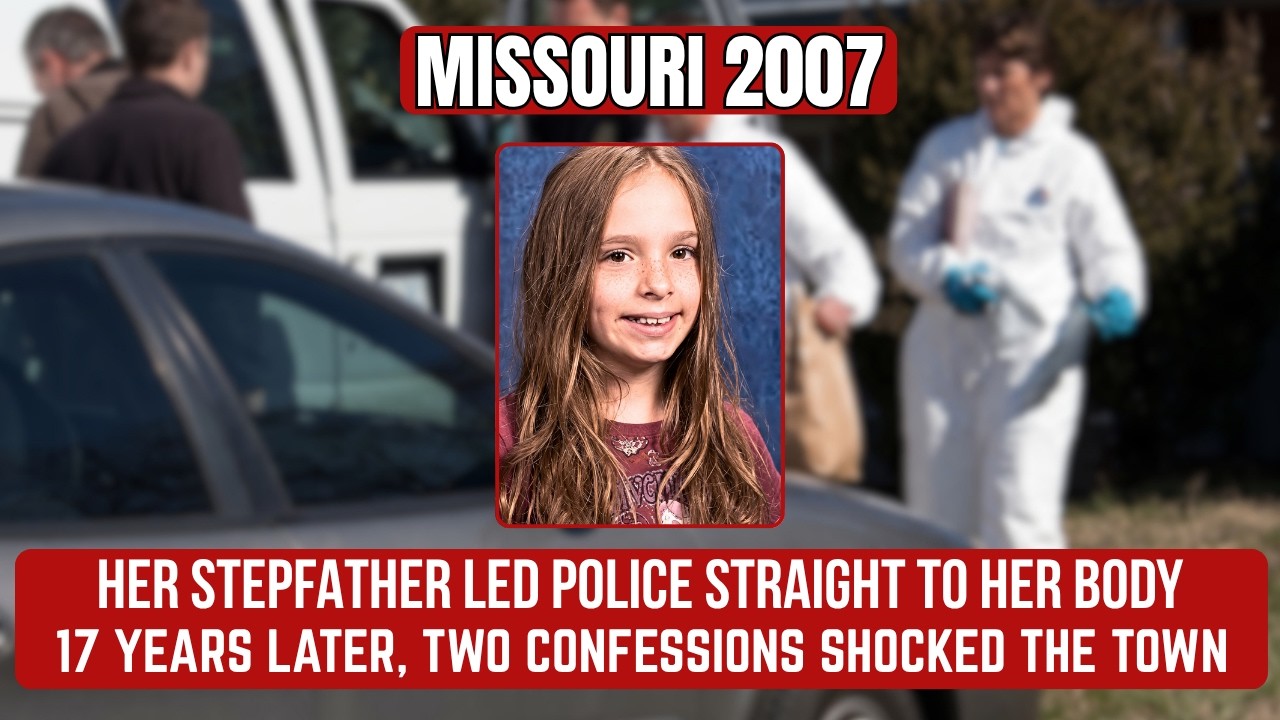
That morning, there was only silence in a house that had never once been silent like that before. Colleen would spend the rest of her life trying to understand what happened in the hours she was not there to hear. Six days later, after a relentless search across McDonald County, the search ended in the Ozark woods. Rowan was found on a narrow rock ledge inside a hole in the earth locals called Fox Cave, though calling it a cave was generous.
She was nine years old, in the fourth grade, and the man who put her there had spent every one of those six days standing beside her mother, walking through fields with search parties, telling anyone who would listen how worried he was. Rowan had a name for him. It was the kind of name only a child gives to someone she has decided, completely and without hesitation, that she can trust. She called him Uncle Chris.
Rowan Damia Ford was born on the 11th of April 1998 in San Diego, California. By the time she was nine, she was living with her mother and her stepfather, David Wesley Spears, in a corner of southwest Missouri so small that everyone recognized everyone else’s car on the road. She was the youngest of five siblings, sister to James, Robert, Janice, and Arian, and by every account the gentlest of them. Her bedroom was painted Barbie pink.
Her favorite color was purple. Her prized possession was a blue bicycle she had only just learned to ride that summer, and she rode it constantly past the same handful of houses, waving at the same handful of neighbors. She loved Hannah Montana, spaghetti, drawing, and books about cats. She had just learned to swim.
But the thing people remembered most about Rowan wasn’t any of that. It was church. She loved it so much that she sometimes walked there alone, arriving before the pastor did, sitting on the front steps just in case anyone needed help setting up. Nobody asked her to do that.
She simply decided that was who she wanted to be. Her fourth-grade teacher, Todd Holt, testified years later that Rowan showed up to school and it was all about the work, all about getting ahead. Another teacher called her a little ray of sunshine. Home was not always easy for her.
Some mornings she came to school without socks in the middle of a Missouri winter. Her hair was sometimes matted and unwashed. Her teachers noticed and quietly, without ever making her feel small for it, they helped where they could. On the morning of what would become her last day, a teacher named Tammy Marshall noticed Rowan’s hair was especially tangled and pulled her aside before class.
Thirty minutes of working through every knot until it sat in a neat ponytail. That afternoon, Tammy went looking for her to see if it had held up. She found Rowan skipping down the hallway alone, grinning, looking, in Tammy’s words, like everything was great. That was the last time anyone at Triway Elementary School ever saw her alive.
The man Rowan called Uncle Chris was Christopher Leroy Collings, thirty-two years old, a longtime friend of her stepfather’s. Earlier that year, he had needed somewhere to stay, and David Spears had opened his door. Collings moved into the basement, ate at their table, and sometimes helped Rowan with her homework. She looked up to him the way children look up to any adult who is kind to them consistently.
What almost no one in Stella knew was that Collings was by then separated from his own wife, and that he had three children of his own, all of them living in Arkansas with their mother. He had helped a little girl who was not his blood with her homework at a kitchen table, while his own children grew up somewhere else entirely. By late October of 2007, Collings had moved out to a travel trailer on his family’s farm in Wheaton, a different town about ten minutes east along State Highway A. Different address, same trust.
Friday the 2nd of November: David Spears, Christopher Collings, and their mutual friend Nathan Mahurin finished a day of farm work, stopped at a liquor store, and went back to David’s house in Stella to shoot pool and drink. At eight that evening, Colleen kissed her family goodbye and left for her overnight shift. Rowan was already asleep on the floor of her bedroom. As far as her mother knew, her daughter was safe, her husband was home, and nothing about the night was unusual.
The three men kept drinking. At some point, Collings suggested moving the party out to his trailer in Wheaton. David agreed. They left a nine-year-old girl alone in a dark house without anyone deciding it mattered.
Around midnight, Nathan Mahurin was ready to call it a night. He had been drinking too much to risk State Highway A, where patrol cars sometimes ran, so he took the back roads instead, the slower way, dropping David at his house before driving himself home. It should have been an unremarkable decision. Instead, it created a window.
If Nathan was taking the long way around, and Collings took the highway, the direct route, he could reach David’s house before either of the other two men made it back. He did the math. He got in his truck. He drove fast.
Inside the house, everything was dark and quiet, and Collings moved through it like a man who had lived there, because he had. He knew exactly where Rowan’s bedroom was. She was still asleep on the floor when he lifted her without a sound and carried her out to his truck. She never woke on the drive back to Wheaton.
Inside the trailer, he kept every light off and never once let himself speak, because he did not want her to recognize his voice. This was not a man losing control. This was a man executing a plan, one careful, deliberate choice after another. Rowan woke inside that trailer, and she fought.
Christopher Collings stood six foot three and weighed over three hundred pounds. She was nine years old, and she never had a chance against that. Afterward, by his own account, he told himself he would take her home. He led her out of the trailer, holding her from behind, keeping her turned away so she could not see his face.
Every detail had been controlled up to that point. What he had not accounted for was the moon. It was a clear November night, and somewhere on that walk, Rowan turned her head and looked back over her shoulder. Moonlight caught his face, and she knew him instantly.
The man who had eaten dinner at her table. The man who had helped her with homework and let her call him Uncle Chris. In the version he later gave to police, he said he panicked. There was an old pickup truck sitting on the property, and coiled in its bed was a length of rope.
He reached for it. In a field outside Wheaton, Missouri, Rowan’s life was tragically taken by a man she had trusted. He drove south into McDonald County to the sinkhole known as Fox Cave and lowered her onto a ledge twenty feet down. He tried pulling branches over the opening to hide it, but the hole was too wide, and the branches fell in beside her.
He drove home, found forensic evidence inside his trailer and on his clothing, and spent the rest of the night destroying it. His clothing, the rope, and other materials were burned that night in a wood stove and a metal drum behind the property, so no evidence would remain. Then Christopher Collings went to bed. The next morning, he would be one of the first people to show up and help search for Rowan Ford.
Colleen came home at nine that morning to a silent house. No footsteps. She checked every room and found nothing. Then she found David asleep on the couch and shook him awake.
Where is Rowan? He said she was at a friend’s house. Which friend? He didn’t know.
Colleen began calling every family Rowan had ever visited, and every answer came back the same. Nobody had seen her. She told David they needed to call the police immediately. David told her to wait, that Rowan would turn up, that she was overreacting.
So she waited, because he told her to, through the morning and into the afternoon, until the light started to fade and the phone still hadn’t rung. At ten minutes to seven that evening, nearly ten hours after she first found the house empty, Colleen called 911 herself. Newton County Sheriff Chris Jennings took the case immediately, and an Amber Alert went out within the hour. In a town of under two hundred people, that meant almost everyone was outside within minutes, flashlights sweeping fields, voices calling Rowan’s name into the dark.
By the 5th of November, the FBI had joined the search alongside officers from three counties, the Missouri State Highway Patrol, and dozens of specialists. All of them were looking for one nine-year-old girl and getting nowhere. Nathan Mahurin was questioned too, repeatedly, about a night that for him had ended in the most ordinary way possible: a long drive home on back roads and a bed he reached sometime around midnight. He was never charged with anything, and investigators found no evidence he had known what Collings intended.
But the detail of his route stayed with the case for years afterward: a small, unremarkable choice that had, without his knowledge, handed another man exactly the head start he needed. David Spears became the first serious suspect. And it wasn’t difficult to understand why. He had waited eight to ten hours to report his own stepdaughter missing.
His story kept shifting under questioning. Eventually, pushed hard enough, he admitted he had left the house again that night at one in the morning, borrowed his mother’s car, and been gone for five and a half hours with no account of where he went. “We caught him in several lies,” Sheriff Jennings would later say. “His story changed multiple times.
”
And then there was Christopher Collings, delivering one of the most calculated performances investigators would ever see. He showed up at the sheriff’s office on his own before anyone called him in. He agreed to a polygraph and a voice stress test. He gave the same consistent account every time he was asked.
He drove to Colleen’s house to check on her. He offered to wear a wire. He suggested places to search, and he told the FBI he believed David was involved. He wasn’t simply acting innocent.
He was actively steering the entire investigation toward someone else with both hands. And for a while, it was working. It wasn’t working on one man. Wheaton Police Chief Clinton Clark had known Christopher Collings for seventeen years, since Collings was a boy.
He had known his adoptive parents. He had been the person Collings called when his mother died. On the 5th of November, Collings flagged Clark down during a routine patrol, talking about how worried he was, how hard he was working to help find Rowan. But he wouldn’t hold Clark’s gaze.
In seventeen years, that had never happened before. Clark called the FBI that same afternoon. Their answer shaped everything that followed. If Christopher Collings was ever going to break, it would not happen in an interrogation room under federal agents.
It would happen with Clark, because Collings trusted him. And that trust, built over seventeen real years, was now the most useful thing investigators had. On the 7th of November, Collings consented to a DNA swab and signed forms to search his trailer, his truck, and a safe he kept at David’s house. Still cooperative, still performing.
But when investigators finally pushed him directly about Rowan, something in him gave way. He grew emotional, told them that if they were going to accuse him, he was done talking, and walked out. That night, he found Clark visibly shaken. He said he was going to stop talking to anyone.
He said he might need a lawyer. Clark read him his rights. Collings signed the waiver, and sitting across from a man who had known him nearly his whole life, he began to cry. He said he would never have hurt her.
He said he loved her. Someone interrupted them before he could say anything more, and Collings left. Clark called the FBI immediately. “He’s at his breaking point,” he told them.
“We’re running out of time. ”
The next day, an investigator named Mark Bridges, who had once employed both David and Collings at his automotive shop, spent the entire day with David under FBI surveillance, wired, with a plane quietly tracking their movements overhead. At one point, Bridges asked David to think like Collings. If you were Chris, where would you take her?
David went quiet for a moment. Then he said, “Let’s go look at some places. ”
The first place he led them to was a sinkhole in the woods of McDonald County. Bridges stood at the edge and saw items near the opening he couldn’t identify.
He would later say he believed David wanted to be found out, that he hadn’t led them there by accident. On the 9th of November at eight in the morning, deputies Mike Hall and Jake Boss lowered themselves into Fox Cave and located her remains twenty feet down, confirming the outcome everyone had feared for six days. She had been there six days. Six mornings her mother had woken up without her.
Six mornings her classroom teacher had looked at an empty desk he could not bring himself to clear. Six mornings hundreds of volunteers, most of whom had never spoken a word to Rowan Ford while she was alive, had pulled on boots and walked fields and creek beds, calling a stranger’s child’s name into the cold, because that was simply what a town of under two hundred people did for one of its own. Chief Clark heard the news over his car radio. Before he could process it, his office called.
Collings had already come by that morning, asking what time Clark started his shift, saying it was urgent. Clark drove through Wheaton looking for him and found nothing until his phone rang. Collings asked whether police were following him in a gray minivan. He said he’d been driving in circles for hours trying to lose them.
He said he felt threatened. A man supposedly helping search for a missing child had spent the morning she was found convinced he was the one being watched. Clark told him to come to the station. Collings refused, said he would only meet in person.
When they finally met, Collings got into Clark’s patrol car, and Clark told him what the FBI had asked him to say. “It’s over, son. We found Rowan this morning. ”
Collings’s head dropped.
His eyes filled. At the station, there were too many people around, so Clark suggested somewhere quiet, and Collings named a spot outside town called Mooney Bridge. When they stepped out of the car, Collings turned to Clark and held out both wrists, waiting for handcuffs. Clark told him it wasn’t necessary.
Collings looked at him and said, “It will be. ”
Sitting on the slope near that bridge, he told Clark everything. The drinking, the pool table, Nathan’s decision to take the back roads. Then he kept going.
How he took the highway instead. How he reached the house first, walked to Rowan’s room, carried her out while she slept. How he kept the trailer dark and stayed silent so she wouldn’t recognize his voice. How she woke and fought.
And how afterward he meant to take her home, keeping her turned away from him in the dark, until the moon caught his face and she knew him. Crying, he told Clark how panic took over, leading to an act that ended Rowan’s life. He described the cave, the branches that wouldn’t cover the hole, the drive home, the wood stove, the drum in the barn. Clark, a man who had sat with this family through seventeen years of ordinary life, had to stop repeatedly during his own later testimony, holding back tears.
They drove back to the station, where Collings repeated the full confession in front of deputies from two counties and the FBI, then gave a second videotaped statement at the Barry County Sheriff’s Department. Same story, not a single contradiction. Every investigator in that room had spent the past week certain David Spears was the one responsible. They had built their entire theory around him.
They were wrong about that, but they were about to learn the case wasn’t finished handing out contradictions. Once David Spears learned that Collings had confessed, he broke completely, and what came out of him stopped the room cold. He said that when he got home that night and found Rowan gone, he knew immediately what Collings had done. So he borrowed his mother’s car and drove to the trailer.
And once there, he said, he joined in. According to his own interrogation, David claimed to investigators that he had been present at the property later that night. Investigators carried that account straight back to Collings. Every single time, his answer was the same.
David was not there. David had nothing to do with any of it. Not the abduction, nor what followed. Two men, two confessions pointing in opposite directions, and both of them could not be true.
The physical evidence overwhelmingly supported Collings. His trailer, his truck, the burned rope and clothing, the sinkhole itself, all of it matched what he had described down to the smallest detail. But David Spears could not simply be dismissed either. Specialized search dogs working separately all alerted to critical evidence inside the car David had borrowed that night, at the driver’s door, the seat, and the rear cargo area.
That was the same car he had driven for five and a half hours with no explanation. Investigators also found troubling material on David’s home computer unrelated to that night. And still, no forensic evidence placed him inside Collings’s trailer. And Collings, who had nothing left to protect by that point, never once wavered on David’s innocence.
Prosecutor Johnny Cox explained the impossible position this created. In every statement to police, Collings had admitted personally causing Rowan’s death. To prosecute David for the same crime, the state would have had to argue that both contradictory confessions were simultaneously true, which risked giving Collings’s own defense grounds to overturn his conviction entirely. “There was no physical evidence that would have supported convicting David Spears,” one investigator said plainly.
As hard as it was, the prosecutor did what the case required. The charges against David Spears were dropped. He pleaded guilty instead to child endangerment and hindering prosecution, was sentenced to eleven years, and with credit for time served since his 2007 arrest, walked out of prison in the spring of 2015. Both men originally faced the maximum charges under Missouri law, and prosecutors announced they would seek the ultimate sentence against both of them.
Both pleaded not guilty. Because of the intense publicity the case had generated across southwest Missouri, each man was granted a change of venue, and the cases were split: Collings to stand trial in Phelps County, Spears in Barry County. It would be four more years before either case reached a jury. In March of 2012, five years after that night, Christopher Collings stood trial for what had happened to Rowan, before a jury brought in from Platte County, seated in a Phelps County courtroom because the publicity around the case had made a fair trial in his own community impossible.
David Spears, by then still awaiting his own separate trial in Barry County, was called to the stand as a witness and largely invoked his right against self-incrimination. Jurors watched the videotaped confession Collings had given at Mooney Bridge play out on a screen in open court. His defense argued a childhood spent shuttled between biological and adoptive parents, time in foster care, a diagnosed dissociative attachment disorder, and severe emotional neglect from infancy. They argued the attack had been unplanned, a panic rather than an intention.
Even Collings’s own father took the stand for the defense, telling the jury that no matter what his son had done, he loved him. The jury heard it, and then they heard from the people who had loved Rowan. Colleen took the stand and described being hospitalized for psychiatric care six months after her daughter was found. “There’s not much of a life,” she told the court.
“I cry a lot. ” Rowan’s older sister, Arian, said she collapsed to the floor when she heard and that the whole family fell into depression. The mother of Rowan’s best friend described how the two children used to sit together in church, how her own son couldn’t sleep alone for months afterward, how she still bought a Christmas ornament for Rowan every single year. And Todd Holt told the court he would never again walk into that classroom without knowing exactly where Rowan’s desk had been the day she disappeared, and exactly where it sat empty the day they learned she was gone.
That testimony took a toll. The jury deliberated for forty-eight minutes. They found Collings guilty of first-degree murder, and in the penalty phase they found that what happened to Rowan had been outrageously and wantonly vile, and that her life had been taken specifically to silence the only witness who could identify him. That witness was nine years old.
They sentenced Christopher Collings to death. What followed was twelve years of appeals. In January of 2014, Collings’s new legal team asked the Missouri Supreme Court to overturn the sentence, arguing his original trial attorneys had failed him. That appeal was rejected that August.
A second appeal filed on similar grounds was rejected in March of 2018. From there, the case moved into the federal courts, where a district judge dismissed his petition in the fall of 2022, and the Eighth Circuit Court of Appeals turned down the next round in January of 2023. In April of 2024, the United States Supreme Court declined to hear the case at all. Every door, one after another, closed.
And through every single one of those twelve years, Colleen and Arian kept showing up, kept reading the rulings, kept waiting for a date that never seemed to arrive. Missouri’s attorney general moved almost immediately to schedule an execution. And in August of 2024, the state supreme court set the date. His lawyers argued brain abnormalities and childhood trauma in a final clemency petition, joined by religious groups who asked the governor to intervene on moral grounds.
Governor Mike Parson denied it, stating that Collings had received every protection the state and federal constitutions provided, and that his conviction would stand for what the governor called a horrendous and callous crime. On the eve of the execution, the United States Supreme Court turned away one last request for a stay. On the 3rd of December 2024, the day Rowan would have turned twenty-six, witnesses gathered at the state prison in Bonne Terre, Missouri. Behind glass sat Colleen and one of Rowan’s brothers.
Also present was Sheriff Chris Jennings, retired now, who had taken the original missing person call seventeen years earlier and carried Rowan’s school identification card in his pocket every day since. The state carried out the sentence for Christopher Collings, bringing the judicial process to a final close. He spoke briefly with a spiritual adviser at his side and was declared dead nine minutes later. His final written statement read in part, “Right or wrong, I accept this situation for what it is.
To anyone that I have hurt in this life, I am sorry. ”
Rowan’s sister, Arian, gave a different kind of statement afterward. “I wanted him held accountable,” she said. “I still do, but the sentence felt too easy compared to what my sister went through.
I cannot even imagine what my little sister went through in her final moments with him being so tall and big compared to her. ”
David Spears watched none of it from that room. He had been released nearly a decade earlier, and while still on probation went to work for the Missouri State Public Defenders Office, the same office that had represented both him and Collings at trial. He was still working there more than a year after the execution, a fact that drew objections from state lawmakers uncomfortable with taxpayer money paying the salary of a man once charged in connection with his stepdaughter’s death.
When a reporter called him at that office in December of 2024 to ask about the execution, he said only that she had called him at work, that he had no comment, and asked her not to call again. Two men: one executed, one still answering phones at a public defender’s office. Mick Epperly, the Barry County Sheriff who had led the original investigation back in 2007, said before the execution that in an entire career in law enforcement, he had never come across a case that stayed with him the way this one had, and that whatever doubts remained about David Spears, Christopher Collings had earned exactly the sentence the jury gave him. Colleen filed for divorce the same month her daughter was found, unable to remain in the house or look at the man who had told her to wait ten hours before calling the police.
She was hospitalized twice in the years that followed. “I just couldn’t take anymore,” she said once. “I’m under psychiatric care right now, trying to get my life back to something of a life. ”
Something of a life, in the end, was what remained.
Rowan’s funeral was held at a church in nearby Neosho, and mourners filled it well past its ordinary capacity: neighbors and strangers alike who had spent six days searching fields for a girl most of them had never met before that week. In 2019, a local writer named Randy Turner published a book on the case titled Lost Angels, examining what had happened to Rowan alongside another unsolved Missouri disappearance, so that her story would not simply fade into a court docket once the appeals ran out. The morning before Rowan’s funeral, the students and teachers at Triway Elementary planted a pink dogwood tree in her honor and released purple balloons into the sky, each one carrying a handwritten note. A small concrete angel was placed at the site, marked with two dates nine years apart.
In April of 2025, on what would have been her twenty-seventh birthday, Triway Elementary dedicated a permanent marble memory bench in her name, built to outlast the markers that had come before it and been lost. Todd Holt drove in from Springfield. He said he wouldn’t have missed it for anything. Tammy Marshall, the teacher who had spent thirty minutes brushing Rowan’s hair on the last morning anyone saw her, said Triway had been the place Rowan felt safest, the place she always wanted to come.
“This will show her,” Marshall said, “that no matter how many years, we still remember her. ”
Days before she disappeared, Rowan’s older sister had moved out of the house. Rowan had written about it in a diary her sister left behind. Dear diary, my sister moved.
What should I do? I will talk to you in the morning. She never got that morning. Seventeen years of investigation produced two confessions, a trial, twelve years of appeals, one execution, and a question nobody in Stella, Missouri, could ever fully close.
Whether Christopher Collings acted entirely alone that night is something only he ever claimed to know for certain, and he is not able to say it again. What can be said is simpler than that. A nine-year-old girl waited every day for a door to open and feet to come running toward the sound of it. On one November night, that sound stopped, and it never came back.
But Rowan Ford is still remembered on a marble bench in a classroom that no longer holds her desk, in a pocket that carried her name for seventeen years. And in the end, she was heard.
