The knife felt warm in Grace’s hand, as if it had absorbed all the rage she had carried for so long. Three years of forced prayers. Three years of watching this man thank God for owning her. Three years of being told that her suffering was divine will.
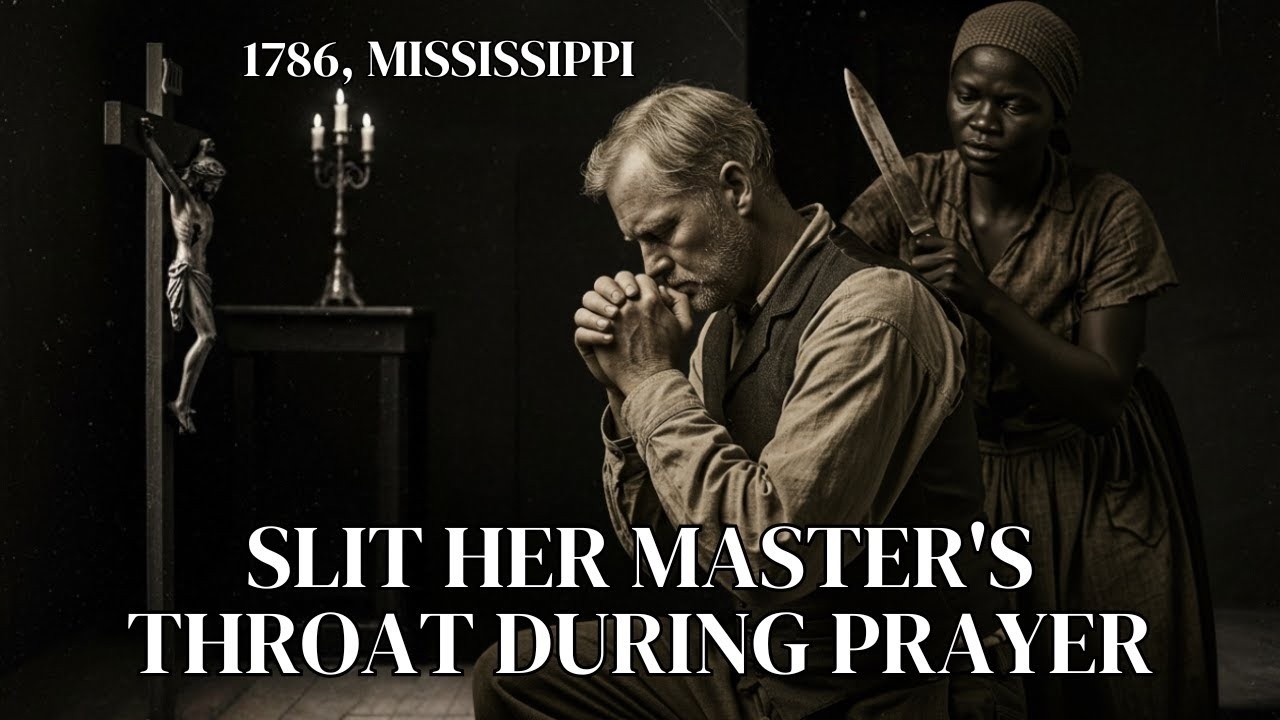
It all crystallized into this single moment of terrible clarity. Jeremiah Witmore’s voice grew softer as he neared the end of his prayer, his head tilted back slightly, eyes closed in peaceful communion with his maker. He never saw Grace approach, never felt the presence of death moving silently across his own floor. The last words he would ever speak were a request for God’s continued blessings upon his household.
He would never know how swiftly that prayer would be answered. The autumn mist clung to the rolling hills of Tennessee like a shroud wrapping around the modest plantation house where Jeremiah Witmore believed himself to be a righteous man. The year was 1786, and the newly formed state still bore the scars of revolution, though for some freedom remained an elusive dream. Every evening as the sun dipped behind the oak trees that lined his property, Jeremiah gathered his household for prayer.
The ritual was sacred to him, a demonstration of his Christian devotion, and he believed in divine protection over his land and chattels. The main room of the house filled with the soft glow of candlelight, casting long shadows across the rough-hewn wooden floors. “Come now, all of you,” Jeremiah would call, his voice carrying the authority of a man who had never questioned his place in God’s design. His wife Martha emerged from the kitchen, wiping flour from her hands.
Their two children, Samuel and Rebecca, aged 12 and 10, reluctantly abandoned their evening chores. But it wasn’t just the Witmore family who attended these nightly devotions. Standing along the walls, forbidden to sit, were the five souls that Jeremiah owned as property. Among them was a young woman of perhaps 20 years, known only as Grace, a name given to her by her previous master, not chosen by herself.
Her real name, the one whispered by her mother in a language now forbidden, had been buried along with her childhood. Grace stood with her hands clasped before her, her dark eyes fixed on the wooden floor. To those who bothered to look, she appeared the picture of Christian submission. Jeremiah often pointed to her as an example of how proper religious instruction could civilize even the most savage soul.
What he failed to see was the way her jaw tightened during his lengthy sermons, or how her fingers would curl into fists when he spoke of divine providence and the natural order of things. The other slaves—old Moses, barely 50 but aged beyond his years; Sarah, a woman of middle age whose children had been sold away; and the two young men, Thomas and Benjamin—had learned to let their minds wander during these sessions. But Grace listened to every word, storing each justification for her bondage, each biblical passage twisted to support her suffering. “Let us pray,” Jeremiah announced on this particular October evening, the same words he had spoken every night for the past three years since acquiring Grace.
The family knelt on cushions placed strategically around the room while the slaves remained standing, their heads bowed in enforced reverence. As Jeremiah began his prayer, thanking God for his blessings and asking for continued prosperity, Grace’s hand moved almost imperceptibly to the folds of her rough cotton dress. Hidden there, secured with a strip of cloth torn from her undergarment, was a kitchen knife she had taken that morning while preparing breakfast. The blade was sharp.
She had made certain of that, honing it against the grinding stone when no one was watching. The prayer continued, Jeremiah’s voice rising and falling with practiced piety. He spoke of gratitude, of divine favor, of the burden and blessing of caring for those whom God had placed under his stewardship. Each word was a lash across Grace’s soul.
Each phrase a reminder of the cage that held her. Martha’s soft amen punctuated her husband’s words, followed by the children’s mumbled responses. The slaves, as always, remained silent. Their agreement was assumed, their souls considered property along with their bodies.
But tonight would be different. Tonight, as Jeremiah closed his eyes and bowed his head in final supplication, Grace stepped forward with the quiet grace of a predator. The floorboards, worn smooth by years of use, made no sound beneath her bare feet. The moment stretched like eternity, suspended between the sacred and the profane.
In the candlelit room, the other slaves had noticed her movement. Old Moses’s eyes widened with a terror that had nothing to do with the act itself and everything to do with its consequences. Sarah’s breath caught in her throat, her hand instinctively moving to cover her mouth. Thomas and Benjamin stood frozen, understanding immediately that they were about to witness something that would change all their lives forever.
Martha Whitmore continued to kneel beside her husband, her own eyes closed in prayer, unaware that death had entered her parlor. The children, Samuel and Rebecca, fidgeted slightly but remained in their positions of reverence, their young minds focused on the promise of warm milk and bed that would follow this nightly ritual. Grace’s breathing slowed as she raised the blade. In her mind, she could hear the voices of all who had come before her.
Her mother, sold away when Grace was barely 14. Her father, whose name she had never known. The countless others who had suffered and died in silence, their stories buried in unmarked graves across the American South. The knife caught the candlelight for just an instant, a brief flash of steel that Moses would later swear looked like a falling star.
Grace’s hand moved with surprising steadiness, the blade finding its mark with the precision of divine judgment. The cut was deep and swift, opening Jeremiah’s throat from ear to ear in one fluid motion. Blood erupted immediately, dark and warm, spattering across the wooden floor and the family Bible that lay open on the small table before him. For a heartbeat, there was only silence.
Then Martha’s scream shattered the evening air. Jeremiah’s body convulsed once, his hands flying to his throat in a futile attempt to stem the flow of life pouring from the wound. His eyes opened wide, meeting Grace’s gaze for the first and last time, with something approaching understanding. Blood frothed from his mouth as he tried to speak, but only a wet, gurgling sound emerged.
“Papa! ” Rebecca shrieked, scrambling backward on her hands and knees as her father’s blood spread across the floor toward her. Samuel, older and quicker to process what he was seeing, lunged toward the door, his young voice cracking as he shouted for help that would not come in time. Martha’s screams continued, high and piercing, as she crawled toward her dying husband.
Her white dress quickly became stained with his blood as she pressed her hands against the wound, trying desperately to hold his life inside his body. “Jeremiah. Oh God, Jeremiah. ”
Grace stood motionless above the chaos, the bloody knife still in her hand.
Her face showed no emotion—not satisfaction, not regret, not fear. She simply watched as the man who had owned her soul bled out on the floor of his own home, his final prayers answered in the most unexpected way. Old Moses was the first to move among the slaves. His weathered hands reached out toward Thomas and Benjamin, pulling them back against the wall.
“Don’t move,” he whispered urgently. “Don’t say nothing. Don’t do nothing. ”
But Sarah couldn’t contain herself.
Years of suppressed anguish poured out in a low, keening wail that seemed to come from the very depths of her being. She had watched her own children disappear into the slave markets, had endured countless nights of forced prayer where she was told to be grateful for her bondage. Now, seeing Grace’s act of ultimate rebellion, something broke inside her. Or perhaps something was finally set free.
Jeremiah’s movements grew weaker, his attempts to speak becoming mere whispers of breath. His eyes, once so certain of their divine authority, now held only confusion and growing darkness. The blood flow began to slow, not because the wound was healing, but because there was simply less life left to spill. Martha’s sobs filled the room as she realized her husband was beyond saving.
She looked up at Grace with eyes full of horror and incomprehension. “Why? ” she gasped. “He was good to you.
He brought you to God. He saved your soul. ”
Grace finally spoke, her voice steady and clear despite the magnitude of what she had done. “My soul was never his to save.
”
The words hung in the air like smoke from the guttering candles. Outside, the Tennessee night continued its peaceful progression, unaware that in one small plantation house the natural order of things had just been violently overturned. Jeremiah Witmore drew his last breath as the clock on the mantel chimed nine times, marking not just the hour, but the end of one world and the beginning of another. The silence that followed Jeremiah’s death was more terrifying than Martha’s screams had been.
It was the silence of a world suddenly turned upside down, where the unthinkable had become reality and no one knew what came next. Grace still held the knife, blood dripping steadily from its blade onto the wooden floor. The metallic scent filled the room, mixing with the smell of tallow candles and the lingering aroma of the evening meal. Martha knelt beside her husband’s body, her white dress now crimson, her hands still pressed uselessly against his throat.
Young Samuel had stopped his flight toward the door and now stood pressed against the wall, his face pale as moonlight. Rebecca continued to sob, her small body shaking with each breath. Both children stared at Grace with a mixture of terror and fascination, as if she had transformed before their eyes from a familiar presence into something otherworldly and dangerous. “What have you done?
” Martha whispered, her voice barely audible. “What have you done to us? ”
Grace looked down at the woman who had been her mistress, who had supervised her daily labors and occasionally offered small kindnesses—an extra portion of food, a worn dress that no longer fit Rebecca, a gentle word when Grace appeared particularly weary. These gestures, once perhaps meant as Christian charity, now seemed like mockery in the face of the fundamental cruelty they had masked.
“I have done what needed doing,” Grace replied, her voice carrying a strange calm that unnerved everyone in the room. Old Moses stepped forward cautiously, his weathered hands extended in a gesture of peace. “Grace, child, you need to put down that knife. You need to think about what comes next.
”
But Grace wasn’t ready to think about consequences. For the first time in her life, she felt truly free, and the sensation was intoxicating. The weight of constant submission had been lifted from her shoulders, replaced by something she had never experienced before: the power to choose her own actions regardless of the cost. “They’ll come for us all,” Sarah whispered, her voice thick with fear.
“They’ll say we all had a part in this. They’ll hang us all. ”
The truth of Sarah’s words settled over the room like a shroud. In the Tennessee of 1786, the murder of a white man by his slave was not just a crime.
It was an act of rebellion that threatened the very foundation of society. The response would be swift and brutal, designed not just to punish the guilty but to terrorize any others who might harbor similar thoughts. Thomas and Benjamin exchanged glances, their young faces reflecting the same terrible understanding. They had not raised a hand against their master, had not even known what Grace planned, but their skin color would make them complicit in the eyes of the law.
“We have to run,” Benjamin said suddenly, his voice cracking with urgency. “All of us, we have to run now before anyone comes looking. ”
“Run where? ” Moses asked, his tone heavy with the wisdom of years.
“You think there’s anywhere in this territory where they won’t find us? You think there’s anywhere we can go where the color of our skin won’t mark us as fugitives? ”
Grace finally lowered the knife, though she didn’t release it entirely. “I’m not running,” she said quietly.
“I’m done running from what I am, from what I’ve done, from what I believe. ”
Martha looked up at her with streaming eyes. “You believe in murder? You believe in destroying families?
”
“I believe in justice,” Grace replied. “I believe that no man has the right to own another’s soul. I believe that your husband’s prayers were an abomination before God, thanking the Almighty for the privilege of keeping human beings in chains. ”
The words struck Martha like physical blows.
She had never questioned the righteousness of their way of life, had accepted without examination the biblical justifications her husband had provided for their ownership of other human beings. Now, faced with the violent consequences of that system, she found herself confronting questions she had never allowed herself to ask. “He was a good man,” she insisted, though her voice lacked conviction. “He fed you, clothed you, brought you to Christ.
”
“He owned me,” Grace said simply. “Everything else was just decoration on that fundamental sin. ”
Outside, the night sounds of the Tennessee wilderness continued—the call of owls, the rustle of small animals in the underbrush, the distant howl of a wolf. But inside the plantation house, time seemed suspended, as if the world was holding its breath to see what would happen next.
Samuel, who had been silent since his initial cry for help, suddenly spoke up. “Someone will come looking,” he said, his young voice trying to sound brave. “When Papa doesn’t come to town tomorrow, when he doesn’t meet with Mr. Henderson about the tobacco crop, someone will come.
”
Grace nodded, acknowledging the truth of his words. “Yes,” she said. “Someone will come, and when they do, they’ll find me here, ready to answer for what I’ve done. ”
The other slaves stared at her in amazement and horror.
The idea of willingly facing the consequences of such an act was almost incomprehensible to people who had spent their lives avoiding even the smallest infractions that might bring punishment. “You’re going to get us all killed,” Sarah said, her voice rising with panic. “We were already dead,” Grace replied. “We just hadn’t been buried yet.
”
The hours that followed Jeremiah’s death passed like a fever dream. Martha had finally stopped her keening and now sat in stunned silence beside her husband’s body, occasionally reaching out to touch his face as if she could somehow call him back to life. The children huddled together on the far side of the room, their eyes never leaving Grace, who remained standing over the scene of her crime like an avenging angel carved from dark wood. Old Moses had taken charge of the practical matters, as he often did when crisis struck the plantation.
He sent Thomas to secure the doors and windows, though they all knew that such precautions were largely symbolic. If the authorities came—when they came—no amount of barricading would keep them out. “We need to clean this up,” Moses said quietly, gesturing toward the spreading pool of blood. “We need to make this look like what?
” Grace interrupted. “Like an accident? Like he cut his own throat while praying? ”
Moses fell silent, recognizing the futility of his suggestion.
There was no way to disguise what had happened here. No story that would explain away the precise nature of the wound or the presence of the kitchen knife still clutched in Grace’s hand. Sarah had stopped her panicked whispers and now watched Grace with something approaching awe. “How long have you been planning this?
” she asked. Grace considered the question carefully. “I’ve been planning this since the day I was born into bondage,” she said finally. “I just didn’t know it until tonight.
”
The truth of her words resonated through the room. Each of the slaves had harbored similar thoughts at various times—moments of rage when the whip fell, instances of despair when families were separated, quiet hours when the injustice of their situation seemed too great to bear. But they had all learned to push such thoughts aside, to focus on survival rather than rebellion. “You’ve doomed us all,” Benjamin said, though his voice carried more resignation than anger.
“You know that, don’t you? ”
“We were already doomed,” Grace replied. “The only question was whether we would die as slaves or as human beings. ”
Martha suddenly looked up, her tear-stained face twisted with grief and confusion.
“I don’t understand,” she said. “Jeremiah read to you from the Bible. He taught you about salvation. He showed you the path to eternal life.
”
Grace’s laugh was bitter and sharp. “He showed me the path to eternal servitude. He used God’s word to justify keeping me in chains, to make me grateful for my own oppression. ”
“The Bible teaches obedience,” Martha insisted, clinging to the familiar certainties of her faith.
“It teaches servants to obey their masters. ”
“The Bible also teaches that all men are created in God’s image,” Grace countered. “It teaches that the truth shall set you free. Your husband chose which verses to emphasize and which to ignore.
”
The theological debate felt surreal in the presence of Jeremiah’s cooling corpse. But it was a conversation that had been building for years. Every forced prayer session, every biblical justification for slavery, every moment when Grace had been required to thank God for her bondage had contributed to this moment of reckoning. Samuel, who had been listening to the exchange with the intense focus that only children can muster, suddenly spoke up.
“Are you going to kill us, too? ”
The question hung in the air like smoke. Grace looked at the boy, barely 12 years old, raised in a system he had never questioned, taught to see her as property rather than a person. In his eyes, she could see genuine fear, but also a kind of curiosity that suggested he was beginning to understand that the world was more complicated than he had been taught.
“No,” Grace said simply. “I have no quarrel with you. You didn’t choose to be born into this system any more than I chose to be born into slavery. ”
Relief flooded the boy’s face, though he continued to watch her warily.
Rebecca, younger and less able to process the complexities of the situation, simply continued to cry softly. “But you’ll tell them what happened,” Martha said. “When they come, you’ll tell them that I killed my husband. ”
“I’ll tell them the truth,” Grace replied.
“That a slave named Grace killed her master because she could no longer bear to live as property. ”
The simplicity of her statement was somehow more terrifying than any elaborate justification might have been. There was no madness in her voice, no wild emotion, just a calm acceptance of what she had done and what would follow. Thomas, who had been silent since securing the house, finally spoke.
“They’ll make an example of you,” he said. “They’ll make it slow and public so that every slave in Tennessee knows what happens to those who raise their hand against their masters. ”
Grace nodded. “I know.
”
“Then why? ” Sarah asked, her voice breaking. “If you knew what would happen, why did you do it? ”
Grace was quiet for a long moment, looking around the room at the faces—black and white, young and old—all staring at her with varying degrees of fear, confusion, and desperate need for understanding.
“Because,” she said finally, “there are some things worse than death, and living as less than human is one of them. ”
Outside, the first pale light of dawn was beginning to creep across the Tennessee sky, bringing with it the promise of discovery and the certainty of consequences that none of them could escape. The morning light filtered through the windows of the Witmore house, illuminating a scene that would haunt the survivors for the rest of their lives. Jeremiah’s body lay where he had fallen, his blood now dark and congealed on the wooden floor.
The smell of death had begun to mingle with the familiar scents of the household, creating an atmosphere of wrongness that seemed to permeate every corner of the room. Grace had finally released the knife, setting it carefully on the table beside the family Bible. The juxtaposition was not lost on anyone present—the instrument of violence resting beside the holy book that had been used to justify so much suffering. She sat now in Jeremiah’s own chair, a transgression that in normal circumstances would have earned her a severe beating.
Martha had moved away from her husband’s body, unable to bear the sight any longer. She sat with her children, holding them close, while her mind struggled to process the magnitude of what had occurred. The woman who had served her breakfast that very morning, who had tended to her household needs with apparent docility, had revealed herself to be capable of calculated murder. “Someone’s coming,” Thomas announced from his position by the window.
In the distance, a cloud of dust marked the approach of riders. Three men on horseback moving at a steady pace toward the plantation. Old Moses felt his heart sink. “That’ll be Henderson and the others.
He said they were supposed to meet with Master Jeremiah about the tobacco harvest. ”
The approaching men were neighbors and business associates, pillars of the local community who would not take kindly to finding their friend and fellow planter murdered by his own property. Their response would be swift and brutal, guided by both grief and the need to maintain the social order that kept them in power. “Grace,” Moses said urgently.
“You still have time to run. Take to the woods. Head north. Maybe you can reach the territories where—”
“No,” Grace interrupted, her voice calm and resolute.
“I told you before, I’m done running. I’m done hiding from what I am and what I’ve done. ”
Sarah began to weep again, understanding that Grace’s decision would likely doom them all. In the aftermath of a slave rebellion, even the most innocent would be viewed with suspicion.
The fact that they had been present when their master was killed, that they had not prevented it or immediately raised an alarm, would be seen as evidence of complicity. The sound of hoofbeats grew louder, and soon voices could be heard outside—men calling out greetings to Jeremiah, expecting him to emerge from the house to welcome them as he always did. When no response came, the tone of their calls changed, becoming concerned and then urgent. “Jeremiah!
Whitmore! You in there? ”
Martha looked at Grace with desperate eyes. “Please,” she whispered.
“Tell them it was an accident. Tell them he fell on the knife. Tell them anything but the truth. ”
Grace met her gaze steadily.
“The truth is all I have left,” she said. “I won’t dishonor it now. ”
Heavy footsteps approached the front door, followed by loud knocking. “Jeremiah!
Martha! Open up! ”
When no answer came, the men outside began to force the door. The sound of splintering wood filled the house as the lock gave way, and three men burst into the main room, their faces flushed with concern and exertion.
The first through the door was James Henderson, a prosperous planter whose own holdings bordered the Witmore property. Behind him came Dr. Samuel Morrison, the local physician, and Sheriff William Crawford, a man whose reputation for dealing harshly with slave infractions was well known throughout the county. All three men stopped short when they saw the scene before them.
Jeremiah’s body lay in a pool of dried blood, while his family huddled together in obvious terror. The slaves stood against the walls, their faces reflecting various degrees of fear and resignation. And in the center of it all sat Grace, calm and composed in her master’s chair, the bloody knife clearly visible on the table beside her. “Sweet Jesus,” Henderson breathed, his face going pale.
“What in God’s name happened here? ”
Sheriff Crawford’s hand moved instinctively to the pistol at his side as his eyes swept the room, taking in every detail. His gaze lingered on Grace, noting her position and demeanor with the practiced eye of a man accustomed to reading guilt and innocence in human faces. “Mrs.
Whitmore,” Dr. Morrison said gently, approaching Martha and the children. “Are you hurt? Are the children harmed?
”
Martha shook her head, unable to speak through her tears. Samuel, showing more composure than his mother, pointed toward Grace. “She killed Papa,” he said, his young voice steady despite the tremor in his hands. “She cut his throat while he was praying.
”
The three men turned to stare at Grace, who met their gazes without flinching. In her eyes, they saw no remorse, no fear, no attempt at deception—only a calm acceptance that was somehow more unsettling than any display of emotion might have been. “Is this true? ” Sheriff Crawford demanded, his voice tight with controlled rage.
“Did you murder your master? ”
Grace stood slowly, her movements deliberate and dignified. “I killed Jeremiah Witmore,” she said clearly. “I killed him because he owned me, and I could no longer bear to be owned.
”
The simple honesty of her confession struck the room like a physical blow. Henderson staggered backward, his face flushing with anger and disbelief. Dr. Morrison crossed himself, muttering a prayer under his breath.
Sheriff Crawford’s hand tightened on his weapon, though he made no move to draw it. “You confess to murder? ” Crawford asked, as if he couldn’t quite believe what he was hearing. “I confess to justice,” Grace replied.
“I confess to reclaiming my humanity from a man who sought to own my very soul. ”
The words hung in the air like a challenge, forcing everyone present to confront the fundamental contradictions of their society. Here was a woman who had committed the ultimate crime against the social order, yet who spoke with a moral clarity that was difficult to dismiss. Henderson found his voice first.
“Hang her,” he said, his words thick with emotion. “Hang her now, before word of this spreads. Make an example that every slave in Tennessee will remember. ”
But Sheriff Crawford, despite his reputation for harshness, was a man who believed in the forms of law, even when dealing with slaves.
“She’ll have a trial,” he said grimly. “Quick and public, so everyone can see that justice is done. ”
Grace nodded as if she had expected nothing less. “I’m ready,” she said simply.
As the sheriff moved to place her in chains, Grace looked around the room one last time, her gaze touching each face—the terrified slaves who would likely share her fate, the grieving family whose world she had shattered, the angry white men who saw her as a threat to everything they held dear. In that moment, she felt something she had never experienced before: the weight of her own choices, freely made. Whatever came next, she would face it as a human being, not as property. The courthouse in Nashville was packed beyond capacity, with people spilling out onto the streets and pressing against the windows to catch a glimpse of the proceedings.
Word of Grace’s crime had spread like wildfire throughout Tennessee and beyond, drawing spectators from hundreds of miles away. Some came seeking justice, others entertainment, but all came to witness what many saw as a fundamental challenge to the natural order of society. Grace sat in the defendant’s chair, her hands shackled but her bearing proud. She had been held in the county jail for two weeks while preparations for the trial were made, and the experience had only strengthened her resolve.
The other slaves from the Witmore plantation had been questioned extensively, but their obvious terror and ignorance of Grace’s plans had eventually convinced the authorities of their innocence. Though they remained under suspicion and would likely be sold to masters far from Tennessee. The prosecutor, District Attorney Marcus Thornton, was a man with political ambitions who saw this case as an opportunity to make his reputation. He had built his argument around the need to maintain order and the sanctity of property rights, painting Grace as a dangerous radical whose actions threatened the very foundation of civilized society.
“Gentlemen of the jury,” Thornton began, his voice carrying clearly through the packed courtroom. “We are here today to consider a crime so heinous, so contrary to the natural order established by God and man, that it shakes the very foundations of our community. The defendant, a slave named Grace, has confessed to the cold-blooded murder of her master, Jeremiah Witmore—a god-fearing man who provided her with food, shelter, and Christian instruction. ”
The jury, composed entirely of white male property owners, listened with grim attention.
Several owned slaves themselves and understood the implications of Grace’s actions for their own safety and security. Grace had been assigned a defense attorney, Thomas Caldwell, a young lawyer with little experience in criminal cases. He had tried to convince her to plead temporary insanity or claim that she had been driven to violence by cruel treatment, but Grace had refused both strategies. “I will not lie about my reasons,” she had told him during their brief consultation.
“I will not pretend to be mad when I have never been more sane. And I will not claim cruelty when the greatest cruelty was simply being owned. ”
Caldwell, despite his inexperience, was a man of conscience who found himself genuinely moved by his client’s dignity and moral clarity. He had decided to base his defense not on denying the facts, but on challenging the fundamental assumptions that made those facts seem so damning.
When his turn came to address the jury, Caldwell stood slowly, his young face grave with the weight of what he was about to attempt. “Gentlemen,” he began, “I will not insult your intelligence by denying that my client killed Jeremiah Witmore. She has confessed to that act openly and without reservation. But I ask you to consider not just what she did, but why she did it, and what her actions reveal about the system that drove her to such desperate measures.
”
A murmur of disapproval rippled through the courtroom. This was not the kind of defense anyone had expected—an attack on slavery itself rather than a plea for mercy. “The prosecution would have you believe that Grace is a monster, a creature so depraved that she would murder the man who fed and housed her. But I submit to you that Grace is something far more dangerous to those who profit from human bondage.
She is a human being who refused to accept that her humanity could be bought and sold. ”
Judge Harrison Blackwood, a stern man in his 60s who had presided over numerous slave trials, banged his gavel sharply. “Mr. Caldwell, you will confine your remarks to the facts of the case and avoid philosophical speculation.
”
“Your honor,” Caldwell replied respectfully, “the facts of this case cannot be separated from the philosophical questions they raise. When we ask why Grace killed her master, we must examine the relationship between master and slave, and whether that relationship is consistent with the principles upon which our nation was founded. ”
The judge’s face darkened, but before he could respond, Grace herself stood up. The courtroom fell silent as she looked around at the sea of white faces—most hostile, some curious, a few showing signs of uncertainty.
“May I speak? ” she asked, her voice clear and strong. “Slaves do not address the court,” Judge Blackwood said sharply. “I am not speaking as a slave,” Grace replied.
“I am speaking as a human being who stands accused of a crime. ”
The distinction was subtle but profound, and it sent a ripple of unease through the courtroom. By refusing to accept the label of slave, Grace was asserting a fundamental equality that challenged the very basis of the legal system that was trying her. “You will sit down and remain silent,” the judge ordered.
But Grace remained standing. “I killed Jeremiah Witmore,” she said, her voice carrying to every corner of the packed courtroom. “I killed him because he claimed to own my soul, and I could no longer bear that blasphemy. I killed him because he used God’s word to justify keeping me in chains, and I could no longer listen to such perversion of divine truth.
”
“Bailiff! ” Judge Blackwood shouted. But Grace continued speaking, her words cutting through the chaos like a sword. “I killed him because I am a human being created in God’s image, and no man has the right to own what God has made free.
I killed him because I would rather die as a human than live as property. ”
The bailiff reached her then, roughly forcing her back into her chair, but the damage was done. Her words had been heard by everyone present, and they would be repeated and debated long after the trial was over. The prosecution called several witnesses.
Martha Witmore testified through her tears about her husband’s kindness and Christian character. The neighbors who had discovered the body, the sheriff who had arrested Grace—all painted a picture of a brutal and unprovoked attack on a righteous man. But when Dr. Morrison took the stand, Caldwell’s cross-examination revealed something unexpected.
“Doctor,” Caldwell asked, “in your examination of the deceased, did you find any evidence of disease or injury that might have affected his treatment of his slaves? ”
“I object,” Thornton said quickly. “The victim’s health is not relevant to this case. ”
“Your honor,” Caldwell replied, “if we are to understand the relationship between the defendant and the deceased, we must examine all aspects of that relationship.
”
Judge Blackwood considered for a moment, then nodded. “I’ll allow it, but keep it brief. ”
Dr. Morrison shifted uncomfortably in his chair.
“I did find evidence of certain conditions that might have affected Mr. Whitmore’s temperament. ”
“What kind of conditions? ”
“He suffered from what we call melancholia, and he had been taking laudanum for chronic pain.
These substances can sometimes cause unpredictable behavior. ”
The revelation sent a murmur through the courtroom. If Jeremiah had been unstable or violent due to his medical conditions, it might provide some justification for Grace’s actions. But Grace herself put an end to that line of defense.
“He was not cruel to me in the way you mean,” she said, ignoring her lawyer’s frantic gestures to remain silent. “He never beat me or violated me. His cruelty was deeper than that. He tried to convince me that my bondage was God’s will, that I should be grateful for my chains.
”
The honesty of her statement was devastating to her own defense, but it also revealed the profound moral courage that had driven her to act. She would not allow even her victim to be slandered, even if it might save her life. As the trial continued, it became clear that the outcome was predetermined. The jury would convict.
They had no choice given the facts and the social pressures they faced. But Grace’s words had planted seeds of doubt that would grow long after her fate was sealed. The verdict came swiftly, as everyone had known it would. “Guilty of murder in the first degree,” the foreman announced, his voice barely audible over the murmur of the crowd.
Judge Blackwood sentenced Grace to death by hanging, to be carried out in one week’s time in the public square, as an example to all who might harbor similar thoughts of rebellion. Grace received the sentence with the same calm dignity she had shown throughout the trial. She stood straight and tall as the judge pronounced her fate, her eyes fixed on some point beyond the courtroom walls, as if she could see something the rest of them could not. In the days that followed, something unexpected began to happen.
Word of Grace’s trial and her eloquent defense of her actions spread far beyond Tennessee, carried by newspapers and travelers to every corner of the young nation. In the north, abolitionists seized upon her story as proof of slavery’s fundamental evil. In the south, her words forced uncomfortable conversations about the moral foundations of their society. Letters poured into the governor’s office—some demanding that the execution proceed as scheduled, others pleading for clemency.
A group of Quakers from Pennsylvania offered to purchase Grace’s freedom, while several prominent ministers debated whether her actions could be justified on religious grounds. But Grace herself seemed uninterested in these efforts on her behalf. When visitors came to her cell—journalists, ministers, curiosity seekers—she spoke with them freely about her beliefs and her reasons for acting as she had. But she never asked for their help in avoiding her fate.
“Are you not afraid to die? ” asked Reverend Samuel Hopkins, a prominent abolitionist minister who had traveled from Boston to meet her. Grace considered the question carefully. “I have been dead for 20 years,” she said finally.
“What you call death is simply the end of that long dying. For the first time in my life, I feel truly alive. ”
The reverend was struck by the profound peace in her voice. “Do you believe God will forgive you for taking a life?
”
“I believe God will judge me for the totality of my actions and my heart,” Grace replied. “I killed one man who claimed to own me, but I freed one soul who belonged to God. I will let the Almighty decide which weighs more heavily in his scales. ”
On the morning of her execution, a crowd of nearly a thousand people gathered in the public square.
Some came to see justice done, others to witness what they saw as martyrdom. The atmosphere was tense, with groups of supporters and opponents eyeing each other warily while sheriff’s deputies maintained order. Grace was brought from her cell in a simple white dress that had been provided by a group of local women who, despite their disapproval of her actions, felt that she should meet her end with dignity. She walked to the scaffold with steady steps, her head held high, showing no sign of fear or regret.
Sheriff Crawford, who had grown to respect Grace’s courage despite his disapproval of her crime, offered her the traditional opportunity to make a final statement. She accepted, stepping forward to address the crowd that had gathered to watch her die. “I stand before you today not as a slave, but as a human being,” she began, her voice carrying clearly across the square. “I am about to pay the ultimate price for asserting my humanity, and I do so willingly.
”
The crowd fell silent, even those who had come to jeer finding themselves moved by her dignity and composure. “I do not ask for your forgiveness, for I have done nothing that requires it. I do not ask for your pity, for I am not to be pitied. I ask only that you remember that every person you see in chains is a human being created in God’s image, deserving of the freedom that you claim as your birthright.
”
She paused, looking out over the sea of faces—white and black, young and old, hostile and sympathetic. “I killed Jeremiah Witmore because he owned me, and I could no longer bear to be owned. I die today because I chose to be human rather than property. If that is a crime, then I am guilty.
If that is justice, then I am content. ”
As the noose was placed around her neck, Grace closed her eyes and began to recite the Twenty-third Psalm, her voice strong and clear. “The Lord is my shepherd; I shall not want. He maketh me to lie down in green pastures.
”
The crowd joined in, their voices creating a strange harmony that seemed to transform the execution into something approaching a religious service. Even those who had come to celebrate her death found themselves moved by the power of the moment. “Yea, though I walk through the valley of the shadow of death, I will fear no evil, for thou art with me. ”
When the trap door opened and Grace’s life ended, a profound silence fell over the square.
Many in the crowd wept openly, though they could not have said whether their tears were for Grace, for Jeremiah Witmore, or for the terrible contradictions of the world they all inhabited. In the days and weeks that followed, Grace’s story continued to spread. Her words were quoted in newspapers and from pulpits. Her example was cited by both abolitionists and defenders of slavery, though for very different reasons.
Some saw her as a dangerous radical whose actions threatened the social order, while others viewed her as a prophet who had died for the cause of human freedom. The other slaves from the Witmore plantation were indeed sold and scattered, as Grace had predicted. Old Moses was purchased by a planter in Georgia, where he lived out his remaining years telling anyone who would listen about the woman who had chosen death over bondage. Sarah was bought by a family in Alabama, and though she never spoke openly about what she had witnessed, she passed the story down to her children and grandchildren as a reminder that freedom was worth any price.
Martha Witmore eventually remarried and moved to Kentucky, but she never forgot the night when her world was turned upside down by a woman who refused to accept that her humanity could be owned. In her private moments, she found herself questioning the assumptions she had never examined before, wondering whether Grace might have been right about the fundamental evil of slavery. The Witmore plantation was sold and eventually abandoned, but locals claimed that on quiet nights you could still hear the sound of prayers being offered in the old house, though whether they were the prayers of the master or the slave, no one could say. Grace’s grave was unmarked, as was the custom for executed criminals, but flowers appeared there regularly, left by unknown hands.
Her name was not recorded in any official history of Tennessee, but it lived on in the whispered stories of those who understood that sometimes the greatest act of faith is the willingness to die for one’s beliefs. In the end, Grace had achieved something that no amount of forced prayers or biblical justification could provide. She had died as she had chosen to live in her final moments—as a free human being, answerable only to God and her own conscience. Her legacy would outlive the institution she had died fighting against, a testament to the indomitable power of the human spirit to assert its dignity even in the face of overwhelming oppression.
The slave who slit her master’s throat during prayer had become something more than a murderer or a victim. She had become a symbol of the eternal struggle between those who would enslave and those who would be free—a reminder that the human soul cannot be owned, no matter how many chains are placed upon the body.
