On a marble bathroom floor in Newport, Rhode Island, four days before Christmas 1980, a woman collapsed and never opened her eyes again. Her name was Sunny von Bülow, and for the next twenty-eight years, while lawyers argued about her body, her marriage, and her money in two of the most-watched trials in American history, she lay in a guarded room that she would never leave. The trials made her husband famous and an actor won an Oscar for playing him, but none of it reached her. For nearly three decades, someone kept sending fresh flowers into a room she could not see them in, and someone came twice a week to do her hair and makeup, though she would never know she was being touched.
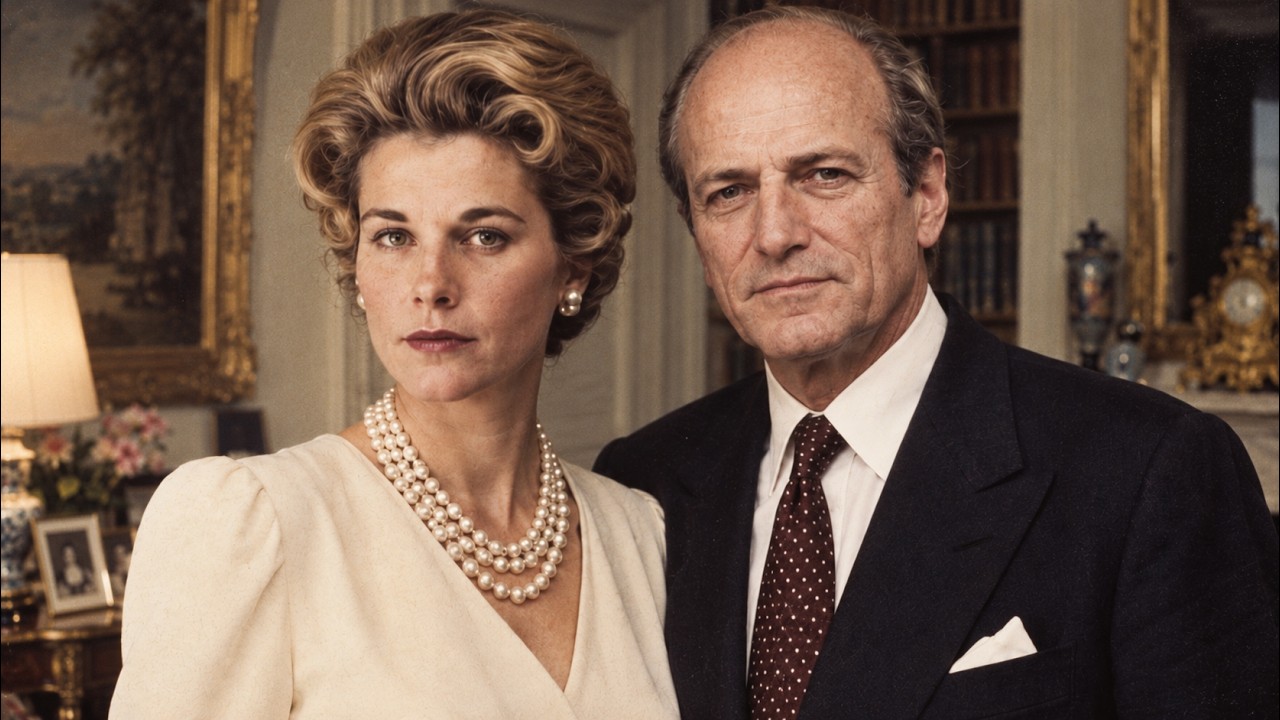
To understand what was lost on that floor, you have to go back to the beginning. She was born Martha Sharp Crawford in late summer 1932, aboard a private railway carriage while her parents rushed from the Greenbrier resort in West Virginia toward New York. Her father, George Washington Crawford, was a Pennsylvania utility magnate who had helped build Columbia Gas and Electric. He was sixty-six when he married her mother, forty years younger.
The baby was named Martha after a swimming instructor’s daughter at the Greenbrier, a Swede who had won Olympic gold. By the time she was four, her father was dead, leaving his only child a fortune reported at more than $75 million. She was raised on Fifth Avenue and at her mother’s Connecticut estate, Tamilain, educated at the Chapin School and St. Timothy’s, and presented to society in 1951.
She was tall and blonde and extraordinarily beautiful, and she was painfully shy. Strangers mistook her silence for slowness. One acquaintance later said she was gorgeous but didn’t have a brain in her head. The people who knew her well remembered someone pleasant and quietly funny.
She was twenty-four when she went to Europe and came home engaged to an Austrian prince named Alfred von Auersburg, known to guests at the alpine castle resort as Alfie the tennis instructor. The family had once ruled a principality of their own, but the money was gone; what remained was the name. They married in 1957 at Tamilain, and from that morning she was Princess von Auersburg. Two children came quickly: a daughter, Annie-Laurie, called Ala, in 1958, and a son, Alexander, in 1959.
The marriage lasted eight years, and there is no record of what went wrong. She came back to New York in 1965 with the children, kept the title, and remarried within a year. His name, when she met him at a Manhattan dinner party, was Claus. Born in Copenhagen in 1926 as Claus Cecil Borberg, he had been sent to Britain as a boy during the Nazi occupation and had taken his mother’s family name, Borberg, then later added the aristocratic particle von.
He had studied law at Cambridge and worked as an executive assistant to J. Paul Getty. They married at the Brick Presbyterian Church on Park Avenue in June 1966, and he resigned from Getty’s employ almost immediately. From that point on, the couple lived on her money.
A daughter, Cosima, was born the following spring, meaning there were now three children in the household: two Auersburgs and one von Bülow. In 1970, she bought Clarendon Court in Newport for $250,000 and spent more than twice that renovating it. She had the lawn itself lowered seventeen feet so that from inside the drawing room, the Atlantic Ocean would sit exactly where she wanted it. She sat on volunteer boards, hosted fundraisers, and managed her fortune.
But the marriage was fraying. By 1979, both she and her husband had begun discussing divorce openly with their friends. The terms of the paperwork made the situation clear: if the marriage ended in divorce, Claus would receive nothing; if she died, he would inherit $14 million. On the twenty-sixth of December 1979, the family was together for Christmas when Sunny began to fade.
Her speech thickened, her coordination went, and her twenty-year-old son Alexander had to walk her upstairs and settle her in bed. The next morning around nine, her maid, Maria Schrallhammer, who had been at her side for twenty-three years and had come with her from Austria, heard moaning through the bedroom door. Sunny could not be roused. Maria found Claus and asked him to call the doctor.
The doctor was not called at nine, not at ten, not at noon. The call was made around two that afternoon, and Claus told the physician when he rang back that his wife had been drinking the night before and was probably sleeping it off. Maria would later testify that Sunny had not been up and about that morning and had not, so far as she knew, been drinking. The doctor arrived at six that evening.
By then she was vomiting, fighting for air, and in front of him she went into cardiac arrest. He got her back. She arrived at Newport Hospital in a coma, with extraordinarily low blood sugar that would not rise no matter how much sugar they gave her. And then, on the twenty-eighth of December 1979, she woke up.
She was herself. She went back to work, managing her trusts and attending board meetings. The discharge diagnosis was bronchopneumonia and hypoglycemia of undetermined etiology. In English: we do not know why this happened.
There was nothing to report, no crime because there was no cause. She was advised to avoid alcohol and to eat regularly, and she was sent home. Four months later, in April 1980, it happened again. She was hospitalized once more, incoherent and disoriented, and the doctors again wrote down reactive hypoglycemia, cause undetermined.
Twice she was carried out of her life and brought back, and twice the medical profession looked directly at the mystery and filed it away. She had 359 days left. On the morning of December 21, 1980, she was found face-down on the marble bathroom floor. It was four days before Christmas.
Her children were in the house. Her husband was in the house. She never spoke again. In January 1981, her two eldest children moved her to Columbia Presbyterian Medical Center in New York, to the Harkness Pavilion, where she had a private room and a guard on the door.
Someone had decided, quietly, that she needed to be protected from a person, not from an illness. Ala was twenty-two and Alexander twenty-one. They had no standing and no authority, so they did the only thing they could: they bought an investigation. They spent $400,000 of their own funds on private detectives, a sum well past a million today.
The investigation produced a black bag containing drugs and a used hypodermic syringe reported to carry traces of insulin. In July 1981, Claus von Bülow was indicted. In the winter of 1982, his trial opened in Newport Superior Court, the first American criminal trial ever broadcast gavel-to-gavel. For weeks, the nation heard about her medicine cabinet and her drinking, and from the defense a portrait of a woman who was frail and self-destructive.
She could not answer. She was 300 miles north, behind a guarded door, being turned every few hours so her skin would not break down. In all those weeks and all those thousands of pages of transcript, nobody once called her by the name she was born with. She was Mrs.
von Bülow, the victim, the body on the floor. On March 16, 1982, the jury convicted Claus von Bülow on both counts, and he was sentenced to thirty years. Then something strange happened: he became popular. Spectators cheered him outside the courthouse, and headlines reported that he was gaining fans.
He was tall and dry and beautifully spoken, and forty million people had watched him for six weeks. She was not available to be interviewed. He never spent a night in prison. Harvard law professor Alan Dershowitz took up his appeal, and in April 1984, the Rhode Island Supreme Court threw out the conviction and ordered a new trial.
The family did not survive the weight. Cosima was fourteen when her mother went down. The world required her to choose a parent, and she chose her father, saying then and never taking it back that he had not done it. Her grandmother disinherited her for it.
When the old woman died at Columbia Presbyterian in the spring of 1984, just floors from where her daughter lay silent, Cosima, seventeen, was not permitted to attend the funeral. Her step-grandfather told a reporter, One is dead and the other is worse than dead. The second trial ran through the spring of 1985 and went very differently. Medical experts testified that there had been no injection at all.
The blood sugar specialist who had told the first jury that only injected insulin could explain her symptoms was made to concede under cross-examination that certain prescription drugs could produce a similar picture. A forensic toxicologist demonstrated that the encrustation on the famous syringe could not mean what the state said it meant. On June 10, 1985, the jury acquitted Claus von Bülow of everything. He said afterward that he wanted to be forgotten and to live peacefully.
That August, he appeared on the cover of Vanity Fair in black leather, photographed inside his wife’s New York apartment. Her son described it as the man thumbing his nose at us. Her children were not finished. Within weeks they filed a civil suit against him for $56 million on their mother’s behalf.
Just before Christmas 1987, a deal was struck. Claus von Bülow gave up every claim to his wife’s fortune and the income from the trust she had set up for him. He agreed to divorce a woman who could not be told she was being divorced, to leave the United States, and never to profit from the story. In exchange, Cosima was restored to her grandmother’s will, a share worth roughly $30 million.
Then the sale began. Clarendon Court went for $4. 2 million, the Fifth Avenue apartment for six, and the contents of her life, the paintings, the furniture, the porcelain, everything she had ever chosen, were auctioned over two days for eleven and a half million. She was alive for all of it.
That same summer of 1985, the year they lost, Ala and Alexander did something unexpected. They founded an organization in Fort Worth, Texas, and they did not name it after themselves. They named it the Sunny von Bülow National Victim Advocacy Center. Its purpose was not to reopen their mother’s case.
It was about everybody else’s. They had watched a system discuss their mother’s body on national television without ever once giving her a voice. They had watched the person the crime happened to become the last person anybody asked. So they built the chair the law had never given her.
That organization still exists, now called the National Center for Victims of Crime, operating out of Washington, more than forty years old. In 1986, they founded a second thing. In 1983, their father, Prince Alfred von Auersburg, had been in a car accident in Austria. He never regained consciousness either.
He lay in an irreversible coma for nine years and died in 1992. Ala and Alexander had a mother in a coma in New York and a father in a coma in Austria. Two parents, two continents, neither reachable. In the middle of that, they founded the Sunny von Bülow Coma and Head Trauma Research Foundation to study the exact condition that had taken both of the people who made them.
That foundation also survives, now called the Brain Trauma Foundation, and its work has shaped how head injuries are treated in hospitals that have never heard of Newport. She was in the hospital for eighteen years, then moved to a private nursing home on the Upper East Side in 1998. Doctors said she never showed any sign of brain activity. There was nothing to be done, and everyone involved knew it.
Here is what they did anyway. There were fresh flowers in that room, always, week after week. By the early nineties, the room alone cost about $1,500 a day, plus another two to three hundred thousand a year for private nurses around the clock. Twice a week, someone came in and did her hair and her makeup.
There is no medical reason for it. It changes no outcome and is recorded on no chart. A woman who cannot see a mirror and cannot know she is being touched has her hair set in a room she will never leave, by someone who will never be thanked. Twenty-eight years of Tuesdays.
They were not waiting for her to wake up. They were not fools. They kept the flowers coming and the hair done because the alternative was to treat her as a thing that had already ended. For four years, the world had called her a case.
In that room, someone insisted she was a person. She died on December 6, 2008, at the nursing home on the Upper East Side. She was seventy-six. Twenty-seven years, eleven months, and fifteen days had passed since the morning on the marble floor.
Her three children released a single statement that day. They had not always agreed; one of them for years had not even been permitted to attend her own grandmother’s funeral. But all three names sat beneath the same six words: We were blessed to have an extraordinarily loving and caring mother. Alan Dershowitz, reached for comment, said grief was the only true outcome.
The memorial service was held on January 14, 2009, at the Brick Presbyterian Church in New York, the same church where she had married Claus von Bülow forty-three years before. He was not there. He had spent the years since his acquittal in London, reviewing books and plays under his own name. He died in May 2019 at ninety-two.
A friend called it a sad ending to a sad life. She is buried at St. Mary’s Episcopal Churchyard in Portsmouth, Rhode Island, a few miles from the marble floor and the guarded rooms. The stone does not say Princess von Auersburg.
It does not say Mrs. von Bülow. It reads Martha Sharp Crawford. The name from the railway carriage.
The name from before any of it. Of every name she was ever given, it was the one that had cost nobody anything at all. Twenty-eight years of silence, and her children spent the rest of their lives lending her name to strangers who had no one else to ask for them.






