In 1921, in Wichita, Kansas, a short-order cook named Walter Anderson and a businessman named Edgar Ingram opened a small restaurant that would quietly invent an entire industry. They called it White Castle, and they built it on a radical idea for the time: selling the same clean, cheap, standardized hamburger at multiple locations, prepared so openly that customers could watch every step. Fast food, as a category, did not exist yet. McDonald’s was decades away.
White Castle created the template before the template had a name. Anderson had spent years working lunch counters and had learned things that were not obvious to other operators. Americans were deeply suspicious of ground beef. Decades of bad press, sharpened by Upton Sinclair’s exposé of the meatpacking industry, had left the public uneasy about what actually went into commercial hamburger.
Anderson’s answer was transparency. He cooked the burgers on a clean grill in full view of the customers. There was no mystery about the meat or the person handling it. The visible cooking process was not just a design choice; it was a sales argument.
He also solved a practical problem. Rather than putting a patty on a large roll, he designed a small square patty that fit a small square bun. The meat sat directly on a bed of diced onions, and five small holes punched into the patty allowed onion steam to rise up through the meat, cooking it from both sides at once. The method cut cooking time dramatically and made it possible to produce large numbers of burgers quickly on a flat grill.
The burger finished in about a minute. It was soft rather than crispy, tasting primarily of steamed beef and onion, small enough to eat in three or four bites. White Castle still makes the burger the exact same way today. Ingram provided the capital and the organizational discipline.
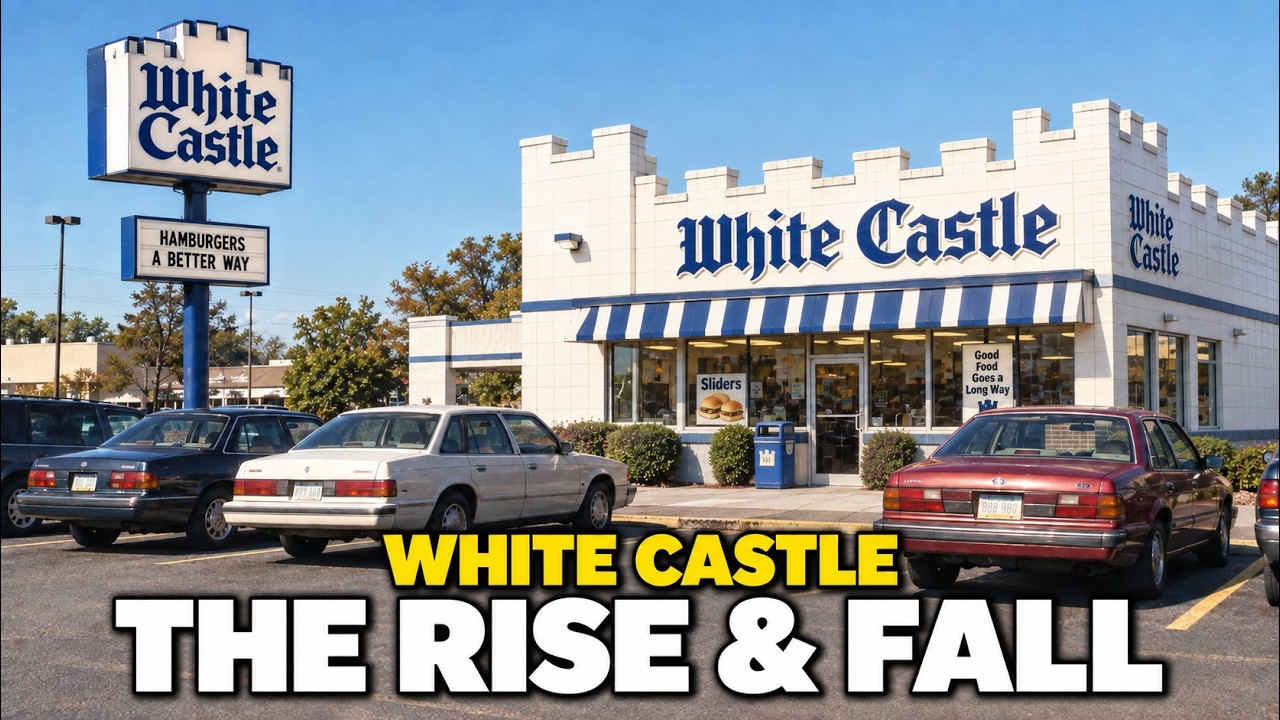
He understood that the building itself had to communicate something that most roadside food stands of the era did not: permanence and cleanliness. He chose white porcelain enamel panels for the exterior and a crenelated roofline that read as a kind of architectural shorthand for a castle, suggesting solidity and trustworthiness. The color white was deliberate. In the early 1920s, when sanitation remained a genuine public concern, that visual signal mattered.
The third pillar of the concept was price. The original burger cost a nickel, cheap enough that a working man could buy several and make a full meal. The formula worked. By 1930, White Castle had more than one hundred locations across the Midwest.
The company invested aggressively in standardization. Every location used identical equipment. Every patty was the same size and weight. Buns came from White Castle’s own bakeries.
The company owned its meat processing facilities and its paper goods plants, giving it a level of supply chain control that few restaurant businesses of the era could match. Ingram published a manual detailing exactly how everything worked, from cooking procedures to cleaning routines to the specific properties the bun needed after steaming. The operational system he built in the 1920s is recognizably the model the entire fast food industry eventually adopted. The chain spread through the Midwest and into the Northeast, reaching New York, New Jersey, and Chicago.
For most of that period, it faced no meaningful competition doing what it did. Customers developed a relationship with the product that went beyond ordinary loyalty. The restaurants were very small, usually a counter with stools rather than a dining room. You sat close to the grill and watched your food being made.
The experience was immediate and compact, dominated by the smell of hot onions and steamed beef that hit you as soon as you opened the door. The burgers were ordered in multiples, sold in bags, then in boxes, then in the now-famous “crave case” holding thirty sliders. The implicit logic of the brand was always that one was not enough. Then came the post-war years, and with them, the pivotal decision that would define White Castle’s limited future.
After 1945, the American landscape transformed. The interstate highway system was coming. Suburbs were spreading outward from city centers. Car ownership was exploding.
Rising incomes and a baby boom created an extraordinary opportunity for restaurant chains that could establish themselves in the new suburban corridors. White Castle did not move aggressively into that environment. Its footprint was built in dense, older industrial cities, Cincinnati, Detroit, Chicago, New York, Columbus, Minneapolis, St. Louis, markets where the original concept of corner locations, counter service, and low prices worked extremely well.
The suburban drive-in format that McDonald’s and others built from the early 1950s onward required different real estate, drive-thru windows, and large parking lots. White Castle moved toward it slowly and selectively. The deeper structural reason for the chain’s limited growth was a decision the company made and held to for a century: White Castle never franchised. While McDonald’s, Burger King, and Wendy’s expanded at speed by deploying franchisee capital, royalty payments, and aggressive growth strategies, White Castle retained complete ownership and operation of every single restaurant.
Every location was company-owned, company-operated, and funded entirely out of the company’s own resources. This kept the system consistent and free of the franchisee conflicts that later damaged chains like Quiznos and Sizzler. But it also capped growth. McDonald’s went from a handful of locations in the early 1950s to thousands by the mid-1960s by using other people’s money.
White Castle grew slowly, stayed concentrated in its original markets, and watched competitors capture the suburban growth wave that reshaped American eating habits. By the time the fast food landscape solidified in the 1970s, White Castle had something valuable: an intensely loyal customer base in specific cities and a distinctive product with no real equivalent. But it had missed the window when the national fast food map was being drawn. Its location count peaked at around 420 restaurants in the early 1970s, after more than fifty years in business, at a time when McDonald’s already had several thousand.
The chain had a half-century head start and still operated only a few hundred locations. The 1970s brought new pressures. Inflation drove up the cost of beef, buns, oil, and energy. White Castle’s economics depended on selling enormous quantities of very inexpensive food.
When input costs rose, the company raised prices and invested in efficiency, but the nickel burger identity was gone. The 1970s also brought intensified competition for late-night customers, a space White Castle had once owned largely by default. The frozen food business, launched in the 1980s, became increasingly important. White Castle sliders in grocery stores found a ready audience among people who lived outside the chain’s geography or who wanted the product at home.
By the early 2000s, frozen sliders were available nationally at major grocery chains. The irony was notable: the company that did not expand its restaurants nationally still managed to get its product into freezers across the country. In 2004, the movie Harold & Kumar Go to White Castle introduced the chain to an enormous young audience as the object of an almost irrational late-night craving. It was genuinely useful brand exposure.
But the movie could not put a White Castle in Los Angeles or Atlanta or Houston. Brand awareness without physical access is a marketing problem that is very difficult to solve. The frozen aisle was a partial answer, but not the same as a restaurant. The chain attempted targeted expansion in the 2000s and 2010s, opening locations in Las Vegas and a handful of other markets, drawing heavily on Midwestern tourist traffic.
These were small experiments rather than a systematic national push. Menu additions like chicken rings and the Impossible Slider, a plant-based patty introduced in 2019 using the same steaming method, added variety without changing the core concept. Labor economics also shifted. In 2021, White Castle raised its starting wage to fifteen dollars an hour, ahead of federal requirements, citing recruiting difficulties.
That was the right thing for employees, but it materially changed the cost structure of a business built on very low margins per transaction. The COVID-19 pandemic was particularly difficult. White Castle closed its dining rooms and shifted to carryout and drive-thru. Many of its urban locations had been built for an era of dense pedestrian foot traffic, with limited parking and no drive-thru lane.
Some locations had no drive-thru capability at all. Foot traffic dropped sharply and did not recover quickly. The company permanently closed a number of underperforming restaurants, and not all were reopened. By 2023, the location count had fallen below 350, down from the early 1970s peak of around 420.
There is a version of White Castle’s history in which the no-franchise decision looks wise rather than limiting. The company never faced the franchisee revolts, quality inconsistencies, or financial collapses that damaged franchise-heavy chains. It maintained complete control over its product for over a hundred years. The slider you buy today is the same size, the same square bun, the same steam holes, the same onions as the one your grandmother bought.
The Ingram family still owns the company, now into its fourth generation, an unusual achievement in American corporate history. Most major restaurant chains have changed hands multiple times, gone public, or been acquired by private equity. White Castle has done none of that. But the numbers remain stark.
The company that invented fast food operates fewer restaurants than many small regional chains that have been in business a fraction as long. Its geography is a snapshot of the industrial Midwest and the Northeastern urban corridor from about 1940, with a few later additions. There is no White Castle in California, none in Texas, none across most of the South, none in the Pacific Northwest. For the majority of the American geographic footprint, White Castle exists only as a frozen product in the grocery aisle.
What the chain preserved by not growing fast is a product and an experience that have not fundamentally changed in a century. The loyalty of its existing customers is specific and difficult to explain to someone who has never eaten there. People who grew up with sliders in Columbus or Detroit or Chicago describe a craving that only that particular combination of steamed beef, soft sweet bun, and onion can satisfy. Most fast food chains are interchangeable to a meaningful percentage of their customers.
White Castle does not have a substitute. The original White Castle on Kellogg Street in Wichita is long gone. But in Columbus tonight, a small white building with a crenelated roofline, bright inside and smelling of steamed onions, is probably still open past midnight.
The counter is still selling sliders in bags and boxes to people who have been coming for years and cannot really explain why they keep coming back, except that they are hungry for exactly this and nothing else is quite the same.
