When Catherine of Valois died in 1437, she was one of the most important royal women in England. Queen of England, wife of the legendary warrior king Henry V, mother of Henry VI, and eventually the ancestor of the Tudor dynasty, she might have been expected to rest peacefully within Westminster Abbey. Instead, Catherine lived one of the strangest afterlives of any English queen. Her tomb was destroyed, her coffin opened, and her body lifted from beneath the ground.
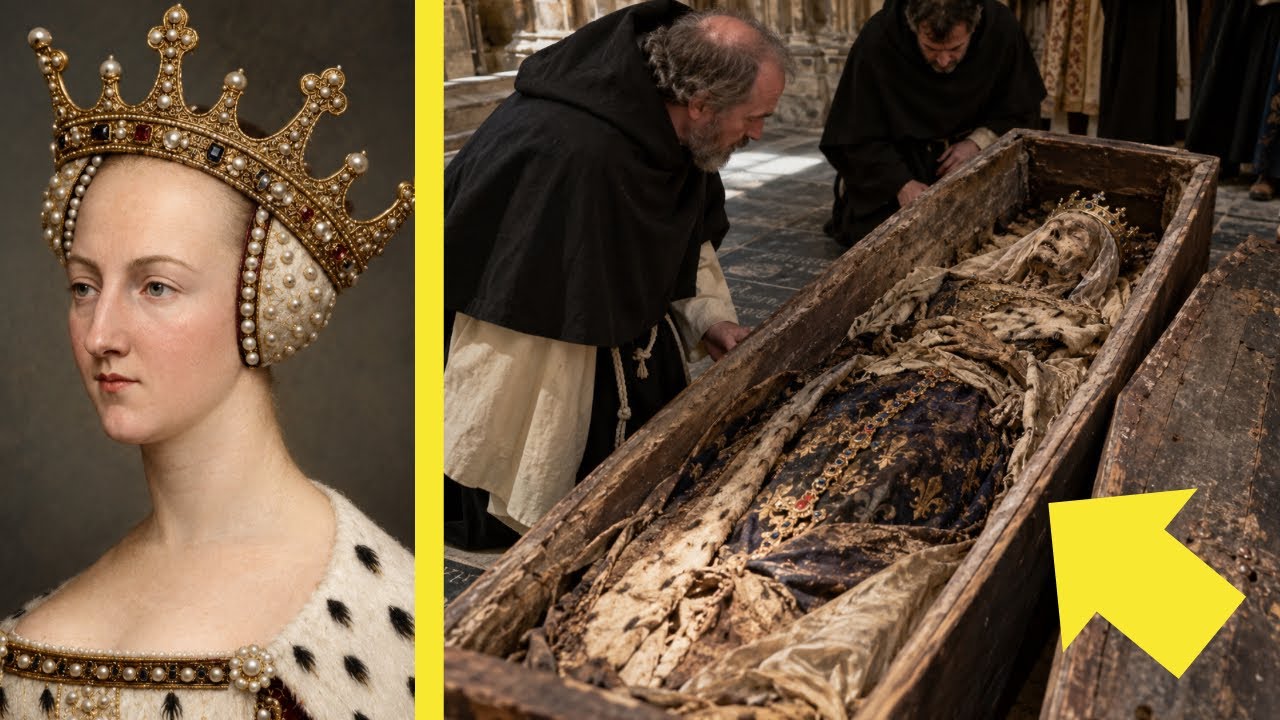
For centuries, her remarkably preserved remains lay above ground in Westminster Abbey, where visitors could see her and even touch her. The diarist Samuel Pepys went further. More than 230 years after her death, he kissed the dead queen. The story begins with her life and death.
Born in Paris in 1401, Catherine was the daughter of King Charles VI of France and Isabeau of Bavaria. Her life became intertwined with English history when Henry V invaded France and won his famous victory at Agincourt in 1415. Five years later, the Treaty of Troyes attempted to end the long conflict between England and France. As part of the agreement, Henry married Catherine in 1420, making her Queen of England.
In December 1421, she gave birth to a son, the future Henry VI. The marriage was remarkably short. Henry V died in France in August 1422, most likely from dysentery, leaving Catherine a widow at around twenty-one. Her infant son became King Henry VI, and Catherine later became linked to a Welshman named Owen Tudor.
The precise legal status of their relationship has long been debated, but they had several children together. That relationship became enormously significant because one of their sons, Edmund Tudor, became the father of Henry Tudor. Henry Tudor eventually defeated Richard III at the Battle of Bosworth in 1485 and became King Henry VII. Catherine of Valois was therefore the grandmother of the first Tudor monarch, though she never lived to see it.
Catherine died on 3 January 1437 at Bermondsey Abbey, aged only about thirty-five. Her body was taken to Westminster Abbey, where her funeral was held on 10 February, and she was buried in the old Lady Chapel. At that point, Catherine had received a perfectly respectable royal burial. She was not originally abandoned or deliberately denied a grave.
The strange treatment of her remains began decades later. In 1485, Catherine’s grandson Henry Tudor seized the English throne. Henry VII was deeply concerned with establishing the legitimacy and grandeur of the new Tudor dynasty he had founded. One of the greatest architectural projects of his reign was the construction of a new and magnificent chapel at Westminster Abbey, today known as the Henry VII Lady Chapel.
But there was a problem. An older Lady Chapel already stood on the site, and Catherine of Valois was buried inside it. Construction of the new chapel began in 1503, which meant the existing medieval structure had to be demolished. Accordingly, Catherine’s tomb was dismantled and her remains exhumed.
There was nothing inherently shocking about moving a body under these circumstances. Medieval and early modern churches were frequently remodelled, altered, and expanded, sometimes forcing the relocation of graves. What happened next was far more unusual. Catherine was never given a proper replacement tomb.
Instead, her remains were moved near the grave of her first husband, Henry V. Westminster Abbey records show that Catherine’s body was placed inside the enclosure of Henry V’s tomb, in an open coffin made of loose wooden boards. What should have been a temporary arrangement became remarkably permanent. Catherine remained there for centuries.
Normally, a buried human body would undergo extensive decomposition over decades, but Catherine’s remains had apparently become partially embalmed or dried out. Consequently, when her coffin was disturbed, parts of her body were still recognisable. This made Catherine something of a curiosity. Visitors to Westminster Abbey could see the remains of a woman who had been Queen of England.
As the decades passed, Catherine became less like a queen awaiting proper reburial and more like a grim tourist attraction. People were apparently able to get very close to the body, and the most famous example occurred in the seventeenth century. On 23 February 1669, the celebrated diarist Samuel Pepys visited Westminster Abbey. It happened to be Pepys’s thirty-sixth birthday, and during his visit he was shown the remains of Catherine.
At that point, Catherine had been dead for around 232 years. Pepys recorded the extraordinary encounter in his diary. He was allowed to touch the upper part of Catherine’s body, and then he did something almost unimaginable for a modern visitor to Westminster Abbey. He kissed her.
Pepys wrote about kissing Catherine on the mouth and reflected that he had kissed a queen. It is one of the strangest entries in his vast diary. More importantly, it reveals how casually Catherine’s remains were treated. This was not merely a sealed royal coffin temporarily stored inside a chapel.
A visitor could apparently approach the body, touch it, and kiss what remained of the queen’s face. It is difficult to imagine a more dramatic reversal of fortune. Catherine had once been crowned Queen of England, and now her centuries-old body was a curiosity for visitors. The obvious question is why Westminster Abbey allowed this situation to continue.
There does not appear to have been any deliberate decision to humiliate Catherine or permanently deprive her of a grave. Instead, her extraordinary fate seems to have resulted from a combination of construction work, neglect, and changing attitudes toward the dead. Her original resting place disappeared when Henry VII built his new Lady Chapel. Her body was moved, but no one provided the queen with an alternative permanent monument.
Then time passed. Years turned into decades, and decades turned into centuries. Once Catherine’s remains had stayed in the same location for generations, the temporary arrangement became a practical part of Westminster Abbey itself. There was also a very different attitude toward human remains in earlier centuries.
Bodies, bones, graves, and relics were encountered far more frequently than most people experience today. Churches contained graves beneath their floors. Monuments could be opened or disturbed, and those interested in antiquities were fascinated by the physical remains of historical figures. Nevertheless, Catherine’s treatment was unusual enough to eventually draw criticism.
A Queen of England was still lying above ground hundreds of years after her death. Finally, action was taken. In 1778, Catherine’s remains were removed from their exposed location and placed in a vault beneath the Chapel of Saint Nicholas at Westminster Abbey. More than 270 years had passed since her original tomb had been destroyed, and for the first time in centuries, Catherine’s remains were properly covered with earth.
But even this was not her final resting place. Another century passed before the strange journey of Catherine’s body finally reached its end. During the nineteenth century, Westminster Abbey underwent significant restoration and archaeological investigation. The story of Catherine’s unusual burial attracted attention once again, and in 1878, during the reign of Queen Victoria, her remains were finally placed in what was intended to be their permanent resting place.
They were buried beneath the altar of Henry V’s chapel. Catherine finally met, at least symbolically, with the husband whose spectacular military victories had helped make her Queen of England. It had taken 441 years after her death for Catherine’s remains to reach their final resting place. An important distinction should be made.
It is often claimed that Catherine of Valois was left unburied for 400 years, but that is not literally true. She was properly buried after her death in 1437, and her body remained in her original tomb for more than six decades. It was not until the early sixteenth century, when the new Henry VII chapel was being built, that her tomb was destroyed and her body exhumed. She was then left above ground for nearly three centuries before being reburied in 1778, and finally, in 1878, she received her last resting place.
The true story is more interesting than the popular version. Catherine of Valois was buried as Queen of England, but a massive construction project by her grandson led to the destruction of her tomb, and her partially preserved body then remained above ground at Westminster Abbey for generations. Kings and queens came and went. The Tudor dynasty rose and disappeared.
The Stuarts took the throne, England experienced civil war, a king was executed, and the monarchy was restored, and Catherine remained there. By the time Samuel Pepys kissed her remains in 1669, the woman he touched had lived in a completely different medieval world more than two centuries earlier. Eventually, attitudes changed and Catherine was returned beneath the ground. Yet it was only in 1878, 441 years after her death, that the wandering remains of Henry V’s queen finally reached the resting place where they remain today.
Few royal bodies have endured such an extraordinary journey. Catherine of Valois was a French princess, an English queen, the mother of a king, and the grandmother of the founder of the Tudor dynasty, but for centuries after her death she was something far stranger: a forgotten queen whose preserved body became one of Westminster Abbey’s most macabre sights.
