On the third of September 1971, a small peninsula jutting into the Persian Gulf declared its independence from Britain. The new state, Qatar, had barely a hundred thousand people and an economy that would have seemed modest for a single mid-sized city. Its ruler, a family called the Al Thani, governed a flat, barren stretch of limestone and sand where summer temperatures routinely passed forty-nine degrees Celsius and fresh water was so scarce that entire communities depended on a few wells. For most of its recorded history, Qatar was barely a footnote.
Its people survived by fishing, herding goats, harvesting dates, and above all, diving for pearls. That trade had sustained the Gulf for centuries, but in the 1920s the Japanese perfected cultured pearls, and the market collapsed almost overnight. Qatari divers, who had risked ruptured eardrums and shark attacks to pry oysters from the seabed with their bare hands, suddenly found their labor worth almost nothing. Coastal communities were ruined.
Then, in 1939, prospectors working for the Anglo-Persian Oil Company found crude oil near the western town of Dukhan. But the outbreak of World War Two halted all operations, and Qatar did not begin exporting oil until 1949. Oil revenue transformed the country at a bewildering pace. Roads replaced camel tracks.
Hospitals and schools appeared where none had existed. Air conditioning made the brutal climate tolerable, and desalination plants turned seawater into drinking water. Yet even as money reshaped the physical landscape, Qatar remained a second-tier producer by Gulf standards. Its reserves were modest compared with those of Saudi Arabia, Kuwait, or Iraq.
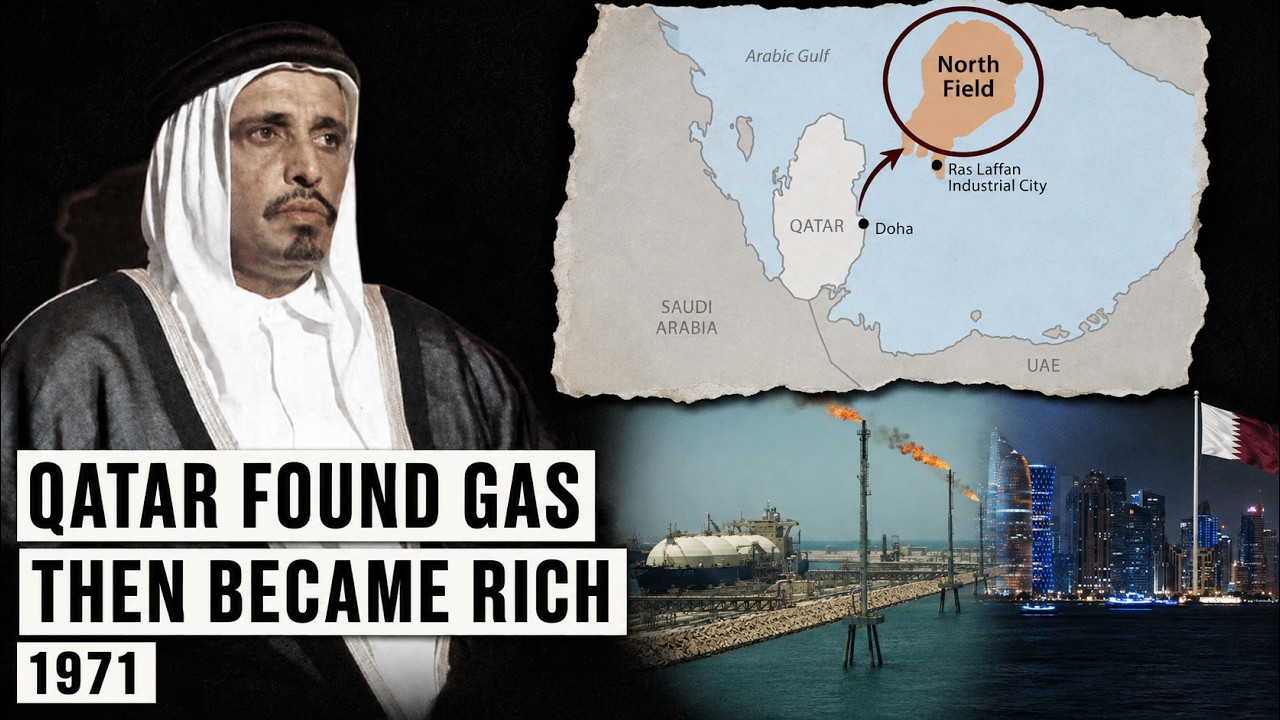
When Britain announced in 1968 that it would withdraw from the Gulf by 1971, Qatar briefly explored joining a proposed federation of emirates, but negotiations stalled over representation and autonomy. So Qatar went its own way. In the same year it became independent, something extraordinary was happening off its northeastern coast. Shell Oil had been drilling exploratory wells in the waters north of the peninsula.
The region was known to have geological formations that suggested hydrocarbons, but no one anticipated what the drill bits struck. When exploration engineers first reached the gas deposits in 1971, the initial readings were promising but unclear. Gas fields are notoriously difficult to assess. Unlike oil, which pools in underground reservoirs that can be measured with reasonable accuracy from a few wells, natural gas deposits can stretch across vast subterranean formations requiring years and dozens of appraisal wells to map.
Qatar began the slow, painstaking process of figuring out what it had found. Over the next fourteen years, fifteen appraisal wells were drilled across the offshore area, and with each new well, the estimates grew. By the mid-1980s, geologists had reached a conclusion that stunned the energy sector. The North Field was the largest unassociated natural gas deposit ever discovered in human history.
It covered roughly six thousand square kilometers beneath the Gulf, an underwater area almost half the size of Qatar’s own landmass. Its recoverable reserves were estimated at more than nine hundred trillion cubic feet of natural gas. But there was a problem, and it was enormous. In 1971, and even through the 1980s, natural gas was not a particularly valuable commodity.
Oil dominated global energy infrastructure. Cars ran on gasoline, power plants burned coal or fuel oil, and heating systems relied on oil. The international market for natural gas was limited, fragmented, and technically challenging. Gas cannot simply be pumped from the ground and shipped across the ocean like crude oil.
At ordinary temperatures and pressures, it occupies a huge volume relative to its energy content. Transporting it over long distances required either expensive, geographically restricted pipelines or a way to turn the gas into a liquid that could be loaded onto ships. That process, known as liquefaction, involves cooling natural gas to about minus 160 degrees Celsius, at which point it condenses into a liquid roughly one six-hundredth of its gaseous volume. The technology existed, but it was costly, complex, and considered risky.
Building an integrated LNG operation required multi-billion-dollar upfront investments in liquefaction plants, specialized refrigerated carriers, and receiving terminals in destination countries. In the 1980s, with oil prices low and the global economy uncertain, very few investors were willing to bet that much money on a small Gulf state with no track record in LNG trade. For nearly two decades after its discovery, the North Field remained largely untapped. Qatar knew it was sitting on one of the greatest energy deposits in history, but it lacked the technology, the capital, and the market conditions to exploit it.
The country continued relying primarily on its modest oil production, and the North Field remained a tantalizing, unrealized promise. Then came a palace coup. On the twenty-seventh of June 1995, Sheikh Hamad bin Khalifa Al Thani deposed his father in a bloodless takeover while the elder sheikh was on vacation abroad. It was a dramatic move, but in many respects an expression of frustration.
Sheikh Hamad had served as crown prince and defense minister, and he had watched with growing impatience as his father’s government squandered the country’s potential. The economy was stagnant. State finances were mismanaged. There were credible reports that billions of dollars in state revenue had been lost to corruption and poor governance.
The North Field, the key to Qatar’s future, remained largely undeveloped. Sheikh Hamad had a different vision. He recognized, with a clarity few leaders in the region shared at the time, that natural gas would become one of the most important energy sources of the twenty-first century. The world was slowly waking up to the environmental costs of burning coal and heavy fuel oil.
Natural gas burned cleaner, produced lower carbon emissions, and was increasingly viewed as a transitional fuel toward lower-carbon energy systems. Demand for LNG was growing in Asia, particularly in Japan and South Korea, where geography made pipeline imports impractical. Meanwhile, the technology for liquefying and shipping gas was becoming more reliable and cost-effective with each passing year. Sheikh Hamad bet everything on the North Field.
Almost immediately after taking power, he began aggressively courting global oil companies to invest in developing Qatar’s gas reserves. He partnered with Mobil Oil, the American energy giant, to develop the first large-scale LNG projects. Many industry analysts at the time considered this a reckless gamble. The capital requirements were staggering, the technology was still evolving, and the global LNG market was small and dominated by established producers like Indonesia and Algeria.
But Sheikh Hamad pressed forward with an urgency that bordered on obsession. In 1996, just one year after taking power, Qatar shipped its first cargo of liquefied natural gas. It was an achievement noticed by few outside the energy sector at the time, but it marked the beginning of what would become the fastest and most dramatic economic transformation of any country in the late twentieth century. The numbers tell a story that is almost hard to believe.
When Sheikh Hamad took power in 1995, Qatar’s GDP stood at roughly eight billion dollars. By the time he voluntarily handed power to his son in 2013, that figure had risen to about 199 billion dollars, an increase of more than twenty times in under two decades. Per capita GDP, measured by purchasing power parity, exceeded 114,000 dollars, making Qatar one of the wealthiest countries on earth per person. By 2010, Qatar’s LNG production capacity reached 77 million tons per year, and the country had become the world’s largest exporter of liquefied natural gas.
But Sheikh Hamad understood something that many resource-rich states fail to grasp. He knew that gas revenues alone would not guarantee long-term prosperity. History is full of countries that discovered vast natural resources and then squandered them through corruption, mismanagement, or failure to diversify. Nigeria found oil in the 1950s and remains mired in poverty.
Venezuela sits on the largest proven oil reserves in the world, yet it has suffered one of the most catastrophic economic collapses in modern history. Even within the Gulf, some oil-producing states have struggled to build economies that can survive beyond the hydrocarbon era. Sheikh Hamad was determined that Qatar would not take that path. Alongside the massive investment in LNG infrastructure, he launched an ambitious program of economic diversification, institution building, and international engagement.
In 2005, he established the Qatar Investment Authority, a sovereign wealth fund designed to invest the country’s gas surpluses in a diversified global portfolio. The logic was elegant and forward-looking. Natural gas is a finite resource. The day will come when the wells run dry or the world moves beyond fossil fuels altogether.
By converting gas revenues into a permanent financial endowment invested across multiple asset classes and geographic regions, Qatar could ensure that the wealth generated during the gas era would continue delivering returns for future generations. It was the same philosophy Norway had pursued through its Government Pension Fund, but Qatar pursued it with a speed and ambition that set it apart. The fund grew with astonishing rapidity. By 2026, it managed assets estimated at 600 billion dollars, making it one of the largest sovereign wealth funds on the planet.
Its portfolio read like a register of global capitalism’s most important institutions. It held stakes in major European banks. It owned positions in luxury brands and technology companies. It acquired prominent real estate in London, Paris, New York, and Washington.
Through subsidiaries, it controlled Harrods, the famous London department store. It became the largest owner of Paris Saint-Germain, the French football club that grew into one of the most valuable sports institutions in the world. It held major stakes in Volkswagen, Barclays, Credit Suisse, and dozens of other multinational corporations. But Qatar’s transformation was not purely financial.
Sheikh Hamad recognized that for a small country vulnerable to regional pressures, economic power alone was not enough. Qatar needed influence. It needed a voice. It needed to matter on the world stage in ways that went beyond the size of its gas reserves.
In 1996, the same year Qatar shipped its first LNG cargo, Sheikh Hamad founded Al Jazeera. On the surface, it was simply a satellite news network, but in reality it was one of the boldest exercises of soft power ever attempted by a small state. Al Jazeera was born as the first independent 24-hour Arabic-language news channel, designed from the start to be provocative, confrontational, and impossible to ignore. The timing was deliberate.
In the mid-1990s, the Arab media landscape was dominated by state-controlled broadcasters that functioned as mouthpieces for their governments. Independent journalism in the Arab world was practically nonexistent. Al Jazeera shattered that mold. It aired discussions no other Arab network would dare touch.
It interviewed dissidents, opposition figures, and controversial voices from across the political spectrum. It broadcast footage from conflict zones that other networks avoided. It gave airtime to viewpoints that directly challenged the narratives of Saudi Arabia, Egypt, and other regional powers. For Qatar, Al Jazeera served a deep strategic purpose.
It gave this small state a loudspeaker reaching more than 300 million households in over 100 countries. It allowed Qatar to shape narratives and influence public opinion, presenting itself as a progressive, independently minded nation with influence far beyond its size. It also, naturally, earned Qatar many enemies. Saudi Arabia, the United Arab Emirates, Egypt, and Bahrain viewed Al Jazeera as a destabilizing force, and the network became a central point of contention in the 2017 Gulf diplomatic crisis, when those four countries cut diplomatic ties with Qatar and imposed a blockade.
They demanded, among other things, that Qatar shut down Al Jazeera entirely. Qatar refused. The blockade finally ended in 2021, but the episode demonstrated how effectively Qatar had used media as a geopolitical weapon. Qatar was also deploying its gas wealth in another field that was often underestimated but immensely powerful: sports diplomacy.
The government poured billions into acquiring international sporting franchises, hosting major events, and building world-class sports infrastructure. The 2011 acquisition of Paris Saint-Germain turned the club into a global brand and gave Qatar a direct line into Europe’s cultural heart. Signing players like Neymar and Kylian Mbappe was never just about football. It was about placing the Qatari flag, figuratively, in the living rooms of hundreds of millions of people around the world.
Then came the grandest prize of all. In 2010, Qatar won the bid to host the 2022 FIFA World Cup, becoming the first Middle Eastern country ever to do so. The decision was controversial from the start, dogged by allegations of corruption in the bidding process and criticism of the country’s treatment of migrant workers who built the stadiums and infrastructure. But Qatar pressed ahead, spending an estimated 220 billion dollars on World Cup-related construction and development, making it the most expensive sporting event in history by a staggering margin.
New stadiums were built, a new metro system, new highways and hotels, and an entirely new city, Lusail, rose from the desert north of Doha. The World Cup was, in many ways, the culmination of Qatar’s decades-long strategy of using wealth to acquire visibility, legitimacy, and influence on the global stage. The story of the North Field, however, was not finished. The field itself is a geological marvel.
It lies beneath the waters of the Persian Gulf and extends across the maritime border between Qatar and Iran. The Qatari portion is known as the North Field; the Iranian portion is called South Pars. Together they form one continuous geological structure containing an estimated 1,800 trillion cubic feet of natural gas, along with roughly 50 billion barrels of natural gas condensates. For decades, Qatar enjoyed a massive advantage over Iran in developing its side of the field.
While Qatar invested heavily in LNG infrastructure and began exporting gas to world markets in the late 1990s, Iran’s development of South Pars was hampered by international sanctions, technical difficulties, and chronic underinvestment. By the 2020s, Qatar was producing about 18. 5 billion cubic feet of gas per day from the field, compared with roughly 2 billion from the Iranian side. That disparity gave Qatar a huge strategic edge, but it also created a source of geopolitical tension, as Iran watched its neighbor extract wealth from a shared resource at a pace Iran could not match.
Nor did Qatar rest on its existing production capacity. In 2019, the country announced plans for a massive expansion of the North Field that would increase LNG production capacity by more than 60 percent. The North Field Expansion project, divided into phases known as North Field East and North Field South, represented one of the largest energy investments in history. Major global energy companies, including TotalEnergies, Shell, ExxonMobil, ConocoPhillips, and Eni, were brought in as partners, each taking minority stakes in the expansion alongside Qatar’s national energy company, Qatar Energy.
When the expansion operates at full capacity, it is expected to raise Qatar’s LNG production capacity from 77 million tons per year to 126 million tons per year, cementing Qatar’s position as the most important LNG supplier on the planet. The timing could not have been more strategic. Russia’s 2022 invasion of Ukraine sent shockwaves through global energy markets and forced Europe to urgently seek alternatives to Russian pipeline gas. Suddenly, LNG was no longer just a valuable commodity; it was a matter of national security for some of the world’s largest economies.
Qatar, with its vast production capacity and long-term supply contracts, found itself at the heart of a geopolitical chessboard it had been quietly preparing for decades. What made Qatar different was not merely the size of the North Field. It was a series of strategic decisions made by Qatari leaders over three decades: decisions about when to invest, with whom to partner, how to deploy revenues, and how to position the country on the world stage. The decision to focus on LNG rather than pipeline exports freed Qatar from being locked into fixed relationships with specific customers along specific routes.
LNG can be loaded onto a carrier and shipped to any port with a receiving terminal, giving the producer enormous flexibility to sell to whatever market offers the best price at any given time. It also provides political insulation, because no single customer can exert undue leverage over your supplies. Qatar recognized this early, and its commitment to building the world’s largest LNG fleet, including the development of the massive Q-Max and Q-Flex carriers, the largest LNG carriers ever built, gave it unrivaled logistical capabilities. The decision to sign long-term supply contracts with major Asian economies provided a stable revenue stream that supported the country’s financial planning for generations.
The decision to reinvest gas revenues abroad through the Qatar Investment Authority rather than simply spending them domestically created a financial cushion that could support the country through periods of low energy prices and, ultimately, through the complete transition away from fossil fuels. And the decision to use wealth as a tool of diplomacy and influence rather than military power led Qatar to host the largest American military base in the Middle East, Al Udeid Air Base, which serves as a forward headquarters for US Central Command. By providing a strategically vital military facility to the United States, Qatar purchased a security guarantee that no amount of domestic military spending could have provided. The result of all these decisions is a country that, by almost any measure, has outpunched its weight for decades.
Qatar has mediated disputes in Lebanon, Sudan, and Afghanistan. It has hosted peace talks between the Taliban and the United States. It played a pivotal role in negotiations over the Iranian nuclear agreement. It has served as a mediator in prisoner exchanges and ceasefire agreements in some of the world’s most intractable conflicts.
For a country with a citizen population of roughly 300,000, that level of diplomatic influence is exceptional. But the story also has a darker side that cannot be ignored. The wealth that transformed the country was built in part on the labor of millions of migrant workers who came to Qatar from South Asia, Southeast Asia, and Africa seeking economic opportunity, and often found exploitation instead. The kafala system, which tied workers’ legal status to their employers, created conditions described by human rights organizations as modern slavery.
Workers’ passports were frequently confiscated, they were housed in overcrowded labor camps, faced delayed wages, and could not leave the country without their employer’s permission. In the years leading up to the World Cup, reports of migrant worker deaths on construction sites drew intense international scrutiny and criticism. Qatar has since reformed some aspects of the kafala system, introducing a minimum wage and giving workers greater freedom to change jobs, but critics argue that enforcement remains uneven and that the fundamental imbalance of power between employers and workers persists. There is also the essential question looming over every oil state on earth: what will happen when the gas runs out, or more precisely, when the world no longer needs it?
The global transition to clean energy is accelerating. Renewable energy costs are in constant decline. Electric vehicles are replacing internal combustion engines. Governments around the world have committed to carbon neutrality targets.
Natural gas demand may continue to grow in the short and medium term, particularly in developing economies that need a reliable transitional fuel, but the long-term trajectory is unmistakable. Fossil fuels, including natural gas, will eventually be replaced by cleaner alternatives. Qatar is better positioned than most petrostates to handle this transition, thanks to the strategic decisions it made over the past three decades. Its sovereign wealth fund provides a financial cushion that can support the country even if gas revenues decline sharply.
Its economic diversification into finance, aviation, tourism, education, and real estate reduces its dependence on a single commodity. Its deep diplomatic relationships and strategic partnerships provide a degree of geopolitical resilience beyond the economic sphere. Qatar’s National Vision 2030, a comprehensive development plan launched in 2008, explicitly acknowledges the need to build an economy that can thrive beyond the hydrocarbon era. It calls for investment in human capital, knowledge-based industries, environmental sustainability, and social development.
It is an ambitious plan, and its success will depend on Qatar’s ability to translate its financial wealth into institutional depth and human capabilities that ensure prosperity across generations. In 1971, Qatar was a newly independent state with a tiny population, modest oil revenues, and a gas field no one quite knew what to do with. Within a single generation, it became one of the richest countries in the world, the largest exporter of liquefied natural gas, and a diplomatic mediator whose influence stretched from Washington to Beijing, from London to Kabul. That transformation was not inevitable.
It was not an automatic result of geography. It was the result of specific decisions made by specific leaders at specific moments in time. Some of those decisions were visionary, some were ruthless, and some were a combination of both. The North Field continues to produce.
The LNG carriers still cross the oceans. The sovereign wealth fund continues to grow. The question today is no longer whether Qatar can sustain its extraordinary rise.
The question is what will happen when the world that made Qatar rich begins to change in ways that even the most far-sighted strategists could not fully anticipate.
