In the fall of 1893, a construction worker stood on a wooden platform suspended over Stony Creek, in the Selkirk Mountains of British Columbia, and reached for a section of steel frame that was being lowered to him by a cable strung between anchor points on the gorge walls above him. The platform was tied to the face of the gorge at a height that placed the stream 290 feet below his feet. The walls around him were granite and argillite, wet with mountain drainage that did not distinguish between construction season and any other. The Selkirks at Stony Creek received more annual precipitation than almost any other location on the main line of the Canadian Pacific Railway.
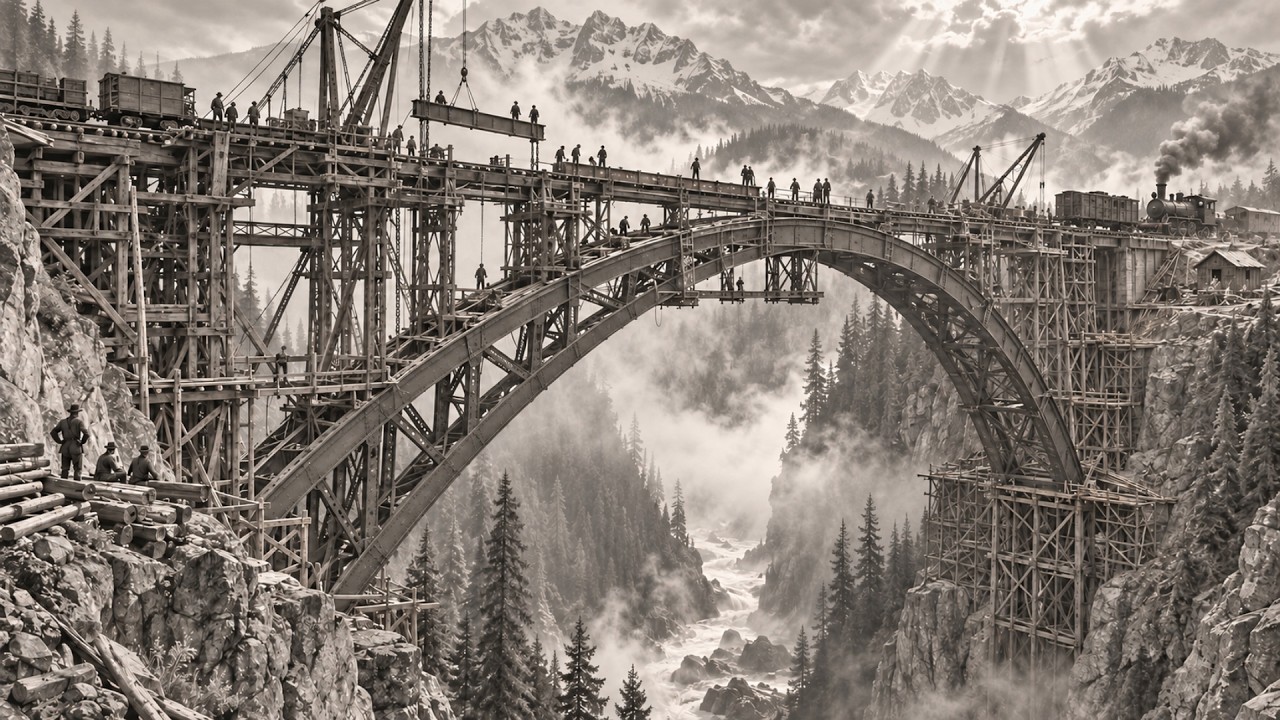
The timber on the gorge walls was dense spruce and cedar. The sky above the cleft was about as wide as the structure he was building. The cable overhead ran from a temporary anchorage tower on the eastern rim to a matching tower on the western rim. The steel section sliding along the cable weighed several hundred pounds.
His job was to receive it at the loading point, guide it to its connection point, and hold his position on the platform while the men above adjusted the load. The platform was not level. Things were never level at Stony Creek. Nothing at Stony Creek was level except the stream itself.
The stream, 290 feet below, looked like a white line passing through the conifer canopy of the gorge floor. It ran fast and cold from its source in the snowfields of the Selkirk range above. It carried snowmelt from a high mountain watershed with no wide valley to slow it down, and no soil to absorb what the granite could not hold. The gorge it had carved through the Selkirk rock was narrow, vertical, and permanent in the way that water cutting through rock over geological time is always permanent.
The Canadian Pacific Railway had needed to cross that gorge in 1885 because the gorge stood between the western entrance of Rogers Pass and the descent to the Columbia River valley, and the main line could not bypass it without regrading slopes that had made Rogers Pass the preferred route in the first place. So they crossed it with timber. In 1885, they had no other option. In 1893, they were correcting the consequences of that choice.
A steel arch that a construction worker was helping to build in the fall of 1893 would span 336 feet between the gorge walls, 290 feet above the stream. It would carry the main line of the Canadian Pacific Railway between the summit of Rogers Pass and the Columbia River valley at Revelstoke. When completed, it would be among the highest railway bridges in Canada, and among the most isolated. The nearest town of any consequence was Revelstoke, 30 miles to the west along the main line.
The bridge site had no road access. It had no river access. It had the railway line running directly through it, the construction camps that the contractor had set up beside the track in the narrow valley, and the supply trains that the Canadian Pacific sent according to the schedule that construction required. The steel sections being lowered by cable over Stony Creek had traveled to the site by rail from fabrication shops in the east, been transferred at Revelstoke to construction supply trains, and climbed the grade to the point where the railway track crossed the gorge that the new bridge was meant to span.
To understand why the Canadian Pacific Railway was building an arch of steel across Stony Creek in 1893, one had to understand what the original structure at that site was, and why it could no longer carry what the main line demanded of it eight years after its construction. The original Stony Creek crossing was a timber trestle. It was built in 1885, during the final push to complete the Canadian Pacific transcontinental main line, under conditions that did not allow for the engineering study that a structure of that height and permanence would normally have required. The men who built it built it quickly because speed was the only option the schedule allowed.
The schedule did not allow for deliberation or delay. The schedule barely allowed for completion. The Canadian Pacific Railway Company had been incorporated by the government of Canada in 1881 under terms that required completion of the transcontinental line within ten years. These terms were not theoretical.
The government of Canada had committed to linking British Columbia with the eastern federation by railway as a condition of British Columbia entering Confederation in 1871. By 1880, that commitment was a decade old, the railway was unbuilt, and the political consequences of the gap between promise and performance had become a structural problem for the government in Ottawa. The syndicate that received the Canadian Pacific charter in 1881—George Stephen, Donald Smith, James Hill (until his departure), and the Montreal financial interests that backed them—accepted terms that granted land grants and government subsidies in exchange for a construction schedule that required them to build faster than any transcontinental railway had ever been built before, across terrain that no previous transcontinental survey had fully solved. The route through British Columbia was the problem that had delayed the project for a decade.
A railway line extending west from the prairie plains toward the Pacific coast had to cross the Rockies, then the Columbia Mountains, the Selkirk range, and the Monashee Mountains before it could descend toward the coast. The Rockies were a formidable barrier. The Columbia Mountains were a second barrier once the first was passed. The distance between the two ranges was not flat.
It was the Rocky Mountain Trench, a valley of acceptable width and gradient, but crossing the Selkirks themselves had yielded no usable route for any of the surveys conducted during the 1860s and 1870s. No known pass through the Selkirks existed at elevations a steam locomotive could climb while pulling a loaded train until 1881. Major Albert Bowman Rogers was the surveyor the Canadian Pacific sent into the Selkirks in 1881 to find the pass that earlier surveys had not identified. Rogers was a survey engineer of the American school, trained and experienced in midwestern and mountain surveys during the American railway expansion of the 1860s and 1870s.
He was known among the men who worked under him for a combination of physical endurance and professional seriousness that translated, in practice, into long periods in high mountain terrain on minimal supplies and maximum field distance from any resupply point. He found the pass that bears his name in the summer of 1881. The pass across the Selkirks at the location Rogers identified crossed at an elevation of about 4,354 feet. The approach grades from both sides were within the limits allowed by the Canadian Pacific’s engineering specifications as an operable route.
It was the desired route. No other route across the Selkirks was confirmed by later engineering as viable within the standards a railway required. The problem with Rogers Pass as a permanent operating route was the same problem that governed every aspect of construction in the Selkirks. The mountains received snowfall that engineers from eastern surveys had not designed for and that no operating department had ever experienced.
Snow accumulation at the summit of Rogers Pass in an ordinary winter reached depths that required the construction of snowsheds, roofed timber structures covering sections of the open track to keep it from being buried. The approach grades to the summit were subject to avalanche conditions that no practically constructed snowshed could resist. The main line over Rogers Pass, once completed, would operate under conditions that eastern railway experience had no precedent for. The engineers knew this when they built the line across it in 1885.
They built it anyway because the route existed, the schedule required completion, and there was no other route. The construction of the Canadian Pacific main line through the Selkirks was contracted in 1884 and 1885, in the British Columbia sections, to Andrew Onderdonk, a construction engineer from California who had managed vast labor forces in the American West and understood that the work he had contracted to do in the Fraser Valley and the mountain ranges beyond it required a supply of labor he could not hire locally or bring from the eastern provinces in sufficient numbers. The workforce Onderdonk mobilized for the British Columbia sections of the Canadian Pacific was predominantly Chinese. The men who built the Canadian Pacific through the Fraser Valley, over the Gold Range, through the Columbia River valley at Revelstoke, and up to the western entrance of Rogers Pass were, in the vast majority, men who had come from Guangdong Province in southeastern China, mainly from the Pearl River Delta region, from the rural districts around Canton and its surrounding counties.
They had been coming to British Columbia in increasing numbers since the Fraser River gold rush of 1858. By the early 1880s, the Chinese population of British Columbia was the largest Chinese population in Canada. The labor market they formed was the market from which Onderdonk drew the workforce the Canadian Pacific needed. They came for the same structural reason that Irish immigrant laborers had come to build American canals and railways a generation earlier, and that Italian immigrant laborers were arriving in the eastern United States in the same years for the same purpose.
The wages available in British Columbia for men classified by the labor market as unskilled workers in rock blasting, earth moving, timber framing, track laying, and every other category of physical labor that a railway construction project in mountain terrain demanded in enormous quantities were a tangible improvement over what these men could earn in Guangdong, where the agricultural economy was under pressure from population density, land fragmentation, and the disruption imposed by the Taiping Rebellion and its aftermath on the rural districts during the 1850s and 1860s. The improvement did not mean comfort. The wages Onderdonk paid Chinese workers on the Canadian Pacific were one dollar a day at the standard rate. The wages he paid white workers for comparable labor ranged from $1.
50 to $2. 50 a day. This differential was what the British Columbia labor market of 1882 set as the price of Chinese labor compared with white labor. Onderdonk’s accounting reflected this differential consistently through the construction record.
Chinese workers were hired and managed through a contracting system structurally similar to the padrone system that Italian labor contractors operated on American railway and construction projects in the same decade. A Chinese labor contractor, known in the literature of the era by the English term “boss” or by the Cantonese term referring to the elder man of the work gang, organized the workers, negotiated contracts with the construction company, provided camp housing, managed the supply of food and equipment from the stores the company kept beside the right of way, and supplied the labor the contract specified. The wage paid by the company went directly to the contractor. What the individual worker received was what remained after deducting the contractor’s administrative fees, housing costs, and the profit margin on the food and supplies he bought from the contractor’s store.
The net wage that reached the worker after those deductions was the margin the 1882 British Columbia labor market allowed a Chinese worker to keep from a dollar a day. Conditions at the work sites in the Fraser Valley and the mountain districts were the conditions of rock construction in the 1880s in terrain that did not lend itself to construction. The Fraser Valley section required blasting ledges into vertical rock faces above a river that ran fast, cold, and deep. Men were lowered by ropes to drill blast holes and set powder charges, then hauled up before the fuse was lit, or not hauled up in time, and the record of which happened in each case exists in the construction accounts at the level those accounts required to track material costs, not at the level required to track human beings.
The mountain sections beyond the valley required cutting grades that could only be achieved by moving rock, and rock could only be moved by powder, and powder was handled by men who had gained their experience with the behavior of black powder and nitroglycerin in mountain temperature conditions during the weeks preceding the accident that ended their acquisition of experience. The death toll among Chinese workers on the British Columbia sections of the Canadian Pacific is not fixed precisely in any historical source, because the construction accounts from which an exact count could be derived were not kept at a level of individual detail that makes accuracy possible. Estimates in the historical literature range from a few hundred to more than a thousand deaths among the Chinese, attributed to construction accidents, disease spread by unsanitary conditions in the construction camps, and nutritional deficiency resulting from a camp diet that the contractors did not adapt to the caloric requirements of construction laborers in the mountains in a British Columbia climate. The published institutional histories of the Canadian Pacific Railway Company treat these figures at a level of approximation supported by the surviving records.
The names that fall below the level of the boss exist in those records, where they appear in forms that archival research in the Chinese Canadian experience on the Canadian Pacific has been working to recover for decades without completion. Construction crews reached Stony Creek at the western entrance of Rogers Pass in the spring of 1885. The summit of the pass lay ahead of them. The schedule required completion of the line to Craigellachie and connection with the construction crews coming from the east by autumn.
The gorge at Stony Creek was 290 feet deep and 336 feet wide at the elevation required by the railway grade. There was no time to design, fabricate, and erect a permanent steel structure at that crossing in the available construction season. There was time to build a timber trestle. The timber trestle is what the schedule allowed.
It is what they built. The timber for the Stony Creek bridge came from the surrounding forest, the Selkirk range. At the main line elevation there are stands of mature conifer, Douglas fir, and western red cedar of a diameter reached by mature pine at high elevations over centuries of slow growth in a mountain climate. The timber bents that the construction crews erected in the Stony Creek gorge in 1885 were built from that timber, cut and hauled to the gorge rim, then lowered into position by crews working on rope scaffolding over the same face that would later require the steel erectors to anchor their footing on a platform tied to the gorge wall.
The difference between the 1885 bridge and the 1893 steel construction was not the height above the stream. The height was the same. The difference was in material and permanence, and it was the reason the railway decided, eight years after the bridge was built, that the timber bridge was no longer an adequate solution. The locomotives the Canadian Pacific put into service on the Rogers Pass grade during the late 1880s were heavier on every operating axle than the locomotives the 1885 bridge had been designed to carry.
Mountain service on the grades east and west of the Rogers Pass summit required the heaviest freight power available because the grades demanded it, and railway operating policy during the late 1880s assigned classes of steam power to the mountain main line whose tractive effort matched what the grades required. The dimensions of the timber members of the Stony Creek bridge had been set to match the locomotives of 1885. The locomotives of 1890 were not the locomotives of 1885. The calculations of dead load plus live load plus dynamic impact that the timber members of the bridge were required to carry each time a heavy freight crossed the Stony Creek gorge exceeded the calculations made by the bridge’s designers.
The Canadian Pacific’s engineering department inspected the structure, managed crossing speeds, and did everything that could be done. What could be done was not a permanent solution. The bridge had to be replaced with a structure the railway intended to build once for the loads the main line would have to carry across any planning horizon the engineering department could define. The decision to replace the Stony Creek bridge with a steel arch was required by the engineering of the crossing.
The gorge was too deep and too narrow for a steel truss resting on piers from the gorge floor. Building a pier founded in the gorge bottom and rising 290 feet to railway level was not an engineering impossibility, but it was a construction problem of a different order from a pier built in a wide, shallow river valley with suitable soils, manageable depth, and working room around the cofferdam. The walls of the gorge at Stony Creek offered no working room. The stream ran fast and cold at the bottom.
The gorge floor was rock, roots, and running water, with no level surface sufficient to stage the materials that a pier of that height might require. The crossing, in its depth, narrowness, and verticality, was ideal for an arch. The arch required no pier from below. It required only two abutments, one on each gorge wall, and a structure capable of spanning the distance between them by transferring load in compression along the arch curve from crown to springing.
Steel in compression is steel in its most efficient state. The arch form suited the crossing. The crossing required the arch form. The steel for the Stony Creek arch was fabricated in plants in eastern Canada and the United States and shipped west by rail, the only way any material reached the interior of British Columbia in 1893, which was why the Canadian Pacific’s construction department controlled its supply chain from the fabrication point to the construction site.
The chord sections, lateral bracing, and rib components that formed the Stony Creek bridge arrived at a construction siding near the crossing on flatcars and were moved into the gorge by the construction supply system. There was no road in the gorge. The gorge contained the railway track across its top, which ended at the gap where the old bridge stood while the new bridge was being built, the gorge walls, and the cable system that the construction engineers had strung between anchorage towers on the eastern and western rims to allow erectors to lower steel sections from the rim to assembly points on the gorge face. A 290-foot-high bridge was being built over a mountain stream in the Selkirk range in 1893 with the equipment that the construction technology of the time provided: cables, pulleys, winches, timber scaffolding, and men.
The men who erected the steel arch at Stony Creek in 1893 were not the Chinese construction workers who had built the original timber bridge in 1885. The British Columbia labor market of 1893 was not the labor market of 1882. The Chinese immigrant labor force that Onderdonk had gathered for the original construction had dispersed partly after the main line was completed. Some stayed in British Columbia, settling in communities that grew into Chinatowns in Victoria and Vancouver and in interior towns along the railway line.
Some returned to China. The mobile construction workforce available for the Stony Creek bridge replacement of 1893 drew on the labor force that Canadian Pacific projects hired in the 1890s: a mix of new European immigrants, increasingly Italian and Slavic men arriving through Atlantic ports and moving west, plus men who had lived in British Columbia long enough to know the nature of the work and its conditions. The Italian workers who appear in the Stony Creek construction records, in whatever form those records survive, belonged to the same population that Pennsylvania Railroad contractors hired for the Rockville Bridge over the Susquehanna River in the same decade: men from Calabria, Campania, Sicily, and Basilicata who came seeking North American wages by the shortest available route, because the agricultural economy of southern Italy no longer provided the subsistence margin that a man’s work on his own land or on the land of the estate where he formerly worked had produced. They arrived at Halifax or New York and moved toward the work that the labor market classified as requiring strong backs and not requiring English: excavation, blasting, hauling, and erection at construction sites where the continent’s infrastructure was being built.
The contracting system that brought them to the Stony Creek site was the padrone system that managed Italian construction labor across North America in the 1890s, with the same structural relation between worker and wage, and the same intermediary taking a share before the rest reached the man who did the work. Working conditions on the Stony Creek erecting platforms in 1893 were the conditions of high-altitude construction in the Selkirks. The season in which the steel arch erection could be performed at Stony Creek was bounded on the one end by the spring snowmelt that kept the gorge damp and the rock faces unstable until drainage settled, and on the other end by the approach of the early mountain winter that arrived in the Rogers Pass area ahead of what the calendar indicated. The working period was summer and early fall, which in the Selkirks meant July, August, and part of September before heavy snowfall began from the mountain peaks.
The men worked on erecting platforms during that period under conditions ranging from summer heat in a mountain gorge under direct sun to the cold rains of thunderstorms that the Selkirk heights generated regularly during the construction months. The platforms they stood on were tied to the gorge rock at heights above the stream that made a fall from them fatal without question. Rope suspension, tie-off timber, and the men’s own care on the platforms were all that the British Columbia labor laws of 1893 required the construction company to provide as protection from falls. This meant that the British Columbia labor law of 1893 did not oblige the construction company to document prominently, in the later engineering history of the structure, what happened to any man who fell from the platforms of the Stony Creek gorge in the summer of that year.
The steel arch was completed and the first trains crossed it before the end of the 1893 construction season. The timber bridge that the arch replaced was demolished. The timbers from which it was built—the mature spruce and cedar that the 1885 crews had cut from the Selkirk forests—were removed from the gorge, and the steel arch was left alone to carry the Canadian Pacific main line across Stony Creek. The first freight trains across the new structure were the Canadian Pacific’s mountain freight locomotives, Consolidation and ten-wheel classes assigned to the Rogers Pass grade.
The arch did not move the way the timber bridge had moved under heavy loads. The steel distributed the dynamic impact of a passing locomotive through the arch form to the abutments on the gorge walls. The abutments, founded in the granite of the gorge walls, did not compress under the load. The arch held.
The crossing that had been rebuilt because the original structure was no longer adequate for the railway’s growing loads now had a structure designed for loads beyond those the line carried in 1893, because the Canadian Pacific’s engineering department performed the same calculations that the Pennsylvania Railroad’s engineering department would perform seven years later at the Rockville crossing. Whatever they built at Stony Creek, the main line would still be there in fifty years, and the loads on it would not be lighter than they were in 1893. What the Stony Creek arch was asked to carry in the decades after its completion was the full development of Canadian Pacific steam locomotives, from the Consolidations of the 1890s through the development of the mountain type locomotives in the early twentieth century. The Rogers Pass gradient imposed on Canadian Pacific motive power development a demand for tractive effort that the railway met with successive classes of heavy steam locomotives.
The Selkirk locomotives, a class of articulated steam locomotives that the Canadian Pacific introduced in 1929 specifically for Rogers Pass mountain service, were among the largest and most powerful steam locomotives to operate in Canada, named for the mountain range whose gradients required their development. These locomotives crossed the Stony Creek bridge because it was the main line between the summit and the Columbia River valley, and the main line was the road through which traffic flowed. The bridge that the erecting crews had raised in 1893 carried the mountain traffic of the transcontinental railway for thirty-six years of steam locomotive development before the structure was rebuilt. In 1929, the Canadian Pacific replaced the 1893 bridge with a new steel structure at the same crossing.
The 1929 bridge retained the arch form that the gorge engineering required. The new arch incorporated the structural calculations that thirty-six years of steel bridge development and load-increase experience had added to what the 1893 engineers had been able to determine. The rebuilt arch was designed to accommodate the loads of 1929, which included the Selkirk class locomotives entering service at that time and the loaded coal and grain cars they were assigned to haul down the eastern slope from the summit. The rock walls of the gorge that had carried the 1893 abutments are the same walls that carried the 1929 abutments.
The granite of the Selkirks was not a variable in the calculation. The Rogers Pass route through the Selkirks was bypassed in 1916 when the Canadian Pacific completed the Connaught Tunnel, a five-mile bore through the mountain mass, which eliminated the steepest grades and the most avalanche-prone sections of the original surface line. The tunnel put the main line under the summit of Rogers Pass instead of over it, reducing the maximum grade in the mountain section and ending the operating disruptions that avalanche conditions had imposed on winter operations since 1885. The Connaught Tunnel bypass did not eliminate the Stony Creek crossing.
The bridge remained in place on the new alignment because the western portal of the tunnel and the descent to the Columbia River valley still required crossing the Stony Creek gorge. The tunnel changed the grade and the operating conditions of the approaches. The gorge did not move. The Canadian Pacific underwent the institutional changes that the twentieth-century railway industry imposed on the companies that built the transcontinental lines.
The original syndicate led by Stephen, Smith, and their partners divested their interests through successive capital transactions over the decades following the completion of the main line. The railway reorganized its management and operations under the competitive and regulatory pressures of the twentieth century and survived the disruptions that ended or absorbed many of the smaller railways that were its contemporaries. It continues to operate under the name Canadian Pacific Railway, now Canadian Pacific Kansas City after the 2023 merger with Kansas City Southern. The main line through Rogers Pass remains the company’s western corridor.
The bridge over Stony Creek on that corridor is the arch built in 1929, rebuilt again in 1993 to meet the load increases that six decades of traffic since 1929 had accumulated. If you drive the Trans-Canada Highway through Glacier National Park and stop at the viewpoint above Stony Creek, you can see the arch from above. The gorge below is the same gorge that the 1885 bridge, the 1893 arch, and the current 1929 arch all spanned. The creek still runs 290 feet below.
The steel above it is the engineering the gorge requires: two points on two opposite walls with a curve between them transferring load in compression to the granite. A Canadian Pacific freight train crosses the bridge several times a day. The structure absorbs the crossing the way a steel arch anchored in mountain granite absorbs the impact of a crossing. The arch does not visibly respond.
The gorge walls do not give. The creek moves between them as it has moved since before any of this existed. There is no sign at Stony Creek that records the names of the men who stood on the working platforms in the fall of 1893. There is no sign recording the names of the Chinese workers who built the timber bridge in the summer of 1885.
The Canadian Pacific Railway appears in the published histories of the Rogers Pass construction as the institution that owned the line, whose financial resources and engineering decisions determined what was built and when. Andrew Onderdonk appears in those histories as the contractor who executed the British Columbia sections according to the terms the railway set. The Chinese workers who formed the bulk of his construction force through the Fraser Canyon and the mountain sections appear in those histories as an aggregate: fifteen thousand workers, one dollar a day, and a death toll that sources do not agree on because the records do not settle it. The Italian and European immigrant workers who erected the steel arch in 1893 appear in the construction accounts of the Canadian Pacific’s engineering department at the level those accounts required to track material costs, labor costs, and contract payments.
The men who worked under the boss, who received the steel chord sections on erecting platforms above Stony Creek, guided them to the connection points, and held their footing on the tied timber while the men above adjusted cable tension, those men exist in the construction records as a total labor cost against budget lines that required accounting in 1893. The historical records of the Canadian Pacific are distributed between the corporate archives, the holdings of Library and Archives Canada in Ottawa, and the institutional collections that absorbed portions of the railway’s documentation during the institutional transitions of the twentieth century. Whether the construction accounts for the 1893 Stony Creek bridge replacement survive at a level of individual detail below the level of the boss, whether the daily time sheets, the work rosters, and the names of the men who were on the platforms above the gorge on specific days and in specific seasons exist, is a matter that the published engineering histories of the Rogers Pass construction address at the level of structural and institutional narrative, not at the level of individual labor. The arch above Stony Creek has been rebuilt three times since the first timber bridge was built in 1885.
Each rebuilding was driven by the same logic. The loads on the main line grew beyond what the existing structure was designed to carry, and the Canadian Pacific’s engineering department determined that replacement was necessary. The logic behind the rebuildings was the logic of a living railway on an active main line. Loads do not stop growing, and structures must absorb them or be replaced.
The current arch above Stony Creek will carry freight for as long as Canadian Pacific operates a main line through Rogers Pass. The main line through Rogers Pass is the road through the Selkirks that Major Rogers found in 1881, that the construction crews reached in 1885, and that fifteen thousand Chinese workers built under conditions that the British Columbia labor laws of that year did not oblige anyone to document for the sake of the men who endured them. The arch is still there. The stream still flows 290 feet beneath it.
The granite walls are the same walls that have anchored the abutments of every version of the Stony Creek crossing since 1885. The timbers of the original bridge are gone. The men who built it exist in the construction records of the Canadian Pacific at the level those records required to account for them as a cost of construction.
They are not in those records as human beings.
