Enlisted in the Sea: The Meals That Kept a Carrier Alive
In 1952, aboard a carrier off the coast of Korea, the galley crew of Number 14 galley served more than 15,000 meals in a single day. Three shifts. 5,000 men. No weekends, no days off, no pause for a storm or a general quarters alarm.
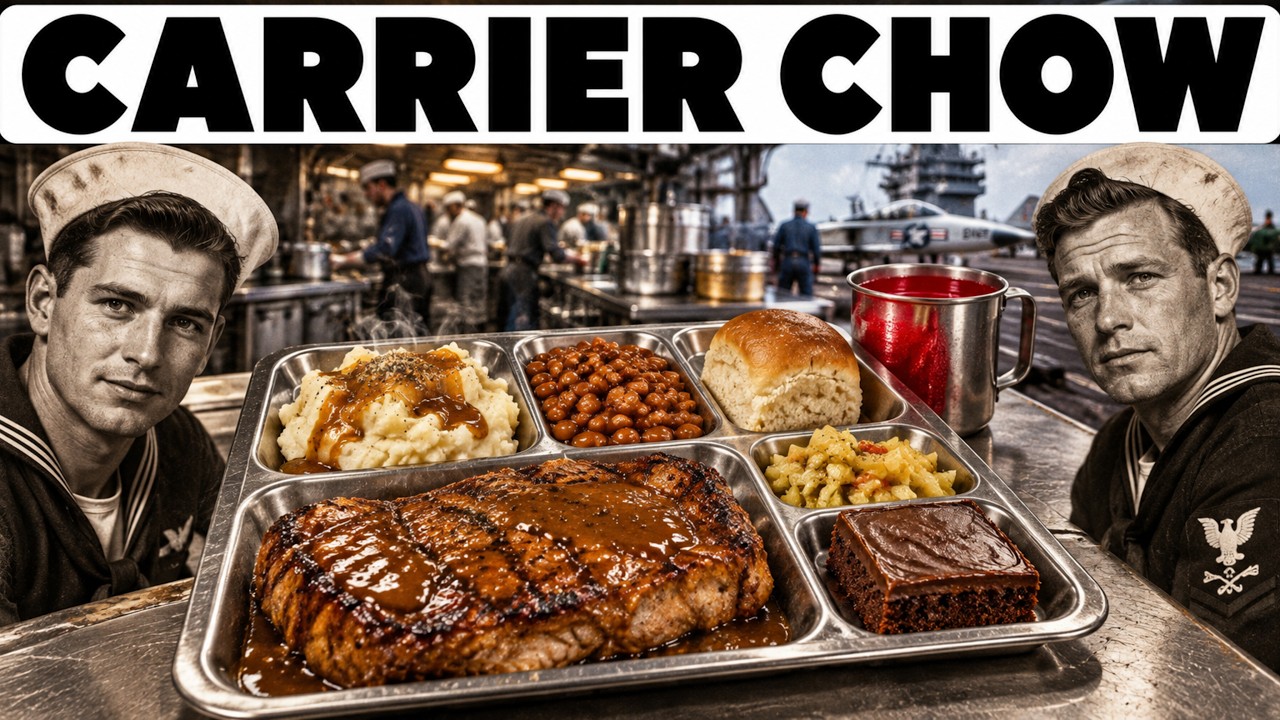
The dish that fed them all was called SOS—creamed chipped beef on toast—and it was so hated that sailors wrote home to complain about it. Yet it kept the entire fleet on its feet. And Navy coffee, Number 3 on the list, practically ran the ship. The full story of what those sailors ate is stranger than most people imagine.
Nobody pictures steak under the stars when they think of carrier food. The truth is that the men who served from Korea through Vietnam ate things like Bug Juice, powdered eggs, and a pressed meat loaf they called Horsecock. And they ate them by the ton, every single day, for months on end. Bug Juice was the Navy’s all-purpose fruit drink.
A powdered concentrate mixed in enormous stainless steel dispensers by the dozens of gallons. Cherry, grape, orange, lime—it hardly mattered. They all tasted like sugar, chemistry, and the faint memory of fruit. The color was unnaturally bright, the kind of red or green that does not occur in nature.
And here is the part that became legend: that same concentrate was strong enough that cooks used it to scrub the rust and tarnish off brass fittings and tile decks in the galley. Sailors watched their drink dissolve corrosion and then drank it anyway, because on a hot ship in the tropics, cold and wet beat almost everything. It was free, it was endless, and it was always there in the mess line. Men joked that it would strip paint and clean an engine.
They were only half joking. For thousands of young men far from home, Bug Juice was the taste of their entire enlistment. Fewer things were less loved than powdered eggs. Fresh eggs are fragile, perishable, and useless three weeks into a deployment, so the Navy went powdered.
Dehydrated egg came in giant tins, reconstituted with water into a pale yellow slurry that cooks poured onto flat-top griddles the size of a dinner table. Scrambled, they came out rubbery and faintly sulfurous, with a texture somewhere between custard and foam insulation. Men doused them in salt, pepper, ketchup, hot sauce—anything to drown the flavor. But powdered eggs did a job no fresh egg could.
They lasted for months in a hot storeroom without spoiling, and they delivered real protein to men working 18-hour days on a steel deck. A carrier might go through hundreds of pounds of egg powder in a single morning. The cooks learned every trick to make them palatable: folding in a little reconstituted milk, a scrape of margarine, a handful of diced ham when there was any. Fresh eggs showed up for the first few days out of port, a brief luxury.
Then the powder took over, and everyone knew the vacation was done. The name is crude, and the sailors who coined it meant every bit of it. Horsecock was the long tube of bologna, luncheon loaf, or pressed mystery meat that came out of cold storage for sandwiches and midnight meals. Slabs of it, pink and glistening, stacked on the serving line beside a loaf of white bread and a jar of mustard.
On a carrier feeding thousands, cold cuts were the fastest way to put something solid in front of a hungry man who had 20 minutes before his next watch. You slapped two slices between bread, grabbed a handful of chips if the geedunk had any, and ate it walking. There was no ceremony to it, but that loaf of pressed meat kept for a long time, cost the Navy almost nothing per serving, and never required a hot galley or a cook standing over a griddle. On the busiest nights, when the flight deck ran around the clock, Horsecock sandwiches fed more men than any hot entrée on the ship.
Sailors mocked it endlessly and ate it constantly. That contradiction was the Navy mess in a nutshell. Spaghetti and tomato sauce earned the nickname Red Lead after the thick, rust-colored primer painted onto the ship’s bare steel to stop corrosion. The comparison was not entirely a compliment.
Carrier spaghetti came out of giant kettles, the noodles soft to the point of surrender. The sauce was a sweet, slightly metallic tomato gravy stretched with whatever ground meat the storeroom could spare, glued together in a way no Italian grandmother would recognize. But Red Lead had virtues the critics ignored. A kettle of it could feed hundreds in one pass down the line.
It filled a man up fast with cheap carbohydrates, and it reheated without complaint for the next shift. The cooks could make it in volume, serve it in volume, and clean up in minutes. For a teenager from Ohio who had never eaten pasta that did not come from a can, it tasted like something exotic and fine. He would not say that out loud, of course.
On the mess deck, you called it Red Lead. You cleaned your tray, and you went back to work. Beans and franks, universally known as Beanie Weenies, was comfort food engineered for a warship. Canned pork and beans dumped into a kettle, sliced hot dogs stirred through, a squirt of molasses or brown sugar, and a shot of mustard to wake it up.
That was the whole operation. It required no fresh ingredients, no refrigeration beyond the cans, and almost no skill to produce at scale. A mess crew could open a few dozen institutional cans, heat the lot, and have dinner ready for 500 men before the first of them even set down a tray. The beans delivered cheap protein and fiber.
The franks delivered salt, fat, and the illusion of a real meat course. Served with a square of cornbread to sop up the sweet, smoky bean liquor, it was the kind of meal that sat heavy and kept a man going through a long watch. Nobody bragged about Beanie Weenies, but on a ship a thousand miles from the nearest grocery, a hot dish that cost pennies and never ran short was worth more than anything on a menu. When a carrier needed to turn ground pork trimmings and canned ham into something that looked like a proper dinner, the answer was ham loaf.
Chopped cured ham bound with cracker crumbs, egg, and a little milk, pressed into long sheet pans and baked until the top caramelized under a glaze of brown sugar and mustard, then sliced thick and laid on the steam line. It had the dignity of a roast at a fraction of the cost. This was resourcefulness disguised as a main course. The scraps and ends that would otherwise go to waste got ground, seasoned, and reborn as the evening entrée.
The glaze gave it a sweetness that cut the heavy salt of the cure. The crumbs stretched the meat, so one tray fed twice the men it should have. Sailors sometimes squinted at it suspiciously, uncertain what exactly they were eating, which is how it earned a spot in the long tradition of carrier mystery meat. But a good mess crew made ham loaf taste like Sunday at home.
And a homesick 19-year-old noticed the difference. Nothing fed a crowd of young men more reliably than macaroni and cheese baked in enormous sheet pans. The Navy version started with elbow macaroni boiled in volume, folded into a sauce built from reconstituted milk, flour, margarine, and bricks of processed cheese that melted smooth and never broke. Poured into pans, topped with crushed crackers or a dusting of paprika, and baked until the edges crisped and the center bubbled golden.
A carrier galley could produce it by the hundredweight. Mac and cheese hit every mark the mess needed to hit. It was cheap, the ingredients kept for months, and it was the one dish that even the pickiest, most homesick sailor would eat without a word of complaint. It was warm and soft and familiar in a world that was none of those things.
The crust along the pan’s edge was prized, and men timed their place in the chow line, hoping to catch a corner piece. For a lot of those sailors, the mac and cheese on the mess deck tasted exactly like the one their mother made. And for 20 minutes, that mattered more than anyone admitted. Here is what the war movies never show you.
A carrier galley was not a kitchen. It was a factory that ran 24 hours a day, 7 days a week for the entire length of a deployment, which could stretch nine months or longer. Cooks worked rotating shifts, mixing bowls the size of bathtubs, griddles you could park a jeep on, kettles that held hundreds of gallons stirred with what amounted to a boat oar. The storerooms below decks held tons of flour, canned goods, and frozen meat, enough to feed a small town for months with no resupply.
The men who ran it—the cooks and the mess attendants—worked some of the hardest, least glamorous hours on the ship. They were up before the pilots and cleaning long after the last plane landed. Nobody gave them medals. But a carrier that cannot feed its crew cannot fight.
Three hot meals a day, plus a midnight meal for the night shift, was not a luxury. It was a weapon system. And it never, ever stopped. Slumgullion, or just slum, was the Navy’s name for the catch-all stew that absorbed whatever the storeroom needed to use up.
Cubed beef or pork, potatoes, onions, carrots, a can or two of tomatoes, and whatever vegetables were closest to turning, all simmered together for hours in a vast kettle until the whole thing melted into a thick, savory brown stew. No two batches were ever quite the same, because the recipe depended entirely on inventory. Slum was pure efficiency. It stretched a small amount of meat across an enormous number of men by leaning on cheap potatoes and vegetables to carry the volume.
It wasted nothing. The long simmer broke down the toughest, cheapest cuts into something tender, and the starch from the potatoes thickened the broth into a gravy that clung to every spoonful. Ladled over rice or bread, it was filling in the deep, lasting way that only a real stew can be. Sailors grumbled that you never knew what was in it.
And they were right. But on a cold night in rough seas, a bowl of hot slum was exactly what a tired man wanted. Swedish meatballs, inevitably nicknamed Cannonballs, were a mess deck staple that sailors actually looked forward to. Ground beef and pork mixed with breadcrumbs and reconstituted egg, rolled by hand into dense spheres, browned on the griddle, then finished in a creamy brown gravy and served over egg noodles or mashed potatoes.
On a ship where so much of the food was poured, ladled, or scooped, a plate of meatballs felt almost like a restaurant meal. The nickname fit. They were heavy, round, and substantial—the kind of food that anchored a man through a long watch. The breadcrumbs stretched the meat so the galley could serve thousands without a king’s budget, and the gravy pulled everything together into something rich and warming.
A good batch of Cannonballs moving down the serving line lifted the whole mood of the mess deck. Word spread fast when they were on the menu. Men who normally ate in silence, exhausted, suddenly had something to say. In a place where most meals were about survival, the Cannonballs were about a small, real pleasure.
And the crew knew the difference. Chicken à la King was the Navy’s idea of elegance, and by mess deck standards, it nearly was. Diced chicken in a creamy sauce studded with peas and bits of pimento, poured steaming over rice, toast, or split biscuits. It carried a fancy French-sounding name, and that alone made it feel like a step up from slum and Red Lead.
The genius of the dish was how far it stretched a little chicken. A modest amount of meat disappeared into a generous cream sauce, and the sauce did the work of filling a man up and coating everything it touched. On a carrier where every pound of protein had to be rationed across thousands of mouths, that math mattered enormously. The pimento added a flash of color, which on a tray full of beige and brown was practically a celebration.
Veterans of Korea and Vietnam remember à la King with a strange fondness, partly for the taste and partly for the name. It sounded like something a man might order in a city restaurant on leave. Served from a steam table pan to a sailor in dungarees, it was as close to that world as the ship could get. Navy bean soup is older than the carriers it was served on, and there may be no dish more deeply woven into naval tradition.
Dried navy beans soaked and then simmered for hours with a ham bone or chunks of salt pork, onion, and little else, until the beans broke down and thickened the broth into a creamy, smoky, pale soup. It got its very name from this exact use. The beans kept indefinitely in the storeroom. The ham bone was already paid for by an earlier meal.
And the result could feed an entire crew for the cost of almost nothing. It was cheap, it was nutritious, and it was nearly impossible to ruin. A kettle left to simmer only got better and thicker. Sailors ate it with cornbread or crackers crumbled in, and it filled them the way few things could.
The United States Senate has served a version of navy bean soup in its dining room every single day for over a century. That is no accident. On a warship, it was the reliable backbone that was always there when fancier meals ran out. Here is the dish men wrote home to complain about, and the one that fed the fleet anyway.
Creamed chipped beef on toast, known throughout the military by a far less polite name abbreviated to SOS. Thin slices of dried, heavily salted beef torn into shreds and stirred into a thick white gravy of flour, margarine, and reconstituted milk, then ladled over toast until the bread went soft beneath it. It was gray. It was gloppy.
And generations of sailors claimed to despise it. And yet SOS appeared on breakfast lines through Korea, through Vietnam, and long after, because it was brilliant engineering. The dried beef lasted forever without refrigeration. The gravy stretched a tiny amount of meat across a mountain of toast.
It was hot, it was filling, and it delivered salt and protein to men about to work a brutal shift. Here is the quiet truth under all the complaining: plenty of sailors secretly liked it. They ate it. They cleaned their trays.
And decades later, some of them stood in their own kitchens making SOS for a confused family, because the taste brought the whole ship rushing back. Hated out loud, missed in private. That was SOS. Fresh milk on a nine-month deployment was a fantasy.
So the Navy drank its milk powdered and reconstituted. Dehydrated milk solids whisked into cold water in big dispensers, producing a thin, faintly chalky liquid that technically counted as milk. Chilled hard enough, it was almost convincing. Warm, it was a reminder of exactly where you were and how far from home that was.
But reconstituted milk did essential work. It gave growing young men calcium and protein. It went into the eggs and the mac and cheese and the cream gravies. And it kept in powder form for the entire cruise without spoiling.
The cooks depended on it as an ingredient far more than as a drink. A real glass of cold, fresh milk became one of the first things a sailor craved on liberty—the small luxury that marked the difference between the ship and the shore. On board, the powdered version was simply what milk was. New sailors wrinkled their noses the first week.
By the end of the deployment, they had forgotten milk ever tasted any other way. Here is the problem that shaped every single meal on this list. No refrigeration lasts forever, and no ship can carry enough fresh food to feed 5,000 men for the better part of a year. So everything had to be chosen for one quality above all others: the ability to survive.
Dried beans, canned meat, powdered egg, powdered milk, flour, rice, salt pork, dehydrated potato. These were not chosen because anyone loved them. They were chosen because they would still be edible six months into a deployment in a hot storeroom near the equator. Every nickname the sailors invented—Bug Juice, Horsecock, Red Lead, slum—was a little rebellion against that reality, a way of laughing at food that existed to last rather than to please.
The cooks performed small miracles, turning shelf-stable rations into something that resembled home cooking. And the men ate it. All of it. Because out there, between the catapult launches and the night landings, a hot tray of food was not just fuel.
It was the one thing on the whole ship that reminded them they were still people. Navy hamburgers earned the name sliders, and the nickname carried a warning. Flat patties cooked in volume on a greasy flat-top griddle, slapped onto a soft bun so loaded with grease that sailors swore they would slide right down your throat and straight through you. They were not gourmet.
They were not even particularly good. But sliders were beloved anyway, because a burger is a burger. And on a ship, a burger meant a small taste of an American drive-in on the far side of the world. The griddle men could turn out sliders by the hundreds.
Fast, cheap, and hot. Dressed with a slice of processed cheese, a limp leaf of lettuce if the stores had any, mustard, and a squirt of ketchup, a slider was the closest thing to civilian food the mess deck offered. Men ate two or three at a sitting. The grease was a feature, not a bug, because it carried flavor and calories that a hardworking body burned right through.
For a lot of those sailors, the first thing they wanted when the ship hit port was a real hamburger, precisely because the slider had kept the craving alive for months. Spam and its institutional cousins were everywhere, because canned pork was the perfect warship protein. Sealed in metal, it lasted years, needed no refrigeration, and could be fried, baked, diced, or ground into a dozen different dishes. Sliced and grilled until the edges crisped, it went onto breakfast lines beside the powdered eggs.
Diced, it disappeared into fried rice, casseroles, and bean dishes, adding salt and fat to stretch a meal. Baked whole with a brown sugar glaze and a few cloves, it did a passable imitation of a holiday ham. Sailors had a complicated relationship with it, the way soldiers and sailors always have. They mocked it relentlessly, and they ate it by the ton.
The reliability was the whole point. When the fresh meat ran out—and it always did—the canned pork was still down there in the storeroom, exactly as good as the day it was loaded. It fed the fleet across the Pacific through two wars and never once spoiled. A carrier could not have stayed at sea without it, and every man on board knew it, even as he complained.
Baked beans were a Navy institution with the weight of tradition behind them. And on many ships, they anchored the Saturday or Sunday morning meal without fail. Dried navy beans slow-baked for hours with salt pork, molasses, brown sugar, and mustard until they turned deep brown, sweet, and smoky. The sauce reduced to a thick glaze clinging to every bean.
This was not a thrown-together side. A proper pan of baked beans took most of a day in the oven, and the long, slow cook was what gave them their soul. Beans like these came out of the oldest American sailing traditions, when beans and salt pork kept crews alive on voyages that lasted months. By the carrier era, they had become a ritual—the dependable weekend dish that told a sailor what day it was in a world where every day otherwise felt the same.
Served with cornbread or brown bread and a side of franks, a plate of Navy baked beans was humble, cheap, and deeply satisfying. The sweetness was a small kindness in a hard place, and the men who grew up on them never forgot the taste. Autodog was the sailor’s name for soft-serve ice cream, and no dessert on the ship was more fiercely loved. The machine turned out a pale soft swirl, usually vanilla, sometimes chocolate, dispensed with a pull of the handle into a cone or a dish.
The name, crude as ever, came from the way it curled out of the nozzle. And the men did not care, because Autodog was cold, sweet, and gloriously ordinary in a place that offered almost nothing of the kind. The ability to make ice cream at sea was a genuine point of pride for the United States Navy, a tradition going back to World War II, when some ships were practically floating creameries. On a carrier steaming through the tropics, where the heat below decks was punishing and the work never stopped, a cone of Autodog was pure morale in a cup.
Sailors lined up for it. They talked about it. When the machine broke down, it was treated as a minor emergency. It cost almost nothing to produce, and it bought more goodwill among the crew than a cook could ever imagine.
A little cold sweetness, and for a few minutes a man forgot where he was. Geedunk was the ship’s snack bar, and the word came to mean the snacks themselves—the candy, the chips, the sodas, and whatever small treats a sailor could buy with his own money outside the mess line. On a long deployment, the geedunk was a lifeline of small comforts. A candy bar eaten alone on a quiet watch.
A bag of chips to crush over a sandwich. A cold soda that was not Bug Juice. These things cost the sailor a little out of pocket, but they bought something the regular mess could not: the simple dignity of choice. In a life governed entirely by schedules and orders, where every meal was decided for you, the geedunk let a man pick his own small pleasure.
The counter was a social spot, too—a place to linger for a minute, trade a joke, feel briefly like a civilian. The treats themselves were nothing special. The same candy and chips sold in any corner store back home. But that was exactly the point.
The geedunk was a piece of home you could hold in your hand. And on a steel ship in a war zone, that was worth every cent. Here is what nobody back home understood about the food. It was never really about the food.
A carrier deployment meant months away from everything a young man knew, with mail arriving in clumps weeks late. No privacy. No quiet. And the constant low hum of danger.
The mess deck was where the crew came together three or four times a day, every single day. It was the one place that smelled a little like a kitchen, that offered something warm, that followed a rhythm older than any of them. When a sailor stood in that line and the cooks had made something that tasted like his mother’s cooking, even badly, even in a steam table pan, something in him settled. The baked beans on Sunday, the mac and cheese with the crispy corner, the cone of Autodog on a brutal night.
These were not just calories. They were the small, reliable anchors that kept thousands of exhausted, homesick young men steady through months of a kind of loneliness hard to describe to anyone who was never out there. The food held the crew together. That was always the real job.
When a carrier found a rare, quiet stretch—no flight operations, calm seas—the crew got a Steel Beach picnic, and it was the closest thing to a holiday the ship ever knew. Grills were hauled up onto the flight deck, that vast expanse of steel that gave the tradition its name, and the cooks fired up burgers, hot dogs, chicken, and sometimes steak out in the open air. Men came up from the sweltering spaces below, squinted in the sunlight, and ate standing in the breeze with the ocean stretching to the horizon in every direction. After weeks in the fluorescent hum of the mess deck, a meal under an open sky felt almost unreal.
The food was the same food the galley always served, more or less, but the setting transformed it completely. There was music sometimes, and laughter, and the strange luxury of eating slowly with nowhere to be. A Steel Beach picnic cost the Navy very little and gave the crew something priceless: a day that felt different, a memory that stood out from the gray sameness of deployment. Sailors talked about these picnics for the rest of their lives.
The flight deck never slept, and neither did the galley. Midrats—short for midnight rations—was the fourth meal of the day, served in the small hours for the men coming off and going on to the night shift. It was rarely anything fancy. Often it was the day’s leftovers reheated: soup, cold cuts for sandwiches, a pan of something simple pulled together fast.
But midrats mattered enormously to the men who depended on it. The sailors working the overnight watches, the deck crews turning aircraft, the engineers deep in the heat of the plant, were doing some of the hardest and most dangerous work on the ship. And they were doing it while the rest of the world slept. A hot meal at 2:00 in the morning told them the Navy had not forgotten them.
It broke up an endless shift, put fuel in a depleted body, and gave a small circle of exhausted men a few minutes together in the quiet. There was a particular camaraderie to the midrats crowd—the night owls of the ship, eating soup and sandwiches while the stars wheeled overhead. The food was humble. The gesture was not.
Beef stew was the heavy artillery of the mess deck—the dish that filled a man to the brim on a cold, rough night and asked nothing more of him than a spoon. Cubed beef browned and then simmered for hours with potatoes, carrots, onions, and a rich brown gravy thickened by the meat and the starch until it stood up thick in the bowl. Unlike slum, which took whatever was around, a proper beef stew was a deliberate dish built to be good. The long simmer turned the cheapest, toughest cuts tender, so the galley could serve real beef to thousands without breaking the budget.
The vegetables stretched it further and made it a complete meal in a single bowl. Served over rice, egg noodles, or alongside thick slices of bread for sopping, it was the kind of food that warmed a man from the inside and stuck with him through the longest watch. When the sea was high and the ship was pitching and everyone was cold and tired, a bowl of hot Navy beef stew was close to the best thing in the world. It tasted like being taken care of.
On a ship where every day blurred into the next, Sunday dinner was the Navy’s quiet way of marking time. And fried chicken was its crown jewel. Chicken pieces dredged in seasoned flour and fried in big batches until the skin went deep golden and crackling, the meat staying juicy beneath. For a galley feeding 5,000 men, frying chicken at that scale was a real feat of logistics and labor, which is exactly why it was saved for Sundays and special days.
It was effort made visible, a signal that today was different. Served with mashed potatoes and gravy, a scoop of vegetables, and a biscuit or a square of cornbread, Sunday fried chicken was as close to a home-cooked family dinner as the ship could manage. And the men responded to it like family. The mess deck felt lighter on fried chicken day.
Sailors lingered a little longer over their trays, talked a little more, remembered Sundays back home with people they missed. The cooks knew what that chicken meant, and they took pride in getting it right. It was never just a meal. It was a message from the galley that someone still cared.
Navy coffee is its own legend, and it practically ran the ship. Black, scalding, and strong enough to strip the enamel off your teeth. Brewed by the gallon and kept hot around the clock in urns that never went empty. Sailors drank it constantly, from the 4:00 in the morning watch to the long haul past midnight.
And a carrier would have ground to a halt without it. This was not coffee for enjoyment. This was coffee as fuel, as medicine, as ritual. On a ship where men worked punishing hours on rotating shifts, often with too little sleep, that bottomless urn of brutal black coffee was what kept eyes open and reflexes sharp on a flight deck where a moment’s inattention could kill.
The coffee was always there—the one constant in a life of chaos. Men took it with such seriousness that a good cup was a point of pride and a bad pot was grounds for mutiny. Decades later, Navy veterans still make their coffee far too strong for anyone else at the table, because somewhere out at sea, that taste became the taste of staying awake, staying alert, and staying alive. Real steak—actual grilled beef—was the rarest luxury the carrier offered.
And when it appeared, the whole ship knew it was a special day. Steaks pulled from the deep freeze and grilled, often up on the flight deck during a Steel Beach picnic. The smell of searing beef drifting across the deck and down into the spaces below. After weeks of ground meat, canned pork, and stretched-thin entrées, a whole piece of grilled steak on a man’s tray felt almost impossible—a glimpse of the life waiting back home.
It was usually reserved for a holiday, a milestone in the deployment, or a reward after a brutal stretch of operations. The Navy understood something important about morale. You could feed men slum and SOS for months if every so often you gave them something to look forward to. Steak was that something.
Men talked about it for days before and days after. It tasted better than any steak had a right to. Not because of the cut, but because of everything around it: the salt air, the long watch, the company of the crew. On a warship, a simple grilled steak became an event.
And an event became a memory that lasted a lifetime. At the very top of the list is the one meal the Navy refused to skip, no matter where in the world the ship happened to be: the holiday dinner. On Thanksgiving and Christmas, even in a war zone, even in the middle of combat operations, the galley crews worked themselves to exhaustion to put out a full spread. Roast turkey with stuffing and gravy, mashed potatoes and sweet potatoes, cranberry sauce from the can, vegetables, rolls, and pie, served on tables the cooks had done their best to make feel festive.
The men filed through in their cleanest uniforms and ate until they could not move. And for a few hours, 5,000 sailors a thousand miles from everyone they loved got to feel just a little like they were home. This was the meal that mattered most. Not because of the food—though the food was the best the ship ever served—but because of what it stood for.
It was the Navy saying, across all that ocean, that these men were not forgotten. That tradition still held. That somewhere out there, family was thinking of them, and the service was thinking of them, too. A sailor could be homesick to his bones, scared, bone-tired.
But when he sat down to a hot turkey dinner on Christmas aboard a carrier at war, something in him held together. That meal fed more than bodies. It fed the thing that kept men going. The next time you sit down to an ordinary dinner, think about the men who ate standing up on a steel deck a thousand miles from home, grateful for a plate of SOS.
If your father or grandfather served, ask him what he ate out there, and watch his face when he tells you about the Autodog, or the midrats, or the Christmas turkey. Those meals are still in there. Every one of them. They were never just meals.
They were how a crew stayed human in the middle of an ocean and a war.
