The sun hung dead center overhead, motionless as lead. Lips cracked, tongues swollen, throats stuck together like dry leather. The dirt in the trench had ceased to be dust—it had turned to ash, sifting through the palms like fine gray sand. A man groaned to the right, another to the left, but no one dared look at them.
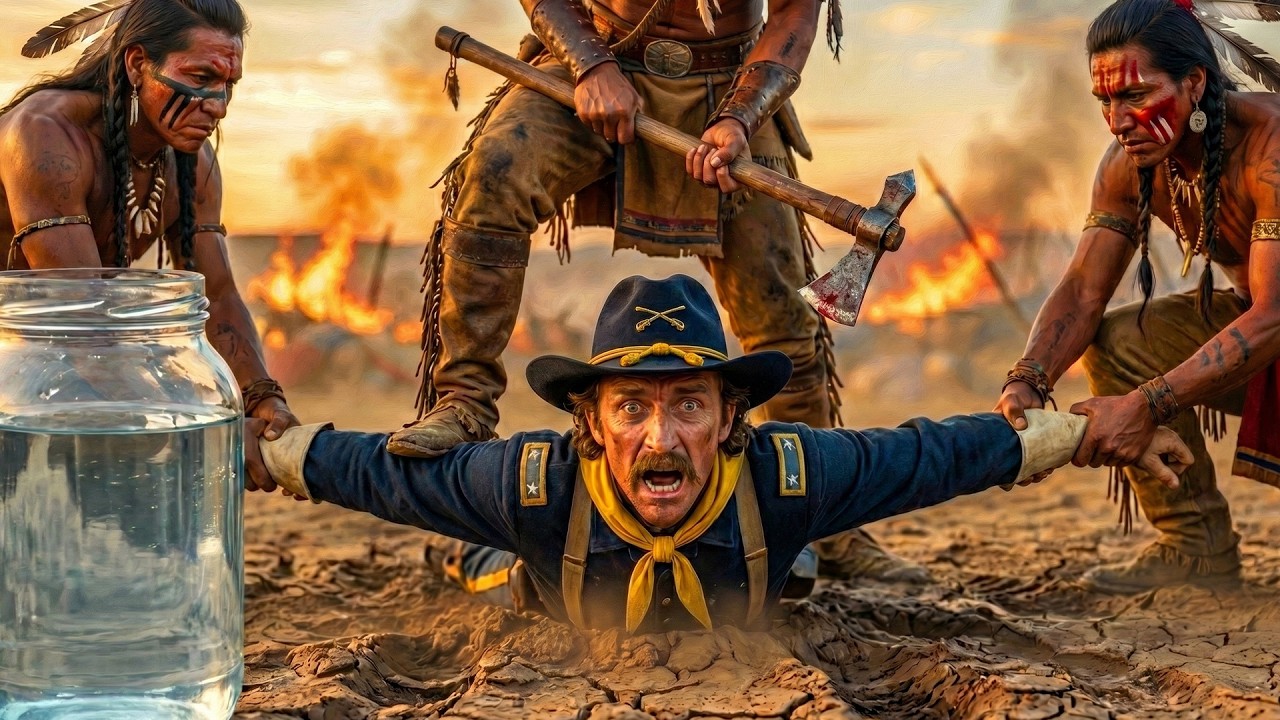
Somewhere on the opposite slope of the valley, a Lakota marksman was waiting for a head to rise. Raise it, and die. Keep it down, and go mad from thirst. A few hundred meters below, at the bottom of that valley, the blue band of the Little Bighorn River shone in the sunlight, calling to them.
It was the farthest place on earth. When darkness descended on the evening of June 25, 1876, the men who had survived on Reno Hill had not yet fully grasped what had happened. A few hours earlier, cavalry troops under Major Marcus Reno had charged into the Little Bighorn Valley, found a force of Lakota and Cheyenne warriors many times larger than expected, and been forced to retreat after heavy casualties. The men climbing the hill were exhausted, panicking, some gravely wounded.
Captain Frederick Benteen’s unit joined them shortly after. Then came the ammunition wagons. The total force numbered between 350 and 400 men—tired, terrified men with absolutely no idea what was going on. Where was General George Armstrong Custer?
No one knew that night. Custer was supposed to attack from the north while Reno pressed from the south, catching the Lakota camp in a crossfire. Custer had not arrived. Gunfire had been heard in the distance from the depths of the north, and then those sounds had ceased too.
No one slept through the night. Behind the shallow trenches, or on that flat ridge with almost no cover, the men waited, staring into the darkness. The hill was less a strategic position than a place of condemnation. A steep cliff to the west, an open plain to the east, and slopes swarming with Lakota and Cheyenne warriors to the north and south.
From an engineering standpoint, it was not defensible. It was a trap. The men dug with picks, pocket knives, even the iron of signposts. In some places the ground was so hard the picks bounced back; in others they struck stone.
The resulting holes were not trenches, only shallow pits deep enough for a man to lie down and protect his head. The night chill, that wild merciless cold of the Montana highlands, gave way within hours to scorching heat. For the wounded, surviving the night in the makeshift field hospital—nothing more than an open area covered with a few blankets and some canvas—was torture in itself. Dr.
James DeWolf had lost his life during the first raid. The remaining doctors tried to bind wounds and stop bleeding in the dark with limited supplies. When the sun rose on the morning of June 26, the attack resumed. This time it was more organized, more intense.
Lakota and Cheyenne warriors surrounded the hill completely and established sniper positions. They watched every movement and fired at every opportunity. Raising one’s head brought the risk of death. Bending to grab a canteen, reaching over the edge of the trench, leaning over a wounded comrade—any of these was enough for a marksman hiding behind a distant slope to pull the trigger.
Most of the men who fell that morning were not shot while performing heroic acts, but while making the most ordinary movements. One soldier took a bullet as he sat up in his trench. Another while hugging his wounded friend. Another simply while reaching out to get a view of the hill.
Death was not selective. It was random and instantaneous. That randomness created the greatest psychological devastation. A person searches for meaning in war—why him and not me?
There were no answers here. As the Montana sun climbed higher, the temperature rose rapidly. In this geography, midsummer midday heat can exceed forty degrees Celsius. There was no shade on the hill, no trees, no shelter.
The ground itself had become the floor of a heated oven. Soldiers could not touch their metal weapons bare-handed. Uniforms absorbed sweat and slowly dried, not with a cooling sensation but with a scorching burn against the skin. The horses tied behind the trench line neighed murderously from thirst and heat, their sounds mingling with the groans of the wounded into a constant hum over the hill.
The most critical point was this: there was no water. The kegs carried onto the hill had been emptied or lost during the chaotic hours of June 25. During the retreat, many packs, ration bags, and even weapons had been left behind. Some men had full canteens, but it was clear the marathon would drag on.
The canteens of 350 men would not last more than a few hours in the Montana heat. And in the valley, right there, that blue shining water flowed along its rocky banks. For now, that life was at an unreachable distance. No word from Custer.
No messenger. No reinforcements. By the afternoon of June 26, it seemed no one expected him anymore. Expectation had turned into silent despair.
Officers looked at each other; it was glances that spoke. Everyone sensed the situation, but no one voiced it. The saving attack from the north had not happened and was not going to happen. They did not yet know what had become of Custer and his 210 men; it would be days before the meaning of that event was buried at the bottom of the valley.
For now, the only things they knew were that they were surrounded, they were thirsty, and the night would come again. Thirst kills differently than a battle wound. A bullet is instantaneous and absolute; it either kills or it doesn’t. Thirst works slowly, methodically, patiently.
The human body is a machine that is sixty percent water. Deprived of it, first the thoughts blur, then the muscles burn, then the tongue swells and blocks the throat, and finally the mind loses the boundary between reality and fiction. On the morning of June 26, the men on Reno Hill were still at the beginning of this process. By afternoon, they would enter its middle stage.
Those bearing the heaviest burden were not the wounded; it was the healthy soldiers forced to listen to their groans. The field hospital hardly deserved the name. A few canvas sheets and blankets, set up in the relatively most sheltered—and even that was relative—depressed part of the hill. Dr.
Henry Porter and the assistant surgeons worked with what they had. Chloroform was running low. Morphine was on the verge of depletion. Bandages had turned into bloody rags.
The severely wounded—those shot in the intestines, chest, or hips—were already wrestling with death. Saving them would have required a real hospital, an operating room, and blood transfusions. None of these were available. But thirst added another layer.
When a wounded man gets thirsty, he believes water is the only thing that will suppress his pain. This belief is partly true—dehydration drives a body in shock into much faster collapse—but it also becomes a mental obsession. By mid-morning, the severely wounded were screaming for water. The cries started one by one, then merged, intertwined, turned into a continuous texture of sound over the hill.
One man yelled, “Water! For God’s sake, water! ” Another murmured the word in a semi-conscious state. Further away, someone could no longer form words at all, only a hoarse sound from his throat.
The healthy soldiers heard these sounds. There was no escape. On that small flat ridge, sound reached everywhere. A soldier said years later, “Hearing the bullets didn’t scare me anymore.
Hearing those sounds did. A man yelling water is a dying man, and you know it. And you have nothing to give him. ”
Were the Lakota and Cheyenne marksmen using this psychological pressure consciously?
It is difficult to say with certainty. But the strategy of the siege was clear: keep the men on the hill, immobilize them, wait for their resources to run out. Arrows and bullets applied horizontal pressure; the sun and thirst applied vertical pressure. The two forces worked together, and the trenches were inadequate against both.
The effectiveness of the marksmen was documented throughout that day. The rocky outcrops on the western slope and the woods on the eastern side offered excellent hiding spots. Some of these marksmen explained in interviews in later years that they watched every movement on the hill, targeting anyone who reached for a canteen or peeked over the edge of a trench. A soldier merely raising his arm was enough.
That movement, lasting less than a second, could prompt a marksman 150 meters away to blink and pull the trigger. Under these conditions, some men entered into bizarre and desperate quests for solutions. There were the horses—animals tied behind the trench line, driven mad by thirst and heat. They hadn’t drunk water for hours, but they had blood.
Statements record that some soldiers considered making small incisions in the animals’ jugular veins and drinking the flowing blood. A few actually tried it. Blood does not quench thirst; on the contrary, its high salt and protein concentration accelerates dehydration. But desperation renders logic dysfunctional.
Some licked the bottoms of their canteens. Some put pebbles in their mouths, an old method to stimulate the salivary glands. These were not remedies passed down through generations. They were temporary deceptions invented by desperation, and the salivary glands had already dried up anyway.
The pebble sat like a foreign object, producing nothing. In the afternoon, when the sun reached its zenith, the heat became unbearable. The ground burned the hands. Metal pouches, belt buckles, and gun barrels became untouchable in direct sunlight.
Some soldiers wrapped uniform cloth around their heads, both for protection and to place their hats on the trench edge—an old tactic to draw a marksman’s fire and reveal his position. But the capacity for such sophisticated thoughts was steadily diminishing. Signs of psychological collapse were recorded throughout the day. A sergeant, for no apparent reason, sat in his trench and began to cry.
The soldiers next to him tried to calm him, but he couldn’t stop for minutes. A private climbed out of his trench and started walking without knowing where he was going; two friends forcefully pulled him back and sat him down. These behaviors were symptoms of the cognitive impairment that emerges in the advanced stages of severe dehydration: weakening impulse control, dulled danger perception, passive acceptance. Major Reno had to face this picture.
Marcus Reno is not remembered as a hero of the Little Bighorn. History has been harsh on him. His retreat during the initial attack raised serious questions about his leadership, and in the following years military courts repeatedly put those questions on the table. But at noon on June 26, with 350 men on his hands, zero water, and no hope for reinforcements, he had to make a decision.
Captain Benteen was a different character—experienced, cool-headed, well-liked by his soldiers, unlike Reno. The two officers assessed the situation. When the options were laid out, none of them were good. To wait meant a slow death.
A general charge into the valley likely meant mass annihilation. There was a third option, smaller, faster, more daring—or perhaps not daring. Desperate would be more accurate. Sending someone down to get water.
When this idea was first heard, several officers remained silent. The path down to the valley—a steep, narrow, completely exposed ravine that would later be known as Water Carrier’s Ravine—lay directly under the observation angle of the Lakota marksmen. A man descending would turn into a target at the bottom. Even if he reached the river, his back would be turned on the way back.
The odds of returning alive were not high. But the wounded were still screaming. That continuous broken sound from the field hospital hung in the middle of the decision-making process. That afternoon, that sound would push some men to volunteer.
In military history, the word “volunteer” is often misunderstood. In cinema and novels, volunteering is the product of heroic impulse—the man steps forward, jaw clenched, eyes resolute, accepting death. In reality, volunteering emerges from a much more complex psychological process. On Reno Hill that afternoon, when the call went out, the men who stepped forward did not step forward to be heroes.
They were men who could no longer bear to listen to that sound—”Water. For God’s sake, water. “—that they had been hearing for hours. Sitting motionless and waiting felt more unbearable than death.
This distinction matters, because it tells us not what those men did, but why they did it. The call for volunteers did not come as an official speech. It spread through the trenches like a word-of-mouth whisper: men were needed to go down and get water. They would carry metal canteens and camp kettles.
Reach the river. Fill them. Return. Simple, clean, and almost certainly fatal.
Among the first to step forward was Sergeant Stanisław Roy, Polish-born, in the regular army for a few years, a survivor of Reno’s first raid on that frantic morning. No record survives of Roy explaining in his own words why he stepped forward, but the statements of other surviving volunteers in later years gathered around a common theme: hearing the voices of the wounded had become intolerable. The exact number of volunteers is debated; different sources give figures between thirteen and eighteen. Some were cavalry privates, some sergeants, from different units.
Their common point was this: the metal canteens and camp kettles they carried would create serious weight when filled. Gravity would help on the descent. Climbing back up that steep slope with full containers, under a hail of bullets, was another calculation entirely. As the volunteers prepared, Captain Benteen organized a rifle line.
The marksmen at the edge of the hill would open heavy fire on the Lakota and Cheyenne positions in the valley, the suppression partially covering the descent and return of the water party. “Partially” was critical here. The tactic would not end the sniper fire; it would only try to reduce its intensity. The Lakota and Cheyenne warriors were in their positions, superior in number, and knew the geography much better.
Water Carrier’s Ravine, named for what was about to happen, lay on the western slope of the hill. It was narrow, steep, and rocky. Both sides were open, targetable from the north and south, from any point on the opposite slope. The ravine itself was like a straight corridor—a person moving within it was as predictable and vulnerable as a bullet passing through a rifle barrel.
The distance to the river was nearly 250 meters, but that distance felt much longer under those conditions, in that heat, under that fire. When the volunteers gathered at the mouth of the ravine, they looked down. One survivor told a journalist years later, “I looked down and thought, this is not a journey. This is an end.
” He went down anyway. Why? “Because behind me a man was screaming for water, and I didn’t have the courage to look at him. ” That sentence is perhaps the most concise summary of the day.
The officers gave final instructions. Speed was essential. To stop was death. They would go down, fill the containers as quickly as possible, and return.
If anyone fell wounded, the team would not stop. This rule was clearly stated and clearly heard. The fallen would be left behind, because stopping would not only fail to save them but endanger the entire team. This was the mathematics of war: not sacrificing five to save one.
When the men heard the rule, they did not react. Silence meant acceptance. Benteen’s rifle line took position. The marksmen huddled against the trench edges, barrels turned toward the valley, waiting for the signal.
Reno stood next to the volunteers. He knew better than anyone what the next step meant. The responsibility for this decision belonged to him, and it would be brought up repeatedly in courtrooms in the coming years. But in that moment, there was no other option.
Or rather, there was: to wait. But waiting was also a choice, and its outcome was becoming increasingly clear. Reinforcements were not arriving. Custer was not coming.
As the hours passed, the water shortage increased, the wounded worsened, the healthy diminished. After a certain point, no decision could be made at all—including descending into the valley—because the minds that would make the decision would have become dysfunctional. Therefore: now. The volunteers looked at the empty canteens in their hands.
The metal containers burned in the sun; they needed to be wrapped in cloth to be held. Some wrapped the handles of the kettles in fabric. Some slung canteens over their shoulders by their carrying straps, leaving their hands free to catch themselves when climbing or falling. Small preparations, details that might seem meaningless, but they formed the last threads tying the men’s minds to the moment.
At the mouth of the ravine, those few seconds before moving found a place in testimonies. A private turned to the man next to him and just looked. The other looked back the same way. There was nothing to be said, or everything that could be said had already been said in that look.
Another man took a small piece of cloth from his pocket—maybe a photograph, maybe a letter, maybe just cloth—and put it back. No one asked what the movement meant. Benteen’s rifle line opened fire. Dust and smoke rose in the valley, on the opposite slopes, in the rocks.
The fire was not meant to silence the enemy positions; that was impossible. It was meant only to distract, to shorten their aiming time. A window of a few seconds. An interval of chaos.
The water party plunged into the ravine during that interval, down toward the river, empty canteens in hand, lungs burning, feet stumbling on the rocky ground, with that distinct fear that hunches the shoulders and ducks the neck, anticipating a bullet from the hills at any moment. They ran. When the first step was taken into the valley, time began to process differently. This is a recurring phenomenon in war testimonies, based on a neurological reality.
Adrenaline distorts the brain’s perception of time. A human under threat registers details with extraordinary clarity—the shape of a stone, the tone of a voice, the angle of a shadow—but feels as if the flow of those details has slowed. Those who returned alive described this with different words but the same essence: everything passed both very fast and very slow. The first thirty meters of the ravine were relatively sheltered; the slope’s own incline restricted the angle of the marksmen looking from the ridge.
These thirty meters offered an illusion. Maybe the ravine wasn’t as dangerous as they thought. Maybe Benteen’s rifle line really had suppressed the positions on the opposite slope. Maybe—
The first bullet dust struck dead center in the ravine.
The Lakota marksmen were ready. Benteen’s fire had not surprised them; the tactic was not foreign to them, and seconds were enough to shift positions and angle into the ravine. From the midpoint onward, the water party entered a completely open target field. Bullets came from right and left, from above and diagonally.
Dust sprayed, stones flew. A canteen dropped from its owner’s hand with a metallic clatter, struck not in the holding hand but in its coarse metal body. The men did not hesitate. They couldn’t.
Hesitation meant presenting a stationary target. Movement was the only guarantee of life, and the movement turned into an uncontrolled, intuitive, almost animalistic sprint. Tactical thought had been disabled. The only thing left was to go forward, down, toward the river.
Halfway through the ravine, one of the men running in front stumbled and fell. The soldier next to him slowed for a moment—an instinctive movement, a reflex to help—then kept going. The fallen man got up. He had tripped on a stone, not taken a bullet.
He kept running. But that brief deceleration was etched into the mind of the soldier beside him. “I shouldn’t have even hesitated,” he thought. The thought never left him.
At another point, on the southern edge of the ravine, a private suddenly spun around—whether reflex or conscious, unclear—and collapsed to the ground along with the canteen in his hand. The man behind him jumped over him. The next one passed over him. They kept running.
The fallen private’s voice was heard, a short, sharp sound of pain, but no one stopped. The rule not to stop was no longer just an order; it was a condition the body naturally complied with. His name was not put on record. The names of all those who fell were not recorded.
Some were shot, some had stumbled, some were somewhere in between—bullet-grazed in a painful but non-lethal place, still running because there was no option but to run. Reaching the bank of the river did not mean salvation. The Little Bighorn was narrow and shallow at that point, waist-high in some places, below the knee in others. The banks were muddy and slippery, the water flowing in brown turbidity, full of mud, plant debris, and animal tracks.
But at that moment, for those men, it was the purest water in the world. Those who reached the bank immediately knelt down. This was not a strategic decision; the legs gave way, the bodies bent, the hands plunged into the water. Bending also partially reduced their silhouette—an accidental safeguard that perhaps saved a few lives.
Canteens were dunked. Camp kettles were filled. The process lasted seconds, but those seconds felt endless, because firing continued from the opposite bank and from the rocks upstream. Bullets hit the water, raising small, thin, fast white columns that immediately disappeared and gave way to the next.
A soldier filling his camp kettle saw a column rise right next to him and pulled his hand back, reflex. Then he dunked it again; he couldn’t pull his hand back until the kettle was full. Another man collapsed face-first into the water while filling his canteen. The soldier next to him looked.
Did he die? Did he fall? Was he hiding? He understood the answer in a second.
The man lay face down in the mud of the riverbank, canteen in hand, motionless. The survivors had to leave the bank with full containers. A full camp kettle can weigh fifteen to twenty kilograms; coupled with multiple canteens and carrying straps, the weight was felt exponentially on that steep slope. Gravity had helped on the way down.
Now the same gravity had become the enemy. The legs were already exhausted—the sprint, the heat, the thirst, the adrenaline had drained them—and now they had to climb with the weight of full containers, while the marksmen were still there. The way back was at least as dangerous as the descent. In fact, it was more dangerous.
The men moved slower, unable to run fast and balanced with the weight, and their backs were turned to the marksmen. Instinctively the worst position for any soldier. At least you can see the bullet coming from the front. You don’t even feel the one from behind.
Benteen’s rifle line was still firing. The soldiers above saw the men running in the ravine, sometimes disappearing in the dust, sometimes reappearing. They watched with a distinct sense of helplessness. They were not in a position to help.
All they could do was keep firing and wait. In the middle of the ravine, on the way back, a man fell and did not get up. The soldier twenty meters behind caught up to him. Despite the rule, instinct won, and he grabbed the fallen man’s arm.
The man was heavy; the full canteens and kettles prevented him from getting off the ground. The second soldier tried to pull him to his feet, and for a few seconds the two of them remained in the ravine as a stationary target. Two more bullets struck near them. The man still didn’t fully get up, but the second soldier dragged him by the arm, half-dragging, half-carrying, continuing up the slope.
Those watching from the hill later described the moment: two men in the middle of the ravine, climbing with slow and staggering steps, one with empty hands holding the other. A canteen spilled. The water splashed against the stones and flowed down, absorbed by the scorching earth. But the man did not let go of what he was holding.
When the first men reached the hill and fell behind the trenches, they could not move for a few seconds. They only breathed deep, ragged, painful breaths. They dropped the full containers; someone took them and ran toward the field hospital. Behind them in the ravine, there were still sounds.
When the first kettle reached the field hospital, a wave of movement passed among the wounded—the physical manifestation of hope. But “hope” remains too clean a word. A more accurate description: proof that the organism does not give up even at the deepest point of exhaustion. Severely wounded men, lying unable to move for hours, raised their heads when they heard the sound of that kettle placed on rocky ground.
Some couldn’t lift their heads, but turned them. Eyes opened. Dr. Porter and his assistants distributed the water, first to those in the most critical condition—though “most critical” was vague; almost everyone was critical.
Some men drank straight from the canteen. Some had water dripped through small cloths because their swallowing reflex had weakened. It was recorded that a private wept unconsciously the moment he first felt the water; he wasn’t even aware of it himself. The tears just flowed, and he didn’t try to stop them.
The water was brown—that season’s tone of the Little Bighorn, dense with mud and plant content. It wasn’t clean; it wouldn’t be classified as potable by today’s standards. But for those men, at that moment, it was the purest water in the world. No one looked at its color.
No one questioned its smell. But in the ravine below, the sounds were still continuing. The men who couldn’t make it back—shot and fallen, left halfway, whom even the assisting soldier couldn’t carry—remained inside the ravine. Some were dead, understood by a distinct stillness when viewed from the top of the hill.
But some were not dead. These men were yelling in the ravine among the stones, right under the sun. The soldiers on the hill heard them. The surviving volunteers heard them too—men who had just sat down in their trenches, legs trembling, lungs burning, having emptied their full canteens, hearing the voices of their comrades lying in the ravine.
The human ear processes the tone of a familiar voice differently than an unfamiliar one. This is a neurological fact. The voice of the man you lived with, sat around the same campfire with, drank from the same canteen with, is not an abstract human voice. It is personal.
And that personal voice rose from the ravine that afternoon. No one went back. This must be understood not as cowardice but as mathematical necessity. Re-entering the ravine would not be a rescue operation but a second suicide.
The Lakota marksmen were still in their positions; anything that moved was a target. The man going back would likely fall himself before reaching the wounded man. The officers made this calculation and gave no one the order to go back. No volunteers stepped forward either.
Or if they did, they were turned back. But the rightness of the rule did not remove the burden of listening to those sounds. What happened on Reno Hill that afternoon was later recorded in military literature as the “water party,” a cold bureaucratic name sufficient to cover the raw truth. Official records gave numbers, listed names, recommended medals.
Indeed, the vast majority of the volunteers who returned alive were later awarded the Medal of Honor, the highest military decoration in American history. But the medal ceremonies did not bring back the voices of the men left in the ravine. The statements of the surviving volunteers were compiled over decades by journalists, historians, and military analysts. There is a common texture: the men didn’t talk about the run, but the return.
Not the river, but the ones left in the middle of the ravine. Not the water they saved, but the men they couldn’t save. Sergeant Roy rarely spoke of that day in his later life. When he did, he didn’t go into details.
He just said, “I sat on the hill and listened below. I listened until the sound stopped. ” What did he feel when the sound stopped? He never answered that question.
In the later hours of June 26, the intensity of the siege began to change. As the sun slanted to the west, a stir was observed in the Lakota and Cheyenne camp. Smoke rose. The sounds changed.
The soldiers on the hill couldn’t make sense of it at the moment. It would later be understood that reinforcements under General Alfred Terry were approaching from the southeast, and that approach had forced Sitting Bull’s camp to retreat. But this information had not yet reached the hill. The only thing that changed was the thinning of the fire—first intermittent, then less frequent, then almost inaudible bursts.
When night fell again, the siege had effectively ended. But it would be necessary to wait for morning to understand this. No one slept on the hill that night. Not like the previous night; this time with a different kind of wakefulness.
The previous night’s had stemmed from fear and uncertainty. This night’s came from a deeper, quieter place. The men sat in their trenches staring into the darkness. Some spoke in low voices, in short sentences.
Some didn’t speak at all. In the field hospital, some of the severely wounded lost their lives that night. Some were still alive when the water arrived. The water hadn’t been enough to save them; their wounds were too deep, the shock too advanced, their bodies too depleted.
The water was important as a symbol, but it wasn’t a medical miracle. The dead were moved to a sheltered corner of the hill with the first light of morning. On the morning of June 27, when General Terry’s vanguard forces reached the hill, Reno and Benteen’s men had spent over forty-eight hours under siege. During those forty-eight hours, according to official records, thirty-two people had lost their lives and more than forty-four were wounded.
But these numbers measured only the physical dimension of the losses. The first officer to arrive with Terry’s soldiers saw the men sitting in their trenches with hollow eyes and faces burnt by dust and sun, and wrote in his diary: “These did not look like men who had come out of a battle. These looked like they had come out of not a battle, but somewhere else, from another experience. ” It was hard to describe what kind of place that was.
Those forty-eight hours on Reno Hill became one of the most comprehensively studied chapters in the military history of the American West. The Battle of the Little Bighorn went down in history books with the dramatic annihilation of Custer, a focus that often left what happened on top of the hill in the shadows. But Custer’s story is instantaneous and catastrophic, a battle with a definitive beginning and a definitive end. The story of Reno Hill is a longer, slower, perhaps darker kind of existential experience: waiting, enduring, staying despite everything.
The water party operation is the sharpest point of that experience. It contains an unexplainable mixture—heroism and desperation, courage and coincidence, survival and leaving behind. The men who received the medals generally spoke briefly at their ceremonies. Some didn’t speak at all.
One sergeant who received the Medal of Honor gave this answer to a journalist after the ceremony: “We went down and we came back. That’s all. ” The journalist pressed for more details. The sergeant repeated, “We went down and we came back.
We came back because they couldn’t. ” It is perhaps the most accurate summary of that day. The Little Bighorn River still flows today in the same valley, in the same bed, with the same brown turbidity in the summer and the same clarity in the spring. The ravine known as Water Carrier’s Ravine remains within a park where visitors hike.
Above it stands a small sign with its history and a short summary of the operation. The writing has faded. At the bottom of the ravine, near the riverbank, a few stones lie on the ground. Some are natural.
Some perhaps were intentionally left. Who left them? When? Why?
These are not known. But those stones are there on that little muddy bank, the sun rising over them every day. The water flows.
