The jury foreman’s voice cut through the silence of the Lancaster County courtroom. Asked whether the panel had reached a verdict, he answered yes. A clerk read the charge—first-degree murder in the death of Claire Whitaker. The answer came back clear and final: guilty.
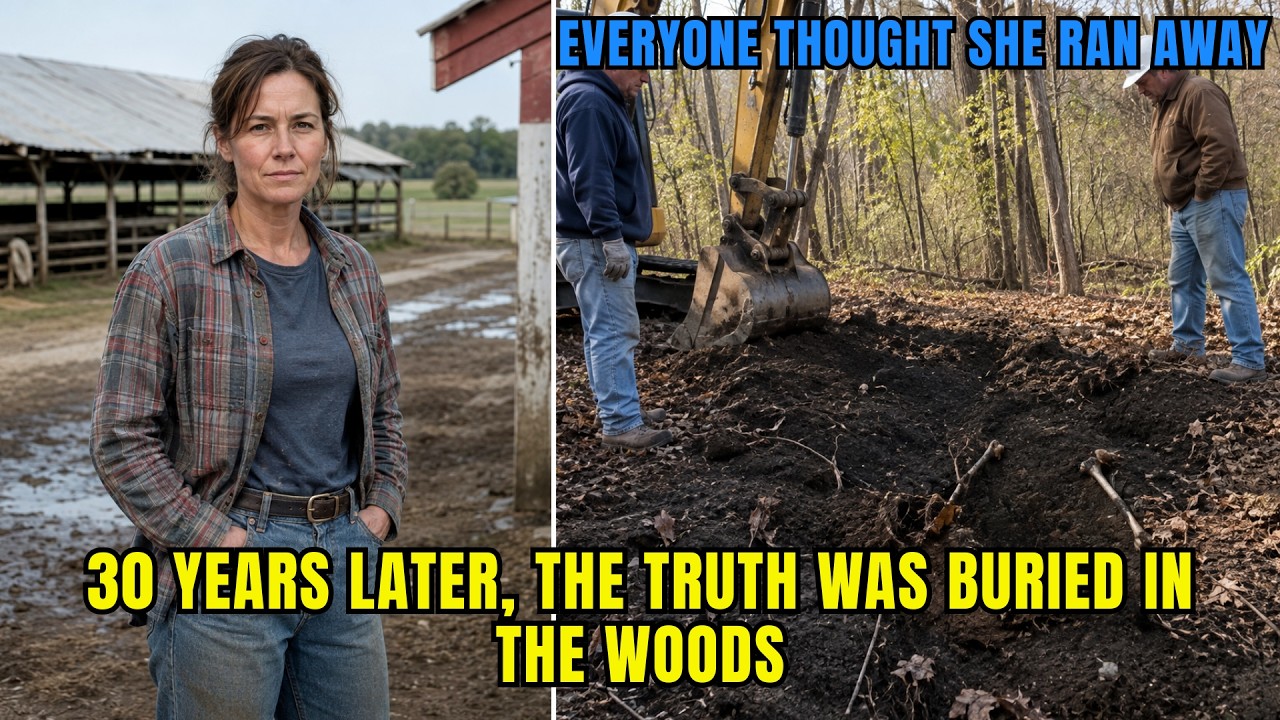
Richard “Rick” Whitaker lowered his head slightly. His daughter Emily raised a hand to cover her mouth. Ethan Whitaker, now forty-five, sat between his siblings and stared at the floor. For nearly thirty-two years, the three of them had lived with a question no one could answer: did their mother leave them, or was she taken?
The verdict answered it in a way none of them had wanted to face. The man who had raised them after her disappearance was the one the law now said had ended her life. No one in the courtroom cheered. There was no sense of victory.
There was only the weight of a case that had begun on a gray November morning in 1989 and had taken three decades to reach this moment. —
In the fall of 1989, Manheim, Pennsylvania, was a quiet farming community in the broad agricultural region of Lancaster County. Families raised livestock and worked land that had passed through generations. The Whitaker family ran a pig farm a few miles from the center of Manheim, with a main house, long barns, and a small red shed across the yard.
From the outside, Richard and Claire Whitaker and their three children looked like any other farm family. Behind that calm surface, though, tensions simmered that few outside the family understood. On the morning of Friday, November 10, Rick Whitaker started work early with his eldest son, thirteen-year-old Ethan, preparing the barn for a new group of piglets. Claire, thirty-nine, a former nurse, came to help even though she had undergone minor surgery four days earlier.
Her task that morning was to wipe down the hanging lights in the barn. She set a plastic bucket on the concrete floor, climbed up, and reached overhead. Around nine o’clock, Ethan noticed his mother suddenly stop, gripping the metal frame of the bucket. He asked if she was all right.
Claire said she felt a little dizzy and continued working. But less than twenty minutes later, her legs wavered again, and the bucket tipped sideways. Rick came over, told his wife to stop, and asked her to go rest at the house. Claire reluctantly agreed.
Before she left, Rick reminded her that a pet carrier was in the red shed, about thirty yards from the pig barn, which he would need at the end of the day. “If you feel better, you can bring it to the workshop,” he told her. “If not, leave it. ” Claire nodded and walked out of the barn.
Ethan watched her cross the yard toward the red shed before returning to work. It was the last time he ever saw her. More than an hour later, Rick and Ethan moved to the small room at the front of the barn. Rick looked out the window and realized the pet carrier had not been placed by the workshop.
He asked Ethan to go check on his mother. The boy ran to the red shed and found the door slightly ajar. The pet carrier was still inside. Ethan called out, “Mom?
” No one answered. He looked around the shed, then ran to the main house. Claire was not in the kitchen, the living room, or the bedroom. Her car was still parked in the yard, and her heavy winter coat still hung by the door.
Ethan ran back to tell his father. Rick and his son searched the workshop, the barns, around the house, and the road passing through the farm, calling Claire’s name again and again. The two younger children did not know where their mother had gone either. As the minutes passed, confusion turned to panic.
Claire had not been feeling well. The car was still there. There was no sign she had intended to leave the farm. In the early afternoon, after calls into the cold fields met only silence, Rick went into the kitchen, picked up the wall phone, and reported his wife missing at about 1:35 p.
m. —
A Manheim Borough police cruiser turned off Doron Road and entered the Whitaker farm, followed by a Pennsylvania State Police patrol car from the Lancaster barracks. Officer Raymond Null, thirty-four, was the first to meet Rick Whitaker in front of the main house, while Trooper Samuel Price began recording the names of everyone who had been at the farm that morning. Within twenty minutes, Detective Thomas Keller, forty-two, arrived to coordinate the missing-person case and asked the family to recount the morning in precise chronological order.
Rick said Claire had worked with him and Ethan in the pig barn since about eight. Around nine, she felt dizzy. Around 9:20, she nearly lost her balance a second time. “I told her to go rest at the house,” Rick told Keller.
“I just asked her to bring the pet carrier if she felt well enough. ” Ethan confirmed that his mother had left the pig barn alone and walked across the yard toward the red shed. Had he seen her go in? No, Ethan shook his head.
He had only seen her heading in that direction, then gone back to work. Around 2:10, Keller, Officer Cole, and Trooper Price walked from the pig barn to the red shed, about thirty yards away. The front door stood open about a foot. The wooden shelves inside were stacked with spare parts, old bags, metal buckets, and farm tools.
The gray pet carrier Rick had mentioned still lay on the floor at the far end of the shed. Near the left aisle, Officer Cole found a brown work glove. Rick identified it as Claire’s. A few feet away, Trooper Price noticed a small light-colored button on a shelf base.
No one in the family immediately claimed it. Keller ordered the men not to touch anything until the scene was photographed. At 2:27, Price pointed to three small dark brown spots on the wooden floor near the tool storage area. “Tom, you need to look at this,” he said.
Keller bent down to examine them but drew no conclusions. The spots were too small to indicate what had happened, and in a working farm building they might have been there a long time. Still, he ordered samples taken. A long-handled corn fork with a four-pronged steel head lay against the north wall, on its side on the floor rather than with the other tools.
Rick said the fork was used regularly on the farm and that he did not know who had used it last. Keller sealed the fork, the glove, the button, samples of the dark material, and several fabric fibers found near the aisle as evidence. Some plastic crates and tools in the shed seemed to have been moved, but Rick could not say whether that had happened that morning. There was no pool of blood, no obvious drag marks, no broken furniture.
Most importantly, Claire was not there. Around 3:05, Keller asked Rick whether his wife’s health might explain what they were seeing. “She felt dizzy twice,” Rick replied. “Maybe Claire came in here, passed out, and fell.
Maybe she hit something. If she was hurt, where would she go? ” He looked toward the main house. “I think she would come home.
” The answer caught Keller’s attention. The distance from the red shed to the back door of the house was only a few minutes’ walk. If Claire had been conscious enough to leave the shed for help, the house was the closest place. At 3:25, Officer Cole and Rick searched the house.
Claire’s purse was still there. Clothes still hung in the closet. No bag had been taken, and most of the cash and personal papers remained untouched. Her heavy dark blue winter coat still hung on the hook by the back door.
Outside, her 1986 Buick LeSabre was parked exactly where Rick said she had left it that morning. Keller asked if Claire had relatives who might have come without calling first. Rick mentioned a sister in York and an old friend in Lititz. Officer Cole called both from the kitchen phone.
Neither had seen or heard from Claire that day. By 4:20, Trooper Price had interviewed the three closest farm families along Doron Road. No one remembered seeing Claire walking along the road, and no one had seen an unfamiliar car stop at the farm around the time she vanished. Darkness fell before five.
The temperature dropped, and the open ground between the pig barn, the red shed, and the main house sank into gray twilight. Keller stood in the yard with Officer Cole, tracing Claire’s last known path. She left the pig barn around 9:20. Ethan saw her walk toward the red shed.
More than an hour later, she was gone. The car was still there. The purse, clothes, and money were still in the house. The pet carrier had not been taken from the shed.
Keller did not yet have enough to treat the red shed as a crime scene, let alone conclude Claire had been abducted or killed. But before leaving to organize a search after dark, he said quietly to Trooper Price, “A sick woman doesn’t just vanish in the middle of a farm and leave nothing behind. ” Price looked toward the nearby house and replied, “Then we need to find out where she went. ”
—
That evening, Keller requested additional state police reinforcements.
He wanted to pin down Claire’s final twenty-four hours, especially the period from her appearance in the pig barn until Ethan discovered she was missing. Around 5:15, he sat with Rick at the kitchen table and asked the husband to recount everything again, hour by hour. Rick repeated the sequence: Claire entered the barn around eight, felt dizzy near nine, nearly fell again around 9:20, and left for the red shed shortly after. Around 10:30, when Rick realized the carrier had not been brought to the workshop, he sent Ethan to look for her.
“From the time Claire left the barn until you sent Ethan to look for her, where were you? ” Keller asked. “In the barn,” Rick answered. “Ethan and I were still working there.
”
Keller then spoke with Ethan alone. The boy recounted nearly the same sequence. His mother felt dizzy. His father told her to rest.
Claire walked toward the red shed, and the two of them kept working. Did you see your father leave the barn after your mother left? Ethan thought for a few seconds, then shook his head. “No, I remember Dad was with me.
” Keller wrote the answer in his notebook but did not dwell on it. At that moment, it was only one part of a timeline, not conclusive evidence for or against anyone. Around 6:10, a small search team began sweeping the area around the house under flashlight beams. Officer Cole searched the workshop and secondary sheds.
Trooper Price and two other officers searched the grain storehouse, tractors, trucks, and large equipment that might conceal an injured person. Drainage channels along the fields were examined carefully. By about 8:00, there was no trace of Claire anywhere near the farm. The state police tracking-dog team arrived at 8:35.
Handler Mark Duggan used a shirt Claire had recently worn to give the dog her scent. The dog moved from the main house into the yard, returned toward the pig barn, then pulled Duggan toward the red shed. The dog stopped near the shed door, continued around the back of the building, and headed toward an open space between the outbuildings. After a few dozen meters, the trail went cold.
The dog circled, picked up the scent again, and lost it once more. Duggan tried starting from the red shed, but the result was no clearer. “I don’t have a clear enough trail to determine which direction she took,” he told Keller. The search continued until nearly midnight.
Barns, grain stores, machinery sheds, drainage channels, and both sides of the road through the farm were checked. Police knocked on neighboring doors asking if anyone had seen a thirty-nine-year-old woman walking or an unfamiliar car stopping between 9:20 and 10:30 in the morning. No one had. —
On Saturday, November 11, the search expanded into surrounding fields and neighboring farms.
Claire’s description went out to law enforcement across Lancaster County: a white woman, thirty-nine, a former nurse, missing from her family farm near Manheim. Local radio stations aired the notice in morning news bulletins, and newspapers picked it up in later editions. Keller asked hospitals in Lancaster, Lititz, and Ephrata to check for an unidentified woman who might have been admitted. No hospital reported receiving anyone matching her description.
Traffic accidents from November 10 were reviewed. No abandoned vehicle, no unidentified victim. Claire’s Buick remained at the Whitaker farm. By the end of the morning, police had no witness who could confirm seeing Claire after Ethan watched her leave the pig barn.
Keller wrote three possibilities in his case notes. She might have suffered an accident after feeling dizzy and still be lying somewhere outside the searched area. She might have left voluntarily without telling her family. Someone else might have taken her from the farm.
None of these theories was supported by enough evidence to favor it over the others. But after nearly twenty-four hours, one fact was hard to deny: Claire had not appeared at any hospital, had not called relatives, had not used the car parked outside the house, and no one in Manheim could confirm seeing her since the previous morning. —
By Sunday morning, November 12, news of Claire’s disappearance had spread beyond the fields around the family farm. More than forty volunteers gathered near the pig barn from seven in the morning—neighbors, friends of the Whitaker family, volunteer firefighters, and farmers from along the surrounding roads.
Detective Keller divided the area into grids on a topographic map and ordered the groups to walk in lines, staying close enough together to avoid missing any clothing, footprints, or item Claire might have been carrying. “Don’t look for anything specific,” Keller told them before the groups split up. “If you see something strange, don’t touch it, call us. ”
The first search focused on freshly harvested cornfields behind the Whitaker farm.
Rain from previous days had left the ground soft, and broken corn stalks slowed the search. Volunteers moved along every row, checking low areas, drainage channels, and ground around abandoned machinery. Fire Chief Robert Heinz of the Manheim Fire Department led another group to two small ponds and a stream crossing a neighboring farm. Neighbors allowed police to open gates and search barns, stores, and abandoned buildings on their land.
Trooper Price and Officer Cole covered ditches along the roads nearest the farm, in case Claire had reached the road and been struck by a vehicle. No one found anything. The dog team returned that day. Mark Duggan again scented the dog from Claire’s clothing and started at the red shed.
The dog responded clearly around the shed, tracked her scent, and moved toward open ground. But as on Friday night, the trail soon scattered. Duggan tried again from the main house and from the site of Claire’s Buick, but none of the attempts produced a consistent direction. On November 13, Keller expanded the search into a wooded area a short distance from the main part of the farm.
The Whitakers had bought the land shortly before, and Rick usually called it “the new woods. ” Rows of bare trees, thorny underbrush, and a ground cover of rotting leaves made the search far harder than in open fields. Nearly thirty people spent hours moving through the woods, checking hollows, fallen logs, drainage channels, and low ground. Keller and Trooper Price followed an old path wide enough for farm vehicles, but found no clothing, no signs of digging, nothing that could be directly linked to Claire.
Meanwhile, reports about the missing woman went out on radio and in local papers, and the calls began to come in. A gas station attendant on Route 72 said he had seen a woman resembling Claire on the evening of November 10. After Keller showed him a photo, he was no longer sure, and another customer was later identified as the woman he had seen. A bus driver recalled a woman with similar hair at the Lancaster bus station.
Police checked schedules and found the passenger; it was not Claire. On November 14, a waitress at a roadside restaurant near Ephrata called police after remembering a woman sitting alone. Officer Cole went to interview her and quickly determined her clothing did not match what Claire had been wearing the morning she vanished. Each initial report brought hope to the Whitaker family, then ended in disappointment.
Rick continued to join searches around the farm whenever police allowed. Ethan and the two younger children stayed mostly with relatives. Ethan repeatedly asked whether police had found his mother. No one had an answer.
By November 16, search teams had covered hundreds of acres of farmland, numerous barns and abandoned outbuildings, ponds, streams, roadside ditches, and most of the new woods. Hospitals remained in contact. No unidentified body had been found. No accident involving Claire.
No transaction or phone call suggested she had contacted relatives. Her photos still hung in stores and gas stations around Manheim, but after nearly a week, Detective Keller faced a troubling reality. Dozens of officers, firefighters, farmers, and volunteers had searched a wide area without finding any tangible trace. Claire Whitaker seemed to have vanished from the farm itself, leaving behind her car, her family, and a void that grew harder to explain with each passing day.
—
Nearly a week into the search, Keller realized the fields, ponds, and barns around Manheim might not give him answers unless he understood the life of the woman who had disappeared. On the morning of November 17, he and Trooper Price returned to the Whitaker farm, but this time they brought notebooks and a list of people close to Claire rather than a search team. The investigation had changed. The question was no longer just where Claire had gone, but what had been happening in her life before November 10.
Rick sat with Keller at the family kitchen table and described the marriage as stable. The couple had been married for many years, had three children, and had built most of their life around the farm. Rick acknowledged they had gone through a very difficult period about five years earlier. Claire had been involved with someone else, he had discovered it, and they had nearly lost hope.
According to Rick, the couple then sought marital counseling in Lancaster and decided to stay together for the family. “We got past it,” Rick told Keller. “I thought that time was over. ”
After that period, Claire left the nursing job she had held for years.
She began spending most of her time at home, caring for the children, managing the farm’s accounts, bills, and paperwork, and helping Rick when farm work was heavy. Rick said the decision was made together. The farm needed more paperwork, the three children needed their mother at home, and Claire no longer wanted to work irregular hospital shifts. But as Keller spoke with Claire’s friends, a different picture slowly emerged.
Linda Parker, who had known Claire since her nursing days, told Keller that Claire missed the hospital and missed having a life outside the farm. “She loved the kids,” Linda said, but she had not liked feeling that everything in her life had to revolve around the farm. Another friend, Susan Keller, said that after the first affair, Rick never fully trusted his wife again. If Claire came home late, Rick wanted to know where she had been.
If she met friends, he wanted to know who was there. He regularly checked the family phone bills when they arrived at month’s end. Susan recalled a time when some friends joked to Claire that if they wanted to see her, they would first need to be on Rick’s approved list. Claire laughed at the remark, but Susan said the smile faded quickly.
“She asked us not to say things like that in front of Rick,” Susan told Keller. “At the time, I thought she didn’t want to argue with her husband. ”
Keller asked Susan whether she had ever seen Rick hit Claire or directly threaten her. Susan said no.
Linda could not recall any specific incident of violence either. What they described was harder to define: phone calls asking where Claire was, questions about the people she had met, times she declined invitations because she said Rick would not like it, and the sense that after the mistake she had made five years earlier, she constantly had to prove she was trustworthy. Rick had a different explanation. When Keller asked about checking phone bills, he did not deny it.
“After what happened, I had reason to worry,” he said. “But checking the bill doesn’t mean I locked her here. ” He also rejected the idea that he had forced Claire to leave nursing. According to Rick, Claire herself had agreed that the farm and family needed her more.
“If she wanted to go back to the hospital, she could have told me. ”
Keller did not argue. At that point, his file contained no evidence that Rick had assaulted his wife, and an unhappy marriage did not explain her disappearance. Still, more people were saying Claire was not as content as the Whitaker family presented her to the community.
On the afternoon of November 18, Keller met Linda a second time, at a café in Manheim. He asked directly whether Claire had ever said she wanted to leave her family. Linda paused, then answered that Claire had spoken of wanting to reclaim part of her life, but had never said she would abandon her three children. She might leave Rick, Linda said, but she would not disappear from them.
Keller asked how Claire described life at home. Linda looked at her coffee cup before answering. She once said she felt like a prisoner on her own farm. It was a harsh statement, but Keller knew it was only a friend’s account.
Rick said the marriage had been saved five years earlier. Claire’s friends said the cracks had never fully closed. No one could prove which account reflected the whole truth. But by the end of the second week, Keller realized something he had not known on the day Claire disappeared.
Behind the image of the wife, mother, and former nurse quietly living on a Pennsylvania farm was a marriage badly damaged by infidelity, and the people closest to Claire believed she had never truly felt free again. —
On November 20, ten days after Claire’s disappearance, Keller began a careful review of calls made and received at the farm over the preceding months. In the stack of phone bills Rick had turned over, Keller and Trooper Price noticed a Lancaster number appearing frequently, sometimes two or three times on the same day. Rick said he knew the number.
It belonged to the office of Keystone Livestock Services, a company that provided herd management for many Lancaster County farms. Daniel Mercer, forty-one, a field livestock manager, worked regularly with the Whitaker farm and had known the family for nearly three years. Daniel was married with two children and lived with his family near Lititz. According to Rick, Daniel called Claire often because she handled the farm’s accounts, feed bills, and pig delivery schedules.
But Keller noticed the call frequency had increased markedly since late May. Some calls lasted longer than he would expect for work discussions, and some appeared in the evenings or on weekends. On November 21, Keller went to the Keystone Livestock Services office on Harrisburg Pike. The receptionist, Carol Benson, confirmed that Daniel called Claire regularly, but said most of the work between them did not require all those calls.
When Keller asked whether Daniel visited the Whitaker farm often, Carol answered, “Yes, but not as much as those bills suggest. ” That same day, Keller and Price examined the office Claire had used in the house. In a small notebook kept with farm bills, they found Daniel’s home phone number written by hand, without a company name beside it. Keller returned to Linda Parker, and this time placed Daniel Mercer’s name clearly on the table.
Linda was silent long enough for Keller to know his question had hit its mark. Was Claire having an affair with him? Linda looked out the window, then nodded. According to Linda, the relationship had begun in late May 1989.
At first, Claire only said she was seeing someone who made her feel listened to. After a few weeks, she admitted it was Daniel. The two used Daniel’s visits to farms in the area to meet without drawing attention. Sometimes they parked on quiet back roads between Manheim and Lititz.
Other times, Claire told her family she was going shopping or running errands and met Daniel at a small hotel outside Lancaster. Keller checked the records. At a hotel on Route 30, the paper register showed two occasions during the summer when Daniel Mercer had rented a room. The July bill was paid in cash.
The front desk clerk was not sure Claire had been with him, but remembered Daniel because he had been there in a company truck. A waitress at a restaurant near Lititz also recalled seeing Claire sitting with a man resembling Daniel in late summer. None of these details alone proved what happened on November 10, but they confirmed part of a story neither Rick nor police had known when Claire disappeared. On November 22, Keller asked Linda how serious the relationship had become.
Linda told him it was no longer casual for Claire. In the final weeks of summer, Claire began talking about divorce. She did not want to leave her children, but she believed she could not continue living as she had been. She wanted a small house and a return to nursing, Linda recounted.
She thought she could start over. With Daniel? Linda answered that Claire hoped so, but Daniel seemed hesitant. Claire complained that Daniel said he loved her, but every time she spoke of the future, he said he needed more time.
He had a wife, two children, and a life of his own that he was not ready to change. Susan Keller, another friend, recounted a similar story. Around early October, Claire said Daniel was increasingly worried the affair would be exposed. She wanted to settle things, while Daniel wanted everything to stay as it was.
—
On the afternoon of November 22, Detective Keller and Trooper Price went to Daniel Mercer’s home near Lititz. Daniel answered the door, but his expression changed when Keller said they wanted to inquire about Claire Whitaker. At first, he described her as a client and a friend. Keller placed copies of the phone bills on the table.
“Do you call all your clients this much? ” Daniel looked at the numbers but did not answer immediately. Keller continued, asking about meetings on back roads and the hotel in Lancaster. After a silence, Daniel admitted it.
“All right,” he said. “We were involved. ” He added that the relationship had begun in late May and continued until around the time Claire disappeared. Daniel insisted he cared for Claire but had never promised to leave his wife.
“She wanted more than I could give,” he said. Keller asked when the two had last met. Daniel said they had met within the week before Claire’s disappearance, and the conversation had not been pleasant. Claire had wanted to know whether he truly intended to build a future with her.
Daniel said he had to think about his children. When Keller asked how Claire had reacted, Daniel looked at the table and said, “She was angry. She said she couldn’t keep living between two lives. ”
By that evening, the investigation had shifted sharply.
Claire was not merely an unhappy wife who might have walked out. She had been in a secret relationship with a married man, was considering divorce, and appeared to want to start a new life through that relationship. It also meant that, for the first time since November 10, police had someone outside the family who had reason to fear what would happen if Claire decided to tell the truth. Daniel Mercer.
—
On November 23, Keller and Price asked Daniel Mercer to come to the state police office in Lancaster for a formal statement. The interview began at 9:12 in the morning. Daniel, forty-one, had already admitted the affair, but when Keller asked how serious it was, he seemed to evade the question. “I cared about Claire,” Daniel said, “but she thought this relationship could be the start of a new life.
I never told her I would leave my family. ” Keller asked what would happen if Claire told Rick, or Daniel’s wife, the truth. Daniel was silent for a moment, then said things would get very bad. For police, this created a motive that could not be ignored.
Daniel had a wife, two children, a steady job at Keystone Livestock Services, and a reputation in the Lancaster County farming community. If the affair came out, he risked losing everything. Meanwhile, Claire was talking about divorce and wanted Daniel to make a decision. Keller moved to the most important question.
On the morning of November 10, from 8:00 until noon, where were you? Daniel said he had been at home near Lititz with his fifteen-year-old son, Matthew. He had planned to go to a farm north of Lancaster that morning, but the trip was canceled, so he stayed home working on the sound system of the family’s old Chevrolet truck. Around 10:00, he called the Keystone office to ask about the following week’s schedule.
Had he left the house at any point? “No, not before lunch,” Daniel said. That same day, Price spoke privately with Matthew Mercer. The boy confirmed his father had been home most of the morning and that the two had worked in the garage.
Matthew remembered his father asking him to fetch SAE wrenches, and that they had gone inside for sandwiches afterward. But when Price asked whether he had been beside his father continuously from 8:00 until noon, Matthew said no. He had gone into the house sometimes and out to the yard other times. The testimony supported Daniel’s account but did not prove his innocence conclusively.
On November 24, Keller reviewed Keystone’s call records. Receptionist Carol Benson remembered receiving a call from Daniel around 9:50 on the morning Claire disappeared. The office’s handwritten log contained the entry “D. Mercer schedule for Monday” beside 9:52.
The call had been made from the Mercer home number. This indicated at least one call placed from Daniel’s house during the critical period. But Keller knew that in 1989, phone records alone could not prove Daniel himself had been holding the receiver. Another witness strengthened the timeline.
Harold Weaver, who lived on the farm across from the Mercer home, said that around 10:15 that morning, he had passed on his tractor and seen Daniel standing near the garage wearing the brown jacket he usually wore for work. Weaver had known Daniel for years and was fairly certain the man he saw was Daniel. The distance between the Mercer home and the Whitaker farm made it difficult for Daniel to have been in Manheim during the period Claire disappeared, but Keller did not yet rule him out. On November 25, police examined Daniel’s Chevrolet truck.
The bed, cab, floor mats, and tool area were searched. No visible blood, no hair, no items identified as belonging to Claire were found. The clothing Daniel said he had worn was also examined; nothing connected it to the red shed. Keller and Price continued reviewing Daniel’s work schedule, fuel receipts, and the places where he usually met Claire.
A receipt from an auto parts store in Lititz showed Daniel had bought carburetor cleaner the previous afternoon, consistent with his explanation that he had been repairing the truck on the morning of November 10. Police also searched the hotels where Daniel and Claire had stayed and found no registrations under Daniel’s name on the day she disappeared. Keller asked Daniel whether Claire had ever threatened to call his wife. “I didn’t threaten her,” Daniel replied, “but she said she didn’t want to keep hiding this forever.
” Keller asked, “And you wanted to keep hiding it? ” Daniel looked at him directly. “I wanted to keep my family. ” That was precisely what kept Keller from removing Daniel from the suspect list.
He had a big secret to protect and good reason to fear Claire revealing it. But after days of searching, police had found no witness, receipt, physical evidence, or any trace linking Daniel to the Whitaker farm on the morning of November 10. On the contrary, his son, the landline call, and Harold Weaver’s statement placed him near his home during the time Claire disappeared. By the end of November, Daniel Mercer remained a central figure, but the focus on him began to weaken.
—
Keller returned to the map of the Whitaker farm and the timeline written on the board in the office. Claire left the pig barn around 9:20, walked toward the red shed, and disappeared from the farm more than an hour later. If Claire had not left secretly, and if Daniel Mercer had indeed been near Lititz at that time, the question Keller had been trying to answer across Lancaster County returned to its starting point. What happened to Claire in the short period after she left the pig barn on her family’s farm?
In early December, with the Daniel Mercer investigation producing no evidence linking him to the Whitaker farm, Keller returned to the women who had known Claire longest. On December 2, he and Trooper Price met Linda Parker for a third time, at her home in Lititz. This time Keller asked specifically what Claire had been planning in the weeks before November 10. Linda said Claire had moved beyond complaining about life at the farm and had begun talking seriously about divorce.
“She wanted to go back to nursing,” Linda recounted. “She wanted her own place. But she never said she would leave the children. ” Did Rick know about this plan?
Linda did not think Claire had told her husband directly. What Claire feared most, Linda said, was not just the divorce itself, but Rick discovering her affair a second time. Claire believed Rick had never forgiven the first infidelity five years earlier. If Rick learned about Daniel Mercer, she did not know how far the conflict would go.
Keller asked, “Did Claire ever say Rick would hurt her? ” Linda hesitated. “She wasn’t always clear in what she said, but she told me around the end of October: ‘If Rick finds out everything, I don’t know what he would do. ’” Keller asked Linda to repeat the exact words, then wrote the sentence in his notebook.
Linda said she had not considered it a warning of a crime at the time. Claire was under strain, Daniel was not ready to commit to a future with her, and she did not know how to tell Rick she wanted to end the marriage. “I thought she was afraid of a nasty argument,” Linda said. “Now I don’t know.
”
Two days later, Keller met Susan Keller, the friend who had worked with Claire at the hospital. Susan recounted a detail she had not previously shared with police because she had found it too vague. In late October, the two had coffee at a small restaurant in Lancaster. Claire spoke of the Whitakers’ recent purchase of additional wooded land near the farm, a place where Rick sometimes used machinery to clear trees and inspect the ground.
As they talked about the marriage, Claire’s tone suddenly changed. Susan remembered her saying, half-jokingly, half-seriously, “If I ever disappear, tell them to look in the new woods. ”
Keller stopped writing. Had she used the word “disappear” specifically?
Yes. Had Susan asked Claire why she said that? Susan nodded. She had asked Claire not to say frightening things like that.
Claire only replied that Susan knew how angry Rick got when he felt betrayed. Susan did not recall Claire saying Rick had threatened to kill her, and Susan herself had never seen Rick strike his wife. That very fact made Keller cautious. A remark recalled weeks after the event might be significant, even take on deeper meaning after Claire’s disappearance than it had at the moment it was said.
Still, Keller could not ignore the location Claire had mentioned. —
On the morning of December 5, Keller organized a second search of the new woods, the wooded land the Whitakers had recently bought at the edge of their property. This time it was not dozens of volunteers walking in lines. Keller limited the operation to Trooper Price, Officer Raymond Cole, six officers, two volunteer firefighters, and the dog team led by Mark Duggan, to reduce the risk of destroying any traces.
They brought survey maps and divided the woods into narrow strips. From 8:20 in the morning, teams carefully examined the old path, low areas, thorn thickets, uprooted trees, and spots where the soil color or consistency seemed abnormal. Keller paid particular attention to a path wide enough for a pickup truck or tractor to enter from the farm side. Officers used probes to check several soft areas and piles of leaves that looked as though they might have been disturbed recently.
They found nothing. The dog scented Claire’s clothing but picked up no clear trail in the woods. In the afternoon, Price’s team examined a deep drainage ditch near fallen trees on the north side. They found no clothing, no personal items, no trace of a grave, no remains.
By 4:40, the light was fading, and Keller called off the search. Before leaving the woods, Price asked whether Claire’s remark to Susan had changed his view of the case. Keller looked at the tree trunks darkening in the dusk and answered, “It gives us a reason to search. It doesn’t give us proof of what happened.
”
That was also the biggest problem of the investigation at that moment. Two independent friends described Claire as a woman preparing to leave her marriage and afraid of how her husband would react if his second affair came to light. One remembered her saying she did not know what Rick would do. The other remembered a more chilling statement.
If she disappeared, look in the new woods. But no evidence showed Rick had assaulted Claire, and the woods held no trace of her. Police still did not know whether those words reflected real danger or the fear of a woman caught between a failed marriage and a secret affair with no future. —
By mid-December, Keller no longer saw Rick Whitaker as merely a husband waiting for his wife’s return.
Daniel Mercer’s name remained in the file, but what police had been able to verify about his morning on November 10 made it increasingly difficult to place him at the Whitaker farm. Meanwhile, the accounts of Linda Parker and Susan Keller forced investigators to return to the man who had been at the farm when Claire was last seen. On the morning of December 12, Keller and Trooper Price met Rick at the state police office in Lancaster. Keller began with the phone bills that had led them to Daniel.
“When did you first notice Claire’s frequent calls to Mercer? ” Rick said that around midsummer, he noticed the Keystone Livestock Services number appearing several times on the bill. Initially, he paid little attention because Claire handled the farm’s paperwork and Daniel worked with them regularly. But by August, Rick began to feel the number of calls was excessive.
“I asked Claire,” he said. “She said they were about work. ” Then Rick called Daniel directly. According to Rick, Daniel also explained that they were discussing pig delivery schedules, feed orders, and other farm matters.
Keller asked, “Did you believe him? ” Rick looked at the table. “I wanted to. ” Rick also admitted that he had called Daniel’s wife, Janet Mercer, after the suspicion did not fade.
Janet said she knew her husband communicated with clients regularly and had no reason to think Daniel was having an affair. Rick said these reassurances led him to set the matter aside for a while. “I didn’t know they were having an affair,” he said. “If I had known, I would have confronted them.
”
Keller did not tell Rick that Claire had confided to her friends that she feared her husband’s reaction if the affair came to light. Instead, he moved to another question. If Claire wanted a divorce, what would happen to the farm? Rick looked at him and said, “She never told me she wanted a divorce.
” “I’m asking if she had. ” Rick was silent for a few seconds, then said it would be very complicated. The financial records police had gathered showed the family owned farmland, pig barns, machinery, and livestock, as well as loans related to expanding operations. Claire had been involved in managing the accounts, and part of the property had accumulated during the marriage.
Keller spoke with Harold Bennett, an accountant in Lancaster who had prepared the Whitaker family’s tax returns for years. Bennett did not know whether Claire had been preparing to file for divorce, but he confirmed that dividing the property could put significant pressure on the farm’s operations. It might require appraising land or equipment, distributing debts, and if one party needed to buy out the other’s share, the farm might need to borrow more or sell assets. With three children, custody and support would become contentious issues.
Bennett stressed that these were merely possible consequences, not evidence that Rick had a motive to commit a crime. But for Keller, they provided context for a question that was growing in importance. If Claire truly intended to leave her husband, Rick stood to lose more than just a marriage. On December 14, Price examined papers found in the family office.
In a file containing financial documents, investigators found a brochure from a Lancaster law office outlining divorce and equitable distribution of property under Pennsylvania law, along with a sheet detailing estimated values for two parcels of land and some equipment. Claire’s name was not on the brochure, there was no date proving when Rick obtained it, and nothing indicated he intended to harm his wife. Keller refused to treat it as conclusive. But when asked about the documents, Rick said he had spoken informally with a lawyer several years earlier, after the first affair, to understand what might happen if the marriage ended.
He insisted that was five years ago and they had decided to stay together. When Keller asked why the land valuation notes appeared relatively recent, Rick explained that he regularly tracked the farm’s value for loans and insurance. That might have been entirely true, but it also made investigators realize Rick had previously thought about the financial consequences of divorce. At this stage, the case against him was still only a collection of suspicious elements.
Claire wanted to end the marriage, according to her friends. She was having a second affair. Rick had suspected Daniel for months. A divorce could damage the farm significantly.
And Claire had disappeared on family land during a period when Rick was one of the last people to see her alive. None of this proved Rick had harmed his wife. So Keller returned to the morning of November 10, to a detail he had noticed on the first day but had not considered especially important. Around 10:30, Rick had not told Ethan, “Go find your mother.
” He had told him, “Go check on your mother,” and directed him to the red shed. On December 15, Keller asked Rick about this. “Why did you think Claire was in the red shed after more than an hour? ” Rick answered immediately, “Because I asked her to bring the pet carrier.
” “But what if she had already brought it and gone back to the house? ” “Then Ethan would check the house. ” Keller pressed. “You didn’t see Claire enter the red shed.
Ethan only saw her heading toward it. Why was that the first place you sent your son? ” Rick grew agitated. “Because it was the most logical place.
I needed the carrier. It hadn’t been brought yet. I thought she might be there. ” Keller did not argue further.
Rick’s answer was reasonable, but the detail remained in the file. At the end of the interview, police had no physical evidence placing Rick in the red shed with Claire, no eyewitness who saw the two arguing that morning, and no proof he had known of her affair with Daniel before she disappeared. But for the first time, scattered threads were forming a clearer path for the investigation. A woman who wanted to end her marriage, a husband who might face losing his wife, his money, and part of the life he had built, and Claire’s disappearance on the farm itself, where Rick was among the last to see her alive.
—
By the end of December, the greatest obstacle to focusing the investigation on Rick Whitaker was the statement of a thirteen-year-old boy. On December 19, Keller and Price reviewed the full timeline of the morning of November 10, placing Ethan Whitaker’s account beside his father’s. According to Ethan, he worked with both parents in the pig barn from around eight. After Claire felt dizzy a second time around 9:20, Rick told his wife to go rest at the house.
Ethan saw his mother leave the barn and head toward the red shed. From that moment until Rick asked him to check on her more than an hour later, Ethan said his father continued working with him. Keller met Ethan privately at his aunt’s house in Manheim, with the family’s consent. He tried to keep the conversation simple.
After your mother left, what did you and your father do? Ethan described how they continued preparing the piglet pens. Rick checked the water pipes while Ethan swept old feed from the aisle and moved some tools. Sometimes Rick stood at the far end of the barn row.
Other times the two worked close together. Ethan remembered his father asking him to fetch a wrench, then the two discussing the need to finish the barn area before the start of the week. Did your father leave the barn? Ethan thought, then answered, “I don’t remember him going anywhere.
” Were there times you couldn’t see him? “Maybe when I went to get something, but he was still there. ”
Keller did not press. Ethan did not claim to have watched his father every minute, but what he remembered clearly was that there had been no absence long enough to notice.
Rick had not appeared panicked, had not changed clothes, had done nothing Ethan found strange at the time. Keller and Price later returned to the pig barn to try to reconstruct the timing. The distance from where Rick said he had been working to the red shed was less than a minute’s walk. But a crime hypothesis required more.
Rick would have had to leave without Ethan noticing, reach the red shed, confront Claire, overpower or injure her, get her out somehow without leaving a large blood trail, and return to the pig barn before his son realized he was gone. If Claire was dead or unable to walk, the problem was greater. Rick would have needed a vehicle or extra time to move her. Police examined the small truck and other farm vehicles Rick might have used.
No blood was proven to be Claire’s. The clothing Rick said he had worn that morning produced no useful evidence. The samples from the red shed did not link him to any attack. The fingerprints on the corn fork were not significant because it was a tool used regularly by many family members.
No employee, neighbor, or passerby saw Rick remove Claire from the red shed. No one saw a truck leave the farm with Claire inside. And Rick never admitted to harming his wife. On December 21, Keller asked Trooper Price whether they could narrow the timeline further.
Price spread the pig barn diagram on the table. “We can place Rick here before Claire left,” he said, pointing. “And Ethan here after she left. Between those points, all we have is a child’s memory.
” Keller understood the problem. A thirteen-year-old could not reasonably be expected to watch his father every second. But police could not treat the minutes when Ethan was not looking directly at Rick as evidence that Rick had left. Most importantly, Keller did not want to put Ethan in a position of choosing between his father and his missing mother.
The boy was the one sent to look for Claire, the one who called her name in the red shed, the one who ran through the empty house before realizing she was not there. Whenever asked, Ethan held to one central point: in his memory, his father was in the pig barn with him during the time his mother disappeared. By the end of 1989, Keller could articulate reasons to suspect Rick. Claire was considering divorce.
She was having a second affair. Rick suspected Daniel Mercer. A separation would have cost the family dearly. But motive did not answer the question of opportunity.
There was no body, no known weapon, no witness, no physical evidence placing Rick with Claire in the red shed. In theory, Ethan was the only person who could accurately place Rick during that critical period, and Ethan’s testimony put his father in the pig barn. For Keller, that was the wall against which all suspicions broke. He could imagine why Rick might want to stop Claire from leaving, but he could not prove Rick had time to hide her.
—
In early January 1990, Keller received the final forensic results for the evidence collected from the red shed. They did not provide the breakthrough he had hoped for. The three dark brown spots Trooper Price had found on the shed floor were identified as human blood, and blood typing produced a result consistent with Claire’s. But in 1989, that was far from proving the blood was hers.
Millions of people could share the same blood type, and Claire had lived and worked on this farm. Rick also reminded investigators that his wife had undergone surgery four days before her disappearance and had felt dizzy twice that morning. If Claire had fallen or been injured in the red shed, a small amount of blood could have appeared without any connection to an attack. The four-pronged corn fork was examined separately.
The lab found insufficient blood to prove it had been used as a weapon. Some traces on the metal head yielded no conclusions, and fingerprints on the wooden handle were of little value because Rick, Claire, and other family members probably used the tool in daily work. The glove was confirmed to be Claire’s, but that only proved she had been in the red shed or used something stored there. The button and small fabric fibers found on the shelf were also consistent with what Claire was wearing on November 10.
Keller spread all the findings on his desk and realized the problem was not a lack of suspicious details. It was an abundance of such details with no conclusive proof. Daniel Mercer had a motive to conceal his affair, but his son, the landline call at 9:52, and Harold Weaver’s statement all placed him near his home in Lititz during the period Claire disappeared. There was no trace of Claire in Daniel’s truck, and no witness saw him near the Whitaker farm that day.
Rick had a different motive. According to her friends, Claire was considering divorce and feared her husband discovering her second affair. A separation could affect land, property, custody, and the farm’s future. But motive did not prove murder.
Ethan Whitaker still insisted his father had been with him in the pig barn for nearly the entire critical period. No trace of Claire’s blood was found on Rick’s clothing or vehicles. No one saw him enter the red shed with his wife. No one saw him take Claire from the farm.
The second search of the new woods, the place Claire had asked Susan Keller to search if she disappeared, produced no article of clothing, no personal item, and no patch of ground identifiable as a grave. On January 9, Keller took the file to meet Assistant District Attorney Michael Donnelly in Lancaster. Donnelly listened as Keller explained the timeline, the affair, the accounts of Linda Parker and Susan Keller, the search findings in the red shed, and the questions surrounding Rick. After about an hour, he closed the file.
“Tom,” Donnelly said, “you’re asking me to prove a murder. But first, we haven’t even established that a murder occurred. ” That was the insurmountable weakness. Claire was still legally missing.
Without a body, there was no autopsy, no time of death, no cause of death, no way to determine whether she had been shot, stabbed, struck, or even whether she had died. Cases without a body could be prosecuted, but the Whitaker file at that time did not contain sufficiently strong circumstantial evidence to do so. Donnelly said police needed something new—a witness, a confession, clear physical evidence, or finding Claire. Keller continued investigating in the months that followed.
New sightings were checked. A woman reported seen in Harrisburg was not Claire. A call from Maryland led nowhere. Police returned to some ponds, barns, and wooded areas when the weather changed, with the same results.
Winter turned to spring. The number of volunteers gradually declined. The reports became less frequent. No one officially closed the investigation, and Keller still kept Claire’s photo on the board beside his desk.
But every direction led back to the same gaps. Daniel had a reason but a relatively strong alibi. Rick had evidence that raised police suspicions, but his son placed him in the pig barn. Blood was found in the red shed, but it did not prove an attack.
The new woods carried Claire’s warning, but no trace of her. By mid-1990, the file remained open, but the investigation had lost what it most needed in those first days: a new direction. —
The summer of 1990 passed without any new trace of Claire Whitaker. Detective Keller kept the file on his desk in Lancaster, but the calls that had come almost daily became intermittent.
On July 18, a truck driver reported seeing a woman resembling Claire at a rest stop east of Harrisburg. Trooper Price spent nearly two days examining employees and drivers who had stopped there before confirming the woman was a local resident. In September, a caller from York said Claire might be living under another name in an apartment complex. Officer Cole went to check.
The woman in question was nearly ten years younger than Claire. Another lead took Keller to Baltimore after a Greyhound employee remembered a passenger resembling the photo on the missing-person poster. Ticket records and employee statements showed no connection. By November 1990, exactly a year after Claire disappeared, the posters that had hung in gas stations, restaurants, and shops around Manheim had faded.
Some remained on church bulletin boards and in grocery stores, their edges worn with time. Linda Parker and Susan Keller continued to call Detective Keller whenever they heard anything, but no one had new information. Keller still believed Claire had not left voluntarily. “A mother doesn’t leave three children, a car, money, and everything she owns without any preparation,” he told Price after reviewing the file.
But a detective’s belief was not evidence. The red shed had not proven an attack. The new woods had been searched twice. Daniel Mercer still had a timeline supported by several people.
And Ethan still believed Rick Whitaker had been in the pig barn during the critical period. There was no body, no cause of death, no confession. In 1991, Pennsylvania State Police continued checking Claire against lists of unidentified persons and Jane Doe cases reported in neighboring states. None matched.
Keller ordered another search of a pond and a drainage ditch after a resident reported seeing a suspicious small truck near Manheim on the day Claire disappeared, but the informant could not recall the license plate, the vehicle’s color, or the driver. The search produced nothing. It became one of the last leads investigated with significant resources. Time moved on outside the file.
Rick continued to live at the Whitaker farm and raise the three children. Ethan turned fifteen, but the morning he had run to the red shed looking for his mother remained a vague memory. Daniel Mercer returned to his life with Janet and their two children near Lititz. The affair that had been a secret was no longer one, but police found no evidence linking Daniel to Claire’s disappearance.
By the end of 1991, Keller had been assigned to new cases. Claire’s file was not closed—a missing-person case does not require a formal announcement to stop active work. The reports, crime scene photos, search maps, phone bills, and statements of Rick, Daniel, Linda, and Susan, along with the evidence bags from the red shed, were numbered, sealed, and transferred to storage. Keller kept a copy of Claire’s photo in his personal file.
Before the box left the office, he wrote a line on the last notes page: “No evidence she left voluntarily. ” Below that line, there was no answer as to where Claire had gone or who had caused her disappearance. —
The years that followed brought no answers to the Whitaker family, only a lengthening distance from the day Claire disappeared. There were no more lines of people walking the fields around Manheim, no tracking dogs running between the red shed and the outbuildings, no police cars regularly parked in front of the family home.
Claire’s file existed, but most of the time it sat in storage in Lancaster, retrieved only when a photo of an unidentified woman needed comparison or when a new report came in. In 1993, a woman in Ohio was thought to resemble Claire; fingerprints ruled it out. In 1996, a man said he had seen a woman resembling her in Philadelphia years earlier, but the information was too vague to verify. The years that followed were similar: a name, a face, a late memory, then silence again.
While the investigation sat nearly dormant, Claire’s three children grew up. Ethan entered adulthood with a memory that would not fade: the morning of November 10, 1989, when his father asked him to go to the red shed to check on his mother. He still remembered the door slightly open, the pet carrier lying untouched at the back, and his own voice calling for his mother in a shed that never answered. For years he wondered whether he had missed something in those few minutes—a footprint, a sound, something odd.
But memory does not clarify simply by thinking about it. Ethan’s two younger siblings had been small when Claire disappeared. For them, their mother gradually became photos in an album, stories told by relatives, an empty chair at events where Claire should have been. High school graduations passed without her.
Birthdays, Christmases, family weddings. Then the first grandchildren arrived, one by one. Every occasion carried the same unanswered question. Was Claire still alive somewhere, or had she died long ago?
Rick Whitaker continued to run the farm, his hair gradually turning gray. The children left home one by one, but he could still be seen at the feed store, cattle auctions, and farmers’ gatherings in Lancaster County. To many in Manheim, Rick was the man whose wife had disappeared and never been found. Some felt sympathy for him, believing Claire had been unhappy in her marriage, had had an affair, and had finally decided to leave her old life behind.
From that perspective, Rick was the one left to raise three children after his wife abandoned him. But another story never fully disappeared. Linda Parker and Susan Keller never believed Claire had voluntarily abandoned her children. They still remembered what she had said in those final weeks, especially her remark about the new woods.
Some who had taken part in the 1989 search also could not understand why Claire would leave without the car, the money, the coat, or any of her personal belongings. For them, the answer was simpler, and more terrible. Claire never left the farm alive. —
Detective Thomas Keller retired in 2004.
Before leaving, he reviewed the Whitaker file one last time. The weaknesses remained exactly as they had been fifteen years earlier. Daniel Mercer had an affair, but no evidence linked him to the farm. Rick had a motive police suspected, but Ethan placed him in the pig barn.
A few drops of blood were found in the red shed, but not enough to prove a murder. The new woods had been searched, and no body had been found. Keller could not turn his instinct into a case. The two-thousands passed, then the early twenty-tens.
Forensic technology advanced. Manheim changed. Some fields around the town were sold or changed hands, but in Pennsylvania records, Claire Whitaker remained missing. By 2019, Ethan was in his forties.
Rick had become an elderly man, having lived nearly three decades on the same land where his wife had disappeared. Daniel Mercer had aged too, long retired from the work that had brought him to the Whitaker farm. Thirty years had passed, and still two conflicting accounts of that November morning in Lancaster County remained. One said Claire Whitaker left her husband to start a new life.
The other said she never had the chance to leave the farm. No one could prove which account was true, and after three decades, Claire’s silence was the only thing the two accounts shared. —
On the morning of October 7, 2019, nearly thirty years after Claire Whitaker disappeared, a small excavator entered the woods northwest of Manheim to clear trees and widen an access path to a parcel recently converted to farmland. The land, about twenty acres, had once belonged to the Whitaker farm but had been sold several years earlier to the family of Nathaniel Brooks, a local farmer.
Around 9:40, Caleb Martin, thirty-one, an employee of Brooks Excavating, was using the machine to pull a rotted tree stump from a low bank when he saw a white object mixed with the black soil that had just been turned up. At first, Martin thought it was a deer bone. The woods were full of animals, and finding bones was not unusual. But when he climbed down from the machine and moved closer, he realized the long bone had a different shape from anything he had seen before.
A few feet away, another small curved white piece lay beneath fallen leaves. Martin called his supervisor, Douglas Reed, over to look. Reed looked for less than a minute, then said, “Stop digging. ” At 10:07, they called 911 in Lancaster County.
Deputy Sheriff Mark Ellison of the Northern Lancaster County Regional Police Department arrived at 10:26. He ordered the workers to stay out of the disturbed area and to photograph the objects before approaching. Ellison had seen human bones in an accident years earlier and did not want to jump to conclusions, but the shape of the long bone prompted him to request urgent assistance. By 11:15, the area around the excavator was cordoned off.
Detective Rachel Monroe, forty-four, who handled several cold-case files for the Lancaster County investigative unit, arrived with an investigator from the coroner’s office. After an initial examination, the forensic specialist confirmed that at least one of the bones was highly likely to be from an adult human. Tree-clearing work stopped immediately, and no one was allowed to move the excavator. Monroe ordered a wide perimeter around the initial discovery site because the excavator may have dragged the bones from their original location.
By early afternoon, the search team began removing soil by hand rather than with machines. Within about an hour and a half, they found additional bone fragments deeper beneath the soil and tree roots. Part of a rib appeared about six feet from the first discovery, then part of a pelvis. Around 3:20, an investigator called Monroe to an area below a fallen tree trunk.
In the soil, they found a piece of blue synthetic fabric, almost completely deteriorated. Nearby was the metal part of a zipper and some fabric scraps that might have been part of clothing. Nothing remained intact enough to identify who had worn it. But the type of fabric led the specialist to believe these items had been buried for many years.
Before dark, another discovery made the site treatment extremely cautious. Deputy Ellison found a small metal object in the soil a few feet from the bones. After photographing and extracting it, it turned out to be a small pendant, rusted by time, the kind of jewelry common in the late seventies and eighties. There was no name engraved on it, no lettering legible enough to identify an owner.
Monroe did not allow anyone to connect it to any specific missing person. At that point, they did not even know the sex of the remains. Around five in the evening, as Monroe stood by the command vehicle looking at a map of the land, she asked Nathaniel Brooks how long the woods had been in his family. Brooks said he had bought it from another owner in 2014, and before that it had been part of the Whitaker farm.
Monroe looked up from the map. “Whitaker? ” Brooks nodded. “The farm where that woman who disappeared a long time ago lived.
Claire something. ” The name made an older investigator standing nearby turn around. Sergeant Paul Hinesley, who had begun his career in Lancaster County in the early nineties, remembered the case. He asked exactly which part of the land they were standing on.
Brooks pointed to the old path running through the woods and said people there called this area “the new woods” because the Whitakers had bought it shortly before Claire disappeared. For a few seconds, silence. Monroe had never investigated the Whitaker case, but she knew enough to appreciate the significance of the coincidence. She called the records unit and requested the complete file of Claire Whitaker, missing since November 10, 1989, in Manheim.
That night, the site was secured. —
On the morning of October 8, a forensic anthropologist from Penn State University assisted with a controlled excavation. Additional skeletal remains were found in a relatively concentrated area, indicating these were not just bones dragged by animals from elsewhere. No purse or identifying documents were found.
Nothing allowed police to immediately confirm the buried person was Claire. But that same day, a box of old files was delivered from storage to Monroe’s office. The box contained photos of Claire at age thirty-nine, maps of the Whitaker farm, statements from Rick, Ethan, Daniel Mercer, Linda Parker, and Susan Keller, photos of the red shed, results of blood stain analysis, and a report on the four-pronged corn fork. Monroe lingered over Susan Keller’s statement from December 1989.
One sentence was underlined in blue ink by Detective Thomas Keller: “If I ever disappear, tell them to look in the new woods. ” Thirty years earlier, Keller had taken police into those same woods twice and had not found Claire. Now, beneath the soil of the wooded land that had once been part of the Whitaker farm, officers were recovering the remains of someone who had lain there a long time. No one could say it was Claire Whitaker, but for the first time in nearly three decades, the file bearing her name was no longer confined to storage.
—
On October 9, 2019, the remains recovered from the new woods were taken to the forensic laboratory, where Dr. Laura Bennett, a forensic anthropologist assisting the Lancaster County coroner’s office, began her examination. Detective Rachel Monroe did not ask Bennett to begin with Claire Whitaker’s name. She wanted the skeleton to speak for itself before the 1989 file influenced the conclusions.
During the first three days, Bennett arranged every bone that had been recovered, recorded its state of preservation, and identified the missing parts. The skeleton was incomplete. Some small bones may have been moved by animals from their original positions, but the pelvis and skull were intact enough for initial assessments. On October 14, Bennett called Monroe.
“Female, most likely,” she said. Based on changes in the pelvis, teeth, and joints, Bennett estimated the person had been between thirty-five and forty-five years old. Stature was estimated between 163 and 170 centimeters. Monroe opened the old file.
Claire Whitaker had been thirty-nine when she disappeared, and about 168 centimeters tall. The two initial parameters matched, but thousands of women could fit that description. The next step was dental examination. In 1989, Detective Keller had obtained Claire’s dental records in the early months of the investigation in case an unidentified body was found elsewhere.
Thirty years later, the old X-rays were still preserved in the file. Dr. Michael Grant, a forensic dentist retained by the coroner’s office, compared the records to the remains’ teeth. Claire had a large filling in a lower molar and a crown on an upper right molar; both features appeared on the skeleton.
Another tooth extracted before 1989 matched a healed area in the jaw. On October 18, Grant told Monroe that the dental comparison showed a very strong match with Claire Whitaker. But Monroe wanted independent confirmation, so Claire’s three children were contacted. Ethan Whitaker, now forty-three, came to Lancaster with his sister Emily to provide DNA samples.
Ethan had lived thirty years with the possibility that his mother was still alive. When Monroe explained that the remains had been found in the new woods, Ethan was silent for a long moment, then asked, “That particular woods? ” Monroe answered, “Yes. ” Ethan did not ask more.
Bone samples were sent to the laboratory for comparison with the children’s DNA. The analysis took several weeks. While waiting, Bennett continued examining the skeleton and discovered something that moved the case beyond the question of identity. On several bones of the torso, there were injuries that did not resemble damage from the excavator or from thirty years underground.
At least one injury showed a fracture response that occurred while the bone was still fresh—at or near the time of death. More importantly, there were several narrow defects whose shape led Bennett to suspect they were caused by a long, relatively pointed object. She cautiously refrained from calling them stab wounds based on bone alone. “I can say there was trauma near the time of death,” Bennett explained to Monroe.
“I cannot yet identify the weapon that caused it. ”
The statement brought to Monroe’s mind an item of evidence still preserved since 1989. She asked the evidence custodian to locate item number 89-11-C, the four-pronged corn fork found in the red shed on the afternoon Claire disappeared. On October 25, the old sealed box was brought out of storage.
The wooden handle had darkened with time, while the steel head with its four long tines remained intact. Monroe did not allow anyone to say it was the weapon. The spacing of the tines and the characteristics of the injuries on the bones were enough only to raise a new question, not provide an answer. The fork was sent for reexamination using techniques unavailable to investigators in 1989.
—
On November 6, nearly thirty years after Claire’s disappearance, Monroe received a call from the laboratory. The familial DNA comparison was complete. The result, combined with the dental records, allowed the Lancaster County coroner’s office to identify the remains as Claire Whitaker. Monroe and the victim services coordinator went to meet the three children before the information was made public.
Ethan sat silent as he heard the confirmation. Emily began to cry. The youngest asked the question that had haunted the family since 1989: “So Mom didn’t leave us. ” Monroe answered with what the evidence allowed her to say with certainty at that moment.
Claire had died, and her remains had been found on land that once belonged to the family farm. There was no evidence she had started a new life and then returned there. For the children, that answer ended a doubt they had carried since childhood—their mother had not disappeared because she wanted to forget them. But it also extinguished the last hope that Claire was still alive.
On November 8, the coroner amended the case status. Claire Whitaker was no longer merely a missing person. The injuries to the skeleton, the circumstances in which the remains had been hidden, and the totality of the facts since 1989 all pointed to an investigation of death as a homicide. Detective Monroe opened a new file on her desk but placed Thomas Keller’s old box beside it.
Thirty years earlier, police had found the red shed, a few drops of blood, the corn fork, the affair, the warning about the new woods, and a missing woman. Now they had finally found Claire in the woods she had once mentioned. But Monroe recognized what every cold-case investigator faces: finding the victim does not mean finding the killer. After thirty years, the question “Where is Claire Whitaker?
” had an answer. The harder question was just beginning. Who took her there? —
On November 12, 2019, Detective Rachel Monroe spread the complete Claire Whitaker file across the long table in the cold-case review room in Lancaster.
Thirty years of paperwork lay before her: the crime scene report from November 10, 1989, photos of the red shed, farm maps, phone bills, financial records, search logs, old lab results, and dozens of statements collected by Detective Thomas Keller. Monroe started from the beginning, not with Richard Whitaker. She read the statements of Daniel Mercer, Linda Parker, Susan Keller, the neighbors, the employees of Keystone Livestock Services, then Rick and Ethan. On a whiteboard, she wrote the timeline: 8:00 a.
m. , Claire enters the pig barn. 9:00 a. m.
, she feels dizzy. 9:20 a. m. , she nearly falls a second time.
After 9:20, Claire leaves the barn. Around 10:30, Ethan is sent to look for his mother. Monroe identified the gap of more than an hour. Then she noticed a detail Keller had asked Rick about but could not pursue further in 1989.
It was not Rick who entered the red shed and discovered Claire’s absence; he sent Ethan there. She pulled the boy’s first-day statement. Ethan only said he had seen his mother walking toward the shed, not that he had seen her enter it. Rick also said he had not seen his wife enter the shed.
So, after more than an hour, why had Ethan been directed specifically to that place? Monroe wrote beside the timeline: “Why the red shed? ” Rick’s 1989 answer had been logical. The pet carrier had not been brought to the workshop, so he assumed Claire might still be in the shed.
Monroe did not consider this detail evidence of guilt, but compared with what police now knew—that Claire’s remains lay in the new woods—it deserved reconsideration. In the following days, Monroe reconstructed Claire’s entire life before her disappearance. The first affair, about five years earlier, had been followed by counseling, then Claire left nursing and moved into managing the farm’s business. The second affair with Daniel Mercer began in late May 1989.
The landline calls increased. Claire told Linda Parker she wanted a divorce and a return to nursing. Daniel did not want to break up his family. Rick noticed the volume of calls between Claire and Daniel, questioned them both, and even contacted Janet Mercer.
Financial records showed a divorce could force the Whitaker farm to appraise land, equipment, and livestock, raise issues of custody and support, and potentially require selling or mortgaging assets. Monroe also recovered the Pennsylvania divorce law brochure and the land valuation notes Keller had gathered in 1989. No document proved Rick knew Claire was about to leave him. No document proved murder.
But they showed the consequences of divorce were not unfamiliar to him. Monroe continued with Daniel. The old file showed he had a motive to conceal the affair, but the timeline remained relatively strong. Matthew Mercer confirmed his father was home.
Keystone recorded a call from the Mercer landline at 9:52. Harold Weaver saw Daniel near the garage around 10:15. Monroe asked an investigator to recheck the driving distance between the Mercer home and the Whitaker farm using the road network as it existed in 1989. It would have been difficult for Daniel to be in Manheim after Claire disappeared and then appear at home at those specific times without creating a nearly impossible gap.
He was not ruled out entirely, but after thirty years, the file did not place Daniel at the red shed. Then Monroe opened the file on the new woods. Keller had searched the path twice. The second time, on December 5, 1989, teams covered the old path, drainage channels, and soft ground, but did not find Claire.
Monroe placed the old search maps beside the coordinates where the remains were found in 2019. The site lay near the edge of an area marked for searching, within a section of dense trees and sloping ground. There was no evidence the 1989 officers had stood at the exact burial point. Susan’s recollection of Claire’s remark—“If I ever disappear, tell them to look in the new woods”—was no longer just a strange detail in the file.
Claire had in fact been found there. On November 18, Monroe moved to the physical evidence. The sealed bags from the red shed were opened under controlled conditions. The three blood spots, which the 1989 exam could only identify as human blood of a type consistent with Claire’s, were sent for DNA analysis.
The lab also took samples from the glove, the preserved fabric fibers, and the four-pronged corn fork. Several weeks later, the first results came back. The DNA from the blood samples that still contained enough material matched Claire Whitaker. For the first time, police could say with far greater certainty than Keller in 1989 that Claire had bled in the red shed.
A small spot on the glove also contained her blood. Specialists reexamined the corn fork using modern imaging and trace analysis. No DNA on the wooden handle could identify who had used it thirty years earlier. But in a small crevice near the metal head attached to the handle, the lab recovered a quantity of heavily degraded biological material that contained indicators matching Claire.
The result was not enough to treat the fork as the murder weapon. It had been used on the farm, could have come into contact with Claire in harmless ways, and its storage for three decades required cautious interpretation. Monroe asked Dr. Laura Bennett to recompare the spacing of the fork’s four tines with the injuries on the bones.
Bennett concluded that some features might match a tool with similar long tines, but she could not specifically identify that corn fork as the cause of the injuries. Nevertheless, the picture of the red shed had changed. In 1989, police had a few drops of Claire’s possible blood. In 2019, DNA confirmed Claire had bled there, that an item of hers carried her blood, and that there were signs of trauma near the time of death, with a tool in the shed that could not be ruled out morphologically.
Monroe turned to vehicle records. The farm trucks and machinery Keller had examined produced no significant results. Mileage records were incomplete, and no documents proved which vehicle had left the farm during the period of Claire’s disappearance. Thirty years later, most of the vehicles were no longer available for reexamination.
Finally, Monroe returned to Ethan’s statement. The thirteen-year-old boy in 1989 had said something simple and consistent. After Claire left the pig barn, his father remained there with him. Monroe wrote two large words on the board: motive and opportunity.
With Rick, she could build a reasonable motive. She could prove Claire’s blood was in the red shed. She knew Claire had been buried in the new woods. She could place Claire’s warning beside the site where the remains were found.
But she could not prove Rick was in the red shed at the moment Claire was injured. No eyewitnesses. No confession. No DNA of Rick with incriminating significance inside a shed on his own farm.
Most critically, the only person who had been with Rick during that period still said his father was in the pig barn. Thirty years of science had strengthened the evidence about what happened to Claire, but it had not yet resolved the question of who had the opportunity. To move the case forward, Monroe had to return to the person who had stood between these two questions since 1989. Ethan Whitaker.
—
On December 3, 2019, Detective Rachel Monroe met Ethan Whitaker in a small interview room in Lancaster. Nearly thirty years after the thirteen-year-old had first given police an account of the morning his mother disappeared, Ethan was forty-three. Gray was appearing at his temples, and his voice was slow and careful. Before the interview began, Monroe explained that she did not want him to force himself to remember uncertain things.
“I don’t need your guesses,” she said. “I just want to go through it step by step, using exactly what you said in 1989. ” A copy of Ethan’s old statement lay on the table between them. Monroe began at 8:00.
On November 10, Claire entered the pig barn and worked with Rick and Ethan. Around 9:00, Claire felt dizzy. Around 9:20, she nearly fell a second time, and Rick advised her to go rest at the house. Monroe confirmed this.
After your mother left the barn, you told Detective Keller your father was with you. Ethan nodded. “Yes, that’s what I remember. ” Monroe did not challenge him.
She turned the page. In his 1989 statement, Ethan had described sweeping the aisle, carrying tools, and going into the office at the front of the barn several times. Do you remember this? Ethan looked at the line for a long time, then said yes.
The pig barn was long, and the office was at the east end. He often went there for water or small tools. When you were in the office, could you see your father? Ethan paused.
“No, not always. ” How long? “I don’t know. ”
Monroe continued through every detail.
Ethan went to the office once to get a water jug and once to find a wrench Rick needed. Maybe he went to the small storage area next to the barn for supplies. In 1989, those actions were so ordinary that the boy had not considered them separate periods of time. When Detective Keller asked, “Was your father with you?
”, Ethan, based on his general memory, answered that the two had worked together all morning. But thirty years later, reading each sentence again, he realized that did not mean he had continuously seen Rick. Ethan said in a low voice, “I said Dad was with me the whole time. But if you asked me whether I saw Dad every minute, no, I can’t say that.
” Do you remember any time your father left the barn? Ethan shook his head immediately. “No. I don’t remember seeing him leave.
But you also can’t deny that he left. ” Ethan was silent for several seconds, then answered, “No, I can’t. ” It was not an accusation. Monroe knew that.
Memory cannot be amplified after thirty years, but from an investigative standpoint, the wall that had previously protected Rick had begun to crack. —
On December 5, Monroe, Corporal Jason Hill, and an investigator from the district attorney’s office returned to the old Whitaker farm. The pig barn had been modified. The red shed was not in the condition it had been in 1989, but the locations of the buildings could still be determined from old photos and maps.
They measured the distance from where Rick said he had been working to the red shed. The walk took about forty-five seconds; a brisk walk, less than thirty. From the red shed to the road leading into the new woods, the drive in a small truck took less than two minutes. Monroe did not consider this experiment proof that Rick had done anything, but it answered a question Keller had never been able to resolve.
If Ethan had lost sight of his father for a few minutes, could Rick have left the pig barn without the boy noticing? The answer was yes. Still, that was not enough to explain moving Claire to the woods. Monroe turned to vehicle records.
An old log from the Whitaker farm showed that on November 10, 1989, a Chevrolet CK truck was commonly shared by the farm. The odometer log was not regular, but entries for November 9 and 11 showed an increase in mileage beyond what normal farm work could explain. There was no separate entry for the day Claire disappeared. A fuel receipt from the afternoon of November 10 showed the truck had been filled, but no name of the person who paid.
Again, not conclusive, but it pushed Monroe to look for former Whitaker farm employees. One name appeared in the 1989 payroll records: George Miller, then twenty-four, a seasonal worker that fall. Miller now lived in York County. On December 9, Monroe and Hill went to see him.
At first, Miller said he did not remember much about the day Claire disappeared other than police arriving at the farm and questioning everyone. But when Monroe showed him a photo of the Chevrolet truck, he sat longer. “I remember that truck,” Miller said. “Rick was very particular about it.
” Monroe asked if anything unusual had happened in the days after the disappearance. Miller recounted that on the afternoon of November 10 or the following morning—he was not entirely sure—he had seen Rick washing the bed of the small truck near the water hose beside the workshop. Hill asked, “Is there anything strange about that? ” Miller shook his head.
Farmers wash trucks all the time. But it had been cold that time of year. “I remember thinking he was thorough. ” Monroe asked whether he had seen blood.
Miller said no. Had he seen Claire in the truck? No. Had he seen Rick drive the small truck toward the new woods?
No. Miller’s statement only described behavior that became noteworthy thirty years later because of what police then knew, but in itself it remained innocent. Monroe brought everything back to Lancaster. On the whiteboard, she began connecting the points.
Claire wanted a divorce, and had the affair with Daniel. Rick already suspected the calls. The new woods. Claire’s DNA in the red shed.
Signs of trauma on the bones. The corn fork that could not be ruled out. The truck with the unclear odometer. A former employee recalling the truck bed being washed.
And now Ethan could no longer confirm that his father had been continuously visible to him. District Attorney Michael Donnelly Jr. , the son of the prosecutor who had reviewed the file in 1990, was brought into the review team. Donnelly cautioned Monroe that the evidence remained circumstantial.
“If we move forward,” he said, “each link must stand on its own before the full picture is assembled. ” Monroe agreed. After weeks of rebuilding the timeline, the prosecution developed a theory that explained the totality of the evidence without requiring anything extraordinary. Claire left the pig barn around 9:20 and went to the red shed during a period when Ethan was not directly watching his father.
Rick could have left the barn and met his wife there. Perhaps the confrontation began over matters that had been building for months. The affair. The calls with Daniel.
The possibility Claire would leave her husband. The risk of dividing the farm. In the red shed, Claire was attacked and bled. Afterward, her body was transported by farm vehicle along the road into the new woods and concealed in the area the excavation had revealed thirty years later.
No one in the review room declared the theory proven. No witness had seen the confrontation. No one had seen Rick carry Claire. There was no unique DNA linking him to the weapon.
But what distinguished the 2019 file from the 1989 file was that every gap was beginning to narrow. Ethan’s alibi evidence had not vanished, but it was no longer definitive. The red shed no longer contained only Claire’s possible blood; DNA confirmed she had bled there. The new woods were no longer just a place Claire had once mentioned; they were where her remains had actually been found.
The truck was no longer just a farm vehicle; it was a possibility consistent with distance and time. Thirty years earlier, each detail had been separate and led nowhere. Now the small points were connecting to one another. Monroe had no confession, no smoking gun.
But for the first time since 1989, she could draw a logical path from the pig barn to the red shed, from the red shed to the new woods, and place Richard Whitaker in the middle of it. —
On December 17, 2019, Detective Rachel Monroe and Trooper Jason Hill went to the home of Richard “Rick” Whitaker for what they knew might be the final interview before the case went to the district attorney. Rick was in his seventies. He no longer did the heavy farm work he had done thirty years earlier, but he still lived in Lancaster County and was still known to many in the farming community.
The conversation began at 9:18 in the morning. Monroe did not hedge. She placed a photo of the excavation site in the new woods in front of Rick. “We found Claire,” she said.
Rick looked at the photo for a long time. “I know,” he answered. “The kids already told me. ” Monroe asked if he could explain why his wife’s remains were on wooded land that had belonged to the family.
Rick said he could not. He reminded them that police had searched that land in 1989 and found nothing. “If I knew Claire was there,” he asked, “why would I have let the police search it? ” Monroe did not argue.
She moved to the red shed. This time, she told Rick that modern DNA testing had confirmed the blood spots collected from the floor in 1989 belonged to Claire. Rick answered, “She’d just had surgery. She was dizzy.
Maybe she fell. ” Monroe asked, “In the red shed? ” He answered, “Maybe. ” Then she was found in the new woods?
Rick looked at her. “I don’t know what happened to Claire after she left the barn. ” Monroe placed a photo of the four-pronged corn fork on the table. Rick recognized it.
He said it was an ordinary farm tool, used by many. When Monroe explained that biological material matching Claire had been found in a crevice near the metal head, and that some injuries on the bones might match a tool with similar long tines, Rick shook his head. Claire worked on the farm, he said. Her DNA could have been anywhere.
Monroe could not deny the point. Forensic analysis had not identified the corn fork as a unique weapon. Monroe moved to Daniel Mercer. Rick maintained that in 1989 he had only suspected the volume of calls between Claire and Daniel and had not known they were having an affair.
“If I had known, I would have been angry,” he said. “Of course I would have been angry. But being angry doesn’t mean killing someone. ” Monroe asked about divorce.
Rick said Claire never explicitly told him she was going to leave. According to him, the documents about property division and land value notes concerned financial matters he had been thinking about since the first affair and while managing the farm. Then Monroe returned to the morning of November 10, 1989. “You said Ethan was with you in the barn the whole time.
” Rick said yes. “Ethan says now he can’t confirm that. ” For the first time in the interview, Rick did not answer immediately. Monroe continued.
“He went to the office for water. He went for tools. There were periods when he couldn’t see you. ” Rick leaned back in his chair.
“It’s been thirty years. He doesn’t remember exactly. ” Did you leave the barn during those periods? “No.
” Did you go to the red shed and meet Claire? “No. ” Did you take Claire to the new woods? Rick looked directly at Monroe.
“No. I did not kill my wife. ”
The interview lasted about two hours. Rick offered an explanation for nearly every detail.
The blood could have come from a fall. The corn fork was a shared tool. Daniel was someone he had once suspected. The divorce papers did not prove Claire was preparing to leave him.
Police had already searched the new woods. The small truck was used for dozens of tasks. Washing the truck bed was ordinary farm routine. No single explanation was illogical.
But when Monroe compared them to what had been established in 2019, the gap between each explanation and the accumulated evidence became harder to ignore. Claire had bled in the red shed. She had not abandoned her children to start a new life. Her remains were in the woods where she had once asked Susan Keller to look if she disappeared.
Ethan no longer provided his father with continuous cover, and a former employee recalled Rick washing the bed of the farm’s small truck around the time Claire vanished. —
On January 6, 2020, Monroe and District Attorney Michael Donnelly Jr. presented the entire file to a Lancaster County judge. Donnelly’s case did not rely on any single piece of evidence.
He presented circumstantial evidence: a motive arising from the failed marriage and the affair, opportunity during the periods when Ethan could not see his father directly, Claire’s DNA in the red shed, trauma near the time of death, the concealment of the remains in the new woods, Claire’s warning before her disappearance, and the vehicle details and subsequent behavior. After reviewing the statement, the judge issued an arrest warrant for Richard Whitaker on a charge of first-degree murder. On the morning of January 8, while darkness still hung over the fields of Lancaster County, three Pennsylvania State Police cars stopped in front of Rick’s house. At 6:42, Monroe and Hill went to the door.
Rick came out wearing a flannel shirt and work pants. “Richard Whitaker,” Monroe said, “you are under arrest for the death of Claire Whitaker. ” Rick offered no resistance. All he asked for was a coat before they left.
By midday, the news had spread across Manheim and Lancaster County. People who had bought cattle from Rick, neighbors who had known him for decades, and those who had searched for Claire in 1989 saw his name in local news bulletins. One neighbor told a reporter he could not believe the man he had known for three decades could be accused of such a thing. Linda Parker’s reaction was different.
When told of the arrest, she was silent for a moment, then said, “I waited thirty years for someone to ask these questions in front of a court. ”
The hardest part of this ordeal did not belong to the community but to Ethan, Emily, and their younger brother. For thirty years, they had lived between two possibilities: either their mother had left them, or something had happened to her. Finding Claire’s remains had ruled out the first.
Now the arrest revealed a truth even more painful to face. The man who had stayed with them after their mother disappeared, the man who had raised them into adulthood and lived with them for three decades without Claire, was now accused by the state of being the one who had prevented her from returning. —
The trial of Richard “Rick” Whitaker began in Lancaster County court in September 2021, nearly thirty-two years after the morning Claire Whitaker disappeared from the family farm. Rick, now past seventy, entered the courtroom in a light shirt and dark jacket and sat beside his lawyers, while the rows behind him filled with reporters, Manheim residents, and people who had known the Whitaker family since the late eighties.
In his opening statement, District Attorney Michael Donnelly Jr. acknowledged the point the defense would inevitably repeat: “No one saw Rick kill Claire. There was no video, no confession, no witness who saw him take a body to the new woods. ” But he added, “This case is not about a single picture.
It is about the pieces that, when placed in their proper positions, form a picture. ” The first piece was motive. Linda Parker testified that Claire had said in the weeks before her disappearance that she wanted a divorce, a return to nursing, and a new life. Susan Keller recounted the statement that silenced the courtroom: “If I ever disappear, tell them to look in the new woods.
”
The prosecution then presented the affair with Daniel Mercer. Claire had been involved with another man, and Rick had noticed the calls between them. The prosecution argued that if the marriage ended, Rick would face division of property, custody, child support, and financial strain on the Whitaker farm. Defense attorney Charles Brennan responded immediately.
“Claire had a previous affair, and Rick stayed in the marriage,” he said. “Divorce law brochures and some land valuation figures do not prove murder. ” Brennan added, “Thousands of people get divorced every day. They don’t become killers.
”
After motive, Detective Rachel Monroe presented the results of the reexamination of the evidence collected on November 10, 1989. Modern DNA analysis confirmed that the blood stains on the floor belonged to Claire. Her blood also appeared on the glove. Dr.
Laura Bennett explained that the injuries on the skeleton had occurred at or near the time of death, and that some features might be consistent with a long, pointed tool resembling the four-pronged corn fork. The prosecution brought the fork, sealed for more than thirty years, before the jury. But Brennan forced Bennett to concede the crucial point during cross-examination. “You cannot tell this jury that this corn fork killed Claire Whitaker, can you?
” Bennett answered, “No. I cannot definitively identify this tool. And Claire lived on a farm. ” “Yes, she worked with tools like this.
” “Yes. ” The defense argued that Claire’s DNA on a tool inside her own farm was not unusual, and that blood in the red shed did not reveal who caused the bleeding. Brennan reminded the jury that Claire had undergone surgery and felt dizzy that morning. Then the defense brought Daniel Mercer back to the center of the case.
Daniel had been having an affair with Claire. He had a wife, children, a job, and a reputation he feared losing if Claire exposed their relationship. Brennan said police had a man with a clear motive. But after thirty years, they decided the man they were looking for was Richard Whitaker.
The prosecution responded that Daniel had not been ignored. Matthew Mercer’s testimony, the 9:52 phone call record, and Harold Weaver’s statement placed Daniel near Lititz when Claire disappeared. There was no physical evidence placing Daniel at the Whitaker farm. Then came the new woods.
The jury was shown 1989 maps beside the 2019 excavation maps. Monroe pointed to the site where Claire’s bones had been found and the road into the woods connecting it to the farm area. Donnelly repeated Claire’s warning to Susan. The defense described it as a remark remembered after Claire’s disappearance, from a friend who knew the marriage was strained.
Brennan asked Susan, “Did you write down that sentence on the day Claire said it? ” She answered, “No. ” “Did you report it to police before Claire disappeared? ” “No.
” “So we are relying on your memory. ” Susan looked toward the jury. “I remember it because it made me uncomfortable. ”
The hardest witness was not Linda, not Susan, not Daniel, not even the forensic expert.
It was Ethan Whitaker. When Ethan, forty-five, took the stand, he had to pass the table where his father sat. He did not look at him. Donnelly began with the morning of November 10, 1989.
Ethan described his mother standing on a bucket in the pig barn wiping the lights, then feeling dizzy. He remembered Rick asking Claire if she was all right. He remembered the second time she nearly lost her balance and his father telling her to rest. Then Claire left the barn.
Donnelly asked, “Was that the last time you saw your mother alive? ” Ethan was silent for several seconds. “Yes. ”
He recounted that more than an hour later, his father asked him to go check on his mother.
Ethan went to the red shed. The pet carrier was still there. “I called for my mom,” he said. No one answered.
His voice changed as he described running to the house, then returning to tell his father that Claire was not there. Donnelly handed him the 1989 statement. “At thirteen, you told Detective Keller that you were with your father the whole time. Do you still stand by that today, in the sense that you saw him every minute?
” Ethan looked at the statement. “No. ” He explained that he had gone to the office for water, gone for a wrench, done other things that took his father out of his sight. “I’m not saying I saw my dad leave the barn,” Ethan insisted.
“I didn’t see him go anywhere. I just can’t say I saw him every minute. ”
During cross-examination, Brennan focused precisely on this point. “Do you remember your father walking toward the red shed?
” “No. ” “Did you see your father attack your mother? ” “No. ” “Did you see your father put your mother in a truck?
” “No. ” “Did you see your father bury your mother? ” Ethan looked directly at the attorney. “No.
” Brennan paused. “So you’re not changing your memory. You’re just saying that after thirty years, there were minutes when you didn’t see your father? ” “Yes.
” When Ethan left the stand, he glanced toward Rick for the first time. No words passed between them that anyone in the courtroom heard. Rick only looked at his son, and Ethan turned away. In his closing argument, Brennan said the prosecution was asking the jury to fill in the gaps with suspicion.
No one knew exactly when Claire died. No one witnessed a murder. Forensic analysis had not identified the corn fork as the weapon. Memories were more than thirty years old.
Daniel had a motive. Brennan argued that police focus on Rick was narrow-minded after the remains happened to surface on the old family land. “Suspicion is not proof,” he said. Donnelly did not deny the gaps.
He returned to the full picture. Claire was preparing to end her marriage. Rick already suspected Daniel. Claire feared her husband’s reaction.
She walked toward the red shed and disappeared. Her blood was confirmed inside. The remains showed signs of violence near the time of death. The woman who once said to look for her in the new woods was found there at last.
The road to that area connected it to the farm. The alibi that had once seemed continuous for Rick actually contained periods when Ethan could not see his father. Donnelly said, “No single piece of information has to be the whole picture. But you are not required to look at each piece and ignore the rest.
”
That day, the judge read the final instructions on reasonable doubt and circumstantial evidence. The twelve jurors left the courtroom to begin deliberations. Rick remained seated beside his lawyer. Ethan and his siblings sat in the back of the same building, finally forced to hear two conflicting accounts of what had happened to their mother.
One account said Claire Whitaker was killed by her husband and carried to the woods she had feared. The other said the state had turned old memories, incomplete evidence, and coincidence into a murder no one had witnessed. After thirty-two years, Richard Whitaker’s legal fate hung behind the closed door of the jury room. —
After hours of deliberation, on the afternoon of September 24, 2021, the twelve jurors returned to the Lancaster County courtroom.
The murmur in the back rows fell silent as the door opened. Richard “Rick” Whitaker stood beside his lawyers, hands folded in front of him. In the back rows, Ethan Whitaker sat between his siblings. None of them spoke.
They had waited nearly thirty-two years to learn their mother’s fate. But now the answer could take from them the only father they had left. The clerk asked whether the jury had reached a verdict. The foreperson stood and said, “Yes, we have.
” On the charge of first-degree murder in the death of Claire Whitaker, the answer was read clearly into the silent room: “Guilty. ” Ethan lowered his head. Emily raised a hand to cover her mouth. Rick showed almost no emotion.
He turned to his lawyer, spoke a few quiet words, and sat down. There were no cheers, no sense of triumph. For the three Whitaker children, the death of the woman they had lost in 1989 was now legally confirmed, while the man who had raised them through all the years since had been proven by the state to be the one who caused it. After the trial, District Attorney Michael Donnelly Jr.
told the press that the case had not been built on any single piece of evidence. It had been built on evidence that had endured through generations of investigation: what Claire told her friends, the failed marriage, the affair with Daniel Mercer, the financial consequences of divorce, the blood spots in the red shed, the signs of trauma on the remains, the burial site in the new woods, and the gaps finally exposed in the 1989 alibi. The defense announced it would appeal, insisting the state had never possessed an eyewitness, a confession, or conclusive forensic evidence that Rick was the one who attacked Claire. Rick himself did not change his account.
At sentencing, weeks later, when given the opportunity to speak, he stood before the judge and said, “I did not kill Claire. I said that in 1989, and I say it today. ” The judge reminded him that the jury had heard both sides and had made its decision. Rick Whitaker was sentenced to life imprisonment for first-degree murder under the applicable sentencing framework, and was transported from Lancaster County court under police escort.
But Claire Whitaker’s story did not truly end when the door closed behind Rick. For Ethan, Emily, and their younger brother, the verdict answered a question they had carried since childhood, while creating another loss almost inseparable from the first. For thirty years, they had lived between two possibilities: either their mother had died, or Claire had voluntarily left her husband, the farm, and her three children to start a new life. For children without answers, the second possibility carried a particular pain.
Every year Claire did not return was understood as a year she chose not to come back. Every birthday without a call, every Christmas without a message, every graduation without her presence left the same question: had their mother died, or had she simply not wanted them anymore? In 2019, the bone fragments buried beneath the soil of the new woods finally answered that question. Claire had not built another family in a distant state.
She had not lived under another name. She had not chosen thirty years of silence toward her children. She had never been given the chance to come back. But that answer came at a heavy price.
Two years later, the jury’s verdict forced the three children to face the fact that the father who had stayed, who had raised them, who had lived with them through Claire’s absence, was the person the law identified as the cause of that absence. Perhaps no one bore this more heavily than Ethan. At thirteen, he had only done what his father asked: check on his mother. He ran to the red shed without knowing he was stepping into the moment that would divide his life into before and after November 10, 1989.
More than three decades later, he had again stood before a jury to explain that the statement which had once, unintentionally, become an important part of his father’s alibi—that he had been with Rick the whole time—did not mean he had seen his father every minute. He did not accuse Rick with a new memory. He only conceded the limits of the old one. That simple distinction became one of many pieces of evidence that helped the prosecution reconstruct the period police had been unable to account for in 1989.
After the legal proceedings ended, Claire’s remains were returned to her family. Thirty years after her disappearance, she was finally buried under her own name, Claire Whitaker. But her loved ones asked that she not be remembered only as a woman buried in a cemetery in New Timber, nor as a wife who had betrayed her husband, nor as a victim in a murder trial that lasted for weeks. Before all that, Claire had been a nurse, a mother of three, a thirty-nine-year-old woman who had wanted to reclaim part of her life and had tried to shape her own future.
The imperfect choices she made in life were not a death sentence, and how she died should not be the only measure of how she is remembered. Detective Thomas Keller, who had handled the disappearance investigation since 1989, was informed of the verdict years after his retirement. The file he had once been forced to place in storage, with no body, no conclusive forensics, and no clear timeline, had finally reached the point he could not reach three decades earlier. Not because Keller had overlooked some spectacular piece of evidence, and not because Rachel Monroe had found a single clue that solved everything.
The case was resolved through smaller, more durable things. Evidence preserved rather than discarded. Dental records kept. Friends’ testimonies that never left the file.
DNA analysis that surpassed the blood typing limits of 1989. Remains that were identified. And a new generation of investigators willing to open an old file and begin reading from the first page. Perhaps the final image of the case remains the new woods.
In 1989, it was only a recently purchased forest beyond the Whitaker farm. When Susan Keller recounted that Claire once said, “If I ever disappear, tell them to look in the new woods,” the remark could be understood as the exaggeration of a woman living in a strange marriage. Police searched there and found nothing. Time passed.
The trees grew, leaves fell and grew again, and Claire’s words lay silent inside a file among thousands of other pages. Thirty years later, the soil of those same woods was turned, and Claire finally appeared. The warning no one could prove in 1989 turned out to point to the place where she had lain all those years. So Claire Whitaker’s strange case did not end with a miracle.
It ended because evidence was preserved, because science was given the chance to advance, because friends did not forget what Claire had said, because children kept living with the question of their mother, and because investigators were willing to open an old box and begin reading from the first page. Thirty years earlier, Claire Whitaker had vanished from her farm without a farewell. Thirty years later, she finally returned to her family.
Not the way they had hoped, but in her own name, with the truth that she had never abandoned her children, and with a story that was no longer buried beneath the shadows of the new woods.
