In 2004, a construction crew in the English city of York began a routine dig for a new building. Their equipment struck something unexpected beneath the surface. Bones. Not a few bones, but dozens, then more.
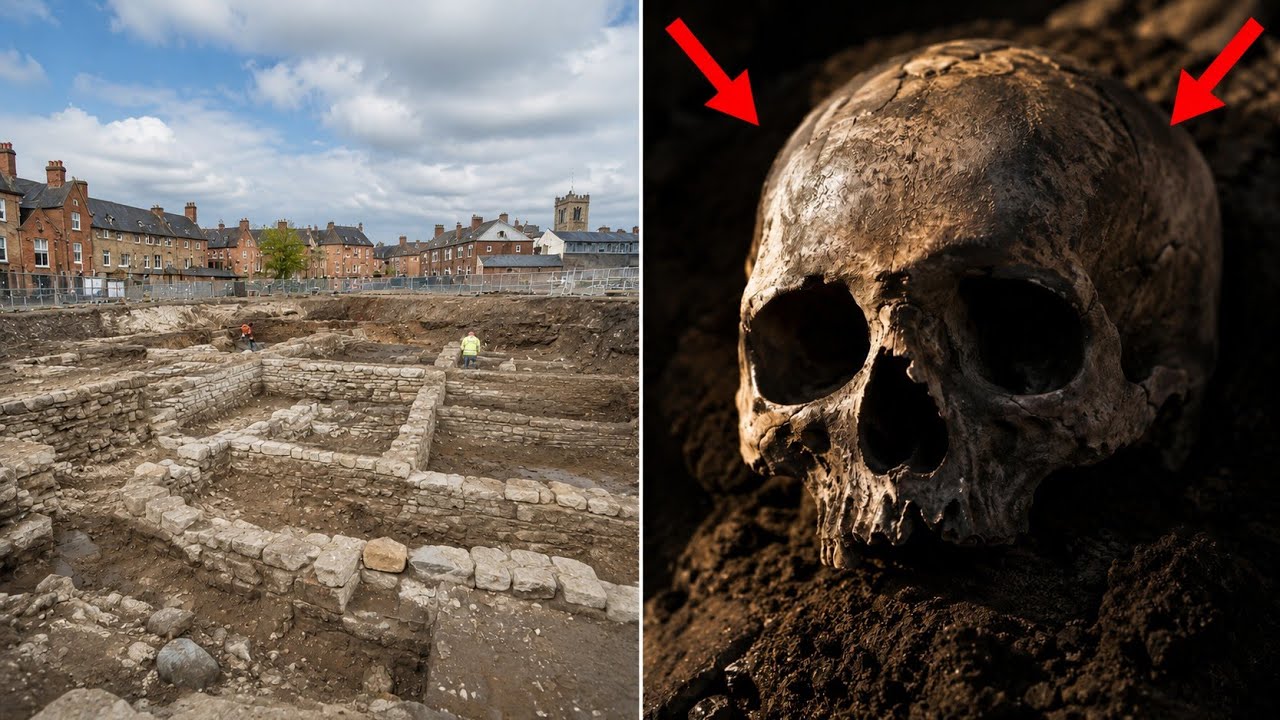
By the time archaeologists took over the site, they had uncovered the remains of at least eighty people, buried in a way never before seen in Britain. Most of the skeletons had no heads. Some had been decapitated with precision. Other bones showed the mark of a single powerful blow from behind, a precise and deliberate strike that only a trained fighter could deliver.
More disturbing still, many bones bore bite marks. Not human bites, but animal bites. Huge animal bites, the kind left by lions, bears, and other creatures used in Roman gladiatorial spectacles. The forensic conclusion was inevitable.
These were gladiators. The largest gladiatorial cemetery ever found outside Italy, buried in Britain, thousands of miles from the Colosseum, in a city the Romans called Eboracum. Then the DNA analysis team arrived. Samples were extracted from teeth and thigh bones, the two most reliable sources of ancient genetic material.
The samples were sent to independent laboratories. The results went through several rounds of verification because the first set of findings was so unexpected that the team assumed they had made a mistake. They had not made a mistake. None of the eighty skeletons examined showed Italian or Roman genetic origin.
The largest gladiatorial cemetery ever found outside Italy, full of men who died in the Roman arena, buried with the honor reserved for professional fighters whose bones bore the physical marks of years of elite combat training, contained not a single Roman. The DNA told a story that stretched across three continents. The majority of the skeletons traced their genetic origins to North Africa, to what is now Algeria, Tunisia, and Libya, men born on the southern shore of the Mediterranean who somehow ended up dying in a fighting pit in northern England. Several skeletons showed clear genetic markers from the Middle East, with origins matching modern-day Syria, Lebanon, and Iraq.
The DNA of one skeleton matched patterns found almost exclusively in Eastern Europe. Another showed genetic origins from the Caucasus, the mountainous region between the Black Sea and the Caspian Sea. These men came from every corner of the Roman Empire and beyond. The physical evidence fully supported the genetic findings.
Bone density and muscle attachment points showed that these individuals had begun intense physical training in childhood. This was not the kind of training a volunteer Roman citizen underwent. It was training imposed on someone who had no choice. Isotope analysis of their teeth confirmed that they had not grown up in Britain or Italy.
They had been brought there. Rome did not produce its greatest warriors. Rome hunted them and captured them. It took the strongest and most imposing men from every land it conquered, from Africa, the Middle East, and Eastern Europe, and turned them into a spectacle that kept the Roman public entertained for centuries.
Rome’s greatest warriors were never Roman at all. Understanding what the DNA revealed requires understanding the truth of the gladiatorial system, because it was not merely entertainment. It was an industry. The Roman arena system resembled a modern professional sports franchise system, except that the athletes were considered property.
Gladiatorial schools, known as ludi, spread throughout the Empire. The most famous, the Ludus Magnus, sat next to the Colosseum in Rome. These schools were not open to volunteers seeking fame. They were processing centers for conquered peoples.
When Roman legions swept through North Africa, they did not merely seize land. They assessed the men they captured. The largest, strongest, and most physically capable individuals were separated from the general slave population and sent directly to the ludi. The same process repeated in the Middle East after Roman campaigns against the Parthians and Syrians, and in Eastern Europe after campaigns against Germanic and Dacian tribes.
These men underwent years of the most sophisticated athletic training the ancient world had ever seen, along with specialized diets. Isotope analysis of skeletons from the York site showed a diet rich in carbohydrates and calcium, completely different from what the average Roman citizen ate. The men also underwent regular combat training and received medical care that was remarkably advanced by ancient standards. Rome invested heavily in these men because they were a source of profit.
A famous gladiator generated enormous revenue for arena owners, the emperor, and the Roman state. Killing them off too quickly was bad for business. The goal was not death. The goal was organized, exciting, profitable combat.
And the best raw material for that product came from entirely outside Rome’s borders. The DNA results revealed something else no one had expected. They restored individual identity to men whose identities had been erased from history. One skeleton in particular caught the research team’s attention.
Its owner was enormous by ancient standards, estimated at over six feet tall, and his bone structure suggested a body mass that was exceptional in the Roman era. His DNA traced to North Africa. His teeth showed he had grown up somewhere near the current border between Algeria and Morocco. He was then transported to Britain, fought in the arena at Eboracum, and died there.
For two thousand years, he had no name, no origin, no story. The DNA gave him back his continent. Across the cemetery, similar stories emerged. A man from Syria buried next to a man from the Caucasus.
A man from North Africa buried beside someone whose genes pointed to modern-day Romania. Men who in life were enemies, whose native civilizations had warred against each other for generations, buried together in the same pit in northern England. They were united not by choice, culture, language, belief, or loyalty. They were united only by the fact that Rome had decided their bodies were useful.
This is what the history books never mentioned. This is what the DNA could not hide. The evidence forces a question. If the gladiators were so clearly foreign, if their origins were so geographically diverse, why did Roman records never acknowledge it?
The answer is propaganda. Rome’s political identity rested on a single foundational idea: Roman superiority. The Empire existed in the official narrative because Romans were stronger, smarter, more civilized, and more capable than all the peoples of the earth. The arena embodied this superiority in physical form.
Roman crowds watching gladiatorial combat believed they were witnessing a celebration of Roman power. If it had been acknowledged that the gladiators in the arena were of African, Middle Eastern, and Eastern European origin, that narrative would have been turned upside down. It would have suggested to the Roman public that the most physically dominant humans on earth came from the lands Rome had conquered, not from Rome itself. The Senate never officially recorded gladiators’ origins.
Artwork always depicted gladiators with vague or Roman features. The names given to gladiators in public records were Roman names, stage names assigned by arena owners to replace whatever names these men had carried from their homelands. Rome built its greatest spectacles on men it then systematically pretended did not exist. For most of human history, the bones in the York grave would have told us nothing beyond basic physical characteristics.
Ancient DNA analysis did not exist. Genetic material inside two-thousand-year-old teeth was thought to be too degraded, too contaminated, and too damaged by centuries of soil exposure to yield reliable results. That changed in the past two decades. Advances in ancient DNA extraction techniques, specifically a method called next-generation sequencing, made it possible to reconstruct genetic fingerprints from samples previously considered useless.
Researchers learned how to identify and isolate authentic ancient DNA from modern contamination introduced during excavation and sample handling. The York gladiator study stands as one of the most rigorous ancient DNA projects ever conducted on Roman-era remains. Multiple independent laboratories verified the results. The findings were compared against genetic databases covering populations throughout Europe, Africa, and the Middle East.
This was not hasty research. It was not careless. It was careful and conclusive. Nor is the York discovery an isolated case.
Gladiatorial remains have been found at sites across the Roman Empire, in Turkey, North Africa, Romania, and Greece. As ancient DNA technology has been applied to these sites over the past decade, the same pattern has repeated consistently. Foreign origins. Non-Roman genes.
Men brought from the farthest reaches of the Empire to perform in arenas built to celebrate Roman greatness. But the implications extend beyond gladiators. If Rome systematically distorted the origins of its most famous cultural institution, what else was distorted? The Roman legions themselves, long believed to have consisted primarily of Italian Romans, show striking genetic diversity in modern cemetery studies.
Population genetics in Roman Britain reveal levels of African and Middle Eastern ancestry that no textbook has adequately explained. The Roman Empire was not the ethnically homogeneous civilization that two centuries of Western scholarship portrayed. It was something more complex, more diverse, and more interesting than the myth that replaced it. The gladiators were only the first piece of evidence.
DNA extraction is still ongoing, and every result rewrites something. One final detail from the York excavations escaped most reports. The gladiators were buried with care. In Roman society, slaves and the conquered were rarely treated with respect.
Bodies were discarded. Mass graves were common for the lowest social classes. There were no ceremonies, no rituals, no acknowledgment of individual humanity. But the York gladiators were buried differently.
Grave goods were found beside some of the skeletons. The positioning of the bodies showed deliberate, organized burial. The evidence suggests rituals were performed. Someone cared enough to give these men a proper burial.
We do not know who. We do not know why. The DNA cannot tell us that. But somewhere in Roman Britain, two thousand years ago, someone looked at these foreign men, these unknown captives killed in the arena, and decided they deserved more than oblivion.
History forgot them anyway. Until the DNA said otherwise. Two thousand years of Roman history. Two hundred years of modern scholarship.
Eighty headless skeletons at a construction site in England. And DNA results no one was prepared for. The gladiators were not Roman. They had never been Roman.
And Rome knew it all along.
