The rescan came in on a Tuesday, and by the time the afternoon light began to soften the old city, Dr. Michael Thompson had already spent three weeks wondering about the bride. Now, with the enhanced image filling his screen at 6,400 dots per inch, every fiber of paper and grain of silver halide resolved into startling clarity, he finally saw what his eyes had only sensed before. What he had taken for a decorative chain was not uniform, not smooth, not cast in any factory mold.
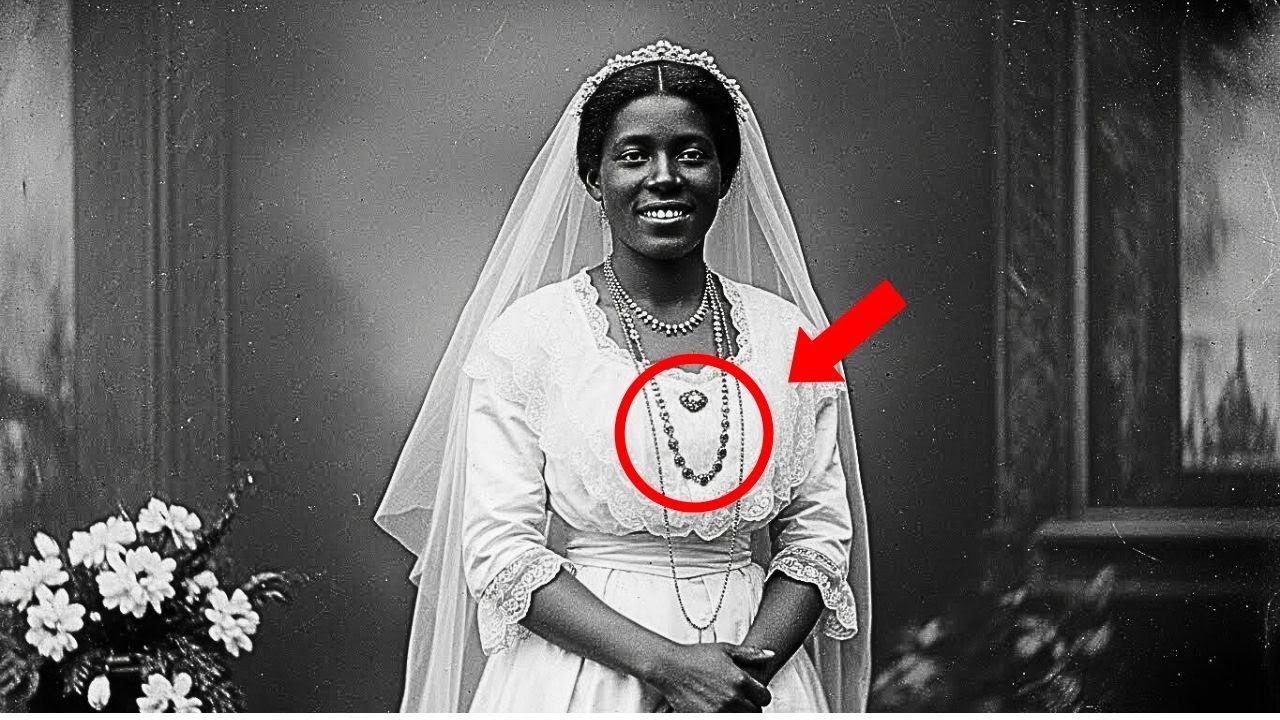
The metal bore distinct hammer marks, irregular links shaped by hand, each one slightly different in size from the next. And there, deep in the worn areas where the iron had rubbed against skin for months or years, were grooves, polished smooth by endless movement. Near what would have been the back of the neck, barely visible even at this resolution, were file marks where something substantial had been removed. Perhaps heavier restraining elements.
Perhaps a lock. “That’s not jewelry,” Michael whispered to the empty room. His coffee sat cold and forgotten beside him. The photograph had come from the estate of Ellanora Price, a Charleston resident who had died at ninety-seven with no living relatives.
Her belongings had been liquidated at auction, and the museum had purchased a collection of family documents and photographs deemed of historical interest. Michael’s task was to catalog and digitize them. He had opened a leather portfolio marked simply “Wedding 1904” and found a young African-American woman in a modest parlor, smiling with an intensity that seemed to defy the solemn conventions of early twentieth-century portraiture. Her hands were clasped at her waist, and around her neck hung what appeared to be a simple metallic necklace.
The image was so striking that he had set it aside for special attention. The next morning, in the climate-controlled archives where the musty smell of old paper defeated all preservation technology, Michael began the search for the woman’s identity. Ellanora had been born in 1922, which meant the bride could not have been her mother. Perhaps a grandmother, or a great aunt.
The genealogical record was frustratingly incomplete, gaps that were common for African-American families of that era, birth certificates scarce, many records never properly kept. Then, at the bottom of the third box, he found a leather-bound journal, its cover cracked with age, its pages yellowed at the edges. Inside, in careful, elegant script, Ellanora Price had recorded her family history in 1985. The first entry read: “My great-grandmother Rose was married on June 14th, 1904 in Charleston.
She wore the necklace as was tradition. This is her story passed down so we never forget. ”
Michael’s hands trembled as he turned the pages. Ellanora had transcribed fragments of oral history told to her by her grandmother, Rose’s daughter.
The journal spoke of slavery, of emancipation, of survival. It mentioned the necklace repeatedly, always with reverence, always with weight. Then came the passage that made Michael sit back in his chair, the full implication washing over him like a wave. “The necklace was made from Grandmother Ruth’s chains.
After freedom came, she had them changed, made into something we could choose to wear. ”
Ruth had been born into slavery in 1838, on a rice plantation thirty miles north of Charleston. Cross-referencing the journal with plantation records at the South Carolina Historical Society, Michael found her listed in the 1860 census of enslaved people simply as “Ruth, house servant. ” No last name.
No age beyond “adult female. ” A line item in someone else’s ledger. According to Ellanora’s journal, Ruth had been punished repeatedly for teaching other enslaved children to read, a crime under South Carolina law. Each time she was caught, the punishment grew more severe.
In 1863, the final time, the overseer ordered an iron collar forged for her, a punishment collar designed to humiliate and restrict. It was heavy, with a chain that hung down her chest, marking her as disobedient and making an example of her to anyone who might defy the rules of bondage. Ruth wore that collar for two years, through 1863 and 1864, even as the Civil War raged and rumors of emancipation spread through the slave quarters in whispers and coded songs. Rose’s mother remembered her own mother’s neck bearing permanent scars, indentations where the metal had pressed day after day.
The weight caused chronic pain, made sleeping difficult, marked Ruth physically and psychologically. When Union troops arrived in Charleston in February 1865, Ruth was among the first to be freed. According to family legend, the moment the soldiers cut the lock on her collar, she did not throw it away. She gathered the pieces carefully, wrapped them in cloth, and hid them under the floorboards of the small cabin she shared with her daughters.
For years they remained there, a reminder of what had been endured and what had been survived. Michael imagined her hands wrapping those chains, choosing to keep the evidence of her suffering rather than destroying it. It was an act of courage, to hold on to pain not to wallow in it, but to remember, to testify, to transform it into meaning for the generations that would follow. In 1902, Ruth made a decision that would echo through her family for over a century.
She was sixty-four, her body worn by decades of hard labor and the lingering effects of the collar. Her granddaughter Rose, then eighteen, was engaged to a young carpenter named James who had recently moved to Charleston from Columbia. Ruth wanted to give Rose something meaningful for her wedding, something that connected her to her heritage and reminded her of the strength that ran through their blood. She took the pieces of iron from their hiding place and brought them to a blacksmith named Samuel, a formerly enslaved man who had learned his trade during bondage and now ran a small forge on the edge of Charleston’s Freedman community.
Michael found Samuel’s business listed in the 1902 Charleston City directory, and a record of his death in 1910, but little else. Ruth told Samuel exactly what she wanted: transform the shackle into something beautiful, but keep enough of the original form that its history would never be forgotten. Samuel worked for weeks. He heated the iron until it glowed red, then carefully hammered out the heaviest, most brutal sections, the parts designed to cause pain and mark Ruth as property.
The links that had encircled her neck, the ones bearing the wear patterns of her skin, the grooves that testified to her endurance, these he kept. He cleaned and smoothed them, removing rust and rough edges but preserving the essential character of the forged iron. Then he forged a delicate clasp, something that could be opened and closed with ease, a choice, not a compulsion. He polished certain sections until they caught the light, creating contrast with the darker worn areas.
The result was a necklace that looked like jewelry at first glance, but on closer inspection revealed its true origins. Heavy enough to feel substantial against the skin, to remind the wearer of its history. Light enough to be worn comfortably, to be chosen freely. When Ruth saw the finished piece, Ellanora wrote, she wept.
Not from sorrow, but from grief for what had been lost, pride in what had been survived, and hope for what her granddaughter’s generation might build in freedom. June 14, 1904 dawned clear and warm over Charleston. Rose woke before sunrise, her stomach fluttering with nervous excitement. Today she would marry James, and tonight she would move into the modest home he had built with his own hands on the northern edge of the city.
But first, there was the tradition Ruth had created, a tradition that would be passed down through generations yet unborn. Ruth came to Rose’s room carrying a wooden box. Inside, wrapped in white linen, lay the transformed necklace. “This was made from the chains I wore,” Ruth told her granddaughter, her voice steady despite the weight of memory.
“I wore it in bondage without choice. Today, you will wear it in freedom because you choose to. You will wear it to remember where we came from, what we survived, and to carry that strength forward into your new life. ”
Rose lifted the necklace from its wrapping, feeling its substantial weight, the iron cool against her palms, the links clinking softly with a sound that was both musical and sobering.
She could see the hammer marks Samuel had left visible, the wear patterns from her grandmother’s skin, the careful craftsmanship that had transformed suffering into something that could be honored. Her mother fastened the clasp at the back of her neck, and Rose felt the weight settle against her collarbone. Not oppressive. Present.
The photographer arrived mid-morning, a white man named Harold who operated a studio downtown and did occasional work in the Freedman’s community. He set up his camera in the front parlor, arranging Rose near the window where natural light would illuminate her face. He worked with professional efficiency, suggesting small adjustments to her posture and the angle of her head. When he was satisfied, he ducked under the black cloth.
“Hold very still,” he instructed. “And if you can manage it, a pleasant expression would be nice. ”
Rose did not offer the polite, restrained smile typical of portrait photography. She smiled broadly, genuinely, radiantly, a smile that contained joy for her wedding day, pride in her heritage, defiance against anyone who might think her people broken by their history.
The shutter clicked, capturing that smile, that necklace, that moment for posterity. Michael’s investigation took him deeper into Charleston’s African-American community history. Using Ellanora’s journal as a guide, he searched for descendants of Rose and James, hoping to find someone who might know what had happened to the necklace after the wedding day. The trail was complicated.
Families had moved, names had changed through marriage, and records for Black families in the early twentieth century were often incomplete. He started with church records. Ellanora’s journal mentioned that Rose and James had been married at Mother Emanuel AME Church, the same historic church that would become nationally known over a century later after a tragic shooting in 2015. At the church’s archives, a patient archivist helped him search through baptism records, marriage certificates, and membership rolls.
There he found Rose and James’s names and began to trace their family forward. They had four children, three daughters and a son. The eldest, Mary, was born in 1905, nine months and two weeks after the wedding. In the Charleston Chronicle, a Black-owned newspaper, Michael found Mary’s wedding announcement from 1927.
It was brief, but it mentioned that the bride wore a treasured family heirloom passed down from her grandmother. The necklace had been worn again. He tracked Mary’s daughter, Ruth, named after her great-grandmother, who married in 1952. Through census records and city directories, Michael pieced together her life: she had worked as a teacher, raised two daughters, and lived in Charleston until her death in 1988.
Her obituary mentioned that she was preceded in death by her mother Mary and survived by her daughters Angela and Patricia. Michael now had contemporary names. A search of online directories yielded nothing for Angela, but he found a Patricia Johnson living in Mount Pleasant, just across the Cooper River. His hands shook slightly as he dialed the number.
The phone rang four times before a woman’s voice answered, cautious, slightly suspicious. Michael introduced himself as a curator at the Charleston Heritage Museum and explained that he was trying to locate descendants of a woman named Rose who had married in 1904. There was a long pause. Then, quietly: “Rose was my great-great-grandmother.
Why are you asking? ”
Three days later, Michael sat in Patricia Johnson’s living room in Mount Pleasant, surrounded by family photographs and the aroma of fresh coffee. Patricia, a retired nurse in her early sixties, had agreed to meet after he explained the photograph and his research. On the coffee table lay several albums she had brought from a closet, their pages filled with images spanning generations.
“My grandmother Ruth told me about the necklace when I was twelve,” Patricia said, carefully turning pages in one of the albums. She showed me her wedding pictures, 1952, right after she finished teachers college. There she is, wearing the same necklace Rose wore. ” She pointed to a photograph where a young woman in a modest white dress stood beside a man in a dark suit, and around her neck was the unmistakable iron necklace, its distinctive links visible even in the black-and-white image.
Patricia explained that the tradition had continued through four generations. Rose wore it in 1904. Her daughter Mary wore it in 1927. Mary’s daughter Ruth wore it in 1952.
And Patricia’s mother, Angela, wore it in 1976 when she married Patricia’s father in a small ceremony at Mother Emanuel. “Mama always said it was the most important thing she owned,” Patricia remembered, her voice thick with emotion. “More important than her wedding ring, more important than any inheritance. It was our history made physical.
”
Michael leaned forward. “Patricia, do you know where the necklace is now? ” This was the question that had driven him, the missing piece. Patricia’s expression shifted, a mixture of pride and melancholy.
She stood and walked to a bookshelf, pulling down a leather-bound box similar to the one Ruth had used to present the necklace to Rose nearly a century earlier. “My mother wore it in 1976, and she planned to pass it to me when I got married in 1985,” Patricia said, sitting back down with the box in her lap. “But by then, I had learned more about our family history, about what that necklace represented. I thought about Ruth, my great-great-great-grandmother, wearing chains for two years.
I thought about how she kept them, transformed them, made them into something we could choose to wear. And I realized that her story, our story, needed to be shared beyond our family. Keeping it private felt like letting her suffering remain invisible. ”
Patricia opened the box, and there, nestled in white silk, lay the necklace.
Michael’s breath caught as he saw it in person for the first time. The iron links, dark and substantial, the wear patterns visible even after more than a century, the delicate clasp that had transformed restraint into choice. Patricia lifted it gently, the links clinking softly together, and held it up to the light. “In 1960, my mother and grandmother made a decision together,” Patricia continued, her eyes fixed on the necklace.
“The civil rights movement was growing stronger, and they felt that Ruth’s story, all of our ancestors’ stories, needed to be preserved, not just in family memory but in public memory. They wanted people to understand not just the brutality of slavery, but also the resilience, the creativity, the absolute refusal to let that brutality define us completely. ”
Angela and Ruth had approached the Charleston Heritage Museum with an offer. They would donate the necklace, along with the wedding photographs from all four generations, Ellanora’s journal, and detailed documentation of the family history.
In exchange, the museum would commit to displaying the necklace and telling Ruth’s story as part of its permanent exhibition on Charleston’s African-American history. The museum agreed, and in a small ceremony in December 1960, Angela wore the necklace one final time before placing it in the museum’s care. “But then something happened,” Patricia said, her expression darkening. “The museum’s director at the time, this was before integration, before the Civil Rights Act.
He accepted the donation, but never put it on display. He filed it away in storage with a vague note about folk artifacts and no mention of the collar, the transformation, or Ruth’s story. My grandmother was furious, but there was little she could do. The legal donation had been completed, and in 1960 a Black woman didn’t have much recourse against a white-run institution.
”
Michael felt a wave of shame wash over him, even though he hadn’t been born when it happened. “Patricia, I had no idea. This never should have—” She raised her hand, stopping him gently. “I know you weren’t responsible.
But now you understand why this matters so much. For sixty years, Ruth’s necklace has been hidden in your museum storage. Her story untold, her transformation from enslaved to free woman reduced to an inventory number in a database. ”
Six months later, on a warm June morning in 2020, almost exactly 116 years after Rose’s wedding, the Charleston Heritage Museum unveiled a new permanent exhibition titled “Chains Transformed: Stories of Resilience and Reclamation.
” At the center, lit carefully to highlight every detail, hung Ruth’s necklace in a custom-designed display case. Beside it were the four wedding photographs: Rose in 1904, Mary in 1927, Ruth in 1952, and Angela in 1976, each woman wearing the same necklace, their smiles echoing across generations. Michael had spent months working with Patricia, local historians, and community leaders to ensure the exhibition told Ruth’s story with the dignity it deserved. The display included excerpts from Ellanora’s journal, historical context about punishment collars and slavery in South Carolina, information about Samuel the blacksmith who had transformed the shackle, and a video installation where Patricia and other descendants shared family memories.
The opening ceremony drew over three hundred people. Patricia stood near the display, surrounded by family members, cousins she had reconnected with during the research, young people learning their family history for the first time, elders who remembered hearing stories about Ruth from their grandparents. When Michael invited her to speak, Patricia approached the podium with the same dignity her ancestor Rose had shown in that 1904 photograph. “My great-great-great-grandmother Ruth wore chains that were meant to break her spirit,” Patricia said, her voice steady and clear.
“Instead, she took those chains and made them into something her descendants could choose to wear, not as a burden, but as a testament. She transformed suffering into strength, bondage into legacy. This necklace reminds us that we are not defined by what was done to us, but by how we respond, how we survive, how we transform pain into purpose. ”
As the ceremony concluded and visitors began to move through the exhibition, Michael stood back and watched an elderly woman lean close to the display case, studying Rose’s photograph.
She pointed to the necklace and whispered something to the young girl beside her, perhaps her granddaughter. The girl leaned in, her eyes widening as she noticed the hammer marks, the wear patterns, the weight of history made visible. In that moment, Michael understood the true power of what he had helped bring to light. Ruth’s story was no longer hidden in storage, reduced to an inventory number.
It was alive again, speaking across centuries, reminding everyone who encountered it that resilience can transform even the heaviest chains into something chosen, something meaningful, something that connects past to present and ensures that suffering is never forgotten, but also never the final word.
