In the winter of 1934, a federal surveyor named Harlon Goss found himself standing in a clearing that no map had ever recorded, surrounded by nineteen structures and somewhere between sixty and eighty people who spoke a language he could not understand. He had been sent into the Gory River backcountry of central West Virginia to complete a cadastral mapping project that had stalled three times in the previous decade. The assignment was routine. The terrain was not.
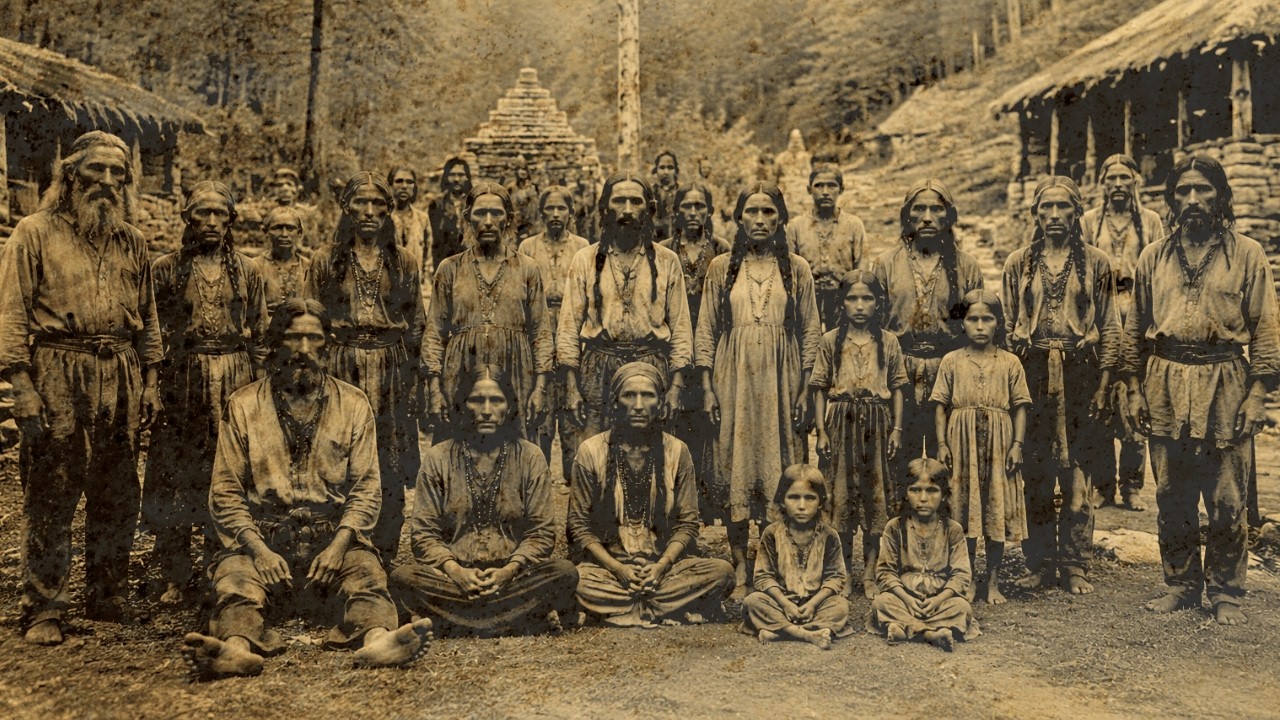
Goss had followed a creek drainage into a hollow so narrow and so densely canopied that his compass needle became unreliable beneath the iron-rich ridgeline above him. He pushed through two days of deadfall and laurel thicket before reaching the clearing, and what he found there would occupy the remaining thirty years of his life, destroy his career in the federal land office, and leave behind a body of field notes that the Smithsonian would quietly transfer to a restricted archive in 1967. The settlement was not abandoned. It was alive.
Nineteen structures arranged in a pattern Goss would later describe as concentric, with a central stone platform flanked by two smaller platforms of unmortared sandstone. The people who emerged to meet him wore clothing stitched from animal hides and homespun flax in a style that bore no resemblance to the backcountry Appalachian dress of the period. Their skin tones ranged from olive to deeply weathered brown. When they spoke, Goss could not understand a single word.
He spent eleven days in that hollow. He filled two field journals with phonetic transcriptions, sketches of the stone platforms, diagrams of the settlement layout, and detailed descriptions of daily rituals he observed but could not explain. The people, who referred to themselves by a term Goss transcribed as *ombre* or *ombry*, were not hostile. They fed him.
They allowed him to sit among their evening gatherings. They pointed to the sky and spoke in long rhythmic cadences that sounded, Goss wrote, like someone reading a psalm in a language the earth had forgotten. When Goss returned to Charleston with his journals, he submitted a supplementary report to the regional survey office describing the settlement and requesting that a linguist be dispatched to the site. His supervisor, a man named Dale Wheeling, rejected the report as fabricated.
Goss was placed on administrative leave. He appealed. The appeal was denied. He resigned in March of 1935 and spent the next eight months trying to arrange a return expedition on his own.
The linguist who finally agreed to accompany him was a retired faculty member from the University of Virginia named Arthur Selidge, a specialist in Semitic philology who had spent two decades cataloging dead languages of the Eastern Mediterranean. What Selidge found in that hollow would never be published in any peer-reviewed journal. But the notes he left behind, now scattered across three private collections and a single uncataloged box in the university’s special collections library, tell a story that should have rewritten the history of the American continent. Selidge arrived at the Gory River Hollow in November of 1935, accompanied by Goss and a local packhorse handler named Curtis Webb.
The journey took four days from the nearest maintained road. Selidge was sixty-three years old, in poor health, and carried with him a leather case containing phonetic transcription charts, a wax cylinder recorder, and a sheath of comparative vocabulary lists covering Phoenician, Aramaic, classical Hebrew, Ugaritic, and several dialects of ancient South Arabian. He expected to find an isolated community speaking a degraded form of Scots-Irish English, perhaps mixed with remnants of a Cherokee or Shawnee trade pidgin. He expected to spend three days documenting the curiosity and then return to Charlottesville to write a brief ethnographic note.
He stayed for forty-one days. The first thing Selidge noticed was the phonological inventory. The language of the ombre folk contained a set of consonant sounds that do not exist in any Native American language family and do not appear in any European language that could have reached Appalachia through colonial settlement. There were emphatic consonants produced deep in the throat, sounds Selidge recognized immediately because he had spent decades reconstructing them from inscriptions carved into stone tablets in Syria and Lebanon.
There was a distinction between two types of *s* sound that mapped precisely onto the split between the Hebrew *sin* and *shin*. There was a guttural stop, a sound produced by closing the back of the throat entirely and then releasing it in a sharp burst, which Selidge could only compare to the Arabic *ayin* and the Hebrew *ayin*. He began recording. The wax cylinders he had brought were limited, so he rationed his recordings carefully, capturing evening recitations that appeared to follow a liturgical structure.
In parallel, he sat with the older members of the community, a group of five men and three women who seemed to function as keepers of the spoken tradition, and worked through basic vocabulary. He pointed at objects. He asked for numbers. He requested words for sun, moon, water, stone, fire, blood, bone, eye, hand, father, mother, child, death.
The vocabulary list that emerged from those sessions now fills sixteen pages of Selidge’s notebooks. On the margins of almost every page, in his cramped handwriting, he wrote the same notation again and again: *Spaf proto NWS*. That abbreviation stands for Proto-Northwest Semitic, the hypothetical ancestor language from which Phoenician, Hebrew, Aramaic, Moabite, and Ugaritic all descended. The language the ombre folk were speaking in a West Virginia hollow in 1935 contained root structures, vowel patterns, and grammatical features that corresponded not to any single known Semitic language, but to the reconstructed ancestor of the entire family.
Selidge was hearing, spoken aloud, a tongue that linguists had only ever theorized on paper. The word for water was *mayim*. The word for fire was *esh* or *ash*. The word for stone was *abnu*.
The word for *I* was *anu*. The word for hand was *yadu*. These were not English words. They were not Cherokee words.
They were not Scots-Irish words. They were words that belonged to a linguistic world that existed three thousand years ago on the eastern shore of the Mediterranean Sea, in the cities of Tyre and Sidon and Byblos, in the highlands of ancient Canaan, in the river valleys where the earliest alphabets were carved into wet clay. Selidge understood what he was hearing, and he understood that no one would believe him. On his ninth day in the settlement, Selidge examined the central platform.
It was a slab of native sandstone approximately four meters long and two meters wide, raised about half a meter off the ground on a base of stacked fieldstone. The surface had been dressed smooth, not by modern tools, but by a grinding technique that left faint circular striations visible under raking light. Cut into the upper surface, in shallow but precise grooves, was a sequence of characters that made Selidge sit down on the ground and not speak for nearly an hour. The characters were not Latin.
They were not Cherokee syllabary. They were not any form of runic script carried by Norse or Germanic settlers. They were, in Selidge’s assessment, a variant of the Paleo-Hebrew script, the angular geometric writing system used in the kingdoms of Israel and Judah before the Babylonian exile in the sixth century BCE. Twenty-two characters, a consonantal alphabet written from right to left.
The letter forms were not identical to any single attested example of Paleo-Hebrew, but the structural logic was unmistakable. Several of the individual characters, particularly the forms corresponding to *beth*, *daleth*, *mem*, and *shin*, were close enough to known examples that Selidge could read them without a reference chart. He spent three days transcribing the inscription. The text ran to approximately forty words.
It appeared to be a dedication or covenant formula, beginning with a phrase Selidge tentatively translated as “we who were sent from the house,” followed by a geographical reference he could not resolve and a series of obligations or commandments governing conduct within the community. The closing phrase contained a word Selidge recognized as a variant of the Hebrew term *olam*, meaning forever or for all ages. The people who carved that inscription intended it to endure. Goss, who had been watching the transcription process with growing unease, asked Selidge what the inscription said.
Selidge told him it was a covenant. Goss asked, “Between whom? ” Selidge said he could not tell yet, but the grammar, the vocabulary, and the script all pointed in the same direction. Whoever had founded this community had come from the ancient Near East, and they had come carrying their language, their writing, and their ritual practices intact.
The implications were staggering, and Selidge knew it. The orthodox position in American archaeology, then and still the dominant position today, held that no significant contact occurred between the peoples of the Old World and the peoples of the Americas between the end of the last Ice Age migration across the Bering land bridge and the arrival of Norse explorers in the eleventh century. The ombre folk settlement, if Selidge’s analysis was correct, demolished that timeline completely. It suggested not merely contact but colonization, not merely colonization but cultural continuity sustained over millennia in the remote interior of a continent that was supposed to have been sealed off from the rest of the world.
Selidge did not publish. He returned to Charlottesville in January of 1936 with his notebooks, his wax cylinders, and a series of rubbings taken from the central stone platform and from two smaller carved stones he found built into the walls of the oldest structures in the settlement. He wrote a preliminary paper and submitted it to the *American Journal of Semitic Languages and Literatures* at the University of Chicago. The paper was rejected without review.
The editor’s note, preserved in Selidge’s correspondence file, stated that the claims were “so far outside the boundaries of responsible scholarship as to constitute either a hoax or a delusion. ” Selidge tried two more journals. The *Journal of the American Oriental Society* declined to send the manuscript to reviewers. The *Bulletin of the American Schools of Oriental Research* returned it with a handwritten note suggesting that Selidge consult with a physician.
He gave up on publication in 1937 and spent the next five years corresponding privately with a small circle of scholars willing to examine the evidence without prejudging its conclusions. That circle included a retired professor of comparative linguistics in Edinburgh, a Jesuit priest in Beirut who specialized in ancient South Arabian inscriptions, and a self-taught epigrapher in Ohio named Vernon Crew, who had spent decades documenting anomalous inscriptions found on rocks and cave walls throughout the Ohio and Mississippi River valleys. It was Crew who first suggested that the ombre folk were not an isolated anomaly but a surviving remnant of a much larger and much older pattern of pre-Columbian settlement by peoples from the Eastern Mediterranean. Crew had been collecting reports of inscribed stones found in the American interior since the early 1900s.
He had documented over forty sites where he believed he could identify Phoenician, Hebrew, or Libyan script carved into native rock surfaces. Most of the academic establishment dismissed his work as misidentified tool marks, natural weathering patterns, or outright fraud. But Crew’s files were meticulous, his photographs were clear, and his comparisons between American inscriptions and known Old World script forms were, in several cases, difficult to explain away. The correspondence between Selidge and Crew, preserved in Crew’s papers at a county historical society in southern Ohio, runs to nearly three hundred letters exchanged between 1937 and 1949.
In those letters, a picture emerges. The ombre folk were not alone. They were the last visible survivors of a migration that may have begun as early as the tenth century BCE and continued in waves over a period of six hundred years or more. Selidge returned to the ombre settlement three more times between 1936 and 1941.
Each visit lasted between two and six weeks. He traveled on foot with Goss and Webb, carrying equipment that grew heavier with each trip as he brought additional reference materials, recording supplies, and comparison texts. During the second visit, in the autumn of 1937, Selidge focused on the verb system. What he found stunned him.
The ombre language preserved a set of verbal conjugations that linguists had long theorized must have existed in Proto-Northwest Semitic but that had never been attested in any surviving text or inscription. The language distinguished between completed and ongoing actions in a way that neither Hebrew nor Aramaic does in their historically recorded forms, but that comparative reconstruction predicted the ancestor language should have done. It was as if someone had handed Selidge a living specimen of a creature that science had only ever seen in fossilized bone fragments. Selidge also documented the numeral system during this visit.
The ombre folk counted in a base-ten system using terms cognate with the Semitic numerals but showing archaic phonological features. The word for *one* was not the Hebrew *echad* or the Aramaic *chad*, but a form Selidge transcribed as *achad*, which preserves a final syllable lost in all attested Semitic languages but predicted by comparative reconstruction. The word for *seven* preserved a fricative consonant that had shifted to a stop in Phoenician and been lost entirely in later Aramaic. Each numeral was a piece of evidence, and each piece pointed in the same direction.
This language had not borrowed from Semitic. It had not been influenced by Semitic contact. It was Semitic, from a stratum older than any written record. His notebooks from these visits fill seven bound volumes.
They have never been published in their entirety. Excerpts have circulated among researchers in the field of pre-Columbian contact studies, but the originals remain in private hands, controlled by a descendant of Selidge’s sister, who has declined repeated requests to allow full scholarly access. What the notebooks reveal, even in the fragmentary form available, is extraordinary. The ombre folk maintained an oral tradition Selidge described as a covenant narrative.
It was recited communally on specific occasions, primarily at the equinoxes and at what appeared to be a harvest observance held in late autumn. The narrative told the story of a departure from a homeland across the water, a journey of great duration and hardship, and an arrival on a shore where the people were instructed by a voice or authority, which the narrative did not name directly, to go inland until they found a place where no other people lived and no path led in or out. They were to build their settlement there, preserve their language, maintain their rituals, and wait. What they were waiting for, Selidge could not determine.
The narrative used a term he transcribed as *hakets*, which in Hebrew means the end in the eschatological sense, the appointed time, the culmination. The ombre folk believed they had been placed in that hollow for a purpose that would be fulfilled at some future date, and their primary obligation was to survive intact until that date arrived. The settlement was governed by a council of elders who bore the title *zakanim*, a term that is the direct plural of the Hebrew word *zaken*, meaning elder. Disputes were resolved through a process of communal deliberation that Selidge compared to the judicial procedures described in the book of Deuteronomy.
The community observed dietary restrictions consistent with the laws of kashrut, including the avoidance of certain animal species, the separation of specific food categories, and the ritualized slaughter of animals according to a method that involved draining the blood and offering a spoken formula before consumption. They practiced circumcision. They marked their doorposts with a substance Selidge identified as a mixture of clay and iron oxide. They oriented their central platform toward the east, and they referred to their deity by a name that Selidge could not bring himself to write in full in his notebooks, recording it instead as a single Hebrew letter, the *yod*, followed by three dots.
This convention is used in Jewish scribal tradition when the divine name is too sacred to spell out. Selidge, a Christian scholar with decades of training in Hebrew texts, recognized the practice immediately. He also recognized the name itself. It was a variant, phonetically shifted but structurally unmistakable, of the four-letter divine name, the Tetragrammaton, the name of the God of Israel.
Harlon Goss, who accompanied Selidge on the first three return visits, kept his own journal. Goss was not a linguist. He was a surveyor and a practical man. His notes focus on physical details: the construction of the dwellings, the layout of the paths, the tools used for cultivation, the methods of water management.
The dwellings were stone-founded structures with timber framing and walls of wattle and daub, plastered on the interior with a lime-based mixture Goss described as surprisingly smooth and durable. The roofs were thatched with river reed in a layered pattern that shed water efficiently. The floor plans were rectangular, not circular, and each dwelling had a single entrance oriented toward the central platform. The water management system was particularly remarkable.
A series of stone-lined channels, no wider than a hand’s breadth, ran from a spring on the upper slope of the hollow down through the settlement, branching at junctions to serve individual dwellings and a larger communal channel that fed the central area near the platform. The channels were graded with sufficient precision that the water flowed steadily without pooling or eroding the channel beds. Goss, who had surveyed irrigation projects in his federal work, estimated that the gradient had been calculated to within a fraction of a degree. This was not casual ditch digging.
This was engineering. Goss noted that the construction techniques bore no resemblance to the building traditions of the surrounding Appalachian population. Scots-Irish settlers in the region used horizontal log construction with notched corners. German settlers used timber-frame construction with stone or brick nogging.
The ombre folk used neither. Their building method, Goss wrote, looked like something you might see in a picture of the Holy Land. The tools were a mixture of stone, bone, and a small quantity of metal implements that appeared to be made from native copper, hammered cold rather than smelted. The copper pieces included blades, awls, and several ornamental objects that Goss sketched in detail.
One of the ornamental pieces was a flat copper disc about eight centimeters in diameter, pierced at the top for suspension on a cord and bearing on its face an incised design that Goss described as a seven-branched candlestick. Selidge, when shown the sketch, identified it without hesitation as a menorah, the seven-branched lampstand described in the book of Exodus and used as a symbol of the priestly cult of ancient Israel. The ombre folk had lived in that place, by their own reckoning, for longer than memory could reach. Their word for the length of their habitation was a term Selidge translated as “since the trees were young.
” When pressed for a more specific time frame, the eldest member of the council, a man Selidge estimated to be in his late eighties, gestured toward the surrounding forest and said a phrase Selidge later rendered as, “We were here before the oaks. ” Eastern white oaks in the Appalachian range can live for four hundred years; some specimens have been documented at over five hundred. If the ombre folk had been in that hollow before the oldest oaks in the surrounding forest, their settlement predated the arrival of the first European colonists in Virginia by at least a century and possibly much longer. But the linguistic evidence suggested a far more ancient origin than even the oldest trees could account for.
The grammatical structures Selidge documented were closer to the language of the Ugaritic texts, dated to the fourteenth and thirteenth centuries BCE, than to any form of Hebrew or Aramaic attested in the first millennium. The verb system preserved features that had been lost in all known Semitic languages by the time of the Babylonian exile. The noun morphology retained case endings that disappeared from spoken Hebrew before the compilation of the earliest biblical texts. Whatever community had brought this language across the Atlantic had departed from the Near East before the linguistic changes of the Iron Age had taken hold.
That placed the migration, on purely linguistic grounds, no later than the tenth or eleventh century BCE. The tenth century BCE. The era of Solomon. The era of Phoenician maritime expansion.
The era when the fleets of Tyre and the kingdom of Israel entered into a joint commercial venture that the Bible describes in the accounts of Solomon’s trading expeditions to a distant and unidentified land called Ophir. The ships of Tarshish, the text says, brought back gold, silver, ivory, apes, and peacocks. They sailed for three years before returning. Scholars have debated the location of Ophir for centuries.
Proposals have included India, East Africa, the Arabian Peninsula, and Southeast Asia. No consensus has been reached. Vernon Crew, in a letter dated April 1939, proposed to Selidge that the ombre folk were descended from a contingent of one of these joint expeditions. Not a trading voyage to Ophir, but a colonizing mission.
Perhaps a splinter group that separated from a fleet, perhaps a deliberate settlement effort that was never recorded in the surviving biblical texts because the scribes who compiled those texts did not know about it or chose not to include it. Selidge was cautious about this hypothesis. He acknowledged the linguistic evidence but resisted drawing specific historical conclusions. His notebooks contain several passages in which he argues with himself, crossing out speculative sentences and replacing them with more measured formulations.
He was a careful scholar. He knew that extraordinary claims required extraordinary evidence. And he knew that what he had, while remarkable, was not enough to overturn a century of established archaeological consensus. But he also knew what he had heard.
He had sat in that hollow and listened to people speak a language that should not have existed anywhere on earth outside of ancient clay tablets and scholarly reconstructions. He had seen the inscription on the central platform and read it in a script that was supposed to have vanished from use two and a half thousand years ago. He had examined their customs and found a community organized along lines that mirrored the social and religious structures of Iron Age Israel with a precision that no accidental convergence could explain. The Second World War intervened.
Selidge’s health, already fragile, deteriorated further. He made no visits to the ombre settlement between 1941 and 1946. Goss, who had maintained periodic contact with the community through Curtis Webb, reported in late 1942 that a logging company had begun operations on the ridgeline above the hollow. The company had constructed a road along the ridge that, for the first time, made the upper watershed accessible to vehicle traffic.
Goss was alarmed. He wrote to Selidge urging him to contact the National Park Service or the Forest Service to request protection for the site. Selidge wrote two letters, one to each agency. Neither agency responded.
In 1944, Curtis Webb made a solo trip into the hollow to deliver salt and cloth that Goss had purchased for the community. Webb returned three weeks later and reported to Goss that the settlement had changed. Several of the younger members of the community had left. The logging road had brought outsiders into the area, hunters and trappers who had stumbled onto trails leading down from the ridge into the watershed below.
The ombre folk had been seen by people from the outside for the first time in presumably generations. Webb said the remaining community members were agitated. The elders had convened extended sessions on the central platform, sessions that Webb described as prayers or deliberations conducted with an urgency he had not observed before. By the spring of 1945, when Goss himself attempted to reach the settlement, the hollow was empty.
The structures were intact. The central platform was undamaged. The carved stones were still in place. But the people were gone.
Every one of them. They had taken their personal possessions, their food stores, the wax cylinder recordings that Selidge had left in the care of the eldest council member, and their tools. They had left nothing behind except the buildings themselves and the inscriptions carved into stone too heavy to move. Goss searched the surrounding hollows and ridgelines for three weeks.
He found no trace of them. They had moved deeper into the mountains, into terrain so rugged and so remote that even a man who had spent his career mapping wilderness could not follow. The ombre folk had done what their covenant narrative said they were supposed to do when the outside world came too close. They had withdrawn.
They had gone where no path led, and they had vanished. Selidge died in 1951 without ever publishing his findings. His obituary in the University of Virginia alumni magazine described him as a scholar of Semitic languages who had spent his career translating Ugaritic administrative texts. It made no mention of West Virginia, no mention of the ombre folk, and no mention of the research that had consumed the last fifteen years of his life.
Goss lived until 1968. In his later years, he gave several informal talks to local historical societies in the Kanawha Valley about his experiences in the backcountry. He spoke in general terms about an isolated community, about unusual cultural practices, about a language no one could identify. He never used the name ombre in public.
He never provided specific coordinates. And he never mentioned Selidge by name. The surveyors who worked with Goss in his later career at a private engineering firm in Charleston described him as a man who seemed to be carrying a weight that he could not set down and could not explain. The ombre folk story would have died with Goss and Selidge if not for two developments that occurred decades after both men were gone.
The first was the rediscovery of Selidge’s notebooks. In 1983, a graduate student at the University of Virginia named Elena Cordova was conducting research in the university’s special collections library on an unrelated topic, early twentieth-century correspondence between American and European Semitists, when she came across a box that had been accessioned but never cataloged. The box contained seventeen items. Three were Selidge’s field notebooks from his first and second visits to the ombre settlement.
One was a folder of correspondence with Vernon Crew. The remaining items were loose pages of linguistic analysis, vocabulary comparisons, and grammatical notes. The box had no finding aid, no index card, no shelf location in the master catalog. It had been placed on a high shelf in a back storage room and forgotten.
Cordova recognized the significance of what she was reading within the first hour. She was not a Semitist herself. She was a doctoral candidate in anthropology with a secondary interest in pre-Columbian contact theories. But she could read Selidge’s transcriptions, and she could follow his linguistic arguments, and she could see that the evidence he had assembled was unlike anything she had encountered in the scholarly literature.
She photographed the entire contents of the box before reporting the find to the library staff. This was a wise decision, because within six months of her report, the box was removed from the special collections reading room and transferred to a restricted-access category that required written authorization from the university provost’s office to view. Cordova’s request for continued access was denied without explanation. The second development came from an entirely different direction.
In 1997, a team of forestry researchers conducting a timber inventory in the Monongahela National Forest, working with aerial survey data and ground-truthing transects, documented the ruins of what they initially described as an abandoned homestead in a narrow hollow approximately twenty-three miles southeast of the town of Richwood in Nicholas County, West Virginia. The site was deep in old-growth forest, accessible only by game trails, and showed no evidence of occupation within living memory. The forestry report noted the presence of stone foundations, a raised stone platform, and anomalous carved markings on several stone surfaces. The report was filed with the regional forester’s office and copied to the West Virginia Division of Culture and History.
No archaeological investigation was initiated. The site was classified as a historic homestead of undetermined origin, assigned a state site number, and added to the inventory of uninvestigated sites that currently numbers in the thousands across the state. But Elena Cordova saw the forestry report. She had maintained an active file on the ombre folk since her discovery of the Selidge notebooks, and she had set up alerts through professional networks for any reports of anomalous stone structures in the central Appalachian region.
The forestry report matched the descriptions in Selidge’s notebooks in seven specific details: the hollow orientation, the settlement layout, the raised central platform, the unmortared sandstone construction, the rectangular floor plans, the eastern orientation of the dwelling entrances, and the carved markings on stone surfaces. Cordova visited the site in the summer of 1998. She spent four days conducting a surface survey, taking photographs, and collecting stone samples from the carved surfaces for weathering analysis. She did not excavate.
She did not remove any artifacts. What she found at the site confirmed in physical terms what Selidge had described in his notebooks sixty years earlier. The stone platform was there. The carved characters were there, weathered but legible.
The rectangular foundations of at least twelve structures were visible, some partially buried under leaf litter and humus accumulation but structurally intact. And she found something Selidge had not mentioned in the notebooks she had access to. Behind the central platform, partially buried under a fallen hemlock trunk, Cordova found a stone basin. It was carved from a single piece of sandstone, roughly circular, about sixty centimeters in diameter and thirty centimeters deep.
The interior surface was stained with a dark residue. The basin rested on a low pedestal of the same stone, and the pedestal bore a continuous band of incised characters running around its circumference. Cordova photographed the basin and the inscription from every angle. She sent the photographs to a colleague at Johns Hopkins, a specialist in Northwest Semitic epigraphy, without telling him where the photographs had been taken.
She asked him simply to identify the script and offer a preliminary reading. His response came back in three days. The script, he wrote, appeared to be a form of Proto-Canaanite or early Phoenician, probably dating from no later than the tenth century BCE based on the letter forms. The text appeared to be a ritual formula associated with a libation offering.
He asked where she had found it. She told him West Virginia. He did not respond to her next four emails. The basin was a ritual vessel, a *kiyor*, the kind of object described in the priestly texts of the Hebrew Bible as part of the furnishings of a sacred precinct, used for purification rituals, for washing before approaching the altar, for the preparation of offerings.
Its presence at the ombre settlement elevated the site from an ethnographic curiosity to something with profound theological and historical implications. This was not a community that had simply preserved an ancient language through isolation. This was a community that had preserved an ancient religious practice complete with its material apparatus, its ritual furniture, its sacred architecture. They had maintained in the mountains of West Virginia a functioning sanctuary modeled on the ritual precinct of ancient Israel.
Cordova’s paper was rejected by *American Antiquity*. The editor informed her that the claims fell outside the scope of evidence-based archaeology and that the journal could not publish findings that relied on undocumented notebooks from a deceased scholar and unverified epigraphy from an unproven site. Cordova pointed out that she had visited the site, that the site had a state registry number, and that her stone samples were available for independent weathering analysis. The editor declined to reconsider.
She submitted the paper to three more journals. All rejected it. She presented a version of the paper at a regional archaeological conference in 2001. The presentation was attended by eleven people.
Nine of them were sympathetic researchers who already worked in pre-Columbian contact studies. The other two were senior faculty members from major universities who attended, as far as Cordova could tell, specifically to challenge her during the question period. One of them accused her of fabricating the Selidge notebooks. She offered to provide the photographs she had taken before the box was restricted.
He declined to examine them. The resistance Cordova encountered was not new. It was the same resistance that had met every researcher who had attempted to present evidence of pre-Columbian contact between the Old World and the Americas. Barry Fell, a marine biologist at Harvard who published a series of books in the 1970s arguing that Phoenician, Celtic, and Egyptian voyagers had reached the Americas centuries before Columbus, was savaged by the archaeological establishment.
His epigraphy was attacked, his credentials questioned, his motivations impugned. Some of the criticisms were valid. Fell was not a trained epigrapher, and some of his readings were almost certainly incorrect. But the ferocity of the response went far beyond scholarly critique.
It was a boundary-enforcement action. The message was clear. Do not bring evidence that challenges the accepted narrative. If you do, you will be destroyed professionally.
Cyrus Gordon, who was a trained epigrapher, one of the most accomplished in the world, received similar treatment when he endorsed the Bat Creek inscription and the Paraíba stone. Gordon had deciphered Linear A, the undeciphered script of Minoan Crete, and had produced authoritative grammars of Ugaritic and other ancient Near Eastern languages. His credentials were unimpeachable. But when he applied those credentials to inscriptions found in the Americas, his colleagues turned on him.
He was not refuted. He was shunned. The pattern was consistent. Evidence that did not fit the accepted timeline was not examined.
It was suppressed, ignored, or destroyed, not through conspiracy but through a professional consensus that treated the very question as invalid. The site in Nicholas County still sits in the state database, unexamined, classified as a historic homestead of undetermined origin, waiting for funding and personnel that have never materialized. The Selidge notebooks remain under restriction at the University of Virginia, requiring written authorization from the provost’s office to view. The descendant of Selidge’s sister still controls the seven bound volumes of his later field notes and still declines requests for scholarly access.
The photographs Elena Cordova took in 1998 remain in her personal collection. And somewhere in the deepest hollows of the central Appalachian range, in terrain so rugged that even a surveyor who spent his career mapping wilderness could not follow, the ombre folk, if any still survive, are still waiting. Their covenant narrative said they were placed in that hollow for a purpose that would be fulfilled at some future date, and their primary obligation was to survive intact until that date arrived.
The carved stones remain in place, weathered but legible, bearing an inscription that begins with the words “we who were sent from the house” and ends with a word that means forever.
