She stood at the window of her Manhattan hotel room and looked out over the trees of Central Park. Once she had been the first lady of the Confederacy. She had defended slavery while despising it. She had predicted the defeat of the South before almost anyone dared speak of it.
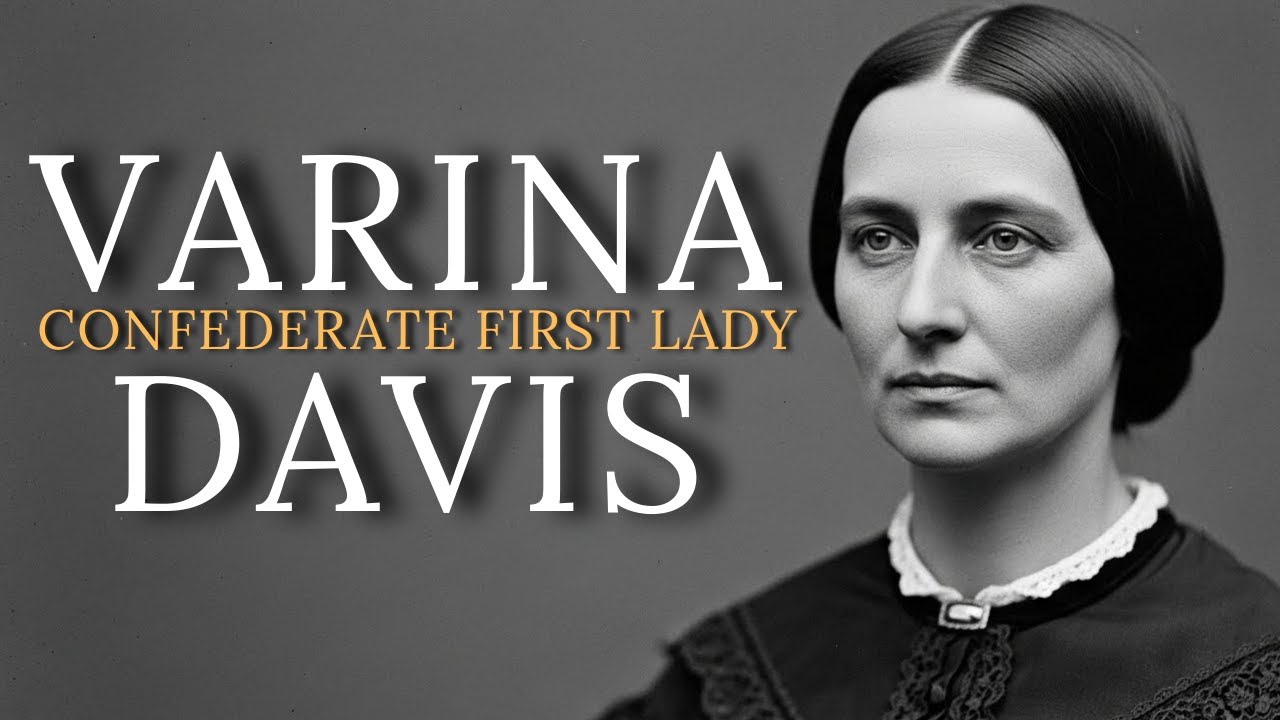
And now she had become everything the South had taught her to hate: a northern woman, a working journalist, a friend to the widow of Ulysses S. Grant. She had escaped. The question was how.
Her name was Varina Howell Davis, and she was born on May 7, 1826, at Marlborough Plantation in Louisiana, the daughter of William Howell and Margaret Kemp. Her father’s grandfather had governed New Jersey; her mother’s father had fled Ireland to plant cotton. She was half northern, half southern, belonging nowhere truly. No one told her that the family fortune had been stolen from human beings.
No one explained their suffering. She would learn that painfully, and late. Her childhood home was The Briars, near Natchez, where cotton wealth surrounded everything like the air they breathed. Enslaved workers filled the fields endlessly, and she believed this world eternal and natural.
She never questioned why some people served others. She never wondered about their terror or pain. That ignorance shaped her. When she turned thirteen, her father’s creditors arrived.
They seized the home. They took furniture, silverware, and human beings, all of it sold at public auction. The shame and humiliation were complete. Wealthy relatives rescued the family, but the lesson stuck: security is fragile, pride precedes collapse, and survival depends on the mercy of others.
Philadelphia called when she was ten. She boarded a northbound coach to Madame Grelaud’s Academy, where northern girls surrounded her: wealthy, sophisticated, educated, alive with forbidden ideas. The North revealed itself as intellectual, progressive, beautiful. She fell in love with a world Mississippi despised.
Something in her had already fled forever. Judge George Winchester became her tutor. He was Harvard-educated, brilliant, dangerous. He taught her Latin, French literature, history, and critical thinking.
He taught her to question authority, to read deeply, to think independently. Meanwhile, southern girls learned needlework and silence. She was becoming something unsuited for southern womanhood, unsuited for anything. By age nineteen she was tall, thin, olive-skinned, and unmarriageable by southern standards.
Her father was bankrupt. She had no dowry. No suitors called. Men preferred prettier, quieter, richer women.
She seemed destined for spinsterhood, irrelevance, obscurity. Then December 1843 arrived, and everything changed. Jefferson Davis appeared at Hurricane Plantation for Christmas. He studied her with intense eyes.
He was Joseph Davis’s younger brother, a widower of thirty-five who had buried a wife named Sarah Knox Taylor and still worshiped her memory. Varina understood immediately that he would always love the dead woman more than he would ever love her. She married him anyway. She always knew she was second.
They married at The Briars on February 26, 1845, a small, quiet ceremony. None of his family attended. They had opposed the match. His brother Joseph controlled him financially, and his relatives resented her as an outsider.
From the first day, she was invading their household, unwanted and barely tolerated. They moved to Brierfield, their new home, but Joseph Davis controlled the land. She had no legal claim. Soon his widowed sister, Amanda, arrived with seven children, demanding space in the house.
Joseph made that decision without consulting her. She spent years sharing her home with his relatives against her will. Jefferson vanished to campaign for Democratic candidates, and the Mexican War pulled him away for months. She remained at Brierfield, placed under Joseph Davis’s harsh guardianship.
She despised the man, yet he controlled her life while her husband fought distant battles. Her letters to Jefferson grew bitter. He responded with cold indifference. The marriage was already breaking.
In 1846 Jefferson was elected to Congress, and she finally escaped to Washington. She arrived in a city alive with intellectual debate, political salons, forbidden ideas, and visiting northern relatives. The capital intoxicated her completely. She would spend fifteen glorious years there.
Washington became her real home, her true love, her sanctuary. At twenty she established herself as Washington’s most dazzling hostess. Her conversations sparkled with literary references. She made friends across party lines.
Northern politicians’ wives became her closest companions. She was a Whig politically, married to a Democrat. She socialized with abolitionists. She questioned slavery’s morality.
In Washington, she was allowed to be herself. In 1852, at twenty-six, she gave birth to Samuel. Joy flooded through her; Jefferson became a doting father. For a moment the marriage found warmth.
But Samuel died before his second birthday. No reason was given, just childhood illness and death. Margaret was born healthy in 1855, and Jefferson Jr. came in 1857.
Loss followed anyway. Franklin Pierce appointed Jefferson Secretary of War in 1853. She moved in elite circles. Presidents consulted her husband.
Yet she remained powerless: a woman in a man’s world, educated enough to be threatening, beautiful enough to be noticed, ambitious enough to be deeply resented. She felt politics in her bones but could never grasp it truly. By late 1855 the marriage existed in invisible separation. She loved Washington.
He wanted Mississippi plantations. He became a radical secessionist. She wanted compromise. He worshiped slavery as divinely ordained.
She called enslaved people human beings with frailties. He revered his dead first wife. She grieved being second. They shared nothing real.
In June 1862 she confided to her mother: the South did not have the resources to win this war. The North’s discipline and perseverance would make it invincible. She made that prophecy one year into the war, and she was right. She had seen it immediately.
The South’s defeat was inevitable. Yet she had to pretend to believe in victory. On November 6, 1860, Abraham Lincoln won the presidency. She had told a friend months earlier that secession would be a complete failure.
The friend never believed her. Her dread deepened when Jefferson answered the call to lead the Confederacy. She knew their world would burn. She had predicted it, and she was watching her prediction come true helplessly.
In January 1861 Jefferson resigned from the Senate. She packed her belongings and left Washington forever, the city she had loved more than anywhere on Earth. She left her northern relatives, her intellectual salon, the life she had built. She departed into Mississippi darkness carrying only resentment and predictions of failure.
In February 1861 the Montgomery Convention elected Jefferson President of the Confederate States. He had preferred to serve as a general in the field. He did not want the burden, but he accepted it. Varina waited behind.
She was not at his inauguration. Perhaps she knew something he did not understand. In the summer of 1861 the Confederate capital moved to Richmond, Virginia. The White House of the Confederacy became their residence.
Richmond swelled from 40,000 to 140,000 souls in months. Soldiers marched everywhere. Death became ordinary. She moved into that chaos knowing what her husband did not: the North would win completely.
Richmond society women resented her immediately. She was too educated. She spoke too much. Her olive complexion was unfashionable.
Critics called her a mulatto or a squaw. She had northern relatives and friends, and rumors spread that she was a spy for Lincoln. Her conversation baffled simpler women. Her insights threatened provincial men.
She tried to fit in. She failed. In April 1864 little Joseph, age five, chased his brother onto the balcony of the White House of the Confederacy. He fell.
His neck broke. He died. She held her dead son while Richmond prepared for invasion. Two weeks later she gave birth to Winnie: life emerging from devastation.
Death and birth were separated by fourteen days. Winnie was born in the war’s final year and became the Confederacy’s symbol of hope and endurance. Photographs of her circulated to raise morale. She was the South’s possession, not her daughter.
They raised her as the nation’s mascot. Varina had lost one child; she grieved losing another to history’s demands. She spent her energy where it mattered: visiting hospitals, distributing goods to wounded men, gathering supplies from sympathetic women, writing letters for paralyzed soldiers. She brought food to hospitals when Richmond starved.
She worked tirelessly while society women gossiped. Years later, even her critics acknowledged she had been a competent, caring first lady. But she had done it reluctantly. Lydia Johnston, wife of General Joseph E.
Johnston, became her public enemy. She accused Jefferson of ruining her husband’s career and accused Varina of being complicit. Other generals’ wives joined the attack. Newspapers published supposed betrayals.
Politicians plotted against them. The Confederate government itself became hostile. She was trapped in a nation at war while simultaneously at war with its elite. Union forces closed in.
Richmond prepared to abandon the city. Chaos replaced order. Deserters roamed the streets. She organized the escape, arranging carriages, gathering children, securing supplies.
She was the efficient administrator of their collapse. Her hands moved while her heart despaired. She was fleeing a war she had predicted, a nation she had doubted, a cause she had never believed in. In May 1865 Union troops caught them fleeing Georgia.
Jefferson was imprisoned at Fort Monroe. The family was restricted to Georgia, forbidden to leave. She was effectively a prisoner herself. She had escaped the North once in 1861; now the North had captured her.
She was a captive of history’s momentum. For months, Winnie and Varina were forbidden contact with Jefferson. She fought tirelessly to secure his release. She wrote letters to newspapers.
She published articles about his unjust imprisonment. She became a public advocate for a man who did not love her. Even in his prison cell, he remained her consuming purpose. Eventually they were allowed to join Jefferson at the fort, not as a wife but as a mother visiting a prisoner.
The family occupied officers’ quarters. Winnie was the only child allowed regular visits, bringing him news, messages, connection to the outside world. Varina was there physically, but her presence changed nothing in his heart. She was still second.
Released on bail in 1867, Jefferson faced a ruined fortune. The Mississippi plantation was confiscated. His property was seized. He was completely destitute.
She had to work, something women of her class never did. She had to support the family while her husband attempted to rebuild his career. She borrowed money. She scrimped constantly.
Jefferson tried commission houses in England. They collapsed. He accepted positions with insurance companies. They failed spectacularly.
He speculated on investments. He lost everything. Every venture he touched crumbled. Meanwhile she waited and worried, knowing poverty approached, knowing security evaporated, knowing the family might lose everything.
She became an expert in financial anxiety and dread. In 1871 Jefferson was discovered on a train with Virginia Clay, the wife of a fellow political prisoner. Newspapers published the scandal across the nation. Varina was devastated.
For three years he had exchanged passionate letters with this woman. He had loved her. He had been willing to betray her publicly. The marriage was irreparably broken.
After the scandal they lived apart for years. He sought work in Tennessee. She remained in the north. He struggled.
She endured his failures. He moved to Beauvoir with Sarah Dorsey, who helped him write his memoir. Varina resented that friendship and knew it meant something more. Their separation became permanent even while they were together.
Sarah Dorsey was cultured, educated, wealthy, widowed. She had been Varina’s classmate in Philadelphia and was always prettier, richer, more successful. Now she was helping Jefferson write his memoir, playing the role that should have been Varina’s. She watched them collaborate on his autobiography.
She was written out of her own story. By 1878 Varina had reluctantly moved to Beauvoir with her husband. It was Sarah Dorsey’s estate, given to Jefferson. Varina had never wanted to live there.
She resented Sarah Dorsey’s presence. She despised country living. Beauvoir meant isolation, Mississippi, the past. The house was architecturally beautiful but emotionally barren.
She was trapped. When Sarah Dorsey died of breast cancer in 1879, she left Beauvoir to Jefferson and Winnie, but not to Varina. In her will she ensured Varina would have no legal claim. It was the ultimate humiliation.
A woman who knew her was controlling property from beyond death. Varina had been explicitly excluded, and Sarah understood exactly how much that would hurt. She cared for Jefferson in his final years. She helped him write articles.
She collaborated on speeches. She was the beautiful wife performing duty, not the passionate partner recapturing lost love. When Jefferson died on December 6, 1889, she grieved not the loss of her husband but the end of her obligation. His death freed her finally.
For the first time in her adult life, she was truly free. She had no husband to serve, no man’s ambitions to support, no one’s reputation to rehabilitate. She was sixty-three years old. She had little money, but she possessed freedom.
This was a revelation. She could think her own thoughts. She could speak her own opinions. In 1890 she published her own account: *Jefferson Davis, Ex-President of the Confederate States of America, A Memoir by His Wife*.
It was her first publication under her own name. It was her attempt to tell their story, not his. The book sold poorly, but it gave her agency. It gave her voice.
That same year, Kate Davis Pulitzer visited the South and recognized something: here was an intelligent woman with important stories to tell. Joseph Pulitzer offered her a job as a columnist for the *New York World*, fifteen hundred dollars annually, a way out of poverty and into professional life. She accepted immediately. In 1891 she left the South forever.
She packed her belongings and moved to New York City with her daughter Winnie. White southerners erupted in outrage. She was a traitor to her people. She was abandoning her sacred duty to preserve Confederate memory.
She was betraying the South itself. She did not care. She boarded the northbound train. New York embraced her immediately.
This widow of a failed Confederate president brought sophistication, history, celebrity. She was a living artifact of American history, a woman who had walked through national devastation. She was invited to salons. She was welcomed in literary circles.
She became friends with intellectuals and artists. She was simply herself; no judgment followed. She became a New York lady. She took daily rides in her carriage through Central Park.
She attended concerts and theatrical productions. She visited exhibitions and museums. She hosted small salons in her apartment. She read constantly.
She wrote letters to friends across the country. She lived the life of an educated, cultured woman. In 1893 she met Julia Dent Grant by accident at a Hudson River resort. Julia was the widow of Ulysses S.
Grant, the man the South hated most. Yet they became friends. They had both sacrificed themselves for great men. They had both lived through devastation.
Their friendship shocked the nation completely. It meant everything. It symbolized national reconciliation. Former enemies became allies; history’s antagonists found common ground.
She wrote prolifically for the *New York World*: articles about war, history, politics, women’s rights. She wrote about her experiences as first lady. She wrote to earn a living but also to establish her own legacy. She was no longer just the wife of Jefferson Davis.
She was a writer. She was an intellectual. She was somebody. On the war’s twentieth anniversary she published an article saying that God in his wisdom had allowed the North to prevail.
She was saying publicly what she had said privately in 1862. The North had won because it was God’s will. She was absolving herself of the Confederacy’s sins, claiming moral clarity, reclaiming her truth. She attended reunions of Confederate and Union veterans alike.
She was a member of both the Daughters of the American Revolution and the United Daughters of the Confederacy. She moved between worlds, bridging them, refusing to let her life be defined by a single cause. She had spent decades serving the South. Now she was healing wounds.
In 1898 her youngest daughter, Winnie, died of gastritis at thirty-four. Winnie had been her companion, her fellow writer, her link to the future. She had never married, never had a life independent of her mother’s shadow. Now she was gone.
Varina considered returning south, surrendering to grief. She almost surrendered completely. But she chose to live fully. She continued writing.
She continued socializing. She continued her daily rides through Central Park. She continued meeting with intellectuals and artists. She chose to fill her remaining years with meaning.
She refused to become a monument to grief. She was seventy-four, with fourteen more years to live. She used them all. She moved into apartments in Manhattan hotels.
Her final apartment overlooked Central Park, the city’s great green heart, visible from her window. She looked out on trees and sky and life moving below. She was not looking backward anymore. She was looking outward at the living world, at the future, at possibility, at life itself.
Richmond offered her a house free of charge if she would return home. They wanted their old first lady. She refused repeatedly and consistently. She preferred anonymity in the north to celebrity in the south.
She preferred freedom to comfort. She preferred her New York apartment to the finest mansion in Mississippi. She was finally choosing herself. In 1902 she sold Beauvoir to the Mississippi Division of the Sons of Confederate Veterans for ten thousand dollars, stipulating it be used as a Confederate veterans’ home and memorial.
She was transforming her husband’s estate into something public, ensuring his name would endure as historical artifact rather than personal property. At a reception she met Booker T. Washington, the African-American educator. They had a civil conversation.
She treated him as an equal. This simple act scandalized conservative white southerners. A southern lady speaking respectfully to a black man was unthinkable. Yet she did it.
She had lived long enough to see past old prejudices. She did not simply survive her life. She transcended it. She had been born into privilege, married into power, lived through national cataclysm, and died in a Manhattan hotel overlooking a beloved park.
She had been a Whig, a first lady, a Confederate widow, a journalist, a writer, a bridge between enemies. She had more identities than most. She had predicted the Confederacy’s failure in 1862. She had known before most men that the South could not win.
She had lived in that terrible knowledge, watching her husband lead a nation toward destruction, watching him refuse what she saw clearly. The war came and went exactly as she predicted. She lived long enough to be vindicated. Jefferson Davis is remembered as a historical figure, a presidential name, a monument in Richmond.
But his monument exists partly because of her work. She wrote his memoir. She preserved his legacy. She ensured he would be remembered as a complicated man in a complicated age.
She rehabilitated his reputation even as she renounced his cause. She had been born a half-breed, part north, part south, fully belonging to neither. She had lived her entire life split, divided, contradictory. In New York this contradiction resolved.
She claimed both her northern heritage and her southern history. She defended neither exclusively. She had finally integrated the warring parts of herself into a coherent whole. Congress voted to pension the widows of Confederate generals.
She was never included. She was the widow of the Confederate president himself, yet she received no government support. She had to work for a living when already in her sixties. The South, which claimed her as its daughter, abandoned her financially.
Only the North offered employment. Her closest companions in her final years were not relatives but friends. She developed genuine friendships in New York, people who valued her intellect, her conversation, her presence. She had escaped not only the South’s limitations but her family’s emotional burdens.
She had chosen her community. She had created her own family. She lived eighty years. The Civil War was fought when she was in her thirties.
She lived forty-one years after it ended. She lived long enough to see the South recover, to see the nation reconcile, to become obsolete, irrelevant, free. Then she used that irrelevance as freedom. In October 1906 she contracted pneumonia, the disease that had killed her husband.
She was eighty years old. She lay dying in her apartment overlooking Central Park. For the last time she looked out on the trees, the sky, and the moving city below. She had lived sixty-five years before coming to New York, and fifteen years there, the freest of her entire life.
New York City gave her a funeral procession through its streets. The widow of the defeated Confederacy was honored by the victorious North. Her coffin was transported by train to Richmond, Virginia, where she was buried beside her husband in Hollywood Cemetery. The tombstone read simply: “At Peace.
”
She had never been at peace while living. She had always been anxious, divided, struggling. But in death she found peace. The epitaph was her victory.
The woman who became the Confederate first lady was born with northern blood, educated in the north, loved the north her entire life, befriended the North’s widow, and died in the north. She was the least southern of first ladies, yet the South claims her as theirs. History’s cruelest joke is that she became famous for the role she hated. She did not build a physical monument.
She did not leave behind a university or a hospital with her name. But she built something more important: she built a life that mattered, a model of transformation, proof that enemies could become allies, a bridge between warring Americas. That was her monument.
