The silence came before the bullets, and it stayed long after the noise had died. In the middle of the afternoon on June 25th, 1876, under the scorching Montana summer sun, in the hills above the Little Bighorn River, the guns of George Armstrong Custer’s five cavalry companies fell silent one by one. The exact time is unknown because there were no survivors, no one left to look at a watch. Historians estimate that the most intense phase of the battle, the final moments, lasted somewhere between 45 minutes and an hour.
Some say less, fifteen minutes, maybe twenty. Considering the ferocity of the pressure exerted by the warriors of the Great Sioux Nation and the Northern Cheyenne that afternoon, even fifteen minutes seems like a very long time. Then everything stopped. The horses fell silent.
The guns fell silent. The screams, those bloodcurdling cries rising in both English and Lakota, mingling together, were swallowed up. Over the valley that curved along the hills, in that deep basin where the waters of the Little Bighorn River whispered, it was as if even the millions of insects fell silent for a moment. Nature held its breath as if trying to understand what had happened.
Gunpowder smoke dissipates slowly on a windless day. In the hot air of the Montana summer, that gray-white cloud rising like incense hung over the hills for a long time. Then slowly, under its own weight, it began to drift downward. Just like a curtain rising on a theater stage.
And the scene revealed when the curtain rose was the kind that no one present, neither the Lakota and Cheyenne warriors, nor the elders watching from afar, nor the women hearing the sound from the great camp in the valley, would ever forget for the rest of their lives. 210 American soldiers on a hill, in a valley, over the dunes stretching along a winding stream. All on the ground. All motionless.
The navy blue and golden yellow of their uniforms had gained a strange brilliance in the scorching light of the July sun, as if it were a carefully arranged framed painting laid over them. But this was no painting. This was the last breath of the 7th Cavalry Regiment. Step onto that hill for a moment.
Under your feet is dry, cracked earth. There is no grass, or almost none. The July sun has been scorching this earth for weeks, and the grass no longer has time to grow. A fine reddish-brown dust covers everything.
The stones, the bushes, the dead horses, the dead men. This dust clings to you, too. It gets in your mouth. It gathers in the corners of your eyes.
And there is the smell. Blood carries a metallic smell when freshly spilled, similar to copper, slightly different from rust, sharp, somewhat sweetish, dense enough to turn the stomach. But the smell of the battlefield is not just that. There is gunpowder, that bitter choking mixture of sulfur and charcoal.
There is horse manure. When animals are pumped with adrenaline, their bowels empty, and a battlefield always carries this scent. And beneath it all, there is something more insidious, darker. Human flesh beginning to heat up under the sun.
In July in Montana, temperatures can reach 35 degrees Celsius. Corpses begin to decompose even before sunset. In those first fifteen minutes, when the guns fell silent, when the smoke began to clear, when the warriors scattered down from the hill, think about what was happening in the great camp in the valley. The massive Sioux and Cheyenne camps stretched for several miles along the Little Bighorn River.
According to historical estimates, there were 7 to 10,000 people there: warriors, elders, women, children. Over 500, perhaps up to 800 warriors had joined the battle that day. First against Marcus Reno’s companies at the southern end of the valley, then against Custer attacking from the north. Now imagine that camp.
The sound of gunfire coming from afar for hours. The departure of their own warriors, their return, their departure again. The carrying of wounded men, children crying, women rushing frantically between the teepees. And then, that moment, the silencing of the guns.
Kate Bighead, a former resident of the camp, would recount years later: “When the sound stopped, everyone stood still. No one spoke. Even the children stopped crying. We all just listened, and the silence told us everything.
”
This silence said different things to different people. For the elders at the southern end of the valley, it said that Reno’s soldiers had crossed the river and fled, that the threat from that direction had been temporarily neutralized. For the warriors in the northern hills, the young men still holding their weapons, adrenaline still coursing through their veins, this silence was the signature of victory. But for the women, for the old women, for the mothers and wives and sisters, this silence was first a suspicion, then a question, then gradually a reality.
The movement toward the hill began. This movement should not be thought of as something initiated with a frenzy of violence or brutality, at least not initially. In Lakota and Cheyenne societies, it was a deep-rooted tradition for women to go to the battlefield after the war and search for their own dead. Warriors were sometimes left on the field wounded, sometimes lifeless.
Gathering, washing, and preparing the dead, this was a responsibility shouldered by the women. A sacred responsibility, painful but honorable. That is how it started that day, too. The women were looking for their own men first.
But what they saw along the path leading up to Last Stand Hill, Custer’s final stand, turned this search into something else. On the eastern side of the slope surrounding Last Stand Hill, in the shadow of a few bushes, blue uniforms were visible. Some soldiers were still clutching their weapons. Contracting fingers sometimes do not let go even after death.
Some faces were turned to the dirt, others were looking at the sky, that clear Montana sky, an almost transparent blue. It is these faces, these open eyes, these frozen expressions that provide the details historians struggle with the most when trying to understand Custer’s last moments. Because those faces no longer tell anything. They just stare.
210 men. The number carries meaning on its own. But on a battlefield, meaning emerges from space, not from numbers. Where were these men?
How were the bodies piled? In what order? In what chaos? Archaeological studies, especially the extensive surface surveys conducted after the 1983 forest fire, have given us a map of those final moments.
Thanks to bullet casings, metal detectors, and careful observation, we know this. Custer’s companies did not die en masse in a single location. They scattered. Perhaps in panic, perhaps in an attempted tactical maneuver, but ultimately, they breathed their last in small groups, in disconnected spots.
This dispersion shows how chaotic the final moments were. This was not an orderly retreat. This was not a disciplined defensive position. This was the sweeping away of the final particles of a dissolving structure.
And every particle was a man lying on the dirt, motionless under the sun. The first fifteen minutes passed, then half an hour, then an hour. The sun continued to slide west, shadows lengthened. The heat did not wane.
A Montana July afternoon reaches its peak temperature just before the sun lowers. And under that heat, upon the 210 men, time began to work. The sounds from the valley changed over time. There were cries of victory, short, sharp, the kind that dislodges something inside your chest.
There were sounds of mourning, long, drawn out, deep. And among these, there were much lower, much more serious voices, the voices of women. Conversations, directives, questions, and answers. It was time to go up to the battlefield.
On the hill of the last stand, the corpses were still waiting. The sun was looking down on them. The Montana dust was slowly covering them. And from afar, from the depths of the valley, footsteps were approaching.
You don’t see them first, you hear them. Footsteps sound different on that dry, hard earth of Montana. Not soft, the ground is too hard for that, but not heavy either. More like a whisper rising from the ground, mixing with the dust.
A sound that somehow spreads even on a windless day. The climb of dozens of women, old men, and youth to the hill first made itself known with this sound. Then silhouettes appeared, first a few, then more, then a group, then a crowd. On the ridge of the hills, on that sharp Montana horizon, in that golden red light where the sun now struck from a side angle.
To understand who the women descending on the battlefield were, one needs to know who they were. These were not abstract figures. These were people who had lived for years under the shadow of American military oppression, displaced from their homelands, deceived by treaty after treaty, their sacred lands stripped away. The Fort Laramie Treaty signed in 1868 had given the Black Hills region to the Sioux Nation forever.
A promise was made that no one will set foot on these lands. Then gold was found. In 1874, an expedition personally commanded by Custer announced the gold deposits in the Black Hills to the public. And then the treaty turned into a piece of paper.
Think about what they carried with every step as they climbed that hill. Years of hunger. The suffocating shame of being squeezed onto reservations. The faces of their children.
The faces of children who went to war, who never returned, who returned wounded. This day, this 25th of June, 1876, was the day something that had been building up for a long time exploded. And now the guns were silent and the hill awaited them. Lakota historical narrators and Cheyenne testimonies emphasized that the vast majority of women in this scene primarily searched for their own men.
It could not have been otherwise. Not all the warriors had returned. Some had fallen in the valley in the first clash against Reno. Some on this hill, right in the middle of the battle against Custer’s companies.
And finding them, identifying the bodies, recognizing them, being with them was a necessity, both a practical and a spiritual necessity. Imagine a woman. We do not know her name. History did not record the individual details of this scene, or they could not, or they did not want to.
But we can imagine her. Middle-aged, strong hands, her face carrying both exhaustion and that familiar ossified determination. She walks holding a long stick made from a tent peg. This stick is both a support and a measuring tool.
She uses it to find her way while walking among the corpses without touching the bodies of the American soldiers. She is looking for her own man. Her eyes look at every face, evaluate, and move on. But sometimes she stops.
Lakota and Cheyenne martial customs did not require leaving the enemy warrior’s body entirely intact. Post-death rituals involved both mourning and triumph. These were not separate things, they were intertwined. Honoring the enemy with a counting coup strike, that is, touching the corpse, symbolically acknowledging his strength, was a deep-rooted tradition.
But beyond this, rendering the enemy’s body unrecognizable was also a common practice in those days. This had both practical and symbolic reasons. The practical reason was this. According to Lakota and Cheyenne beliefs, a warrior’s transition to the afterlife was connected to bodily integrity.
Mutilating an enemy warrior’s body could prevent his soul from making a peaceful transition, or at least so it was believed. This belief was not universal. It varied from tribe to tribe, from person to person. But on that hill that day, when this belief merged with years of accumulated rage, it found its own unique expression.
The symbolic reason was more complex. Think about who these men were. Men in blue uniforms coming from the far east, entering their lands. These were not abstract enemies.
They were tied to specific names, specific faces, specific events. Custer’s name was associated with the Washita massacre of 1868, a raid on the camp of Cheyenne Chief Black Kettle on a winter morning. Women, children, the elderly. 89 dead, over 400 wounded and captured.
And the commander of that raid was lying on this hill today. Memory is not short. The women walking on this hill remembered the winter of eight years ago. They remembered Washita.
And further back, Sand Creek, 1864, the attack by Chivington’s men on a sleeping camp in Colorado. Hundreds of dead, mostly women and children. Memory was walking on that hill. Let’s look at what is documented on a surface level.
Surviving Lakota and Cheyenne testimonies, both those passed down through oral tradition and those recorded in interviews with researchers in subsequent decades, describe the sounds of knives, arguments, and ritualistic movements on the battlefield after the fight. The vast majority of the American bodies were found partially or completely stripped by the burial details that arrived days later. Weapons and ammunition were taken. This was a practical necessity.
But beyond that, there were things done to the bodies. Historian Robert Utley uses careful language when documenting this issue. Mutilation, that is, the desecration of the corpse, had occurred extensively on the battlefield. This deeply shocked the American public.
But Utley and historians who think along the same lines, like Dee Brown, point out the error of stripping these actions from their context. The American army had done similar things to enemy bodies throughout history. War pushes humanity to its darkest point. This is not a one-sided tale of savagery.
But to understand what happened on that hill in the later hours of that afternoon, one needs to understand what was felt there. The smell was now overwhelming. The July sun had scorched these lands for hours, and the corpses, the dust of the battlefield, gunpowder residue, and blood had mingled together. The flies, Montana’s large, persistent flies, had long since begun to arrive.
The silence was no longer a true silence. This buzzing, this whispering, these sounds of feet stepping on dry earth, these women’s voices rising and falling rapidly from time to time, when all combined, it formed a strange, bizarre texture of sound. And within this texture of sound, on the ridge of the hills, the women were working. For those who found their own dead, their husbands, their sons, their brothers, the mourning began.
In the Lakota mourning tradition, hair is cut, faces are scratched, and there is loud wailing. This is not a controlled mourning. On the contrary, the outward expression of pain, reflecting it onto one’s own body, is encouraged. In one corner of the hill, these sounds rose, deep, muffled sounds that tightened the chest.
On the other hand, there was a different kind of work. Attempts to recognize, select, and evaluate among the American soldiers. Some had been seen before. The faces of the men who raided the camps sometimes remain in the memory.
Others were complete strangers. But among all of them, there was one who was sought after. One name, one face, one uniform. Long Hair.
This was Custer’s name among the Lakota and Cheyenne. The commander known for his long blond hair. The architect of Washita. The pioneer of the Black Hills expedition.
This name passed in whispers from one place to another on that hill, from mouth to mouth, silent and fast, like a river skipping from one rock to another. He had to be found. On the northern slope of the hill, among the bushes, among the corpses of warriors and horse carcasses, Cheyenne and Lakota women moved slowly. They examined every face.
They evaluated every uniform. And at one point, exactly where, exactly when, this detail was not recorded, someone’s voice rang out a little sharper than the others. They found him. To recognize a man, you don’t necessarily have to look at his face.
Sometimes the posture is enough. Sometimes the cut of the uniform, the breadth of the shoulders, the position of the hands. Sometimes, too, and this is a common occurrence on battlefields, nothing is enough. Because death takes a person away from themselves.
It extinguishes that familiar expression, that characteristic posture, that light in those eyes, leaving only substance behind. Flesh and bone. A structure beginning to turn to dust. This is how George Armstrong Custer lay on the evening of June 25th, 1876.
But finding him took longer than you might think. And this duration carries its own meaning. Last Stand Hill is not the highest point of the Little Bighorn battlefield, but strategically, it is the most prominent. Its surroundings are relatively open.
Its slope is steep. And there are very few natural obstacles on it to take cover behind. Why Custer retreated, or was forced to retreat, exactly to this spot is still debated among historians. Some read this as a conscious defensive decision.
Others say it was not a decision, but a result. There were no other options left. They didn’t choose the hill, the hill chose them. What both interpretations agree on is this.
The hill was the final point. When archaeological findings and surviving testimonies are evaluated together, a consistent picture emerges of exactly where Custer’s body was found. On the northern slope of the hill, on the edge of a depression or a slight incline, intertwined with some of the other corpses. Next to him, or very close by, was the body of his brother, Tom Custer.
And a little further away, the other officers, rendered almost impossible to identify. But Custer’s body was different. And this difference caught the attention of those on that hill. It must be understood.
The women and elders who descended on the battlefield that day did not have the luxury of examining the corpses one by one. There was time pressure. The other American forces under the command of Reno and Benteen were still trying to hold on to the hills a few miles south. The camp was large and vulnerable.
It needed to move, to pack up. Everything had to be fast. But when they found Custer, the pace slowed down. Kate Bighead, whose real name has been a subject of scholarly debate, described this moment to researcher Thomas Marquis.
The women recognized him quickly. His blond hair had been cut. Either he had cut it himself before the battle, or there was another reason. But his face was familiar.
Long Hair no longer had long hair. But he was Long Hair. This detail, his hair being short, matches historical records. Custer had his hair cut shortly before setting out on the Little Bighorn campaign.
Whether on his last visit to his home in Monroe, Michigan, or at Fort Abraham Lincoln, this is debated. But the result was clear. Those brilliant golden blonde locks cascading down his shoulders were now a detail belonging to legend. The real Custer had gone to battle that morning with a much simpler appearance, and this saved him, at least partially.
Scalping was a common practice in the wars of that era, and it was not exclusive to Native warriors. White hunters and soldiers in the American frontier wars also practiced it, and some states even placed official bounties on Native scalps. But that day on Last Stand Hill, scalping required long and voluminous hair, both practically and symbolically. A scalp with short hair could neither be carried as a trophy of victory, nor carry the same symbolic weight.
This is why Custer’s head was left intact. But the phrase “left intact” can be misleading. Because even though the integrity of his body was relatively preserved compared to the other soldiers around him, this does not mean he was untouched. His uniform had been stripped, or at least partially.
There was a wound mark on his left thigh area. Whether it was a bullet wound or something else is debatable. There was also a wound on his right temple. The burial details’ reports recorded these wounds.
It is impossible to say with certainty which wound occurred during the battle, and which occurred afterward. Now take a step back and try to see the scene in its entirety. On the northern slope of Last Stand Hill, on the hard earth, lies George Armstrong Custer. 36 years old, holding the rank of general.
Actually, this was a brevet, or temporary, rank. His real rank was lieutenant colonel, but everyone knew him as a general. The owner of a 15-year military career, the brilliant cavalry officer of the Civil War, the man of Yellow Tavern, of Gettysburg, of Appomattox, then the man of the West, the man of Washita, the man of the Black Hills, and now the man of this soil. Beside him, a few meters away, lay his older brother, Boston Custer, who had joined the expedition as a civilian and lost his life in the middle of the battle.
Further away, his brother Tom. Tom Custer was one of the rare officers to receive the Medal of Honor twice in the Civil War, a destiny granted to very few in history. That day, the hill disregarded this family bond. Death recognizes no hierarchy.
When the women gathered around Custer, they just looked for a while. Let us not romanticize this look. There was triumph in it, there was anger in it, perhaps there was also bewilderment. This man had been a symbol of threat for years.
Now, he was in the dirt. Myth and reality superimposed for that moment. But what was more important was this. Among the women, especially among the Cheyenne women, there were those who had formed a personal connection with Custer.
This connection went far beyond the war. Following the Washita raid of 1868, Custer had kept one of the Cheyenne women he took prisoner, Monaseetah, or her other known name, Meotzi, by his side. The exact nature of this relationship is historically ambiguous and debated. Some Cheyenne oral traditions tell that this relationship carried a symbolic weight over Custer’s death.
Traces of this connection also exist in the accounts relayed by Kate Bighead, even though Marquis’s compilation methods and interpretations have been questioned by scholars. Did this connection play a decisive role on that hill? We do not know. History lacks the document to answer this question definitively.
But we do know this. Custer’s body was handled with a different kind of attention compared to those around him. What lay behind this difference: respect, hatred, ritual, familiarity, it is hard to say. Perhaps a mixture of all of them.
Perhaps none of them. Perhaps just that short hair. Get a little closer. Enter that circle mentally.
The sun has now clearly shifted west. The shadows have lengthened. The heat is still suffocating, but it is no longer at its peak. The flies have grown even thicker with the heat.
From afar, from the southeast, from the hills where Reno’s companies are holding on, the sound of gunfire comes from time to time. Irregular, sparse, but it comes. The battle is not completely over yet, but for this hill, it is. What do the women have in their hands?
This is not an emotional question, but a practical one. The women who came up to the battlefield had brought tools to carry their own men: carrying gear, knives, rope. But they also had tools of daily life on them. Because in those days, the sheaths and pouches on a Cheyenne or Lakota woman carried everyday work tools: sewing materials, leather working tools, needles, awls, scrapers made of bone or thorn.
These tools would be at the center of the next moment. The account relayed by Kate Bighead in 1927, and it must be emphasized again, this is a single primary Cheyenne testimony and is academically debated, says this. The women leaning over Custer’s body used ordinary sewing tools, needles made of bone, and the reason for what they did stemmed not from simple anger, but from a specific and conscious thought. On that hill, on that late afternoon, for the women gathered around Custer’s body, this was not an end.
This was the final sentence of a long story. And final sentences are chosen carefully. The hill was waiting. The tools were ready.
And what had accumulated over the years, not anger, a more accurate word would be the meaning accumulated over the years, was about to find expression in an action. First, consider the silence. Because everything around this scene, the battle before it, the chaos after it, the distant gunfire, the lament of mourning, the sounds of horseshoes, all seemed to recede at once. Or it feels that way when trying to reconstruct this moment.
As if even history held its breath here. As if everything else on that hill, the other corpses, the other women, the other voices, blurred, and only a single scene remained in the center. A woman, a face, and a decision. We do not know when this decision was made.
Perhaps that morning, before the battle had even begun, while the women waited at the edge of the camp. Perhaps days, weeks, months ago, on another night of mourning, after another loss, a thought quietly taking shape inside someone who learned that another treaty had been broken. Or perhaps it was instantaneous. Upon seeing the face, upon recognizing that specific face, something fell into place, and what needed to be done became clear on its own.
The human mind sometimes works like this. It translates something it has known for a long time into action with a trigger. We now come to the core of the account Kate Bighead relayed to Thomas Marquis in 1927. It is necessary to state once again that this account is debated, that it comes from a single source, and that Marquis’s compilation method has been questioned by academics.
But at the same time, this must also be stated. There is no definitive counter-evidence that would require the complete rejection of this account. History sometimes lives in such gray areas. And this gray area says something meaningful on its own.
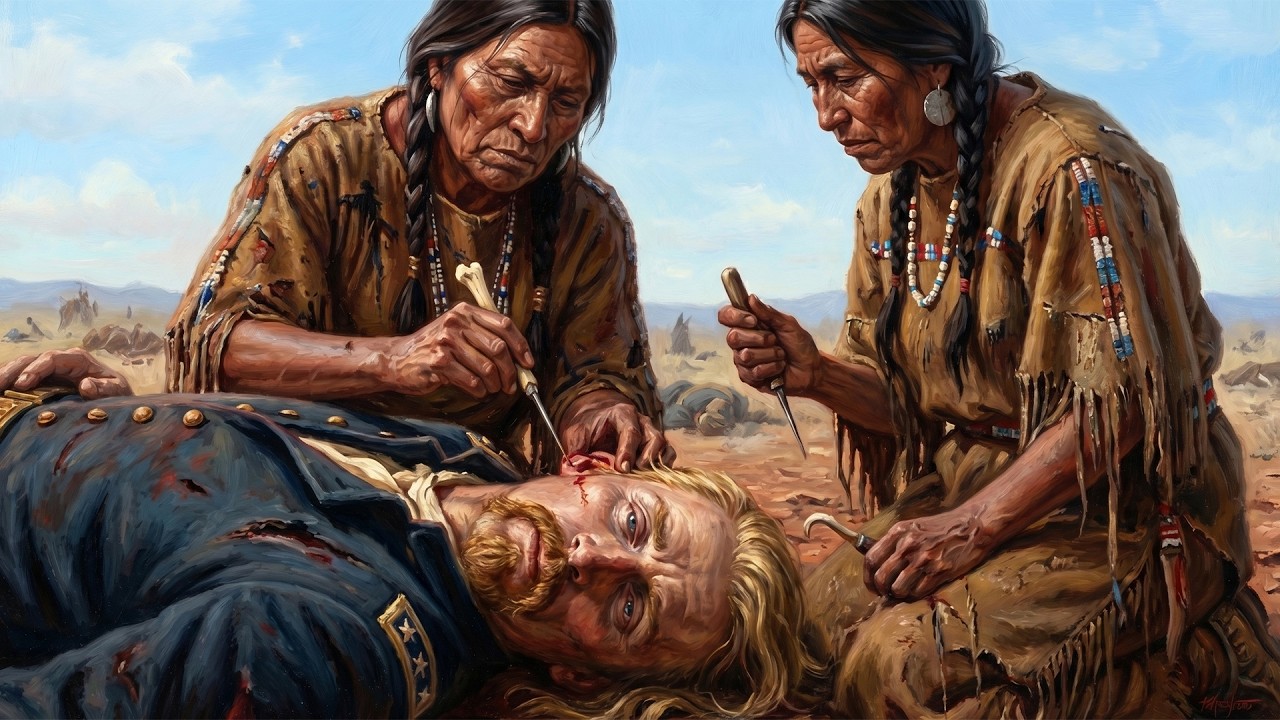
The account tells this. Cheyenne women, their exact number is unknown, it is said to be more than two, knelt beside Custer’s body. In their hands, they held the tools they used for daily sewing work: fine needles made of bone, or in some versions, an awl, a pointed tool made of bone or metal used to pierce leather. They inserted these tools into Custer’s ears.
They pierced right through his eardrums. And as they did this, they spoke among themselves. What they said, or what they are said to have said, forms the spirit of this ritual. The transmitted versions contain words to this effect: “We warned you once, you didn’t listen.
Maybe you will hear better in the afterlife. ”
Leave this sentence hanging in the air for a moment. “We warned you once, you didn’t listen. ”
To understand the historical truth behind these words, we need to go to 1868.
After the Washita raid, some kind of contact was established between Custer and the Cheyenne leaders. Some Cheyenne elders had personally warned Custer: if he continued to attack Cheyenne lands, Cheyenne camps, there would be a price to pay for it. The exact content of this warning, its exact timing, who delivered it, these are lost in historical ambiguity. But the reality of this warning is consistently relayed in Cheyenne oral tradition.
Custer did not listen. He went to the Black Hills. He made the expedition. He found the gold.
He announced it. He ignored the borders drawn by treaties or saw them as a temporary duty. And in 1876, according to the orders of his superiors, he marched to the Little Bighorn. Now, think about that needle.
An object made of bone, thin, a few centimeters long. A tool used by a Cheyenne woman in her daily life to sew leather, to bead, to repair tents. This object has no relation to violence, to savagery, to weapons of war. Precisely because of this, this choice is not accidental.
It is symbolic. This was not a weapon. This was a message. And the content of the message carries more than one layer.
The first layer is the most superficial. The direct connection between the sense of hearing and the warning. Ears are for listening. This intervention performed on ears that did not listen reverses this logic or completes it.
The thought, “you didn’t listen in this world, maybe you’ll hear in the afterlife,” contains both a curse and, strangely, a hope. That is to say, it says, maybe one day you will understand. This is a much more complex emotion than anger. This is the last cry of someone who wants to be understood.
The second layer goes deeper. In Cheyenne and Lakota belief systems, the soul’s journey after death is shaped by how it lived in this world. Piercing the eardrums would affect not the soul’s ability to hear, but perhaps its ability to listen. Or at least such symbolic thought was involved.
This should be read not as a direct expression of faith, but rather as a symbolic act. It is more than saying, we are marking you. We are sending you to the afterlife as a defined thing. The third layer is perhaps the most personal one.
This act was in the hands of women. These were not things done by warriors on the battlefield. This was something done by women in their own language, with their own tools, with their own hands. And this was no coincidence.
There were women and children among those who died at Washita. Among those who lost their lives in Black Kettle’s camp that winter morning, in a raid that began to the accompaniment of an army band playing music, there were more than just fighting men. The pain of those women, the pain of those specific concrete women with names, found an echo on this hill, in these hands, in this fine bone needle. The sun is now quite low.
Shadows have almost entirely covered the eastern slope of the hill. The heat is still high, but it has retreated from that suffocating peak. The smell of the battlefield, blood, gunpowder, dust, the beginning of decay, is now so intense that the nose stops distinguishing it after a while. The senses dull.
Only the sharpest things, the most direct things, pass through the mental filter. Custer lies on the ground. On his back or face down? Testimonies are not entirely clear on this.
The reports of the burial details say they found him on his back, his arms partially open, his face turned to the sky. The woman or women leaned over. There are two wrong ways to tell this scene. The first is to tell it as pure savagery, as a horror show.
The second is to romanticize it, to imbue it with a poetry it did not have. Both betray the reality of this moment. The truth is this. This was a conscious act committed by grieving people.
An act we can neither fully understand nor fully judge. But not trying to understand is the greatest betrayal to history. The bone needle was brought out. A thin, neat, used tool.
Its edges smoothed out, its tip still sharp. Tools like this were a Cheyenne woman’s most basic everyday objects. Leather was sewn with them. Moccasins were made, tents were repaired.
Now it was held in hand for a different job. The ear, when viewed from the outside, is a complex structure. The outer ear canal reaches the eardrum, a thin, delicate membrane sensitive to vibration. Great force is not required to damage it.
An object inserted at the right angle, to the right depth, is enough. This procedure was done in one ear, then in the other. Slowly or quickly? We do not know.
Silently or while speaking? In the version relayed by Kate Bighead, it is said that there was talking during this time. Those words of warning, that sentence, “Maybe you will hear in the afterlife. ” But exactly whether this sentence was said during, before, or after the act cannot be definitively deduced from the details of the relayed account.
Perhaps what matters is not the exact timing. What matters is the thought itself. This thought, this “you didn’t listen” thought, was not directed at a single man on that hill. Custer was a symbol, a figure wearing a uniform, taking orders, representing the system.
But he was also a real human being, someone with his own decisions, his own choices, letters he signed with his own hands. These two things were inextricably intertwined for that moment. And perhaps exactly because of this, this act was not merely symbolic. It was also deeply personal.
What happened after this? The women stood up. They turned to other corpses to find, to carry, to prepare their own men. Life continued even on that hill in the midst of death.
The great camp had begun to pack up. Belongings were being loaded, children gathered, the wounded carried. They had to go. The army would come back.
It always came back. Custer remained in the dirt. Beside him, a few meters away, his brothers. Around him, along the slope of the hill, his men.
The sun set. Montana’s nights, cool even in summer, began. The stars came out. At that altitude, in that clear sky, even the Milky Way band becomes visible at night.
The hill fell silent. But that silence was now different from before. The silence before the battle was full of tension, the pressure of something about to explode at any moment. The silence immediately after the battle was full of shock, the weight of what had happened.
But the silence that descended now was something more permanent, the silence of closure. Something had been said, something had been done, and it could not be taken back. Two days, exactly two long scorching days, had passed since that silence and the smell of blood settled into the Little Bighorn Valley. On the morning of June 27th, the reinforcement troops under the command of General Alfred Terry and Colonel John Gibbon joined forces with the exhausted men of Major Reno and Captain Benteen, who were on the verge of madness from thirst, and began to advance slowly toward that cursed hill.
As they approached the valley, the first thing that greeted them was not the ghostly emptiness of the Indian camp or the ashes of extinguished campfires. It was that heavy, rotten smell of flesh carried by the wind from far away, which tied a person’s stomach in knots and burned the throat. The horses neighed restlessly, pulling hard on their reins, resisting going toward that hill. Even the animals, with that primal instinct of nature, could sense that the destruction waiting for them ahead did not belong to this world.
The gunpowder smoke had long since dissipated, and the deafening chaos of the battle had given way to an incessant and disgusting hum created by millions of blowflies, driving a person out of their mind. When the soldiers set foot on that height, which would go down in history as Last Stand Hill, many fell to their knees and began to vomit at the sight they saw. Some wept, while others, with the blank stares brought on by shock, tried to comprehend this savagery that pushed the limits of the mind. The top of the hill, baking under the sun, was covered with the unrecognizable corpses of 210 men, once the proudest, most arrogant soldiers of the 7th Cavalry Regiment.
The traces left behind by the shadows that descended on that hill after the battle, by those furious native women, were literally horrifying. Bodies were left naked, skins flayed, limbs torn apart, and bellies slit open. The faces of most were so brutally mutilated that the burial details could not identify their comrades in arms, not even the brothers they had fought shoulder to shoulder with for years. The identity of many could only be understood from old scars on their bodies or with personal items scattered around them.
Death on this hill had turned not merely into an end, but almost into an exhibition, a bloody canvas of revenge. The soldiers with trembling hands began to search for their commander, that legendary General George Armstrong Custer they thought invincible. Finding him was like looking for one last branch to cling to in this nightmare. And they found him.
He lay on his back near the peak of the hill, in a spot surrounded by the corpses of his loyal men and loyal horses. His face was turned to the sky. When the soldiers approached their commander’s body, they encountered a very strange sight compared to the others. Custer’s body, unlike the soldiers around him who had been reduced to a heap of flesh, was relatively intact.
There were only two bullet wounds on his body, one just below his left chest, close to his heart, and the other on his left temple. Even more interestingly, he had not been scalped. The reason for this was not any respect the Indians had for him. Custer had cut off his famous long blonde curls before setting out on the campaign, and according to native beliefs, the soul of a body without hair long enough to be scalped would not be incomplete in the next world.
Furthermore, his face had not been slashed with knife blows like the others. At first glance, the officers, thinking their commander had escaped those terrifying rituals, took a deep breath and leaned in to look at him more closely. But right at that moment, a detail illuminated by the angle of the morning sun froze their blood. Custer’s face was not peaceful.
On the contrary, beneath that cold mask of death, the traces of absolute despair and terror he experienced in his final moments were etched. But this was not the truly horrifying part. The leaning officers noticed that terrible intervention hidden beneath the dried blood clots around their commander’s ears. Both eardrums had been pierced repeatedly and mercilessly from the outside in with a very thin and pointed tool, probably a sewing needle or an awl made of bone.
This was no accidental wound. It was not a mark that a stray bullet or shrapnel could make during combat. This was a very conscious, very careful, and directly targeted ritualistic procedure. The soldiers present there might not have immediately understood the dark message behind these needle holes.
But years later, in the oral histories of the native tribes, in the whispers of Kate Bighead, one of the Cheyenne women who went up that hill, the blood-curdling reason for this truth would come to light. “We opened his ears so he could hear because in life he did not hear our warnings and our words, so that perhaps in the next world, in the spirit realm, he could hear the truth better. ”
Those fine bone needles had pierced not only Custer’s body, but also his boundless arrogance, leaving a lasting eternal curse to be carried to the afterlife. The officers in the burial detail experienced a profound psychological collapse when they saw this truth right there in that silence.
The site before them was a tableau in which America’s vision of the invincible West had completely collapsed and shattered. In that moment, an unwritten rule came into play. The details of this truth, of this absolute humiliation, and of that ritual performed on their commander’s ears must never reach the civilized society in the East, the politicians in Washington, and especially Custer’s widow, Libby. A newly established nation needed heroes, not a man torn apart, his ears pierced with sewing needles, who had his army destroyed because of his own arrogance.
There on that hill, beneath the hum of flies, a silent oath was sworn. Autopsy reports were kept superficial and only phrases like “died heroically, shot in the chest and head” were written into official documents. The corpses were hastily buried in shallow graves with just a little dirt thrown over them. Those shallow pits, where bones would re-emerge the first time the wind blew, were actually proof of how precariously the truth was buried.
In the years following the war, the Victorian-era press and the American government put a massive propaganda machine into action. Monuments were erected, paintings were drawn, and thousands of lithographs showing Custer’s last moments were hung in bars and saloons across the country. In those paintings, Custer was always standing, sword in hand, surrounded by his loyal soldiers, fighting nobly to his last breath as a mythic figure. In none of those paintings were there flies, disgusting smells, soldiers soiling themselves in fear, or Cheyenne women bursting his eardrums.
History was written not by the victors but by those who best hid the truth. The truth the wounds opened by those fine sewing needles and that ritual were condemned for years to live only in the fireside chats of Indian tribes, in their dark whispers, and in the dusty corners of secret military archives read by very few people. Today, when you go to that hill, to that windy Montana plain, the upright white tombstones tell you that heroes lie there that day. However, when you truly listen to the sound of that wind, you can still hear the whisper those bone needles made as they pierced flesh, that terrifying prophecy.
History thought it had buried the truth under the dirt. But what was forgotten was that the true owners of those lands never engraved the truth into the dirt, but into their own memories, into that dark and ceaseless wind. It is unknown how clearly Custer hears that wind in the other world.
But that bloody message in his ears continues to echo in this world as one of history’s best-kept secrets.
